

Introduction
The formation and distribution of large gas reservoirs in the Sinian-Cambrian in the Sichuan Basin are closely related to the distribution and evolution of the Deyang-Anyue rift trough [1⇓⇓⇓⇓⇓⇓⇓⇓-10]. The exploration breakthrough of Well Weiji in 1964 resulted in the first Sinian Dengying Formation gas field-Weiyuan gas field, which is located at the structural high of the paleo-uplift on the west side of the Deyang-Anyue rift trough. With continuous exploration of paleo-uplift, the Anyue gas field, a huge monolithic marine carbonate gas field with total resources of more than trillion cubic meters, was discovered in the Gaoshiti-Moxi paleo-uplift in the central Sichuan Basin in 2011, and it is located at the structural high of the plat-form margin zone on the east side of the Deyang-Anyue rift trough [11⇓-13]. As more and more data are available from the deepening sedimentary and evolutionary studies of the Deyang-Anyue rift trough, the Dengying Formation platform margin of the paleo-uplift in the middle segment of the rift trough has been relatively finely delineated, and the exploration and research have been gradually advanced to the north slope of the paleo-uplift. Significant breakthroughs in the tests of wells PT1 and JT1 in the paleo-uplift on the east side of the rift trough in 2020 [3] further confirmed that the platform margin of the Dengying Formation in the Penglai area in the northern segment of the Deyang-Anyue rift trough has a great exploration potential, which is a potential gas province at the level of trillion cubic meters.
Outstanding achievements have been made in oil and gas exploration in the Weiyuan, Ziyang, Gaoshiti-Moxi and Penglai areas around the Deyang-Anyue rift trough, and significant progress has also been made in the studies of structure-lithofacies palaeogeography, reservoirs and hydrocarbon accumulation of the Sinian-Cambrian strata [14⇓⇓⇓-18]. Intensive studies have been made with respect to the origin and evolution of the Deyang-Anyue rift trough, and the controls of the rift trough on hydrocarbon generation, accumulation and preservation [9,19⇓⇓⇓ -23]. It is unanimously believed that sedimentary differentiation is recorded in the Dengying Formation in the Sichuan Basin, the rift trough controlled the sedimentation, reservoir, and hydrocarbon accumulation features of the Sinian-Cambrian, and the source-reservoir assemblage is superior in the northern and middle segments of the rift trough, with relatively large exploration potential. It is also proposed that the Deyang-Anyue rift trough controls the formation and distribution of large gas fields. Scholars have focused on the formation and evolution of the rift trough, mostly dealt with the northern and middle segments of the rift trough, but rarely reported the southern segment. Currently, there are mainly two viewpoints on the southern segment of the rift trough: (1) no sedimentary differentiation occurs in the Dengying Formation in southern Sichuan Basin, and the rift trough did not affect this region where carbonate platform is dominant [24]; and (2) the rift trough affected the whole southern Sichuan Basin during the deposition of the fourth member of the Dengying Formation (Deng 4 Member for short), and multiple isolated mound shoal bodies are developed in the rift trough in southern Sichuan Basin [23]. Limited by the relatively scarce data in the southern Sichuan Basin (low signal-to-noise ratio of 2D seismic data in deep layers, and few wells encountering the Dengying Formation), the southern segment of the rift trough has not been investigated systematically from geological prospective, and remains unclear for its exploration prospect, which restrict the expansion of deep oil and gas exploration in southern Sichuan Basin. Based on the latest drilling and seismic data, we demonstrated the distribution characteristics of the Late Sinian-Early Cambrian Deyang-Anyue rift trough in southern Sichuan Basin, and conducted intensive research on the sedimentary characteristics of key strata such as the Deng 4 Member and the Qiongzhusi Formation under the control of the rift trough, providing a reference for the further intensive discussion on the significance of the Deyang-Anyue rift trough to oil and gas exploration in southern Sichuan Basin.
1. Regional geological setting
At the beginning of the Nanhua Period, the Rodinia supercontinent was splitted, opening up the stage of the Proto-Tethys Ocean evolution. During this period, the Sichuan Basin, located at the northwest margin of the Upper Yangtze Plate, was in an extensional tectonic setting. The Sinian-Early Cambrian multi-episode Tongwan Movement caused differential uplift to elevate and denudate the Dengying Formation in the basin to varying degrees, forming a rift trough striking nearly N-S in the Changning-Neijiang-Deyang area in the basin, which set the sedimentary pattern in the basin (Fig. 1 ) [20,25⇓⇓⇓ -29]. The Sinian-Lower Cambrian at the edge of the Deyang-Anyue cratonic rift develops multiple stacked platform-margin mound shoals, which are widely distributed [23,30] (Fig. 1 ). Moreover, the Sinian-Lower Cambrian is complete stratigraphically in the Sichuan Basin. The Sinian can be divided into the Lower Sinian Doushantuo Formation and the Upper Sinian Dengying Formation. The Dengying Formation can be subdivided into the first, second, third and fourth members (Deng 1, Deng 2, Deng 3 and Deng 4) upwardly. The Lower Cambrian can be divided into the Maidiping Formation, Qiongzhusi Formation, Canglangpu Formation and Longwangmiao Formation upwardly (Fig. 1 b). The Deyang-Anyue rift trough started to form in the depositional period of Deng 1 + Deng 2, and developed in the depositional period of Deng 3 + Deng 4. It was filled and leveled in the depositional period of Maidiping Formation and Qiongzhusi Formation. Ultimately, it disappeared in the depositional period of the Canglangpu Formation. However, the development period and morphological characteristics of the rift trough from the Late Sinian to the Early Cambrian are different in the northern and southern parts of the basin, and the stratigraphic characteristics in southern Sichuan Basin are also distinct from those in central and northern Sichuan Basin. This study focuses on the part of the rift trough in the south to central Sichuan Basin and its two sides. In the following description, the inside part of the rift trough is collectively referred to as "inner trough", and the two sides of the rift are collectively referred to as "marginal trough".
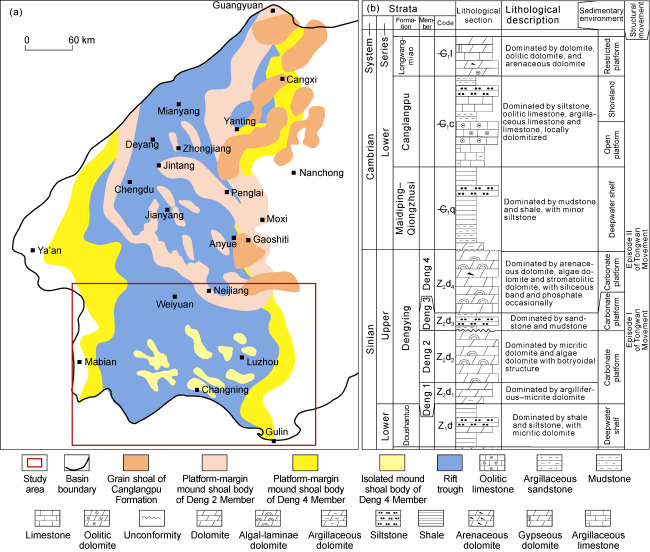
Fig. 1. Location and stratigraphic column of the study area (modified from Ref. [23]). |
2. Stratigraphic characteristics of rift trough and its periphery
Previous studies have indicated evident differences in the sedimentary characteristics among the Dengying Formation, Maidiping Formation and Qiongzhusi Formation in the Deyang-Anyue rift trough and its periphery [10]. At the beginning of the Cambrian, the expansion of the rift trough ended, and the episode II of Tongwan Movement caused the decline of the sea level and the overall uplift of the platform. The trough was then filled with the Maidiping Formation and Qiongzhusi Formation [10]. We used the 2D and 3D seismic, well and outcrop data in southern Sichuan Basin to describe the distribution and morphology of the southern segment of the rift trough, starting from the thickness of Dengying Formation and Lower Cambrian.
2.1. Stratigraphic correlation of Dengying Formation
Due to the lack of paleontological evidence, the Dengying Formation is mainly divided stratigraphically depending upon lithology and electrical characteristics, together with the regional tectonic evolution law and the precise tracking of seismic data in the basin [24]. The Deng 1 Member is mainly muddy micrite dolomite, with relatively high natural gamma ray (GR). The Deng 2 Member is mainly botryoidal dolomite, with generally low GR. The Deng 3 Member is mainly composed of sandstone-mudstone, with high GR. The Deng 4 Member is mainly composed of thrombolite and stromatolite-latticed mound dolomite, with low and stable GR [24,31 -32].
The drilling results of the Dengying Formation in the southern and middle segments of the rift trough were compared, and the thickness contour map of the Dengying Formation was compiled in combination with seismic data (Fig. 2 ). From the rift trough to the platform margin and the intra-platform, the lithologic combination and formation thickness change significantly. The Dengying Formation is generally thin in the inner trough and thick in the marginal trough, either in the north or the south of the basin, with a few differences.
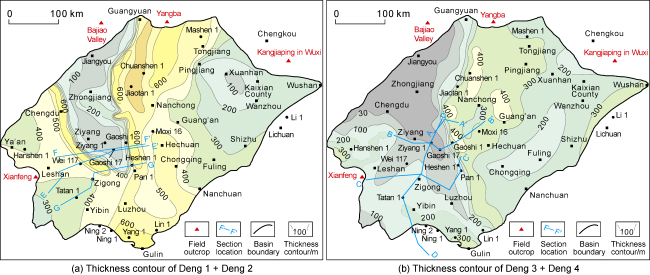
Fig. 2. Thickness contour map of Dengying Formation in the Sichuan Basin. |
In the middle segment of the rift trough, the overall thickness of the Dengying Formation and the thickness and lithologic combination of the members are quite different between the inner trough and the marginal trough. In the marginal trough, the thickness of Deng 1 + Deng 2 reaches 650 m and the thickness of Deng 3 + Deng 4 reaches 450 m; the lithology is dominated by algae-rich dolomite. In the inner trough, the smallest thickness of Deng 1 + Deng 2 is only 50 m, which is 63.5 m in Well Ziyang 1; the lithology is mainly dolomite, siliceous dolomite, argillaceous dolomite and mudstone.
In the southern segment of the rift trough, the thickness of Deng 1 + Deng 2 is stable in the range of 400-550 m, and exceeds 600 m only in some parts (e.g. Well Yang 1). The thickness of Deng 3 + Deng 4 is different between the marginal trough (300-400 m) and the inner trough (100-200 m). The Dengying Formation in the inner trough is characterized by rich silica, rich mud, and spiky high GR value, which is different from the trough margin.
In addition, the lithology of the Deng 3 Member varies greatly in the north and south of the basin. In the central-north of the basin, the Deng 3 Member is mainly composed of dark mudstone, in Well Ziyang 1 and Well Gaoshi 1 for example. In the south of the basin, the Deng 3 Member is dominated by dolomite with minor argillaceous dolomite, in Well Ning 2 and Well Yang 1 for example. This indicates that the water body was generally shallow in the south and deep in the north during the deposition the Deng 3 Member, and also, from a side, confirms that the rift trough was not yet split to the south at this time (Fig. 2 ).
2.2. Stratigraphic correlation of Maidiping Formation+ Qiongzhusi Formation
Previous studies of the Cambrian source rocks found that the Qiongzhusi Formation and Maidiping Formation are developed differentially inside and at the margin of the Deyang-Anyue rift trough [10,27,33]. The Early Cambrian Canglangpu Formation is an important period of tectonic transformation for the Sichuan Basin, when, along with the transition from regional tension to compression, the early rift trough filled and leveled during the deposition of the Qiongzhusi Formation presented a relatively balanced settlement on the sedimentary basement rather than the differential settlement inside and at the margin of the trough during the deposition of the Canglangpu Formation. In this study, the lithology, electrical properties and seismic characteristics of the Qiongzhusi Formation were carefully investigated, and it is divided into three members. It is believed that the deposition and filling process of the Deyang-Anyue rift trough can be divided into four stages: (1) The deposition of the Maidiping Formation, the first period of deposition and filling on the basis of karst morphology of the Dengying Formation, when argillaceous dolomite, mudstone and phosphorite were deposited inside the trough, and a set of extremely thin phosphoric dolomite and phosphoric was deposited at the margin of the trough. (2) The deposition of the Qiong 1 Member, when a set of high-GR dark shale and sandy shale was mainly deposited, with carbonate rocks locally developed inside the trough, and there was no deposit at the marginal trough. (3) The deposition of the Qiong 2 Member, a set of high-GR dark shale and sandy shale was mainly deposited, with carbonate rocks locally developed inside the trough and local depressions, and there was almost no deposit at the marginal trough. (4) The deposition of the Qiong 3 Member, which was developed in the whole basin, when a set of high-GR and high-TOC dark shale was extensively deposited along with the large-scale transgression in the early stage, and the deep water shelf deposit evolved into shallow water shelf deposit as the seal level fell in the middle-late stage. After the filling and leveling in the periods of Qiong 1 Member and Qiong 2 Member, the differential deposition inside and at the margin of the Deyang-Anyue rift trough was no longer evident, and there was only the deposition of the Qiong 3 Member in the marginal trough.
Taking the seismic section across Well Pengshen 3-Well Pengtan 1-Well Moxi 108 as an example, the fine well- seismic calibration reveals that the Maidiping Formation and the Qiong 1 Member were mainly developed inside the trough, and the Maidiping Formation, Qiong 1 Member and Qiong 2 Member deposits overlapping in the Deyang-Anyue rift area. In the depositional period of the Qiong 3 Member, with the occurrence of large-scale transgression, a set of dark shale with high organic matter abundance was widely deposited inside and at the margin of the Deyang-Anyue rift trough (Fig. 3 ).
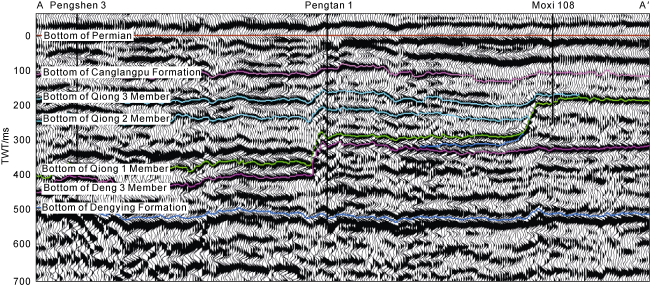
Fig. 3. Seismic section of east wing A-A° of rift trough in the study area (with the bottom of the Permian flattened, section location shown in |
2.2.1. Stratigraphic correlation for the northern, middle and southern segments of the rift trough
It is found that the thickness and lithologic combination of the Lower Cambrian Maidiping Formation and Qiongzhusi Formation are very different inside and at the margin of the rift trough, according to the drilling stratigraphic correlation, analysis of small shelly fossils, sedimentary stratigraphic correlation, and plotting of formation thickness contour map.
In terms of lithologic combination, inside the trough, the Maidiping Formation contains a set of phosphorus- rich mixed lithology such as argillaceous dolomite, mudstone and limestone, and the Qiongzhusi Formation is composed of gray-black carbonaceous shale, mudstone, dark gray siltstone mudstone, and siltstone. In contrast, at the margin of the trough, the Maidiping Formation is evidently thinner, with phosphoric dolomite and phosphoric limestone [34], and the Qiongzhusi Formation is dominated by dark gray mudstone, silty mudstone and siltstone, with thinner gray black carbonaceous shale at the bottom.
In terms of formation thickness, the Maidiping Formation cannot be traced and predicted on seismic section due to small stratigraphic thickness and the lack of drilling data in the platform margin and intra-platform. Here, the formation thickness contour is mapped only for the Maidiping Formation inside the rift trough. Fig. 4 shows that the strata in the middle and northern segments of the rift trough are thick, especially in the Deyang-Anyue area where the Maidiping Formation reaches 150 m and the Qiongzhusi Formation reaches 800 m. In contrast, the strata in the southern segment is thinner, with the Maidiping Formation thinner than 75 m mostly and the Qiongzhusi Formation being up to 600 m or about 400 m in the Luzhou area, reflecting the characteristics of shallow water in the south and deep water in the north during the deposition.
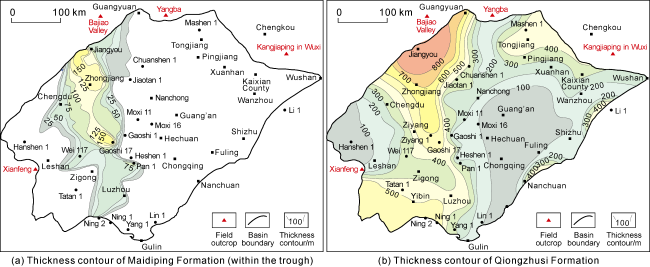
Fig. 4. Thickness contour maps of Lower Cambrian (a) Maidiping Formation and (b) Qiongzhusi Formation in the Sichuan Basin. |
2.2.2. Fine stratigraphic correlation of the southern segment of the rift trough
After the deposition of Maidiping Formation and Qiongzhusi Formation, the rift trough was basically filled and leveled. Therefore, according to the principle of filling and leveling, the Maidiping Formation and Qiongzhusi Formation were correlated to analyze the internal morphology of the southern segment of the rift trough. For this purpose, two E-W sections across the trough and one section inside the trough were selected.
Section B-B° is an E-W section across wells Zitan 1, Zitan 4, Ziyang 1, Gaoshi 17, Gaoshi 1, Heshen 5 and Nüji, spanning the rift trough in central Sichuan Basin (Fig. 5 ). From the west to the east, the cumulative thickness of the Maidiping Formation and the Qiongzhusi Formation increases and then decreases. For example, the cumulative thickness of the two formations is 225 m in Well Zishen 1, and as large as 565, 703 and 699 m in wells Zi 4, Ziyang 1 and Gaoshi 17, respectively; in wells Gaoshi 1, Heshen 5 and Nüji, the Maidiping Formation is absent or extremely thin, and the cumulative thickness of the Maidiping Formation and the Qiongzhusi Formation is 210, 184 and 163 m, respectively. This shows that the inner trough is characterized by deep water body, large accommodation space, and large cumulative thickness of the Maidiping Formation and the Qiongzhusi Formation, and the marginal trough is characterized by shallow water body, extremely thin Maidiping Formation and thin Qiongzhusi Formation. At the marginal trough, the micritic limestone is too thin to identify [34]. Inside the trough, the thickness of the Maidiping Formation and the Qiongzhusi Formation changes greatly, indicating that the depth of the water body is significantly changing inside the trough, where certain differential sedimentation occurred.
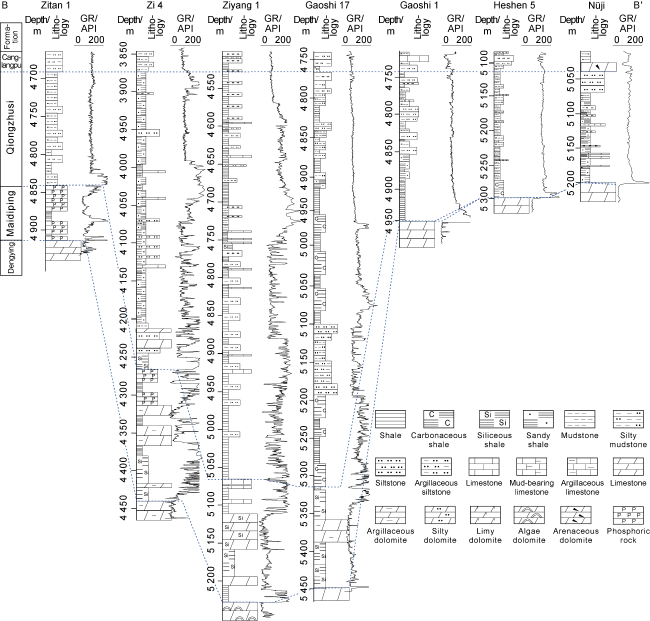
Fig. 5. Section B-B' of Dengying Formation-Canglangpu Formation in the study area (section location shown in |
Section C-C° is a W-E section across wells Laolong 1, Jinshi 1, Zishen 1, Desheng 1, Pan 1, Heshen 2, and Gaoshi 32 in southern Sichuan Basin. The cumulative thickness of the Maidiping Formation and the Qiongzhusi Formation in the wells on this section varies greatly, being 223, 433, 428, 387, 363, 221, and 191 m, respectively. The Maidiping Formation is relatively thick in Well Jinshi 1 and Well Pan 1, being 97 m and 115 m, and extremely thin in Well Zishen 1 and Well Desheng 1 between Well Jinshi 1 and Well Pan 1. Inside the trough, the Maidiping Formation is thick above the base filled and leveled; at the margin of the trough, the Maidiping Formation is thin and mostly dominated by micritic dolomite, making it indistinguishable from the underlying Dengying Formation [34]. In other words, Well Jinshi 1 and Well Pan 1 are deployed inside the trough, and Well Zishen 1 and Well Desheng 1 at the margin of the trough and contain thick Qiongzhusi Formation, indicating that the rift trough is somewhat differential in the southern segment (Fig. 6 ).
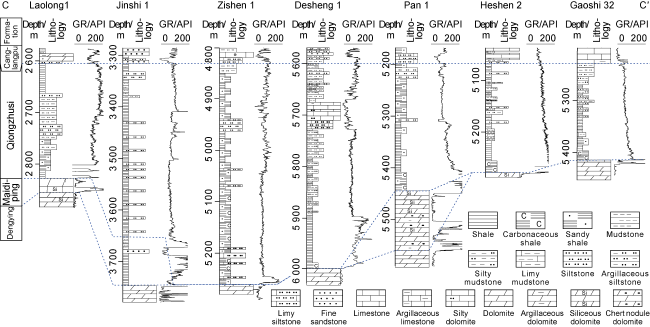
Fig. 6. Section C-C' of Dengying Formation-Canglangpu Formation in the study area (section location shown in |
Section D-D° is an S-N section across wells Yangshen 106, Chuanlong 1, Tatan 1, Zishen 1, Songtan 1, Ziyang 1, and Pengshen 3. The cumulative thickness of the Maidiping Formation and the Qiongzhusi Formation in wells on this section is large, being 386, 474, 458, 428, 421, 703 and 722 m, respectively. Specifically, the Maidiping Formation is developed in Wells Ziyang 1 and Pengshen 3. Moreover, there is an abrupt change in thickness between Well Songtan 1 and Well Ziyang 1, which means that there is a big step between the two wells, or from the marginal trough to the inner trough, corresponding to differential sedimentation (Fig. 7 ). The Maidiping Formation at the marginal trough is mainly composed of siliceous shale or micritic-powder crystal dolomite, and it is indistinguishable from the overlying Qiongzhusi Formation or the underlying Dengying Formation in terms of lithology, electrical property and seismic reflections. Overall, the cumulative thickness of the Maidiping Formation and the Qiongzhusi Formation in southern Sichuan Basin is smaller than that in central and northern Sichuan Basin, and such cumulative thickness varies greatly and frequently in southern Sichuan Basin.
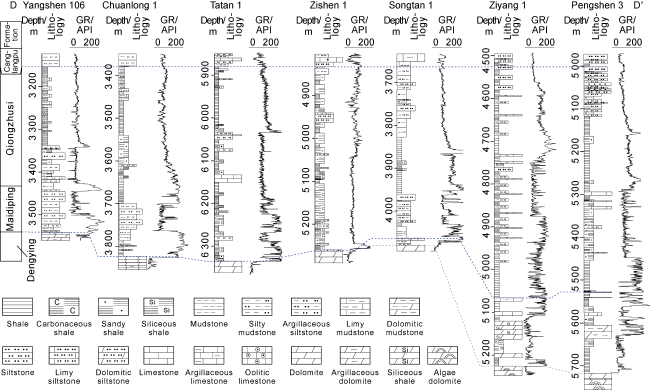
Fig. 7. Section D-D' of Dengying Formation-Canglangpu Formation in the study area (section location shown in |
3. Stratigraphic development in the southern segment of the rift trough
3.1. Facies distribution of Dengying Formation
Based on previous studies and the re-examination of lithological characteristics of typical outcrops and coring wells inside and at the margin of the Deyang-Anyue rift trough in southern Sichuan Basin, it is believed that the Deng 2 Member in southern Sichuan Basin exhibits no facies variation and is dominated by carbonate platform, while the Deng 4 Member reveals facies change in an order of basin-slope-secondary slope-platform margin- restricted platform from the inner trough to the marginal trough.
The platform margin facies is represented by Well Yang 1, where the Deng 4 Member is 374 m thick and lithologically dominated by algal dolomite and arenaceous dolomite, with the stacking of multi-stage algal mound shoals which are as thick as 15 m individually and are the product of mound shoal complex at the platform margin (Fig. 8 a).
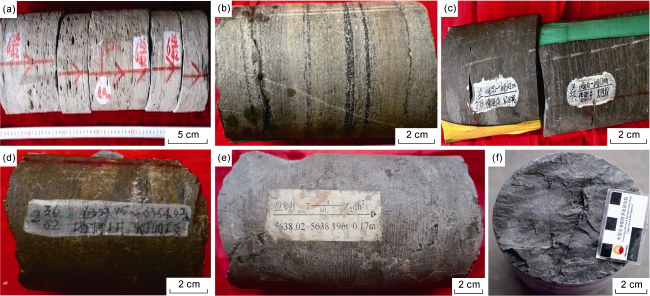
Fig. 8. Cores illustrating typical sedimentary facies in the study area. (a) Well Yang 1, Deng 4 Member, gray dolomite, dissolved vugs with diameter of 1-10 mm; (b) Well Desheng 1, Deng 4 Member, 6202.10-6202.34 m, breccia dolomite, dissolved pores; (c) Well Desheng 1, Deng 4 Member, 6085.92-6086.30 m, mud-bearing micrite dolomite, dissolved vugs not developed; (d) Well Tatan 1, Deng 4 Member, 6353.95-6354.03 m, gray micritic dolomite, with siliceous mass; (e) Well Pan 1, 5638.02-5638.19 m, micritic dolomite; (f) Well Chuanlong 1, 3828.25-3828.42 m, dark gray micritic dolomite. |
The secondary slope facies is shallower than and somewhat different from the slope facies. It is represented by Well Desheng 1, which did not penetrate the Deng 4 Member. In the 45 m long coring interval, the Deng 4 Member is lithologically dominated by muddy micrite dolomite, with sandy strips, and it is believed to have deposited in a generally low-energy sedimentary environment, except for high-energy shoal zone observed locally (Fig. 8 b-8c). Slope and shelf facies belts are dominated by low-energy micritic dolomite deposits (Fig. 8 d-8f).
Since the Dengying Formation in south Sichuan Basin was drilled with limited information or not drilled, 2D seismic lines were used to demonstrate the sedimentary variation inside and at the margin of the trough. It is found that the southern Sichuan Basin contains the Deng 4 Member with greatly varying thickness, and presents multiple secondary rifts and alternating uplifts and sags (Fig. 9 ). Coupling with sections of Maidiping Formation and Qiongzhusi Formation across wells provided above, it is confirmed that there are multiple secondary rifts in southern Sichuan Basin. On the plane, the rifts present finger-like distribution, and the facies belts are up and down alternatively, including the restricted platform- platform margin-secondary slope-slope-basin-slope-secondary slope-slope-secondary slope-platform margin- restricted platform, from the west to the east (Fig. 10 ).
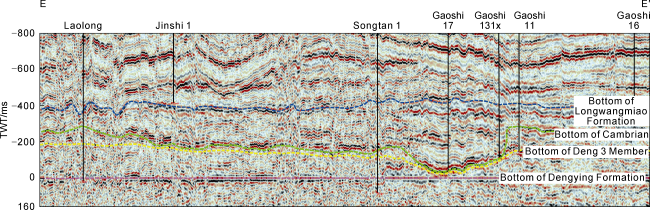
Fig. 9. 2D seismic section of E-E° in the study area (with the bottom of Dengying Formation flattened, and the section location shown in |
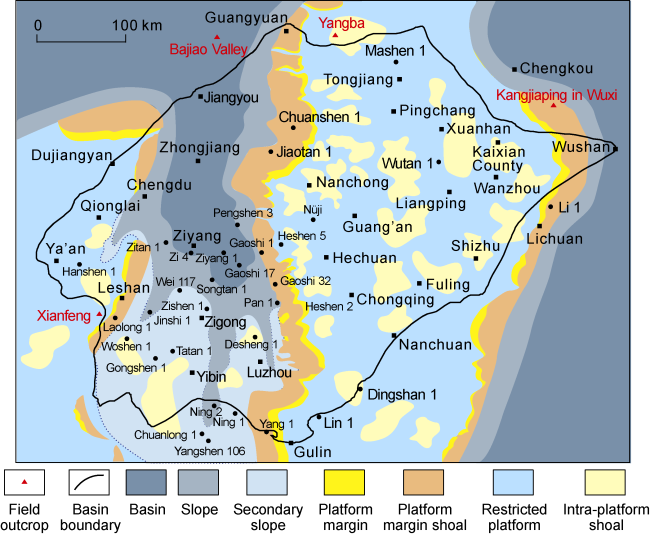
Fig. 10. Sedimentary facies map of Deng 4 Member in the Sichuan Basin. |
3.2. Distribution of the rift trough
Based on horizon calibration for wells encountering the Dengying Formation in the study area and the seismic interpretation scheme in adjacent areas, the structural and stratigraphic interpretations were performed using the 2D and 3D seismic data in southern Sichuan Basin. Furthermore, the distribution of the rift trough were determined through comparison of wells at different positions in the north and south of the basin. It is found that the thicknesses of Dengying Formation, Maidiping Formation and Qiongzhusi Formation vary greatly in southern Sichuan Basin.
The middle segment of the rift trough develops the Gaoshiti-Moxi platform margin. On the seismic section (Fig. 11 ), it can be seen that the Dengying Formation thins significantly from the marginal trough to the inner trough. Below the Cambrian bottom reflector (Fig. 11 , the green line), that is, inside the Dengying Formation, the seismic events decrease, some events are truncated, and the events become more continuous; above the green line, that is, inside the Lower Cambrian, the seismic events increase, and the strata become thicker and overlap the Dengying Formation.
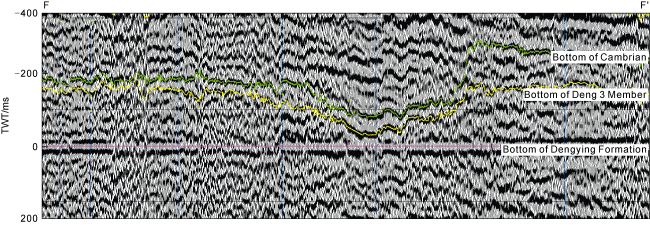
Fig. 11. Seismic section F-F' for central Sichuan Basin (the bottom of Dengying Formation flattened, and the section location shown in |
The seismic section for the southern Sichuan Basin also shows the characteristics of variation from the marginal trough to the inner trough (Figs. 9 and 12 ). According to the overall morphology of the section, the Dengying Formation thins in a relatively wide range and generally in a step-like fashion, and exhibits evident slope only in the step transition area but stays relatively flat in other parts. Compared with the steep slope shape of the rift trough in central and northern Sichuan Basin, the rift trough in southern Sichuan Basin is wider and gentler, and contains multiple steps with alternating sags and uplifts.
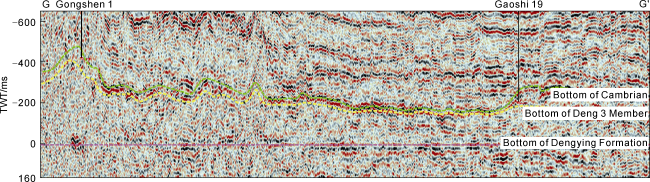
Fig. 12. Seismic section G-G' of southern Sichuan Basin (the bottom of Dengying Formation flattened, and the section location shown in |
4. Tectono-sedimentary evolution of the southern segment of the rift trough
The rift evolution in the Late Sinian-Early Cambrian controlled the overall sedimentary pattern in this period, and the shape and scope of the rift trough varied in different periods. It is comprehensively believed that the evolution of the rift trough in southern Sichuan Basin experienced four key stages: stabilization in the Deng 1-Deng 2 period, opening in the Deng 3-Deng 4 period, filling in the Maidiping-Qiongzhusi period, and extinction in the Canglangpu period (Fig. 13 ).
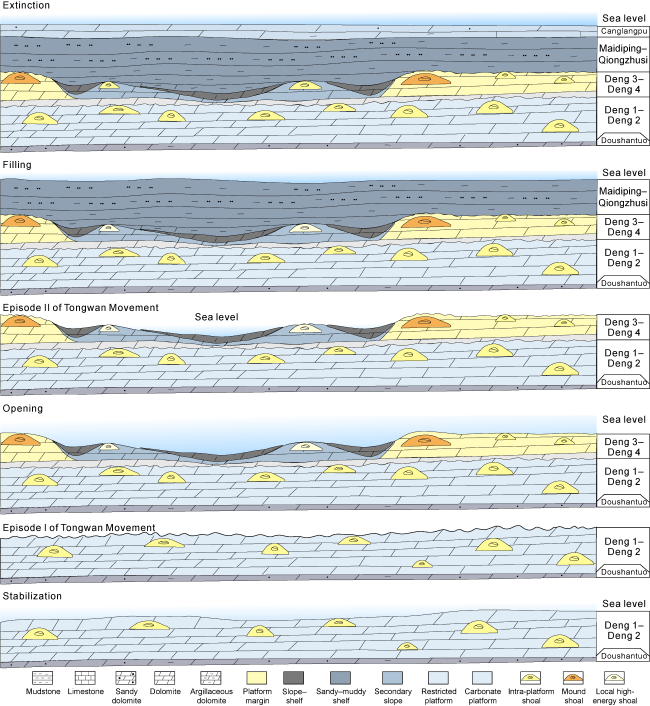


Fig. 13. Evolution model of Deyang-Anyue rift in southern Sichuan Basin. |
(1) Stabilization. During the deposition of Deng 1-Deng 2, the strong intraplate rift and tension activities occurred at the margin of the Yangtze plate under the joint control of the Sinian basement weak zones, the mantle upwelling in southern Qinling and the slab pull of proto-Tethyan oceanic lithosphere, leading to rift in early weak zones [35-36]. From the thickness map of this period (Fig. 2 a), it can be seen that there was an evident banded stratigraphic thinning area in the Anyue-Mianyang area, indicating that the northern segment of the rift trough had begun to take shape. However, the thickness of the strata in the south of the basin changed only slightly, indicating that the deposition was significantly differential between the north and south of the Sichuan Basin in this period. At this time, the southern segment of the rift trough was not yet split and stayed in a stable cratonic period. The southern Sichuan Basin as a whole was dominantly a carbonate platform and in a relatively shallow and high-energy environment, where in certain areas intra-platform shoals were developed.
During the episode I of Tongwan Movement, strong uplift and denudation took place in southern Sichuan Basin, forming an erosion interface [24]. The Deng 3 Member in this region was less affected by the Hannan paleo-continent uplift and terrigenous clastic materials [37], and is still mainly composed of dolomite deposits. With the strengthening of tension, the rift trough extended to the south, giving rise to a huge depositional differentiation in southern Sichuan Basin.
(2) Opening. During the deposition of the Deng 4 Member, the rift trough was split southward and expanded greatly, connecting the north and south of the basin. The rift trough displayed finger-like distribution in the Mianyang-Jiange belt, reaching a depth up to 800 m. It became thinner southward to about 400 m. The central and northern segments were about 80 km wide at the narrowest parts, and the southern segment was up to 230 km wide. At this time, there was evident depositional differentiation in southern Sichuan Basin. The marginal trough was dominated by algal arenaceous dolomite, and the inner trough displayed the alternation of sags and uplifts and was dominated by micritic dolomite and mud- bearing micritic dolomite, with high-energy arenaceous dolomite strips locally. In this period, the southern segment of the rift trough was generally wide, gentle and shallow.
During the episode II of Tongwan Movement, due to differential subsidence, the southern and central Sichuan Basin was relatively high in geomorphology and suffered relatively strong erosion. Therefore, the Deng 4 Member in southern Sichuan Basin was relatively thin.
(3) Filling. Since the Cambrian, the Tongwan Movement was ended, and the whole area was subjected to extensive transgression. Thick muddy and sandy-muddy rocks and carbonates of Maidiping Formation and Qiongzhusi Formation were deposited inside the trough. A set of hybrid limestone, dolomite, and mudstone with a thickness of 150 m was deposited in the Maidiping Formation which was in the transitional period. This set of hybrid strata thinned and even pinched out towards the sides of the rift trough. In contrast, very thick shale and clastic rock of the Qiongzhusi Formation were deposited inside the trough, and they thinned rapidly towards the marginal trough. At this time, the filling and leveling processes had basically completed (Fig. 13 ).
(4) Extinction. From the above stage to the Canglangpu period, the whole area was continuously filled and leveled, and the rift trough tended to disappear.
5. Conclusions
The southern segment of the Late Sinian-Early Cambrian Deyang-Anyue rift trough in the Sichuan Basin contains complete strata. The thickness of Deng 1 + Deng 2 is stable at 400-550 m and exceeds 600 m only locally. The thickness of Deng 3 + Deng 4 is variable, being 300-400 m in the trough margin and 100-200 m in the inner trough. The Deng 3 Member is mainly composed of dark mudstone in the central-northern part of the basin, and of dolomite with minor argillaceous dolomite in the southern part of the basin. The thickness of the Maidiping Formation and the Qiongzhusi Formation in southern Sichuan Basin is relatively small, but changes greatly and frequently.
During the deposition of the Deng 4 Member, the Deyang-Anyue rift trough extended southward, with its influence reaching the southern Sichuan Basin. Compared with the middle and northern segments of the rift trough, the southern segment is generally wide, gentle and shallow, and contains multiple steps, with alternating uplifts and sags, forming the finger-like distribution in plane view. In the depositional period of Deng 1-Deng 2, the southern Sichuan Basin was dominated by carbonate platform, showing no evident depositional differenttiation. However, the Deng 4 Member exhibited evident differential sedimentation, in an order of basin-slope- secondary slope-slope-secondary slope-platform margin- restricted platform from the inner trough to the marginal trough. The evolution of the rift trough in the southern Sichuan Basin has experienced four key stages generally: the stable cratonic stage of the Deng 1-Deng 2 members, when the rifting trough did not affect the southern Sichuan Basin; the opening period of Deng 3-Deng 4 members, the rift trough expanded greatly and connected the north and south; the filling stage of the depositional period of the Maidiping Formation-Qiongzhusi Formation, the rift trough was basically filled and leveled; the extinction period of the Canglangpu Formation, the whole area was filled and leveled, and the rift trough extincted.