

Introduction
The oilfield discussed in this paper is not the usual geological definition in a narrow sense but the generalized one that refers to the oilfield group or oil area operated by an oilfield company, such as Daqing oilfield in NE China and Shengli oilfield in East China, which is composed of dozens of oilfields. The development stage of an oilfield is mainly divided into 3 periods based on its production evolution pattern generally, production growth, stable production, and production decline. Sometimes, the latter production decline stage is separated independently. This division method is represented by Oludnev [1] of the former Soviet Union. In addition, the development stage can also be divided according to the water cut. If the water cut is less than 20%, it is the low water cut stage; if the water cut is greater than and equal to 20% and less than 60%, it is the medium water cut stage; if the water cut is greater than and equal to 60%
and less than or equal to 90%, it is the high-water cut stage; and if the water cut is more than and equal to 90%, it is the ultra-high water cut stage [2]. Tong [3] also divides the oilfield development into four stages according to water cut, but with some differences in the boundary value of water cut. The development practice shows that the simple division of the development stage of the production increment, stable production, and production decline, is too ideal. Some oilfields show multiple stages of plateaus at different production scales or oil rates, and then stable production at a specific production scale for a while during the production decline stage. Such a complex pattern of production evolution is typical in large oilfields, posing a challenge for dividing the development stage.
Mature oilfield is also a common concept. However, the boundary or connotation of "mature" is not yet definite. It is defined according to production as the late production decline stage or according to water cut as late high/ultra-high water cut stage. It is also defined by the development time. For example, oilfields that have been developed for more than 30 years are called mature oilfields. A large amount of production data shows that it is not scientific to use the development time as the benchmark for defining mature oilfield. For example, the Changqing and Xinjiang oilfields in NW China have been developed for 60 years and still show a trend of production growth or stable production, which cannot be considered mature oilfields at all.
As a result, some fundamental issues, such as development stage division and the definition of mature oilfields, are yet to be understood in depth. In this paper, we analyze several indicators such as oil production, water cut, recovery percent of recoverable reserves and development time, and their controlling or influencing factors of several typical oilfields in eastern China, the Romashkin oilfield [4] in Russia and East Texas oilfield [5] in the United States. It aims to obtain some common understanding, establish the equation of production evolution based on recoverable reserves, and propose the division method of development stage and the criterion of mature oilfields.
1. Recognition of several statistical laws
Based on the production data and empirical practices of mature oilfields in eastern China, the following statistical laws were studied and summarized combining with reservoir engineering principles to divide the development stage rationally [6].
1.1. Production evolution pattern based on recoverable reserves
Arps production decline equation and water drive characteristic curve are adopted for predicting the oil production in recoverable reserve calibration and development planning [7-8]. However, oilfield development strategy research needs to forecast the production evolution pattern throughout the development process. Weng [9] proposed the “Poisson cycle” model in his monograph Fundamentals of Forecasting Theory, which is the first model established in China to predict the production evolution of the entire oil and gas field development process and is often referred to as the “Weng cycle” model in the industry. Chen [10] improved it and proposed a generalized “Weng cycle” model, reflecting oilfield production's evolution from increasing to declining to some extent, and is highly valued by oilfield development practitioners and widely used in development strategy research.
It is worth noting that oilfield development is highly complex, with many adjustment measures implemented and new blocks and layer systems invested year by year. It is influenced by multiple factors, such as economics, policy and technology, and may have dynamic changes in goals. Therefore, the production evolution pattern cannot be described by its equation with time variation alone, and the applicability of the generalized Weng cycle model is limited. For example, it does not apply to Daqing and Shengli oilfields.
Oilfield development is an open system. The production evolution pattern is influenced by natural factors such as reservoir geology and physical percolation properties, and artificial interventions such as geological reserves put into production year by year and continuously increasing recoverable reserves. These influences run through the whole process of oilfield development. Oil production and recoverable reserves are two interdependent, mutually influencing and constraining development indicators, and the role of recoverable reserves should be considered in the production evolution model.
Inspired by the generalized Weng cycle model and to further highlight the role of recoverable reserves, the following production evolution model is proposed.
In Eq. (1), Nr is the recoverable reserves, which controls the production growth, and the negative index controls the production decline. In cases that recoverable reserve is difficult to obtain accurately, geological reserves can be used instead, with only changes in the coefficients.
In the case that the recoverable reserves grow proportionally with time, the proposed production evolution model in this paper is the generalized Weng cycle model. Production data of several typical oilfields were fitted with Eq. (1) or (2). Figs. 1 and 2 show the fitting results of production evolution of the Daqing and Shengli oilfields with Eqs. (1) and (2), respectively. In Eq. (1), recoverable reserve is regarded as the controlled variable, while geological reserve is taken as the controlled variable in Eq. (2). Table 1 shows the comparison of the production evolution equations for some oilfields obtained by applying the model of this paper and the generalized Weng cycle model. As depicted in Fig. 1 , Fig. 2 and Table 1 , the production evolution model proposed in this paper has better fitting results than that of the generalized Weng cycle model.
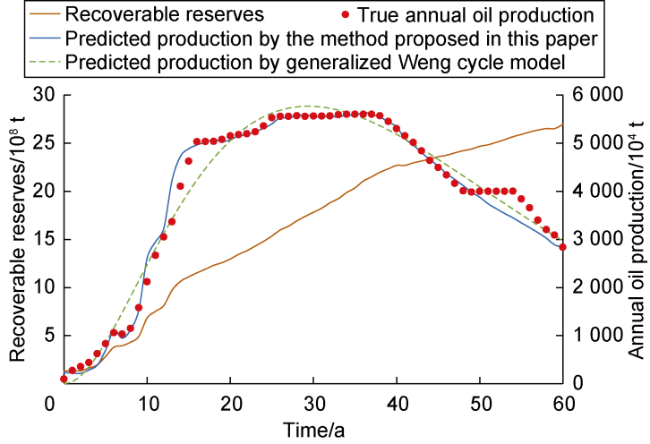
Fig. 1. Comparison of predicted production by the production evolution model and actual production of Daqing oilfield. |
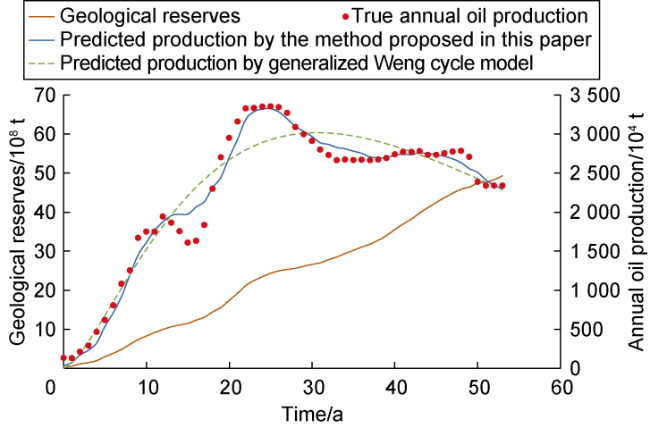
Fig. 2. Comparison of predicted production by the production evolution model and actual production of Shengli oilfield. |
Table 1. Comparison of the production evolution equations of different oilfields obtained by using the model of this paper and the generalized Weng cycle model |
| Oilfield | Generalized Weng cycle model | Model in this paper | ||
|---|---|---|---|---|
| Production evolution equation | Correlation coefficient | Production evolution equation | Correlation coefficients | |
| Daqing | Q=46.7t2e-t/14.5 | 0.976 | Q=136.6Nr(t)1.7e-0.04t | 0.988 |
| Shengli | Q=74.5t1.5e-t/20.1 | 0.913 | Q=0.000 89N(t)1.31e-0.046t | 0.978 |
| Romanshkin | Q=15.4t3.2e-t/6.0 | 0.949 | Q=0.7N(t)1.0e-0.1t | 0.955 |
| East Texas | Q=2 342t0.1e-t/27.4 | 0.897 | Q=3.1N(t)0.6e-0.03t | 0.945 |
| Zhongyuan | Q=116.6t1.2e-t/9.1 | 0.930 | Q=0.003N(t)1.25e-0.08t | 0.958 |
| Jiangsu | Q=0.4t2.5e-t/11.8 | 0.929 | Q=0.02N(t)1.0e-0.04t | 0.962 |
| Jianghan | Q=34.1t0.52e-t/39.4 | 0.806 | Q=0.001N(t)1.56e-0.05t | 0.907 |
| Henan | Q=202.9t0.18e-t/40.6 | 0.856 | Q=0.78Nr(t)0.72e-0.04t | 0.925 |
1.2. Matching law of production decline and reserve- production imbalance
Eq. (1) shows that the increment in recoverable reserves becomes smaller with the development time, consequently the exponentially declined trend term plays a dominant role and the oilfield production begins to decline. Statistics on production data from several typical oilfields (Fig. 3 ) indicate that the years at which the reserve-production balance factor (i.e., the ratio of increased recoverable reserves to the production of a year, equivalent to the reserve replacement factor under U.S. Securities and Exchange Commission (SEC) guidelines)[11-12] decreases steeply to less than 1 has a good match with the years at which declining production begins to occur. Among the oilfields in Table 1 , only the Daqing oilfield produced steadily for another four years after its reserve-production balance factor reduced to less than 1, this is mainly because of the higher oil recovery rate from the recoverable reserves in tertiary recovery. Stable production is mainly maintained by the succession of newly discovered reserves and enhanced oil recovery technologies, i.e., continuous increase of recoverable reserves [13⇓-15]. Therefore, taking the starting point of the steep decline of the reserve-production balance factor as a criterion for the emergence of production decline period also has some reservoir engineering basis.
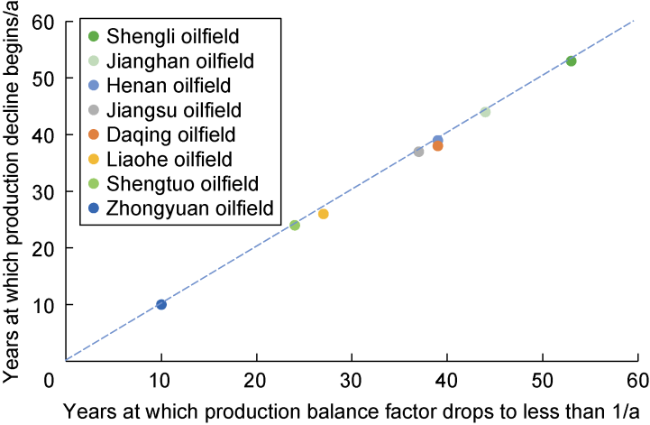
Fig. 3. Comparison of the beginning years of oil production decline and those with reserve-production balance factor less than 1 in different oilfields. |
1.3. Matching law between water cut and recovery percent of recoverable reserves
Water cut and recovery percent of recoverable reserves are essential indicators that characterize the development stage of a water flooding oilfield. Some scholars regard water cut more than 90% as a benchmark of the late development stage. Some scholars set the recovery percent of recoverable reserves of more than 80% as the benchmark of this stage [1]. However, the quantitative relationship between water cut and recovery percent of recoverable reserves needs to be studied further.
1.3.1. Relationship between water cut and recovery percent of recoverable reserves based on relative permeability curve
The relative permeability curve is a crucial basis for understanding the oilfield development law. It can be used to investigate the relationship between water cut and recovery percent of recoverable reserves theoretically. According to the fractional flow equation, the statistical relationship of relative permeability and water saturation, and the relationship of recovery percent of geological reserve and water saturation, the relationship of recovery percent of geological reserve and water cut can be deduced as follows:
Generally, the recovery percent of geological reserves at the water cut of 98% is used as the oil recovery (Re). The recovery percent of recoverable reserves can be obtained by introducing the concept of water-oil ratio.
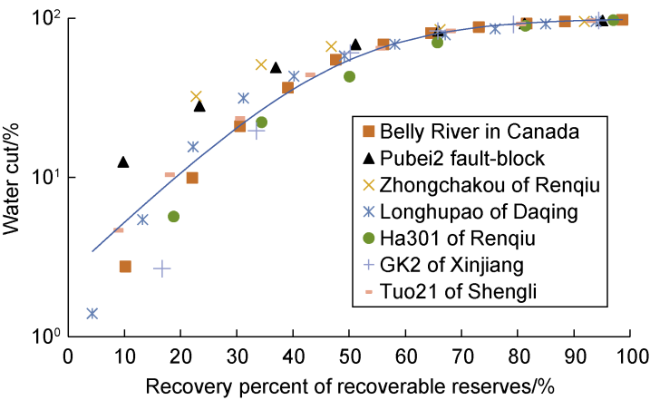
Fig. 4. Relationship between water cut and recovery percent of recoverable reserves based on relative permeability curves. |
1.3.2. Relationship between water cut and recovery percent of recoverable reserves based on production data
In general, one oilfield group or general oilfield usually consists of multiple oilfields or reservoirs in the narrow sense, which has different geological conditions and varies widely in discovery and production time. Undoubtedly, this further complicates the relationship between water cut and recovery percent of recoverable reserves.
Assuming that an oilfield group consists of n oilfields (or reservoirs) in the narrow sense, the comprehensive recovery percent of recoverable reserves of the oilfield group can be deduced from Eq. (5):
The comprehensive water-oil ratio of the oilfield group is:
It is evident that the water-oil ratio distribution, reserve ratio, and oil production ratio of each oilfield (or reservoir), in a narrow sense, determine the relationship between the recovery percent of recoverable reserves and the water-oil ratio of the oilfield group. However, this relationship cannot be expressed analytically yet. According to Eqs. (5) and (6), the relationship between the recovery percent of recoverable reserves and water-oil ratio of the oilfield group under different combination scenarios can be obtained by using the Monte Carlo stochastic simulation method with the reserve ratio, production ratio and water-oil ratio as random numbers. The simulation results show that the recovery percent of recoverable reserves at 90% water content is concentrated in (75%, 80%), with a mean value of 78%. It indicates that even for the oilfield group, the relationship between the average recovery percent of recoverable reserves and the average water cut at the ultra-high water cut stage shows a reasonable regularity due to normalization.
The statistics of nine oilfields, such as Daqing and Shengli oilfields (Fig. 5 ), show that the recovery percent of recoverable reserves at the water cut of 90% is concentrated in the interval of (74%, 84%) with a mean value of 79.6%, especially Daqing, Shengli and Zhongyuan oilfields, which are closer to the mean value. As adjustments have been strengthened, especially low water-cut reservoirs have been put into production and multiple enhanced oil recovery measures adopted in late stage, Romanshkin oilfield has a better development performance due to the change in water cut or water-to-oil ratio structure.
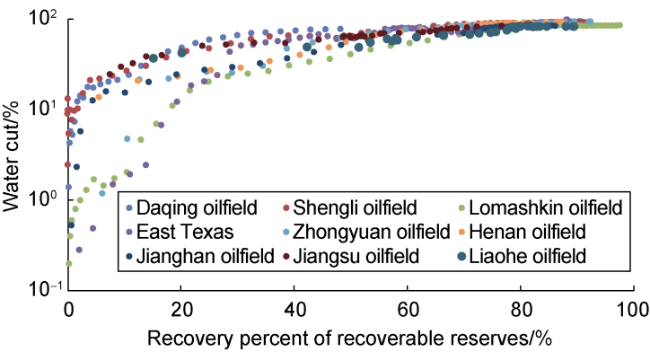
Fig. 5. Relationship between water cut and recovery percent of recoverable reserves in different oilfields. |
2. Production evolution model and development stage division method
Oilfield development is a process of constant deepening of understanding and adjustment, while different types of oilfields have different approaches, further increasing the difficulty of dividing development stage. There may be multiple steps of oil production in the stable production stage and a certain period of relatively stable production in the production decline stage. Therefore, determining the demarcation points of the development stage needs to be studied.
2.1. Methods determining the demarcation points of the development stage
2.1.1. Method determining the initial point of stable production stage
The stable production stage of an oilfield corresponds to a relatively stable interval of the zero-value line of the production derivative (essentially the difference), the starting point of which is the initial point of the stable production stage. The practicality of the method is confirmed by a large amount of oilfield production data, such as the Daqing oilfield shown in Fig. 6 .
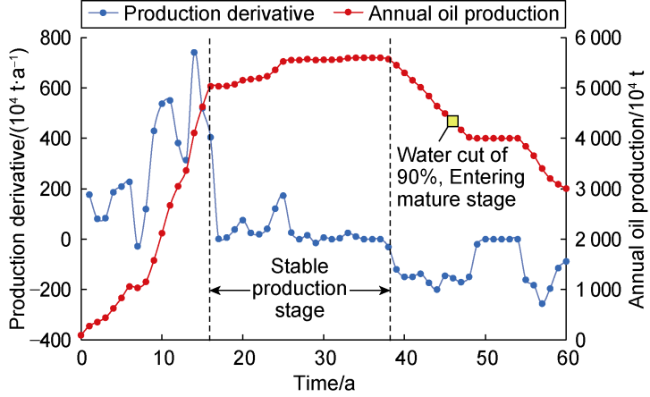
Fig. 6. Variations of production derivative and annual oil production with development time of Daqing oilfield. |
2.1.2. Method determining the initial point of production decline stage
According to the matching law between production decline and reserve-production imbalance given earlier, the starting point of steep decline of the reserve-production balance factor can be taken as the initial point of the production decline stage. For example, as shown in Fig. 7 , the production decline stage of the Shengli oilfield appears after 53 years of development.
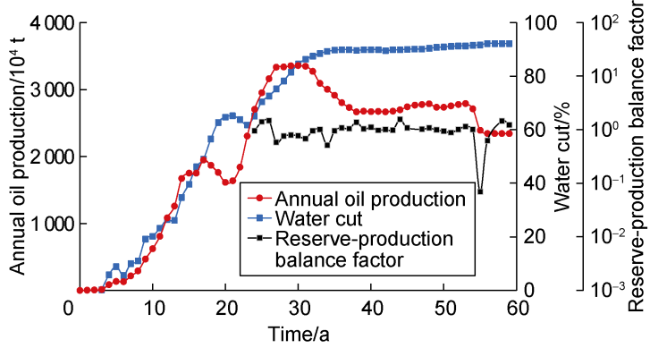
Fig. 7. Variations of annual oil production, water cut and reserve-production balance factor of Shengli oilfield with development time. |
2.2. Several typical patterns of production evolution
A large amount of oilfield production data show there are two kinds of production evolution patterns, namely, growth-stable-decline and growth-decline. Furthermore, stable production stage has two types, peak plateau and stepped stabilizing, and the production decline stage comes in two types, rapid decline and stepped decline. It is further summarized into the following five patterns.
(1) Growth-peak plateau-stepped decline pattern, represented by Daqing oilfield and Lomashkin oilfield. Daqing oilfield had an oil production of (5000-5600)×104 t per year in the stable production stage, then had a production dropping to 4000×104 t first and a production of around 3000×104 t currently in the stepped decline stage [16]. Romashkin oilfield produced at a steady rate of 8800×104 t for 7 years and then at a steady rate of 1800×104 t for 17 years after entering the production decline stage.
(2) Growth-stepped stabilizing-stepped decline pattern, represented by Shengli oilfield. The stable production stage of the Shengli oilfield can be divided into two plateaus, with oil production of 3300×104 t and 2700×104 t, respectively. It entered the production decline stage with stable production of 2300×104 t to date.
(3) Growth-stepped plateau-rapid decline pattern, represented by the Henan and Jianghan oilfields in China. In the stable production stage, Henan oilfield had three oil production plateaus of (220-250)×104, 170×104 and 230×104 t, and then entered the rapid decline stage. Jianghan oilfield entered the rapid decline stage after stable production with three plateaus of 100×104, 80×104, and 90×104 t (Fig. 8 ).
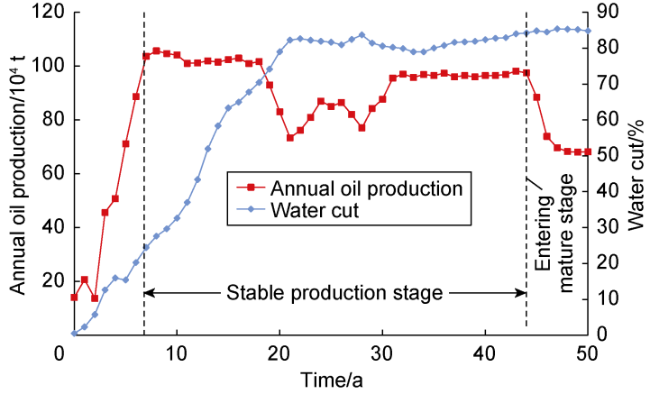
Fig. 8. Variations of annual oil production and water cut of Jianghan oilfield with development time. |
(4) Growth-peak plateau-rapid decline pattern, represented by Jiangsu oilfield. As is shown in Fig. 9 , Jiangsu oilfield entered the rapid decline stage after a stable production at the peak of 170×104 t. Such oilfields don’t have reserves discovered successively for development and large-scale enhanced oil recovery measures.
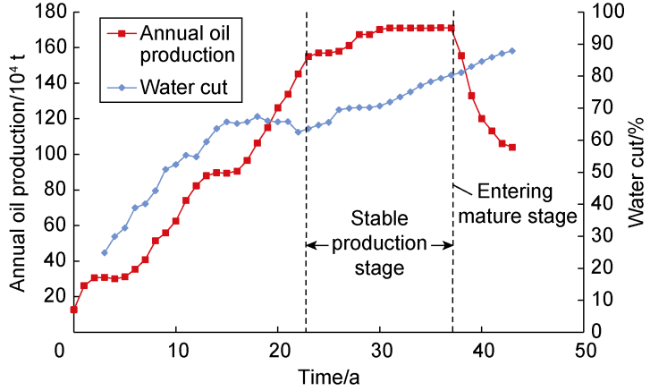
Fig. 9. Variations of annual oil production and water cut of Jiangsu oilfield with development time. |
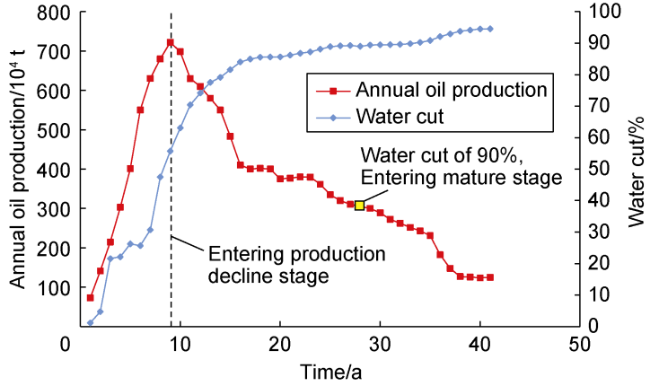
Fig. 10. Variations of annual oil production and water cut of Zhongyuan oilfield with development time. |
(5) Growth-continuous decline pattern, represented by the Zhongyuan oilfield, China and the East Texas oilfield, US. After reaching the production peak of 730×104 t, Zhongyuan oilfield had no large scale geological reserves discovered and put into production, thus couldn’t keep production stable, and directly entered into long-term production decline stage.
2.3. Connotation and criterion of mature oilfield
A mature oilfield or late stage of development is a relatively vague concept. In light of the research results and by considering oil production and water cut comprehensively, the following understandings on the connotation and criterion of mature oilfield have been reached.
(1) Taking the initial point of production decline stage as the criterion for mature oilfield is not appropriate. For example, Zhongyuan and East Texas oilfields entered the production decline stage too early, and the main recoverable reserves are recovered at this stage.
(2) It is not reasonable to take 90% water cut alone as the criterion of mature oilfield. For example, in the Shengli oilfield, the water cut reached 90% at the second production plateau of the stable production stage.
(3) Taking development time as the criterion of a mature oilfield is even more unreasonable. In Fig. 11 , the statistical data of different oilfields show that the development time is too scattered and shows little regularity at a specific recovery percent of recoverable reserves.
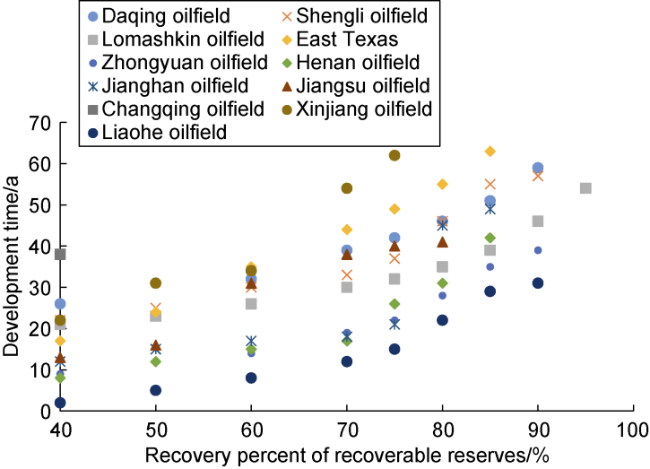
Fig. 11. Relationship between the recovery percent of recoverable reserves and development time of different oilfields. |
(4) According to the above analysis results, it is more scientific to use a water cut of 90% (or recovery percent of recoverable reserves of 80%, which have a better match) and the initial point of production decline stage as the criterion of mature oilfield. If the water cut of 90% appears in the production decline stage and the recovery percent of recoverable reserves at this point is about 80%, then the water cut of 90% is taken as the criterion. If the water cut does not reach 90%, but the recovery percent of recoverable reserves reaches 80% in the production decline stage, and the water cut is close to 90% at this point, then 80% of recovery percent of recoverable reserves can be also taken as the criterion. If the point of 90% water cut or 80% recovery percent of recoverable reserves appears before the production decline stage, then the initial point of production decline stage is regarded as the criterion.
According to the above criteria, the initial time of entering mature stage for several oilfields in eastern China, the Lomashkin oilfield and the East Texas oilfield, are determined, as shown in Table 2 .
Table 2. Criterion of several typical mature oilfields |
| Oilfield | Years when reserve- production balance factor reduces to less than 1/a | Years when water cut reaches 90% or recovery percent of recoverable reserves reaches 80%/a | Years when the oilfield becomes mature/a | Recovery percent of recoverable reserves when oilfield entering mature stage/% |
|---|---|---|---|---|
| Daqing | 39 | 46 | 46 | 80.4 |
| Shengli | 53 | 46 | 53 | 82.4 |
| Lomashkin | 25 | 35 | 35 | 80.5 |
| East Texas | 3 | 59 | 59 | 82.7 |
| Zhongyuan | 9 | 28 | 28 | 78.8 |
| Henan | 39 | 31 | 39 | 79.0 |
| Jianghan | 44 | 45 | 45 | 80.6 |
| Jiangsu | 37 | 41 | 41 | 81.0 |
3. Analysis of typical oilfields
The methodology proposed in this paper has been applied to classify the development stage of some oilfields in eastern China and to determine the initial point of mature stage. Table 3 indicates that several typical oilfields have entered the mature stage. However, there are different paths to the mature oilfield stage in different production evolution stages and recovery percent of recoverable reserves with different basin types, oilfield types, reservoir geological characteristics, and development methods. But the recovery percent of recoverable reserves in the mature stage is concentrated at about 20%. Several typical cases are given below.
Table 3. Development time and recovery percent of recoverable reserves of different stages for some oilfields |
| Oilfield | Production growth stage | Stable production stage | Recovery percent of recoverable reserves at production decline stage/% | Recovery percent of recoverable reserves at mature stage/% | ||
|---|---|---|---|---|---|---|
| Year/a | Recovery percent of recoverable reserves/% | Year/a | Recovery percent of recoverable reserves/% | |||
| Daqing | 16 | 13.0 | 23 | 56.0 | 31.0 | 19.6 |
| Shengli | 27 | 53.1 | 26 | 29.3 | 17.6 | 17.6 |
| Lomashkin | 19 | 35.5 | 6 | 14.4 | 50.1 | 19.5 |
| East Texas | 3 | 8.0 | 0 | 0 | 92.0 | 17.3 |
| Zhongyuan | 9 | 43.3 | 0 | 0 | 56.7 | 21.2 |
| Henan | 3 | 12.4 | 36 | 68.2 | 19.4 | 19.4 |
| Jianghan | 7 | 19.2 | 37 | 60.1 | 20.7 | 19.4 |
| Jiangsu | 23 | 51.0 | 14 | 17.7 | 31.3 | 19.0 |
The Lasaxing oilfield discovered earlier in the Daqing oil area accounts for nearly 70% of reserves, which dominates the production contribution of the Daqing oilfield. According to the development policy of long-term high and stable production and maximizing oil recovery, blocks in this oilfield have been recovered orderly and successively to keep stable production. As separated layer development, infilling well-pattern, separated layer water injection, and measures and technologies in tertiary oil recovery had been put into application gradually [17⇓⇓⇓⇓-22], and peripheral oilfields' exploration, evaluation, and production had been strengthened to increase the recoverable reserves, Daqing oilfield had maintained the annual oil production of more than 5000×104 t for 27 years, setting an example for the development of giant multilayer sandstone oilfields. At the end of the production growth stage of 16 years, Daqing oilfield had reached a recovery percent of recoverable reserves of 13.0%. During the stable production stage of 23 years with the annual oil production of (5000-5600)×104 t, it kept a recovery percent of recoverable reserves of 56%. In the 4 years afterwards, its oil production gradually decreased to 5000×104 t. It entered the mature stage after 46 years of development, and then has been produced at the relatively stable production of 4000×104 t and 3000×104 t until now.
Shengli oilfield is a complex reservoir group in a rift basin, where reservoirs have a variety of types, including complex fault block, monoblock, low permeability, heavy oil, paleo-buried hill carbonate, and marine reservoirs. The reserves in the main reservoirs were discovered in several stages. Its production growth stage lasted 27 years, during which the recovery percent of recoverable reserves was as high as 53.1%, the peak production was 3300×104 t, and the oil recovery rate was up to 3.3%. After five years of stable production, it entered the second production plateau with stable production of (2700-2800)×104 t. After 53 years of development, it has generally entered the production decline stage and mature stage. But as it still has considerable proven geological reserves discovered year by year, and thus recoverable reserves increasing constantly, it is still producing at around 2300×104 t stably.
The main reserves of the Zhongyuan oilfield were discovered in the early stage, and the recovery percent of recoverable reserves was 43.3% during the first nine years of the production growth stage. The peak production was 730×104 t, and the peak oil recovery rate was as high as 2.8%. Afterwards, with no large-scale reserves put into production, it had very limited increase in new recoverable reserves. The reserves and production were seriously unbalanced, which made it difficult to achieve stable production, and then entered the continuous decline stage. According to the criterion that the water cut reaches 90% after entering the production decline stage, Zhongyuan oilfield enters the mature stage after 28 years of development.
In the first 19 years of production growth stage, Lomashkin oilfield had the peak production of 8800×104 t, and an oil recovery rate of up to 3.5%. After six years of stable production, it entered production decline stage. After 35 years of development, it entered the mature stage at water cut of 88% and recovery percent of recoverable reserves of 80%. In the mature stage, it has produced at the stable oil production of 1800×104 t and the oil rate of 0.7% for 30 years. In this stage, as it has kept a low oil recovery rate and natural decline rate, the new reserves put into production and enhanced oil recovery measures can offset the production decline, the oilfield has realized stable production (Fig. 12 ).
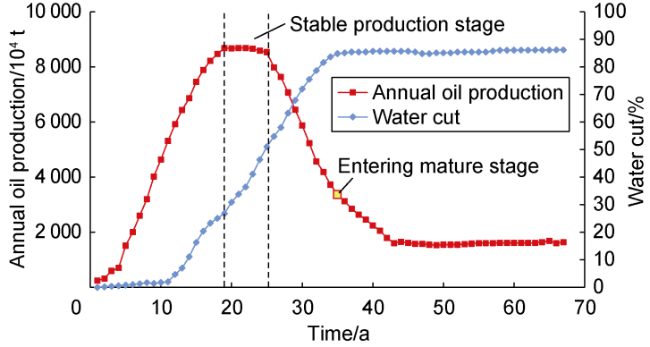


Fig. 12. Variations of annual oil production and water cut with development time of the Romanshkin oilfield. |
4. Conclusions
Due to different geological conditions, development methods, and many other factors, different oilfields have different time at each development stage, and relativity in stable production and production decline stages. The stable production stage may show multiple production plateaus, and the production decline stage may have a relatively stable production at a low oil recovery rate.
Reserve-production balance factor is critical in defining the production decline stage. The start point of its steep decline can be taken as the initial point of production decline stage. There is an excellent statistical matching between water cut and recovery percent of recoverable reserves, and the recovery percent of recoverable reserves concentrates at around 80% when the water cut is 90%.
It is more reasonable to use the "dual standard" of the initial point of production decline stage and 90% of water cut (or 80% of recovery percent of recoverable reserves) as the criterion of mature stage for oilefields, and the recovery percent of recoverable reserves of mature oilfields is concentrated around 20%.
Production evolution in the whole process of oilfield development can be summarized into 5 patterns as follows: growth-peak plateau-stepped decline, growth- stepped stabilizing-stepped decline, growth-stepped stabilizing-rapid decline, growth-peak plateau-rapid decline, and growth-continuous decline.
Nomenclature
a, b, A, A1, B, D—coefficients;
fw—water cut, %;
i—serial number of narrowly defined oilfields (or reservoirs) in an oilfield group;
n—number of narrowly defined oilfields (or reservoirs) in an oilfield group;
N(t)—geological reserves at the tth year, t;
Nr(t)—recoverable reserves at the tth year, t;
Q(t)—production at the tth year, t;
rNi—proportion of geological reserve of the ith narrowly defined oilfield, %;
roi—proportion of oil production of the ith narrowly defined oilfield, %;
Re—oil recovery factor, recovery percent of geological reserves at the water cut of 98%, %;
$\bar{R}_{e}$—average oil recovery factor, %;
Rt—recovery percent of geological reserves, %;
$\bar{R}_{t}$—average recovery percent of geological reserves, %;
Rwo—water-oil ratio;
$\bar{R}_{wo}$—average water-oil ratio;
t—development time, a.