

Introduction
The Qiangtang Basin, along with the Middle East petroleum province, belongs to the Tethyan tectonic domain and is the largest and least explored new area for Mesozoic marine oil and gas exploration in China [1]. After multiple rounds of evaluation and researches, the following five aspects of petroleum geological knowledge have been obtained. (1) The black shales of the Upper Triassic Bagong Formation and the Lower Jurassic Quse Formation are the main source rocks in the Qiangtang Basin [2-3]. (2) The Jurassic Quemocuo Formation and Xiali Formation in the North Qiangtang Depression develop very thick gypsum rock and gypsum-bearing mudstone caprocks, suggesting good regional sealing conditions [4]. (3) Two sets of main source-reservoir-seal assemblages are developed, namely, the lower-source and upper-reservoir assemblage consisting of the clastic reservoir of the Lower Jurassic Quemocuo Formation and the source rock of the Bagong Formation, with the gypsum in the upper Quemocuo Formation as the regional seal, and the lower-source and upper-reservoir assemblage consisting of the source rock of the Quse Formation and the dolomite reservoir of the Buqu Formation with the gypsum of the Middle Jurassic Xiali Formation as the regional seal [5]. (4) The marine Mesozoic in the Qiangtang Basin has experienced large-scale hydrocarbon generation and accumulation [6]. (5) The Qiangtang Basin has a large quantity of prospective oil resources [5].
The above understandings show that the Qiangtang Basin has geological conditions for forming large oil and gas fields. However, due to the low exploration level, the existing data are mainly outcrop and shallow drilling data, with only one scientific exploration well (QK1, 4692 m TD), and the 2D seismic data are poor in quality, restricting the deeper geological understanding. The existing understandings cannot support conventional oil and gas exploration in the basin. In order to deepen the research on petroleum geological exploration in the Qiangtang Basin, shallow drilling sampling of Mesozoic marine source rock in the Qiangtang Basin were carried out and the standard organic geochemistry section of marine source rock was established for evaluating the oil and gas exploration potential, revealing marine shale oil by shallow drilling. Through systematic testing and comprehensive analysis of a large number of samples from shallow wells, outcrops and exploratory trenches in the Biluocuo, Shenglihe and Shiyougou areas, this paper reveals the development characteristics, oil content, reservoir properties, fracturability and oil mobility of Mesozoic marine organic-rich shale, which is of great significance for future unconventional oil and gas exploration.
1. Sedimentary stratigraphic characteristics of Qiangtang Basin
The main body of the Qiangtang Basin rests on the Qiangtang-Changdu massif in the collision zone between the Eurasian plate and the Indian Ocean plate. It is bounded by the Hoh Xil-Jinshajiang suture zone in the north, and by the Bangong-Nujiang suture zone in the south. The basin is composed of three secondary tectonic units: the South Qiangtang Depression, the Central Uplift, and the North Qiangtang Depression (Fig. 1a ), with an area of approximately 20×104 km2 [1,7]. There are Devonian-Carboniferous marine carbonate rocks exposed in the Central Uplift, the Longmucuo-Shuanghu suture zone was spliced before the Mesozoic, and the South Qiangtang Depression and the North Qiangtang Depression were spliced into a unified massif during the Mesozoic [8]. The Hoh Xil-Jinshajiang suture zone began to close from the late Permian to the Early Triassic, completely closed at the end of the late Triassic, when the ancient Tethys Ocean disappeared, and entered into the evolution stage of the foreland basin during the Jurassic (Fig. 1b ) [9]. The Bangong-Nujiang suture zone began to stretch from the middle-late Triassic, when the Meso-Tethys Ocean was formed, entered the open sea shelf sedimentary system southward during the late Triassic-Jurassic (Fig. 1c ). It began to close during the late Jurassic-Early Cretaceous, when the Meso-Tethys Ocean disappeared, and entered into the evolution stage of continental basin during the Early Cretaceous [10].
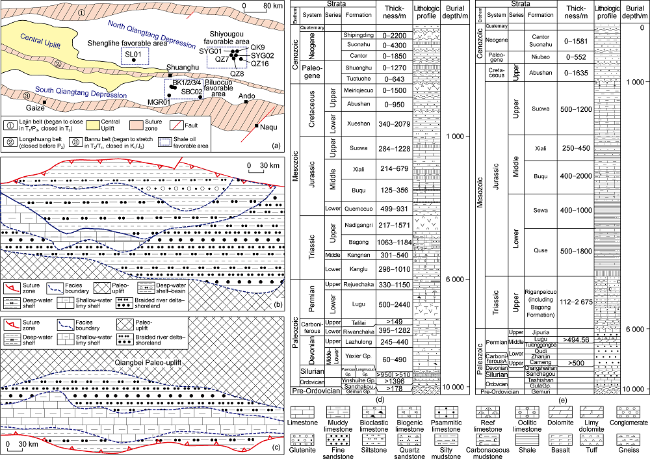
Fig. 1. Mesozoic tectonic division and stratigraphic sequences in Qiangtang Basin. (a) Tectonic zoning and data point distribution of the Qiangtang Basin; (b) Tectonic-lithofacies paleogeographic framework of the Qiangtang Basin from Early Triassic to middle stage of Late Triassic; (c) Tectonic-lithofacies paleogeographic framework of the Qiangtang Basin from late stage of Late Triassic to Late Jurassic; (d) Tectonic-sedimentary sequences and lithological characteristics of North Qiangtang Depression; (e) Tectonic-sedimentary sequences and lithological characteristics of South Qiangtang Depression. |
The Qiangtang Basin can be divided into four tectonic- sedimentary sequences (Fig. 1d , 1e ), namely, Pre-Ordovician crystalline basement, Paleozoic fold basement, Mesozoic marine sedimentary sequence and Cenozoic continental sedimentary sequence [11-12]. The Mesozoic marine sedimentary sequences in the South Qiangtang Depression and the North Qiangtang Depression are slightly different, which presents in four aspects. (1) Controlled by the initial closure of the Hoh Xil-Jinshajiang Ocean suture zone at the turn of Early Triassic/late Permian (T1/P3), the North Qiangtang Depression develops the Middle-Lower Triassic, which is in angular unconformable contact with the underlying Upper Permian. Controlled by the stretch of the Bangong-Nujiang Ocean at the turn of late Triassic/middle Triassic (T3/T2), the South Qiangtang Depression lacks the Middle-Lower Triassic, and has the Upper Triassic in angular unconformity contact with the underlying Upper Permian. (2) The Upper Triassic Bagong Formation in the North Qiangtang Depression and the Upper Triassic Riganpeicuo Group (including Bagong, Bolila and Jiapila formations) in the South Qiangtang Depression are both glutenite and limestone deposits, both of which have tripartition feature. However, the limestone in the South Qiangtang Depression is located in the lower part of the sequence, while the limestone in the North Qiangtang Depression is located in the middle part of the sequence, reflecting the process of seawater spreading from south to north. Moreover, there is also a set of Nadigangri Formation volcanic rock above the Bagong Formation in the North Qiangtang Depression, which is related to the complete closure of Hoh Xil-Jinshajiang Ocean in the late T3 period. (3) The Quemocuo Formation in the North Qiangtang Depression is equivalent to the Quse Formation + Sewa Formation in the South Qiangtang Depression, both of which are sedimentary strata from the Early Jurassic to the early stage of middle Jurassic. The main body consists of one set of calcareous sandy mudstone, with significantly higher sandstone-to- formation ratio in the North Qiangtang Depression than in the South Qiangtang Depression, and also contains bioclastic limestone interlayers. Moreover, the lower Quse Formation and the upper-middle Quemocuo Formation develop gypsum layers. These features indicate the migration of gypsum lakes from south to north. (4) The sedimentary characteristics of the Buqu Formation, Xiali Formation, and Suowa Formation of the Middle-Upper Jurassic in the South Qiangtang Depression and the North Qiangtang Depression are basically similar, with the main body being carbonate rocks intercalated or interbedded with sandy mudstone, except for gypsum interlayers in the North Qiangtang Depression, reflecting the wide sea opening southward during the Middle-Late Jurassic. The marine carbonate rock of the Suowa Formation in South Qiangtang Depression is overlain by the continental clastic rock of the Abushan Formation of Upper Cretaceous, and the continental clastic rock or carbonate rock of residual sea basin of Lower Cretaceous is missing, which is related to the closure of the Bangong-Nujiang Ocean during the Late Jurassic-Early Cretaceous. The main marine carbonate rock of the Suowa Formation in the North Qiangtang Depression is overlain by the continental clastic rock of the Lower Cretaceous Xueshan Formation, and partially covered by micritic limestone and oolitic limestone, reflecting the existence of residual sea basin during the Early Cretaceous.
2. Sedimentary and reservoir characteristics of marine shale
Mesozoic marine shales are well developed in the Qiangtang Basin, including two sets of primary organic- rich shales (Bagong Formation and Quse Formation), and four sets of secondary organic-rich shales (Sewa Formation, Buqu Formation, Xiali Formation and Suowa Formation) [2-3]. Based on the detailed observation and systematic analysis of the outcrop sections and cores from six shallow wells (BK-1, SBC02 etc.) in the Biluocuo area, the exploratory trenches of the Quse Formation in Shenglihe area, and the outcrop sections and the cores of the Bagong Formation from shallow wells SYG01 and SYG02 in the Shiyougou area, the characteristics of the two sets of primary organic-rich shales, i.e., the lower part of the Quse Formation (50-75 m thick) and the middle part of the Bagong Formation (250-350 m thick), are discussed.
2.1. Vertical and horizontal development characteristics of shales
2.1.1. Bagong Formation
The laminated shale of the Bagong Formation is mainly developed in the middle of the formation vertically, distributed in both the north and south Qiangtang areas. Shallow drilling and outcrop sections reveal the thickness of the Bagong Formation ranging from 250 m to 350 m [13]. The laminated shale of the Bagong Formation, controlled by sedimentary environment, is mainly distributed in the pre-delta facies of the Zangxia River to Gladandong-Maqu area, the pre-delta-shallow shelf facies from the sides of the Central Uplift to the eastern part of the basin, and the shelf-shoreland swamp facies of the South Qiangtang Depression. The laminated organic-rich shales are thick (about 350 m) in the south of the South Qiangtang Depression, and in the north and east of the North Qiangtang Depression. For example, the thickness of laminated shale on the outcrop section in the Shiyougou area in the east of the North Qiangtang Depression is about 350 m, the thickness revealed by Well QZ16 is about 366 m, and the thickness revealed by Well QK9 is about 346 m.
2.1.2. Quse Formation
The laminated shale of the Quse Formation is mainly developed in the lower part of the formation vertically, above the gypsum-basalt section which is tens of meters thick. Horizontally, it is mainly distributed in the South Qiangtang Depression and the west of the North Qiangtang Depression, as a set of lagoon-shelf black laminated shale intercalated with dark gray marl, with a thickness of 100-500 m [13]. The source rock on the Biluocuo section in the South Qiangtang Depression is more than 500 m thick, of which the 171.9 m laminated shale in the lower part have the TOC of more than 2.0%, including 35.3 m gray black laminated oily shale, commonly known as "Biluocuo oil shale". A set of interbedding black oily laminated shale, mudstone, marl, and bioclastic limestone is also developed in the Jurassic in the Shenglihe- Xichangliang area in the west of the North Qiangtang Depression. The stratum thickness controlled by the exploratory trench is 74-105 m [14-15], the thickness of the oil shale is 10-27 m, and the thickness of the single layer is generally less than 2 m. The comprehensive study of the paleontological fossil assemblage and stratum contact relationship shows that it was deposited in the Early Jurassic [16], equivalent to the age of oil shale of the Quse Formation in the Biluocuo area of the South Qiangtang Depression.
2.2. Petromineralogical characteristics of shales
2.2.1. Bagong Formation
The Late Triassic Bagong Formation in the Qiangtang Basin mainly includes the sedimentary systems such as shoreland, delta, carbonate platform, and continental shelf [13]. The shoreland and delta sedimentary systems are distributed in the northern edge of the North Qiangtang Depression, the eastern edge of the Central Uplift, and the middle-east part of the basin. The shallow-deep shelves are distributed in the eastern part of the North Qiangtang Depression and the southern part of the South Qiangtang Depression. The carbonate platforms are mainly distributed in the western part of the basin. The Bagong Formation can be vertically divided into three lithologic sections: the lower section is the thickness-unequal interbeds of thick black laminated calcareous shale with thickness of tens of meters and medium-thin siltstone and massive mudstone; the middle section is mainly black laminated calcareous shale mixed with siltstone and massive mudstone; the upper section is gray massive mudstone intercalated with thin siltstone, laminated shale and bioclastic limestone. The source rock of the Bagong Formation includes shale with laminated sedimentary structure and mudstone with massive sedimentary structure. The shale occurs as laminated calcareous or sandy shale (Fig. 2a ), which consists of argillaceous laminae rich in clay minerals and calcareous or silty laminae to form micron-scale rhythmic layers, containing abundant calcareous biological shells (Fig. 2b ). The mudstone occurs as massive calcareous mudstone or silty mudstone, with underdeveloped bedding and relatively low content of biological shell fossils (Fig. 2c ).
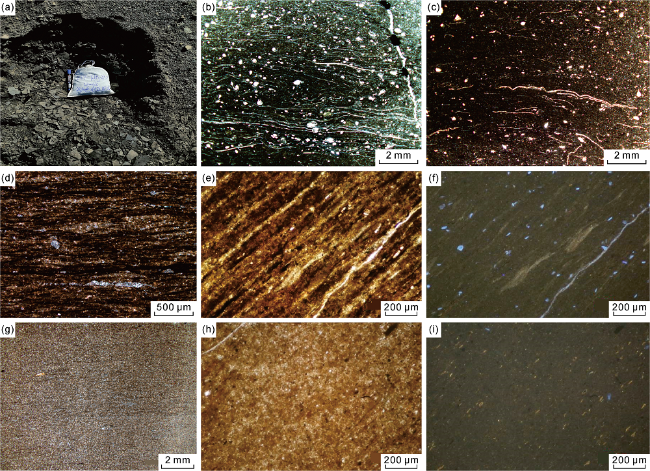
Fig. 2. Sedimentary structure characteristics of shales in Triassic Bagong Formation and Jurassic Quse Formation in Qiangtang Basin. (a) Outcrop section in Shiyougou, dark gray laminated shale of the Bagong Formation, outcrop photo; (b) Well SYG02, bioclastic laminated calcareous shale of the Bagong Formation, ordinary thin section; (c) Well SYG01, 12.1 m, bioclastic massive mudstone of the Bagong Formation, ordinary thin section; (d) Well BK-1, 33 m, laminated calcareous shale of the Quse Formation, with well-developed bedding fractures, ordinary thin section; (e) Well BK-2, 33.2 m, laminated calcareous shale of the Quse Formation, unipolar photo of fluorescent thin section; (f) In the same view field as sample (e), oil distributed in a disperse and strip-shaped manner, emitting dark brown yellow, yellow brown or light yellow fluorescence, fluorescent thin section; (g) Well BK-2, 23.5 m, massive calcareous mudstone of the Quse Formation; (h) Well BK-2, 9.2 m, massive calcareous mudstone of the Quse Formation, unipolar photo of fluorescent thin section; (i) In the same view field as sample (h), oil distributed in a disperse matter, emitting brown yellow, yellow brown and light yellow fluorescence, fluorescent thin section. |
The content of clay minerals in laminated shale of the Bagong Formation is 15.5%-57.0% (averaging 34.9%). The content of brittle minerals is relatively high (43.0%- 84.5%, averaging 65.1%), including quartz (18.4%-58.9%, averaging 34.6%), feldspar (1.0%-8.1%, averaging 2.7%), calcite (1.8%-42.3%, averaging 19.9%), dolomite (2.7%-10.0%, averaging 5.0%), and pyrite (2.3%-4.7%, averaging 2.9%).
2.2.2. Quse Formation
The outcrop sections and cores from shallow wells in the Biluocuo area show that the Quse Formation can be divided into purplish red sandy mudstone section, gypsum and gypseous mudstone/limestone interbedding section, basalt section, black laminated calcareous shale and marl interbedding section, gray massive mudstone interbedded with sandstone and shale section, from bottom to top. The black laminated calcareous shale above the gypsum-basalt section is organic-rich shale section. Similar to the Bagong Formation, the source rock of the Quse Formation can also be divided into two types of sedimentary structures: laminated calcareous shale (or marl) and massive mudstone. The laminated calcareous shale or marl consists of millimeter-scale dark organic-rich argillaceous laminae and bright calcareous-rich laminae to form horizontal rhythmic layers (Fig. 2d-2f ). A large number of bivalve and brachiopod fossils can be seen in core and under microscope, with complete fossil morphology, indicating weak energy in the water body during sedimentation. The mudstone laminae with massive structure are underdeveloped (Fig. 2g-2i ).
The shale in the Quse Formation is generally characterized by low content of clay minerals and high content of brittle minerals, with differences in mineral content among lithological sections. The shale in the lower gypsum-mudstone interbedding section contains clay minerals of 5.7%-38.8% (averaging 20.8%), gypsum of 0%- 40.3% (averaging 8.5%), and brittle minerals (quartz, feldspar, dolomite and calcite) of 47.1%-100.0% (averaging 71.5%). The organic-rich shale section above basalt is characterized by low content of clay minerals and high content of brittle minerals. The content of clay minerals is 14.8%-43.6% (averaging 27.2%), the gypsum content of a small number of samples is 0.6%-21.8% (averaging 4.3%), and the content of brittle minerals is high (36.3%- 85.2%, averaging 71.3%), including quartz (8.4%-24.8%, averaging 16.4%), feldspar (0.6%-2.7%, averaging 1.5%), calcite (22.5%-82.5%, averaging 47.5%), dolomite (1.2%- 12.9%, averaging 6.7%), and pyrite (1.4%-9.2%, averaging 4.6%), indicating a reducing sedimentary environment. The shale section with low organic abundance in the middle-upper part is generally characterized by high contents of clay (averaging 43.9%), quartz (averaging 33.4%) and feldspar (averaging 6.3%), and low content of carbonate minerals (averaging 16.7%), pyrite (basically below 2.0%), and almost no gypsum.
2.3. Shale reservoirs
2.3.1. Bagong Formation
The laminated organic-rich shales in the middle part of the Bagong Formation have well-developed foliation and good reservoir properties, with average porosity of 5.89%. There are two types of reservoir spaces: micro-pores and micro-fractures. Based on the morphology and genesis of pores/fractures, the porous reservoir spaces can be subdivided into intergranular/intercrystalline micro-pore, dissolution micro-pore, organic pore, pyrite moldic pore etc.; the fractured reservoir spaces can be subdivided into bedding fractures and structural fractures (Fig. 3 ).
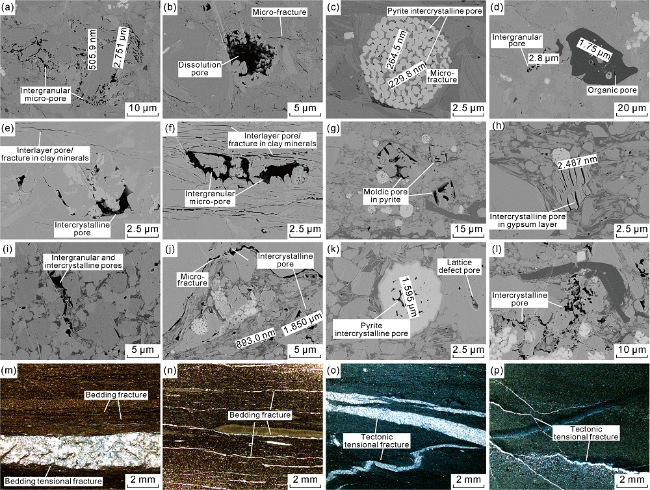
Fig. 3. Types of shale reservoir spaces in Jurassic Quse Formation and Triassic Bagong Formation of Qiangtang Basin. (a) Well SYG01 in Shiyougou area, 12.1 m, Bagong Formation, intercrystalline pores in calcareous shale; (b) The same sample as (a), dissolution micro-pores and structural micro-fractures; (c) Well SYG02 in Shiyougou area, 43 m, Bagong Formation, pyrite intercrystalline pores in calcareous shale; (d) Ortolongba section in Shiyougou area, Bagong Formation, organic pores in silty shale; (e) Sobcha section in Biluocuo area, Quse Formation, intercrystalline pores in calcareous shale and interlayer fractures in clay minerals; (f) Mugoriwang section in Biluocuo area, Quse Formation, intergranular pores in calcareous shale and clay mineral interlayer fractures; (g) Well BK-1 in Biluocuo area, 11.9 m, calcareous shale, pyrite moldic pores; (h) The same sample as (g), intercrystalline pores in gypsum layer; (i) Shenglihe section, Quse Formation, intercrystalline pores and intergranular pores in calcareous shale; (j) Shenglihe section, intercrystalline pores and micro-fractures in calcareous shale; (k) Well SL01, 9.5 m, calcareous shale, well-developed pyrite intercrystalline pores; (l) The same sample as (k), well-developed intergranular pores; (m) Well BK-4 in Biluocuo area, 22 m, Quse Formation, bedding fractures and bedding structural fractures in calcareous shale; (n) Well BK-1 in Biluocuo area, 11.9 m, Quse Formation, bedding fractures in calcareous shale; (o) Well SBC02 in Biluocuo area, 32.3 m, Quse Formation, network tensional fractures in calcareous shale, being filled; (p) Well SYG02 in Shiyougou area, 60 m, Bagong Formation, network tensional fractures in calcareous shale. |
The intergranular/intercrystalline micro-pores are the main reservoir space in the laminated organic-rich shale in the middle part of the Bagong Formation, accounting for over 80% of the total pore volume. The intergranular pores are mostly found between the detrital particles such as quartz and feldspar (Fig. 3a ), and the intercrystalline pores are mainly developed between calcite, pyrite and clay mineral crystals (Fig. 3c ). Dissolution micro-pores are mainly the pores formed by organic acid dissolution of carbonate minerals generated by organic matter in immature-low maturity stage (Fig. 3b ). Organic pores are mainly found in the interior or edge of massive organic matter (Fig. 3d ), are formed by hydrocarbon generation and expulsion of organic matter and volume contraction during thermal evolution, and are secondary reservoir spaces. Fractured reservoir spaces can be divided into two types: bedding fractures and structural fractures. Bedding fractures are mainly found in laminated shale with well-developed foliation, usually composed of muddy and calcareous laminae. Due to the significant differences in mineral composition and sedimentary structure between the two types of laminae, bedding fractures are easily formed during diagenesis. The density of bedding fractures is controlled by the frequency of lamination interbedding. The bedding fractures in the Bagong Formation are important storage spaces, and can also improve the permeability of reservoirs. Owning to intensive structure and fault activities in the Qiangtang Basin, the content of brittle minerals in the Bagong Formation is as high as 75%; under the background of multiple fault activities, micro-fractures are prone to occur (Fig. 3p ), which are developed in a network or bedding pattern. According to the comprehensive evaluation, the laminated organic-rich shale reservoir in the middle of the Bagong Formation meets the shale oil reservoir standard.
2.3.2. Quse Formation
Compared to the laminated organic-rich shale reservoirs in the middle part of the Bagong Formation, the laminated organic-rich shale reservoirs in the lower part of the Quse Formation have similar reservoir space types, but less development of foliation, which is related to the lower content of brittle minerals (65%) than the Bagong Formation. Its average porosity is 4.21%, slightly worse than the Bagong Formation.
Intergranular pores (Fig. 3f , 3l ) and intercrystalline micro-pores (Fig. 3e , 3g , 3i-3k ) are the main reservoir space types of laminated organic-rich shale in the lower part of the Quse Formation, accounting for about 70% of the total pore volume, slightly lower than the Bagong Formation. The abundance of dissolution micro-pores is slightly higher than that of the Bagong Formation, and the abundance of organic pores is slightly lower than that of the Bagong Formation, which is related to the maturity of organic-rich shale in the Bagong Formation (Ro=1.1%- 1.5%) being higher than that of the Quse Formation (Ro=0.9%-1.3%). In the Quse Formation, intercrystalline pores/fractures are also developed between gypsum crystals (Fig. 3h , 3k ), which is related to gypsum salt in-terlayers. The abundances of bedding fractures (Fig. 3e , 3f , 3m , 3n ) and structural fractures (Fig. 3j , 3m , 3o ) in the Quse Formation of the Biluocuo area are significantly higher than that in the Bagong Formation of the Shiyougou area, which is related to the stronger tectonic activity in the Biluocuo area than in the Shiyougou area. According to the comprehensive evaluation, the laminated organic-rich shale reservoir in the lower part of Quse Formation meets the shale oil reservoir standard.
3. Geochemical characteristics of marine shales
3.1. Quse Formation
The laminated organic-rich shales of Quse Formation in the Biluocuo and Shenglihe areas are taken as examples for depicting the organic geochemistry characteristics.
3.1.1. Biluocuo area
There are laminated organic-rich shales intercalated with mudstone outcropped on multiple sections of the Quse Formation in the Biluocuo area. In order to objectively evaluate the geochemical characteristics and shale oil exploration potential of the Quse Formation shales in this area, PetroChina Qinghai Oilfield Company drilled four shallow wells (BK-1, BK-2, BK-3 and BK-4, with TD of 150-200 m) and cored across the wellbores in the Biluocuo structure in 2010. In 2022, Well SBC02 was drilled on the Suobucha section and Well MGR01 was drilled on Mugouriwang section, providing data basis for the evaluation of marine shale oil of the Quse Formation in the Biluocuo area.
The lower part of the Quse Formation on the outcrop section in the Biluocuo area develops gypsum rock with a thickness of about 50 m and basalt with a thickness of several meters (layers 2-3). The upper part contains the grayish black, light gray, and grayish green shales with a thickness of nearly 550 m (layers 4-12). However, the laminated organic-rich shale is mainly in layers 4-8 above the gypsum rock and basalt, with thickness of 58.80 m (Fig. 4 ) [17]. Its TOC value is 1.87%-26.12% (averaging 8.34%), its average content of chloroform bitumen 'A' is 0.66%, and its average residual hydrocarbon generation potential (S1+S2) is 29.93 mg/g (Table 1 ). The layers 9-10 are mainly composed of light gray and grayish green massive shales, which exhibit high TOC in some samples, but mostly occur as thin shale interlayers. The layers 11-12 are interbedding gray mudstone and shale with varying thickness, with the TOC mostly below 1.0%, with an average of 0.37%.
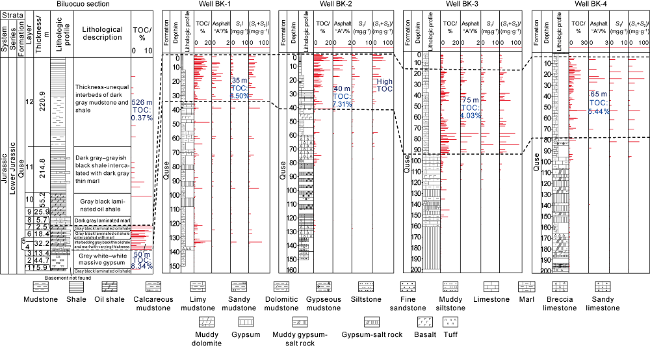
Fig. 4. Organic geochemical characteristics of Quse Formation on the outcrop section of Biluocuo structure and derived from shallow wells. |
Table 1. Geochemical characteristic parameters of the shales of Quse Formation and Bagong Formation in key areas of Qiangtang Basin |
| Formation | Section/Well | TOC /% | Asphalt ‘A’ /% | S1 /(mg·g-1) | (S1+S2) /(mg·g-1) | Ro /% | Kerogen δC13/‰ |
|---|---|---|---|---|---|---|---|
| Quse | Biluocuo outcrop section | 1.87-26.12/8.34 | 0.06-1.87/0.66 | 1.79-1.45/29.93 | 0.90-1.30 | -25.9- -25.1 | |
| Well BK-1 | 0.86-14.60/6.50 (50) | 0.10-1.15/0.75 (7) | 1.07-4.61/1.61 (11) | 1.18-67.44/20.65 (28) | 0.87-1.11/1.05 (6) | -26.1- -24.7 | |
| Well BK-2 | 0.65-32.70/7.31 (67) | 0.10-1.50/0.80 (6) | 1.38-3.70/2.01 (6) | 0.75-60.60/23.50 (21) | 0.84-0.99/0.94 (6) | -26.7- -24.0 | |
| Well BK-3 | 0.40-20.70/4.03 (121) | 0.20-1.76/0.68 (12) | 1.10-6.62/2.12 (22) | 0.18-81.04/16.07 (50) | 0.90-1.20/1.21 (5) | -26.3- -24.6 | |
| Well BK-4 | 0.38-26.30/5.44 (82) | 0.10-2.33/1.25 (8) | 1.10-6.46/2.95 (13) | 0.99-75.73/33.31 (13) | 0.98-1.32/1.25 (10) | -26.4- -24.6 | |
| Well MGR01 | 0.23-0.88/0.52 (22) | 0.25-0.27/0.26 (10) | 0.03-0.60/0.16 (13) | 0.18-0.91/0.30 (11) | |||
| Well SBC02 | 0.35-0.64/0.44 (18) | 0.16-0.25/0.20 (3) | 1.32-1.54/1.49 (3) | 0.90-8.90/3.15 (10) | -24.7- -24.1 | ||
| Shenglihe area | 4.31-21.40/9.76 (109) | 0.25-2.16/1.26 (46) | 0.90-6.14/3.97 (67) | 5.66-111/40.17 (96) | 0.64-1.10/0.94 (3) | ||
| Bagong | Shiyougou outcrop section | 0.78-1.65/1.43 (40) | 0.18-0.45/0.25 (5) | 0.88-0.90/0.89 (3) | |||
| Well SYG01 | 0.69-1.92/1.31 (6) | 0.19-0.59/0.38 (3) | 1.44-1.85/1.84 (3) | 0.80-4.20/2.02 (3) | 1.29-1.34/1.32 (4) | ||
| Well SYG02 | 0.65-1.65/1.21 (3) | 0.32-0.34/0.33 (3) | 1.54-1.80/1.78 (3) | 0.70-1.62/1.16 (2) | |||
| Well QZ7 | 0.90-2.81/1.81 (56) | 0.70-0.74/0.72 (10) | 1.40-1.89/1.59 (4) | -28.4- -24.5 | |||
| Well QZ8 | 0.77-1.25/0.98 (21) | 1.00-1.29/1.17 (10) | |||||
| Well QK-9 | 0.74-2.92/1.99 (26) | ||||||
| Well QK-8 | 0.75-3.10/2.47 (9) | 0.24-0.30/0.27 (8) | 0.80-1.88/1.43 (9) |
Note: 0.27-1.25/0.58 (29) represents minimum-maximum/average (number of samples). |
The four shallow wells (BK-1 to BK-4) all encountered the gypsum rock and basalt in the lower part of the Quse Formation. The black laminated organic-rich shale above the gypsum rock and basalt is equivalent to the layers 4-7 on the outcrop section (Fig. 4 ), which is 35-75 m thick according to the drilling results, with high organic abundance (TOC of 6.50%, 7.31%, 4.03% and 5.44%, respectively), the average content of the chloroform bitumen 'A' of 0.79%, 0.67%, 0.54% and 1.12%, respectively, and the average residual hydrocarbon generation potential (S1+S2) of 20.65 mg/g, 23.50 mg/g, 16.07 mg/g and 33.31 mg/g, respectively, all of which reach the standard of high-quality source rock.
The carbon isotope value of kerogen in the shale samples of the Quse Formation in the Biluocuo area ranges from -26.7% to -24.0% (Table 1 ), with an average of -25.14%. The organic macerals are mainly sapropelite (averaging 47.74%) and exinite (averaging 34%), followed by vitrinite and inertinite (with a total content of 11.0%-35.0%, or averaging 17.4%). The carbon isotope composition and macerals of kerogen indicate that the organic matters of the Quse Formation are mainly Type II1 and Type II2, and present the overall characteristics of hybrid organic matters. The Ro values of outcrop samples in the Biluocuo area are 0.9%-1.3%, and the average Ro values of Wells BK-1 to BK-4 are 0.87%-1.11%, 0.84%-0.99%, 0.90%-1.20% and 0.98%-1.32%, averaging 1.05%, 0.94%, 1.21% and 1.25%, respectively. The closer to the fault zone, the higher the Ro value is. The organic matter is generally in the medium-high maturity stage.
3.1.2. Shenglihe area
The exploratory trench in the Shenglihe area reveals that the oil shale of the Quse Formation is sandwiched in carbonate strata, with a cumulative thickness of 10-27 m for organic-rich shale, and the thickness of single layer generally less than 2 m [14-15]. The oil shale in the Quse Formation in this area has TOC of 4.31%-21.40% (averaging 9.76%), the chloroform asphalt ‘A’ content of 0.25%-2.16% (averaging 1.26%), and the residual hydrocarbon generation potential (S1+S2) of 5.66-111 mg/g (averaging 40.17 mg/g) (Table 1 ), indicating a stronger hydrocarbon generation potential, meeting the high-quality source rock standard.
The kerogen in organic-rich shale of the Quse Formation is dominated by sapropelite, with a content of 58%- 77% (averaging 67.24%), followed by vitrinite (11%-25%, averaging 17.88%), inertinite (10%-17%, averaging 13.24%), and rare exinite. The organic matters are mainly Type II1 and Type II2. The Ro values of vitrinite reflectance of kerogen in organic-rich shale are 0.64%-1.10% (averaging 0.94%), suggesting a medium maturity stage, or higher maturity in the covered area within the basin due to the large burial depth.
3.2. Bagong Formation
The laminated shale of the Bagong Formation is well developed in the Shiyougou-Quemocuo area in the eastern part of the North Qiangtang Depression, and the organic-rich shale is mainly developed in the middle part of the Bagong Formation, with thickness of 250-350 m. The shale in the middle Bagong Formation on the outcrop demonstrate the TOC value of 0.78%-1.65% (averaging 1.43%), the chloroform asphalt ‘A’ content of 0.25%-0.34%, and the residual hydrocarbon generation potential (S1+S2) of 0.88-0.90 mg/g (averaging 0.89 mg/g). In Well QZ7 drilled by China Geological Survey, the shale of Bagong Formation at the well section of 10-175 m has TOC of 0.90%-2.81% (averaging 1.81%), with 30% TOC values greater than 2%; in Well QZ8, the shale of Bagong Formation at the well section of 20-190 m has TOC of 0.77%-1.25% (averaging 0.98%), with 35% TOC values greater than 2%; in Well QK9, the shale of Bagong Formation at the well section of 260-700 m has TOC of 0.74%-2.92% (averaging 1.99%), with 15% TOC values greater than 2%; in Well QK8, the shale of Bagong Formation at the well section of 190-380 m has TOC of 0.75%-3.10% (averaging 2.47%), with 25% TOC values greater than 2% (Table 1 ).
The shallow wells SYG01 and SYG02 reveal that the thickness of the laminated shale in the lower part of the Bagong Formation is 80 m and 52.1 m, respectively. Well SYG01 also encountered about 170 m thick thin laminated muddy micrite and thin bioclastic limestone intercalated with shale in the underlying Borila Formation. In Well SYG01, the shale of Bagong Formation has TOC of 0.69%-1.92% (averaging 1.31%), and the residual hydrocarbon generation potential (S1+S2) of 0.80-4.20 mg/g (averaging 2.02 mg/g). In Well SYG02, the TOC value is 0.65%-1.65% (averaging 1.21%). In general, the TOC values of organic-rich shales of Bagong Formation in the Shiyougou area are 0.65%-3.10%. In addition to the Bagong Formation, the thin interbedded limy shale and laminated muddy limestone of Bolila Formation in this area are also found with high TOC value, which is 0.97%-3.87% (averaging 2.62%) in Well QK9 at 800-1500 m and Well QZ16 at 1400-1480 m, with 50% TOC values greater than 2%.
The carbon isotope value of the kerogen in the Bagong Formation shale in the Shiyougou area ranges from -28.4% to -24.5% (averaging -26.2%) (Table 1 ). In the organic macerals, the content of sapropelite is 19%-48% (averaging 32.8%), the content of exinite ranges from 12.0% to 51.0% (averaging 27.6%), and the content of vitrinite+inertinite ranges from 29.0% to 71.0% (averaging 39.5%). The vitrinite content of the Bagong Formation is slightly higher than that of the Quse Formation. The organic matters of the Bagong Formation are also mainly Type II 1 and Type II 2, with a small portion being Type III. The average Ro value of source rock of Wells SYG01, QZ7 and QZ8 is 1.32%, 1.59% and 1.17%, respectively, which means that the organic matter is in late stage of maturity to early stage of high maturity. The organic-rich shales of the Bagong Formation in the Shiyougou area are more mature than that of the Quse Formation in the Biluocuo area, and generate relatively light oil, which is more movable.
4. Discovery of marine shale oil in Qiangtang Basin and its significance
4.1. Discovery of marine shale oil by outcrop sections and drilling in Qiangtang Basin
Through reconnaissance, 11 of the 30 outcrop sections were selected for drilling 17 shallow wells (Fig. 1a ). Particularly, Wells SYG01 and SYG02 in the organic-rich shale of the Bagong Formation in the Shiyougou area, and Wells SBC02 and MGR01 in the organic-rich shale of the Quse Formation in the Biluocuo area revealed oil seeps during drilling.
The Well SBC02 is deployed to target the black shale of the Quse Formation on the Suobucha section 75 km southeast of Biluocuo, South Qiangtang Depression (Fig. 5a ). Since the stratum is nearly vertical, the drilled rock is almost the shale of the same layer 5 of the section (gypsum not seen at the bottom of the section) (Fig. 5b ). Well SBC02 corresponds to a design depth of 50 m and the actual total depth of 79.5 m. When drilling at 30-75 m, oil flecked liquid was discharged with clean water circulation fluid, and increased with the well depth. When drilling to a depth of 50 m, 300 g oil flecked liquid was collected. After the oil flecked liquid was put on the rock surface to dry, it could be ignited, with a strong kerosene smell, confirming as oil seep. The oil seep contains saturated hydrocarbon (67.41%), aromatic hydrocarbon (3.23%), asphaltene (3.37%), and non-hydrocarbons (25.99%). The shales generating the oil seep exhibit the Ro of 1.11% averagely.
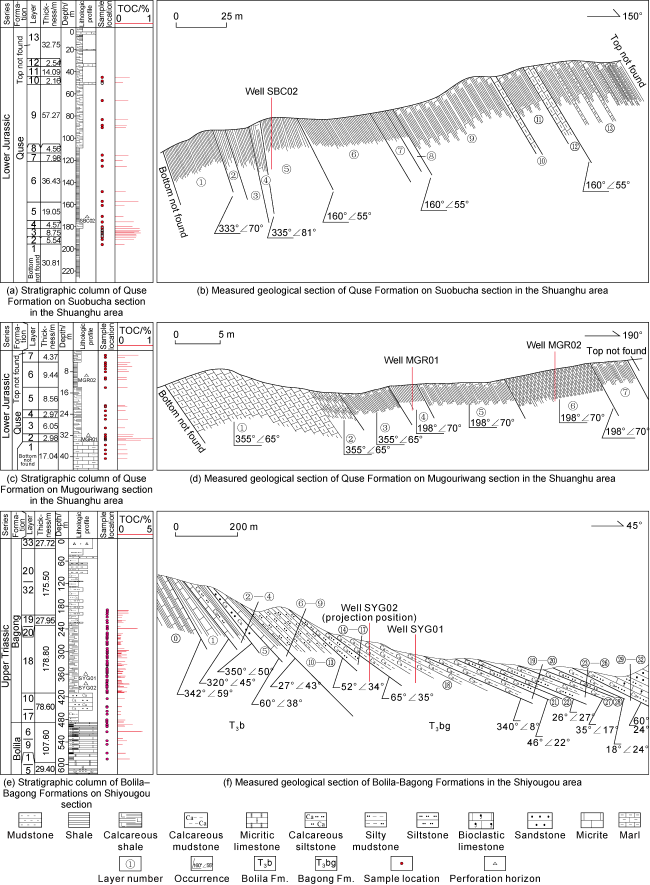


Fig. 5. Geological sections mapped through shallow wells and measurements in Biluocuo and Shiyougou areas. |
Well MGR01 is deployed to target the black shale of the Quse Formation on the Mugouriwang section 30 km southwest of Biluocuo in the South Qiangtang Depression (Fig. 5c ). As the stratum is nearly vertical, the drilled rock is the shale of the same layer 4 on the section (Fig. 5d ). Well MGR01 corresponds to a designed depth of 75 m and the actual total depth of 79.4 m. When drilling at 20-70 m, oil flecked liquid was discharged with clean water circulation liquid, and increased with the well depth. When the well was drilled to a depth of 50 m, 500 g oil flecked liquid was collected. After the oil flecked liquid was put on the rock surface to dry, it could be ignited, with a strong kerosene smell, confirming as oil seep. The oil seep contains saturated hydrocarbon (85.56%), aromatic hydrocarbon (1.55%), asphaltene (1.57%), and non-hydrocarbons (10.32%). The shales generating the oil seep exhibit the Ro of 1.25% averagely, which is proved to be mature light oil.
Well SYG01 is deployed to target the black shale in the lower part of the Bagong Formation and laminated carbonate rock intercalated with black shale in the Bolila Formation on the Shiyougou section in the Shiyougou area of the North Qiangtang Depression (Fig. 5e ), and it is perforated in the lower part of the Bagong Formation (equivalent to layer 18 on the section) (Fig. 5f ). Well SYG01 corresponds to a designed depth of 200 m and the actual total depth of 252 m, encountering 90 m in the Bagong Formation and 162 m in the Bolila Formation. When drilling at 50-90 m in the Bagong Formation, oil flecked liquid was discharged with clean water circulation liquid, and increased with the well depth. When drilling to the well depth of 80 m, 1000 g oil flecked liquid was collected. After the oil flecked liquid was put on the rock surface to dry, it could be ignited, with a strong kerosene smell, confirming as oil seep. The oil seep contains saturated hydrocarbon (94.13%), aromatic hydrocarbon (3.51%), asphaltene (0.12%) and non-hydrocarbons (2.25%). The shales generating the oil seep exhibit the Ro of 1.32% averagely, which is proved to be mature light oil.
Well SYG02 is deployed 2 km southwest of Well SYG01 in the Shiyougou area of the North Qiangtang Depression, targeting the shale in the lower part of the Bagong Formation (Fig. 5e ), and perforating at the horizon equivalent to layer 18 on the section (Fig. 5f ). Well SYG02 corresponds to a designed depth of 50 m and the actual total depth of 52.1 m. When drilling at 20-50 m, a great deal of oil seeps were observed in the clean water circulating fluid. When the well was completed, 1000 g oil flecked liquid was collected. After the oil flecked liquid was put on the rock surface to dry, it could be ignited, with a strong kerosene smell, confirming as oil seep. The oil seep contains saturated hydrocarbon (88.98%), aromatic hydrocarbon (4.73%), asphaltene (0.56%) and non-hydrocarbons (5.73%), with the oil density of 0.86 g/cm3. The shales generating the oil seep exhibit the Ro of 1.34% averagely, which is proved to be highly mature light oil.
The average content of chloroform asphalt ‘A’ and adsorbed hydrocarbon content (S0+S1) of laminated organic-rich shales in the Quse Formation in the Biluocuo and Shenglihe areas and the Bagong Formation in the Shiyougou area are both high, showing a significant positive correlation with TOC values. The adsorbed hydrocarbon content (S0+S1) of the laminated organic-rich shale in the lower part of the Quse Formation (layers 4-8 on the outcrop section, 64-122.9 m, as shown in Fig. 4 ) in the Biluocuo area is 1.30-6.62 mg/g (averaging 2.64 mg/g), and the chloroform asphalt ‘A’ content is 0.54%-1.12% (averaging 0.66%). The organic-rich shales in the upper parts of Wells BK-1, BK-2, BK-3 and BK-4 have the thickness of 35, 45, 75 and 60 m, and the chloroform asphalt ‘A’ content of 1.15%, 1.50%, 1.76% and 2.33% max. or 0.75%, 0.80%, 0.68% and 1.25% on average, respectively. The adsorbed hydrocarbon content (S0+S1) is 4.61, 3.70, 6.62 and 6.46 mg/g max. or 1.61, 2.02, 2.12 and 3.17 mg/g on average, respectively. In Wells SBC02 and MGR01, where oil seeps were found from the middle part of the Quse Formation (layers 9-10 on the outcrop section, 45 m and 50 m thick respectively, as shown in Fig. 5a -5d), the organic-rich shale in the middle part of the Quse Formation has lower TOC than the lower part (layers 4-8 on the outcrop section), but shows the adsorbed hydrocarbon content (S0+S1) of 1.19-1.85 mg/g (averaging 4.49 mg/g) and the chloroform asphalt ‘A’ content of 0.16%-0.25% (averaging 0.20%), both exceeding the lower thresholds (1 mg/g and 0.10%). The oil content of the laminated organic-rich shale in the lower part of the Quse Formation is higher.
Due to limited length of the exploratory trench, the regional strata tracing analysis was performed on the laminated organic-rich shale of the Quse Formation in the Shenglihe area, suggesting that the shale is located in the lower part of the Quse Formation (equivalent to layers 4-8 on the outcrop section in the Biluocuo area). The adsorbed hydrocarbon content (S0+S1) of the shale is 4.35-6.14 mg/g (averaging 4.89 mg/g). The highest oil content of oil shale is 16.3%, and the chloroform asphalt ‘A’ content is 0.25%-2.16% (averaging 1.26%). The oil shale in the exploratory trench has oil smell. When it was put in water, oil seeps floated on the water surface. The oil shale could be directly ignited. The oil content is higher than that of the laminated organic-rich shale in the lower Quse Formation in the Biluocuo area.
The laminated organic-rich shale of the Bagong Formation on the outcrop section in the Shiyougou area is 206.70 m thick, and mainly located in layers 18-20 in the middle-lower part of the section (Fig. 5e , 5f ). In Wells SYG01 and SYG02, the average chloroform asphalt ‘A’ content is 0.38% and 0.33%, and the average adsorbed hydrocarbon content (S0+S1) is 1.84 mg/g and 1.78 mg/g, respectively, all higher than lower thresholds (0.10% and 1 mg/g). This confirms that the laminated organic-rich shale of the Bagong Formation is rich in shale oil. The adsorbed hydrocarbon content (S0+S1) and chloroform asphalt ‘A’ content of the organic-rich shale of the Bagong Formation in the Shiyougou area are lower than those of the Quse Formation in the Biluocuo and Shenglihe areas, which may be attributed to two aspects. First, the TOC value of the organic-rich shale of the Bagong Formation is generally lower than that of the Quse Formation, resulting in a relatively low residual hydrocarbon content in the shale. Second, the source rock of the Bagong Formation has a higher maturity than the Quse Formation, and contains lower density of shale oil, leading to the easier escape of adsorbed hydrocarbon (S0+S1).
4.2. Significance of discovery of marine shale oil in Qiangtang Basin
The United States is the first country in the world to realize commercial development of marine shale oil, the production of which is estimated to reach 5×10⁸ t in 2025, accounting for two-thirds of the country’s total oil production [18-19]. In China, the marine shales in the Tarim, Sichuan and Ordos basins are no longer qualified for shale oil formation due to the high degree of thermal evolution, but have contributed major discovery of shale gas. Commercial development of shale gas has been achieved in the Weiyuan and Luzhou blocks in the south and the Jiaoshiba block in the east of the Sichuan Basin[20]. In contrast, shale oil exploration is only performed in the Mesozoic and Cenozoic continental shales in Songliao, Ordos, Junggar, Bohai Bay, Sichuan and other basins [21⇓⇓-24]. Compared with continental shale oil in China, marine shale oil in the United States has the characteristics of very thick and broad sweet spots in shales, good oil layer continuity, highly mature source rock, high content of brittle minerals, good reservoir quality, easy fracturing, etc. [26-27]. Although China's continental shale oil has witnessed some breakthroughs in exploration, it can only be developed commercially after many theoretical and technical problems are addressed.
The Mesozoic in the Qiangtang Basin is one of the most promising strata in China to accumulate marine shale oil, which may fill the gap in China’s marine shale oil exploration. Most indicators of organic-rich shales in the Quse Formation and Bagong Formation are no less than those of marine shale oil plays in North America, and the organic abundance of the Quse Formation shale is even better. Two shallow wells in the Quse Formation in the Biluocuo area and two shallow wells in the Bagong Formation in the Shiyougou area revealed oil seeps when they were drilled in organic-rich shales, which confirms that the Qiangtang Basin has marine shale oil, and is an important option for searching marine shale oil. It is considered that the shale of the Quse Formation in the Biluocuo area has the best potential for shale oil exploration, followed by the Bagong Formation in the Shiyougou Formation; the oil shale of the Quse Formation in the Shenglihe area is characterized by thin single layer and low maturity.
5. Conclusions
Two sets of marine organic-rich shales, the Lower Jurassic Quse Formation and the Upper Triassic Bagong Formation, are developed in the Mesozoic of the Qiangtang Basin, with proved potential of shale oil exploration. They are both composed of shale with laminated sedimentary structure and mudstone with massive sedimentary structure. The laminated shale in the Quse Formation is located in the lower part of the formation, with a thickness of 50-75 m, distributed in the South Qiangtang and the central-western part of the North Qiangtang. The laminated shale in the Bagong Formation is located in the middle part of the formation, with a thickness of 250-350 m, distributed in both the north and south Qiangtang Depressions. The laminated shales in the Quse Formation and Bagong Formation have well-developed micro-pores and micro-fractures. The micro-pores include intergranular/intercrystalline pores, dissolution micro-pores, organic pores, biological cavity pores and pyrite moldic pores. The micro-fractures include bedding and structural fractures. The content of brittle minerals is 55%-85%, suggesting a high fracturability. The organic-rich shale of the Quse Formation in the Biluocuo area has high TOC value, large hydrocarbon generation potential, and Type II 1 and Type II 2 organic matters in medium-high mature stage. The organic-rich shale of the Bagong Formation in the Shiyougou area has moderate TOC value, and hybrid organic matters in a high-over mature stage. The two sets of laminated organic-rich shales have high chloroform asphalt ‘A’ content, high free hydrocarbon content (S1), and high oil content. Two shallow wells in the Biluocuo area and two shallow wells in the Shiyougou area have revealed oil seeps in the organic-rich shales of the Quse Formation and Bagong Formation, respectively.
The discovery of Mesozoic marine shale oil and relevant geological knowledge in the Qiangtang Basin are of great significance for marine shale oil exploration in the basin beyond the previous practice that conventional petroleum and rich zones are explored preferentially than unconventional petroleum and poor zones.
Nomenclature
Ro—vitrinite reflectance, %;
S0—content of gaseous hydrocarbons in rock, mg/g;
S1—content of free hydrocarbons in rock, mg/g;
S2—content of pyrolytic hydrocarbons in rock, mg/g;
TOC—content of total organic carbon, %.