

Introduction
The Mahu Sag, an important hydrocarbon-rich sag in the Junggar Basin, has witnessed significant breakthroughs in oil and gas exploration in recent years, including the discovery of several oil reserve areas at the scale of hundred million tons in fault zones and slope areas, which form a framework of multi-layer oil bearing and multi-type oil accumulation. The Mahu Sag has been a hot and key area for oil and gas exploration [1⇓⇓⇓⇓-6]. The research on the types and sources of crude oil of the Mahu Sag is expected to have important guiding significance for further exploration. Previous researchers have done a lot of work on the types and origins of crude oil in Mahu Sag. The main point of view is that the crude oils are divided into three types: ascending, mountainous, and descending, according to the distribution of C20, C21 and, C23 tricyclic terpanes (TTs), which are believed to have originated from the source rocks of Permian Fengcheng Formation, Lower Wuerhe Formation and Jiamuhe Formation, respectively [7⇓⇓⇓-11]. On this basis, some scholars indicated that different types of crude oils come from different formations of source rocks [12⇓-14], or that crude oils mainly come from the source rocks of the Fengcheng Formation, but they have not delved into the underlying reasons [15⇓⇓-18]. The authors found that different types of crude oils are distributed in different formations in the Mahu Sag, with different types of crude oils also within the Fengcheng Formation. To clarify the exploration target of the three-dimensional oil-rich Mahu large oil province, it is urgent to re-understand the genesis and sources of different types of crude oils discovered in the Mahu Sag. Based on the geochemical parameters of crude oils and source rocks in different formations, and the results of thermal simulation experiments of hydrocarbon generation, combined with the geological background and previous researches, this paper presents a systematic classification of crude oil types and oil-source correlation, reveals the sources and distribution pattern of different types of crude oils in the Mahu larger oil province, and clarifies the genesis of different types of crude oil, aiming to provide important guidance for further three-dimensional oil and gas exploration in the Mahu Sag.
1. Geological setting
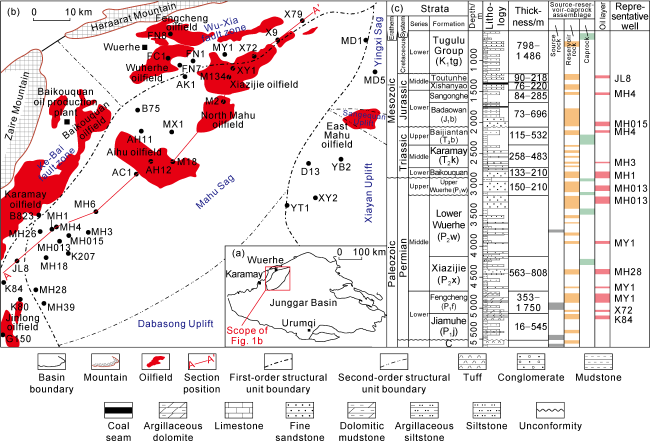
The Junggar Basin, located in the north of the Xinjiang Uygur Autonomous Region, is a large superimposed petroliferous basin in western China, with a total area of about 13×104 km2 (Fig. 1a ) [19-20]. The Mahu Sag, with an area of about 5×10³ km2, is located at the northwest edge of the Junggar Basin, as a southeast-dipping monocline with an inclination of 3°-5°, which is one of the most hydrocarbon-rich sags in the Junggar Basin. It neighbors the Wu-Xia fault zone and Ke-Bai fault zone to the northwest, the Yingxi Sag, Sangequan Uplift and Xiayan Uplift to the east, and the Dabasong Uplift to the south (Fig. 1b ) [14,21 -22]. From bottom to top of the strata in Mahu Sag, there developed the Carboniferous (C); the Permian Jiamuhe Formation (P1j), Fengcheng Formation (P1f), Xiazijie Formation (P2x), Lower Wuerhe Formation (P2w) and Upper Wuerhe Formation (P3w); the Triassic Baikouquan Formation (T1b), Karamay Formation (T2k) and Baijiantan Formation (T3b); the Jurassic Badaowan Formation (J1b), Sangonghe Formation (J1s), Xishanyao Formation (J2x) and Toutunhe Formation (J2t); the Cretaceous Tugulu Group (Kltg); the Paleogene; the Neogene; and the Quaternary (Fig. 1c ). Multiple sets of regional unconformities are recognized between Carboniferous and Permian, Lower Wuerhe Formation and Upper Wuerhe Formation, Permian and Triassic, Triassic and Jurassic as well as Jurassic and Cretaceous, etc. [23-24]. Multiple oil-bearing series, including the Lower Triassic Baikouquan Formation (T1b) and the Permian Upper and Lower Wuerhe Formation (P3w, P2w) mainly, are distributed in the Mahu Sag. Nearly 30×108 t of proven total oil reserves accumulated in the sag and its periphery. The main source rock is the Permian Fengcheng Formation, and the main cap rocks are thick argillaceous rocks of the Xiazijie Formation, Lower Wuerhe Formation, Baijiantan Formation and Tugulu Group (Fig. 1c ) [26]. This paper mainly focuses on the Mahu large oil province, including multiple sets of source rocks and oil-bearing series.
2. Source rocks
2.1. Distribution of main source rocks
Four sets of potential source rocks in the Mahu Sag are developed in the Carboniferous, Lower Permian Jiamuhe Formation, Lower Permian Fengcheng Formation and Middle Permian Lower Wuerhe Formation (Fig. 2 ) [17,25,27 -28]. Among them, the source rocks of the Lower Wuerhe Formation are widely distributed (Fig. 2a ) and dominated by dark gray-black mudstone and carbonaceous mudstone, with a thickness ranging from 0 to 150 m and increasing from north to south. The source rocks of the Fengcheng Formation are the oldest alkali lake source rocks discovered so far and the main set of source rocks in the Mahu Sag. The high-quality source rocks cover an area of about 3800 km2, with a thickness of 50-300 m (Fig. 2b ), and are dominated by argillaceous dolomite and dolomitic mudstone, which are mainly distributed in northern Mahu Sag [1,25]. The Jiamuhe Formation and Carboniferous source rocks are similar in distribution, with an overall characteristic of being thick in the northwest and thin in the southeast. The source rocks of the Jiamuhe Formation are mainly mudstone and tuffaceous mudstone, with a thickness of 25-250 m (Fig. 2c ). The Carboniferous mudstones are mainly concentrated in the northwest margin, with a thickness of 0-200 m (Fig. 2d ).
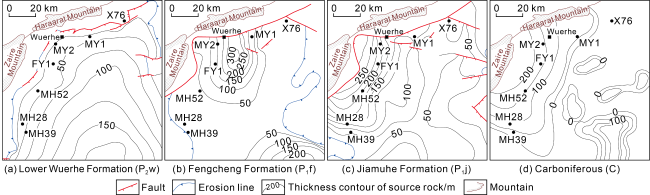
Fig. 2. Thickness distribution map of source rocks in different formations of Mahu Sag, Junggar Basin (modified from Ref. [12]). |
2.2. Organic geochemistry
According to total organic carbon (TOC) and pyrolysis (Rock-Eval) parameters of source rocks, the relationships of TOC vs. hydrocarbon generation potential (S1+S2), Tmax vs. hydrogen index (HI), Tmax vs. depth, and Ro vs. depth were plotted respectively to analyze the organic matter abundance, type, and maturity of source rocks in different formations in the Mahu Sag (Fig. 3 ). The results show that TOC and hydrocarbon generation potential (S1+S2) of source rocks have a good linear relationship (Fig. 3a ), which reflects that the organic matters of source rocks in the same formation are relatively stable, but those in different formations are greatly variable in organic matter abundance and type. Generally, according to TOC and (S1+S2), source rocks are classified as poor, moderate, good, and excellent, with TOC content limits of 0.5%, 1.0%, and 2.0%, and (S1+S2) value limits of 2, 6 and 20 mg/g, respectively. The Fengcheng Formation source rocks are moderate to good in terms of TOC or S1+S2. The Carboniferous, Jiamuhe Formation, and Lower Wuerhe Formation source rocks are primarily good to excellent for significantly higher TOC than that of the Fengcheng Formation, but poor to good in view of (S1+S2). The Fengcheng Formation source rocks are generally moderate to good for TOC, which is higher (S1+S2) than other formations with the same TOC (Fig. 3a ), indicating that the Fengcheng Formation source rocks have a much higher hydrocarbon generation capacity than others. The relationship between Tmax and HI indicates that the Fengcheng Formation source rocks mainly contain Type II and Type I organic matters with excellent oil generation capacity, whereas the source rocks in other formations mostly possess Type III organic matters (and Type II2 in some Carboniferous samples) (Fig. 3b ), suggesting that they are gas-prone with weak oil generation capacity. The Tmax and Ro of source rocks enhance with increased depth (Fig. 3c , 3d), and most of the four sets of source rocks are in the thermal mature stage, and the source rocks of the Carboniferous even reach the high mature stage. The source rocks of the Fengcheng Formation in Mahu Sag have high hydrocarbon (mainly oil) generation capacity, while the source rocks of other formations have low hydrocarbon generation capacity-gas-prone rather than oil-prone.
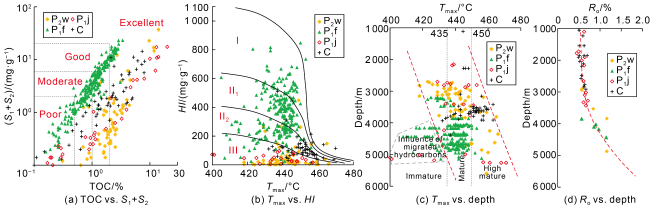
Fig. 3. Geochemical characteristics of source rocks in different formations of Mahu Sag, Junggar Basin ( |
2.3. Biomarkers
The comparison diagram of gas chromatography and mass spectrometry (GC-MS) of saturated hydrocarbons from the source rocks in the study area (Fig. 4 ) displays that there are obvious differences in the characteristics of biomarkers of source rocks in different formations. For the source rocks of the Lower Wuerhe Formation, which are mainly composed of mudstone and carbonaceous mudstone, the total ion chromatogram (TIC) is obviously bimodal, mostly with the post-peak dominance, and high Pr/Ph ratio (greater than 2.5 for most samples); the relative content of TTs is apparently low, the relative contents of Tm, C29 and C31 hopanes are high, and the contents of Ts and C35 hopanes are extremely low; the C27-C28-C29 regular steranes show a "√" shape, indicating C29 steranes dominance (Fig. 4a ). Overall, the source rocks of the Lower Wuerhe Formation are characterized as coal- measure or carbonaceous mudstone. The source rocks of the Fengcheng Formation are mainly mudstones and dolomitic mudstones, which are characterized by obvious dominance in β-carotane and gammacerane contents, indicating a high salinity sedimentary environment; the relative content of steranes is significantly high; the C20, C21, and C23 tricyclic terpeanes distribute in an ascending pattern, and their relative contents are controlled by the maturity; the C27-C28-C29 regular steranes exhibit an ascending pattern (Fig. 4b ). The Jiamuhe Formation and Carboniferous source rocks in the study area have been drilled only by few wells (e.g. Well FC1 for the former, and Well YT1 for the latter). The biomarker characteristics of the Jiamuhe Formation source rock are similar to that of the Fengcheng Formation, with obvious dominance in β-carotane and gammacerane, and C20, C21, and C23 TTs in ascending and mountainous patterns and C27-C28-C29 regular steranes in ascending pattern (Fig. 4c ). However, it is not representative due to the small number of samples. The Carboniferous source rocks vary greatly in biomarker characteristics, with C20, C21, and C23 TTs in both ascending and descending patterns, and the β-carotane content and C27-C28-C29 regular sterane distribution pattern varying greatly (Fig. 4d ), indicating that they may be affected by the migrated hydrocarbons.
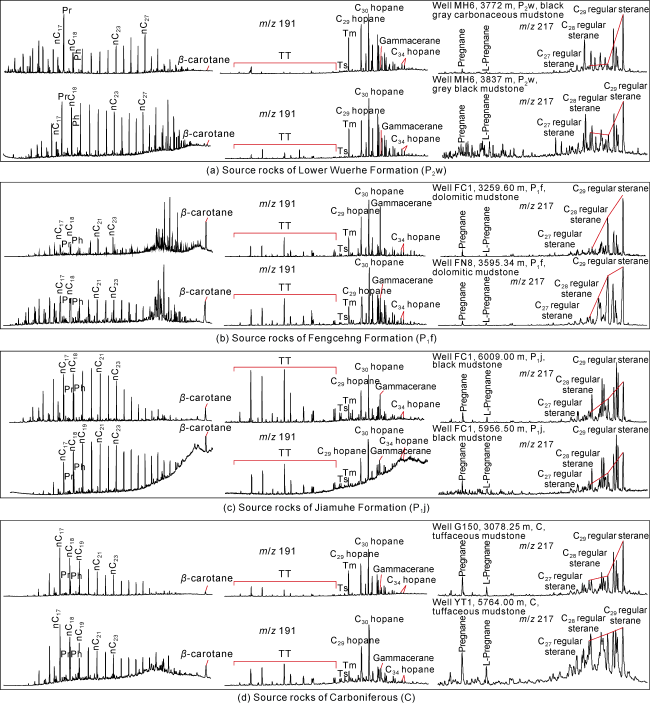
Fig. 4. GC-MS comparison of saturated hydrocarbons of source rocks of different formations in Mahu Sag, Junggar Basin. |
3. Distribution and sources of three types of oil
3.1. Spatial distribution
There are several sets of oil-bearing series in the Mahu Sag, mainly including the Permian Fengcheng Formation (P1f) and Upper Wuerhe Formation (P3w), the Triassic Baikouquan Formation (T1b) and Karamay Formation (T2k), etc. Previous scholars have done a lot of work on the classification of oil types in the Mahu Sag [7⇓-9,11 -12], mainly based on the distribution of C20, C21, and C23 TTs as indicators for classifying oil types and identifying oil sources. This paper collected GC-MS information on saturated hydrocarbon of oils from different formations in the Mahu Sag. Based on the distribution of C20, C21, and C23 TTs, oils in the Mahu Sag are systematically classified. Moreover, the plane distribution diagram of oils in the main oil-bearing series in the Mahu Sag is mapped, to clarify the spatial distribution pattern of oil types.
The characteristics of the oil biomarkers in the Mahu Sag are generally similar, including no significant baseline drift and obvious pre-peak characteristics in the TIC, the obvious dominance of β-carotane and gammacerane contents, and the C27-C28-C29 regular steranes in ascending pattern (Fig. 5 ). The main differences are reflected in the distribution and relative contents of C20, C21, and C23 TTs, the relative content of β-carotane, and the sterane isomerization parameters. According to the distribution of C20, C21, and C23 TTs, the oils in the Mahu Sag are divided into three types: A, B, and C (Fig. 5 and Table 1 ). Type A oil shows C20, C21, and C23 TTs in ascending patterns, a low relative content of TTs (basically lower than C30 hopance), a high relative content of β-carotane, and low sterane isomerization parameters, indicating that the maturity of Type A oil is relatively low. Type C oil exhibits C20, C21, and C23 TTs in descending or cancave patterns, a high relative content of TTs (much higher than C30-hopane), a low relative content of β-carotane, and high sterane isomerization parameters, indicating that the maturity of Type C oil is high. Type B oil demonstrates C20, C21, and C23 TTs in a mountainous pattern, a varying relative content of TTs, and the relative content of β-carotane and sterane isomerization parameters between those of types A and C oils, indicating that the maturity of Type B oil is between Type A and Type C.
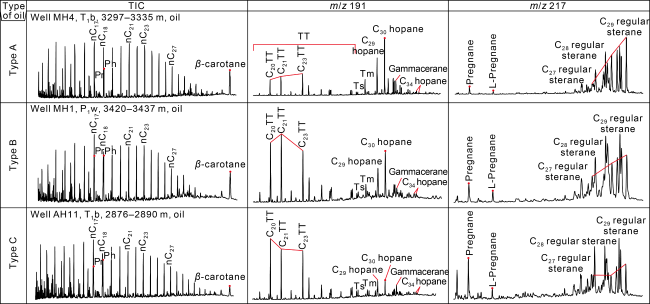
Fig. 5. Classification of oil types in Mahu Sag, Junggar Basin. |
Table 1. Classification of oil types in Mahu Sag, the Junggar Basin |
| Type of oil | Distribution pattern of TTs | β-carotane/ n-Cmax | Gammacerane/ C30-hopane | ββ/(αα+ββ)- C29-sterane | TT/ (TT+C30-hopane) | Distribution location |
|---|---|---|---|---|---|---|
| A | Ascending | 0.29-4.86 1.38 | 0.30-0.80 0.59 | 0.18-0.58 0.46 | 0.15-2.09 0.72 | Edge of the sag |
| B | Mountainous | 0.05-1.54 0.47 | 0.33-0.59 0.49 | 0.49-0.65 0.58 | 0.63-4.49 1.50 | Slope area |
| C | Descending | 0.12-0.50 0.34 | 0.31-0.82 0.40 | 0.57-0.73 0.65 | 1.23-7.45 2.67 | Inner of the sag |
Note: The numerator represents the numerical range, while the denominator represents the average value. |
The plan distribution maps of the different types of crude oil from the main oil-bearing strata (Fengcheng Formation, Lower Wuerhe Formation, Upper Wuerhe Formation, Baikouquan Formation and Karamay Formation) in the Mahu Sag show (Fig. 6 ) that Type A, Type B and Type C oils are orderly distributed in turn from the edge to the inner of the sag. Furthermore, the spatial distribution of oils has an obvious inheritance. Type A oil is distributed in almost all formations and mainly at high positions of the South Mahu slope and the North Mahu, closer to the edge of the sag (Fig. 6 ). Type B oil is also widely distributed in multiple formations, but limited in the plane, mainly in the South Mahu slope, closer to the inner of the sag than Type A oil (Fig. 6a -6d). Type C oil is mainly distributed in the Baikouquan Formation (T1b) and Karamay Formation (T2k) (Fig. 6d , 6e), especially in the central area of the Mahu Sag, with a large distribution range.
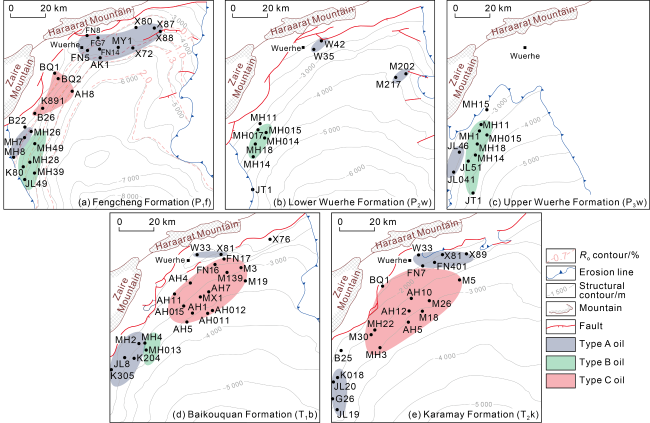
Fig. 6. Plane distribution of oils in main formations in Mahu Sag, Junggar Basin. |
3.2. Sources of oil and gas
3.2.1. Comparison of organic matter carbon isotopes
The carbon isotope of crude oil, extracts, and kerogen is an important parameter for oil-source correlation. Due to the influence of maturity and organic matter type of source rock, the high-maturity or humus-prone source rocks have relatively heavier carbon isotopes. The carbon isotope relationships of kerogen and extracts of source rock in different formations of Mahu Sag (Fig. 7a ) show that the carbon isotopic values of source rock kerogen in the Fengcheng Formation are less than −25.5‰, and that of extracts is less than −28‰, indicating that they belong to the Type II and Type I organic matters. The carbon isotope values of source rock kerogen in other formations are greater than −25.5‰, and that of extracts is greater than −28‰. It is thus inferred that the Fengcheng Formation source rocks are oil-prone, while the source rocks of other formations are mainly gas-prone. The carbon isotope comparison of crude oil and source rock extracts in different formations in Mahu Sag displays (Fig. 7b -7f) that the carbon isotopic compositions of oil, ranging from −31.6‰ to −28.3‰, are well correlated with the carbon isotopic compositions of extracts of the Fengcheng Formation source rocks, but differ greatly from that for other formations (mostly greater than −28‰). This indicates that oils in different formations of the Mahu Sag mainly come from the source rocks of the Fengcheng Formation.
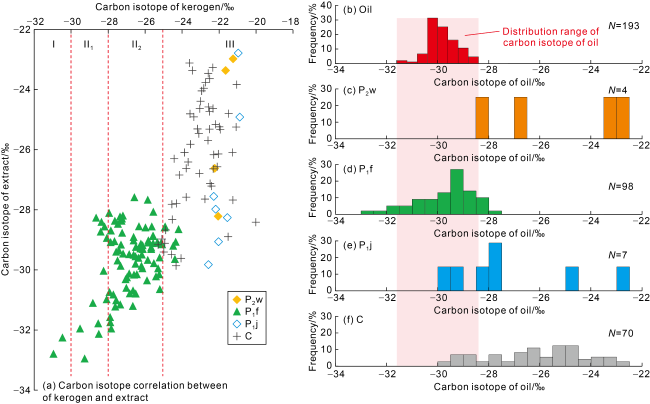
Fig. 7. Carbon isotopic compositions comparison between oil and source rocks from different formations in Mahu Sag, Junggar Basin (N is the number of samples). |
3.2.2. Comparison of biomarker parameters
In addition to carbon isotopes, biomarker parameters are also one of the important methods for oil-source correlation. Fig. 8 contains the different biomarker parameters cross plots of crude oil and source rock in different formations, including Pr/Ph vs. β-carotane/n-Cmax, Pr/Ph vs. gammacerane/C30-hopane, and (C19TT+C20TT)/C23TT vs. C24TeT/C26TT. It can be seen that the Fengcheng Formation source rocks were deposited in an anoxic reducing and high-salinity water environment, dominated by algae input. The source rocks of the Upper Wuerhe Formation were mainly deposited in weak reducing-weak oxidizing brackish to freshwater environment, dominated by higher plant input. The Jiamuhe Formation source rocks reflect similar characteristics to those of the Fengcheng Formation, which are not representative due to a small number of samples. The Carboniferous source rocks were deposited in a greatly varying water environment, dominated by higher plant input. The biomarker parameters of oil samples in Mahu Sag generally overlap with that of the Fengcheng Formation but differ from other formations (Fig. 8 ), which further indicates that oils in the Mahu Sag mainly come from the source rocks of the Fengcheng Formation.
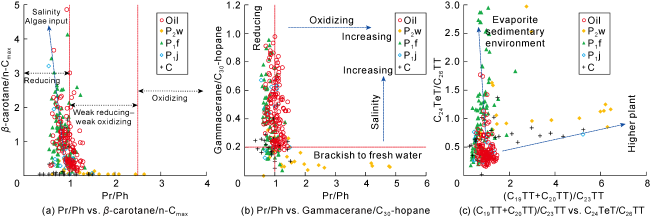
Fig. 8. Biomarker parameter correlation between oil and source rocks from different formations in Mahu Sag, Junggar Basin. |
Based on the above analysis of source rocks with respect to thickness, hydrocarbon generation potential, carbon isotopes, and biomarkers, combined with the geochemical and geological distribution characteristics of oil, it is believed that oils in different formations of the Mahu Sag mainly come from the source rocks of the Fengcheng Formation. First of all, the Fengcheng Formation serves as both a high-quality source rock and a good oil & gas accumulation layer. Oils discovered in the Fengcheng Formation show that there are three types of oil: A, B, and C (Fig. 6a ), which rejects the understanding that different types of oils come from source rocks of different formations. Secondly, although the Fengcheng Formation source rocks have lower TOC than other formations, but with large thicknesses, high HI and hydrocarbon generation potential, and the dominance of types II and I organic matters, suggesting a strong oil generation capacity. By contrast, the source rocks in other formations have relatively high TOC, but poor hydrocarbon generation potential, and the dominance of Type III organic matter, indicating gas-prone rather than oil-prone (Fig. 3 ). The Mahu Sag has multiple sets of oil-bearing series and nearly 30×108 t of proven total oil reserves accumulated in and around the sag. Only the source rocks of the Fengcheng Formation with large thickness and strong oil generation capacity can provide a large amount of crude oil. Finally, the carbon isotopes and biomarker parameters (Figs. 7 and 8 ) show that the oils in the Mahu Sag have a good correlation with the source rocks of the Fengcheng Formation, but differ greatly from the source rocks of other formations, which further verifies that the oils in the Mahu Sag mainly come from source rocks of the Fengcheng Formation.
4. Genesis and exploration significance of oil
4.1. Genesis analysis
Generally, the physical and geochemical properties of oil are mainly influenced by the organic matter type and maturity of source rocks. The above research shows that the crude oils in the Mahu Sag, including types A, B, and C crude oils, mainly come from the source rocks of the Fengcheng Formation. The characteristics of biomarkers in discovered source rock (Fig. 4 ) show that the distribution patterns of C20, C21, and C23 TTs of the Fengcheng Formation source rocks are generally in ascending pattern, which is only similar to Type A oil. But further research shows that the differences between the three oil types may be mainly caused by thermal evolution.
As shown in Fig. 5 and Table 1 , the relative content of TTs and sterane isomerization parameters (e.g. ββ/(αα+ ββ)-C29-sterane) increase, and the content of β-carotene decreases, indicating a gradual increase in oil maturity. The same characteristics are found in the thermal simulation experiment of hydrocarbon generation of the Fengcheng Formation source rocks. In this study, thermal simulation experiments of hydrocarbon generation were performed on samples of the Fengcheng Formation source rocks from Well FN7 after water was added into a closed vessel at high temperature and high pressure. The samples, taken at a depth of 4595.5 m, are composed of gray argillaceous dolomite, with TOC of 0.7%, S1 value of 3.79 mg/g, and S2 value of 1.18 mg/g. The powder samples were extracted before the thermal simulation experiment due to the high content of free hydrocarbons, and then the extracted samples were subjected to experiments at different temperatures (310, 330, 350, 370 °C). In the experiment, 20 g sample and 20 mL water were added at the temperature rising at a rate of 2 °C/min to the set value, and then heated for 24 h. At the end of the experiment, the products at different temperatures were collected after the reactor cooled down to room temperature, and the GC-MS analysis of saturated hydrocarbons was conducted on pyrolysis oils generated at different temperatures. According to the experimental results (Fig. 9 ), with the increasing maturity (from 310 °C to 370 °C), the distribution patterns of C20, C21, and C23 TTs of the pyrolysis oils gradually change from ascending to descending pattern, and the relative content of TTs, the content of pregnane and sterane isomerization parameters also increase. This further confirms that different types of oils in the Mahu Sag come from the source rocks of the Fengcheng Formation with different maturity. It is worth noting that Type B oil (in mountainous pattern) is not discovered in this experiment, and the Fengcheng Formation source rocks neither. However, the analysis of the spatial distribution of Type B oil (Fig. 6 ) suggests that Type B oil is distributed in multiple formations with a small plane range, which is mainly in the South Mahu slope, lying between Type A and Type C oils. Also, Type B oil exhibits the maturity and biomarker characteristics between Type A and Type C oils (Table 1 ). Therefore, Type B oil is speculated to be a mixture of Type A and Type C oils.
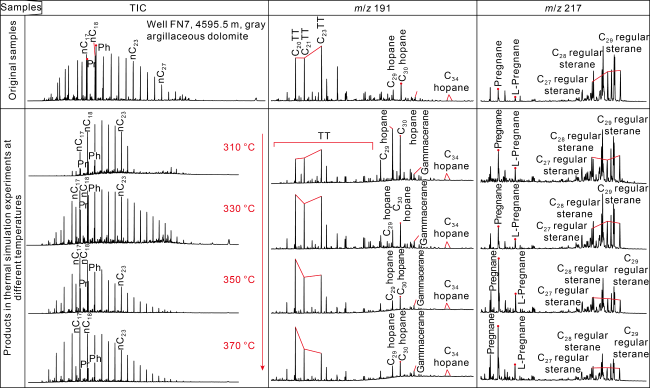
Fig. 9. Evolution characteristics of biomarkers of products in hydrocarbon generation thermal simulation experiments from Fengcheng Formation source rocks of Well FN7 in Mahu Sag, Junggar Basin. |
4.2. Spatial distribution patterns and exploration significance
The existing research shows that there are a large number of deep and large faults in the Mahu Sag, which were mainly formed in the Indosinian Period, corresponding to the peak oil generation period of the Fengcheng Formation source rocks in the sag. These faults, with large throws and fractures in direct connection with the source rocks, are good channels for oil and gas migration [10,30]. It can be seen in Fig. 10 that the source rocks of the Fengcheng Formation at the edge of the sag are relatively shallow with low maturity, mainly generating oil with low maturity. Therefore, Type A oil is mainly found at the edge of the sag (Fig. 6 ). Within the sag, the source rocks of the Fengcheng Formation are highly mature and mainly generate Type C oil, which migrated along the faults and multiple unconformities to and accumulate in the high-quality reservoirs of the Middle-Upper Permian-Triassic. Type B oil mainly appears in the slope area of the sag, which is a mixture of Type A and Type C oils. In general, the Mahu large oil province has a high hydrocarbon generation potential of source rocks, numerous faults and reservoirs, forming a typical source-fault-reservoir coupling and inner-source accumulation pattern (Fig. 10 ). It is thus speculated that a large amount of lighter Type C oil with higher maturity or natural gas may be endowed in the deep formations of the Mahu Sag. From the edge to the inner of the sag, Type A, Type B and Type C oils are orderly distributed, and the conventional oil reservoirs, tight oil reservoirs, and shale oil reservoirs are sequentially distributed within the Fengcheng Formation.
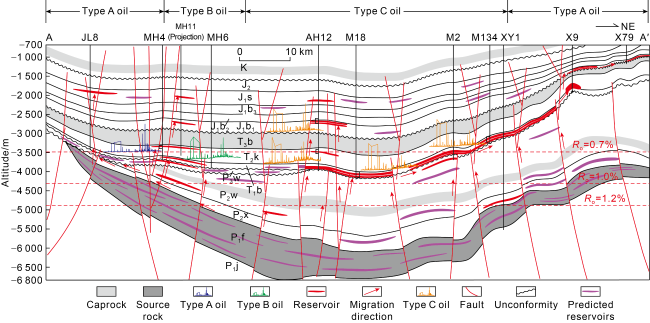


Fig. 10. Hydrocarbon accumulation pattern in Mahu large oil province, Junggar Basin (see |
The new understanding that different types of oils in the Mahu Sag come from the Fengcheng Formation source rocks in different maturity stages effectively explains the source and genesis of different types of oils, which is an objective view on Fengcheng Formation as the major set of source rocks in the Mahu Sag. It provides a new perspective for confirming the main contribution area of the Fengcheng Formation source rocks in different parts and at different depths, and studying the source-reservoir relationship for three-dimensional oil exploration in the Mahu Sag. It will play an important guiding role in predicting the distribution of oils with different properties and favorable exploration areas in the total petroleum system of the Mahu Sag.
5. Conclusions
There are four sets of potential source rocks in the Mahu Sag. The source rocks of the Fengcheng Formation are moderate to good in TOC content, with large thickness, high HI and hydrocarbon generation potential, and the dominance of types II and I organic matters, indicating a strong oil generation capacity. The source rocks of the Carboniferous, Jiamuhe Formation, and Lower Wuerhe Formation have relatively high TOC, but the dominance of Type III organic matter, indicating gas-prone rather than oil-prone.
According to the distribution of C20, C21, and C23 TTs, oils in the Mahu Sag are divided into types A, B, and C. The distribution of C20, C21, and C23 TTs of Type A, Type B and Type C oils present ascending, mountainous and descending patterns in turn, the relative contents of TTs and sterane isomerization parameters (e.g. ββ/(αα+ββ)- C29-steranes) gradually increase, and the β-carotane content gradually decreases, indicating that the maturity of oil gradually increases.
Different types of oils are obviously orderly and inherited in spatial distribution. Type A oil is widely distributed in multiple formations, mainly at high positions of the South Mahu slope and the North Mahu Sag, closer to the edge of the sag. Type B oil is also widely distributed in multiple formations, but limited in plane, mainly in the South Mahu slope. Type C oil is mainly concentrated in the central area of Mahu Sag, with a large distribution range.
The results of oil-source correlation and thermal simulation experiments show that types A and C oils of different formations in the Mahu Sag come from the source rocks of the Fengcheng Formation in different maturity stages, while Type B oil is a mixture of types A and C oils. The Mahu Sag follows a typical source-fault-reservoir coupling and inner-source accumulation model. It is thus speculated that a large amount of lighter Type C oil with higher maturity or natural gas may be endowed in the deep formations of the Mahu Sag. From the edge to the inner of the sag, types A, B and C oils are orderly distributed, and the conventional oil reservoirs, tight oil reservoirs, and shale oil reservoirs are sequentially distributed within the Fengcheng Formation.
The oil-source correlation analysis considers first the carbon isotopes of oil, extract and kerogen, and then the characteristic parameters of oils from the Fengcheng Formation source rocks, such as gammacerane/C30-hopane, β-carotane/n-Cmax, and (C19TT+C20TT)/C23TT. In addition, it is also crucial to identify whether the source rocks are affected by migrated hydrocarbons.
Nomenclature
HI—hydrogen index, mg/g;
Ro—vitrinite reflectance, %;
S1—free hydrocarbon content in rock, mg/g;
S2—pyrolysed hydrocarbon content in rock, mg/g;
Tmax—maximum pyrolysis peak temperature of rock, °C;
TOC—total organic carbon, %.