

Introduction
With the decreasing of middle-shallow hydrocarbon resources, deep carbonate reservoirs (deeper than 4500 m) have become important oil and gas exploitation targets[1⇓⇓⇓-5]. Since most primary pores have been lost in the deep pre-Mesozoic carbonate rock by long and complex burial diagenesis, secondary dissolution pores dominate the reservoir space in the deep subsurface. Deep carbonate reservoirs show strong heterogeneity and complicated distribution [5⇓⇓-8], and they are quite different from the widely distributed microfacies-controlled carbonate res-ervoirs in middle-shallow Meso-Cenozoic. The origin and distribution of secondary pores in deep carbonate reservoirs are more complex and result in variable and complicated oil and gas production behaviors [1-2,5⇓⇓⇓⇓ -10], which cannot be exploited by uniform well pattern [8,10]. This is a substantial challenge that hinders the efficient exploration and development of deep reservoirs.
Numerous studies have investigated the main controlling factors on the development of high-quality deep carbonate reservoirs, such as sedimentary facies, karstification, dissolution and dolomitization, and proposed a series of exploration and development theories and techniques [2⇓⇓-5,8,10]. These efforts have supported the oil/gas exploration and development of reef-shoal, weathering crust and dolomitic reservoirs. Furthermore, the faulting effect on deep tight carbonates has attracted more attention. Fault-controlled carbonate reservoirs, including fractured and fracture-related reservoirs [2,11⇓⇓ -14], have become important “sweet spot” (high-porosity high-permeability fractures and vugs) targets in deep carbonate reservoirs [13-14]. In recent years, a deep strike-slip fault- controlled petroleum system with an area of 9×10⁴ km2 was found in the central Tarim Basin [15-16]. A series of strike-slip faults related fracture-cave reservoir models have been proposed in the Ordovician limestone [12⇓⇓⇓⇓⇓-18]. The largest deep strike-slip fault-controlled oilfield in China was discovered with oil geological reserves more than 1 billion tons and annual oil production exceeding 500×104 t from the fracture-cave reservoirs [14,16]. However, the origin and distribution of the deep strike-slip fault- controlled carbonate reservoirs are too complex [5,7 -8,12⇓⇓⇓⇓ -17] to understand their main controlling factors, forming period and the faulting effect. The complexity of hydrocarbon accumulation, distribution and production performance in deep strike-slip fault-controlled reservoirs renders conventional technologies ineffective [19-20], as they can only identify large fracture-cave reservoirs [13⇓⇓-16].
It is also very complex in the distribution of deep Ediacaran-Lower Paleozoic dolomite reservoirs and natural gas in the Sichuan Basin, which has experienced more than 60 years of arduous exploration since the discovery of Weiyuan Gasfield [21-22]. With deeper understanding and technical advance, the Anyue gas field was discovered in the deep Ediacaran-Cambrian strata around Deyang- Anyue rift trough of the central uplift in 2011. A large layered microfacies-controlled reservoir model has been proposed that the gas accumulation is controlled by four-elements of “paleo-rift, paleo-uplift, paleo-mound- shoal and paleo-erosion surface” [21⇓⇓-24]. With proven gas geological reserves exceeding 1×10¹² m3, the Anyue gas field has become the largest carbonate gasfield in China. In recent years, the Ediacaran Dengying Formation dolomite reservoirs in Anyue gas field have been put into development, and become the target for increasing reserves and production in the Sichuan Basin. Previous studies [24⇓-26] generally suggest that high-energy mound- shoal microfacies controls the development and distribution of the dolomite reservoirs in the platform margin and intraplatform. However, the Ediacaran mound-shoals are mainly of low porosity-permeability reservoirs and resulted in numerous low-yield wells that cannot be efficiently developed by conventional methods and techniques. Recent studies suggest that karstification plays a significant role in the Ediacaran dolomite reservoir and controls the high-quality reservoir distribution alongside mound-shoal microfacies[26⇓⇓⇓-30]. Karstic vuggy-reservoir has become the main drilling target, yielding remarkable achievements in the Ediacaran platform margin mound- shoals. Nevertheless, the poor reservoir property in the intraplatform has hampered the optimization of the high-production well block. Some wells also provide low gas production in the karstic platform margin, constraining the efficient development of the deep gas reservoirs [25].
Recently, some strike-slip faults have been identified in the central Sichuan Basin [31⇓⇓-34]. It is considered that strike-slip faults and their related fractures have increased the porosity and permeability of the Cambrian Longwangmiao Formation [31], acting as conduits connecting source and reservoir and improving reservoir quality and gas production in Anyue gas field [32]. Some studies argue that the sedimentary microfacies and karst paleogeomorphology control the development and distribution of reservoir in Anyue gas field, and the strike-slip faults can only improve the permeability and productivity [33]. The discovery of strike-slip faults provides a new idea for the efficient development of the deep tight reservoirs, but it is ambiguous on how the strike-slip faults control the reservoirs and whether there are large-scale fault-controlled “sweet spot” reservoirs. Current understandings are insufficient to guide well deployment in the strike-slip fault zone. In addition, it is difficult to describe the fractured reservoirs because of low-resolution seismic data in the deep basin. These factors restrict the evaluation of the strike-slip fault-controlled targets in Anyue gas field.
Based on the analysis of strike-slip faults in Anyue gas field, this paper reinvestigates the well data in the strike- slip fault zone, compares fractured reservoirs with matrix reservoirs, and examine the relationship between strike-slip faults and reservoir porosity, permeability and production. By considering the data of horizontal wells through the strike-slip fault zone, we discuss how the strike-slip faults impact the ancient dolomite reservoir and provide the fault-controlled reservoir model in high-efficient wells. This study is of significant implication for the exploration and development of the strike-slip fault-related “sweet spot” reservoirs in the deep tight reservoirs.
1. Geological setting
The Sichuan Basin is located at the northwest of the Yangtze Plate (Fig. 1a ), with an area of about 18×104 km2. It is a superimposed basin with relatively complete Ediacaran-Quaternary sedimentary strata, and has undergone multi-stage tectonic-sedimentary evolution [35⇓-37]. On the pre-Ediacaran metamorphic basement, a nearly N-S trending Deyang-Anyue Ediacaran rift trough was developed under the influence of W-E trending regional extension [37], resulting in the platform-trough architecture of the Dengying Formation. The carbonate sedimentary system of the Dengying Formation is widely widespread on the platform (Fig. 1 ). The Tongwan Movement occurred before the Cambrian deposition, resulting in the Cambrian/Precambrian unconformity widely distributed in the Sichuan Basin. The Deyang-Anyue rift trough inherited the development during the Early Cambrian, but it was gradually filled and disappeared during the late sedimentary period of the Qiongzhusi Formation. Then the carbonate platform began to form across the cratonic basin [21-22,36]. Influenced by the Caledonian-Hercynian tectonic movement, a broad and gentle paleo-uplift emerged in the central basin [35⇓-37]. The Ordovician-Carboniferous gradually pinched out from the periphery to the center of the paleo-uplift. The final shape of the uplift was not completed until the Permian. Since then, it has remained a stable paleo-uplift. Hydrocarbon accumulation conditions are favorable in the central paleo-uplift with Dengying Formation carbonate reservoir in platform margin and intraplatform mound-shoal reservoir, along with widely distributed high-quality source rocks of the Lower Cambrian Qiongzhusi Formation [21⇓⇓-24].
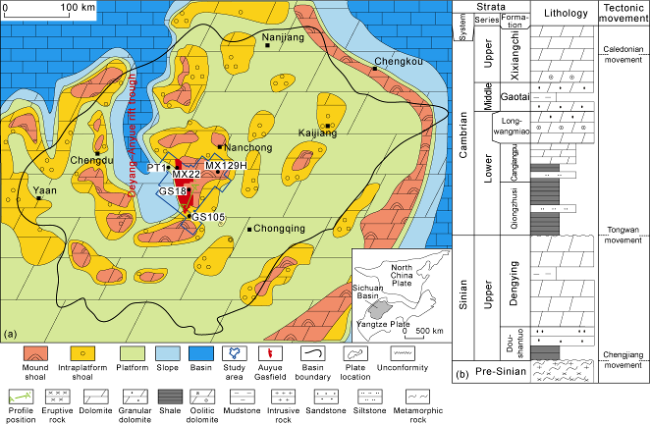
The Anyue gas field is situated within a large structural trap of the central paleo-uplift in the central Sichuan Basin. The key target layers include the Deng 4 and Deng 2 members, Lower Cambrian Longwangmiao Formation and the Permian [25]. The Deng 4 Member is a key development layer with the proven geological reserves of 5900×108 m3 at depths of 5000-5500 m. It constitutes deep structural gas reservoirs characterized by high temperature, normal pressure and bottom water setting. The dolomite reservoir in the Deng 4 Member of mound-shoal microfacies on the platform margin has been fully put into development, and now extending into the intraplatform shoals. The reservoirs exhibit an average porosity of less than 4%, and permeability of less than 1×10⁻³ μm2. The reservoir contains more than 10 layers, each a few meters thick, and distributed over a large range of 350 m in the upper carbonate rocks. The high-quality fracture-vuggy reservoirs, featuring relatively high-porosity (more than 5%) and high-permeability (more than 2×10⁻³ μm2), vary greatly in vertical and horizontal directions. The evaluated open flow rate is (2-530)×104 m3/d, with 70% of the gas wells exhibiting low production. The gas field is characterized by a substantial difference in gas production among wells. The available seismic technology faces challenges in accurately predicting deep high-porosity and high-permeability "sweet spot" reservoirs. With the decreasing of high-quality carbonate reservoirs in the platform marginal mound-shoals superimposed intense karstification, the deep reservoir predicting has become more challenging in platform margin and intraplatform. These have led to significant variability in gas well productivity, and the low-yield wells and subsequent big difficulty in high-efficiency development of the deep gas resources [25].
Previous investigations indicated a limited development of faults in Anyue gas field, with only a few small N-S trending normal faults identified on the platform margin of western anticline [24⇓⇓-27]. However, recent studies have unveiled a series of nearly NW and NE trending strike- slip faults [31⇓⇓-34], and a correlation between some high-yield wells and strike-slip faults in Anyue gas field [32-33]. It suggests that the strike-slip fault-related "sweet spot" reservoir is of great significance in efficiently developing the deep ancient carbonate resources in Anyue gas field.
2. Distribution of the Ediacaran strike-slip faults
Taking into account the small displacement and weak seismic responses of the strike-slip faults in Anyue gas field, a thorough identification and fine interpretation were conducted after reprocessing the seismic data to enhance the seismic resolution of these faults. Based on the analysis of seismic-geological response of the typical strike-slip faults, coherence and curvature were selected for seismic identification of major strike-slip fault zones. Moreover, seismic methods such as structural tensor, maximum likelihood and symmetrical illumination were used to identify small strike-slip faults. The interpreted strike-slip faults in Anyue gas field are shown in Fig. 2 . On the basis of the previous identification of 720 km major strike-slip fault zones [32], more strike-slip faults with a total length of 1860 km have been identified in the Ediacaran (Fig. 3 ), including 1140 km of III-IV orders strike-slip faults.
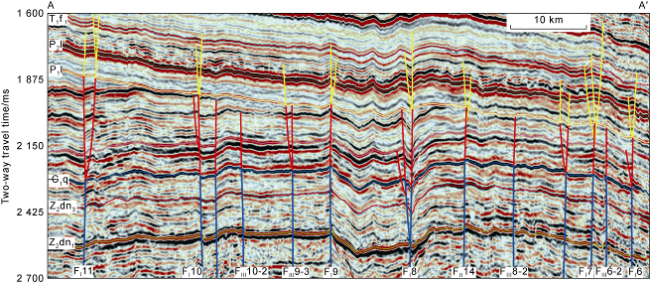
Fig. 2. Typical seismic section of strike-slip faults in Anyue gas field (section location see |
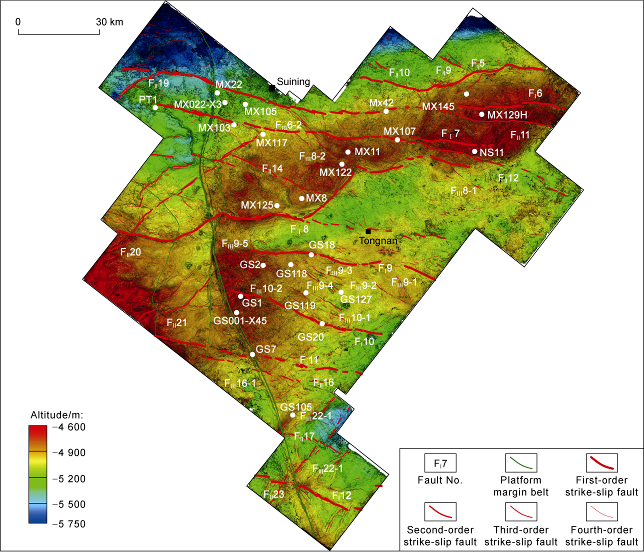
Fig. 3. Distribution of strike-slip faults in the contour map of the top Ediacaran in Anyue gas field and its periphery. |
The distribution of strike-slip faults in Anyue gas field exhibits distinct vertical stratification (Fig. 2 ), primarily occurring within three tectonic intervals: basement- Ediacaran, Cambrian-Ordovician and Permian. A few strike-slip faults extend upward into the Triassic. Notably, many strike-slip faults terminated at the top Ediacaran strata, representing transtensional faults that sequentially develop upward along major faults. The Ediacaran vertical displacement of major faults typically ranges from 60 m to 120 m, with some exceeding 150 m. In the Cambrian-Ordovician carbonates, strike-slip faults are predominantly developed along the Ediacaran major strike-slip faults, exhibiting positive flower structures. Some faults extend upward into the Permian along the major strike-slip faults, primarily manifesting as transtensional faults with obvious inheritance with the Ediacaran strike-slip fault system.
According to the strike-slip fault interpretation by the 3D seismic data, many Ediacaran NW-NWW trending and a few NE-trending strike-slip faults have been identified in Anyue gas field (Fig. 3 ). The major strike-slip fault zone (order I) extends over 50 km and traverses the entire 3D seismic area. Detailed seismic interpretation revealed many small secondary strike-slip faults, most of which are associated with the major strike-slip faults with ambiguous vertical displacement. In the Ediacaran Dengying Formation, the strike-slip fault zone is distinctly segmented with en échelon/oblique fault segments. A fault segment is generally less than 5 km, while a series of segments with small displacement form a long strike-slip fault zone. In the major fault zone, overlapped segments are connected in soft-linkage or hard-linkage pattern, resulting in localized micro-grabens and horsts in the overlap zone.
3. Fractured reservoirs in strike-slip fault zones
It has assumed that vuggy-type and porous-type reservoirs are widespread in the Ediacaran mound-shoals dolomites in the platform margin and intraplatform [27⇓⇓-30]. However, reinvestigation of porosity in cores and thin sections revealed that more than 90% of the primary pores in the ancient carbonate rocks have been lost due to strong cementation (Fig. 4 ). Currently, secondary dissolution pores serve as the primary reservoir space. Our analysis indicates that intergranular dissolution pores and vugs are common in mound-shoal dolomites, particularly in algal dolomite at the platform margin. The thickness of a single layer of karstic vuggy-type reservoir generally ranges from a few centimeters to several meters, exhibiting the characteristics of bedding-parallel dissolution (Fig. 4a ). Unfortunately, the gas production is typically low in the karstic vuggy-type reservoir that is lack of fracture. Well GS105 drilled better porous-type and vuggy-type reservoirs in the target layer, but obtained low gas production due to absence of fractures. This kind of porous-type reservoir has low porosity (less than 3%) and low permeability (less than 0.2×10⁻³ μm2). The porosity of the vuggy-type reservoir is higher up to 3%-8%, but the permeability varies greatly and is mostly less than 2×10⁻³ μm2, suggesting a low porosity-permeability reservoir too. Although gas production may greatly increase through horizontal well and large-scale fracturing stimulation, the matrix reservoirs lacking fractures are generally characterized by low gas production.
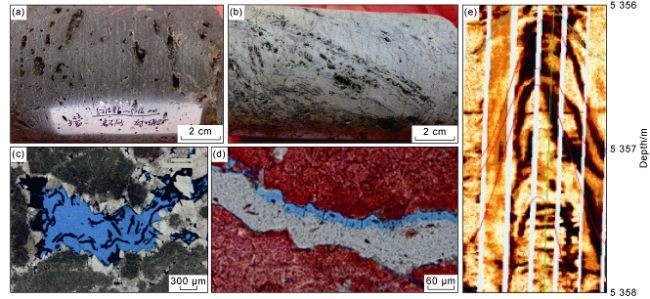
Fig. 4. Dolomite reservoirs of the Dengying Formation in Anyue gas field. (a) Bedding-parallel karstic vugs in tight granular dolomite, poor connectivity, core, 5215.9 m, well GS105; (b) High-angle microfractures and karstic vugs developed along fractures in tight dolomite, good connectivity, core, 5589.5 m, well GS119; (c) Intergranular karstic vugs in algal dolomite, granular dolomite cement at margin, vug filled with asphalt and suffered late dissolution, thin section, 4985.16 m, well GS1, (d) Dolomite filled fractures, the upper fracture edge suffered late cementation and dissolution, thin section, 4985.16 m, well MX103; (e) FMI image of high-angle fractures, well GS10 (highly conductive fractures in red curve, highly resistant fractures in green curve, and center line in green vertical line). |
According to the reevaluation of drilling data, fractures in the strike-slip fault zone are more developed compared to those in the host rocks. Structural fractures are frequently observed in cores within the fault zone, along with diagenetic fractures and dissolution fractures at the top of the Ediacaran weathering crust. Multiple types of micro-fractures, high-angle to vertical occurrence, exhibit parallel, oblique and conjugate assemblage in the strike-slip fault zone (Fig. 4b ). There is significant variation in fracture density, with statistical analysis of core and logging data indicating fracture linear density generally less than 1 fracture/m in the country rock, while it ranges at 2-6 fractures/m and can exceed 10 fractures/m within the strike-slip fault zone. The fracture fillings mainly consist of dolomitic cements, with more muddy fillings at the top of weathering crust. In addition, collapsed breccia and interstitial fillings are observed in the large fracture-cave system. The fractures are either semi-filled or not filled to show an excellent fractured reservoir at the top of the Ediacaran dolomite, with most fractures being opened and connected by fracture-vug network. Through reanalyzing logging interpretation data, it was observed that most high-production wells have penetrated into fracture-vuggy reservoirs with good reservoir connectivity, which is a crucial factor for obtaining high gas production. For instance, wells GS1 and GS7 present well-developed fractures and karstic vugs and better reservoir connectivity by the intersecting of fracture network, and resulted in high gas production.
Despite the low fracture porosity of less than 0.2 % in Anyue gas field, it is noteworthy that karstic vugs may develop along the fractures (Fig. 4 ). According to the analysis of core and imaging logging data, vertical dissolution along fractures is widespread, extending even into peripheral tight carbonate rocks. Additionally, the transport effect of the fracture network plays a crucial role in the development of bedding-parallel karstic pores and vugs. Furthermore, the fractured reservoirs could be developed to form fracture-cave system through its fracture network in localized fault zone. Well GS118 penetrated a large fracture-cave system with a cave diameter exceeding 5 m. The typical fracture-vuggy reservoirs generally exhibit vertical connection and lateral superimposition within the strike-slip fault zone.
According to core analysis, the permeability of the matrix reservoir in the Dengying Formation ranges from (0.001-1.000)×10−3 μm2. Whereas, the permeability of the fractured samples is generally in the range of (0.1-100.0)× 10−3 μm2, indicating an increase by 1-3 orders of magnitude. The microfacies-controlled reservoirs, located away from the strike-slip fault zone, possess dissolution pores and vugs but fewer fractures, resulting in porosity less than 4% and permeability less than 0.5×10⁻³ μm2. In contrast, the fracture-vuggy, fracture-cave and fracture reservoirs within the strike-slip fault zone exhibit higher porosity of more than 4% and permeability in the range of (1-10)×10−3 μm2. Logging interpretation reveals that the the matrix reservoir has a porosity lower than 2.5% and permeability lower than 0.2×10⁻³ μm2. However, the effective porosity may be more than one time, and the permeability may increase by over one order of magnitude in the fractures along strike-slip fault zone (Fig. 5 ).
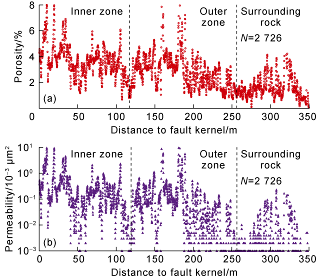
Fig. 5. Correlation diagram between (a) porosity, (b) permeability and distance to fault core in Anyue gas field (data from well logging interpretation; N is the number of samples). |
4. Effects of strike-slip faults on reservoirs and their reservoir models
4.1. Key stages and controlling factors of reservoir development in strike-slip fault zones
Together with the data of strike-slip faults terminated strata, the difference in deformation and natures of overlying and underlying formations, and the U-Pb dating of fracture cements, the strike-slip faults in the central Sichuan Basin have experienced multiple stages of strike-slip fault activities during the Nanhua Period, Late Ediacaran-Early Cambrian, Ordovician-Permian, and Late Permian [34]. Seismic data analysis shows that many strike-slip faults terminated under the Cambrian (Fig. 2 ), and a regional unconformity caused by the Tongwan Movement separates the Cambrian from the Precambrian [38]. Moreover, the Cambrian flower structure is superimposed on the Ediacaran strike-slip faults with a distinct difference, indicating that one stage of strike-slip fault activity had occurred before the Cambrian deposition.
In order to determine the formation time of the reservoir along strike-slip fault zones, U-Pb dating was carried out on the Ediacaran fracture cements [34]. The U-Pb dating revealed ages of 555-572 Ma from the fracture cements of the Dengying Formation (Fig. 6 ), indicating that a stage of intense strike-slip fault activity, accompanied by karstic dissolution and cementation, occurred at the end of the Ediacaran. This strike-slip fault activity was coincided with the weathering crust karstfication caused by the Tongwan movement[38]. Since the cements in the fracture-vuggy reservoir postdata the fractures and vugs, it is inferred that a stage of karstification lasting longer than 5 Ma occurred before the Cambrian deposition, potentially resulting in extensive karstic reservoirs in the Ediacaran weathering crust. This confirms that karstification is the major factor on the reservoir development in the Dengying Formation [28⇓-30]. The fracture network is conducive to the development of dissolution porosity along fracture zones, leading to the formation of high porosity-permeability fracture-vuggy reservoirs within the strike-slip fault zone (Fig. 5 ). Multiple periods of inherited strike-slip fault activities were weak and small in scale in the Cambrian-Permian [32⇓-34] (Fig. 2 ). Furthermore, the later strike-slip fault activity successively developed along the major strike-slip fault that has certain effect on the Ediacaran carbonate reservoirs. U-Pb dating has detected more Permian ages, indicating strong burial dissolution could have taken place and modified the Ediacaran reservoirs.
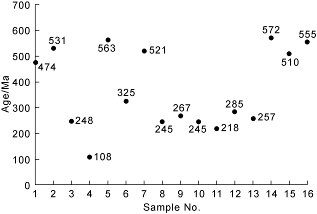
Fig. 6. U-Pb ages of cements in the fracture-vuggy reservoirs in central Sichuan Basin. |
According to the analysis of core and production data, the intraplatform carbonate reservoir of low-energy microfacies in the Ediacaran Dengying Formation is generally tight, while the karstic reservoirs developed in the intraplatform mound-shoals along strike-slip fault zones that are influenced by the fault activity during the syn-sedimentary or early diagenetic period. At the end of the Ediacaran, the high porosity-permeability intraplatform reservoirs mainly occurred in the inner and outer fault zones, influenced by three mechanisms of faulting, microfacies and karstification (Fig. 5 ). Among these factors, strike-slip faults play a significant role in the development of fractured reservoirs. Furthermore, the algal dolomites of mound-shoal microfacies on platform margin in strike-slip fault zone are favorable for the development of dissolution pores by penecontemporaneous and supergenic karstification along the strike-slip fault zone [28⇓-30]. The stronger dissolution along fractures contributes to the development of dissolution pores and vugs, resulting in enhanced porosity ranging from 4% to 8% and permeability exceeding 2×10⁻³ μm2. The results indicate that the strike-slip fault zone facilitated the development of dissolution pores and the formation of high-quality fracture-vuggy reservoirs in mound-shoals on the platform margin, controlled by the coupling of microfacies, faulting and karstification on the basis of high-energy microfacies.
The reinvestigation of drilled wells in Anyue gas field reveals that the tested daily gas production is generally lower than 20×104 m3 in the better matrix reservoirs of the Ediacaran mound-shoals. However, the daily gas production of the fractured reservoirs in the strike-slip fault zone may increase by 1 to 4 times (Fig. 7a ). The stable daily gas production of a development well in the mound- shoal reservoirs is generally as low as (3-10)×104 m3 (Fig. 7b ). In comparison, the stable daily gas production of a well in fractured mound-shoal reservoir is generally in range of (10-40)×104 m3 (Fig. 7c ), indicating 2-5 times more than that of the matrix mound-shoal reservoir. It is worth noting that the strike-slip faults have a more significant effect on the intraplatform reservoir in the Dengying Formation (Fig. 5 ). Fracture and karstic vugs mostly occur in the strike-slip fault zone (Fig. 8 ), indicating that high-yield gas wells are controlled by fault effects. Unlike fractured reservoirs, the fractured reservoirs in the strike- slip fault zone in Anyue gas field support wells to have high and stable production (Fig. 7b , 7c ). The strike-slip faults can control local geomorphic highs and subsequent the development of high-energy microfacies, having a significant effect on the distribution of the intraplatform shoals and karst highlands in the strike-slip fault zone. Therefore, the strike-slip faults are favorable for the development of fractures and karstic pores. They may not only increase the permeability by 1-3 orders of magnitude, but also increase the porosity by more than 1 times through dissolution along fracture zones, ultimately forming high porosity-permeability “sweet spots” of fracture-vuggy reservoirs.
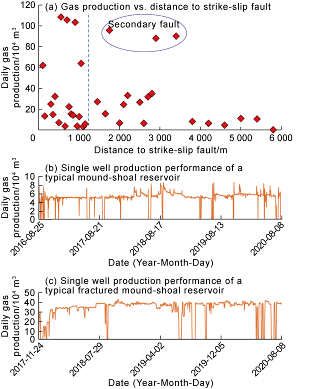
Fig. 7. Gas production of the Dengying Formation along strike-slip fault zones in Anyue gas field. |
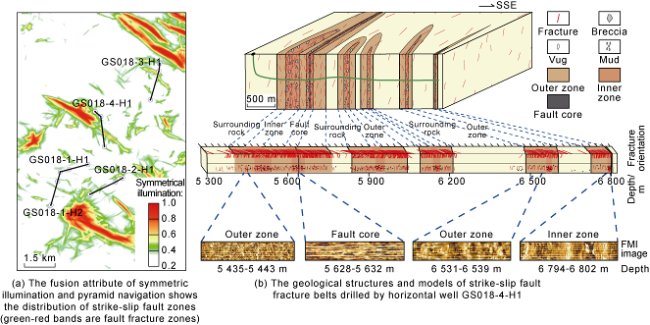
Fig. 8. (a) Seismic attribute of the top Ediacaran and (b) borehole reservoir modelling across a strike-slip fault zone in Anyue gas field. |
Therefore, strike-slip fault-controlled “sweet spot” reservoirs developed well in the Ediacaran Dengying Formation in Anyue gas field. The strike-slip fault system controls the development and distribution of fractured- vuggy reservoirs, and the high-energy mound-shoals developed along the strike-slip fault zone are favorable for development of dissolution porosity, with karstification along the fracture network in the strike-slip fault zone is the key process to form high-quality reservoirs. In this context, the “sweet spot” fracture-vuggy reservoir controlled by faulting, high-energic microfacies and karstification is the most favorable drilling target for high gas production in Anyue gas field.
4.2. Diversity of strike-slip fault-controlled reservoirs
Multiple factors affect the development of high-quality carbonate reservoirs in the Dengying Formation, and the reservoir type, physical properties and distribution are variable in different strike-slip fault zones (Fig. 9 ).
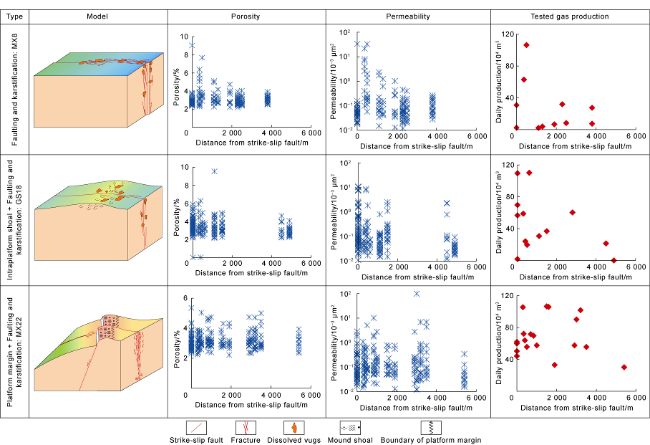
Fig. 9. Strike-slip faults related reservoir models and characteristics in Anyue gas field (porosity and permeability data are the average value from logging interpretation). |
Strike-slip faults developed in well MX8 area in the intraplatform, but there is lack of high-energy microfacies due to the weak hydrodynamic force as in rimmed platform margin. The reservoir porosity and permeability from core and logging data in this well are generally less than 3.5% and 0.2×10⁻³ μm2, respectively. Although many reservoirs within the strike-slip fault zone are not affected by faults and similar to the matrix reservoirs, high-quality “sweet spots” of fracture-vuggy and fracture-cave reservoirs are closely related to strike-slip faults. It indicates that strike-slip faults control the development of the high-quality reservoirs, which can be classified into fault-controlled reservoir (Fig. 5 ).
In well GS18 area within the intraplatform, strike-slip faults developed in the Ediacaran and led to the variable distribution of ancient landform and intraplatform shoals. High-energic microfacies and faulting effect are major factors for the development of high-quality reservoirs. Well logging data reveals that the average porosity of the reservoir is generally in rang of 2%-5%. The porosity has increased significantly in the strike-slip fault zone by more than 20%, and can be increased by 1-2 times in local fractured zone. Furthermore, the reservoir permeability increases more significantly by 1-2 orders of magnitude. Faulting and related karstification suggest that the “sweet spot” fracture-vuggy reservoirs are well-developed in the strike-slip fault zone.
In well area of MX22 at platform margin, the high-energy mound-shoal microfacies of the Dengying Formation developed well along the platform margin, but it was intensively affected by karstification during the Tongwan Movement [38]. The strike-slip fault exhibits weak constructive effects on the matrix reservoirs. Although some high porosity-permeability reservoirs in the strike-slip fault zone is closely related to faulting, such reservoirs also developed far away from the fault zone that was influenced by microfacies and karstification. The reservoir porosity distribution does not show distinct correlation with the distance to the fault zone, and numerous low-permeability (less than 0.1×10⁻³ μm2) reservoirs occur in the strike-slip fault zone. Our analysis revealed intense fracture cementation in some wells and the strike-slip faults have both constructive and destructive effects on the reservoirs. The strike-slip faults at the end of the Ediacaran were mainly of constructive effect, while the faults in the burial period promoted fracture cementation, showing “double-edged sword” effect on both increasing and decreasing porosity during the long diagenetic history. Anyway, most high-permeability reservoirs are closely related to the fracture zone, and their permeability may be increased by 1 order of magnitude and mainly distributed in the strike-slip fault zone.
Generally, the platform margin reservoirs are dominated by mound-shoal microfacies with a superimposed strike-slip faulting effect. Localized porosity and the permeability of some reservoirs are significantly enhanced by the control of platform margin microfacies and faulting effect, and are distributed widely on platform margins. The strike-slip fault has led to the varied distribution and development of localized high-quality fracture-vuggy reservoirs.
4.3. Diversity of reservoir zoning in strike-slip fault zone
The geological and geophysical data revealed that the strike-slip fault zone in Anyue gas field has complex architectures and related karstic reservoirs. The fault effect plays a crucial role on the development and distribution of the sedimentary microfacies and karstification, resulting in large difference of reservoir distribution in inner zone, outer zone and country rock (Figs. 5 and 8b ). Generally, fractures are well-developed in the inner zone-fault core with higher dissolution porosity. There are also localized fracture zones and high-permeable reservoirs in the outer zone, which could led to fault-controlled fracture-vuggy reservoirs. According to the analysis of well data, five kinds of fault-controlled reservoir zones have been identified that include fault core-inner zone, outer zone, fault-tip fracture zone, hard-linked zone and soft-linked zone (Fig. 10 ).
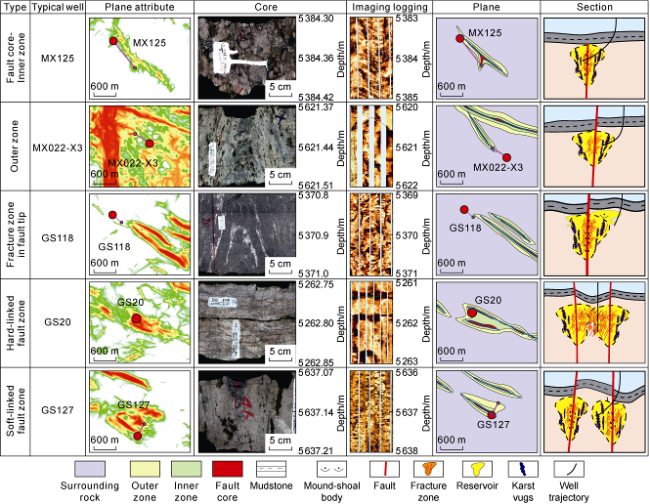


Fig. 10. Typical fractured reservoir models with planar and vertical features of the strike-slip fault zone in Anyue gas field. |
Well MX125 penetrated into the fault core with NW-trending multi-stage inherited fractures. Dissolution vugs developed well along and around the fractures to form fracture-vuggy reservoir within the fault core-inner zone. This kind of reservoir usually occurs in small strike-slip fault zone, which is favorable for the development and distribution of “sweet spot” fracture-vuggy reservoirs. Well MX022-X3 penetrated from the outer zone to fault core of a small strike-slip fault zone. Owing to the weak seismic response of the small (III-VI order) fault zone, it is difficult to identify the fractures by conventional seismic attributes. The well drilled across the fault zone and reveals several sets of fractures in the outer and inner zones. The dissolution vugs also developed in the outer zone and subsequent obtained gas production. Interference well tests indicated a weak fracture connectivity in the outer zone.
Well GS118 drilled through the fault tip of strike-slip fault zone. Lost circulation, drilling break and gas invasion occurred in the fault zone during the drilling process, suggesting a well-developed fractured reservoir. The well obtained high gas production at 109.45×10⁴ m3/d during the well test. Although it is difficult to identify micro- fractures, comprehensive fracture prediction results show that secondary fractures developed well in the fault tip. This suggests that the weak fracturing at fault tip is also conducive to the development of fractures and dissolution vugs, forming widely distributed fracture-vuggy reservoirs along the fault tips. Generally, the overlap zone in the strike-slip zone is characterized with strong faulting, favoring the development of fracture network and dissolution vugs. However, fractured reservoirs within the overlap zone may be severely destroyed by the intense deformation and stress. For example, fractures and strong fault-related karstification are well-developed in well GS20 within a large strike-slip overlap zone. The fracture-vuggy reservoirs are filled seriously to show low porosity-permeability, resulting in low gas production of 1.79×10⁴ m3/d. The seismic and well data analysis reveals that the well penetrated a lower position in the transtensional overlap zone by two hard-linked fault segments. The abundant fractures and pores are prone to be filled to form tight reservoirs. Well GS127, also in the fault overlap zone, drilled from the fault core towards the overlap zone. It penetrated less fractures but more vuggy reservoirs, having 52 m thick and high porosity more than 3% with an average of 3.7%. The analysis suggests that fractures are not developed in the soft-linked fault zone with weak fault effect.
Generally, the reservoir property in the strike-slip fault zone exhibits a decreasing power-law trend from the fault core to country rock. This pattern is consistent with the distribution of fault elements in strike-slip fault zones [39], and similar to the distribution of fracture parameters and porosity-permeability of the Ordovician carbonates in strike-slip fault zones of the Tarim Basin, NW China [12,40]. In contrast to typical strike-slip fault-controlled reservoirs, however, many high-quality reservoirs in Anyue gas field occurred in the outer zone and the transitional zone to the country rock. This pattern can be attributed to the transtensional faulting that has resulted in low topography of the fault core but high landform of the transitional zone between the fault outer zone and the country rocks. This differs from the high horst of fault core in the Ordovician transpressional fault zone in the Tarim Basin. In the fault core of the large transtensional fault zone in Anyue gas field, low-energy microfacies developed in the lowland fault core during syn-faulting period, while high-energy microfacies occurred in the highland of the outer fault zone. Furthermore, Karstic fluid could flow outwards from the fracture developed fault core to the country rock, resulting in widespread karstic reservoirs beyond the fault zone. In this context, the width of the strike-slip fault-controlled reservoir zone is even more than 1 km wide beyond the fault outer zone (Figs. 7a and 9 ).
In summary, the diversity of the scale, assemblage and architecture of the strike-slip faults have diverse effects on reservoirs in Anyue gas field. The fault-controlled “sweet spot” reservoirs are distributed widely by segmentation and zonation in the strike-slip fault zone, requiring different approaches in different segments and zones during the gas exploitation optimization.
5. Conclusions
This study and recent development practice in Anyue gas field have highlighted the significant and varied controlling effects of the strike-slip faults on the Ediacaran carbonate reservoirs. This understanding is of great importance for the efficient development of deep gas resource.
Compared to the Ediacaran matrix reservoir, the fracturing and related karstification in the Ediacaran strike-slip fault zone can substantially enhance the permeability by over one order of magnitude, and the porosity and gas production by more than one time, respectively. This indicates the potential for discovering strike-slip fault-controlled “sweet spot” fracture-vuggy reservoirs within the strike-slip fault zone.
In the strike-slip fault zone at the end of the Ediacaran period, three elements of “microfacies, faulting and karstification” have controlled the development of “sweet spot” fracture-vuggy reservoirs in the Ediacaran dolomite. These fractured reservoirs exhibit diversity in types and zones, influenced by the architecture of the strike-slip fault zone, resulting in widespread distribution and varied segmentation and zonation of fault-controlled reservoirs.
The strike-slip fault-related “sweet spot” reservoir represents a novel type of carbonate reservoir that necessitates distinct development strategies to account for its diversity in types and zones.