

Introduction
In the past 20 years, oil and gas exploration in China has gradually entered into ultra-deep formations (below 6000 m), and many large and super-large oil and gas fields were discovered, such as Yuanba, Anyue, Penglai, Shuangyushi, Shunbei, Fuman, Keshen, and Dabei, indicating a huge exploration potential of ultra-deep reservoirs in the sedimentary basins of China [1⇓⇓⇓-5]. Now oil and gas exploration and development has been gradually entered the 2nd depth space (6000-10 000 m) [6].
Ultra-deep oil and gas exploration faces unique geological conditions. Generally, ultra-deep formations are old, include carbonate, volcanic rock, clastic rock, metamorphic rock, etc., and the biological assemblage is dominated by lower organisms. Ultra-deep formations have evolved for a long time, and the tectonic history is complicated, so it is difficult to recover the prototype or original appearance of a basin [2-3]. At present, ultra-deep formations are at high temperature and high pressure, and because they are close to basin basement, basement faults and deep fluid activity have an important influence on them. In addition, deep fluids are rich in acid gases, such as H2S and CO2, which induce strong fluid-rock interaction [1,7 -8]. The mechanisms of hydrocarbon generation and reservoir formation are diverse [8-9]. The fluid phase state is subject to large changes of thermal evolution and high pressure, resulting in the complex hydrocarbon accumulation process. These geological conditions have profound impacts on the generation, accumulation and distribution of hydrocarbons in ultra-deep layers [1,9⇓⇓⇓ -13], and pose serious challenges to hydrocarbon exploration and development [14⇓⇓⇓⇓⇓⇓-21]. How to understand the special geological environment of ultra-deep layer? What kind of geological process was involved in the generation, transport, and accumulation of hydrocarbons in ultra-deep layer? What happened after the formation of the hydrocarbon reservoirs before they finally went into the present state? What are the patterns of oil and gas distribution in ultra-deep reservoirs?
Based on the major progress and important discoveries made in ultra-deep oil and gas exploration in recent years, this paper discusses the formation and occurrence laws of oil and gas in ultra-deep strata from the perspective of the whole chain from basin formation, hydrocarbon generation, reservoir formation and hydrocarbon accumulation, and puts forward the key issues of ultra-deep oil and gas exploration, so as to arouse the thinking of researchers on the universality and particularity of ultra-deep oil and gas. Our study is expected to provide technical support for ultra-deep oil and gas exploration.
1. The status quo of global ultra-deep oil and gas exploration and the potential of the ultra- deep oil and gas exploration in China
1.1. Status quo of global ultra-deep oil and gas exploration
Deep drilling of more than 10 000 m began in the 1970s. Well Kola 3 is the deepest vertical well in the world, drilled by the former Soviet Union in 1970 and completed in 1993 at 12 262 m. Now it has become a permanent laboratory for earth observation. In October 2022, Well UZ-688 was drilled to 15 240 m in the United Arab Emirates, making it the longest horizontal well in the world. Over the past 50 years, 67 wells with around 10 000 m MD (measure depth) (27 vertical wells and 40 extended reach wells) have been completed worldwide.
Major progress has been made in the exploration and development of ultra-deep oil and gas around the world. As of March 2023, there were 453 oil and gas wells (excluding pure scientific exploration wells) with VD (vertical depth) greater than 8000 m, all of which were located in the United States and China, including 279 in the United States and 174 in China. A total of 52 oil and gas fields with buried depths greater than 8000 m have been discovered, including 45 in the deep water basin of the Gulf of Mexico of the United States, one in the Anadarko Depression of the Xinei Basin (Mills Ranch Gas field), four in the Tarim Basin, one in the Junggar Basin and one in the Sichuan Basin in China.
In the deep water basin of the Gulf of Mexico in the United States, a large clastic oil field with reserves at a scale of 1 billion tons was discovered at around 10 000 m. The basin is a passive continental margin basin with an area of 44.1×10⁴ km2 and water depth of 200-3310 m. Forty-five (45) oil fields with a depth of more than 8000 m have been discovered, with recoverable oil reserves of 9.9×10⁸ t and natural gas reserves of 784×108 m3, of which 25 oil fields have recoverable oil reserves more than 1590×104 m3 each, the largest oilfield is Ballymore oilfield with oil reserves of 1.23×10⁸ t, and the deepest Tiber oilfield was drilled to 10 685 m (water depth of 1259 m), with recoverable reserves of 8900×104 t of oil equivalent. These reservoirs are at low temperature (below 150 °C), and high pressure (pressure coefficient of 1.4), have good physical properties (15%-30% in porosity), and are dominated by oil. The Mills Ranch carbonate oil and gas field in the Anadarko Depression of the Xinei Basin, is 7663- 8103 m deep, with recoverable reserves of 365×108 m3.
In recent years, China has made important discoveries in ultra-deep oil and gas exploration in Fuman, Shunbei and Kuqa areas of the Tarim Basin, Anyue and Penglai areas of the Sichuan Basin, and the southern margin of the Junggar Basin.
The “Deep Earth Project” has been implemented in the Tarim Basin, and 160 ultra-deep wells with VD of more than 8000 m have been drilled. Among them, two oil and gas fields with reserves of more than 10×108 t have been discovered in Shunbei and Fuman in carbonate reservoirs. Dabei-Bozi gas field with reserves of 1×10¹² m3 was discovered in clastic formations. Shunbei Oil and Gas Field, “Shendi No.1” of China Petroleum and Chemical Corporation (Sinopec), with a buried depth of 7300-9000 m [11,22], has 50 oil and gas wells with VD more than 8000 m. The deviated well SB84 has VD of 8937.77 m and produces oil and gas equivalent of 1017 t/d. It is the 22nd “1000-ton well” in Shunbei Oil and Gas Field, and the deepest 1000-ton well on land in Asia. The horizontal well SB56X has MD of 9300 m. Tarim Oilfield Company of China National Petroleum Corporation (CNPC) has completed 71 deep wells with depth of 8000 m and 11 deep wells with depth of 8500 m. The buried depth of Fuman Oilfield is 750-8500 m [5]. Well GL3C was completed at 9396 m (VD of 8057 m, 170 °C), which is currently the deepest horizontal well in Asia. In addition, Well LT1 was drilled to a vertical depth of 8882 m [6], and obtained industrial oil flows from the Cambrian Wusonger Formation at 8200 m, at 162 °C and 90.8 MPa. Well TS5 was drilled to 9017 m (VD), which has the largest vertical depth in the Tarim Basin at present. In addition, large gas fields such as Kesen, Dabei and Bozi, were found in the clastic reservoirs in the Kuqa foreland thrust belt. Four wells are deeper than 8000 m. The industrial gas flow Well DB4 was drilled to a depth of 8271 m with a VD of 8230 m.
There are 142 wells with VD of more than 6000 m in the Sichuan Basin, of which 130 are 6000-8000 m deep and 12 are 8000-9000 m deep (8 for PetroChina and 4 for Sinopec). The VD of Well YS1 in the Yuanba gas area of Sinopec has reached 8866 m. The primary pay zone of the trillion cubic meters gas-area in Penglai of PetroChina is in ultra-deep strata, where Well PS6 was drilled to 9026 m (VD) [1], the bottom hole temperature is 216 °C, and the well was completed at the Sinian Dengying Formation.
In the southern margin of the Junggar Basin, there are 2 vertical wells with a depth of more than 8000 m. Well TA1 was drilled to 8140 m, and Well TW1 to 8166 m in the Jurassic Qigu Formation (J3q). Well TW1 obtained equivalent oil and gas production at 885.4 m3/d from the Cretaceous Qingshuihe Formation (K1q) at 8066-8092 m, where the formation pressure is 171.80 MPa, the pressure coefficient is 2.15, and the bottom hole temperature is 170.13 °C.
1.2. Potential of ultra-deep oil and gas exploration in China
The potential of ultra-deep oil and gas resources is huge in China [9⇓⇓⇓-13,15⇓ -17]. The total area of the ultra-deep sedimentary basins at 6000-10 000 m is 150×104 km2, such as the Tarim Basin, Sichuan Basin, Ordos Basin, Junggar Basin, Qaidam Basin. The remaining resources with buried depths greater than 8000 m reach 176×108 t of oil equivalent, accounting for 33% of the total remaining resources in China. They are important replaced fields. Among them, the remaining oil resources are 24×108 t, accounting for 14%; the remaining natural gas resources are 19×1012 m3, accounting for 86%. The potential of carbonate reservoirs is 122×108 t of oil equivalent, accounting for 70%, and that of clastic reservoirs is 39×108 t of oil equivalent, accounting for 22%. The resource potential of bedrock and volcanic rock is 14×108 t of oil equivalent, accounting for 8%.
2. Research progress of ultra-deep oil and gas geological exploration
2.1. Geological research progress
The ultra-deep strata in sedimentary basins are parts of the complex earth system. This paper discusses the geological characteristics and research progress of ultra-deep oil and gas from the geological processes of basin formation, hydrocarbon generation, reservoir formation and hydrocarbon accumulation.
2.1.1. Multi-cycle evolution of ultra-deep basins
The formation and evolution of cratonic sedimentary basins in China is studied by applying the theory of tectonic history [1,11,23 -24]. Li and He put forward the concept of four-stage superposition in the formation of the cratonic sedimentary basins in China [23-24]. These basins experienced four extensional-convergent cycles at around 18 Ga or 8 Ga, namely Meso-Neoproterozoic, Early Paleozoic, Devonian-Triassic and Jurassic-Quarternary, resulting in multiple cycles of superposition (Fig. 1 ). The development of the sedimentary basins is closely related to the evolutionary cycles of the supercontinent[24-25].
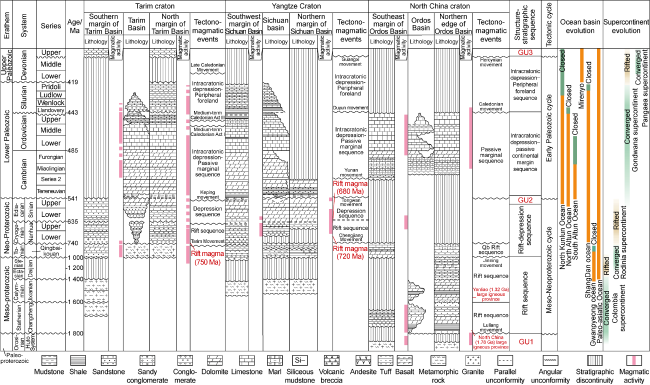
Fig. 1. Major tectonic events and evolutionary cycles in the Paleoproterozoic orogenic system-Upper Paleozoic Devonian system in three cratonic basins in China. |
In three cratonic basins (North China, Yangtze and Tarim), there developed three major unconformities at basement top, Cambrian bottom, Carboniferous or Permian bottom (GU1, GU2 and GU3 in Fig. 1 ), and experienced Meso-Neoproterozoic (Pt2-3) and Early Paleozoic (Pz1) cycles (Fig. 1 ). Other sedimentary basins in China are bounded by the regional unconformities at the Devonian/Carboniferous bottom and the Jurassic/Cretaceous bottom, and experienced two or more cycles [23-24]. In this paper, the above three cratonic basins are taken as examples (Fig. 1 ), and the two cycles in the deep basin are discussed.
(1) The Meso-Neoproterozoic cycle. After multiple stages of rifting and sedimentation, the main body of basins developed into "wide rift valley". According to the rifting period, the basins can be divided into three types. The first type developed on the Archeozoic or paleoproterozoic basement, and experienced the Changcheng Period rift and the Jixian-Qingbaikou period depression in the Meso-Neoproterozoic (Fig. 1 ), such as the North China Craton and its peripheral rift systems, including Yanliao, Baiyun Obo, Luliang, Xionger, Helan Mountain, Ningxia-Mongolia, Gansu-Shaanxi, Shanxi-Shaanxi, and other rifts [26]. The Mesoproterozoic rifted basin in the Ordos region is 3000-6000 m thick and a typical "basin under a basin". The second type developed on the Archean or paleo-Mesoproterozoic basement and experienced the early Neoproterozoic rifting (Fig. 1 ), such as Yanliao and Xuhuai rifts in the North China region, Northern Zhejiang, Northern Jiangxi, Xiang-Guangxi, North Yangtze margin, Kangdian, inner Sichuan Basin and Hotan, Yecheng and Tabei rifts in the Tarim region, which are 1000-3000 m thick, and extended intensively. The third type are the late Neoproterozoic rifting systems (Fig. 1 ), including the internal rifting system in the Sichuan Basin and Hotan, Yecheng, Tabei and other rifting belts in the Tarim region. Their sedimentary thickness is 2000-4000 m, and featured by a typical "bullhead" structure with top faults and bottom depressions.
(2) The Early Paleozoic cycle. During the evolution stage of the Proto-Tethys Oceans (such as Shangdan Ocean, North and South Altun Ocean, Qilian Ocean and other ocean basins) (Fig. 1 ), the Cambrian-Ordovician cratons in China were almost in the south and north latitude of 30°, and developed carbonate rock deposits [27]. The tectonic-sedimentary differentiation within the cratons controlled the development of the platform margin zones and the high-energy reef beach zones. In the Yangtze craton, the Sinian/Cambrian-Ordovician experienced an evolution cycle from separate platforms to unified platforms [27]. In the Tarim region, on the pattern of eastern basin and western platform [28], the platform margin and its slope belt experienced the evolution of eastward migration in the Cambrian (progradation) and westward migration in the Ordovician (retrogradation). In the Silurian period, the basin evolved into south and north zones again [29]. That stage can be divided into Cambrian-Middle Ordovician extension and Late Ordovician-Silurian compression. In the North China Craton, an unconformity developed at the bottom of the Majiagou Formation of the Middle Ordovician or at the top of the Cambrian (called Huaiyuan movement plane), which is a regional unconformity (Fig. 1 ).
2.1.2. Multi-source hydrocarbon generation in ultra-deep strata
High-quality source rocks developed in intracratonic rifts, such as the black shale of the Lower Cambrian Mediping Formation, Qiongzhusi Formation and Yurtus Formation, 20-80 m thick, are the main ultra-deep source rocks in the Sichuan Basin and the Tarim Basin [1⇓-3,30 -31]. The carbonate rock in the 1st, 3rd and 5th members of the Ordovician Majiagou Formation in the central and eastern Ordos Basin is the main source rock which the thickest is more than 60 m.
In addition to hydrocarbon generation by the thermal evolution of organic matter, the retained hydrocarbon in source rocks, dispersed liquid hydrocarbon outside source rocks and early crude oil can be cracked for a second time and provide highly to over mature shale gas and deep conventional gas. These processes are affected by high temperature and complex organic-inorganic interaction between fluid and surrounding rock [1,6⇓⇓ -9,32 -33]. The coupling of temperature and pressure fields and fluid field determines the thermal stability of crude oil, controls gas generation processes, and restricts ultra-deep hydrocarbon phases and resource types (such as light oil and gas, helium, hydrogen, etc.) and the lower limit of large-scale resource occurrence of ultra-deep oil and gas (Fig. 2 ) [1].
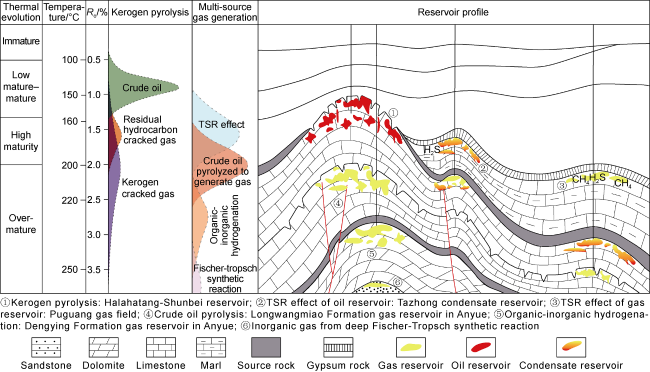
Fig. 2. Evolution model of deep and ultra-deep multi-source hydrocarbon generation and genesis of typical reservoirs (modified from Reference [1]; Ro—vitrinite reflectance). |
Gas from crude oil cracking is the main source to ultra-deep strata. Under the influence of long-term high temperature and deep burial, heavy components in ultra-deep ancient oil reservoirs were transformed into light components continuously, from condensate oil-gas to wet gas, and finally to dry gas [1]. Based on the of study of crude oil pyrolysis kinetics, Zhang et al. [8,30] believed that the temperature that promotes liquid hydrocarbon pyrolysis in large quantities is 190-220 °C. Influenced by the thermal structure and thermal conductivity of the lithosphere, the geothermal gradient and evolution with geological time is different in different basins. The geothermal gradient in the Tarim Basin is 18-22 °C/km, and the temperature range of "oil window" is 80-140 °C at over 6000 m [32-33]. The Cambrian source rocks had been in a slow burial environment for a long time, and had not been quickly and deeply buried until the Cenozoic, making the temperature at about 10 000 m is not more than 190 °C, which is lower than the temperature for large amounts of liquid hydrocarbon cracking. Due to the unique "low temperature and high pressure" environment, a large amount of liquid hydrocarbons (including black oil, original crude oil and condensate oil) can still exist below 8000 m in the Tarim Basin [1,13]. On the contrary, under the ultra-deep, "high temperature and high pressure" conditions, original crude oil in the Sichuan Basin cracked into gas.
As shown in Fig. 2 , the multi-source gas generation shows a coherent sequence. (1) In the oil window (60-150°C), oil was generated by kerogen and accumulated into reservoirs, such as Halahatang, Fuman and Shunbei oil fields. (2) Thermochemical sulfate reduction (TSR) took place at 150-200 °C, 20-30 °C lower than the temperature for crude oil cracking, resulting in oil-type cracking gas with high H2S content, such as Puguang gas field and Tazhong condensate gas field. (3) At 160-220 °C, crude oil began to crack into gas, forming the Longwangmiao Foramtion gas reservoir in Anyue Gas field and Penglai Gas Field in central Sichuan Basin. (4) During the hydrogenation reaction of organic-inorganic matters at 210-250 °C, high temperature and deep fractures made hydrogen-rich fluid as an external hydrogen source for hydrocarbon generation from organic matter. The hydrogen-rich fluid participated in the cracking of organic matter or hydrocarbon through hydrogenation, making the vitinite reflectance (Ro) of the deepest organic natural gas up to 3.5%, such as the Dengying Formation gas reservoir in Anyue gas field. (5) In the Fischer- Tropsch synthetic gas stage, the temperature was higher than 250 °C, inorganic gas was generated during the Fischer-Tropsch synthetic reaction between mantle-derived hydrogen or hydrogen from serpentinized olivine and inorganic carbon. It may be a kind of ultra-deep gas source (Fig. 2 ).
2.1.3. Multiple types of ultra-deep reservoirs
In recent years, a series of large- and medium- sized marine oil and gas fields have been discovered in ultra-deep carbonate rocks, including karst fractured-vuggy reservoir, reef beach reservoir, (pre-salt) porous dolomite reservoir, porous microbial reservoir, fractured-vuggy reservoir in fault zone, fractured-porous reservoir, etc. [3,10⇓ -12,15,22,34⇓ -36]. A variety of reservoir space types, such as pores, fractures, fractures and their combination, are developed in the ultra-deep strata. Fractures, faults and fluid make important contributions to the formation and evolution of reservoirs and the effective preservation of reservoir space [3]. Reservoirs have generally experienced a complex process of diagenetic transformation [22,37⇓ -39].
The Cratonic blocks in China are small, and have strong peripheral activities and irregular boundaries. Aulacogens are often developed from the edges of the Cratonic blocks to their interiors, forming bays on the edge of the Cratonic blocks (such as the Kaijiang-Liangping deep-water shelf trough in the Late Periman-Early Triassic) or rifted belt across the blocks (such as the Mianyang-Changning rift in the Sinian-Early Cambrian). On the margin of the rift belts, there developed multi-stage platform margin belts, such as the platform margin belts in the second and fourth members of the Dengying Formation. Inside cratons, there may be local depression or slope-break belts due to uneven subduction. Fault-controlled slopes and paleo-geomorphic slopes control the development of two types of platform margin belts, on which the rift margin mound-beach body and continental margin mound-beach body (referred as double beach) deposits are formed respectively (Fig. 3 ). The mound-beaches on the margin and highland in the platform are favorable reservoirs. It is an important feature of ultra-deep oil and gas accumulation [3,37⇓⇓ -40].
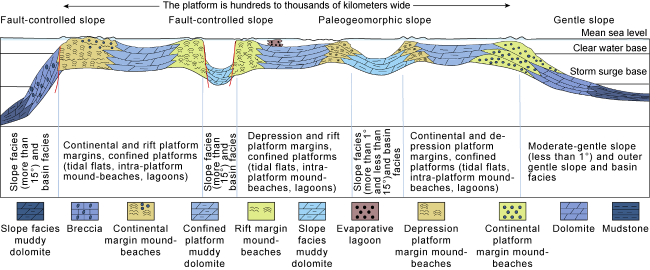
Fig. 3. Two types of marine carbonate platform margins and double beach models in Cratonic blocks (Deng 4 Member in the Sichuan Basin, data adapted from Reference [30]). |
The formation of ultra-deep carbonate reservoirs is controlled by sedimentation, diagenesis and tectonic activity. The primary high-energy facies zone and early dolomitization are the basis for the development of high-quality reservoirs [3,35]. Karst fractured-vuggy reservoirs are formed by atmospheric water karstification related to the unconformity caused by tectonic uplift. Early material foundation and late deeply buried structure and fluid are the key to the formation and maintenance of ultra-deep carbonate reservoirs [3]. Deep reef flat, karst and dolomite reservoirs have the characteristics of facies control [34⇓⇓-37]. Favorable facies zones (gypsum flat, reef flat) and favorable dissolution zones (exposed surface and faults) restrict the distribution of reservoirs. Pores in ultra-deep ancient carbonate reservoirs are mainly formed in sedimentary and epigenetic environments [34-35], and the burial environment is the place where pores are preserved, enriched or depleted. The distribution zone of stromatolite and clotted dolomite is favorable for the development of microbial carbonate reservoirs [36]. The large-scale distribution of reservoirs is controlled by marginal platform, gentle slope, evaporative platform, intraplatform depression, large palaeouplift-unconformity and fault system.
Inner karst reservoirs such as interlayer karst and faulted-dissolved reservoirs are also developed in ultra-deep strata, such as Halahatang, Fuman and Shunbei oil and gas fields, indicating potential exploration from buried hills to inner structures.
The metamorphic rock in buried hills may become favorable reservoirs after late fracture and dissolution transformation, such as Xinglongtai, Penglai 19-6, Penglai 26-6 and other Archean granite gneiss oil and gas fields in the Bohai Bay Basin.
There are also favorable ultra-deep clastic reservoirs. For example, Dabei 4 gas reservoir has porosity up to 8% in the Lower Cretaceous Bashijiqike Formation below 8000 m, which is closely related to reservoir overpressure and restricted fracture development. The development of nano-pores in ultra-deep shale is related to the development of organic pores, high silica content and overpressure.
2.1.4. Multi-stage composite hydrocarbon accumulation in ultra-deep shale
Ultra-deep oil and gas accumulation is controlled by many factors such as temperature, pressure, stress, reservoir space and fluid activity, and shows the characteristics of multi-stage complex accumulation and adjustment. Temperature controls the phase transformation of ultra-deep hydrocarbon, pressure controls the overpressure rupture of ultra-deep cap rock, reservoir rock and mineral types affect hydrocarbon-fluid-rock interaction and chemical reaction that destroy hydrocarbons, and tectonic action restricts the formation and evolution of deep major faults. In conclusion, hydrocarbon composition, hydrocarbon accumulation time, physical properties of cap rock and fault activity control the diffusion and loss of ultra-deep oil and gas, and then control the vertical migration, accumulation and escape of hydrocarbons [41].
The porosity, permeability and hydrodynamic connectivity of ultra-deep reservoirs affect the flow state of oil and gas in the reservoirs, and accordingly determine the dynamic conditions of oil and gas migration and the mechanism and process of accumulation [1,3,41]. In the middle and shallow layers in sedimentary basins, the main driving force on hydrocarbon accumulation is buoyancy, which induces conventional and tight oil and gas accumulation. In deep and ultra-deep layers, the permeability is less than 0.1×10⁻³ μm2, lower than the lowest limit of buoyancy-induced reservoirs. It’s possible for shale and tight oil and gas accumulation [1]. The physical properties of ultra-deep clastic rock can’t meet the lowest limit for buoyancy-induced accumulation, and the fluid is in the restricted Darcy flow field or bound flow field [1,16,42 -43]. To obtain industrial oil flow, it is necessary to conduct artificial fracturing stimulation or natural fracture reconstruction. With development of fractures, vugs and other reservoir space, oil and gas flow in ultra-deep carbonate reservoirs is Darcy flow, and the reservoir structure is highly heterogeneous [41]. The distribution of transport system and reservoirs controls the occurrence of reservoir forming units of different scales and large-scale oil and gas enrichment.
Under ultra-deep geological conditions, deep CO2-rich fluid is in a supercritical state, its density is close to that of liquid, and its ability to dissolve organic matter is very strong. Deep CO2-rich fluid flowing through the source rock can extract retained hydrocarbons, and promote the displacement and migration of deep hydrocarbons. CO2 fluid dissolution can transform reservoirs [1,6 -7]. There exists strong interaction between CO2-rich fluid with oil and gas, which can promote the migration of light oil and build a coupled oil-CO2 reservoir formation model [44].
The multi-cycle superimposed structures in basins controls composite hydrocarbon accumulation in multiple layers. For example, the paleo-uplift in the central Sichuan Basin developed in the Caledonian Period and the Mianyang-Changning rifted trough developed from the Late Sinian to the Early Cambrian are large-angle oblique superimposed structures that control the formation of the largest carbonate gas field in China [37,40,45]. The palaeo-uplift in central Sichuan Basin is a huge gas-rich structure covering a favorable area of 2.2×10⁴ km2 and containing gas resources of over 6×10¹² m3. Vertically, six large porous/vuggy reservoirs are developed in the 2nd and 4th members of the Sinian Dengying Formation, Lower Cambrian Canglangpu Formation and Longwangmiao Formation, Middle Permian Qixia Formation and Maokou Formation. All of them have produced industrial gas flow (Fig. 4 ). In Anyue and Penglai gas areas, hydrocarbon accumulation underwent Caledonian charging-destruction, and late Indosinian charging-cracking-adjustment. The Penglai gas area has the characteristics of fault and lithology controlling traps, stereoscopic and composite gas accumulation (Fig. 4 ), which is manifested as a ternary coupling model of source-fault-reservoir accumulation [34,45 -46].
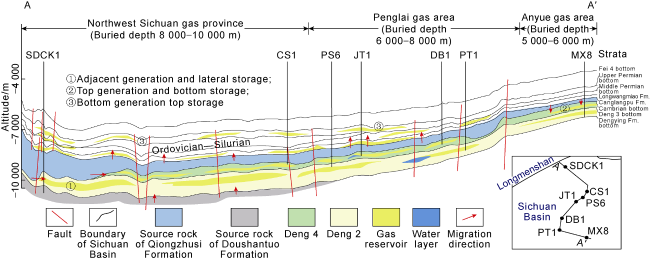


Fig. 4. Distribution model of Sinian-Permian gas reservoirs in Jiange-Penglai-Gaomo area in the Sichuan Basin. |
In the Tarim Basin, the geological environment with low temperature and overpressure in the lowland [32-33] makes light oil and condensate oil abundant [1-2], with the lower limit of occurrence exceeds 10 000 m. Hydrocarbon phase simulation shows that light oil in the Wusonger dolomite reservoir at 8260 m in Well LT1 is the product from the Lower Cambrian Yurtusi source rock under the geological conditions of relatively closed and highly thermal evolution (1.0%<Ro<1.5%) [13,47], generated in the Late Himalayan period [47]. The fault-controlled fractured-vuggy hydrocarbon accumulation model is developed in the ultra-deep Ordovician in Shunbei-Fuman area. The strike-slip fault zone has the characteristics of "controlling reservoirs, controlling traps, controlling transport, and controlling hydrocarbon accumulation". The reservoir is deep, with the oil and gas column higher than 510 m, and the enrichment scale is controlled by the reservoir size and the degree of connectivity. The main source rock of the Yultusi Formation in the Shunbei-Tabei area is still in the stage of large-scale liquid hydrocarbon generation and natural gas generation after the Yanshan period, but the oil and gas accumulation was adjusted late, forming Fuman and Shunbei oil and gas fields at 10×108 t.
In summary, the research progress of ultra-deep oil and gas geology in China is mainly reflected in five aspects. (1) From the perspective of basin formation, the Meso-Proterozoic extensional-convergent cycle and the Early Paleozoic extensional-convergent cycle formed the intra-craton rift and depression basin association, and the tectonic-sedimentary differentiation controlled by them produced the source rock and reservoir assemblage. (2) From the perspective of hydrocarbon formation, thermal evolution and crude oil cracking into gas were controlled by the geothermal gradient, and various genetic types of natural gas were generated in the special geological environment with deep-layer H2S, H2 and CO2, and light oil could exist in ultra-deep reservoirs under the condition of low temperature and late rapid burial. (3) From the perspective of reservoir formation, carbonate reservoir performances were controlled by early high-energy beaches and late superimposition, dissolution and fault activities. Fractured reservoirs were developed in basement metamorphic rocks and clastic rocks, and nano-micron porous reservoirs were developed in clastic rocks, which are more obviously controlled by overpressure. (4) From the perspective of hydrocarbon accumulation, ultra-deep marine reservoirs have generally experienced two stages of crude oil accumulation, cracked gas or partial cracked gas in paleo-oil reservoirs, cracked gas or late formation of highly to over-mature oil and gas. Multi-stage composite reservoir formation and late adjustment are common. (5) From the perspective of oil and gas distribution, rift margin and depression margin inside the craton, and the platform margin belt on the margin of the craton are favorable oil and gas zones which are distributed on large unconformities (i.e., Cambrian bottom, Carboniferous or Permian top) and large fault zones. Major hydrocarbon generating center, large-scale reservoir with high energy facies zones and karst superimposition, thick gypsum or mudstone cap, and stable trap conditions are the key factors for ultra-deep oil and gas enrichment [37,40,48⇓⇓⇓⇓ -53]. In the whole oil and gas system of ultra-deep strata, unconventional oil and gas accumulation is dominant [1,37,43], and large-scale geological units and large-scale hydrocarbon-rich areas are favorable exploration targets.
2.2. Research progress of ultra-deep exploration technology
In terms of seismic survey, the "2W1H” (wide azimuth, wide frequency band, and high density) seismic acquisition technology is effective to improve the accuracy of ultra-deep reservoir imaging and the reliability of the identification of fractures, faults and vugs [11]. Reservoir imaging refers to the unified integration of pre-stack velocity and reservoir attribute inversion into seismic imaging process. On the basis of "double high processing", namely high-precision static correction and near-surface absorption compensation (including surface consistency processing), and high-fidelity denoising and petrophysical analysis, multi-parameter full-waveform inversion imaging (including the inversion of pre-stack reservoir properties, lithology, physical properties and oil and gas bearing properties) is conducted, with the goal to carry out seismic-geological characterization of structural information (horizon, sequence, micro-fault, micro-facies), reservoir physical properties, and oil and gas property of meter-level complex reservoirs. The seismic processing results should directly reflect the spatial changes of oil and gas reservoirs, that is, "seismic reservoir imaging".
"3D imaging of ultra-deep reservoir" and "fine description of fractured-vuggy reservoir" are the key technologies making the "breakthrough to ultra-deep exploration promoted by the Deep Earth Project in the Shunbei area". The accuracy of strike-slip fault displacement was improved from 30 m to 15 m, and reservoir width from 60-80 m to 30-40 m in the seismic data processing of 1.4×10⁴ km2 by using the vertical seismic profiling method, well-controlled velocity model and angle-domain imaging in the ultra-deep fault-controlled fractured-vuggy structure [54]. With these technologies, hundreds of wells have been successfully deployed, and the production capacity of more than 200×104 t has been built in the Shunbei area.
In terms of drilling and completion, the world's first 9000 m four-column drilling rig and high-density drilling fluid able to work at over 200 °C were developed. The reservoir below 8000 m has been drilled in. A number of key technologies, such as deep automatic drilling rig, rotary steering system, efficient PDC (polycrystalline diamond composite sheet) bit, high-temperature-resistant screw, ultra-high temperature-resistant drilling fluid, leakage prevention and plugging, large diameter/high- steel expandable pipe, high temperature and high pressure resistant oil testing and completion tools, coiled tubing, have been broken through, making drilling and completion operation safe, quick and effective [55]. With the performance of the Deep Earth Project in Shunbei Oil and Gas Field, a series of technology have been developed, involving ultra-deep safe and efficient drilling operation, drilling speed increase, well trajectory control, tight plugging and leakage prevention, and micro- and nano- film for wall stabilization. This system effectively realizes the integration and innovative application of key technologies for ultra-deep safe and efficient drilling, greatly improves drilling efficiency and reduces complex faults, effectively ensures the smooth construction of drilling.
The implementation of whole-chain geologic-geophysical exploration and engineering integration and multi-specialty collaborative research proposes "seven elements" for the construction of ultra-deep high-yield wells in Shunbei Oil and Gas Field, namely, fault-based model construction, fracture-cavity description for target selection, reservoir scale definition by spatial analysis, structural characterization for reservoir connectivity analysis, trajectory optimization for increasing producing reserves, fast drilling, completion and precise target, separate fracturing stimulation to increase production [11]. They are effective to keep sustainable high production in Shunbei Oil and Gas field.
3. Key issues to be further explored in ultra-deep oil and gas exploration
3.1. Geological conditions and distribution laws of oil and gas under high-temperature and high-pressure
Although existing theoretical understanding has revealed the characteristics of complex changes in ultra-deep geological conditions, ultra-deep formation is still a new field to be explored [1⇓-3,11,55]. At present, the main problems are as follows: under the condition of high temperature and high pressure, rock mechanical behaviors, and the characteristics, types and deformation laws of geological structures have not been clearly understood due to the limitation of seismic resolution and drilling depth. Ultra-deep hydrocarbon sources are diverse, and the multi-component hydrocarbon formation mechanism, hydrocarbon expulsion and retention mechanisms are not clear. Carbonate and clastic rocks tend to be densified during deep burial, the formation conditions of high-quality reservoirs are complicated, and the formation mechanism of effective reservoirs needs to be further developed due to tectonic activities and the evolution of deep fluids. The effects of fault, fracture and structural heterogeneity on fluid transport and migration should be investigated [41]. The timeliness and dynamic capping mechanism of the cap layer under multi-stage tectonic action are unclear. Most ultra-deep oil and gas reservoirs have undergone complex accumulation, evolution and late adjustment and transformation, and the role and contribution of mantle fluid and deep material to oil and gas accumulation need to be studied [6-7]. The types of oil and gas reservoirs and the law of oil and gas enrichment and distribution need to be further understood. Ultra-deep exploration has exceeded the lower limit of previous resource evaluation, and the potential of oil and gas resources under the theoretical framework of the whole oil and gas system needs to be further clarified [34].
3.2. Prediction methods of geological units and large-scale hydrocarbon enrichment zones
Affected by many factors such as rock mechanics, reservoir physical properties and geothermal gradient, ultra- deep exploration targets are complex and hidden. They are heterogeneous marine carbonate rocks, tight clastic rocks and metamorphic rocks of different scales, with fractures, fractures and vugs, stratigraphic and lithologic, or on fracture zones [52-53,56]. At present, the theoretical methods for high-precision imaging, accurate small reservoir prediction, fracture detection and fluid property prediction cannot meet the needs of exploration practice.
Effective ultra-deep exploration should be run on slope zones, platform margin reef beaches, porous dolomite, large fault zones, fracture zones and other large geological units with favorable conditions for reservoir formation. The structure, reservoir evolution and final positioning of these units are complicated, and four-dimensional determination of these units faces difficulties in boundary, structure and genesis description. Locking large potential oil and gas zones is a higher requirement, which needs more efforts on theory and prediction technology.
3.3. Key technologies and equipment for oil and gas exploration
Ultra-deep temperature, high pressure, high ground stress, rich acid fluid, strong reservoir heterogeneity, complex rock mechanical behavior and complex well structure [54-55], and limited adaptability of downhole tools, instruments, materials and technical means, resulting in complex accidents, long operation cycle, high safety risks, high investment costs in the drilling process, and hinder exploration and development. The ability to independently develop key equipment and instruments such as ultra-deep logging, testing, acidizing and fracturing, as well as drilling fluid control materials, is still weak.
To drill ten thousand meters deep scientific exploration wells, many world-class problems should be solved such as ultra-high temperature, ultra-high pressure, ultra-long open hole section, high stress, strong wear, and multiple sets of pressure systems. The understanding of oil and gas flow mechanism in ultra-deep high temperature and high pressure complex media needs to be deepened, and the supporting technology for effective development of ultra-deep oil and gas resources has not been formed yet, and it is urgent to vigorously tackle the key problems.
4. Conclusions
A total of 52 ultra-deep oil and gas fields have been discovered below 8000 m, which are mainly distributed in the deep water basin of the Gulf of Mexico in the United States, Tarim Basin, Sichuan Basin and Junggar Basin in China. Oil and gas exploration and development in China has entered deep formations at around 10 000 m. Ultra-deep oil and gas resources account for 33% of the remaining total resources, and become an important replacement area for China.
With unique geological conditions, ultra-deep strata become the target for oil and gas exploration in the future. The Mesoproterozoic and Early Paleozoic extensional-convergent cycles controlled the formation of basins, the distribution of source rocks and reservoirs, and the source-reservoir association in North China, Yangtze and Tarim Cratonic basins. Natural gas has various geneses. Light oil accumulates in ultra-deep reservoirs at low temperature and high pressure. There are karst fractured-vuggy, dissolved and fault-controlled fractured- vuggy carbonate reservoirs, porous clastic reservoirs and fractured metamorphic reservoirs controlled by overpressure with high heterogeneity. Oil and gas accumulation experienced multiple stages, late adjustment and repositioning. Oil and gas distribution is controlled by high-energy beach belts at platform margin, regional unconformities, paleo-uplifts and large fracture zones. Large geological units and potential oil and gas enrichment zones are main targets for future ultra-deep oil and gas exploration.
Future study should focus on the geological conditions and distribution laws of ultra-deep oil and gas under high temperature and high pressure, the geological types of ultra-deep exploration targets, the prediction methods of large-scale geological units and enrichment zones, and key technologies and equipment matching ultra-deep oil and gas exploration.