

Introduction
The Ordos Basin is the largest natural gas production base in China. Guided by the sedimentary model of gentle slope delta, some large gas fields such as Sulige, Mizhi, Zizhou and Yulin, have been successively discovered in the basin [1]. By the end of 2021, the geological reserves of 6.9×10¹² m3 had been submitted, supporting the energy security of China. The tight sandstone gas reservoir in the Paleozoic Carboniferous-Permian is an unconventional gas reservoir predominantly sourced from coal measures. Thus, it is significant to directly take the coal-bearing source rocks as the target of exploration and development.
The coal measures in the Ordos Basin exhibit a wide distribution range and significant variations in burial depth [2]. Earlier coalbed methane development was primarily limited to the eastern margin [3], including areas such as Baode, Fugu, Linxing, Liulin, Wubu, Shilou, Daning-Jixian and Hancheng. This region spans approximately 500 km from north to south and 30-60 km from east to west, predominantly consisting of medium to shallow formations [4]. Recently, it has achieved promising results in the exploration of deep coal measures with burial depths exceeding 2 000 m in the Daning-Jixian area of the Ordos Basin and in the Junggar Basin. This indicates more optimistic outlook in deep coal rocks compared to the medium to shallow formations. Academia attributes this breakthrough to the enrichment of free gas in coal rock reservoirs, which differs from the predominant enrichment of adsorbed gas in medium to shallow coal beds [5-6]. The coal rock reservoirs exhibit relatively unique geological characteristics and distinct gas enrichment modes. Thus, separate research on natural gas within deep coal rocks is meaningful. Some scholars’ efforts in this regard [7⇓⇓-10] have suggested that deep coal rocks are notably different from medium to shallow ones, in not only burial depth, but also geological characteristics that were not recognized in previous studies.
In the Ordos Basin, multiple sets of coal rocks are developed in the Benxi Formation, Taiyuan Formation and Shanxi Formation. Especially, the #8 coal rock of the Benxi Formation is distributed stably across the basin [11]. However, the exploration operations have always focused on the coalbed methane in medium to shallow formations, instead of natural gas in deep coal rocks, because the former is considered more economical under similar output. Recent practices demonstrate significantly higher natural gas yields from deep coal rocks, spurring a boom of research and exploration of deep coal rock gas. Based on available drilling, core, logging and seismic data in the Ordos Basin, this paper makes extensive research and comprehensive analysis to address key geological issues, such as the differences between coal rock gas and coalbed methane, and the gas storage capacity, resource potential and preservation conditions of deep coal rocks. New insights are derived into the coal rock gas in the basin with respect to resources, reservoir characteristics, accumulation-dissipation combinations, and enrichment mechanisms. Furthermore, the exploratory well deployment strategy is proposed.
1. Overview of coal rock gas
Coal rock gas is a type of hydrocarbon gas that is generated within medium- to high-rank coal rocks or migrated from other gas sources and stored within coal rock reservoirs. It can be rapidly and commercially exploited through reservoir stimulation. Coal rock gas typically exhibits the characteristics of high burial depth, high coal rank, high reservoir fracture density, high temperature, high pressure, high in-situ gas content, high gas saturation, high free gas content, high gas density, high gas carbon isotopic values, and high total hydrocarbon values from gas logging.
Coal rock gas is generally buried at depths exceeding 2 000 m. The change in burial depth brings changes in the characteristics of coal rock gas reservoirs, especially the gas source, reservoir, gas content and gas isotopic compositions. Coalbed methane mainly refers to the natural gas adsorbed predominantly in shallow coals [12-13]. As revealed in Table 1 , deeper coal rocks have higher ranks and stronger gas generation capacities. At large burial depth, the geostress is high, promoting the development of fractured coal rock reservoirs with high brittleness and low compressive strength. Large burial depth also results in high temperature and pressure in coal rock reservoirs, high total gas content, gas saturation, free gas content and gas density in coal rocks, and high carbon isotopic values of natural gas extensively generated in medium- to high-rank coal rocks.
Table 1. Comparison of coal rock gas and coalbed methane |
| Gas type | Geological characteristics | |||||||||||||||||||||
|---|---|---|---|---|---|---|---|---|---|---|---|---|---|---|---|---|---|---|---|---|---|---|
| Gas source | Distribution | Burial depth/m | Reservoir physical properties | Cleats/ fractures | Migration mode | |||||||||||||||||
| Coal rock gas | Self-source or external source | Gentle areas or structural belts within basin | 2 000- 4 000 | Porosity 0.1%- 16.0%; permeability (0.001-15.000)× 10−3 μm2 | Fractures with aperture greater than 5 μm: 10-19 fractures/9 cm2; fractures with aperture less than 5 μm: 94-308 fractures/9 cm2 | Primary migration (diffusion flow), secondary migration (Darcy flow) | ||||||||||||||||
| Coalbed methane | Self-source | Structural belts or uplifted areas at basin margins | Few hundreds to 1 500 | Porosity 0.1%-8.0%; permeability (0.001- 0.500)×10−3 μm2 | Cleats/fractures developed in shallow coals | Primary migration (diffusion flow) | ||||||||||||||||
| Gas type | Geological characteristics | |||||||||||||||||||||
| Accumulation mechanism | Caprock conditions | Trap types | Preservation conditions | Reservoir temperature/°C | Reservoir pressure/ MPa | |||||||||||||||||
| Coal rock gas | Free, absorption (buoyancy, van der Waals force) | Caprock lithology has significant impact, including mudstone, limestone and tight sandstone | Stratigraphic-lithological trap, micro-amplitude structures locally | Trap and pressure sealing; deep burial, weak hydrodynamics | 65-135 | 22-33 | ||||||||||||||||
| Coalbed methane | Absorption (van der Waals force) | Caprock lithology has minimal impact | Stratigraphic-lithological trap, micro- amplitude structures, hydrodynamics | Pressure sealing, shallow burial, strong hydrodynamics, influenced by atmospheric fresh water infiltration | About 40 | 4-8 | ||||||||||||||||
| Gas type | Geological characteristics | Development characteristics | ||||||||||||||||||||
| In-situ gas density/ (kg•m-3) | Gas saturation | Gas content/ (m3•t-1) | Free gas content | Gas-logging peak value | Carbon isotopes | Development technology | Production characteristics | Predicted ultimate recovery/ 104 m3 | ||||||||||||||
| Coal rock gas | 130- 210 | High, up to 98.6% | Up to 34.0 m3/t, average 21.8 m3/t | Up to 45%, average 24.48% | Gas-logging total hydrocarbon peak greater than 90%, or even up to 100% | δ13C1: −37.6‰ to −16.0‰, δ13C2: −21.7‰ to −14.3‰ | Vertical well, horizontal well or high-angle horizontal well volume fracturing | Well produces gas immediately after it is opened, showing a bimodal production profile [6] | 4 000- 6 000 | |||||||||||||
| Coalbed methane | About 60 | Relatively large change | 8-12 | Low | Relatively low | Relatively light δ13C1: −70.50‰ to −36.19‰ [14] | Long production period, showing a monomodal production profile [6] | Generally less than 2 500 | ||||||||||||||
Firstly, coal rock gas may be originated from single source and mixed sources. In the Ordos Basin, coal rock gas was primarily generated by deeply-buried medium- to high-rank coal rocks. In the Junggar Basin, coal rock gas in the Jurassic Xishanyao Formation of Baijiahai area, was partially contributed by highly matured natural gas from the underlying Carboniferous strata. On one hand, the low-rank coal of the Xishanyao Formation limits its gas generation capacity. On the other hand, the underlying fault-communicated Carboniferous source rocks with a strong hydrocarbon generation capacity provide supplemental gas source for the fractured coal rock reservoirs in the Xishanyao Formation. Such multi-source natural gas in coal rocks like the Xishanyao Formation is newly defined as “coal rock gas” [5] to emphasize the storage characteristics of coal rocks.
Secondly, fractured reservoirs are developed in deeply buried coal rocks. Coal rock gas in the Baijiahai area of the Junggar Basin is supplied by multiple sources, and more importantly, is enriched in free gas state within dense large pores and microfractures. The deep coal rocks of the Benxi Formation in the Ordos Basin, with high thermal maturity, are dominated by bright and semi-bright coals, with well-developed cleats. Moreover, the high stress in deep strata results in highly brittle coal rocks with fractures. Thin section analysis shows that the density of fractures with aperture greater than 5 μm is 10-19 fractures/9 cm2, while fractures with aperture less than 5 μm can reach 94-308 fractures/9 cm2, leading to an overall permeability of up to 14.6×10⁻³ μm2. It is evident that in deeply-buried medium- to high-rank coal rocks, there are extensive matrix gas pores due to large- scale hydrocarbon generation and also dense microfractures, which provide excellent storage conditions for the enrichment of free gas. In well-developed reservoirs, gas migrates as diffusion flow and also Darcy flow, and it accumulates under the driving of the van der Waals force on the coal rock surface and also the buoyancy.
Thirdly, deep coal rocks exhibit high gas content. Deep coal rocks generally possess higher coal ranks, with larger coal grain Langmuir volumes. Under high temperature and pressure, high-density supercritical natural gas is stored in large pores and microfractures, resulting in high gas content and gas saturation. Particularly the proportion of free gas can reach up to 45%, primarily stored in large pores and extensively developed cleats and structural fractures. Thus, local structural traps, lithological traps with reservoirs developed, and caprock sealing conditions control the formation of high-yield sweet spots.
Fourthly, coal rock gas has high carbon isotopic values. Due to the considerable burial depth, coal rock gas is hardly affected by near-surface geological processes. This results in relatively high carbon isotopic values for methane and ethane. Analysis of coal rock gas samples from five wells with depth of 2 427.27-3 227.00 m indicates methane carbon isotopic values ranging from −37.6‰ to −16.0‰ and ethane carbon isotopic values ranging from −21.7‰ to −14.3‰. In contrast, coal rock gas in the shallow eastern part of the Ordos Basin is influenced by biogenic gas mixing [14-15], underground hydrodynamics [16], and structural uplift and desorption fractionation [17], resulting in generally lighter methane carbon isotopic values ranging from −55.52‰ to −46.52‰ and even −70.50‰ to −36.19‰ [14].
Lastly, coal rock gas production curves exhibit a "bimodal" feature. Initially after hydraulic fracturing, free gas stored in large pores and microfractures within coal rocks is rapidly produced. High production and early gas breakthrough occur, forming the first peak in gas production. After a period of stable production, as pressure decreases, adsorbed gas is gradually desorbed. A second peak in gas production or a sustained stable production phase appears. Overall, free gas and absorbed gas are produced sequentially.
2. Geological setting and coal rock characteristics
2.1. Geological setting
The Ordos Basin is a secondary tectonic unit of the North China Platform. With an area of 25×104 km2, the basin is divided into six primary tectonic units, namely the Western Marginal Thrust Belt, Tianhuan Depression, Weibei Uplift, Yishaan Slope, Yimeng Uplift and Jinxi Flexure Belt (Fig. 1a ). Coal rocks are primarily distributed in the Yishaan Slope and the Tianhuan Depression in the west. The Upper Paleozoic strata in the basin, from bottom to top, include the Upper Carboniferous Benxi Formation, Lower Permian Taiyuan Formation, and the coal-bearing strata in Shanxi Formation, showing a gradual transition from marine-continental to continental sedimentary environments. The Shanxi Formation mainly comprises #1 to #5 coal rocks interbedded with sandstone and mudstone. The Taiyuan Formation primarily consists of #6, #6-Lower, #7, and #8-Upper coal rocks, occurring between the Beichagou sandstone at the base of the Shanxi Formation and the Dongdayao limestone, Xiedao limestone, Maoergou limestone, and Miaogou limestone of the Taiyuan Formation. The Benxi Formation mainly includes #8, #9, and #10 coal rocks, where #8 and #9 coal rocks are often merged into one unit, commonly referred to as the #8 coal rock, which is situated above the Wujiayu limestone of the Benxi Formation and below the Miaogou limestone of the Taiyuan Formation. At the bottom of the Benxi Formation are the Pangou limestone and iron-aluminum rock, overlying the unconformity at the top of the Majiagou Formation (Fig. 1b ). The #8 coal rock at the top of the Benxi Formation is generally 2-15 m or up to 25 m thick. It is shallowly buried (500-1 500 m) along the eastern margin of the basin and deeply buried (2 000-4 000 m) within the basin (Fig. 2a ). It exhibits the most stable distribution throughout the basin, and represents as the most potential target for coal rock gas exploration and also the target layer in this study.
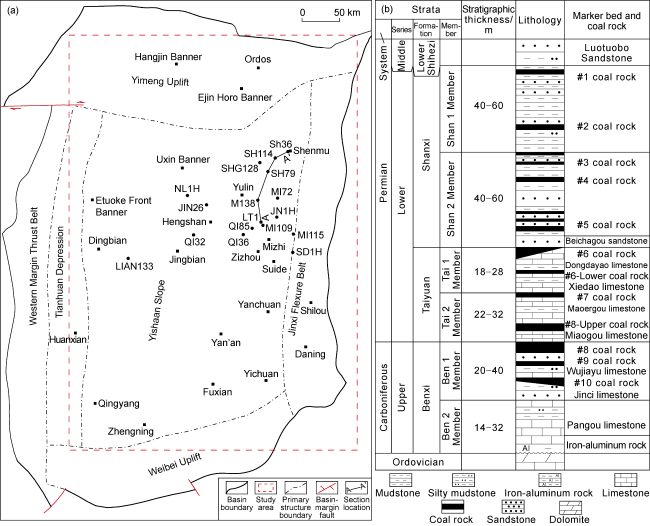
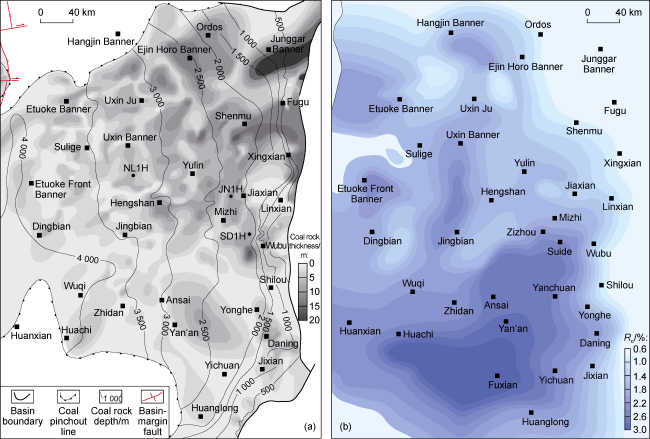
Fig. 2. Coal rock thickness map (a) and Ro contour map of the Benxi Formation (b) in the Ordos Basin (Fig. a is modified from Reference [19]). |
2.2. Coal rock distribution and coal quality of the Benxi Formation
2.2.1. Coal rock deposition and distribution
During the deposition of the Benxi Formation, the Ordos Basin belonged to the nearshore delta and barrier coast tidal flat-lagoon depositional system, receiving the widespread deposits of coal rocks up to 16.08×10⁴ km2. The basin sequentially developed delta plain, delta front and shallow marine lagoon deposits, from north to south [20-21]. In the northern part, swamp deposits developed in the delta plain interchannel bays, with abundant vegetation. Lateral channel migration led to extensive peat deposits, evolving into thick coal rocks up to 25 m thick. In the central part, branch channels developed stably and consistently in the delta front, forming shallow water nearshore swamps in interchannel bays, which evolved into thick superimposed coal rocks ranging from 4 m to 16 m. Southward, in the Jingbian-Zhidan-Yan'an areas, under a barrier coast-lagoon depositional system, the abundant shallow-water coal-forming plants were developed and evolved to form widespread and extensive coal rocks. Due to frequent changes in sea level, the duration of the environment conducive to coal formation was relatively short. Only thin coal rocks (2-12 m) were formed, with abundant tonsteins. Overall, coal rocks are thick and shallow in the northeastern part of the basin, and gradually thinning towards the west and south (Fig. 2a ), with increased occurrences of tonsteins and bifurcation.
2.2.2. Coal quality
Coal quality is an important parameter for characterizing coal rocks. It mainly involves coal macerals, proximate analysis, and macrolithotypes features.
In terms of microscopic composition, the Benxi Formation coal rocks are composed of vitrinite (19.86%- 91.28%, avg. 68.48%), exinite (0-30.99%, avg. 2.94%), inertinite (0-73.16%, avg. 19.50%), and minerals (0.57%-20.20%, avg. 9.31%). Apart from the relatively high proportion of vitrinite, other groups exhibit significant variability, indicating strong heterogeneity of coal rocks.
In terms of proximate analysis, the Benxi Formation coal rocks are found with ultra-low to low volatile matter content, low to moderate ash content, and extremely low moisture content, indicating good coal quality. Specifically, the fixed carbon content ranges from 51.12% to 86.93%, with an average of 72.68%; the volatile matter content ranges from 7.64% to 12.75%, with an average of 10.58%; the ash content ranges from 3.81% to 38.89%, with an average of 16.19%; and the moisture content ranges from 0.40% to 1.09%, with an average of 0.61%.
In terms of coal macrolithotypes, the Benxi Formation coal rocks are mainly composed of semi-bright and bright coals, followed by sub-dull and dull coals. Overall, the #8 coal rock exhibits good coal quality with low clay content in the upper part, but slightly higher clay content and presence of tonsteins in the lower part.
In terms of coal structure, the Benxi Formation coal rocks as a whole are dominated by primary coal, with cataclastic coal and granulated coal locally. Generally, bright and semi-bright coals with primary textures contain well-developed microfractures and cleats, indicating good storage conditions.
3. Conditions for coal rock gas accumulation in the Benxi Formation
3.1. High gas generation capacity of high-rank coal rocks
The rank of coal rock controls its hydrocarbon generation capacity. Generally, lignite can generate less methane, while anthracite is highly capable of methane generation (up to 590 m3/t) [22⇓⇓⇓-26]. In the late Early Cretaceous (107- 138 Ma) of the Ordos Basin, the mantle plume rose in the asthenosphere and thinned in the lithosphere, triggering tectothermal event in the basin to increase the geothermal heat flux and geothermal gradient [27-28]. This led to enhanced coal rank and hydrocarbon generation capacity. For thermal maturity, the Benxi Formation coal rocks generally reach medium to high ranks (Ro of 1.2%-2.8%), except for those in the northeastern part of the basin where the maturity is relatively low (Ro of 0.6%-0.8%), as shown in Fig. 2b . The distribution of gas coal and fat coal is limited, while coking coal, lean coal, meagre coal and anthracite are predominant, indicating a strong gas generation capacity [29⇓-31]. In the high to over-mature coal rocks, most of the residual soluble organic matter and pyrolyzable organic matter have been expelled, resulting in generally low values of chloroform bitumen "A" and pyrolysis hydrocarbons. The total organic carbon (TOC) values of coal rocks in the basin range from 33.49% to 86.11%, with an average of 75.16%.
In the early stage of thermal evolution, Type III organic matter primarily experienced side-chain group detachment reaction, leading to relatively poor gas-generating capability, with the generated gaseous hydrocarbons being 12C-enriched and thus with relatively low carbon isotopic values. In the late stage of thermal evolution, extensive aromatization, cyclization, and aromatic ring disintegration of organic matter became the main drivers of gaseous hydrocarbon generation, leading to increased isotopic values [32] and gas yield. The stable carbon isotopic values of coal rock kerogen range from −24.5‰ to −22.5‰ [33-34], inducing generally higher carbon isotopic values of the generated gaseous hydrocarbons. The carbon isotopic values of methane of coal rock gas typically exceed −37.6‰ and can reach the maximum of −16‰, while those of ethane are generally higher than −21.7‰ and can reach the maximum of −14.3‰, distinct from the natural gas in the Shanxi Formation, He 8 Member and Ordovician in the basin (Fig. 3 ). Relatively heavy carbon isotopes of coal rock gas reflect the strong gas-generating capability of high-rank coal rocks.
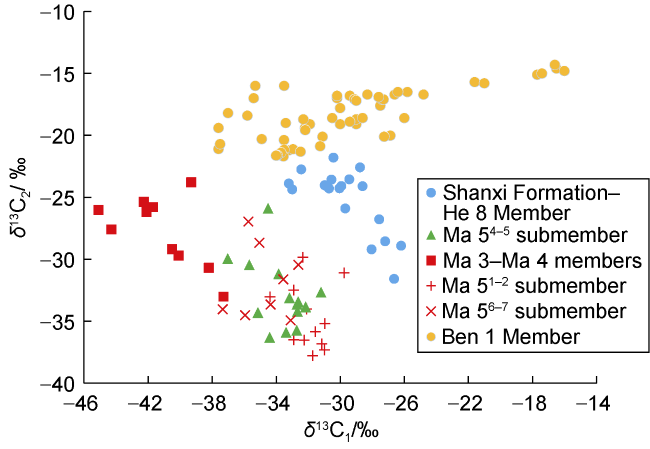
Fig. 3. Carbon isotopic composition of natural gas in typical formations in the Ordos Basin. |
3.2. Development of coal rock reservoirs
Coal rocks, as natural gas reservoirs, have the storage space mainly consisting of matrix pores and fractures. Matrix pores, by genesis, mainly include gas pores, residual plant tissue pores and mineral pores, with their developments dependent on the macerals, minerals and ranks of coal rocks. Fractures mainly include endogenous cleats and exogenous microfractures, with their developments under the control of coal rank, coal structure, tectonic stress and other factors.
3.2.1. Storage space types of coal rock reservoirs
Deep coal rocks are generally dual-porosity media constituted by matrix pores and fractures. In the #8 coal rock of the Ordos Basin, gas pores, residual plant tissue pores, and inorganic mineral pores such as intercrystal pores, intergranular pores and intragranular pores are predominant in the matrix (Fig. 4 ). Additionally, extensive cleats and microfractures are observed.
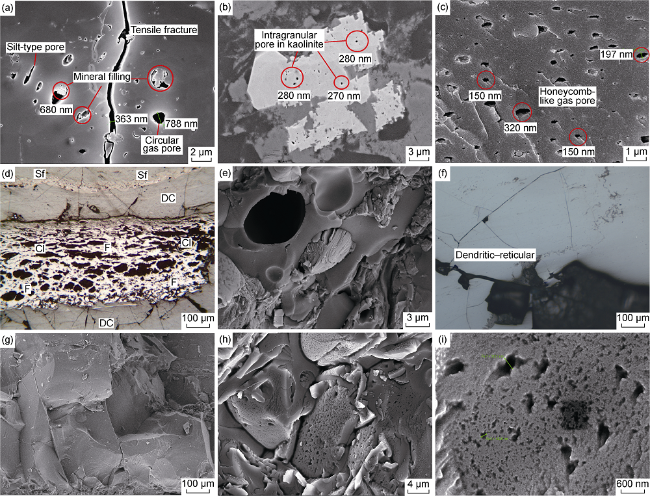
Fig. 4. Microscopic characteristics of coal rock reservoirs in the Benxi Formation of Ordos Basin. (a) Well QI85, 2629.23 m, tensile fracture with aperture of 363 nm, gas pores with diameter of 680-788 nm, SEM; (b) Well QI85, 2 631.40 m, intragranular pores in kaolinite, with diameter of 270-280 nm, SEM; (c) Well QI85, 2 629.34 m, gas pores, with diameters ranging from tens to hundreds of nanometers, SEM; (d) Well QI85, 2 629.15 m, clay-filled fusinite pores, cleats and microfractures in desmocollinite; (e) Well MI115, 2 901.40 m, clay-filled fusinite cell cavity pores, SEM; (f) Well JIN26, 3 101.24 m, dendritic cleats/fractures; (g) Well JIN26, 3 103.40 m, coal vitrinite in dominance, microfractures, SEM; (h) Well JIN26, 3 103.40 m, microfractures and gas pores, SEM; (i) Well JIN26, 3 103.40 m, locally magnified, gas pores, with diameters ranging from nanometers to hundreds of nanometers, SEM. Cl—clay; DC—desmocollinite; F—fusinite; Sf—semi-fusinite. |
(1) Gas pores. In the coal-forming process, as temperature and pressure increase, vitrinite becomes soft and plastic, with organic functional groups and side chains progressively breaking according to the activation energy sequence. With thermal evolution, large molecular hydrocarbons gradually decompose to produce methane-rich gas. The gas aggregates to form gas pores, representing the products and traces of gasification during coalification [35]. When the pressure of the gas formed by thermal evolution is less than the encapsulation resistance of the plastic mass in the coal rock, closed gas pores are formed. Conversely, when the gas pressure exceeds the encapsulation resistance, open gas pores are formed. The gas pores formed in the coal rocks of the Benxi Formation when thermal evolution is densely clustered, appearing elliptical or tubular, with pore diameters ranging from several nanometers to several hundred nanometers. They are most developed in the vitrinite component (Fig. 4a , 4c , 4h , 4i ). Shallow coal rocks generally have lower coal ranks and lower gas production. They developed less gas pores than deep coal rocks.
(2) Residual plant tissue pores, which are inherited from the preserved structure of plant tissues in coal rocks. During coalification, some plant tissue cells are preserved, forming cell cavity pores, which are more common in fusinite and semi-fusinite. The pore diameters range from tens of nanometers to several micrometers, and these pores may be filled with clay minerals (Fig. 4d , 4e ).
(3) Mineral pores refer to the pores formed in coal rocks by mineral particles such as carbonate and clay during the coalification and the geological processes after coalification. They include intragranular dissolution pores, intercrystalline pores and intergranular pores in minerals. These pores are more developed in coal rocks with thin tonsteins and low-rank coal rocks (Fig. 4b ).
(4) Cleats are formed from the gelatinization during coalification, as plastic to semi-plastic coal materials expel fluids such as natural gas and water, under the shrinkage-induced internal tension within the coal matrix. Cleats are classified into face cleats and butt cleats. Face cleats generally extend long, several meters or even tens of meters in vitrain or clarain. Butt cleats are typically orthogonal to face cleats, with their length controlled by the spacing of parallelly developed face cleats. The development of cleats is closely related to coal thickness, type, and composition. At the microscopic scale, cleat lengths range from tens of micrometers to several millimeters, while cleat widths range from hundreds of nanometers to several micrometers (Fig. 4d , 4f , 4g and Fig. 5 ).
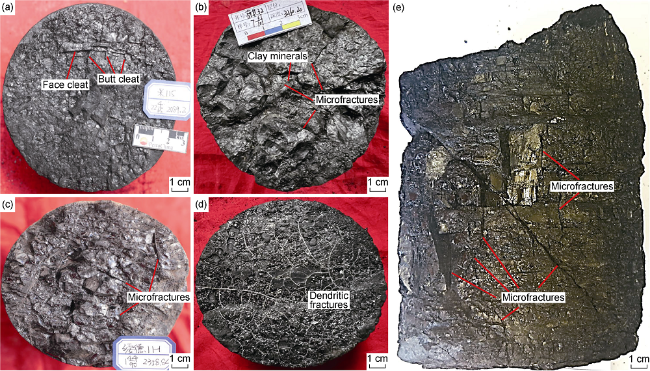
Fig. 5. Core photographs of the Benxi Formation in the Ordos Basin. (a) Well MI115, 2 089.20 m, bright coal in dominance, with face cleats and butt cleats; (b) Well QI32, 3 260.20 m, bright coal in dominance, arrows indicating deformed clay minerals between bright coal blocks, with unfilled microfractures; (c) Well SD1H, 2 358.84 m, bright coal, with face cleats and butt cleats, as well as some fractures filled with calcite; (d) Well QI32, 3 265.36 m, bright coal in dominance, with dendritic and reticular fractures, filled with minerals; (e) Well LIAN133, 3 864.20 m, bright coal in dominance, with cleats, microfractures dominated by shear fractures due to tectonic stress, as well as vertical fractures. |
(5) Fractures are tensional, shear, and tensile-shear fractures formed in coal rocks under geological stress (Fig. 5 ), generally not restricted by coal type. As the result of tectonic stress, features such as striations and steps are visible on fracture surfaces. Fractures are often filled with minerals such as calcite and clay (Fig. 5d ). Although cleats and fractures have different origins, local cleats and microfractures are not easily distinguishable. They both possess good storage and transport capabilities. Fractures of different scales require different study methods. Fractures with nanometer to micrometer widths are observed and analyzed using electron microscopy. Fractures with micrometer to millimeter widths can be studied through core observations. Larger fractures causing coal core fracturing require imaging logging data. Coal intervals with well-developed fractures exhibit clear fracture characteristics from imaging logging data, with fractures primarily characterized by high angle and enriched free gas, with total hydrocarbons of around 80% (Fig. 6 ).

Fig. 6. Electrical imaging log of #8 coal rock in Well SHG128 (arrows indicate effective open fractures). |
3.2.2. Physical properties of coal rock reservoirs
The coal rock reservoirs in the Ordos Basin exhibit favorable physical properties with variations at different scales. Pore structure characterization through combined analysis of CO2 and low-temperature liquid nitrogen adsorption and high-pressure mercury intrusion reveals that micropores (pore diameter less than 2 nm) constitute 42% to 57% of the total volume, macropores (pore diameter greater than 50 nm) constitute 28% to 45%, and mesopores (pore diameter of 2-50 nm) constitute 13% to 15%, indicating a predominant presence of micropores and macropores in the coal rocks. Physical properties differ between centimeter-scale block samples and plug samples. Analysis of centimeter-scale coal blocks shows that porosity ranging from 1.937% to 9.116%, with an average of 5.329%, and permeability is (0.005-1.192)×10−3 μm2, with an average of 0.350×10⁻³ μm2. Analysis of plug samples shows that porosity ranging from 0.540% to 10.670%, with an average of 5.466%, and permeability is (0.001-14.600)×10−3 μm2, with an average of 3.438×10⁻³ μm2 (Table 2 ). Clearly, the porosity values are generally equivalent or slightly lower in block samples than those in plug samples, while the permeability values are significantly lower. When laboratory physical property analysis is conducted on centimeter-scale coal blocks, it reflects only the properties of local microscale blocks. Then it is difficult to assess the storage and transport capabilities of fractures. Analysis of 3 cm-scale plug samples may reflect the storage and transport capabilities of small- to medium-sized fractures with better physical properties. Microscale, core-scale, and imaging logging results of fracture characteristics also exhibit differences. Statistical data from microscopic fracture analysis (Table 3 ) show fewer A-type (length greater than 10 mm) and B-type (length less than 10 mm) cleats with the apertures of both larger than 5 μm, while there are more C-type (length greater than 300 μm) and D-type (length less than 300 μm) cleats with apertures smaller than 5 μm. This indicates a low density of larger-scale cleats and a high density of smaller-scale cleats. Thin sections (Fig. 4f ) provide better insights into the development of microscopic fractures. Observation of core samples (Fig. 5e ) or imaging logging analysis allows for the direct observation of larger fracture features. Fig. 6 depicts the development of effective open fractures of coal rocks in Well SHG128. These fractures are difficult to obtain through analysis of centimeter-scale coal blocks and small plug samples. The characterization is best achieved through imaging or nuclear magnetic resonance (NMR) logging. The formation of large fractures in deep coal rocks is closely related to the high brittleness, low compressive strength and high geostress conditions.
Table 2. Physical properties of coal rock reservoirs in Benxi Formation |
| SN. | Well | Depth/m | Porosity/% | Permeability/ 10−3 μm2 | Sample type |
|---|---|---|---|---|---|
| 1 | MI115 | 2 087.78 | 0.540 | 0.001 | Plug |
| 2 | MI115 | 2 090.32 | 1.610 | 0.001 | Plug |
| 3 | MI115 | 2 105.32 | 3.570 | 0.155 | Plug |
| 4 | MI172 | 2 425.20 | 10.670 | 3.470 | Plug |
| 5 | MI172 | 2 425.45 | 4.770 | 0.802 | Plug |
| 6 | MI172 | 2 427.64 | 8.480 | 0.673 | Plug |
| 7 | MI172 | 2 427.89 | 7.700 | 1.537 | Plug |
| 8 | MI172 | 2 428.39 | 5.630 | 0.743 | Plug |
| 9 | MI172 | 2 428.65 | 6.610 | 1.162 | Plug |
| 10 | MI172 | 2 428.99 | 1.200 | 0.001 | Plug |
| 11 | MI172 | 2 429.29 | 8.470 | 2.096 | Plug |
| 12 | JIN26 | 3 101.33 | 5.333 | 14.600 | Plug |
| 13 | JIN26 | 3 102.46 | 6.551 | 12.000 | Plug |
| 14 | JIN26 | 3 103.48 | 4.992 | 10.900 | Plug |
| 15 | MI109 | 2 373.93 | 5.947 | 0.048 | Block |
| 16 | MI109 | 2 374.80 | 3.708 | 0.005 | Block |
| 17 | MI109 | 2 375.80 | 1.937 | 0.020 | Block |
| 18 | MI109 | 2 376.30 | 2.491 | 0.158 | Block |
| 19 | QI36 | 2 805.34 | 6.370 | 0.942 | Block |
| 20 | QI36 | 2 806.78 | 9.116 | 0.096 | Block |
| 21 | QI36 | 2 807.62 | 7.929 | 0.338 | Block |
| 22 | QI36 | 2 808.57 | 5.136 | 1.192 | Block |
| Average | 5.398 | 2.315 | |||
Table 3. Statistics of microscopic cleats in the coal rocks |
| Sample | Microscopic cleat density/[cleats·(9 cm2)−1] | ||||
|---|---|---|---|---|---|
| A-Type | B-Type | C-Type | D-Type | Total | |
| JIN26-2 | 3 | 10 | 62 | 160 | 235 |
| JIN26-5 | 2 | 10 | 20 | 74 | 106 |
| JIN26-8 | 7 | 12 | 52 | 92 | 163 |
| QI85-1 | 3 | 12 | 48 | 260 | 323 |
| QI85-5 | 2 | 14 | 32 | 220 | 268 |
| QI85-8 | 2 | 8 | 30 | 214 | 254 |
3.3. Coal rock gas accumulation and dissipation combinations
Coal rock reservoirs are rich in both adsorbed and free gases, and the gas accumulation characteristics vary under different geological conditions. As depicted by the nearly N-S sections in Fig. 7 , the total hydrocarbon values at different locations are different, controlled by the coal rock gas accumulation and dissipation conditions.
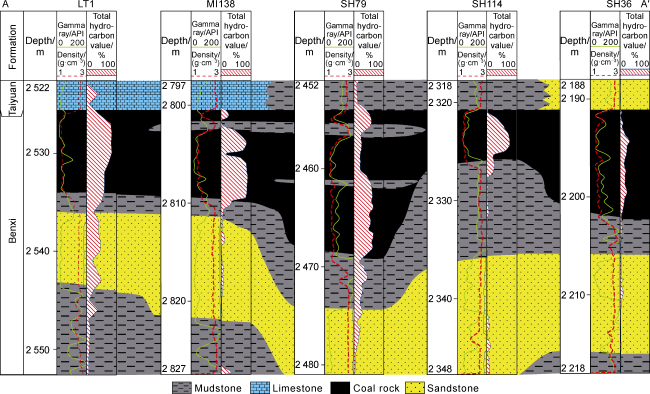
Fig. 7. Sections of the Benxi Formation coal rocks and the overlying and underlying strata of in the Ordos Basin (section location in |
In the delta front of the Taiyuan Formation, which represents a transitional zone between marine and continental deposits with relatively thick mudstones, coal rock-mudstone gas accumulation combination is predominantly formed. The overlying mudstone layers have thicknesses ranging from 2 m to 5 m, providing good sealing conditions. In Fig. 7 , the peak total hydrocarbon values of wells SH79 and SH114 reach 64.66% and 76.87%, respectively, indicating high levels of free gas content and favorable gas accumulation conditions. In the Hengshan-Zizhou-Mizhi areas, the Taiyuan Formation shows a shallow marine depositional environment, with the Miaogou limestone at the bottom. Coal rock-limestone gas accumulation combination is formed in areas with high limestone density, where overlying limestone layers with thicknesses ranging from 2 m to 22 m effectively act as seals. Typical examples are wells LT1 and MI138 shown in Fig. 7 , with peak value of total hydrocarbon exceeding 85%. This indicates high free gas content within such combination. If the geological factors such as pores and fractures that make Miaogou limestone less dense, coal rock-limestone dissipation combination may appear, with low total hydrocarbon values, indicating reduced free gas content in the coal rocks.
In the northern part of the basin, including the Shenmu area and northward, the Taiyuan Formation is primarily characterized by delta plain with well-developed sandstones. This environment leads to coal rock-sandstone dissipation combination, where sandstone layers have thicknesses ranging from 3 m to 12 m. Generally, sandstones exhibit good permeability, allowing for the potential migration and dispersion of free gas from coal rocks to sandstones where the gas accumulates to form sandstone gas reservoirs or directly dissipates. The peak value of total hydrocarbon of the coal section in Well SH36, as shown in Fig. 7 , is only 31.17%, indicating a low free gas content. However, it is also possible to be the case that overlying sandstones are cemented and dense, forming coal rock-tight sandstone gas accumulation combination.
In the eastern part of the basin, there are regular variations in the coal rock gas accumulation and dissipation combinations, mainly controlled by the lithology and phy-sical properties of the overlying Taiyuan Formation. Overall, coal rock-limestone combination in the southern region and coal rock-mudstone combination in the central region exhibit better sealing conditions. They generally show higher peak values of total hydrocarbon, primarily indicating gas accumulation combinations. Conversely, coal rock-sandstone combination in the northern region exhibits poorer sealing conditions, with lower peak total hydrocarbon values, primarily indicating gas dissipation combination. However, fractured or porous zones are possibly present within the limestone cap layer of the Taiyuan Formation due to geological changes, and leading to coal rock gas dissipation. Similarly, in areas where sandstones are prevalent, extremely dense cemented sandstones may form sealing layers. In summary, the combinations of coal rock gas accumulation and dispersion can be classified into the aforementioned five types (Fig. 8 ). Gas- logging total hydrocarbon of wells serves as a direct indicator for assessing coal rock gas accumulation and dissipation combinations. Generally, higher total hydrocarbon values in coal sections indicate favorable conditions for coal rock gas accumulation, while lower values suggest increased gas dissipation and poorer sealing conditions.
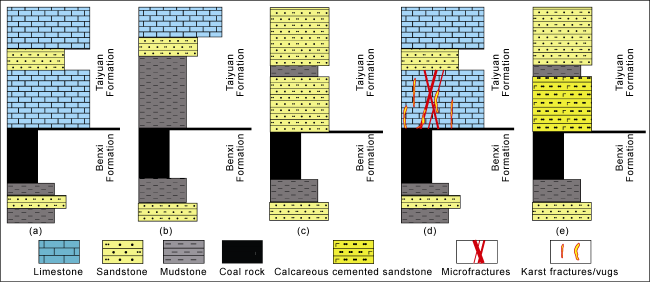
Fig. 8. Coal rock gas accumulation and dissipation combinations of the Benxi Formation in the Ordos Basin. (a) Coal rock-limestone gas accumulation combination; (b) Coal rock-mudstone gas accumulation combination; (c) Coal rock-sandstone gas dissipation combination; (d) Coal rock-limestone gas dissipation combination; (e) Coal rock-tight sandstone gas accumulation combination. |
3.4. Coal rock gas accumulation and enrichment models
3.4.1. Coal rock gas accumulation
The formation of coal rock is controlled by the burial history and thermal evolution history (Fig. 9 ). After the deposition, the Benxi Formation in the Ordos Basin underwent a burial and coalification process for approximately 150 Ma. In this process, the paleo-geothermal temperature rose gradually to over 160 °C, and the coal rank progressed to coking coal, lean coal, meager coal and even anthracite. During the late Early Cretaceous, tectothermal events led to an increase in the geothermal gradient to around 4.5 °C/100 m. After the Late Cretaceous, the strata gradually uplifted, resulting in a gradual decrease in geothermal temperature, with the geothermal gradient evolving to approximately 2.8 °C/100 m. Presently, the geothermal temperature increases gradually from east to west, ranging from 65 °C in the eastern part to approximately 135 °C in the Tianhuan Depression.
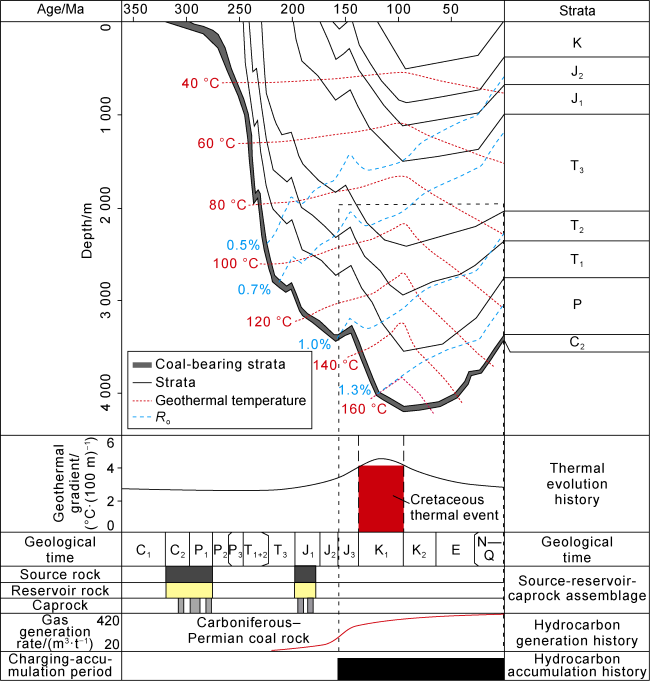
Fig. 9. Coal rock gas accumulation process in the Ordos Basin. |
The gas generation capacity of coal rock is controlled by coal rank. Generally, hydrocarbon generation is minimal in lignite and long-flame coal ranks. Mainly light oil, condensate, and wet gas are generated in gas coal, fat coal, and coking coal ranks. Methane gas production begins on a large scale in the coking coal rank (equivalent to Ro of 1.2%-1.3%). In the lean coal, meager coal, and anthracite ranks, the generation of liquid hydrocarbons and heavy hydrocarbon gases gradually decreases, while methane gas production continues on a large scale with the gas generation capacity continuously strengthened [22⇓⇓-25].
During the period from coking coal to anthracite (Ro of 1.2%-2.4%), large-scale methane gas generation is coupled with tectothermal events, and also matches the formation of fractured reservoirs under the action of tectonic stress during the Yanshanian and Himalayan (Fig. 9 ). During the continuous generation, methane gas first accumulates in the gas pores formed in the plastic and soft vitrinite, and then accumulates in the cleats formed during coal-rock contraction and the microfractures formed under tectonic stress. After the Cretaceous, with slight uplift of the strata, slight reductions in temperature and pressure occurred. However, the medium- to high-rank coal rocks continued to generate methane gas under high temperature, which provided abundant gas sources for the tight reservoirs in the Upper Paleozoic but also maintained the continuous charging and accumulation of natural gas.
3.4.2. Coal rock gas enrichment models
The natural gas enrichment zones within coal rocks are not only related to the sealing capacity of the surrounding rocks, but also to the distribution and reservoir property of the coal rocks. The coal rock gas in the Ordos Basin belongs to self-generation and self-storage natural gas, primarily charging into the micropores and cleats in coal rock matrix under specific temperature and pressure. Within the coal rock intervals, five coal rock gas enrichment models are recognized according to the coal rock morphology and its relationship with surrounding rocks (Fig. 10 ): (1) Lateral pinchout complex enrichment: The coal rock thins and pinches out in the up-dip direction, and transforms into tight mudstone to serve as good seal. The internal pores and fractures are relatively developed, resulting in localized enrichment of coal rock gas. (2) Lens enrichment: Coal rock bodies formed in local swamps gradually thin outwards, and are sealed by mudstones. The natural gas generated by the coal rock accumulates in the coal rock reservoir. (3) Low-amplitude structures and (4) nose-like structures enrichment: These important coal rock gas enrichment models are formed locally within the basin under the influence of tectonic stress in multiple periods. First, during the Indosinian period, due to the north-south compression caused by the Siberian and Yangtze plates, the Qinling Ocean was scissor-closed, resulting in a nearly S-N compressional stress which deformed the strata. Second, during the Yanshanian period, due to the remote tectonic effect induced by the collision between the ancient Pacific plate and the Asian continental plate, there was a principal stress compression from northwest to southeast in the central-eastern basin. Third, during the Himalayan period, under the combined effects of the Neo-tethys tectonic dynamic system and the present-day Pacific tectonic dynamic system, the collision between the Indian plate and the Eurasian plate formed a stress compression from northeast to southwest [36]. These three periods of tectonic stress promoted the development of joint fractures in coal rocks with low compressive strength. (5) Self-sealing enrichment: In localized reservoir zones formed by lateral variations in coal rock properties in gentle parts of the strata, self-sealing enrichment zones of coal rock gas are formed, with surrounding tight coal rocks as seals.
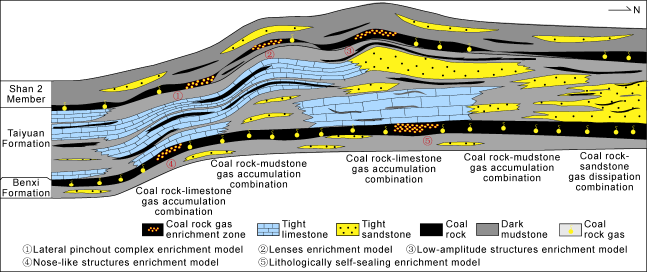
Fig. 10. Types and models of coal rock gas enrichment in the Ordos Basin. |
The coal rock gas in the Benxi Formation exhibits characteristics of source-reservoir integration, widespread distribution of medium-to-high rank coal rocks continually generating gas, matrix pores and cleats/fractures in coal rocks acting as large-scale reservoir space, tight cap rocks providing sealing, and five efficient enrichment patterns.
4. Comprehensive evaluation and target selection
4.1. Resource assessment and exploration potential
Previous studies have conducted multiple evaluations of coalbed methane resources [37-38], mainly in medium and shallow layers. There have been no reports on the assessment of coal rock gas resources with depth exceeding 2 000 m in the central part of the Ordos Basin. In this study, a preliminary estimation of the #8 coal rock gas resources in the exploration area of China National Petroleum Corporation was carried out to delineate the overall potential and distribution of coal rock gas resources in the basin, aiming to support the coal rock gas exploration and development. Due to the lack of relevant standards for resources/reserves estimation, this study divided the evaluation of coal rock gas resources in the basin into eight plays, based on data such as coal rock thickness, thermal evolution degree, and the relationship between coal rock and overlying rocks (Fig. 11 and Table 4 ). The volumetric method was used for estimating the resources as per the formula:
$G\text{=0}\text{.01}AHDC$
The calculation unit area is measured according to the coal rock thickness map. The effective thickness of coal rock is calculated based on the weighted average thickness of each unit on the coal rock thickness map. Referring to the available drilling and logging data, the density of coal rock in the Ordos Basin is determined as 1.42 t/m3. The gas content of an air-dry basis of coal rock is estimated using the information such as coal rank, Ro value, and burial depth of each unit. Among the above parameters, the area and thickness of each unit are determined according to the coal rock thickness map, with relatively high accuracy. The parameters of coal rock density and gas content are preliminary estimated and need to be modified in future work.
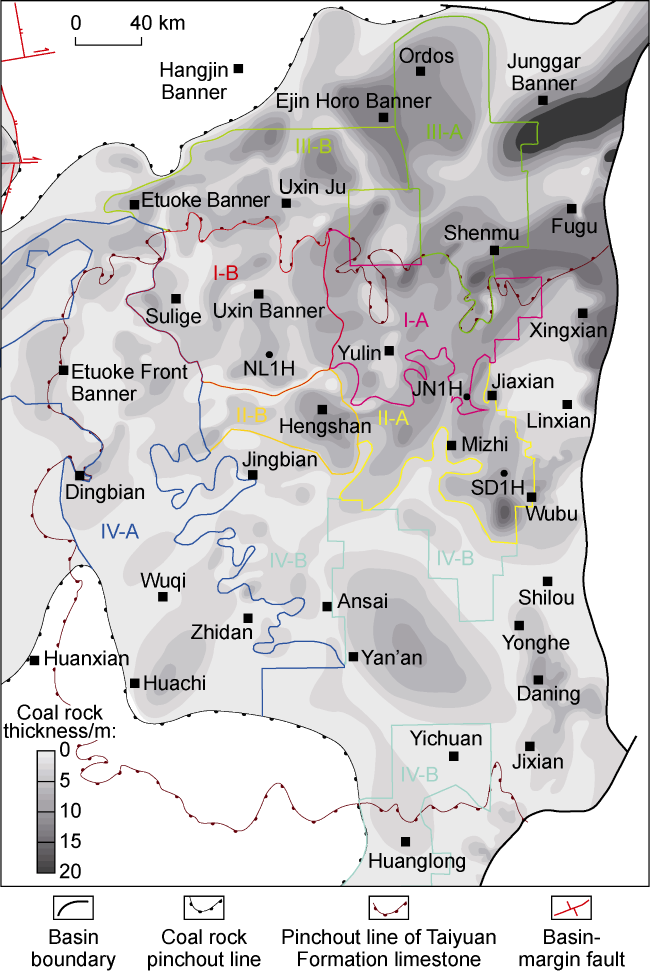


Fig. 11. Comprehensive evaluation of coal rock gas in Benxi Formation of the Ordos Basin. |
Table 4. Division and geological resources of coal rock gas evaluation plays in the Benxi Formation of the Ordos Basin |
| Play | Play code | Ro/% | Coal rank | Depth/m | Area/km2 | Weighted coal rock thickness/m | Geological resources/108 m3 |
|---|---|---|---|---|---|---|---|
| Yulin | I-A | 1.2-1.6 | Medium | 2 000-3 000 | 7 322.4 | 8.02 | 15 010.4 |
| Wushen Banner | I-B | 1.6-2.4 | Medium to high | 3 000-3 800 | 9 386.0 | 4.85 | 13 574.7 |
| Mizhi-Suide | II-A | 1.6-2.4 | Medium to high | 2 000-3 000 | 6 841.1 | 6.87 | 14 014.8 |
| Hengshan | II-B | 1.8-2.4 | Medium to high | 3 000-3 500 | 3 522.1 | 5.19 | 5 451.0 |
| Ordos | III-A | 0.8-1.2 | Medium to high | 1 000-2 500 | 9 811.9 | 8.57 | 11 940.5 |
| Wushen Ju | III-B | 1.0-2.0 | Low | 2 500-3 700 | 8 361.7 | 6.83 | 16 219.3 |
| Dingbian-Huachi-Zhidan | IV-A | 1.4-2.8 | Medium to high | 3 500-4 000 | 27 800.0 | 4.00 | 28 422.7 |
| Ansai-Qingjian-Huanglong | IV-B | 1.8-3.0 | Medium to high | 1 500-4 000 | 18 300.0 | 4.00 | 18 709.9 |
| Total/Average | 91 345.0 | 6.04 | 123 343.3 |
Based on the above calculations, it is preliminarily estimated that the coal rock gas resources in the Carboniferous Benxi Formation #8 coal rock of the CNPC exploration area (excluding the coalbed methane mining area) are approximately 12.33×10¹² m3, which is conservative relative to the estimated resource abundance (approximately 1.35×10⁸ m3/km2). Nonetheless, the abundant resources lay a solid foundation for the exploration of coal rock gas.
4.2. Play evaluation and risk target determination
Division and evaluation of coal rock gas plays in the basin were conducted based on the geological conditions of coal rocks, such as depositional environment of cap rock, thickness, coal rock-cap rock combination, thermal maturity and burial depth. The coal rocks of Benxi Formation in the Ordos Basin were divided into eight plays, belonging to classes I, II, III, and IV. Each class was subdivided into plays A and B based on the internal geological conditions (Fig. 11 and Table 5 ). Classes I and II plays are dominated by mudstone and tight limestone cap rocks developed in the delta front and pro-delta sedimentary environments. They have thick coal rocks, which are predominantly medium to high ranks and deeply buried, with peak values of total hydrocarbons exceeding 80%. They represent the most favorable coal rock gas accumulation plays in the basin. Class III plays are mainly distributed in delta plains in the northern part, with thick coal rocks, and predominant sandstone cap rocks, suggesting moderate preservation conditions. Moreover, the coal rocks exhibit relatively low peak values of total hydrocarbon, and increasing burial depth and gas content from east to west. Class IV plays are mainly deposited in delta front intertidal and subtidal shallow marine environments, characterized by relatively thin coal rocks, good sealing conditions with mudstone and tight limestone cap rocks, high thermal evolution degree, deep burial depths, and large area coverage.
Table 5. Comprehensive evaluation of coal rock gas in the Benxi Formation of the Ordos Basin |
| Play code | Play | Depositional environment | Caprock thickness/m | Thickness of coal seam/m | Combination type | Peak value of total hydrocarbon/% | Well deployed |
|---|---|---|---|---|---|---|---|
| I-A | Yulin | Delta front | 2-13 | 4-14 | Coal rock-mudstone gas accumulation combination | 91 | JN1H |
| I-B | Wushen Banner | 2-19 | 80 | NL1H | |||
| II-A | Mizhi-Suide | Barrier- lagoon in delta front | 30-50 | 4-16 | Coal rock-limestone gas accumulation combination | 100 | SD1H |
| II-B | Hengshan | 2-10 | 80 | ||||
| III-A | Ordos | Delta plain | 8-26 | 4-20 | Coal rock-sandstone gas accumulation and dissipation combination | 30 | |
| III-B | Wushen Ju | 2-12 | 48 | ||||
| IV-A | Dingiban-Huachi- Zhidan | Shallow marine- lagoon in delta front | 8-15 | 2-6 | Coal rock-mudstone gas accumulation combination | 40 | |
| IV-B | Ansai-Qingjian- Huanglong | 2-6 | Coal rock-limestone gas accumulation combination | 58 |
Based on various factors such as coal rock thickness, coal rank, total hydrocarbons of wells, accumulation and dissipation combinations, and burial depth, three risk exploration wells, JN1H, NL1H, and SD1H, were deployed in plays I-A, I-B, and II-A, respectively, in 2022 (Fig. 11 ). Among these, Well JN1H focused on exploring accumulation characteristics of the coal rock-mudstone gas accumulation combination at a depth of approximately 2 300 m in the Jidong mining area of southern Jiaxian County. Well NL1H targeted the coal rock gas characteristics of the coal rock-mudstone gas accumulation combination at a depth exceeding 3 300 m in southern Wushen Banner. Well SD1H aimed to explore the gas reservoir characteristics of the coal rock-limestone gas accumulation combination with significant coal-rock thickness at a depth of 2 200 m within the Suide County.
4.3. Exploration breakthroughs and implications
4.3.1. Exploration breakthroughs in risk exploration and evaluation
Both wells NL1H and JN1H were drilled, fractured and tested by the end of 2022. Well NL1H, with a horizontal section length of 1 500 m, encountered coal rocks of 760 m with a drilling penetration rate of 50.7% and the peak value of total hydrocarbon of 78.5%. After sand-fracturing, it witnessed gas breakthrough immediately after flowback, and revealed a production rate of 5.4×10⁴ m3/d through a 12 mm nozzle. As of November 21, 2023, the well achieved a stable production rate of 2.7×10⁴ m3/d, and a cumulative production exceeding 1 120×104 m3. Well JN1H, with a horizontal section length of 2 211 m, encountered coal rocks of 1 556 m with a drilling penetration rate of 70.38% and the peak value of total hydrocarbon of 99.9%. After sand-fracturing, it showed gas flow immediately after flowback, and revealed a production rate of 8.162×10⁴ m3/d through a 12 mm nozzle. As of November 6, 2023, the well achieved a stable production rate of 4.4×10⁴ m3/d and a cumulative production exceeding 1 200×104 m3.
From 2022 to 2023, Changqing Oilfield had successfully drilled 32 horizontal wells in classes I and II plays, revealing high-yield gas flow in testing. Five wells had production rate exceeding 10×104 m3/d. Typically, Well HT8 demonstrated a test production rate of 18.2×10⁴ m3/d, and an appraisal well with horizontal section length exceeding 2 000 m contributed a test production rate of 28.9×10⁴ m3/d. In November 2023, Changqing Oilfield submitted predicted reserves exceeding a trillion cubic meters and proven reserves exceeding 1 200×108 m3. These recorded strategic breakthroughs in coal rock gas exploration.
4.3.2. Insights and significance of exploration breakthroughs
Through systematic evaluation on the Benxi Formation coal rocks in the Ordos Basin, risk exploration wells were successfully deployed depending on accumulation and dissipation combinations and burial depths. These achievements have far-reaching implications. (1) Coal rock gas in the Ordos Basin possesses immense exploration potential. Breakthroughs in exploration indicate favorable geological conditions for coal rock gas accumulation, laying the foundation for new areas of natural gas exploration in the Ordos Basin. (2) Geological understanding of coal rock gas is correct. The quantitative change in coal rock burial depth leads to a qualitative change in coal rock gas reservoir characteristics. Coal rock gas reservoirs with burial depth exceeding 2 000 m exhibit unique characteristics of "one-deep, ten-high" in terms of coal quality, storage capacity, accumulation and dissipation combination, gas content, gas occurrence mode, and geochemical characteristics. The enrichment mechanism of coal rock gas was discussed from a completely new perspective, preparing for the exploration of various types of coal rock gas reservoirs. (3) Engineering technologies were developed for coal rock gas exploration and development. In exploration practices, technologies for coal rock gas reservoirs were developed, including coal rock geological modeling and seismic prediction, steering drilling of coal-rock horizontal wells, large-scale volume fracturing and pressure-controlled coal rock gas production. These technologies will support the subsequent evaluation and development. (4) The breakthroughs can promote coal rock gas exploration in other coal-bearing basins in China. The success of coal rock gas exploration in the Ordos Basin has triggered the deployment of risk exploration wells in coal-bearing basins such as Sichuan, Bohai Bay, Songliao and Hailar. These results will drive the rapid development of coal rock gas industry in China and produce significant economic and social benefits.
5. Conclusions
Coal rock gas is a type of efficient natural gas following the mechanism of self-generation and self-storage in medium- to high-rank coal rocks, and it exhibits the characteristics of "one-deep, ten-high". The Benxi Formation coal rocks in the Ordos Basin are promising to explore for their widespread distribution, stable thickness, good coal quality, high evolution degree, strong gas generation capacity and large quantity of resources.
The coal rocks of the Benxi Formation developed numerous microfractures under the tectonic stress during the Yanshanian and Himalayan, which together with the gas pores, organic matter pores and inorganic mineral pores in the coal rock matrix, form a favorable three-dimensional pore-fracture storage space. Five types of coal rock gas accumulation and dissipation combinations are recognized. Typically, the coal rock-mudstone and coal rock-limestone gas accumulation combinations are the most important with good sealing conditions and high peak values of total hydrocarbon. The Benxi Formation coal rocks are characterized by source-reservoir integration, widespread distribution of medium-to-high rank coal rocks continually generating gas, matrix pores and cleats/fractures in coal rocks acting as large-scale reservoir space, tight cap rocks providing sealing, and five types of highly efficient enrichment models (lateral pinchout complex, lenses, low-amplitude structures, nose-like structures and lithologically self-sealing).
Eight coal rock gas plays were identified for evaluation, with estimated coal rock gas resources of over 12.33×10¹² m3 at depth exceeding 2 000 m. Successful risk exploration has led to the submission of predicted reserves exceeding a trillion cubic meters and proven reserves exceeding one hundred billion cubic meters. These results hold significant implications for the increase in natural gas reserves and efficient development in China.
The coal rocks of the Benxi Formation of the Ordos Basin, with extensive distribution, rich coal rock gas resources and favorable enrichment conditions, represent a new strategic target for natural gas development. Although a certain understanding of the enrichment mechanism of coal rock gas has been obtained at present, there are still many issues that need to be explored from both theoretical and practical perspectives. Such issues include hydrocarbon generation processes in deep coal rocks, reservoir formation mechanism, mechanisms of high-content free gas under high-temperature and high-pressure, coal rock gas accumulation processes and differentiated enrichment laws.
Acknowledgments
The authors would like to express their sincere gratitude to experts such as Du Jinhu, Zhang Yijie, Guo Xujie, and Yang Fan for their careful guidance and assistance in this study.
Nomenclature
A—area of calculation unit, km2;
C—gas content of an air-dry basis of coal-rock, m3/t;
D—density of coal rock, t/m3;
G—coal rock gas resources of calculation unit, 108 m3;
H—effective thickness of coal rock, m.