

Introduction
The Ordos Basin is one of the important onshore natural gas producing areas in China, and the Upper Paleozoic Carboniferous-Permian strata are the main series of strata for gas exploration. Several large gas fields including Sulige and Daniudi with the proven reserves exceeding 1 000×108 m3 have been discovered in the basin, and the main gas source is the Upper Paleozoic (Carboniferous Taiyuan Formation and Permian Shanxi Formation) coal-measure source rocks [1⇓⇓⇓⇓⇓⇓-8]. With the expansion of exploration to the periphery of the basin in recent years, the Dongsheng gas field was discovered in the Hangjinqi area on the northern margin, and the proven gas reserves reached 1 926.74×10⁸ m3 by the end of June 2021 [9]. Natural gas is mainly enriched in the Duguijiahan area and Shiguhao area to the south and north of the Borjianghaizi fault, respectively [9].
Natural gas accumulation in the Dongsheng gas field was controlled by the Borjianghaizi fault [10]. The Upper Paleozoic source rocks to the south of the Borjianghaizi fault are characterized by large thickness, good quality and high evolution degree, while those to the north of the fault display the opposite characteristics [11-12]. The identification of natural gas origin and the gas-source correlation reveal that the Upper Paleozoic gas in the Dongsheng gas field is typical coal-derived gas [13-14]. Some scholars considered that natural gas in the Hangjinqi area had not experienced obvious lateral migration [11]. However, based on the analysis of main components and carbon isotope composition of natural gas in most cases, natural gas to the south of the fault was believed to experience vertical short-distance migration and near-source accumulation and be derived from the in-situ source rocks in the Carboniferous Taiyuan-Permian Shanxi formations, whereas the gas to the north of the fault mainly experienced distal-source accumulation and was migrated vertically and laterally in long-distance from the Shilijiahan area to the south of the fault [10,13⇓⇓ -16]. The migration phase of natural gas in the area is not understood clearly at present, and the formation water is commonly developed in the Lower Shihezi Formation reservoirs on both sides of the fault [17]. It remains to be analyzed whether the natural gas migrates in water-soluble phase or free phase, and whether it has undergone secondary alterations such as water dissolution and diffusion loss after accumulation.
Migration will cause regular variations in the geochemical characteristics of natural gas, and previous studies focused on the influence of migration on the component content and carbon isotope value of natural gas [18⇓-20]. Light hydrocarbon compounds are important trace components in natural gas, and their rich geochemical information makes them play an important role in the identification of natural gas origin, gas-source correlation, maturity determination, migration phase identification, etc. [4,21⇓⇓⇓⇓⇓ -27]. Moreover, the effects of evaporative fractionation and water dissolution will also cause regular changes in some light hydrocarbon parameters, which should be considered in application [28⇓⇓⇓-32]. The geochemical characteristics of light hydrocarbons in natural gas have been widely used in gas-source correlation and identification of secondary alteration, migration direction and phase state of natural gas in the medium-large gas fields in China [4,24]. Previous studies on the alteration effect of migration on light hydrocarbons mainly focused on determining the migration phase states according to the differences in solubility and polarity of different compounds [26,31]. However, the effects of migration and secondary alteration on common light hydrocarbon parameters and the applicability of common light hydrocarbon indexes and identification patterns still need to be clarified. Therefore, taking natural gas from different regions on both sides of the Borjianghaizi fault in the Dongsheng gas field as an example, this study intends to analyze the composition of light hydrocarbon compounds, reveal the inspiration of geochemical characteristics of light hydrocarbons on the origin, source, migration features and secondary alteration of natural gas, and then analyze the effects of migration and secondary alteration on specific light hydrocarbon indexes and identification patterns, aiming to reveal the migration and accumulation mechanism of natural gas in the Dongsheng gas field and further enrich and improve the contents and methods of geochemical study on light hydrocarbons.
1. Geological setting
The Dongsheng gas field is located in the Hangjinqi area of northern Ordos Basin, spanning three first-order structural units, namely Yimeng Uplift, Tianhuan Depression and Yishaan Slope (Fig. 1a ), with a total area of nearly 10 000 km2. This area is a long-term inheriting paleo-uplift in the northern part of the basin, and it is now a monoclinal structure low in southwest and high in northeast, and is a favorable area for oil and gas migration [33]. The Paleozoic tectono-sedimentary evolution in the Hangjinqi area was controlled by three main faults, i.e., Sanyanjing, Wulanjilinmiao and Borjianghaizi [12] (Fig. 1b ). According to the relief of the basement top surface and structural morphology, the Hangjinqi exploration area can be divided into Western Xinzhao, Eastern Xinzhao, Duguijiahan, Shilijiahan, Gongkahan, Shiguhao and Azhen zones (Fig. 1b ). The proved natural gas reserves at present are mainly located in the Duguijiahan area (1 529.09×10⁸ m3) assisted by the Shiguhao zone (162.87×10⁸ m3) and the Eastern Xinzhao zone (234.78×10⁸ m3). The gas-water relationship in the Dongsheng gas field is complicated with unobvious differentiation of gas and water [17]. Natural gas in the Dongsheng gas field is mainly enriched in the Lower Permian Lower Shihezi Formation (P1x) sandstone reservoirs, and a small amount is also discovered in other sandstone reservoirs such as the Lower Permian Shanxi Formation (P1s) in local areas (Fig. 2 ). The overall physical properties of the reservoirs are mainly low porosity and low permeability [34]. The main source rocks are coal measures in the Taiyuan Formation (C3t) and Shanxi Formation (Fig. 2 ), mainly with type III kerogen.
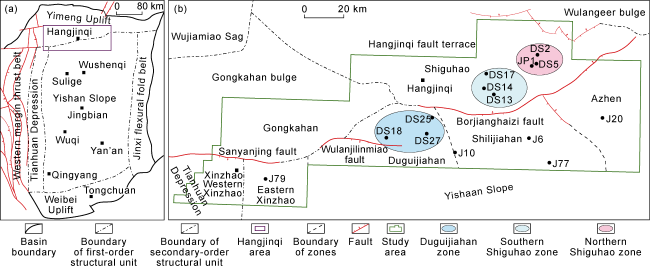
Fig. 1. Location of Dongsheng gas field in Ordos Basin (a) and well location distribution in study area (b) (modified from Reference [17]). |
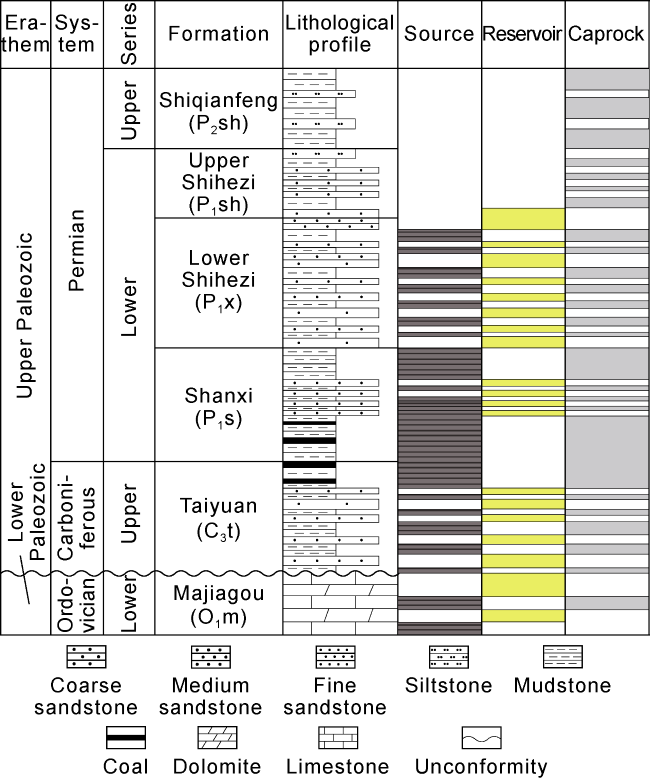
Fig. 2. Comprehensive stratigraphic column of the Dongsheng gas field. |
The quality, thermal evolution degree and distribution characteristics of source rocks on both sides of the Borjianghaizi fault are obviously different. The organic matter abundance of the dark mudstone to the south of the fault mainly reaches the medium standard of source rock, and vitrinite reflectance (Ro) is generally higher than 1.1%, suggesting late mature to high-mature stage, with the thickness of the dark mudstone mainly 30-50 m. However, the P1s dark mudstone to the north of the fault is mainly poor source rocks, and only a few meet the medium standard of source rocks. The Ro values are generally lower than 1.0%, suggesting mainly in early mature stage, and the thickness is commonly between 10 m to 30 m. The caprock in the Dongsheng gas field is the mudstone of the Upper Shihezi Formation (P1sh) and Shiqianfeng Formation (P2sh) (Fig. 2 ) with the thickness of 130-160 m and stable distribution [15].
2. Compositions of light hydrocarbons and methane carbon isotopes
In order to better reveal the response of geochemical characteristics of light hydrocarbons to migration features and secondary alteration of natural gas, as well as the effect of migration and secondary alteration on specific light hydrocarbon indexes and identification patterns, a total of 30 natural gas samples distributed in Duguijiahan, Southern Shiguhao and Northern Shiguhao zones were collected from the Lower Shihezi Formation of the Dongsheng gas field. The components of light hydrocarbon compounds (C5−7) and natural gas were analyzed by using Agilent 6890N gas chromatograph, and referring to Hu et al. [29] for the specific analytical process. The carbon isotope composition of methane was analyzed by using MAT-253 stable isotope mass spectrometer. Relevant measurements were carried out in the Key Laboratory of Hydrocarbon Accumulation of China Petroleum and Chemical Corporation Limited (SINOPEC). The light hydrocarbon chromatograms of typical samples are shown in Fig. 3 , and the analytical results are shown in Table 1.
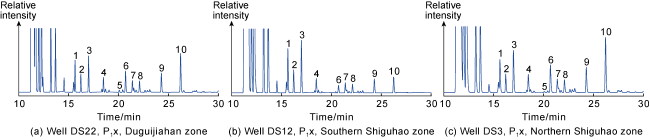
Fig. 3. Chromatograms of light hydrocarbons in natural gas from the Lower Shihezi Formation in Dongsheng gas field. 1—2-methylpentane; 2—3-methylpentane; 3—n-hexane; 4—methylcyclopentane; 5—benzene; 6—cyclohexane; 7—2-methylhexane; 8—3-methylhexane; 9—n-heptane; 10—methylcyclohexane. |
Table 1. Relative compositions of light hydrocarbons and methane carbon isotopic values of natural gas from the Lower Shihezi Formation in Dongsheng gas field |
| Zone | Well | Horizon | C5−7 relative content/% | C6−7 relative content/% | C7 relative content/% | Index of methylcyclohexane/% | Dryness coefficient | δ13C1/ ‰ | ||||||
|---|---|---|---|---|---|---|---|---|---|---|---|---|---|---|
| n-C5−7 | iso-C5−7 | cyc-C5−7 | Paraffins | Cycloalkanes | Aromatics | Various dimethylcyclopentane | n- heptane | Methylcyclohexane | ||||||
| Duguijiahan | DS18 | P1x | 25.3 | 47.6 | 27.1 | 60.2 | 37.8 | 2.0 | 12.0 | 26.9 | 61.1 | 59.3 | 0.976 | −32.1 |
| DS19 | P1x | 27.4 | 44.3 | 28.3 | 56.2 | 41.5 | 2.3 | 16.2 | 25.2 | 58.6 | 57.2 | 0.965 | −33.1 | |
| DS20 | P1x | 26.4 | 43.5 | 30.1 | 56.0 | 41.4 | 2.6 | 13.2 | 26.1 | 60.7 | 59.3 | 0.973 | −32.3 | |
| DS21 | P1x | 29.9 | 40.4 | 29.7 | 57.6 | 42.4 | 0 | 11.4 | 28.8 | 59.8 | 59.8 | 0.973 | −33.1 | |
| DS22 | P1x | 27.7 | 46.0 | 26.3 | 59.7 | 38.5 | 1.8 | 14.2 | 26.9 | 58.9 | 57.5 | 0.965 | −32.4 | |
| DS23 | P1x | 29.5 | 38.8 | 31.7 | 56.0 | 40.9 | 3.1 | 13.7 | 27.0 | 59.3 | 58.2 | 0.961 | −32.9 | |
| DS24 | P1x | 27.8 | 44.3 | 27.9 | 59.1 | 38.9 | 2.0 | 15.7 | 28.8 | 55.5 | 53.9 | 0.965 | −32.7 | |
| DS25 | P1x | 31.4 | 44.3 | 24.3 | 62.7 | 36.3 | 1.0 | 15.5 | 30.4 | 54.1 | 52.9 | 0.953 | −33.1 | |
| DS26 | P1x | 14.5 | 58.2 | 27.3 | 57.5 | 38.7 | 3.8 | 16.8 | 26.9 | 56.3 | 55.4 | 0.961 | −33.1 | |
| DS27 | P1x | 30.2 | 43.3 | 26.5 | 59.2 | 39.6 | 1.2 | 16.8 | 27.4 | 55.8 | 54.8 | 0.955 | −33.6 | |
| DS28 | P1x | 29.3 | 44.3 | 26.4 | 59.9 | 38.9 | 1.2 | 14.0 | 27.9 | 58.1 | 56.8 | 0.972 | −32.9 | |
| DS29 | P1x | 29.2 | 45.2 | 25.6 | 62.1 | 36.4 | 1.5 | 12.5 | 30.5 | 57.0 | 55.5 | 0.975 | −32.0 | |
| DS30 | P1x | 26.0 | 45.5 | 28.5 | 59.5 | 39.1 | 1.4 | 11.8 | 27.8 | 60.4 | 58.7 | 0.970 | −32.3 | |
| Southern Shiguhao | DS11 | P1x | 40.3 | 51.3 | 8.4 | 78.4 | 21.6 | 0 | 12.2 | 40.6 | 47.2 | 45.5 | 0.930 | −32.2 |
| DS12 | P1x | 37.9 | 49.7 | 12.4 | 76.9 | 23.1 | 0 | 19.5 | 35.0 | 45.5 | 44.7 | 0.950 | −32.2 | |
| DS13 | P1x | 32.4 | 41.6 | 26.0 | 59.2 | 39.2 | 1.6 | 13.2 | 29.2 | 57.6 | 56.5 | 0.946 | −32.2 | |
| DS14 | P1x | 33.5 | 40.3 | 26.2 | 60.7 | 37.8 | 1.5 | 13.9 | 28.3 | 57.8 | 56.9 | 0.940 | −32.3 | |
| DS15 | P1x | 32.5 | 42.1 | 25.4 | 59.6 | 39.2 | 1.2 | 14.6 | 28.9 | 56.5 | 55.6 | 0.933 | −32.9 | |
| DS16 | P1x | 34.4 | 41.6 | 24.0 | 61.0 | 37.0 | 2.0 | 14.8 | 30.1 | 55.1 | 54.2 | 0.934 | −32.6 | |
| DS17 | P1x | 30.4 | 40.2 | 29.4 | 54.1 | 44.3 | 1.6 | 13.9 | 24.5 | 61.6 | 60.7 | 0.946 | −33.1 | |
| Northern Shiguhao | DS1 | P1x | 31.7 | 43.2 | 25.1 | 59.4 | 39.2 | 1.4 | 13.5 | 28.2 | 58.3 | 57.1 | 0.945 | −32.1 |
| DS2 | P1x | 32.7 | 42.6 | 24.7 | 60.5 | 39.0 | 0.5 | 15.2 | 27.1 | 57.7 | 56.8 | 0.935 | −32.3 | |
| DS3 | P1x | 31.5 | 40.8 | 27.7 | 56.7 | 42.4 | 0.9 | 14.0 | 26.1 | 59.9 | 58.7 | 0.945 | −32.0 | |
| DS4 | P1x | 33.6 | 44.5 | 21.9 | 64.0 | 35.5 | 0.5 | 15.6 | 30.4 | 54.0 | 53.1 | 0.946 | −32.0 | |
| DS5 | P1x | 28.9 | 41.4 | 29.7 | 53.8 | 44.7 | 1.5 | 14.4 | 25.5 | 60.1 | 59.0 | 0.942 | −31.9 | |
| DS6 | P1x | 32.1 | 41.2 | 26.7 | 60.0 | 39.3 | 0.7 | 14.9 | 28.3 | 56.8 | 55.7 | 0.934 | −32.3 | |
| DS7 | P1x | 32.6 | 43.9 | 23.5 | 61.9 | 37.4 | 0.7 | 14.7 | 29.1 | 56.2 | 55.1 | 0.937 | −32.2 | |
| DS8 | P1x | 33.3 | 42.4 | 24.3 | 60.4 | 38.6 | 1.0 | 17.8 | 28.4 | 53.8 | 52.8 | 0.946 | −31.9 | |
| DS9 | P1x | 35.0 | 42.1 | 22.9 | 63.2 | 36.0 | 0.8 | 17.0 | 32.2 | 50.8 | 49.9 | 0.944 | −32.6 | |
| DS10 | P1x | 35.1 | 43.4 | 21.5 | 64.9 | 34.7 | 0.4 | 15.7 | 38.4 | 45.9 | 44.7 | 0.924 | −32.1 | |
2.1. Compositions of C5−7 light hydrocarbons
In the relative compositions of C5−7 light hydrocarbons of natural gas from the Dongsheng gas field, the n-alkane (n-C5−7), iso-alkane (iso-C5−7) and cycloalkane (cyc-C5−7) contents are 14.5%-31.4%, 38.8%-58.2%, and 24.3%-31.7% in the Duguijiahan zone, respectively (Table 1 ). They are 30.4%-40.3%, 40.2%-51.3% and 8.4%-29.4% in Southern Shiguhao zone, respectively, and 28.9%-35.1%, 40.8%-44.5% and 21.5%-29.7% in Northern Shiguhao zone, respectively (Table 1 ). The P1x gas samples from different zones display consistent compositions of C5−7 light hydrocarbons, and the iso-C5−7 are more enriched than the n-C5−7. The relative content of iso-C5−7 in natural gas from the Duguijiahan zone is slightly higher than that from Southern and Northern Shiguhao zones (Fig. 4a ).
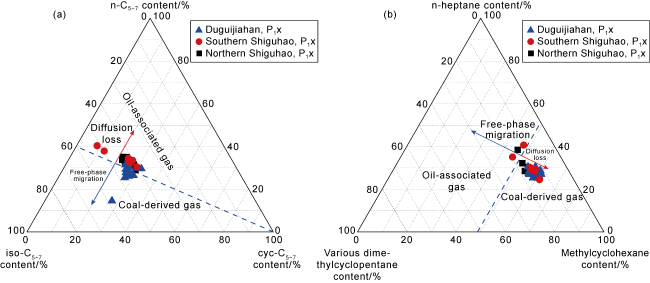
Fig. 4. Ternary diagrams of relative compositions of C5−7 (a) and C7 (b) light hydrocarbons in natural gas from the Dongsheng gas field (modified from Reference [36]). |
2.2. Compositions of C6−7 light hydrocarbons
The relative paraffin, cycloalkane and aromatic contents of C6−7 light hydrocarbons in natural gas are 56.0%-62.7%, 36.3%-42.4%, and 0-3.8% in the Duguijiahan zone, respectively (Table 1 ). They are 54.1%-78.4%, 21.6%-44.3% and 0-2.0% in Southern Shiguhao zone, respectively, and 53.8%-64.9%, 34.7%-44.7% and 0.4%-1.5% in Northern Shiguhao zone, respectively (Table 1 ). The C6−7 light hydrocarbon compositions of natural gas from different zones display dominant distribution of paraffins with significantly low aromatic contents (less than 4.0%), and the aromatics are even undetectable in some samples (Fig. 3b , Table 1 ).
2.3. Compositions of C7 light hydrocarbons
In the C7 light hydrocarbon compositions of natural gas, the relative contents of dimethylcyclopentane, n-heptane and methylcyclohexane are 11.4%-16.8%, 25.2%-30.5% and 54.1%-61.1% in the Duguijiahan zone, respectively. They are 12.2%-19.5%, 24.5%-40.6% and 45.5%-61.6% in Southern Shiguhao zone, respectively, and 13.5%-17.8%, 25.5%-38.4% and 45.9%-60.1% in Northern Shiguhao zone, respectively (Table 1 ). The C7 light hydrocarbons of the P1x gas from different zones mainly display the dominant distribution of methylcyclohexane (Fig. 4b ), and the indexes of methylcyclohexane [35] are 52.9%-59.3%, 44.7%-60.7% and 44.7%-59.0%, respectively, which are generally higher than 50%.
2.4. Dryness coefficients and methane carbon isotope compositions
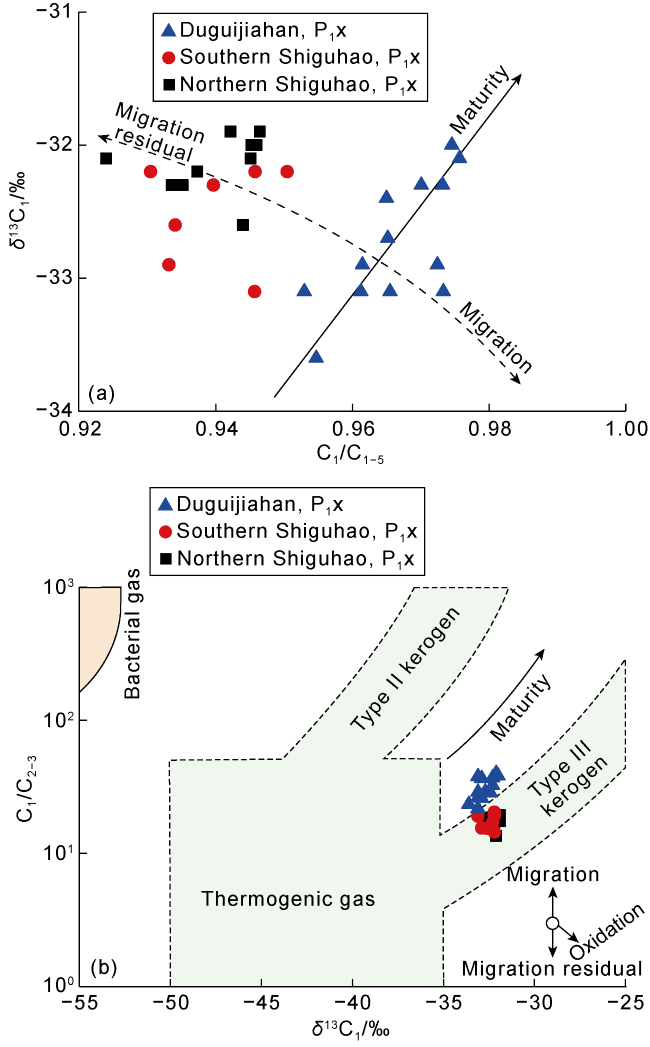
The dryness coefficient of natural gas in the Duguijiahan zone ranges from 0.953 to 0.976 with an average of 0.967, suggesting typical dry gas, whereas that in Southern and Northern Shiguhao zone is significantly lower and consistent, and ranges from 0.930 to 0.950 and from 0.924 to 0.946, respectively, with an average of 0.940, mainly suggesting wet gas (Table 1 , Fig. 5a ). The δ13C1 values of natural gas from the Duguijiahan, Southern Shiguhao and Northern Shiguhao zones are −33.6‰ to −32.0‰, −33.1‰ to −32.2‰, and −32.6‰ to −31.9‰, respectively, with the average values of −32.7‰, −32.5‰ and −32.1‰, respectively (Table 1 , Fig. 5a , 5b ), displaying consistent distribution ranges.
3. Indication of light hydrocarbons on the thermal evolution of source rocks and source of natural gas
3.1. Thermal evolution degree of source rocks
Since the alkylation degree of crude oil increases with thermal evolution degree, Thompson [22,39] proposed to make use of the heptane and isoheptane values to identify the maturity of organic matter. The heptane values of the P1x natural gas in the Duguijiahan, Southern Shiguhao and Northern Shiguhao zones of the Dongsheng gas field are 15.8%-18.2%, 15.1%-25.3% and 14.2%-22.7%, respectively, whereas the isoheptane values are 2.15-3.82, 2.17-2.99 and 1.97-2.73, respectively (Table 2 ). Natural gas samples from the Dongsheng gas field mainly display high mature characteristics in the correlation diagram between heptane and isoheptane values, whereas a small part of the samples display mature characteristics (Fig. 6 ). The heptane and isoheptane values of natural gas from different zones are generally consistent respectively, in which some samples from the Duguijiahan zone display slightly higher isoheptane values (greater than 3), whereas some samples in Southern and Northern Shiguhao zone have higher heptane values (greater than 20%) (Fig. 6 ). These samples were probably affected by migration, water dissolution and other factors, and it is necessary to be cautious in identifying maturity directly.
Table 2. Geochemical parameters of light hydrocarbons in natural gas from the Dongsheng gas field |
| Zone | Well | Horizon | Heptane value/% | Isoheptane value | 2,4-DMP/ 2,3-DMP | Maximum burial temperature of source rocks/°C | Ben/nC6 | Ben/CH | nC7/MCH | Tol/nC7 | K1 | K2 |
|---|---|---|---|---|---|---|---|---|---|---|---|---|
| Duguijiahan | DS18 | P1x | 16.2 | 3.82 | 0.648 | 133.5 | 0.096 | 0.126 | 0.440 | 0.107 | 1.12 | 0.49 |
| DS19 | P1x | 16.0 | 2.15 | 0.754 | 135.8 | 0.101 | 0.159 | 0.430 | 0.124 | 1.12 | 0.34 | |
| DS20 | P1x | 16.1 | 2.82 | 0.665 | 133.9 | 0.134 | 0.165 | 0.429 | 0.115 | 1.12 | 0.39 | |
| DS21 | P1x | 17.9 | 2.52 | 0.678 | 134.2 | 0 | 0 | 0.481 | 0 | 1.12 | 0.30 | |
| DS22 | P1x | 16.3 | 2.82 | 0.680 | 134.2 | 0.070 | 0.103 | 0.457 | 0.103 | 1.13 | 0.42 | |
| DS23 | P1x | 16.2 | 2.66 | 0.671 | 134.0 | 0.098 | 0.132 | 0.456 | 0.194 | 1.13 | 0.37 | |
| DS24 | P1x | 17.4 | 2.70 | 0.827 | 137.2 | 0.082 | 0.133 | 0.518 | 0.104 | 1.11 | 0.36 | |
| DS25 | P1x | 18.2 | 2.65 | 0.785 | 136.4 | 0.033 | 0.063 | 0.564 | 0.051 | 1.12 | 0.33 | |
| DS26 | P1x | 15.8 | 2.25 | 0.789 | 136.4 | 0.134 | 0.211 | 0.476 | 0.232 | 1.11 | 0.32 | |
| DS27 | P1x | 16.9 | 2.16 | 0.786 | 136.4 | 0.033 | 0.059 | 0.491 | 0.078 | 1.12 | 0.30 | |
| DS28 | P1x | 17.1 | 2.71 | 0.701 | 134.7 | 0.041 | 0.066 | 0.480 | 0.072 | 1.13 | 0.37 | |
| DS29 | P1x | 18.2 | 3.51 | 0.738 | 135.4 | 0.065 | 0.105 | 0.535 | 0.055 | 1.12 | 0.39 | |
| DS30 | P1x | 17.1 | 3.56 | 0.658 | 133.7 | 0.067 | 0.089 | 0.461 | 0.067 | 1.12 | 0.44 | |
| Southern Shiguhao | DS11 | P1x | 25.3 | 2.76 | 1.020 | 140.3 | 0 | 0 | 0.862 | 0 | 1.06 | 0.39 |
| DS12 | P1x | 20.2 | 2.99 | 0.926 | 138.8 | 0 | 0 | 0.771 | 0 | 1.14 | 0.38 | |
| DS13 | P1x | 17.8 | 2.70 | 0.674 | 134.1 | 0.038 | 0.062 | 0.507 | 0.103 | 1.12 | 0.33 | |
| DS14 | P1x | 18.2 | 2.66 | 0.684 | 134.3 | 0.025 | 0.063 | 0.489 | 0.120 | 1.13 | 0.32 | |
| DS15 | P1x | 17.4 | 2.41 | 0.717 | 135.0 | 0.033 | 0.054 | 0.511 | 0.070 | 1.12 | 0.31 | |
| DS16 | P1x | 17.7 | 2.47 | 0.758 | 135.9 | 0.058 | 0.100 | 0.545 | 0.111 | 1.12 | 0.33 | |
| DS17 | P1x | 15.1 | 2.17 | 0.673 | 134.1 | 0.043 | 0.055 | 0.397 | 0.113 | 1.12 | 0.30 | |
| Northern Shiguhao | DS1 | P1x | 17.7 | 2.57 | 0.706 | 134.8 | 0.051 | 0.089 | 0.485 | 0.071 | 1.12 | 0.31 |
| DS2 | P1x | 16.2 | 2.36 | 0.716 | 135.0 | 0.013 | 0.022 | 0.469 | 0.032 | 1.11 | 0.33 | |
| DS3 | P1x | 16.3 | 2.28 | 0.701 | 134.7 | 0.025 | 0.036 | 0.436 | 0.066 | 1.11 | 0.31 | |
| DS4 | P1x | 17.8 | 2.61 | 0.744 | 135.6 | 0.018 | 0.034 | 0.563 | 0.024 | 1.14 | 0.32 | |
| DS5 | P1x | 14.2 | 2.06 | 0.770 | 136.1 | 0.065 | 0.060 | 0.423 | 0.075 | 1.10 | 0.31 | |
| DS6 | P1x | 17.3 | 2.45 | 0.718 | 135.0 | 0.024 | 0.042 | 0.498 | 0.038 | 1.12 | 0.31 | |
| DS7 | P1x | 17.6 | 2.53 | 0.735 | 135.4 | 0.025 | 0.046 | 0.518 | 0.035 | 1.12 | 0.32 | |
| DS8 | P1x | 17.4 | 1.97 | 0.796 | 136.6 | 0.041 | 0.076 | 0.528 | 0.042 | 1.11 | 0.30 | |
| DS9 | P1x | 19.5 | 2.18 | 0.779 | 136.3 | 0.030 | 0.064 | 0.632 | 0.031 | 1.11 | 0.32 | |
| DS10 | P1x | 22.7 | 2.73 | 0.645 | 133.4 | 0.012 | 0.024 | 0.837 | 0.015 | 1.13 | 0.34 |
Note: CH—cyclohexane; MCH—methyl cyclohexane. |
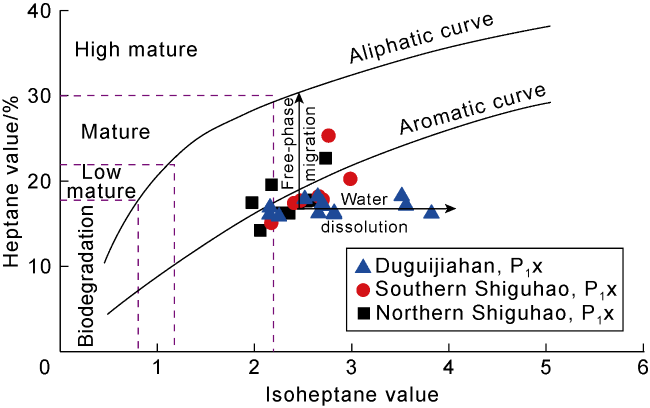
Fig. 6. Correlation diagram between heptane and isoheptane values of natural gas from the Dongsheng gas field (modified from Reference [22]). |
The 2,4-dimethylpentane/2,3-dimethylpentane (2,4-DMP/ 2,3-DMP) value has been considered as a good temperature parameter since it is unaffected by basin type, kerogen type, source rock age, etc. [40], and its correlationship with the maximum burial temperature of source rocks (T) is T=140+15ln(2,4-DMP/2,3-DMP) [21]. The 2,4-DMP/2,3-DMP values of the P1x natural gas from Duguijiahan, Southern Shiguhao and Northern Shiguhao zones in the Dongsheng gas field are 0.648-0.827, 0.673-1.020 and 0.645-0.796, respectively. The calculated maximum burial temperatures of source rocks are 133.5-137.2, 134.1-140.3 and 133.4- 136.6 °C, respectively (Table 2 ), with the average values of 135.1, 136.1 and 135.3 °C, respectively. This suggests that the generation temperature of natural gas from different zones of the Dongsheng gas field is consistent basically.
In thermal simulation experiment, Ben/nC6 and Tol/nC7 ratios of crude oil samples gradually increase with the increasing of the cracking temperature [41], which indicates that they are positively correlated with the degree of thermal evolution. The Ben/nC6 ratio of natural gas from the Duguijiahan, Southern Shiguhao and Northern Shiguhao zones of the Dongsheng gas field is 0-0.134, 0-0.058 and 0.012-0.065, respectively, whereas the Tol/nC7 ratio is 0-0.232, 0-0.120, and 0.015-0.075, respectively (Table 2 ). These two values are overall low and lower than 0.2 and 0.3, respectively, and they display little positive correlationship with the δ13C1 values (Tables 1 and 2 ). This indicates that the two values are affected by the factors such as water dissolution and migration rather than thermal maturity.
3.2. Origin and source of natural gas
The δ13C1 values of the P1x natural gas from different zones in the Dongsheng gas field display centralized distribution and range from −33.6‰ to −31.9‰, suggesting the characteristics of typical thermogenic gas (Fig. 5b ). These gas samples follow the trend of natural gas generated by type III kerogen in modified Bernard diagram (Fig. 5b ), suggesting that they are typical coal-derived gas. Previous studies have demonstrated that, the carbon isotopic values of ethane (δ13C2) range from −27.8‰ to −23.3‰, and the hydrogen isotopic values of methane (δD1) range from −199‰ to −172‰ in the Dongsheng gas field, which indicate that the gas is typical coal-derived gas [13].
The oil and gas generated by humic and sapropelic organic matters follow the trends of aromatic and aliphatic curves in the correlation diagram between heptane and isoheptane values, respectively [22,42]. Natural gas from the Dongsheng gas field follows the aromatic curve in the diagram (Fig. 6 ), suggesting the characteristics of light hydrocarbons in coal-derived gas. The n-alkanes are commonly enriched in light hydrocarbon components generated by sapropelic organic matter, whereas the iso-alkanes and aromatics are relatively enriched in those generated by humic organic matter [43]. Therefore, the relative contents of n-C5−7, iso-C5−7 and cyc-C5−7 can be used to identify the origin of natural gas [44-45]. The C5−7 light hydrocarbons in natural gas from different zones of the Dongsheng gas field display higher iso-C5−7 contents than n-C5−7 contents (Table 1 ), which is consistent with those in typical coal-derived gas. However, the overall iso-C5−7 contents in natural gas from Southern and Northern Shiguhao zones (averaging 43.8% and 42.6%, respectively) are slightly lower than those from Duguijiahan zone (averaging 45.1%) (Table 1 ), and these gas samples display the characteristics of light hydrocarbons in oil-associated gas in ternary diagram of C5−7 compositions (Fig. 4a ). Sapropelic source rocks are undeveloped in the Dongsheng gas field, and both the components and carbon and hydrogen isotopic composition characteristics of natural gas reveal the origin of typical coal-derived gas [13], therefore, these samples have been likely affected by secondary alterations.
Natural gas of different origins display apparent difference in C7 light hydrocarbon compositions, and the light hydrocarbons in coal-derived gas are relatively rich in methylcyclohexane, whereas those in oil-associated gas are commonly rich in various dimethylcyclopentane and n-heptane, therefore, the relative compositions of C7 light hydrocarbons can be used to distinguish coal-derived gas from oil-associated gas [4,44 -45], which display the indexes of methylcyclohexane generally higher and lower than 50%, respectively. Natural gas from the Dongsheng gas field displays dominant methylcyclohexane contents in C7 light hydrocarbons (Fig. 3 ) with the index of methylcyclohexane generally higher than 50% (Table 1 ), which mainly suggest the characteristics of light hydrocarbons in coal-derived gas. Several gas samples from the Shiguhao area display relatively high contents of n-heptane, which is different from the light hydrocarbons in typical coal-derived gas (Fig. 4b ).
The K1 values of light hydrocarbons are associated with organic matter types and unaffected by thermal maturity, and the oil and gas from the same organic matter display consistent K1 values, whereas those from different sources commonly display certain differences [46], e.g., natural gas from source rocks in 3rd Member and 5th Member of Xujiahe Formation in Xinchang gas field in the Sichuan Basin display significantly different K1 values [31]. The α and β values of natural gas from the Dongsheng gas field display obviously and linearly positive correlation with the R2 value of 0.972 (Fig. 7 ). The K1 values range from 1.06 to 1.14, and the average values of natural gas from different zones are all 1.12 (Table 2 ). Moreover, the oil and gas of different genetic types generally have different K2 values [47]. The K2 value of natural gas from the Duguijiahan zone in the Dongsheng gas field is 0.30-0.49, and those from Southern and Northern Shiguhao zones are 0.30-0.39 and 0.30-0.34, respectively, displaying overall consistent distribution range (Table 2 ). Therefore, the overall K1 and K2 values of natural gas from different zones in the Dongsheng gas field indicate the characteristics of the same source.
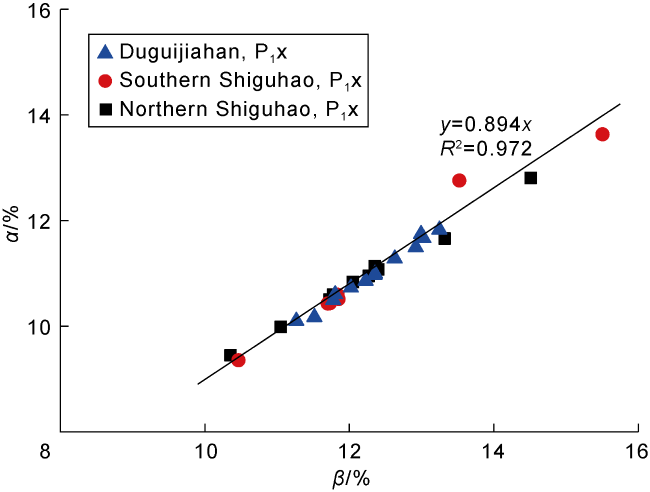
Fig. 7. Correlation diagram of α vs. β of natural gas from the Dongsheng gas field. |
The calculated maximum burial temperature of source rocks according to the 2,4-DMP/2,3-DMP values of natural gas from the Dongsheng gas field ranges from 133.4 °C to 140.3 °C with an average of 135.4 °C, and the consistent temperature in different zones (Table 2 ) suggests the same source of natural gas. The burial depth of Carboniferous-Permian in the Dongsheng gas field gradually increases from north to south. The maximum burial paleotemperature of the C3t-P1s source rocks in Well JP1 in Northern Shiguhao zone is about 110 °C [15], which is significantly lower than the calculated temperature values (133.4-136.6 °C, Table 2 ). This indicates that the main gas in this zone was not generated by in-situ source rocks. However, the maximum burial paleotemperature of the source rocks from Well J10 in Duguijiahan zone is about 140 °C [15], which is close to the calculated temperature (133.4-140.3 °C, Table 2 ). It indicates that natural gas from different zones of Dongsheng gas field has good affinity with the C3t-P1s source rocks to the south of the Borjianghaizi fault.
The δ13C1 values of natural gas can be used to calculate thermal maturity since they have a good correlation with maturity [48], and the empirical equations for coal-derived gas proposed by Stahl [49] and Dai et al. [44] reflect the characteristics of instantaneous gas accumulation and cumulative gas accumulation respectively in high mature stage [50]. The P1x gas from the Dongsheng gas field displays centralized distribution of δ13C1 values, which are consistent in different zones (Table 1 ) and range from −33.6‰ to −31.9‰ with an average of −32.5‰. The source rocks in the Hangjinqi area experienced continuous deep burial and thermal evolution from Carboniferous to Early Cretaceous due to continuous and stable subsidence, and the hydrocarbon generation process has stagnated since Late Cretaceous due to regional uplift [15]. Therefore, the equation for cumulative accumulation of coal-derived gas proposed by Dai et al. [44] (δ13C1= 14.12lgRo−34.39) is suitable for natural gas from the Dongsheng gas field. The calculated Ro values according to the equation range from 1.14% to 1.50% with an average of 1.36%, which are highly consistent with thermal evolution degree of source rocks to the south of the Borjianghaizi fault [12] and apparently higher than the maturity of organic matter in source rocks to the north of the Borjianghaizi fault. This indicates that natural gas from different zones in the Dongsheng gas field including Shiguhao area (Southern and Northern Shiguhao zones) is mainly derived from the C3t-P1s source rocks to the south of the Borjianghaizi fault. Therefore, the comparison of thermal evolution degree based on the 2,4-DMP/2,3-DMP and δ13C1 values suggests that natural gas from the Duguijiahan zone is mainly derived from in-situ source rocks and has experienced near-source accumulation via vertical migration, whereas that from the Shiguhao area has commonly experienced distal-source accumulation after lateral migration from south to north.
4. Tracing of natural gas migration by geochemical characteristics of light hydrocarbons
4.1. Migration phase and process of natural gas
Natural gas generally migrates in water-soluble phase or free phase. During the migration of water-soluble phase, the insoluble components escape first and the soluble components escape later. The solubilities of paraffins, cyc-alkanes and aromatics with the same carbon number increase gradually, therefore, the aromatic/paraffin ratios (e.g., Ben/nC6, Tol/nC7) and aromatic/cyc-alkane ratios (e.g., Ben/CH) of escaped gas increase with the migration distance [24,26]. During the free-phase migration process, the aromatics with high polarity are more easily adsorbed by rocks and display a decreasing content, therefore, the Ben/nC6, Ben/CH, and Tol/nC7 ratios decrease gradually with the increase of migration distance [24,26,51].
Natural gases from different zones of the Dongsheng gas field display overall low contents of aromatics. Except for several samples with undetectable contents of benzene or toluene, natural gas from the Duguijiahan, Southern Shiguhao and Northern Shiguhao zones display the Ben/nC6 values mainly of 0.033-0.134, 0.025-0.058 and 0.012-0.065, respectively, with the average values of 0.080, 0.040, and 0.031, respectively. The Ben/CH ratios are 0.059-0.211, 0.054-0.100 and 0.022-0.089, respectively, with the average values of 0.118, 0.067 and 0.049, respectively. The Tol/nC7 ratios are 0.055-0.232, 0.070-0.120 and 0.024-0.075, respectively, with the average values of 0.108, 0.103 and 0.043, respectively (Fig. 3b , Table 2 ). These three ratios display the overall trend of decreasing from south to north, which indicates that natural gas migration from south to north is mainly in free phase (Fig. 8 ).
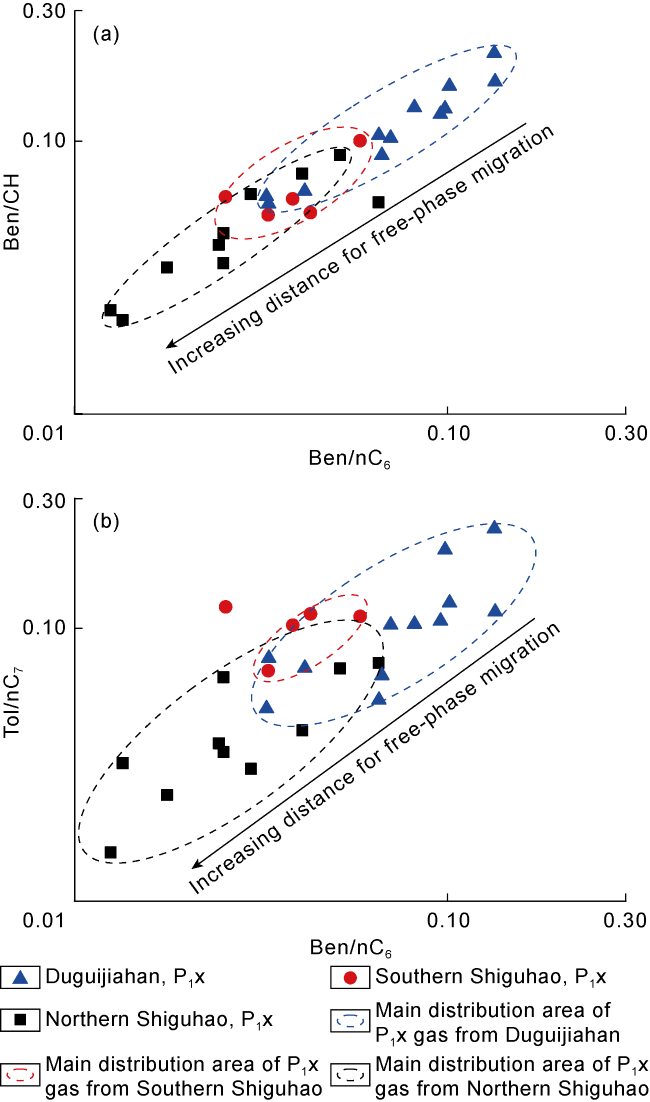
Fig. 8. Correlation diagrams of Ben/CH vs. Ben/nC6 (a) and Tol/nC7 vs. Ben/nC6 (b) of natural gas from the Dongsheng gas field. |
Formation water is generally developed in the P1x reservoirs of the Dongsheng gas field with the main water type of CaCl2, suggesting good sealing of the formation. The average salinities of formation water to the south and north of the Borjianghaizi fault are 41.9 g/L and 52.1 g/L, respectively, displaying significant difference [17]. This indicates that the P1x formation water in the Duguijiahan zone to the south of the fault and the Shiguhao area to the north of the fault is disconnected, and the main natural gas has not experienced large-scale migration in water-soluble phase.
Since the aromatics are easily soluble in water [3,24,26], the natural gas will dissolve in water when it encounters water after filling into the reservoirs and reduce the aromatic contents of natural gas. The contents of aromatics (benzene and toluene) in C6−7 light hydrocarbons of natural gas were considered to be closely associated with the organic matter types [24,29]. The statistics indicated that the aromatic contents in C6−7 light hydrocarbons of coal-derived gas and oil-associated gas were generally higher and lower than 20%, respectively [4]. However, the aromatic contents in C6−7 light hydrocarbons of typical coal-derived gas from the Xujiahe Formation in the Sichuan Basin were even lower than those of typical oil-associated gas from the Zhongba gas field, which was mainly attributed to the water dissolution of aromatics [29]. The aromatic contents in C6−7 light hydrocarbons of natural gas from different zones of the Dongsheng gas field (less than 4.0%) are significantly lower than those of typical coal-derived gas (Fig. 3 , Table 1 ). Besides the effect of rock adsorption during free-phase migration, one of the important factors is that the formation water in this area is generally present [17], which makes different degrees of water dissolution generally occur after natural gas charging. The absence of light aromatic hydrocarbons in some samples may be related to the high degree of water dissolution of natural gas (Fig. 9 ).
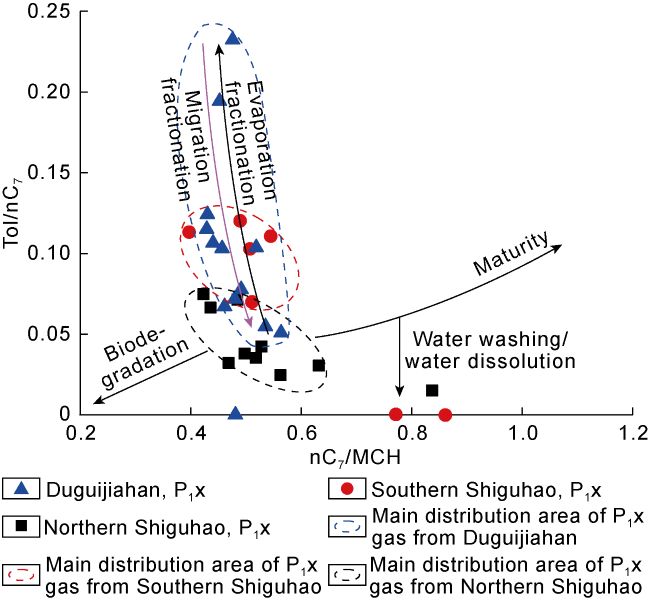


Fig. 9. Correlation diagram of Tol/nC7 vs. nC7/MCH of natural gas from the Dongsheng gas field (modified from Reference [52]). |
Methane rich in 12C preferentially migrates during the gas migration, therefore, the migrated gas displays increased dryness coefficient and slightly decreased δ13C1 value, whereas residual gas after migration displays decreased dryness coefficient and slightly increased δ13C1 value [18]. The dryness coefficients and δ13C1 values of natural gas from the Duguijiahan zone display obviously positive correlation, indicating typical maturity effect, whereas the gas from the Shiguhao area displays significantly lower dryness coefficients and consistent δ13C1 values with slightly higher average value (Table 1 , Fig. 5a ). Both the components and carbon isotope compositions of natural gas from the Shiguhao area are inconsistent with those of the typical migrated gas, and they overall display the characteristics of residual gas after migration. The C1/C2−3 ratio of natural gas from the Shiguhao area is significantly lower than that from the Duguijiahan zone, which also indicates the characteristics of residual gas after diffusion migration (Fig. 5b ). Therefore, natural gas in the Shiguhao area which had been migrated from the south side of the fault experienced significant diffusion loss after accumulation, and the migration during the diffusion loss also caused regular variation of light hydrocarbon compositions of residual gas.
4.2. Effects of migration on light hydrocarbon characteristics of natural gas
The theoretical basis of light hydrocarbons tracing natural gas migration is that different light hydrocarbon compounds have different responses to adsorption and water dissolution during migration [24]. The volatility difference of different compounds can also cause regular variation of some parameters during the evaporation or migration processes [28,30,53 -54], which may further affect the applicability of identification indexes. Source rocks in the Carboniferous-Permian strata of the Hangjinqi area are the C3t and P1s coal measures of humic type, which mainly generated natural gas rather than oil. Therefore, the oil pools are undeveloped in the Dongsheng gas field, and natural gas has not experienced evaporation fractionation. The difference of light hydrocarbon compositions is mainly affected by migration, water dissolution and diffusion loss (Fig. 9 ).
As to the n-heptane, methylcyclohexane and toluene in C7 light hydrocarbons, the boiling points increase successively while the volatilities decrease successively [28,30]. These result in the preferential migration of n-heptane among the three compounds followed by methylcyclohexane, and toluene is the most difficult to migrate. Therefore, natural gas which has experienced gas-liquid phase separation or free-phase migration generally displays higher nC7/MCH ratio [52] and lower Tol/nC7 ratio (Fig. 9 ). The nC7/MCH ratios of natural gas from the Duguijiahan, Southern Shiguhao and Northern Shiguhao zones are 0.429-0.564, 0.397-0.862 and 0.423-0.837, respectively, with the average values of 0.478, 0.583 and 0.539, respectively (Table 2 ). A small number of samples display Tol/nC7 ratio of 0 due to the effect of intense water dissolution, and the other samples from the three zones display Tol/nC7 ratios of 0.051-0.232, 0.070-0.120 and 0.015-0.075, respectively, with the average values of 0.108, 0.103 and 0.043, respectively, which mainly indicate the gradually decreasing trend (Table 2 , Fig. 9 ). Although natural gas from the Shiguhao area has experienced diffusion loss after accumulation, it displays overall higher nC7/MCH ratio and lower Tol/nC7 ratio compared with the gas from the Duguijiahan zone, indicating typical characteristics of migrated gas (Fig. 9 ).
Similar to n-heptane, various dimethylcyclopentane display significantly lower boiling points than methylcyclohexane [28] and is more volatile. Therefore, free-phase migration will increase the total relative contents of dimethylcyclopentane and decrease the relative content of methylcyclohexane in C7 light hydrocarbon composition of natural gas samples, whereas the diffusion loss will cause the opposite effect. Due to the decrease of methylcyclohexane contents compared to n-heptane and dimethylcyclopentane contents, some samples from Shiguhao zone fall into the oil-associated gas zone in the ternary diagram of C7 light hydrocarbon compositions (Fig. 4b ). It is mainly attributed to the effect of free-phase migration (Fig. 4b ) and does not reflect the origin of oil-associated gas. On the one hand, it indicates that the overall effect of free-phase migration on C7 light hydrocarbon compositions of natural gas from the Shiguhao area exceeds the effect of diffusion loss after accumulation (Fig. 4b ), which is consistent with the migration characteristics reflected by Tol/nC7 ratio (Fig. 9 ). On the other hand, the average nC7/MCH ratio of natural gas in Northern Shiguhao zone is slightly lower than that in the Southern Shiguhao zone, which indicates that the loss of natural gas in the northern zone may be slightly higher than that in the southern zone. Therefore, as to natural gas that has undergone large-scale free-phase migration, the effect of migration should be considered when identifying the origin of natural gas directly by using the C7 light hydrocarbon compositions.
The heptane value mainly reflects the proportion of n-heptane in the sum of various methylhexane, n-heptane, methylcyclohexane, various dimethylcyclopentane and other compounds [35]. The methylcyclohexane displays the highest content among C7 light hydrocarbon compounds of natural gas in the Dongsheng gas field followed by n-heptane, and the other compounds display significantly lower contents (Fig. 3 ). Therefore, the heptane value mainly reflects the ratio of n-heptane to methylcyclohexane. Several gas samples from the Shiguhao area display high nC7/MCH ratio (greater than 0.60) and heptane values (greater than 19%) (Table 2 ), which indicate the distinct effect of free-phase migration (Fig. 6 ).
The isoheptane value is the ratio of various methylhexane to various dimethylcyclopentane [39], and these two types of compounds have similar boiling points with insignificant difference in volatility [28]. Therefore, their relative proportions display insignificant variations during the evaporation fractionation [29] and migration processes, which have little effect on the isoheptane values. Natural gas from the Duguijiahan zone mainly has consistent isoheptane values with that from the Shiguhao area (Fig. 6 ), which suggests the insignificant effect of migration on isoheptane values. However, paraffins generally have lower solubility than cycloalkanes with the same carbon number [24,26], and thus various methylhexane display lower solubility than various dimethylcyclopentane. Therefore, water dissolution will increase the relative contents of various methylhexane and decrease the contents of various dimethylcyclopentane in natural gas, which result in the increased isoheptane values. A small number of gas samples from the Duguijiahan zone display relatively high isoheptane values and deviate from the main distribution range, which are associated with the strong water dissolution (Fig. 6 ). For example, natural gas samples from wells DS29 and DS30 have the isoheptane values higher than 3.5 with the Tol/nC7 ratio lower than 0.07 (Table 2 ), suggesting the obvious effect of water dissolution. Natural gas from the Duguijiahan zone has mainly experienced short-distance vertical migration and near-source accumulation with different intensities of water dissolution, which are the important reasons that the gas displays consistent heptane values and significantly different isoheptane values.
The n-C5−7 and iso-C5−7 in the C5−7 light hydrocarbons display obviously different responses to diffusion migration. The isopentane in C5 light hydrocarbons displays a significantly higher diffusion coefficient than n-pentane and thus migrates preferentially [55]. The iso-alkanes such as 2-methylpentane and 3-methylpentane in C6 light hydrocarbons display higher volatility than n-hexane and thus migrate more easily [30]. The iso-alkanes such as various methylhexane and dimethylpentane in C7 light hydrocarbons display higher volatility than n-heptane and thus migrate preferentially [28]. Therefore, the migrated natural gas displays decreased relative contents of n-C5−7 and increased relative contents of iso-C5−7, whereas the residual gas after diffusion migration which has experienced diffusion loss displays increased relative contents of n-C5−7 and decreased relative contents of iso-C5−7 (Fig. 4a ). Natural gas in the Upper Jurassic Penglaizhen Formation of the Xinchang gas field in the Sichuan Basin was derived from the underlying Xujiahe Formation and experienced free-phase migration, and its iso-C5−7/n-C5−7 ratio is significantly higher than that of the gas in the underlying Xujiahe Formation [31]. Natural gas from the Shiguhao area in the Dongsheng gas field of Ordos Basin displays overall lower iso-C5−7 contents and higher n-C5−7 contents than that from the Duguijiahan zone (Fig. 4a ), which are consistent with the characteristics of residual gas after diffusion loss rather than those of migrated gas. These are also consistent with the characteristics reflected by natural gas components (Fig. 5 ), which indicates that the effect of diffusion loss on C5−7 light hydrocarbon compositions of natural gas from the Shiguhao area exceeds that of migration (Fig. 4a ). Therefore, gas samples from the Shiguhao area display relatively high n-C5−7 contents and even fall into the oil-associated gas zone in the ternary diagram of C5−7 light hydrocarbon compositions (Fig. 4a ), which are mainly attributed to the effect of diffusion loss rather than the origin of oil-associated gas. It is necessary to be cautious to directly apply the C5−7 light hydrocarbon compositions to identify the origin of natural gas which has experienced apparent diffusion loss.
It follows that both free-phase migration and diffusion loss affect the C5−7 and C7 light hydrocarbon compositions (Fig. 4 ). On the one hand, significant free-phase migration decreases the relative methylcyclohexane content in C7 light hydrocarbons of coal-derived gas, and thus causes the gas sample to fall into the oil-associated gas zone in the ternary diagram of C7 light hydrocarbon compositions (Fig. 4b ). On the other hand, it will also increase the relative iso-C5−7 contents, and thus cause the gas sample to fall into the coal-derived gas zone in the ternary diagram of C5−7 light hydrocarbon compositions (Fig. 4 ). However, the diffusion loss has the opposite effect compared with the free-phase migration (Fig. 4 ). Meanwhile, significant free-phase migration and water dissolution can affect the heptane and isoheptane values, respectively, which will further affect the identification of genetic types of natural gas and maturity. Therefore, the effects of migration, water dissolution and diffusion loss need to be eliminated when directly using the light hydrocarbon compositions to identify the gas origin, while the effects of free-phase migration and water dissolution shall be taken into consideration when using the heptane and isoheptane values to identify the genetic types of natural gas and maturity, respectively. The ternary diagrams of C5−7 and C7 light hydrocarbon compositions (Fig. 4 ), which have been commonly used to identify the genetic types of natural gas, were modified and improved in this study according to the effects of migration and diffusion loss. The commonly used diagram of heptane versus isoheptane values (Fig. 6 ) was also modified and improved based on different alteration effects of free-phase migration and water dissolution.
5. Conclusions
The light hydrocarbon compositions of natural gas from the Lower Shihezi Formation in the Dongsheng gas field in the Ordos Basin display higher iso-C5−7 contents than n-C5−7 contents, suggesting the characteristics of light hydrocarbons in coal-derived gas. The obviously lower aromatic contents in C6−7 light hydrocarbons (less than 4.0%) indicate that natural gas has experienced different degrees of water dissolution after charging. The distribution dominance of methylcyclohexane in C7 light hydrocarbons suggests the characteristics of light hydrocarbon compositions in coal-derived gas. The heptane and isoheptane values of natural gas range from 14.2% to 25.3% and from 1.97 to 3.82, respectively, which are consistent with those of coal-derived gas, respectively.
Comprehensive analysis of geochemical characteristics of light hydrocarbons indicates that natural gas in the Dongsheng gas field has experienced free-phase migration from south to north, and different degrees of water dissolution have occurred after charging. The gas from the Northern Shiguhao zone to the north of the Borjianghaizi fault has experienced obvious diffusion loss after accumulation. The migration, water dissolution and escape affect the light hydrocarbon compositions of natural gas, among which the long-distance free-phase migration causes the decrease of relative methylcyclohexane contents and Tol/nC7 ratio as well as the increase of nC7/MCH ratio and heptane values. Different degrees of water dissolution increase the isoheptane values of light hydrocarbons, whereas the diffusion loss increases the n-C5−7 contents relative to the iso-C5−7 contents in natural gas from the Shiguhao area.
The ternary diagrams of C5−7 and C7 light hydrocarbon compositions, which have been commonly used to identify the genetic types of natural gas, were modified and improved according to effects of migration and diffusion loss. The commonly used diagram of heptane versus isoheptane values was also modified and improved based on different alteration effects of free-phase migration and water dissolution.
Acknowledgements
The Academician Dai Jinxing has provided sincere guidance, and Profs. Sun Yongge and Hu Guoyi have given many directions and inspirations to relevant studies. The sample collection and measurement have been greatly assisted by SINOPEC North China Company and Key Laboratory of Hydrocarbon Accumulation, respectively. The authors express gratitude to them all.
Nomenclature
K1—molar ratio of (2-methylhexane+2,3-dimethylpentane) to (3-methylhexane+2,4-dimethylpentane), dimensionless;
K2—molar ratio of (various dimethylpentane+3-ethylpentane) to (2-methylhexane+3-methylhexane+1,1-dimethylcyclopentane+1, cis-3-dimethylcyclopentane+1,trans-3-dimethylcyclopentane), dimensionless;
Ro—vitrinite reflectance, %;
α—molar fraction of 3-methylhexane and 2,4-dimethylpentane in C7, %;
β—molar fraction of 2-methylhexane and 2,3-dimethylpentane in C7, %.