

Introduction
Shale oil and gas production in the United States reached 3.62×10⁸ t and 7.64×10¹² m3 respectively in 2021, accounting for 65.90% of total crude oil production and 78.50% of total natural gas production in the country [1]. Drawing on the successful experiences of shale oil and gas exploration and development in North America, China has made significant progress in this field. In 2021, the PetroChina Company Limited produced 0.26×10⁸ t of shale oil, accounting for 2.50% of its total crude oil production, and 128.70×10⁸ m3 of shale gas, accounting for 9.30% of its total natural gas production [2]. As an important component of unconventional oil and gas resources, the efficient exploration and development of shale oil and gas is of great significance for ensuring China's energy security and optimizing its energy structure [3].
Shale oil and gas reservoirs occur in unique geological conditions, with their development exposed to several challenges such as greatly-varying initial production and rapid post-fracturing production decline (with a first-year decline rate of over 50%), despite of the application of long horizontal well volume fracturing technology. Such production decline is mainly attributed to reservoir damage, which has received widespread attention in the petroleum industry. Many scholars have made detailed studies on the sensitivity damage, phase trapping damage, stress sensitivity damage, polymer adsorption damage, inorganic/organic deposition damage, and fracturing flowback fluid damage caused by fracturing fluids [4⇓-6], or the fluid sensitivity damage, solid-phase blockage damage, stress sensitivity damage, and liquid-phase trapping damage caused by drilling fluid invasion [7⇓-9]. However, an investigation on damage caused by fracturing fluid or drilling fluid alone cannot fully reflect the specificity of shale oil and gas reservoir damage. Moreover, the interaction between fracturing fluids and shale has both beneficial and harmful effects. While causing reservoir damage, it can also play a positive role in replacing crude oil and increasing the complexity of the fracture network [10⇓-12]. Shale reservoir damage exhibits typical multi-timescale characteristics, manifesting as the superposition and compounding of damage during drilling and stimulation operations. The compound function zone of drilling and fracturing fluids, which extends from the wellbore into the reservoir, is the necessary path for drilling fluid invasion, fracturing fluid injection, and formation fluid production. This results in the zone being exposed to multiple fluid types, long periods of interaction, and significant mechanical weakening. Therefore, further research is needed on the reservoir damage caused by the compound function of drilling and fracturing fluids.
A method for predicting the dynamic invasion depth of drilling fluids is established to determine the range of the compound function zone of drilling and fracturing fluids. The weakening of mechanical properties on shale fracture surfaces, and the damage of natural and hydraulic fractures caused by fracture closure and rock powder blockage, are evaluated. A reservoir damage model for the compound function of drilling and fracturing fluids is built to reveal the damage mechanisms of shale oil and gas reservoirs during drilling and completion operations. Additionally, reservoir protection strategies are proposed. The study results provide theoretical and technical basis for the diagnosis, prevention, and control of shale oil and gas reservoir damage.
1. The range of the compound function zone of drilling fluid and fracturing fluid in shale reservoirs
During the drilling and completion of shale oil and gas reservoirs, drilling fluid, as the first foreign fluid to come into contact with the shale reservoir, penetrates deep into the reservoir through natural or induced fractures and enters the shale matrix through spontaneous imbibition, forming a drilling fluid action zone within a certain range around the wellbore. In the subsequent hydraulic fracturing process, the fracturing fluid passes through the drilling fluid action zone and forms hydraulic fractures based on the existing natural or induced fractures. Therefore, after hydraulic fracturing, the rock within the drilling fluid action zone interacts with the fracturing fluid, forming a compound function zone of drilling fluid and fracturing fluid. Since the depth of fracturing fluid penetration into the reservoir is much greater than that of drilling fluid invasion, the scope of the compound function zone is determined by the extent of drilling fluid invasion.
1.1. Prediction for dynamic invasion depth of oil-based drilling fluid
1.1.1. Spontaneous imbibition invasion depth of drilling fluid in shale matrix-natural fractures
Spontaneous imbibition generally refers to the behavior of a porous medium spontaneously imbibing a wetting phase liquid driven by capillary pressure. As a dense porous medium, shale has a significant spontaneous imbibition effect on fluids, and its spontaneous imbibition behavior is significantly influenced by fluid characteristics and rock properties. Among the fluid characteristics, the main factor affecting shale spontaneous imbibition is the wettability of the fluid to the rock surface; among the rock properties, the main factor is the porosity and permeability conditions of the rock [13].
Generally, the spontaneous imbibition volume and depth of shale are jointly controlled by fractures and matrix. Yang [14] considered the combined effects of shale pore radius, fracture width, pore shape factor, tortuosity, and other parameters, and proposed calculation formulas for the spontaneous imbibition depth in shale fractures and matrix:
${{h}_{\text{m}}}\left( t \right)\text{=}\sqrt{\frac{r\gamma \delta \cos \theta }{2\tau \mu }}\sqrt{t}$
${{h}_{\text{f}}}\left( t \right)=\frac{\alpha }{\beta }\left[ 1+W\left( -{{\text{e}}^{-1-{{\beta }^{2}}t/\alpha }} \right) \right]$
where $\alpha =\frac{w\gamma \cos \theta }{6\mu },\beta =\frac{{{w}^{2}}\rho g\sin \zeta }{12\mu }$
Based on Eqs. (1) and (2), the spontaneous imbibition depth of drilling fluid in shale matrix and fractures within a certain time frame can be calculated.
1.1.2. Invasion depth of drilling fluid in shale induced fractures
During the process of spontaneous imbibition of drilling fluid filtrate by shale, it is often observed that pre- existing fractures extend and new fractures initiate. In this case, the spontaneous imbibition of drilling fluid filtrate couples with the propagation of induced fractures, and the invasion depth of drilling fluid depends on the extension length of the induced fractures. Shale is rich in organic matter and clay minerals, which can react with water to cause shale fracture. However, K+ in oil-based or water-based drilling fluid commonly used in shale drilling can inhibit the hydration and expansion of clay minerals. Yu et al. [15] found that adding inhibitors to water-based drilling fluids or using oil-based drilling fluids can effectively inhibit hydration, but the alkaline drilling fluids can still cause erosion. When the mineral particles are comparable in size, the order of erosion by alkaline solution is montmorillonite, quartz, kaolinite, illite and chlorite.
After drilling fluid penetrates into natural fractures and the matrix of shale through spontaneous imbibition, it promotes the slow propagation of induced fractures by eroding shale minerals, increasing pressure within the fractures or other actions. This process is typical of subcritical fracture propagation. To further determine the propagation rate of induced fractures formed by the interaction between shale and drilling fluid, this paper proposes a test method for shale drilling fluid-induced fracture propagation rate based on the stress-strain curve. The stress-strain curve of rock can be divided into five stages [16] (Fig. 1 ): compaction stage (I), elastic deformation stage (II), fracture initiation and stable propagation stage (III), fracture unstable propagation stage (IV) and post-peak deformation stage (V). The starting point of stage III corresponds to the crack initiation stress σci of the rock. When the applied stress exceeds the fracture initiation stress, new fractures will initiate within the rock or pre-existing fractures will grow slowly with increasing load, causing overall volumetric expansion of the rock. The stress at the starting point of stage IV is known as the fracture damage stress σcd, and the starting point of stage V is the peak stress of the curve, which is also the uniaxial/triaxial compressive strength σc of the specimen.
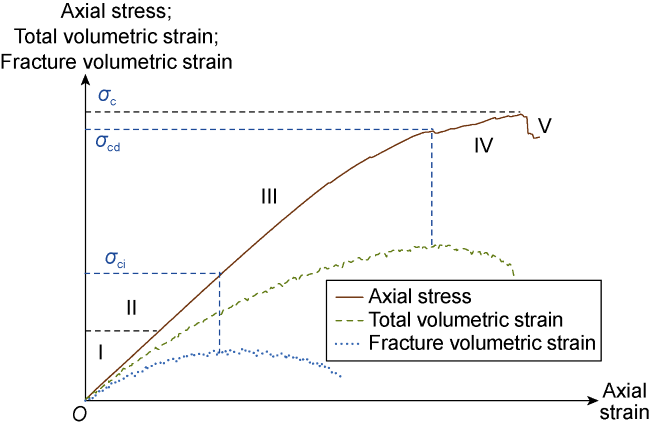
Fig. 1. Schematic diagram of stress-strain curve stages for rock. |
During the deformation process of rock under stress, the total volumetric strain typically consists of elastic volumetric strain and fracture volumetric strain in the rock, given by:
${{\varepsilon }_{\text{v}}}\text{=}{{\varepsilon }_{\text{ev}}}+{{\varepsilon }_{\text{fv}}}={{\varepsilon }_{1}}+2{{\varepsilon }_{3}}$
where ε1 and ε3 represent the axial and radial strains of the rock, respectively, which can be obtained from the stress-strain curve. Based on the Hooke's law, the elastic volumetric strain of the rock is expressed as:
${{\varepsilon }_{\text{ev}}}=\frac{1-2\nu }{E}\left( {{\sigma }_{1}}+2{{\sigma }_{3}} \right)$
The fracture volumetric strain is the difference between the total volumetric strain and the elastic volumetric strain:
${{\varepsilon }_{\text{fv}}}={{\varepsilon }_{1}}+2{{\varepsilon }_{3}}-\frac{1-2\nu }{E}\left( {{\sigma }_{1}}+2{{\sigma }_{3}} \right)$
By calculating the fracture volumetric strain and the total volumetric strain of the rock, Fig. 1 can be plotted. In Fig. 1 , the difference in time points corresponding to σci and σcd during the triaxial compression test is defined as the subcritical fracture propagation time (Δt).
The final length of subcritical fracture propagation (referred to as "critical fracture length") is calculated by [14]:
${{c}_{\text{d}}}=\frac{1}{\pi }{{\left[ \frac{2{{K}_{\text{IIC}}}\left( \sqrt{\mu _{\text{f}}^{2}+1}+{{\mu }_{\text{f}}} \right)}{{{\sigma }_{\text{cd}}}-{{\left( \sqrt{\mu _{\text{f}}^{2}+1}+{{\mu }_{\text{f}}} \right)}^{2}}{{\sigma }_{3}}} \right]}^{2}}$
In the stress-strain curve of Fig. 1 , stage III corresponds to the subcritical fracture propagation stage. σci is the initiation stress of subcritical fracture propagation, while σcd is the fracture damage stress corresponding to the unstable propagation stage of fractures and also the cutoff stress for subcritical fracture propagation. The subcritical fracture propagation rate in this stage is:
$u\text{=}\frac{{{c}_{\text{d}}}-{{c}_{\text{0}}}}{\Delta t}$
In the subcritical fracture propagation, the initial fracture length (c0) is negligible compared to the critical fracture length (cd) corresponding to the shale damage stress σcd. Therefore, setting c0 to zero uniformly does not significantly affect the experimental results, and the subcritical fracture propagation amount is cd−c0=cd.
1.2. Dynamic invasion range of drilling fluid in shale oil and gas reservoirs
To determine the spontaneous imbibition depth of drilling fluid in shale matrix-natural fractures, a shale gas well in the Sichuan Basin was taken as an example. Its basic parameters are shown in Table 1. The calculations show that within a drilling period of 38 d, the spontaneous imbibition depth of drilling fluid in shale fractures could reach 130 cm, and in the shale matrix, it could reach 60 cm (Fig. 2 ). While flowing along the direction of shale fractures, the spontaneously imbibed fluid also percolates into the shale matrix perpendicular to the fracture surface. The development of microfractures in shale significantly increases the actual invasion range of the spontaneously imbibed fluid.
Table 1. Basic parameters of shale reservoirs in a block of the Sichuan Basin, SW China |
| Parameter | Value | Parameter | Value |
|---|---|---|---|
| Average pore radius | 80-280 nm | Liquid viscosity | 0.03 Pa•s |
| Surface tension | 0.03 N/m | Fracture width | (2-10)×10-6 m |
| Shape factor | 0.57 | Liquid density | 1.5×10⁻³ kg/m3 |
| Contact angle | 30° | Fracture dip angle | 90° |
| Pore tortuosity | 5.86 |
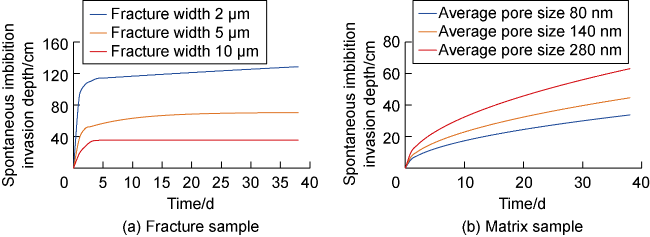
Fig. 2. Relationship between spontaneous imbibition depth of oil-based drilling fluid in shale and time. |
To further clarify the invasion depth of drilling fluid in shale-induced fractures, an oil-based drilling fluid with a specific formula was used. The solid phase was filtered out to obtain an alkaline drilling fluid filtrate, and shale samples were soaked in the filtrate. The shale minerals mainly include quartz (45.28%), illite (21.14%), illite- smectite mixed layer (9.46%), feldspar (10.96%), and calcite (6.83%), with small amounts of dolomite, kaolinite, and chlorite. The shale samples exhibited mixed wettability, with measured wetting angles of 17.56° for simulated formation water and 53.78° for white oil on the rock surface. Experimental results show that after 7 d of exposure to alkaline filtrate, numerous dissolution pores were generated within the shale, causing the structure to become loose and further promoting the interaction between the shale and the foreign fluid (Fig. 3 ).
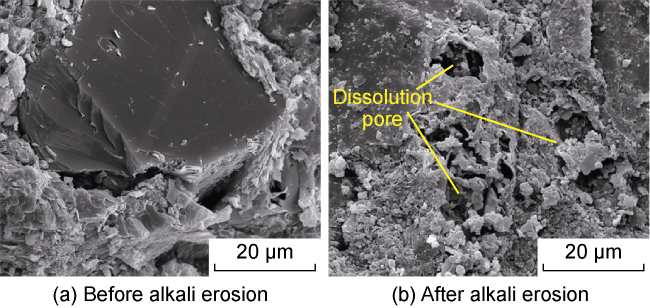
Fig. 3. SEM images of shale samples before and after alkali erosion. |
Observing the end-face photos of shale cores after being treated with oil-based drilling fluid for different durations (Fig. 4 ) reveals that after 7 d, distinct fractures appeared on the core end-face and these fractures penetrated the entire core.
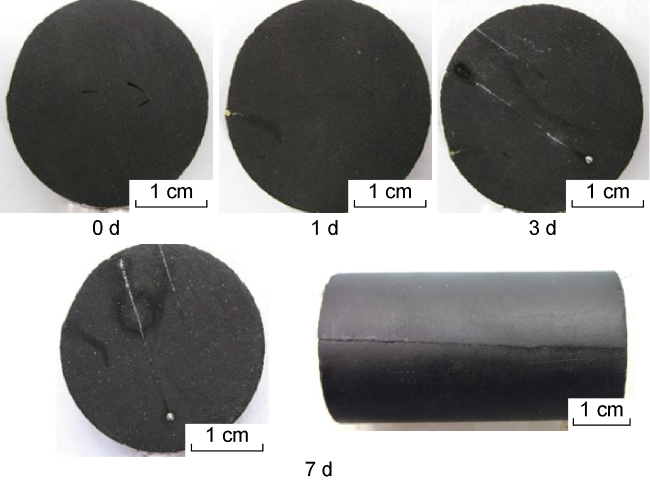
Fig. 4. Fracture propagation in shale under normal pressure after treatment with oil-based drilling fluid. |
Using the stress-strain curve testing method for shale fracture propagation rate, triaxial compressive tests were conducted on five shale samples from the Silurian Longmaxi Formation treated with drilling fluid for different durations (Fig. 5 ). During the 7 d interaction between the drilling fluid and shale samples, the induced fracture propagation rate in the shale was 3.30-8.29 mm/h, corresponding to a critical fracture length of 0.29-0.47 mm (Table 2 ). The critical fracture length is significantly smaller than the aforementioned spontaneous imbibition depth of the drilling fluid along the fracture, indicating that as long as the shale fracture remains in contact with the oil-based drilling fluid, the fluid can spontaneously fill the extending portion of the fracture and promote continuous propagation of the induced fracture. Calculations show that after 7 d of treatment with oil-based drilling fluid, the invasion depth of the drilling fluid due to induced fracture propagation in the shale can reach up to 139 cm. Moreover, over the drilling time, the induced fractures continue to propagate, leading to a continuous increase in the invasion depth of the drilling fluid (Fig. 6 ). In the event of lost circulation during the drilling of horizontal shale sections, the volume and depth of drilling fluid invasion will increase sharply, and the invasion range correlates with the amount of fluid loss, significantly expanding the compound function zone of drilling fluid and fracturing fluid [12].
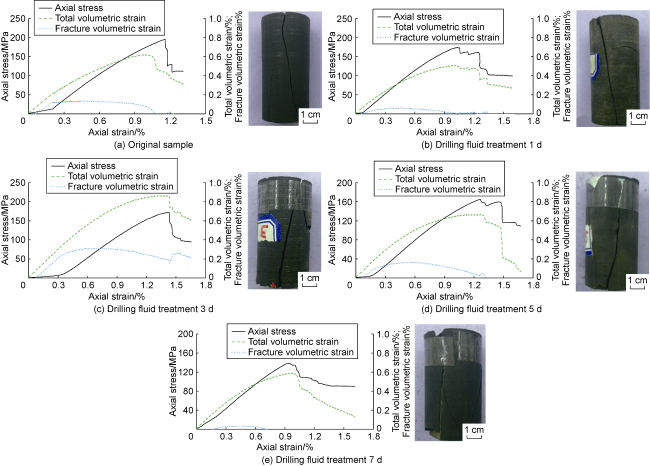
Fig. 5. Triaxial compressive experimental results of shale cores treated with drilling fluid for different durations. |
Table 2. Calculation results of subcritical fracture propagation rate based on uniaxial/triaxial stress-strain curves of shale |
| Sample | Elastic modulus/GPa | Fracture initiation stress/MPa | Fracture damage stress/MPa | Fracture propagation rate/(mm•h−1) | Critical fracture length/mm | Remarks |
|---|---|---|---|---|---|---|
| LC-1 | 21.85 | 74.61 | 171.17 | 4.87 | 0.30 | Original sample |
| LC-2 | 21.59 | 94.75 | 171.95 | 4.91 | 0.29 | Oil-based drilling fluid treatment for 1 d |
| LC-3 | 18.80 | 65.83 | 171.73 | 3.30 | 0.29 | Oil-based drilling fluid treatment for 3 d |
| LC-4 | 17.77 | 73.66 | 153.07 | 5.60 | 0.38 | Oil-based drilling fluid treatment for 5 d |
| LC-5 | 17.46 | 72.41 | 138.20 | 8.29 | 0.47 | Oil-based drilling fluid treatment for 7 d |
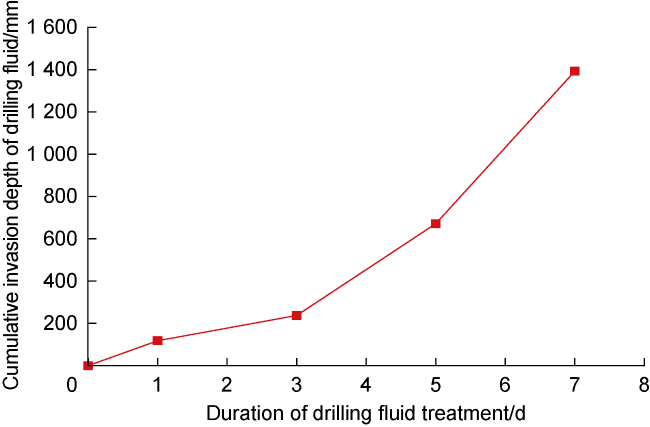
Fig. 6. Changes in cumulative invasion depth of drilling fluid in shale. |
2. Shale reservoir damage mechanism of the compound function of drilling fluid and fracturing fluid
2.1. Weakening of shale mechanical properties
2.1.1. Mechanical properties of shale fracture surfaces
To investigate how the working fluids weaken the mechanical properties of shale fracture surfaces during drilling, completion, and fracturing processes, nanoindentation experiments were conducted on shale samples from the Silurian Longmaxi Formation in the Sichuan Basin. These experiments aimed to assess the changes in mechanical properties before and after exposure to oil-based drilling fluid and fracturing fluid. The average indentation hardness of the original shale fracture surface was 0.71 GPa, and the average elastic modulus was 24.57 GPa. The oil-based drilling fluid used in the experiment was the same as that used in the alkaline erosion test mentioned previously. The low-viscosity fracturing fluid was formulated with slickwater, 0.1%-0.4% emulsion polymer, 0.3%-0.5% mixed fluid with a gel breaker, and 0.1%-0.3% nanofluid surfactant. Eight core plugs were drilled from adjacent locations in the same formation and divided into four groups. The control group was untreated, while the drilling fluid group, fracturing fluid group, and drilling fluid-fracturing fluid group were soaked in their respective fluids for 24 h (12 h each for the combined group). Nanoindentation tests were then performed to measure the elastic modulus and indentation hardness of all the core plug surfaces. The experimental results (Fig. 7 ) reveal the following:
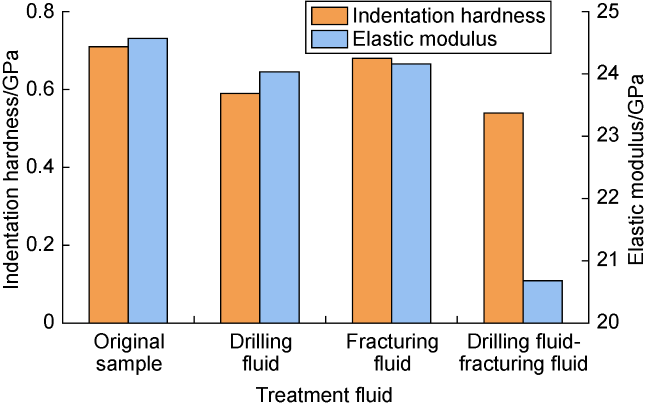
Fig. 7. Mechanical property weakening of shale fracture surfaces after treatment with different working fluids. |
(1) After exposure to the oil-based drilling fluid, the average indentation hardness of the fracture surface decreased by 17.09% to 0.59 GPa compared to the original sample. Exposure to only the fracturing fluid reduced the hardness by 4.76% to 0.68 GPa. Sequential exposure to the oil-based drilling fluid and fracturing fluid resulted in a 24.09% decrease in hardness to 0.54 GPa.
(2) The average elastic modulus of the fracture surface decreased by 2.21% to 24.03 GPa after exposure to the oil-based drilling fluid and by 1.68% to 24.16 GPa after exposure to only the fracturing fluid. Sequential exposure to both fluids led to a 15.85% decrease in elastic modulus to 20.68 GPa.
(3) Both the oil-based drilling fluid and the fracturing fluid weakened the mechanical properties of the shale fracture surface to some extent, with the drilling fluid having a stronger weakening effect. The compound function of the drilling fluid and fracturing fluid had a more pronounced weakening effect on the fracture surface mechanical properties than either fluid alone. After exposure to these working fluids, the mechanical strength of the fracture surface was significantly reduced, making it more prone to deformation and failure.
2.1.2. Overall mechanical properties of shale
The mechanical properties of shale surfaces weaken when exposed to oil-based drilling fluid and fracturing fluid. Over time, these fluids can penetrate deep into the shale matrix through spontaneous imbibition, leading to a reduction in the mechanical strength of the shale matrix.
To quantify the weakening of shale’s overall mechanical properties caused by prolonged exposure to these fluids, core plugs were drilled from adjacent locations in the Longmaxi Formation. The group of drilling fluid treatment was soaked in drilling fluid only, and the group of drilling fluid-fracturing fluid treatment was soaked in drilling fluid and fracturing fluid for the same time in sequence. The total soaking time of the two groups was 1, 3, 5, 7 d. Triaxial compression tests were conducted on all the experimental core plugs to measure the weakening of compressive strength and elastic modulus. The results (Fig. 8 ) show that after 7 d of exposure to drilling fluid, the compressive strength of the shale decreased by 29.55%, and the elastic modulus decreased by 20.09%. In contrast, exposure to drilling-fracturing fluid for the same duration resulted in a 71.70% decrease in compressive strength and a 60.74% decrease in elastic modulus. The drilling fluid weakens the shale strength through a combination of mechanical and chemical effects. After exposure to the drilling fluid, the cohesion and internal friction angle of the rock decrease with increasing soaking time. This leads to a gradual shift in the failure mode of the rock sample from splitting failure to shear failure and ultimately to double shear failure, suggesting more rapid and intense failure. Additionally, in the alkaline environment created by the drilling fluid, clay minerals in the rock sample are eroded, generating numerous erosion pores and loosening the structure, further weakening the mechanical properties of both the shale matrix and fracture surface. The surface of the shale becomes porous after exposure to the drilling fluid (Fig. 3 ), which enhances the invasion depth and hydration of the fracturing fluid into the matrix through the fracture surface during subsequent exposure. This leads to more severe weakening of the mechanical properties of the fracture surface, which intensifies with time. Ultimately, a significant decrease occurs in the mechanical strength of the shale fracture surface, making it easier for proppant to embed into the hydraulic fracture surface and reducing the effectiveness of the fracturing process.
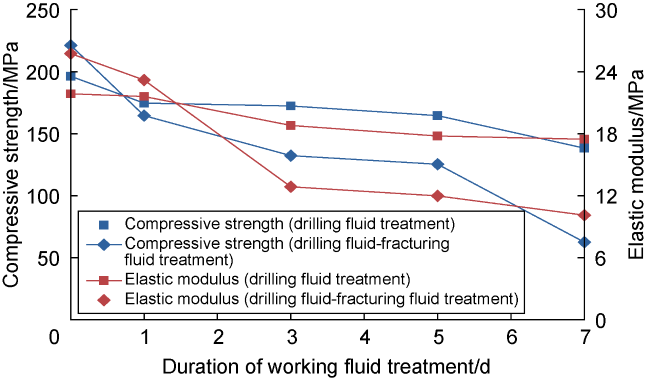
Fig. 8. Weakening of overall mechanical properties of shale after treatment with different working fluids. |
2.2. Stress sensitivity damage
To determine the stress sensitivity of shale hydraulic fractures after exposure to drilling and fracturing fluids, two shale samples (Sample 1 and Sample 2) were artificially fractured and filled with quartz sand. Considering the actual contact sequence of shale and working fluids, the stress sensitivity of shale-filled fracture samples was tested under three conditions: untreated (original), soaked in drilling fluid for 24 h, and sequentially soaked in drilling and fracturing fluids for 12 h each. The stress sensitivity curves are shown in Fig. 9.
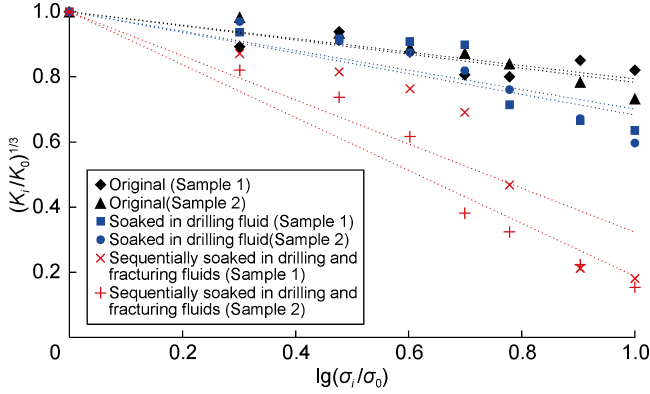
Fig. 9. Evaluation results of stress sensitivity of shale-filled fractures under different conditions. |
Based on the data in Fig. 9 , the average stress sensitivity coefficient for each experimental group was calculated (Fig. 10 ). The original sand-filled fractures exhibited weak stress sensitivity, with an average coefficient of 0.21. After exposure to drilling fluid, the stress sensitivity increased to moderately weak, with an average coefficient of 0.31, representing a 0.48-fold increase. When exposed to both drilling and fracturing fluids, the stress sensitivity became strong, with an average coefficient of 0.74, representing a 2.52-fold increase compared to the original sample.
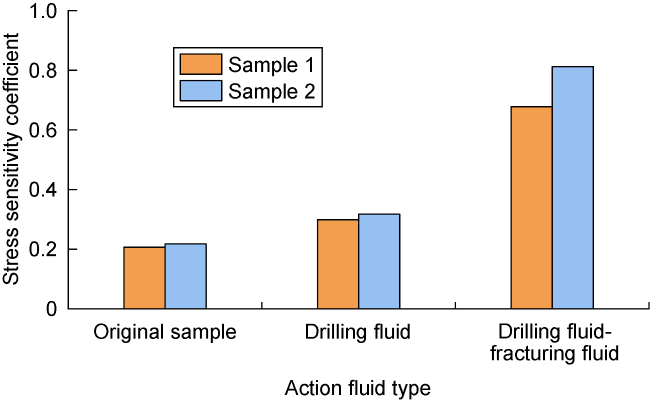
Fig. 10. Stress sensitivity coefficients of shale-filled fractures under different conditions. |
The experimental results demonstrate that both drilling fluid alone and the sequential action of drilling and fracturing fluids can increase the stress sensitivity damage of proppant-filled fractures. Moreover, the sequential action of drilling and fracturing fluids results in even stronger stress sensitivity. This is because drilling fluid can create numerous erosion pores within the shale, weakening its structure and facilitating the subsequent invasion of fracturing fluid. As a result, the mechanical properties of the shale are significantly weakened when exposed to both fluids sequentially, compared to the effects of either fluid alone. Consequently, propped and natural fractures within the composite action zone of drilling and fracturing fluids are more prone to closure during production, leading to a significant reduction in fracture conductivity.
2.3. Solid blocking damage
Weakening of the mechanical properties of shale fracture surfaces can further lead to the detachment of rock particles from the fracture surfaces. During stress sensitivity experiments, it was observed that fluid discharged from experimental groups with strong stress sensitivity became turbid early in the process (Fig. 11a ), with fluid turbidity increasing from 2.32 to 20.56 and a rapid decline in permeability towards the end of the experiment. To assess the degree of blockage caused by the discharged rock particles within the flow channels of shale supported fractures, fluid containing these particles was collected and used as the displacement fluid in a transparent sand-packed tube with the same proppant density. After displacement at 0.2 MPa for 1 h, the permeability of the sand-packed tube before and after displacement was measured. Photographs of the sand-packed tube clearly show that these rock particles were blocking the pores between the proppants, and the blocking damage gradually increased with the displacement time (Fig. 11b ). The rock particles suspension was utilized to repeat the displacement experiment 5 times, and the results of the permeability test before and after displacement demonstrated that the shale rock particles caused a significant average permeability damage rate of 93.50% to the sand-packed tube (Fig. 11c ). Analysis suggests that detached rock particles can become trapped within the proppant pack of hydraulic fractures, reducing the connectivity of flow channels and manifesting as macroscopic solid phase blocking damage, which significantly reduces the conductivity of the supported fractures.
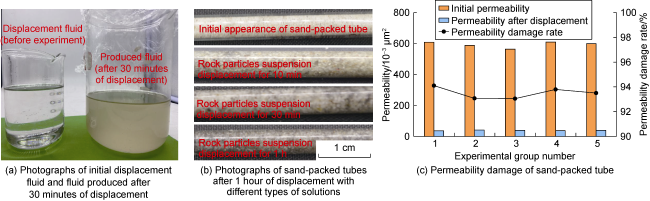
Fig. 11. Experimental photographs of solid blocking damage and permeability damage curves of sand-packed tubes. |
3. Formation damage pattern by the compound function of drilling fluid and fracturing fluid in shale reservoirs
Based on the dynamic invasion depth of oil-based drilling fluids and the evaluation results of drilling and fracturing fluid damage, a composite damage model for drilling and fracturing fluids in shale oil and gas reservoirs is proposed (Fig. 12 ). During the drilling of the reservoir stage, drilling fluid invades along natural and induced fractures near the wellbore in the shale reservoir, forming a drilling fluid invasion zone (Fig. 12a and 12b). As the drilling fluid deeply invades the reservoir through natural and induced fractures, it also enters the shale matrix through spontaneous imbibition, eroding shale minerals and generally weakening the mechanical properties of the invaded shale. The extent of the drilling fluid invasion zone increases with the drilling duration and the propagation of induced fractures, and lost circulation can further expand the invasion range. During the hydraulic fracturing, hydraulic fractures interconnect or merge with natural fractures and induced fractures created during the drilling stage, and penetrate the drilling fluid invasion zone, forming a composite action zone of drilling and fracturing fluids (Fig. 12c ). Some fracturing fluid preferentially enters natural and induced fractures in the reservoir, expanding fracture apertures based on existing fractures to form hydraulic fractures, further enhancing the sequential interaction of fracture surfaces with drilling and fracturing fluids. During production, within the composite action zone of drilling and fracturing fluids, the mechanical properties of the shale are significantly weakened, making fractures more prone to closure with increasing effective stress, thus inducing stress sensitivity damage, and reducing fracture conductivity (Fig. 12d ). Additionally, along the length of hydraulic fractures, the proppant placement transits rapidly from multiple layers to a single layer. When the single-layer proppant segment is located within the composite action zone of drilling and fracturing fluids, the degree of fracture closure and the reduction in conductivity are particularly significant. Weakening of the mechanical properties of fracture surfaces also lead to the detachment of shale rock particles, which, along with broken proppants and precipitated salt crystals, can block proppant packs and natural fractures during fracturing fluid flowback or production, inducing solid phase blocking damage, thereby significantly reducing well productivity and shortening the stable production period.
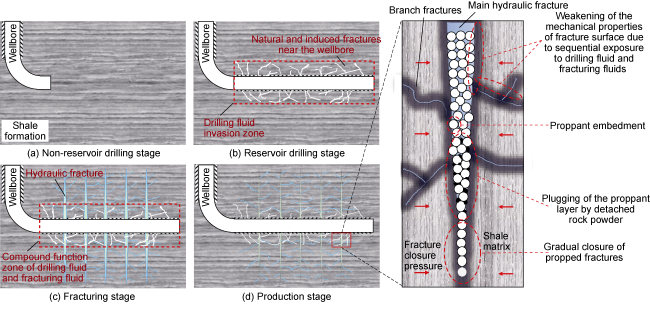


Fig. 12. Model of drilling fluid and fracturing fluid in shale oil and gas reservoirs. |
4. Formation damage control strategies of shale reservoirs in drilling and completion
Through the analysis of the compound damage mechanism of drilling fluid and fracturing fluid in shale oil and gas reservoirs and the establishment of a compound damage model, the range of the compound function zone of drilling fluid and fracturing fluid has been clarified. The weakening of the mechanical properties of shale fracture surfaces, fracture closure, and natural and hydraulic fracture damage caused by rock debris blockage have been evaluated. Based on this, protection strategies for drilling and completion of shale oil and gas reservoirs are proposed:
Prevent leakage and collapse to accelerate drilling in the reservoir section. Well leakage can lead to deep invasion of drilling fluid into the reservoir, which can easily induce solid blocking, liquid-phase trapping, and stress-sensitive damage. This is the most severe form of reservoir damage during the drilling and completion phase. Well collapse and leakage can significantly prolong the drilling cycle of shale horizontal wells, increasing the contact time between the drilling fluid and shale. As contact time increases, the rate of shale fracture propagation also increases. Therefore, improving the leakage and collapse prevention capabilities of drilling fluids, accelerating the drilling speed in the horizontal section of the reservoir, and reducing the contact time between the working fluid and fractures can effectively inhibit fracture extension length and reduce the invasion depth of drilling fluid.
Chemical filming of water-based drilling fluid and prevent weakening of shale fracture surface mechanics. Chemical filming temporary plugging can form a film-like substance on the surface of shale rocks, which can maximize the prevention of contact between drilling and completion working fluids and shale wall surfaces, as well as the weakening effect on shale fracture surfaces. The combination of chemical filming temporary plugging technology and physical particle temporary plugging technology can achieve synergistic effects in protecting the reservoir. Through physical particle temporary plugging technology, the larger pore throats in the reservoir are temporarily plugged and reduced to micro-fine pore throats. Then, chemical filming technology is used to form high- quality temporary plugs on the surface of the micro-fine pore throats, and achieve better reservoir protection.
Strengthen shale fracture plugging to reduce the invasion range of drilling fluid. Shale reservoirs are developed with multi-scale fractures ranging from nanometers to millimeters. Strengthening the plugging of multi-scale fractures in shale can effectively prevent further fracture extension and reduce the invasion of drilling fluid. The amount of drilling fluid entering the reservoir is a key factor affecting the degree of shale reservoir damage, and reducing the amount of drilling fluid entering the reservoir is crucial for effective shale reservoir protection. To overcome the structural damage to shale reservoir microfractures induced by contact with drilling and completion working fluids, micro-nanomaterials can be added to cover the natural fracture surfaces of the reservoir, preventing damage to the mechanical structure of the fracture surfaces.
Optimize the fracturing fluid system to protect fracture conductivity. Fracturing fluids with good gel breaking performance, low residue, and strong anti-swelling properties should be selected to reduce fracturing fluid damage and mitigate the decrease in fracture conductivity caused by weakening of shale fracture surface strength, proppant embedding, and rock debris blockage. At the same time, appropriate amounts of oxidizing agents can be added to the fracturing fluid to promote the removal of blockage damage caused by shale rock debris, inorganic salts, and high molecular weight polymers, protecting the fracture conductivity.
5. Conclusions
The compound function zone of drilling fluid and fracturing fluid is the necessary path for drilling fluid invasion, fracturing fluid injection, and formation fluid production, resulting in multiple types of fluids contacting the rocks within this zone, a long duration of action, and significant mechanical weakening. The depth of fracturing fluid penetration into the reservoir is much greater than that of drilling fluid invasion. The range of the compound function zone of drilling fluid and fracturing fluid mainly depends on the invasion range of drilling fluid.
During the process of drilling into the reservoir, drilling fluid invades the reservoir deeply through induced fractures and natural fractures in the shale, eroding shale minerals and generally weakening the mechanical properties of the shale in the invasion zone. During the hydraulic fracturing process, the compound function of drilling fluid and fracturing fluid further weakens the mechanical properties of the shale, making fractures more prone to closure and causing rock debris shedding during production. This can induce stress-sensitive damage and solid-phase blockage damage to natural/hydraulic fractures, resulting in a significant reduction in fracture conductivity in the compound function zone of drilling fluid and fracturing fluid.
The main protection strategies for drilling and completion of shale oil and gas reservoirs include accelerating drilling in the reservoir section with anti-collapse and anti-leakage measures, using chemical filming of water-based drilling fluid to prevent weakening of shale fracture surface mechanics, strengthening shale fracture plugging to reduce the invasion range of drilling fluid, and optimizing the fracturing fluid system to protect fracture conductivity.
Nomenclature
c0—initial fracture length, m;
cd—final length of subcritical fracture propagation, m;
E—elastic modulus of the rock, MPa;
g—gravitational acceleration, m/s2;
hf(t)—imbibition depth in shale fractures, m;
hm(t)—imbibition depth in shale matrix, m;
i—stress point number;
K0, Ki—initial permeability and permeability corresponding to the ith stress point, 10-3 μm2;
KIIC—mode II fracture toughness, MPa·m0.5;
r—average pore radius, m;
t—time, s;
u—rate of subcritical fracture propagation, m/s;
w—average fracture width, m;
W—Lambert W function;
α—linear spontaneous imbibition coefficient, m2/s;
β—nonlinear spontaneous imbibition coefficient, m/s;
γ—surface tension, N/m;
δ—shape factor, dimensionless;
Δt—time of subcritical fracture propagation, s;
ε1—axial strain of the rock, dimensionless;
ε3—radial strain of the rock in a triaxial compression test, dimensionless;
εev—elastic volumetric strain of the rock, dimensionless;
εfv—fracture volumetric strain of the rock, dimensionless;
εv—total volumetric strain of the rock, dimensionless;
ζ—fracture dip angle, (°);
θ—wetting contact angle, (°);
μ—apparent viscosity of the fluid, Pa∙s;
μf—friction coefficient of the rock, dimensionless;
ν—Poisson's ratio, dimensionless;
ρ—fluid density, kg/m3;
σ0, σi—initial stress and stress at the ith experimental point, MPa;
σ1, σ3—maximum and minimum principal stresses, MPa;
σci—fracture initiation stress (the stress threshold for fracture propagation), MPa;
σcd—fracture damage stress (the stress corresponding to the end of subcritical fracture propagation), MPa;
τ—tortuosity of shale matrix pores, dimensionless.