

Introduction
As of 2021, a total of 532 basement reservoirs have been discovered in 127 basins or depressions [1]. The number of basement reservoirs, recoverable oil reserves, and recoverable gas reserves account for 9.3%, 10.2% and 2.7%, respectively, in the world. However, the current exploration of basement reservoirs primarily focuses on the middle to shallow basement buried-hills, with the target intervals typically ranging from 2 000 to 4 500 m.
Basement reservoirs, as defined by Walters, Landes et al., and Pan, refer to the reservoirs of oil and gas formed on the crystalline basement of a basin, with the predominant rock types of metamorphic or igneous rocks [2⇓-4]. With further exploration, some scholars argue that the formation of basement reservoirs is related to basin evolution. They extend the definition to include "reservoirs formed in sedimentary rocks before the formation of the basin" [5]. This broader definition is known as generalized basement reservoirs, where the reservoir rock types can be metamorphic, igneous, or sedimentary. Buried-hills are an important type of basement reservoirs, divided into the paleo-morphology and interior subtypes [6]. The former is dominantly weathering crust reservoirs, with unconformities and faults as conduits and overlying tight sedimentary strata as seals, while the latter is characterized by reservoir spaces consisting of structural fractures or dissolution pores inside buried-hill, with faults or fractures as conduits and interior barriers as seals [7-8].
In comparison to deep marine carbonate rocks and clastic rocks, deep basement reservoirs have been less explored and studied, and their formation conditions and distribution patterns have been unclearly understood, which hinder the deployment of deep basement oil and gas exploration.
As the oil and gas exploration in China expands to deep and ultra-deep strata, significant breakthroughs have been made in the hydrocarbon exploration in deep to ultra-deep marine carbonate rocks of the Tarim Basin and Sichuan Basin and deep to ultra-deep clastic rocks of some foreland basins such as Kuqa and southern Junggar in China, with the depth ranging from 6 000 to 8 000 m. These breakthroughs demonstrate the enormous potential of deep to ultra-deep oil and gas exploration. Based on the analysis of the ubiquity and uniqueness of basement reservoirs, this paper proposes favorable conditions for large-scale hydrocarbon accumulation in the deep basements of petroliferous basins. It also presents the exploration targets of deep basement reservoirs in onshore China, providing theoretical support for further hydrocarbon exploration.
1. Global distribution of basement reservoir accumulation
The characteristics of basement reservoirs worldwide were analyzed using data from the S&P Global basement reservoir database in 2022 [1]. Until 2021, a total of 532 basement reservoirs had been discovered in 127 sedimentary basins or sub-basins [1]. Among these, 314 reservoirs have detailed information and form the basis for this analysis.
Basement oil and gas exploration started over a century ago, and the discovery of basement reservoirs has noticeably quickened since the beginning of the 21st century, with the burial depth increasing (Fig. 1a, 1b ). In 1913, the first basement reservoir in the world, the Kluang field, was discovered in the South Sumatra Basin, Indonesia, with the reservoir rock being pre-Cretaceous granite. From 1913 to 1959, only 18 basement reservoirs were discovered, with the burial depths all less than 3 000 m. From 1960 to 1999, 184 basement reservoirs were discovered, with only four having burial depths exceeding 4 000 m. From 2000 to 2021, 112 basement reservoirs were discovered, including nine with burial depths exceeding 4 000 m. The Meo Trang oilfield in Vietnam has the greatest burial depth (greater than 5 150 m). China discovered its first basement oil reservoir, the Ya'erxia oilfield in the Jiuquan Basin, in 1959. Subsequent discoveries were made in basins such as the Bohai Bay, Qaidam, and Erlian, with a total of 45 basement reservoirs. Since 2000, large-scale basement reservoirs have been discovered in the Bozhong Depression of the Bohai Bay Basin and the western part of the Qaidam Basin, with burial depths ranging from 3 000 m to 4 500 m.

Fig. 1 Number of basement reservoirs in the world (modified from Reference [1]; the lithology of weathering basement is unknown). |
Stratigraphically, the discovered basement reservoirs covers the Archean to the Paleogene (Fig. 1d ), especially the Archean and Precambrian (149 reservoirs, 47.5%), followed by the Mesozoic (86 reservoirs, 27.4%) and the Paleozoic (75 reservoirs, 23.9%).
The main rock types in basement reservoirs are metamorphic rocks and granites, where 267 reservoirs have been discovered (Fig. 1c ), accounting for 85%. Specifically, there are 141 reservoirs dominated by metamorphic rocks, accounting for 44.9%, including gneiss, schist, slate, marble, and quartzite, 96 reservoirs dominated by granite, accounting for 30.6%, and 30 reservoirs with both granite and metamorphic rocks, accounting for 9.6%.
Cumulatively, globally discovered basement reservoirs have cumulative proven recoverable oil reserves of 7.44× 10⁸ t and recoverable gas reserves of 5 501.60×10⁸ m3. Specifically, the largest one is Bach Ho Field in the Cuu Long Basin, Vietnam, with proven recoverable oil reserves of 2.15×10⁸ t, accumulating to a total of 2.69×10⁸ t of oil equivalent, which is also the world's largest basement reservoir. There are thirteen gas reservoirs with recoverable gas reserves exceeding 100×108 m3. Specifically, the largest one is Suban Field in the South Sumatra Basin, Indonesia, with proven recoverable gas reserves of 811×108 m3, accumulating to a total of 0.72×10⁸ t of oil equivalent, which is the world's third-largest basement reservoir [1]. The basic characteristics of typical basement reservoirs in the world are summarized in Table 1 . China has discovered 44 basement reservoirs in basins or regions such as the Bohai Bay, the southeastern sea, and the Qaidam Basin, with a cumulative proven recoverable oil reserves of 1.09×10⁸ t and recoverable gas reserves of 1 082.86×10⁸ m3 [1].
Table 1 Basic characteristics of global basement reservoirs |
| No. | Country | Basin | Basin type | Oil/gas reservoir | Onshore/ Offshore | Horizon | Reservoir rock type | Recoverable oil reserves/ 108 t | Recoverable gas reserves/ 108 m3 |
|---|---|---|---|---|---|---|---|---|---|
| 1 | Vietnam | Cuu Long | Back-arc basin | Bach Ho | Offshore | J | Granite, diorite | 2.15 | 511.40 |
| 2 | Venezuela | Maracaibo | Foreland basin | La Paz | Onshore | Pz | Crystalline basement, metamorphic rock | 0.49 | 246.19 |
| 3 | Indonesia | South Sumatra | Back-arc basin | Suban | Onshore | K2 | Crystalline basement, metamorphic rock | 811.56 | |
| 4 | Vietnam | Cuu Long | Back-arc basin | Rang Dong | Offshore | J | Granite, diorite | 0.34 | 76.46 |
| 5 | China | Bohai Bay | Back-arc basin | BZ19-6 | Offshore | Ar | Granite, gneiss | 0.14 | 450.24 |
| 6 | Libya | Sirte | Rift basin | Amal | Onshore | Ar | Volcanic breccia | 0.28 | 36.81 |
| 7 | India | Mumbai | Rift basin | Mumbai High | Offshore | Ar | Metamorphic rock, igneous rock | 0.22 | 56.63 |
| 8 | Venezuela | Maracaibo | Foreland basin | Mara | Onshore | AnPz-Pz | Granite, metamorphic rock | 0.16 | 48.49 |
| 9 | Vietnam | Cuu Long | Back-arc basin | Su Tu Vang | Offshore | J | Granite, diorite | 0.17 | 28.32 |
| 10 | Russia | West Siberia | Back-arc basin | Novoportovskoye | Onshore | C | Weathered basement * | 224.55 | |
| 11 | Brazil | Sergipe | Rift basin | Carmopolis | Onshore | Pz2 | Metamorphic rock | 0.14 | 6.14 |
| 12 | China | Bohai Bay | Back-arc basin | Xinglongtai | Onshore | Ar | Gneiss | 0.09 | 6.51 |
| 13 | Yemen | Sayun-Masila | Rift basin | Tawila | Onshore | An | Granite | 0.09 | 5.66 |
| 14 | Hungary | Pannonian | Back-arc basin | Ulles | Onshore | Pz | Dolomite, schist | 98.82 | |
| 15 | China | Bohai Bay | Back-arc basin | Jinganbao | Onshore | Ar | Metamorphic rock | 0.06 | 5.23 |
| 16 | China | Bohai Bay | Back-arc basin | Chengdao | Offshore | Ar | Gneiss | 0.05 | 2.83 |
| 17 | Libya | Sirte | Rift basin | Rakb | Onshore | Ar | Weathered basement * | 0.05 | 3.82 |
| 18 | Norway | Horda Platform | Rift basin | Rolvsnes | Offshore | Ar | Granite, gneiss | 0.04 | 12.18 |
| 19 | China | Bohai Bay | Back-arc basin | Huanxiling | Onshore | Ar | Metamorphic rock | 0.03 | 7.55 |
| 20 | Thailand | Phitsanulok | Rift basin | Sirikit | Onshore | AnK-K | Metamorphic rock | 0.03 | 2.12 |
In summary, the globally discovered basement reservoirs are numerous, widely-distributed, various stratigraphically, and small-scale individually. The relatively large reservoirs are primarily located in rift basins, back-arc basins, and foreland basins associated with Meso-Cenozoic plate tectonic activities (Table 1 ). The tectonically active zones between the Eurasian Plate and the Pacific Plate have the majority of basement reservoir [9]. Several basement reservoirs have been discovered in the Songliao Basin, Bohai Bay Basin, and the southeastern sea area of China [10⇓⇓-13]. Basement reservoirs have also been found in back-arc basins such as the Cuu Long Basin in Vietnam and the Java Basin in Indonesia. Foreland basins formed by plate collisions and orogenies are significant regions for discovering basement reservoirs, such as the Maracaibo Basin in Venezuela, Jiuquan Basin in China, Magallanes Basin in Chile, and the Pannonian Basin in Europe. Pull-apart basins in large strike-slip fault zones are also favorable for the formation of basement reservoirs, such as the Sirte Basin in Libya, the Suez Basin in Egypt, the Campos Basin in Brazil, and the Qaidam Basin and Bohai Bay Basin in China [14-15].
2. Basic characteristics of basement reservoirs
Compared to the sedimentary rock reservoirs, the basement reservoirs are unique in reservoir-forming elements (e.g. reservoir rocks, source rocks, and source- reservoir assemblage) and dynamics, such as strong reservoir heterogeneity, early reservoir-forming time, allochthonous hydrocarbon source, multiple types of source- reservoir assemblages, and hydrocarbon accumulation by pumping effect under the driving of source-reservoir pressure difference.
2.1. Strong reservoir heterogeneity and early reservoir-forming time
Basement reservoirs are diverse in rock types, including metamorphic, igneous, and sedimentary rocks [12⇓⇓⇓⇓⇓⇓-19]. The review of discovered basement reservoirs worldwide reveals diverse space types, with the dominance of porous-fractured and fractured types with low porosity and ultra-low permeability. Futhermore, basement reservoirs exhibit distinct multilayered structures. Near the top of the basement is dominated by weathering crust reservoirs, with well-developed matrix pores. Farther away from the weathering crust, interior fractured reservoirs become prevalent, without matrix pores (Table 2 ).
Table 2 Basic characteristics of basement reservoirs |
| Rock type | Lithology | Storage space type | Reservoir characteristics and distribution patterns | Examples |
|---|---|---|---|---|
| Metamorphic rocks | Mainly dynamic metamorphic glutenite, gneiss, schist, granitic gneiss, and mixed rocks | Porous-fractured and fractured, with dual porosity, low porosity and ultra-low permeability | The storage spaces of reservoirs in weathering zones are primarily composed of pores, followed by fractures, with the fracture-pore combination in dominance. The storage spaces of interior reservoirs are mainly characterized by pore-fracture type and fracture type. Rocks with predominantly light-colored minerals are brittle and more prone to fragmentation, forming reservoirs. Folding and faulting actions control the development of fracture zones. | The Archaean metamorphic rock buried-hill reservoirs in the Bozhong Depression, the Carboniferous-Permian metamorphic rock reservoirs in the Central Uplift Zone of the Songliao Basin, the metamorphic rock buried-hill reservoirs in the Liaohe Basin, and the metamorphic rock reservoirs in the Altyn Tagh piedmont in the Qaidam Basin. |
| Granite | Mainly granodiorite and monzodiorite | Fractured-porous and fractured, with the storage spaces dominated by intergranular pores, feldspar and amphibole dissolution pores, microfractures, joints, and structural fractures | Medium-acid granites with a higher felsic content are more favorable for the development of reservoirs. The reservoirs are vertically zoned, and exhibit weathering crust type and interior type. The former is dominated by weathering process, with the storage spaces primarily composed of pores and fractures-pores. The degree of pore/fracture development and the intensity of weathering are positively correlated. The latter is dominated by tectonic process, with the storage spaces mainly composed of fractures and cavities, showing a low matrix porosity. | The granite buried-hill reservoirs in the Bach Ho Oilfield of Cuu Long Basin in Vietnam, and the granite buried-hill reservoirs in the Penglai 9-1 Oilfield, the Dongping area of the Qaidam Basin, and the Huizhou Sag of the Pearl River Mouth Basin in China. |
| Medium-basic volcanic rocks | Mainly two series: subalkaline and alkaline. The former is dominated by andesite, basaltic andesite, dacite, and rhyolite, while the latter is mainly represented by basaltic trachyandesite. | Dominantly fractured-cavity reservoirs, with dissolution cavities being the primary feature (the main dissolved minerals are feldspar and amphibole), followed by fractures (particularly structural and dissolution fractures) | Rocks such as volcanic breccias and rhyolite of explosive and effusive facies exhibit the optimal reservoirs properties | Reservoirs in the Carboniferous of the Junggar Basin, the Permian of the Sichuan Basin, and the Jurassic of the Huizhou Sag in the Pearl River Mouth Basin. |
In tectonically stable sedimentary basins such as cratonic and depression basins, the formation of basement reservoir primarily occurs after the formation of the basin basement and before the filling of overlying sedimentary rocks. In sedimentary basins with strong tectonic activity, such as Meso-Cenozoic rift basins and foreland basins, basement reservoirs may undergo additional tectonic reworking after the formation of weathering crust reservoirs. Therefore, the long-term exposure to weathering process and subsequent tectonic reworking are the main drivers to the formation of basement reservoirs.
The basement rock types and their combinations play a crucial role in weathering, dissolution, and tectonic reworking. Studies indicate that the higher the content of light-colored minerals (e.g. feldspar and quartz), the stronger the erosion, and the higher the rock brittleness, which are more conducive to rupture and physical weathering of the rocks, leading to the formation of fractures and dissolution cavities. Conversely, the higher the content of dark-colored minerals, the weaker the dissolution; the higher the content of plastic minerals like biotite, the higher the rock ductility and plasticity, making it less prone to large-scale fracturing, so that the rocks have less-developed reservoirs and can act as potential seals/barriers [20⇓-22].
Late-stage tectonic movements reshape the distribution and spatial combinations of basement rock types, making it complex and challenging to predict reservoir characteristics. The Qaidam Basin is an example of Meso-Cenozoic superimposed petroliferous basin developed on a Paleozoic folded basement. Its formation and evolution are closely related to the subduction of the Indian Plate, the uplift of the Tibetan Plateau, and the movement along the Altyn Tagh fault zone. It has experienced four evolution stages: Hercynian, Yanshanian, Early Himalayan, and Late Himalayan [23]. Intense tectonic movements resulted in complicated basin base-ment structure, leading to a complex and variable lithology of basement rocks. Studies show that the lithology of basement reservoirs in the Altyn Tagh piedmont is dominated by metamorphic rocks and granite, with local occurrences of basalt, andesite, and other lithologies (Fig. 2 ). The basement gas reservoirs discovered so far, such as Dongping, Kunteyi, and Lenghu, are primarily associated with metamorphic rocks, while the reservoirs such as Jianbei and Niudong are mainly associated with granite [24].

Fig. 2 Distribution of basement lithology in the northern margin of the Qaidam Basin. |
The development of the basement weathering crust reservoir depends on the preservation state and subsequent reworking of the weathered strata. Well-preserved weathered strata typically exhibit a multilayered structure, showing the patterns of three [25] or four divisions[22]. The most favorable reservoirs are primarily located in the weathered and semi-weathered layers, characterized by the development of dissolution cavities. Late-stage reworking processes, such as river erosion, folding and denudation, and fault displacement, can lead to uneven thickness distribution of the basement weathering crust. In the Bohai Bay Basin, the granite weathering crust exhibits a dual-layer structure, and the reservoir distribution is influenced by structural tilting, fault damage, hydraulic erosion, and overlying formations [22]. In the Bozhong Depression, the Archean buried-hill metamorphic rock reservoirs can be categorized into exposed and covered buried-hill types based on their space types and patterns. Exposed-type reservoirs are controlled by both weathering and tectonic reworking, while covered-type reservoirs are mainly influenced by the latter [8].
Structural processes such as folding and faulting play a dominant role in the large-scale distribution of basement reservoirs. The uplift and erosion associated with stratigraphic folding result in variations in basement explosion, lithology and occurrence, consequently leading to the alternation of reservoirs and tight barriers. For instance, in the Haiwaihe area of the Liaohe Depression, the Archean metamorphic buried-hills exhibit an alternation of mixed granite reservoirs and amphibolite barriers [26]. Stress differences induce systematic patterns in the distribution of fractures formed by structural processes within folds. Tensional fractures dominate the fold core, being perpendicular to strata, while shear fractures are prevalent in the flanks, displaying smaller dip angles [21]. The development of faults is closely related to the degree of fracture development, with larger fault throws and proximity to faults leading to denser fracture networks. Faults are crucial for the vertical extension of basement weathering crust reservoirs to interior reservoirs, especially in large-scale strike-slip fault zones and adjacent areas, where the vertical extension of interior fractured reservoirs can be several kilometers [27-28].
In summary, basement reservoirs have the characteristics such as early formation, well-developed fractures and cavities, strong heterogeneity, and high resistance to compaction. These characteristics enable the petrophysical properties of basement reservoirs to be independent of burial depth. Thus, large-scale effective reservoirs can exist even in deep to ultra-deep basements. In the Qaidam Basin, the porosity of sandstone reservoirs decreases with increasing burial depth. However, basement reservoirs, whether composed of metamorphic rock or granite, maintain porosities of 2%-10% at depth of 1 000 m to 7 000 m (Fig. 3 ). In the Kunteyi structure at the northern margin of the Qaidam Basin, wells K2, K101, and K1-1 have been drilled in the No.1 basement trap (Fig. 2 ). At a depth of around 7 000 m, the wells encountered basement rocks, primarily composed of quartzite, mica quartz schist, and schist, with the storage space dominated by fractures. Core analysis revealed the matrix porosity ranging from 1% to 3%, but variable permeability between 0.28×10⁻³ μm2 to 136.00×10⁻³ μm2. The log interpretation indicated porosities ranging from 2% to 10%. The wells were tested to be able to obtain industrial gas production.

Fig. 3 Variation of porosity with depth for basement and sandstone reservoirs in the Qaidam Basin. |
2.2. Allochthonous hydrocarbon source and multiple types of source-reservoir assemblages
Given that basement rocks such as metamorphic and volcanic rocks do not inherently generate hydrocarbons, allochthonous hydrocarbon source is a prerequisite for the formation of basement reservoir accumulations. There are two main perspectives on the hydrocarbon origin of basement reservoirs: the inorganic theory and the organic theory [29-30]. The inorganic theory suggests that hydrocarbons transported from the deep mantle along fault zones into the crust can accumulate and accumulated within the basement reservoirs. Conversely, the organic theory emphasizes that basement reservoir oil and gas originate from hydrocarbons generated by the pyrolysis and cracking of organic matters in sedimentary rock layers. The debate on the genesis of basement reservoir oil and gas still exists. But from an exploration perspective, the focus should be on the evaluation of hydrocarbon source rocks and the spatial configuration of source rocks and reservoirs to provide a basis for regional assessments for basement reservoirs.
Based on the analysis of existing basement reservoirs, the positional relationship between source rocks and basement reservoirs can be categorized into two major assemblage types: contacted type, and separated type (Fig. 4 ).

Fig. 4 Types of source rock-basement assemblages. |
The contacted source rock-basement assemblage can be further divided into three subtypes:
(1) Overlying source rock: In this configuration, the basement reservoir is overlain by the hydrocarbon source rock, forming an assemblage of upper source and lower reservoir. In the early stage of basin development, under marine or lacustrine transgressions, organic-rich shale source rocks were deposited above the basement. This assemblage is widespread in the lower parts of depression basins or structurally gentle areas of faulted basins, where the basement has not undergone intense later tectonic reworking. Exploration in the deep basement reservoirs in the Damintun Sag of the Liaohe Depression in the Bohai Bay Basin has confirmed the exploration potential of this source rock-reservoir assemblage.
(2) Lateral source rock: In this configuration, the basement reservoir is adjacent to a hydrocarbon-generating depression, where faults act as conduits for hydrocarbon migration. The reservoir conditions are superior and are mainly distributed in the middle to lower parts of the slope zones of faulted basins, with burial depths ranging from 3 000 m to 5 000 m. This subtype is a major target for exploration in deep basement reservoirs, reflected by significant discoveries in various depressions in the Bohai Bay, the Southeast China Sea area, and the Qaidam Basin. Faults play a crucial role in this subtype, acting not only as important conduits but also significantly influencing reservoir properties and controlling oil and gas enrichment.
(3) Encapsulated source rock: This subtype is generally developed in relatively high uplifted blocks within hydrocarbon-generating depressions, where abundant source rocks and favorable reservoir conditions facilitate the formation of large reservoirs in the basement. When the basement interior reservoirs are complicated by faults during later tectonic movements, they can form mainly fracture-dominated interior reservoirs. Driven by the source-reservoir pressure differential, hydrocarbons move downward along faults or fractures until accumulation to form reservoirs. Examples include the Xinglongtai Oilfield in the Liaohe Depression, the BZ19-6 Oilfield in the Bozhong Depression, and the Bach Ho Oilfield in Vietnam.
The separated source rock-basement assemblage refers to the condition where source rocks and basement rocks do not contact directly, but communicate through faults or unconformity surfaces. This assemblage is commonly developed in the margins and uplift zones of basins, and middle-upper slope zones. The target layers of basement reservoirs have relatively shallow burial depths, making them the primary focus of current deep exploration. Examples include the Shaleitian Uplift, Bonan Low Uplift and Shijiutuo Uplift in the Bohai Sea area, the southwestern and northwestern margins of the Qaidam Basin, and the Songnan Low Uplift in the Qiongdongnan Basin, where the basement reservoirs have the depths ranging from 2 000 m to 3 000 m.
The separated source rock-basement assemblage can be further classified into three subtypes:
(1) Communicated by normal fault: This subtype is developed in faulted basins, with major source rocks usually located in the basin center or the downthrown side of sag-controlling fault. Basement reservoirs are controlled by block faulting and can be developed in slope zones of faulted basins and uplifted blocks. This configuration results in the formation of lower-positioned buried-hill and higher-positioned buried-hill in slope zones, and buried-hill of uplifted blocks.
(2) Communicated by reverse fault: This subtype is developed in foreland basins or regions with reverse faults, such as the Altyn Tagh piedmont fold-thrust belt in the Qaidam Basin. During the Himalayan Period, fault became active and involved into the basement, forming basement blocks in the hanging wall. Hydrocarbon source rocks in the foot wall consist of Jurassic coal and Paleogene lacustrine shale. Faults allow hydrocarbons to accumulate in structurally high-positioned basement reservoirs, as observed in the Dongping basement gas reservoir.
(3) Communicated by strike-slip fault: This subtype is usually developed in large strike-slip fault zones and their derived structural belts. Influenced by regional tectonic stress, strike-slip faults can occur during basin sedimentation, exerting controls on basin formation, such as the control of the Altyn Tagh fault zone on the Qaidam Basin[24]. They can also occur after basin formation, as seen in the Tan-Lu fault zone in the Bohai Sea [27]. Basement reservoirs in strike-slip fault zones exhibit well-developed faults and fractures. Given no direct contact with source rocks, under the source-reservoir pressure differential, hydrocarbons migrate laterally along faults or fractures until they are accumulated in reservoirs. Exploration practices have revealed that the Altyn Tagh piedmont fault zone in the Qaidam Basin and the Tan-Lu fault zone in the Bohai Bay Basin are favorable areas for the distribution of basement reservoirs. Fig. 5 shows the distribution of basement reservoirs in sedimentary basins.

Fig. 5 Distribution of basement reservoirs in sedimentary basins. |
In China, 33 basement oil and gas fields have been discovered in the mid-shallow strata (less than 3 500 m). These fields are primarily located in the uplift marginal areas, high positions of secondary positive structural belts and upper-central parts of slope zones of the Liaohe Depression, Jiyang Depression, Huanghua Depression, and Bozhong Depression of the Bohai Bay Basin, and the Altyn Tagh piedmont zone of the Qaidam Basin. Important discoveries have also been made in the central uplift zone of the Songliao Basin, the Songnan Low Uplift of the Qiongdongnan Basin, and other regions. From the perspective of source-reservoir assemblages, basement reservoirs in the mid-shallow strata are primarily of the separated source rock-basement assemblage, with faults serving as the main conduits for oil and gas migration. So far, there are ten basement reservoirs discovered at depths ranging from 3 500 m to 4 500 m, mainly in the positive structural belts or the lower-central parts of slope zones in the faulted basins, termed the "uplifts in sags". These reservoirs, characterized by close contact between hydrocarbon source rocks and basement rocks, abundant hydrocarbon sources, and favorable cap rock conditions, have the potential to form large basement accumulations. Examples include the Xinglongtai Oilfield in the Xinglontai structural belt of the Liaohe Basin and the BZ19-6 Oilfield in the uplift zone on the eastern slope of the Bozhong Depression. There are also three basement reservoirs discovered at depths exceeding 4 500 m, including the Chengu Field (4 600-4 700 m) in the Liaohe Depression, the Jianbei gas field (4 600 m) in the northwestern margin of the Qaidam Basin, and the Kunteyi gas field (6 900-7 100 m) in the Qaidam Basin.
2.3. Hydrocarbon accumulation by pumping effect under the driving of source-reservoir pressure difference
Previous studies suggest that the hydrocarbon accumulation in the basement buried-hills with separated source rock-basement assemblage is primarily driven by buoyancy, with oil and gas migrating along faults or unconformities until they are trapped and accumulated in buried-hill formations [31]. However, the effectiveness of basement reservoirs in deep-seated formations and their ability to accumulate hydrocarbons in conjunction with overlying source rocks are crucial for guiding the exploration of deep basement reservoirs. The validity of inverted charging-pattern of hydrocarbon was controversial. Some scholars contend that this pattern contradicts fundamental physical laws, asserting that hydrocarbons always migrate from bottom to top under buoyancy [32]. Others propose that source-reservoir pressure difference plays a role in hydrocarbon accumulation, with higher pressure difference leading to increased oil migration efficiency [33-34], which supports the inverted charging-pattern. Under specific geological conditions, there is also the concept of structural pumping effect for hydrocarbon accumulation [35], where tectonic stresses generate shear zones or fractured zones, creating cavities through rock deformation. Hydrocarbons from surrounding source rocks migrate toward these cavities and accumulate. Other Similar concept includes "seismic pumping effect"[36].
Based on the characteristics of hydrocarbon accumulation in basement reservoirs, there is a possibility of pumping effect for hydrocarbon accumulation in deep basement reservoirs. Under this model, driven by a significant pressure difference between the abnormally high-pressure hydrocarbon source rock and the normal- or negative-pressure basement reservoir, hydrocarbons generated from the source rock move towards and accumulate in the basement reservoir. This model highlights the effectiveness and universality of basement reservoir in deep sedimentary basins, providing valuable insights for selecting exploration zones in deep basement reservoirs. The following is the demonstration based on known pressure characteristics of basement reservoirs and the pressure difference between source rock and reservoir. Additionally, deductions will be made regarding the depth of oil and gas downward migration.
Basement reservoirs exhibit a multi-pressure system, with normal- to negative-pressure reservoirs being predominant. The pressure data from basement reservoirs like Shen'anpu, Chenghai, Xinglongtai, Nanpu 2, and Bozhong, as well as sandstone reservoirs adjacent to hydrocarbon sources, reveal that the pressure coefficients for basement reservoirs range from 0.78 to 1.24, with an average of 0.99 across 21 data points. In comparison, sandstone reservoirs exhibit pressure coefficients ranging from 1.04 to 1.29, with an average of 1.17 across 14 data points. According to the fitted pressure-depth (p-H) relationship, the pressure coefficient of basement reservoirs decreases with increasing burial depth, while the pressure coefficient of sandstone reservoirs increases with burial depth (Fig. 6 ). Due to differences in properties between seals and reservoirs, multiple pressure systems exist within one single basement reservoir. However, the basement reservoirs generally exhibit a decreasing trend in pressure coefficient from weathered reservoirs at the top of the basement to interior reservoirs of the basement. For example, in the Xinglongtai metamorphic rock buried-hill reservoir in the Liaohe Basin, the pressure coefficients for four oil- and gas-bearing intervals at different depths are significantly different [37], being 1.20 for 2 450- 3 100 m, 1.02 for 3 100-3 400 m, 0.91 for 3 400-3 960 m, and 0.81 for 3 960-4 500 m, respectively. The pressure coefficients vary greatly among these intervals, indicating that the deeper the buried-hill interior reservoir, the lower the pressure coefficient.

Fig. 6 Depth-pressure relationship of basement and sandstone reservoirs in the Bohai Bay Basin. |
The basement reservoir and overlying source rock exhibit a significant residual pressure difference, providing the driving force for hydrocarbon accumulation by pumping effect. In the Archaean buried-hill gas reservoir of the BZ19-6 oilfield in the Bozhong Depression, the overlying source rocks have the pore fluid pressure of 50-60 MPa and the formation pressure coefficient of 1.4-1.6, in the depth range of 3 000-4 000 m, while the reservoir pressure coefficient is approximately 1.0. The pressure difference between the source rock and the reservoir is 13-26 MPa, providing overpressure dynamics for gas migration [7]. In the Pearl River Mouth Basin, the hydrocarbons of HZ26-6 volcanic reservoir were generated from the Wenchang Formation source rocks in the Huizhou Sag and then migrated primarily under the action of source-reservoir pressure difference [38].
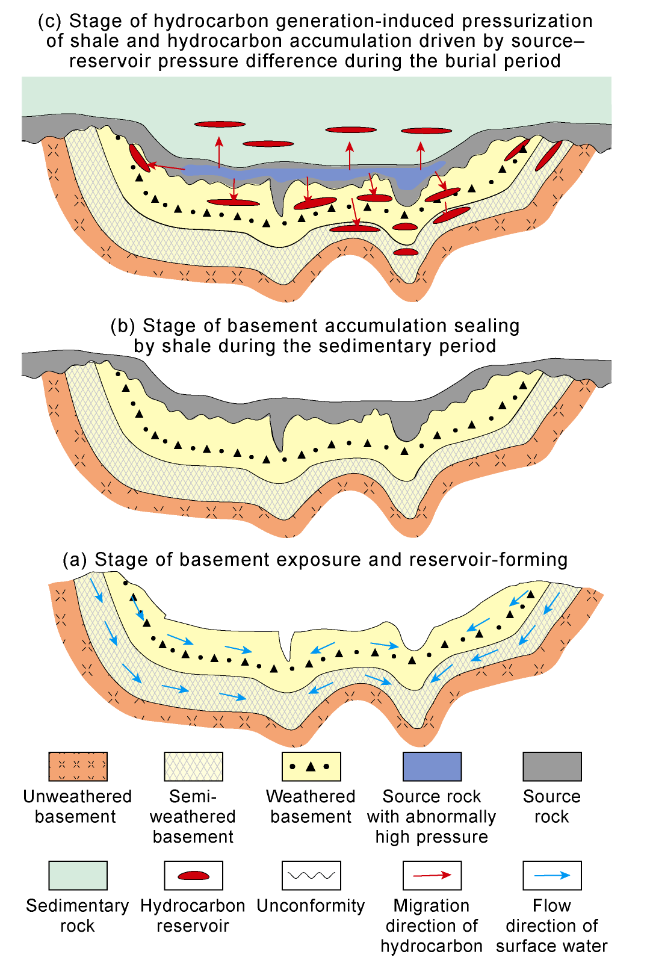


Fig. 7 Model of hydrocarbon accumulation by pumping effect in basement reservoirs under the driving of source-reservoir pressure difference. |
Explorations confirm that basement interior reservoirs can extend downward by 1 000 m to 2 000 m. Basement interior reservoirs, predominantly of fracture type, raise the question about the maximum depth of downward extension. The following theoretical predictions address this question.
Assuming the overlying source rock has a fluid pressure coefficient of 1.5 and the basement reservoir has a pressure coefficient of 1.0. Hydrocarbons generated in the source rock are blocked from moving upward and laterally, but can only migrate downward along faults or fractures. If oil and gas move downward continuously in pure phase without considering buoyancy and capillary resistance, the oil column height when a balance of fluid pressure is reached between the source rock and the basement reservoir is the maximum extension of the fractured reservoir. Such balance is expressed as:
${{H}_{0}}\times {{C}_{p}}\times {{\rho }_{w}}=\left( {{H}_{0}}+{{D}_{oil}} \right){{\rho }_{w}}$
${{D}_{oil}}={{H}_{0}}\left( {{C}_{p}}-1 \right)$
Using Eqs. (1) and (2), the pressure coefficient of the basement reservoir is assumed to be 1.0, and the maximum depths of vertical downward migration for oil droplets generated by source rocks with different pressure coefficients are detailed in Table 3. It is evident that with increasing burial depth and pressure coefficients of the source rock, the depth of migration into the interior fractured reservoir increases. When the burial depth of the source rock is 3 000 m, the exploration depth of the basement interior reservoir can reach 600 m to 2 400 m. When the burial depth of the source rock is 5 000 m, the exploration depth of the basement interior reservoir can reach 1 000 m to 4 000 m. Accordingly, exploration of basement oil and gas can not only extend to deeper layers but also to inside basement.
Table 3 Maximum depth of oil and gas migration in fractured basement reservoirs under normal pressure |
| Source rock burial | Maximum depth of vertical downward migration of oil droplet at different pressure coefficients/m | |||||
|---|---|---|---|---|---|---|
| depth/m | 1.2 | 1.3 | 1.4 | 1.5 | 1.6 | 1.8 |
| 3 000 | 600 | 900 | 1 200 | 1 500 | 1 800 | 2 400 |
| 3 500 | 700 | 1 050 | 1 400 | 1 750 | 2 100 | 2 800 |
| 4 000 | 800 | 1 200 | 1 600 | 2 000 | 2 400 | 3 200 |
| 4 500 | 900 | 1 350 | 1 800 | 2 250 | 2 700 | 3 600 |
| 5 000 | 1 000 | 1 500 | 2 000 | 2 500 | 3 000 | 4 000 |
3. Exploration targets of deep basement reservoirs in onshore China
3.1. Favorable conditions for evaluation of deep basement reservoirs
Petroliferous basins in onshore China are predominantly superimposed, with significant variations in basement structure, basin evolution and its impact on basement reworking. There is no unified standard for evaluating basement reservoirs. Here, a comprehensive evaluation is proposed in four aspects:
(1) Basement lithology composition and late-stage reworking degree: The parts of basins with intense tectonic activity in the basement, characterized by the development of magmatic and regional metamorphic zones, are favorable for the distribution of deep basement reservoirs.
(2) Source-reservoir assemblage: Basements situated below or adjacent to hydrocarbon-generating depressions, featuring contacted source rock-basement assemblage, exhibit superior reservoir-forming conditions.
(3) Development of large deep faults: Regions with well- developed faults, especially strike-slip faults, facilitate the formation of basement interior reservoirs, but also provide advantageous conduits for hydrocarbon accumulation.
(4) Regional mudstone seal capacity: High-quality regional mudstone seals effectively inhibit upward fluid migration, allowing the basement reservoir to form independent accumulation and overall hydrocarbon content.
3.2. Exploration targets of deep basement reservoirs in basins
3.2.1. Cratonic basins with Precambrian crystalline basement
Cratonic basins such as Ordos, Sichuan, and Tarim possess both Precambrian crystalline and folded basements. Such deep basements are unknown structurally and have been rarely studied with respect to petroleum geology in a systematical way. Coupling with scarce wells available, the exploration targets of basement reservoirs remain unclear. Recent studies indicate that ancient cratonic basins in China, due to their small block size and relatively poor internal stability, undergo strong tectonic differentiation due to regional tectonic movements. They commonly experience a two-stage basin evolution (intracontinental rifting, followed by cratonic sagging). Rift zones in intracontinental rifts develop high-quality source rocks, which form good source-reservoir assemblages with adjacent basement rocks, presenting a good exploration potential. The Ordos Basin features the NE-trending wide rifts of the Lower Proterozoic Changcheng System, with the Cuizhuang Formation source rocks having the thickness exceeding 40 m, total organic carbon content ranging from 0.50% to 1.52%, and vitrinite reflectance of 2.0% to 3.0% [39], demonstrating a significant hydrocarbon generation potential. In the Sichuan Basin and Tarim Basin, multiple rifts develop in the Nanhua basement, and high-quality source rocks are observed in outcrops. Source rocks with high organic matter abundance are speculated within the rifts [40-41]. Source rocks in rift zones are coupled with metamorphic rocks and granite reservoirs in the rift flanks to form good source-reservoir assemblages worthy of exploration.
3.2.2. Sedimentary basins with Paleozoic folded basement
The Early Paleozoic folded basements of the Junggar Basin and Qaidam Basin are composite of various rock types as a result of late-stage granite intrusion. These diverse and widespread basements are products of intense reworking by tectonic processes during the Late Paleozoic to the Meso-Cenozoic. In the Junggar Basin, the Carboniferous volcanic rocks and underlying crystalline basement constitute the primary reservoirs. The reservoirs consist mainly of basic volcanic rocks, intermediate-acidic volcanic rocks, and basement granite, with porosity of 6.07%-19.10%, averaging 8.30%. Multiple NE and nearly EW large buried-hill uplift structures develop above the Carboniferous basement, adjacent to the hydrocarbon-generating center in the system. A good source-reservoir assemblage is formed, suggesting a promising exploration target. In the Qaidam Basin, the basement reservoirs are predominantly granitic rocks intruded during the Caledonian to Indosinian period, with local occurrence of metamorphic rocks, basalt, and andesite. Such reservoirs have the porosity of 1.8%-11.6%, averaging 4.3%. The source rocks are mainly the Jurassic coals. So far, multiple basement gas reservoirs, such as Dongping, Jianbei, and Kunteyi, have been discovered on the high positions of the Altyn Tagh piedmont fault zone. The deep basement blocks in the structural belt, adjacent to the Jurassic hydrocarbon-generating depression, exhibit favorable conditions for reservoir-forming, including large trap area and fault transport. Typical regions like the Niuzhong Slope and Lengbei Slope represent important targets for exploration of deep basement oil and gas.
3.2.3. Faulted basins with Meso-Cenozoic block-faulted basement
The Meso-Cenozoic rift basins, affected by tectonic reworking in multiple tectonic cycles, have basement rocks involved in structural deformation, resulting in well-developed basement reservoirs and favorable reservoir-forming conditions. Numerous basement reservoirs have been discovered in the shallow to middle layers. The lower slopes and uplifts in sags adjacent to hydrocarbon-generating depressions are the key exploration areas. In the Songliao Basin, the basement comprises two types of reservoir rocks: low-grade metamorphic rocks of the Carboniferous-Permian, and granite of the Indosinian- Yanshanian. The faulted structures also host high-quality source rocks, such as the Shahezi Formation and Yingcheng Formation of the Lower Cretaceous. In recent years, the distribution of source rocks in the depressions (e.g. Gulong, Changling, and Xujiaweizi) in northern Songliao Basin was investigated. The thickness of source rocks in the Shahezi Formation is predominantly 100-300 m, and even up to 1 500 m. The thickness of source rocks in the Yingcheng Formation is mainly 100-200 m, with a maximum of 500 m. The lateral contact of basement reservoirs with source rocks forms a favorable assemblage. Future exploration will focus on the Xujiaweizi and Changling depressions, especially the basement buried-hills in the lower slopes and uplifts in sags. In the Bohai Bay Basin, the basement reservoirs primarily consist of Archaean and Paleozoic metamorphic rocks and granites, with structural fractures and dissolution cavities as the main storage spaces, and the porosity of 3%-10%, averaging 5%. Several basement oil and gas discoveries have been made in the shallow to medium formations of the Liaohe and Bozhong Depressions. Deep basement structural traps adjacent to hydrocarbon-generating sags should be emphasized, such as the Zhanghai buried-hill zone in the Huangye Depression, the Dashentang buried-hill zone, the Beidagang buried-hill zone, and the Longwangmiao buried-hill zone in the eastern sag. The Hetao Basin at the northern edge of the Ordos Basin is a Cenozoic faulted basin that developed on the Precambrian metamorphic basement, where reservoirs have been discovered at high positions of the Jilantai metamorphic buried-hill. Future exploration can focus on the slopes and internal structural belts of the Linhe sag.
4. Conclusions
Basement reservoirs have been globally discovered with a widespread distribution. The predominant reservoir rocks include Archean and Precambrian metamorphic rocks and granites. Large-scale basement reservoirs are mainly located in rift basins, back-arc basins, and foreland basins associated with plate tectonic activities during the Meso-Cenozoic period.
The basement reservoirs were generally formed early and independently from burial depth, and large-scale effective reservoirs are found in deep formations. Two types of source-reservoir assemblage exist: contacted source rock-basement, and separated source rock-basement. The former is the primary assemblage in deep basement formations. Significant pressure difference between source rocks and reservoirs indicates the presence of pumping effect for hydrocarbon accumulation in deep basement formations.
Based on a comprehensive evaluation of factors such as basement tectonic activity, source-reservoir assemblage, large deep faults, and regional caprocks, the main targets for future exploration of deep basement reservoirs are determined. Such targets include: (1) the Precambrian crystalline basements at the margins of intracontinental rifts in ancient cratonic basins (e.g. Sichuan and Ordos); (2) the Paleozoic folded basements and large-scale strike-slip fault zones adjacent to hydrocarbon-generating depressions in Junggar and Qaidam basins; and (3) the Meso-Cenozoic basement blocks in the slopes and the uplifts in sags adjacent to hydrocarbon-generating depressions in the Songliao, Bohai Bay, and Hetao basins.
Acknowledgments
The authors extend thanks to Professor Wen Zhixin from PetroChina Research Institute of Petroleum Exploration & Development who provided the database of global basement reservoirs, and Professor Guo Qiulin who contributed his guidance on pumping effect for hydrocarbon accumulation and relevant theoretical calculations.
Nomenclature
Cp—pressure coefficient of source rock;
Doil—maximum downward migration distance of oil droplet, m;
H—depth of the oil and gas reservoir, m;
H0—oil column height, m;
p—reservoir pressure, MPa;
ρw—density of the formation water, kg/m3.