

Introduction
The concept of petroleum system, which covers the reservoir-controlling function of different geological elements, has been widely accepted and used by scholars at home and abroad, but the process of putting forward is relatively long [1]. In 1972, the American Association of Petroleum Geologists first proposed the concept of oil- bearing system. The more widely-recognized concept of petroleum system was jointly proposed by Magoon and Dow in 1994, which was defined as a natural system con-sisting of a set of effective hydrocarbon sources and all related oil and gas reservoirs preserved up to now and the necessary geological elements and geological processes required for reservoir formation [2]. The theory of petroleum system considers the correlation of various hydrocarbon accumulation factors under the dominance of buoyancy, and has laid the theoretical foundation of modern oil and gas geology. The theory has been improved and developed in further application, including the Total Petroleum System (TPS), Composite Petroleum System (CPS), Total Composite Petroleum System (TCPS) and the likes proposed by some scholars [3]. In the past 40 years, one of the greatest advances in oil and gas geology and exploration research is the discovery of unconventional oil and gas such as non-buoyancy dominated tight oil and gas, shale oil and gas. The large-scale exploration and development of the unconventional type broke the constraints of conventional oil and gas geology theory, and then the concept and theory of the Whole Petroleum System (WPS) came into being [4-5]. Under normal geological conditions, the WPS is characterized by vertically orderly distribution, with shale oil and gas and tight oil and gas formed in the lower part, conventional oil and gas separated from the source rock in the middle part, oil and gas resources such as heavy oil bitumen and gas hydrate formed in the upper part. The WPS is characterized by three complete sequences, namely, the whole-process hydrocarbon generation, the full-type reservoir formation and the whole sequence hydrocarbon accumulation. That is, the research on the whole process hydrocarbon generation of source rocks under different formation environments and different evolution stages should be valued to establish the whole process hydrocarbon generation model and time series [6]. The research on full-type reservoir formation of genetic types of full grain-size reservoirs, deep densification process and diagenetic mechanism should be carried out, thereby clarifying the occurrence state and flow mechanism of conventional and unconventional reservoir fluids [7-8]. It is emphasized to carry out studies on the whole sequence of hydrocarbon accumulation from hydrocarbon generation and evolution to conventional trap accumulation, unconventional continuous accumulation, late transformation and adjustment, to clarify the coupling mechanism and orderly distribution of convention-unconventional source-reservoir assemblages, and to establish a unified accumulation sequence of conventional oil and gas-tight oil and gas-shale oil and gas in hydrocarbon accumulation events [9]. The WPS theory completely describes the joint coexistence characteristics, coexistence mechanism and coexistence law of conventional and unconventional oil and gas, and analyzes and guides the exploration of different types of oil and gas resources from a new perspective of source-reservoir coupling and orderly accumulation.
The WPS theory has been widely applied in major basins in China, and making breakthroughs in guiding oil and gas exploration and development [10⇓-12]. For example, a WPS centered on the source rocks of the Cretaceous Qingshankou Formation was formed in medium-shallow strata of the northern Songliao Basin, with conventional oil-tight oil-shale oil successively developed from top to bottom, and conventional oil-tight oil-intercalated shale oil-shale type shale oil developed orderly from the basin edge to the sag center. Three accumulation models are established including buoyancy-driven conventional oil charging above source, intra-source shale oil retention and pressure-driven tight oil charging below source. In the Ordos Basin, the WPS consisted of major source rocks in Benxi Formation and Taiyuan Formation of Carboniferous-Permian, with the accumulation system of intra-source retained coalbed methane and coal rock gas, intra-source and near-source tight gas in basin center, intra-source, near-source and far-source gas accumulation system at basin edge. The hydrocarbon supply capacity of source rocks and the accumulation capacity of various types of reservoirs determine the accumulation and distribution range of shale, tight and conventional oil and gas in the basin.
Two sets of major source rocks of Upper Triassic and Jurassic are developed in the Sichuan Basin, forming two sets of continental WPSs. The WPS taking the Upper Triassic Xujiahe Formation as the major hydrocarbon source is dominated by gas reservoirs, however, that with the Da'anzhai Member of Jurassic Ziliujing Formation as the major hydrocarbon source includes both oil and gas reservoirs. This study mainly aims at the gas accumulation system originated from the source rocks of the Upper Triassic Xujiahe Formation and genetically related. The Jurassic Shaximiao Formation and the Triassic Xujiahe Formation are main natural gas producing layers in the continental strata of the Sichuan Basin [13-14], which are characterized by the coexistence of multiple types of gas reservoir and wide distribution in large areas. The two formations are important fields for future reserve increase and efficient production construction in the Sichuan Basin [15]. With the rapid progress of increasing reserves and production in the Tianfu gas field with 100 billion cubic meters dominated by tight gas of the Shaximiao Formation, it is urgent to find alternative new fields or new directions in the continental production layer to provide resource guarantee for sustainable development of the oilfield [16]. From the perspective of the WPS theory, this paper deeply analyzes the spatial distribution characteristics and enrichment laws of continental natural gas resources in the Sichuan Basin, for the sake of establishing an overall understanding of conventional and unconventional gas reservoirs in the WPS of the Sichuan Basin, and guiding the multi-zone three-dimensional exploration and the cooperative development of conventional and unconventional oil and gas resources in the Sichuan Basin. It also provides references for oil and gas exploration and development in other continental basins.
1. Overview of exploration and development
The Sichuan Basin has a long history of exploration and development of continental natural gas. Since the 1950s, it has experienced three stages: structural gas reservoir exploration by giving consideration to deep layers, lithologic gas reservoir discovery and three-dimensional exploration.
Early structural gas reservoir exploration and deep exploration stage (1956-2006). The exploration work in this stage was concentrated in the western Sichuan Basin, mainly including local structural exploration and deep exploration as well as shallow exploration. Zhongba, Pingluoba, west Qionglai and other small- and medium-sized structural gas fields were discovered successively, wtih the proved natural gas initially-in-place of only 318×108 m3. At this stage, the Upper Triassic Xujiahe Formation was identified as an important exploration series in Sichuan Basin, with an annual natural gas output of 14.3×10⁸ m3 by 2006.
Lithologic gas reservoir discovery stage (2007-2017). This stage proved the geological conditions for forming large lithologic gas provinces in extensive central Sichuan Basin, and realized the exploration transformation from structural trap to lithologic trap, from single structure to large-scale gas-bearing area, from western Sichuan Basin to extensive central Sichuan Basin. The exploration and development of Xujiahe Formation, taking into account the Jurassic, successively discovered Hechuan, Anyue, Guang'an in central Sichuan Basin, Xinchang in western Sichuan Basin and other gas fields in extensive central Sichuan Basin. China National Petroleum Corporation Limited (CNPC) submitted proved reserves of 6 300×108 m3 in the mineral rights area, and the annual production in the continental field reached a maximum of 29×108 m3.
Stereoscopic exploration stage (the year 2018 to present). In recent years, based on favorable accumulation zones for the Shaximiao Formation in central Sichuan Basin which is characterized by source rocks in the Xujiahe Formation, large source-communicating fault, overlapping development of high-quality reservoir, evaluation and deployment were conducted for exploration and development integration. It is confirmed that the Nos. 6, 8 and 9 sand groups in the first submember of second member of Shaximiao Formation (Sha 21 submember for short) in Yanting Block, No. 8 sand group in Sha 21 submember in Santai Block, and Sha 11 submember in Jianyang Block are characterized by large-area gas-bearing properties. The Shaximiao Formation can be divided into 23 sand groups upwardly, with Nos. 1-5 developed in Sha 1 Member, Nos. 6-9 developed in Sha 21 submember, Nos. 10-15 developed in Sha 22 submember, Nos. 16-20 developed in Sha 23 submember, Nos. 21-23 developed in Sha 24 submember. By the end of 2023, the total proved petroleum initially-in-place of the Shaximiao Formation in Tianfu gas field in central Sichuan was 2 013×108 m3 and the daily gas production was 1 000×104 m3. At the same time, under the guidance of the WPS theory, the exploration of Xujiahe Formation transferred to near-source tight gas in the transition zone of central and western Sichuan Basin. Several drilling wells obtained high-yield industrial gas flow in fourth member of the Xujiahe Formation (Xu 4 Member for short) in Jianyang Block. In 2023, the cumulative production of continental tight gas of China's petroleum mining right area exceeds 40×108 m3.
2. Geological conditions of continental oil and gas in Sichuan Basin
2.1. Paleo-tectonic environment of continental sediments in the basin
The Sichuan Basin, where is a superimposed basin developed on the basis of the Upper Yangtze Craton [17], has experienced three stages of evolution: Sinian-Late Triassic Carnian marine carbonate platform [18]; Late Triassic Norian-Late Cretaceous composite foreland basin or intracontinental depression basin [19]; folding uplift and tectonic transformation since Late Cretaceous [20].
In the Early Late Triassic, the western margin of the Upper Yangtze Block was gradually transitioned from residual marine carbonate platform to shallow continental shelf clastic rock deposits, and experienced the transition from marine carbonate rock to continental clastic rock. In the middle-late stage of Late Triassic, influenced by the closure of the paleo-Tethys Ocean, the Songpan-Ganzi area was gradually uplifted and strongly folded, and then extruded and thrust to the east, resulting in the formation of the Longmenshan nappe tectonic belt. The "Anxian Movement" unconformity in the Xujiahe Formation of the Longmenshan piedmont belt marks the end of the marine sedimentary history of Sichuan Basin, and enters the sedimentary evolution stage of continental clastic rock. A large number of coarse clastic lime conglomerates were deposited in the front of Longmenshan Mountain. With the uplifting of Longmenshan, the basin was subjected to stronger NW compression, and the western Longmenshan front subsided intensively. The western Sichuan foreland basin was formed on the eastern part, it can be divided into foreland thrust zone, foreland depression zone, foreland slope zone and foreland uplift zone westwards (Fig. 1a ).
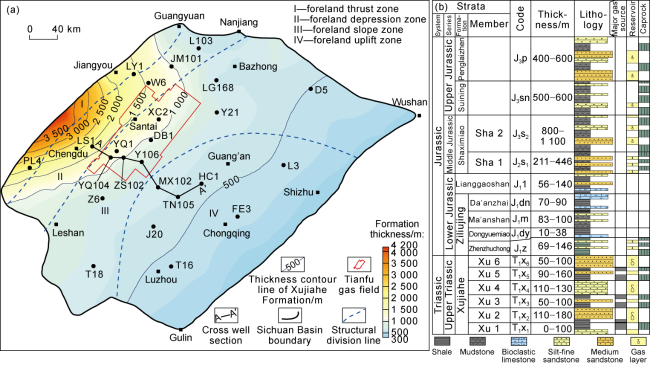
Fig. 1. Residual thickness superimposed with tectonic zoning map (a) and comprehensive stratigraphic column of continental strata (b) of the Xujiahe Formation, Sichuan Basin. |
Under the weakly extensional tectonic background after the Indosinian extrusion, a broad intracraton depression basin was formed in the Early Jurassic-early Middle Jurassic. In the Middle Jurassic, the thrusting activities in Longmenshan began to weaken, however, the tectonic activities in Micangshan-Dabashan became intense, and the sedimentation and subsidence center of the basin gradually migrated from northeast to southwest. After the deposition of the Jurassic Shaximiao Formation, influenced by various stages of the Yanshanian and Himalayan Movements, a series of low and gentle structures were locally formed in the Yanshanian Period and finally in the Himalayan Period [21].
2.2. Continental sedimentary strata
In the Late Triassic, the Sichuan Basin completed the major marine-continental transition and entered the stage of foreland-depression lacustrine basin as a whole, with a set of continental strata of 1 500-6 000 m (Fig. 1b ). Influenced by the Indosinian multi-stage tectonic movement and multi-provenance system, the Xujiahe Formation is a set of delta-lacustrine sedimentary system with a thickness of 300-3 500 m and a gradual thickened stratum dominated by terrigenous clastic rocks from the east to the west of the basin, and the lithology is interbedded conglomerate, sandstone and mudstone. The Xujiahe Formation can be divided into 6 members upwardly, including 3 second-order sequences, namely, the early sequence of Longmenshan foreland basin (Xu 1, Xu 2 members), the late sequence of Longmenshan foreland basin (Xu 3 Member) and the Dabashan uplifting sequence (Xu 4 Member-Xu 6 Member) [13-14]. Of them, the bottom boundary of early sequence of Longmenshan foreland basin is the bottom boundary of Xujiahe Formation, which is an unconformity surface and can be stably tracked on seismic profile. The bottom boundary of late sequence of Longmenshan foreland basin is a regional tectonic movement interface, which displays an abrupt change in lithologies and lithofacies. The carbonate rock debris occurred above the interface and with metamorphic rock debris below the interface. There is a large unconformity in piedmont belt of western Sichuan Basin and large overlapping surface in the central Sichuan Basin. The bottom boundary of the uplifting sequence of Dabashan is a regional unconformity interface.
The Shaximiao Formation is mainly characterized by purplish red mudstone mixed with grayish green and gray fine-medium sandstone. The bottom boundary is divided by thick sandstone of Shaximiao Formation or grayish green and purplish red mudstone and gray black shale of Lianggaoshan Formation. The top boundary is characterized by purplish red mudstone of Shaximiao Formation and brick-red siltstone of Upper Jurassic Suining Formation. The interior of Shaximiao Formation is bounded by regionally-distributed shale with Conchostraca, which can be further divided into Sha 1 Member and Sha 2 Member, with Sha 1 Member being shallow delta-lacustrine facies deposit and Sha 2 Member being a fluvial facies deposit [22].
2.3. Development of source rocks
The Xujiahe Formation is mainly sourced from the Xu 1, Xu 2, Xu 3 and Xu 5 members [23] (Table 1 ). The source rock of the hydrocarbon generation center is greater than 200 m thick, dominated by vitrinite and exinite. The δ13C value of the source rock is generally greater than −25.5‰, dominated by Type III organic matter. The western Sichuan Basin is the hydrocarbon generation center of the Xujiahe Formation, with a hydrocarbon generation intensity of (50-120)×108 m3/km2. Vertically, the Xu 5 Member is characterized by the highest organic matter abundance, with an average total organic carbon content (TOC) of 2.40%, followed by the Xu 3 Member with an average TOC value of 1.73%. The TOC values of Xu 1 Member + Xu 3 Member is averagely 1.70%. The maturity of source rocks in the Xujiahe Formation is controlled by burial depth and regional tectonic evolution, and the degree of thermal evolution varies greatly with regions. From plane distribution of current maturity levels, the western and northern depression are in high thermal maturity, with vitrinite reflectance (Ro) value greater than 1.6% generally, reaching the high- to over-mature stage. The maturity level gradually decreases from the central Sichuan basin to the southern part and eastern part. The thermal maturity level of source rocks decreases vertically.
Table 1. Source rock evaluation parameters of Upper Triassic Xujiahe Formation in Sichuan Basin |
| Horizon | Source rock type | Source rock thickness/m | TOC/% | Maturity/ % | Organic matter type | Hydrocarbon generation intensity/ (108 m3•km−2) | |
|---|---|---|---|---|---|---|---|
| Upper Triassic Xujiahe Formation | Xu 1 Member + Xu 2 Member | Dominated by humic source rock, with a minor of mixed source rock | 40-340 | (0.50-13.28)/1.70 | 1.40-2.78 | Dominated by Type III, with a minor Type II2 | 20-320 |
| Xu 3 Member | 40-320 | (0.51-8.72)/1.73 | 1.00-2.44 | ||||
| Xu 5 Member | 40-320 | (0.51-14.8)/2.40 | 0.80-1.90 | ||||
Note: values after “/” are averages. |
2.4. Reservoirs
The reservoir rocks of the Upper Triassic Xujiahe Formation are of various types, including lithic sandstone, feldspar lithic sandstone, lithic feldspar sandstone and lithic quartz sandstone. The reservoir is characterized by a porosity of 6%-14% and a permeability of (0.01-1.00)× 10−3 μm2, falling in the range of low-porosity to extra-low porosity and extra-low permeability. The reservoirs are mainly fractured-porous type, and the pores are mainly intragranular, intergranular dissolution pores and intergranular pores. The fractures are mainly structural fractures, interlayer fractures and broken fractures [13].
The reservoir rock types of Middle Jurassic Shaximiao Formation are mainly feldspar lithic sandstone and lithic feldspar sandstone. The storage space is mainly residual intergranular pore, followed by feldspar dissolved pore. The reservoir has a porosity of 7%-18% and a permeability of (0.1-10.0)×10−3 μm2, mainly with the development of low-porosity, low-permeability and extra-low permeability/porosity types [13-14].
2.5. Fault development
Faults play an important role in hydrocarbon migration and late adjustment [24]. The Late Triassic-Jurassic is an important period for the formation and development of foreland basin in Sichuan Basin, in which the early tensile fracture activity is transferred into compression-torsion type. Folding and uplifting began around the basin and progressed into the basin. Orogenic belts such as Longmenshan, Micangshan-Dabashan are developed, providing a provenance basis for clastic rock deposition in the basin [25]. Influenced by the Indosinian, Yanshanian and Himalayan movements, the faults are mainly developed in near EW and NN directions [26]. According to the crossing horizon of the top and bottom boundary of fault, the developed faults in the Xujiahe Formation can be divided into 4 orders (Table 2 ). The first-order and second-order faults are developed in large scale, mainly strike-slip faults and slip reverse faults. The lower faults cross the bottom of Triassic or Permian, and the upper faults cross the Jurassic Shaximiao Formation. The third- and fourth-order faults are small reverse faults, which are internal faults of Middle-Upper Triassic and internal faults of Xujiahe Formation respectively. The first- and second-order faults can adjust the natural gas migration from Xujiahe Formation to Shaximiao Formation, thereby to control the oil and gas enrichment of the far-source Shaximiao Formation. The third- and fourth-order faults are conducive to enrichment and accumulation of the near-source tight sandstone gas of the Xujiahe Formation.
Table 2. Fault classification and development characteristics of Xujiahe Formation in the Sichuan Basin |
| Fault classification | Fault properties | Crossing horizon | Oil test | Example |
|---|---|---|---|---|
| First-order fault | Strike-slip fault | Upper: Jurassic; Lower: Permian | Water production near fault | Xu 6 Member, Well PQ2 |
| Second- order fault | Slip reverse fault | Upper: Jurassic; Lower: Triassic | Water production: less than 200 m from the fault; Gas production: more than 300 m away from the fault | Xu 2 Member, Well G2; Xu 2 Member, Well G9; Xu 2 Member, Well GJ |
| Third-order fault | Small reverse fault | Upper: Xujiahe Formation; Lower: Leikoupo Formation | Gas production near fault | Xu 31 submember, Well TF1; Xu 31 submember, Well FS1; Xu 4 Member, Well YQ1 |
| Fourth-order fault | Small reverse fault | Xujiahe Formation inner fault | High gas production in fault plane | Xu 31 submember, Well TF101; Xu 32 submember, Well ST1; |
2.6. Formation pressure
Formation pressure plays an important indicative role in judging formation sealing and gas reservoir preservation conditions, and the formation pressure coefficient is also commonly used to classify gas reservoir types [27]. The pressure coefficient of gas reservoirs varies greatly with zones and horizons, generally indicating ultra-high pressure to low pressure gas reservoirs in the study area. The pressure coefficient of gas reservoirs in the Xujiahe Formation is higher than that in the Shaximiao Formation. In the Xujiahe Formation, it is 0.9-2.2 for gas reservoir and gradually decreases from depression zone to uplift zone (Fig. 2a ). The pressure coefficient of gas reservoir is well correlated with the development degree of source rock, indicating that overpressure by hydrocarbon generation plays a key role in the level and distribution of formation pressure. The pressure coefficient of Shaximiao Formation is generally 0.4-1.5, including high-pressure gas reservoir, normal-pressure gas reservoir and low-pressure gas reservoir. Similarly, the pressure coefficient of gas reservoir in the Shaximiao Formation in the hydrocarbon generation center of the Xujiahe Formation in western Sichuan Basin is high, and the gradually decreases from the hydrocarbon generation center to periphery (Fig. 2b ).
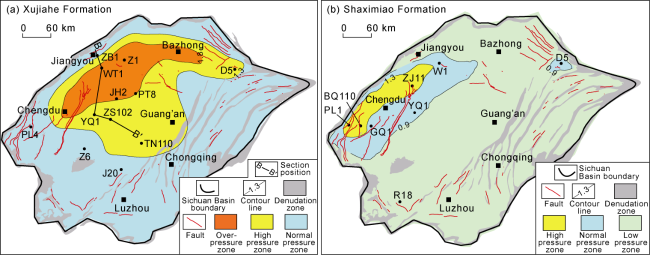
Fig. 2. Plane distribution of pressure coefficient of gas reservoirs in the Xujiahe Formation and Shaximiao Formation in the Sichuan Basin. |
3. Hydrocarbon accumulation and accumulation model of continental whole petroleum system in the Sichuan Basin
3.1. Distribution and key geological elements of vertical accumulation sequence
The analysis of typical gas reservoir showed that the Xujiahe Formation and Shaximiao Formation in the Sichuan Basin are a set of reservoirs genetically related. Vertically, the source rock of Xujiahe Formation is the major horizon for hydrocarbon generation, and three accumulation systems are respectively developed, including intra-source shale gas of the Xujiahe Formation, near-source tight gas of the Xujiahe Formation, and far-source conventional-tight gas of the Shaximiao Formation (Fig. 3 ).
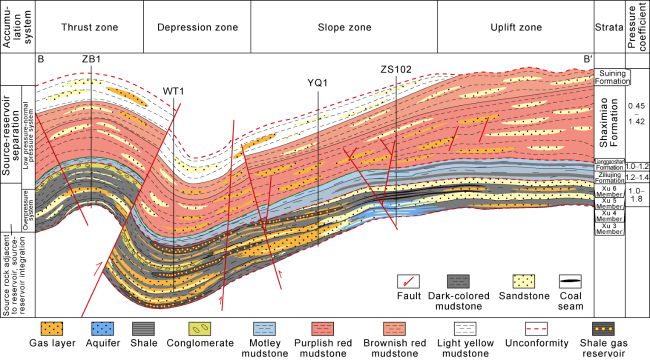
Fig. 3. Schematic diagram of continental shale gas-tight gas reservoir in Longmenshan-Central Sichuan Basin (see the section location in |
The intra-source shale gas is mainly developed in the Xu 1 + Xu 2, Xu 3 and Xu 5 members, which mainly develop interbedding of thick shale and thin tight sandstone, showing the accumulation characteristics of "large-area distribution in the source, superimposed interbedded sandstone and mudstone". The enrichment of intra-source shale gas is mainly controlled by paleo-environment, hydrocarbon generation capacity, lithological combination and reservoir type. Taking the shale gas reservoir of Xu 5 Member in Jianyang as an example, interbedding of organic-rich shale and sandstone is developed in this block. The sedimentary period of shale is characterized by warm and humid climate, oxygen-poor and anoxic and shallow lacustrine freshwater environment with abundant plants, which is conducive to the formation of organic-rich shale with high abundance of organic matter. With source rocks in a large scale, the shale with a TOC value greater than 2% is more than 200 m thick and in the mature to high-mature stage with Ro values of 1.0%-1.3%. It is in the stage of abundant gas generation with a hydrocarbon generation intensity of about 28×108 m3/km2, thereby to lay a good hydrocarbon source foundation for the enrichment of shale gas in the source. The storage space of carbonaceous shale and siltstone is well developed. Among which, the carbonaceous shale mainly develops organic pores and bedding fractures, with an average porosity of 4.89%. The porosity of fine sandstone is mainly 6%-7%, providing storage space for the enrichment of intra-source shale gas. The interbedded distribution of carbonaceous shale, siltstone and fine sandstone is conducive to multi-layer superimposed accumulation of intra-source shale gas. After sand fracturing in shale and siltstone interbeds in the Xu 5 Member of Well TF101, an industrial gas flow of 8.62×10⁴ m3/d and a pressure coefficient of 1.36 are obtained in the test. The results prove that Xujiahe Formation has a good prospect of accumulating intra-source shale gas.
The near-source tight gas reservoirs are mainly developed in the delta front sandbodies in the Xu 2, Xu 3, Xu 4 and Xu 6 members. Taking the tight gas reservoir of the Xu 4 Member in Jianyang area as an example, the sandstone reservoir generally represents a porosity of less than 10% and a permeability of less than 1×10⁻³ μm2, which is a typical tight sandstone reservoir. The carbon isotopic compositions of natural gas show that the Xu 4 Member tight gas in Jianyang area is different from that of depression zone and uplift zone, indicating that the natural gas in depression zone has not migrated to slope zone and uplift zone on a large scale (Fig. 4a ). Dai Jinxing et al. and Liu Wenhui et al. found that the carbon isotopic composition of methane of natural gas is well correlated with the degree of thermal evolution of source rock during hydrocarbon generation [28-29]. Based on the data of thermal simulation experiment of source rock hydrocarbon generation in the Xujiahe Formation in western Sichuan Basin, the empirical formula for converting Ro of natural gas was established [30] to analyze the natural gas of Xu 4 Member in Jianyang area. The converted Ro values were 1.03%-1.29%, which is consistent with the thermal evolution degree of the source rocks in the Xu 32 submember in this area. The results indicated that the natural gas in Xu 4 Member in Jianyang area is evidently characterized by near-source hydrocarbon supply (Fig. 4b ). Under this setting, tight gas accumulation is mainly controlled by reservoir physical properties and fractures. The better the physical properties, the more developed the fractures are, and the higher the gas production will be. For example, high-production interval in Well YQ104 is characterized by high permeability (averaging 0.282× 10⁻³ μm2), low displacement pressure (0.677 MPa), and fracture development. In the well test, a daily gas of 20.20×10⁴ m3 and a pressure coefficient of 1.54 were obtained.
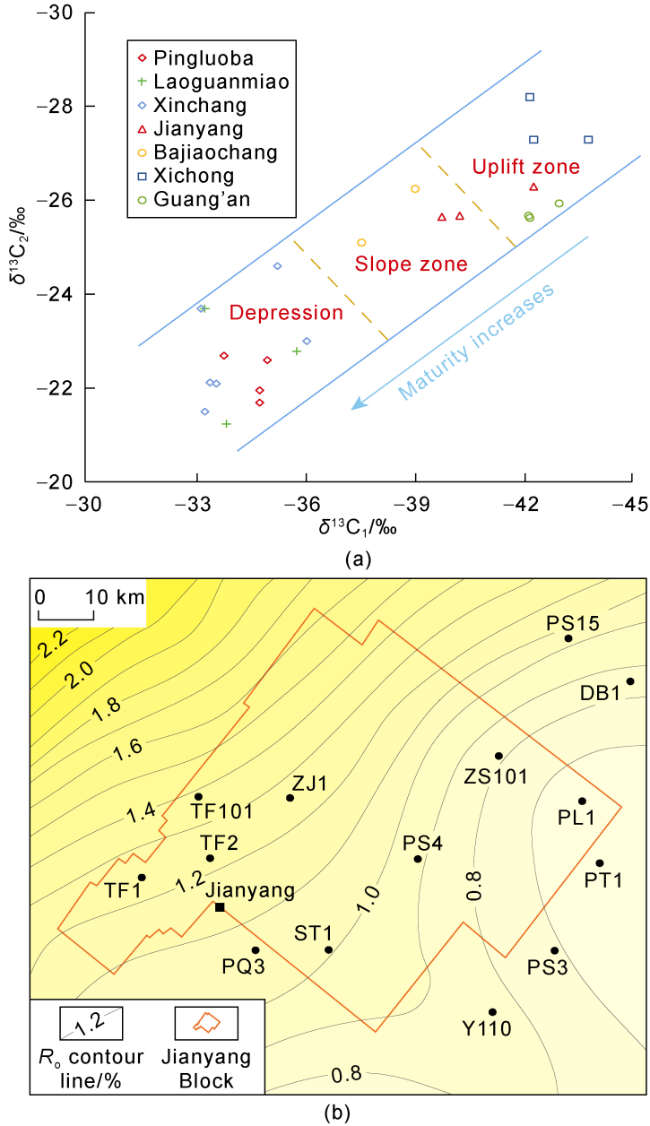
Fig. 4. Carbon isotopic composition distribution of natural gas in the Xujiahe Formation in different zones (a) and thermal maturity of Xu 32 submember source rock in Jianyang (b). |
The far-source conventional-tight gas accumulation system is mainly developed in the Jurassic, including Ziliujing, Shaximiao, Suining and Penglaizhen formations, with Shaximiao Formation as the major gas production horizon. The gas-source correlation results showed (Fig. 5 ) that the Shaximiao Formation is dominated by coal-type gas. The Lower Jurassic lacustrine source rocks, which are mainly in the eastern and middle Sichuan Basin, act as the supplemental gas source of the Shaximiao Formation. Oil and gas are mainly transported vertically through faults and transversely along sandbodies. The source-communicating faults and internal faults are configured to form multiple fault-sandbody combinations together with multiple groups of sandbodies, providing highly-efficient transport system for multiple horizons. Large-scale network river channels extend far, forming a long lateral transport system, which is conducive for large-scale accumulation of natural gas. The Shaximiao Formation is characterized by multiple stages of charging. The first stage of charging (70-90 Ma): During the medium-high peak period of hydrocarbon generation in the Xujiahe Formation, corresponding to the active stage of the Longquanshan fault zone in western Sichuan Basin, the reservoir of the Sha 1 Member gradually became tight and that of the Sha 2 Member was not tight. The second stage of charging (35-50 Ma): The Xujiahe Formation was in the middle-low peak period of hydrocarbon generation, the source rocks in Da'anzhai Member reached the peak of hydrocarbon generation, and the activation of source- communicating faults gradually stopped and the internal faults were activated. The Sha 1 Member is belonged to the shallow delta-lacustrine sedimentary system; however, the Sha 2 Member is belonged to the fluvial sedimentary system, with vertical superposition of 10-30 m thick sandbodies in multiple periods and wide and continuous distribution in plane, forming a superposed sandstone gas area [31]. The gas reservoir is characterized by burial depth less than 3 000 m, moderate compaction, and well-preserved intergranular pores, with a porosity of 8%-12% and a permeability mostly lower than 1×10⁻³ μm2. Generally, it is dominated by tight sandstone reservoir, with a small proportion of conventional reservoirs. The Shaximiao Formation tight gas reservoir is a typical secondary gas reservoir, developing a lower-source and upper-reservoir combination with the Xujiahe Formation as the major source rock. The source-communicating fault plays an important role in the vertical migration of natural gas, and the gas reservoir is characterized by complex pressure distribution [32]. Taking the Sha 1 Member gas reservoir in Zitong gas field close to the hydrocarbon generation center of the Xujiahe Formation as an example, there are two source-communicating faults in the area that reach the interior of the Shaximiao Formation, which are in vertical contact with multi-stage channel sandbodies. The natural gas is charged into multiple sets of sandbodies through fault and accumulates laterally along the channel to form reservoirs. The Sha 2 Member gas reservoir in the Jinqiu Block in central Sichuan Basin, which is far away from the hydrocarbon generation center of the Xujiahe Formation, develops a number of source-communicating faults and intrastratal adjustment faults. The channel sandbodies and source- communicating faults are mostly intersected obliquely. Dominated by single point charging of multi-sandbody, the adjustment fault provides good channel for secondary migration of natural gas.
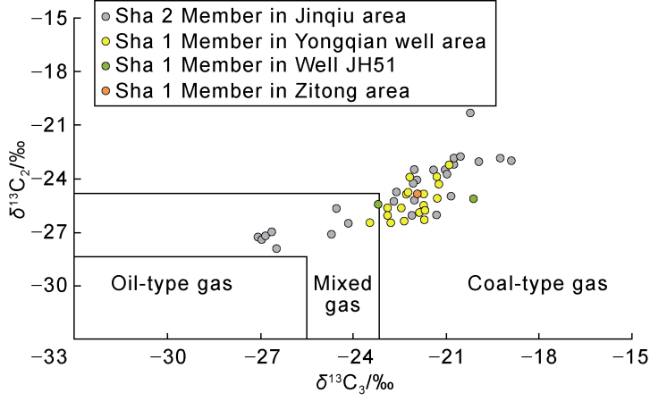
Fig. 5. Comparative analysis of natural gas sources in Shaximiao Formation. |
3.2. Distribution characteristics and major controlling factors of planar accumulation sequence
The Xujiahe Formation gas reservoir is evidently controlled by foreland basin tectonic zoning. According to the tectonic zoning, a series of reservoirs in the Xujiahe Formation are successively formed on plane including the thrust zone tectonic gas reservoir, depression zone shale gas reservoir-tight gas reservoir, slope zone tight gas reservoir and uplift zone conventional-tight gas reservoir.
3.2.1. Thrust zone structural gas reservoir
The gas reservoirs in the thrust belt are mainly structural gas reservoirs, which are scattered and small in scale, with the development of edge water and bottom water. The typical representatives are gas reservoirs in the Xu 2 Member in Zhongba and Xu 31 submember in Pingluoba (Xu 2 Member gas reservoir from previous strata division). The natural gas is mainly sourced from the western Sichuan depression, with sufficient gas supply. Affected by fractures and corrosion, the permeability of thrust belt gas reservoirs is usually (0.1-10.0)×10−3 μm2, with pore diameter generally greater than 2 μm, which belong to the conventional gas reservoirs. The pressure coefficient of the thrust belt gas reservoir in the Xu 2 Member is 0.9-1.3, which belongs to normal-pressure gas reservoir.
The Xu 31 submember gas reservoir in Pingluoba is a short-axis hummocky anticline with moderate folding strength, good structural type, sufficient differentiation of gas and water, and liable to gas enrichment. There is a good correlation between reservoir physical properties and fractures in the Xu 31 submember gas reservoir in Pingluoba. The fractures play an important role in controlling the high production of gas wells. For example, the average plane porosity of Well PL2 is 4.76%, among which the average plane porosity of micro-fractures accounts for 46.8%. The fracture plane porosity of most samples with porosity greater than 5% accounts for 25%-95% of the total number. The fracture is developed in network- shaped form, which connects the effective pore throat and macro-fracture. According to the comparison between the production test and the statistical results of fracture density development, the fracture development area is the sweet spot zone of gas reservoir. The fracture densities of wells PL1 and PL2 are 3.85 and 6.73 fractures/m, respectively. The tested open flow rates are 45.03×10⁴ m3/d and 104.38×10⁴ m3/d, respectively.
3.2.2. Shale gas-tight gas reservoirs in depression zone
The foreland depression zone deposited thick-layer of source rocks, mainly coal streak and carbonaceous mudstone with high-organic carbon content, and covers an area of (8-12)×104 km2. The thickness of coal streak is usually thin, generally no more than 10 cm and in limited scale. It is not produced in separate layers but usually associated with sandstone or shale. As a transition type of coal rock gas and shale gas, the potential needs to be further evaluated. The thickness of a single layer of carbonaceous mudstone is 5-20 m, and the gas generation intensity of a single layer is (5-20)×108 m3/km2, which has abundant material basis. In addition, the sedimentary sandbodies developed in the Xu 1, Xu 2, Xu 3 and Xu 5 members of the depression have a maximum area of 11000 km2. The intra-source sandstone can be as a favorable reservoir for gas charging and enrichment, and the exploration potential is extraordinarily considerable.
3.2.3. Tight gas reservoir in the slope zone
The slope zone is close to the western Sichuan Depression, and the reservoir is tight, with large gas-bearing areas. The distribution of gas and water is characterized by "east-west belts and north-south zones". The pattern of natural gas migration and accumulation is mainly confined Darcy Flow, which is characterized by "near-source hydrocarbon supply, vertical migration, local enrichment and high yield".
There are three sets of main source rocks in the Xujiahe Formation vertically in the slope zone. The organic matter is characterized by a TOC value greater than 1% generally, Type III organic matter with a minor of Type II2. All of them have reached the mature to high-mature stage, and the gas generation intensity is as high as 130×108 m3/km2. The tight gas in the slope zone is characterized by large-scale distribution due to the inter distribution between the widely-covered source rocks and the stably-distributed sandstones in the Xu 31 submember and Xu 4 Member. Due to the abundant supply of multiple source systems, favorable sedimentary sandbodies developed in superimposed continuous distribution in the delta front facies belt of lacustrine basin. The upper slope zone developed chlorite coating, with well-preserved primary pores and good physical properties (reservoir porosity of 8%-14%). In the lower slope zone, the chlorite coating is underdeveloped and the strata are strongly compacted. The particles are mainly in line and concavo-convex contacts, showing poor physical properties (reservoir porosity of 6%-8%). From the perspective of the source-reservoir configuration, the lower slope is characterized by development of source rock and tight reservoirs, and the enrichment and high yield of gas is mainly controlled by the physical properties of high-quality reservoirs. The upper slope is characterized by good physical properties and nondevelopment of source rocks. This phenomenon resulted in poor hydrocarbon charging and insufficient differentiation of gas and water, thereby to make the water production rate on the upper slope significantly higher than that on the lower slope (Fig. 6 ).
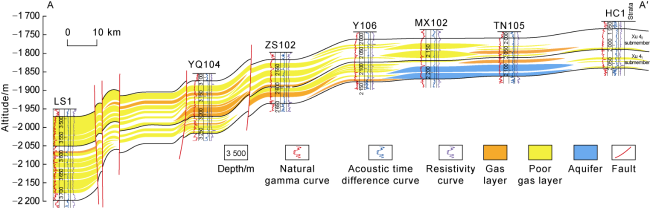
Fig. 6. Gas reservoir section of the Xu 4 Member in slope zone of Sichuan Basin (see |
3.2.4. Conventional-tight gas reservoirs in the uplift zone
The foreland uplift zone is dominated by lithologic and structural-lithologic gas reservoirs, which are characterized by large-area gas-bearing, gas enrichment in structural highs, low gas saturation and high rate of water production, such as the gas reservoirs in the Xu 6 Member in Guang'an and the Xu 31 submember (previously Xu 2 Member) in Hechuan. The hydrocarbon generation intensity is generally less than 20×108 m3/km2 because this region is far from the hydrocarbon generation center and the source rock is thin. A set of black "belt" mudstone of 20-30 m is stably developed in the Xu 31 submember in Hechuan-Anyue area, with strong hydrocarbon generation capacity, high organic matter abundance, and mainly Type II2 and Type III kerogen. The current Ro values are 1.44%-1.50%, indicating the peak of gas generation. The exploration and discovery of uplift zone is mainly concentrated in the Xu 31 submember, Xu 4 Member and Xu 6 Member, of which all reservoirs are fractured-porous type and porous-type with better physical properties than those in depression zone and slope zone. The porosity of this kind of reservoirs is mainly 6%-10%, and high-porosity sandstones with porosity larger than 10% are also developed. The medium of permeability is greater than 1×10⁻³ μm2, representing low-porosity and low-permeability sandstone reservoirs. High-quality reservoirs and locally-developed low-amplitude structures control the gas accumulation and gas-water differentiation, which affects gas distribution and accumulation.
3.3. Accumulation model of continental whole petroleum system
The unique geological conditions for reservoir formation in the continental strata of the Sichuan Basin make the WPS more complicated. Vertically, Xujiahe Formation and Shaximiao Formation take Xujiahe Formation as the major hydrocarbon source, and orderly developing the WPS of intra-source shale gas and near-source tight gas in the Xujiahe Formation and far-source conventional-tight gas in the Shaximiao Formation (Fig. 7 ).
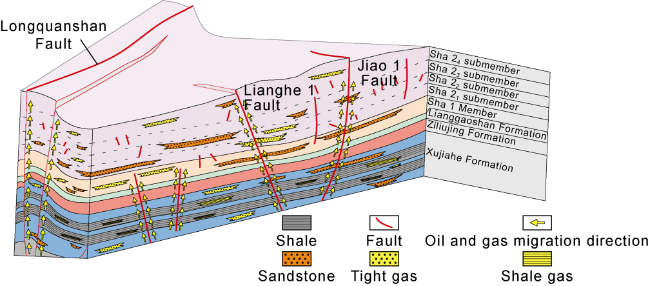
Fig. 7. Accumulation mechanism model of continental WPS in the Sichuan Basin. |
The intra-source shale gas reservoir is mainly developed in the Xu 32 submember and the Xu 5 Member, with thick mud and thin sand, forming the shale gas accumulation model of "large-area distribution, source-reservoir integration". The near-source tight gas reservoir is mainly developed in the Xu 31 submember and the Xu 4 Member adjacent to the source rock system, with the tight gas accumulation model of "near-source hydrocarbon supply, fault-fracture controlling production, and source-reservoir configuration controlling accumulation". The far- source conventional-tight gas reservoir is mainly developed in the Shaximiao Formation, with an accumulation model of "secondary adjustment, composite transport of fault-sandbody, two-stage charging and coupling of physical property differences". The experimental study of reservoir geology and fluid mechanics shows that the reservoir is characterized by a porosity of 12% and a permeability of 1×10⁻³ μm2. The pore-throat radius is 1 μm, which is the lower limit of Darcy flow and buoyancy-driven reservoir formation, and also the upper limit of non-buoyancy-driven and non-Darcy flow field. Under these physical conditions, the hydrostatic pressure and capillary pressure reach a balance. Fluids are dominated by confined Darcy flow, slip flow and diffusion flow [33-34]. The intra-source shale gas reservoir is tight, with a porosity of 2%-6%, a permeability less than 0.1×10⁻³ μm2, and a pressure coefficient of 1.5-2.0. The shale gas reservoir flow follows diffusion migration law under bound dynamic field. The natural gas is mainly in adsorption state, and represented by shale gas reservoirs in Xu 5 Member in Jianyang and Xu 2 Member in Xinchang. The near-source tight gas reservoir is characterized by a porosity of 4%-8%, a permeability of (0.1-1.0)×10−3 μm2, and a pressure coefficient of 1.2-1.6. It is characterized by slip flow under confining dynamic field, represented by gas reservoirs in the Xu 4 Member in Jianyang and Xu 31 submember in Qiulin. The far-source conventional-tight gas reservoir is characterized by a porosity of the 6%-18% and a permeability over 1×10⁻³ μm2, and relatively low pressure coefficient of 0.8-1.2, following the Darcy seepage law under free dynamic field and typically represented by the Shaximiao Formation gas reservoir in the Jinqiu Block.
The orderly changes of geological conditions such as burial depth, physical properties, pressure and hydrocarbon generation intensity in different zones led to the formation of a whole sequence of accumulation systems in the Xujiahe Formation, including structural gas reservoirs in thrust zone, shale gas-tight gas reservoirs in depression zone, tight gas reservoirs in slope zone and tight and conventional gas reservoirs in uplift zone (Fig. 8 ).
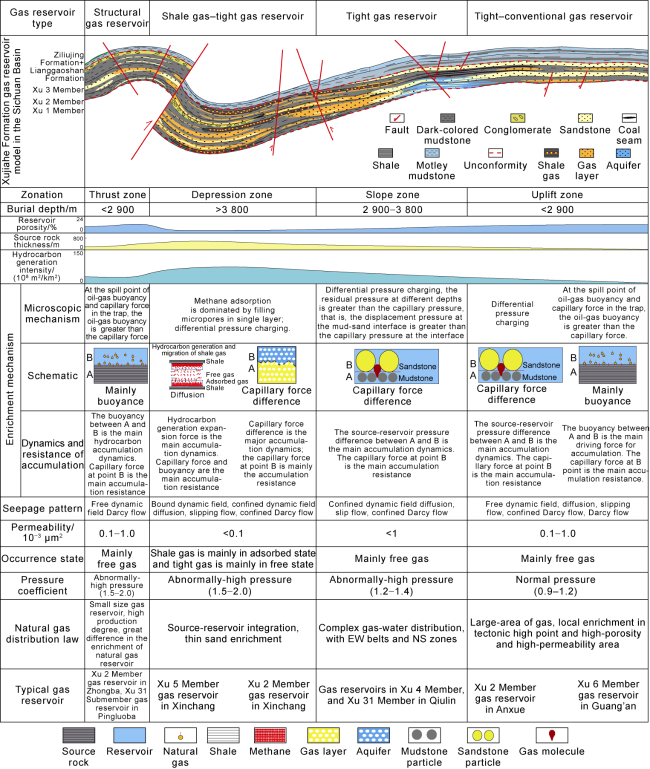


Fig. 8. Conventional-unconventional hydrocarbon accumulation mechanism and accumulation model of Xujiahe Formation in the Longmenshan-Central Sichuan Basin. |
From depression zone to uplift zone, the Xujiahe Formation is characterized by gradually shallower depth, thinner source rock thickness, lower maturity, decreasing hydrocarbon generation intensity, better physical properties and decreasing pressure coefficient. The orderly change of geological conditions controlled the accumulation types and enrichment mechanisms in different zones. Under the influence of tectonic compression and uplift denudation, the Xujiahe Formation in the western Sichuan depression has a large burial depth generally greater than 3 800 m, and permeability less than 0.1×10⁻³ μm2. The source and reservoir are integrated, dominated by the shale gas reservoir and intra-source thin tight gas sandstone reservoir. The diffusion force and capillary force difference are the main migration driving forces. The slope zone has a burial depth of 2 900-3 800 m and permeability of (0.1-1.0)×10-3 μm2, with capillary force difference as the migration force under the confining dynamic field. It is characterized by large-area gas bearing, self-sealing accumulation, and high-permeability controlling production. The uplift zone is located in the central Sichuan Basin, with a burial depth generally less than 2 900 m, thin source rock, low gas generation intensity, relatively good reservoir physical properties, and local permeability greater than 1×10⁻³ μm2. The main migration force is buoyancy and capillary force difference. The lithological and structural-lithological traps are developed, which are characterized by mutual hydrocarbon supply, combined production control of structural high points and high-quality reservoirs. The buried depth of the thrust zone is relatively shallow, generally less than 2900 m. Affected by the Yanshan-Himalayan tectonic movement, the gas reservoir of Xujiahe Formation in Sichuan Basin was subjected to fault reconstruction in the late period. The communication of faults caused evident secondary adjustment in the gas reservoir formed in the early thrust zone, and the reservoir had good physical properties and a large number of faults and fractures. Natural gas is transported vertically along faults with buoyancy as the main migration force, showing evident gas-water differentiation.
4. Exploration
Under the guidance of the WPS theory, "intra-/near- source gas prospecting", the central and western Sichuan area is rich in oil and gas resources and has the conditions for large-scale shale gas and tight gas development, which is an important research field in the next step. The source rocks with large continuous thickness and high abundance of organic matter and large-scale sandbodies are developed in this area, and the source and reservoir are well configured, showing the conditions for large-scale accumulation.
The tight gas in Xu 4, Xu 3 members and shale gas in Xu 5 Member in central and western Sichuan Basin have shown good exploration prospects. Of them, the sandbody of the main channel in the front delta of the Xu 4 Member in Jianyang area is developed. Combined with the fracture distribution law, the optimal exploration area is 1 700 km2. Three wells have obtained high-yield gas flow, and the tested daily gas production of wells YQ1, YQ104 and TF101 is 31.26×10⁴, 20.20×10⁴, 21.01×10⁴ m3, respectively. Well YQ1 has been in production for more than 300 d, with cumulative gas production of 1 600×104 m3 and no water production, showing good test production effect. The Xu 5 Member interbedded shale in Jianyang area is distributed on a large scale and contains gas continuously. The optimal exploration area is 3 000 km2. Well TF101 obtained 8.62×10⁴ m3/d of natural gas in the Xu 5 Member shale-siltstone interbedded interval. In addition, the sandbody of the underwater distributary channel in the front fan delta of the Xu 3 Member in northwestern Sichuan is developed. Combined with the inherited paleo-structure of the Late Indosinian-Middle Yanshan Period and the high-quality reservoir of fault-fracture-pore complex, the optimal exploration area is 5 300 km2. The risk exploration well WT1 obtained high-yield industrial gas flow in the Xu 3 Member, with a daily gas output of 108×104 m3.
The Shaximiao Formation mainly develops far-source conventional gas and tight gas. The Shaximiao Formation has the advantages of three-dimensional accumulation with vertical multi-stage gas-bearing sandbodies due to its superior physical properties, vertical multi-stage superimposed channel sandbodies, wide planar distribution and shallow burial. Hydrocarbon source, reservoir, structure, fault, preservation and other conditions comprehensively indicated that the central and western Sichuan area located in the hydrocarbon generation center has the condition of large-scale reservoir formation. It is predicted that the favorable gas-rich channel is sand groups 6, 7, 8, 9 in the Sha 1 Member and Sha 21 submember, with gas-bearing channel area of 6 450 km2. At present, large-scale gas reservoirs have been discovered in Tianfu gas field and Zhongjiang gas field, with estimated resources of 3.9×10¹² m3, which are the key areas for continuous expansion.
5. Conclusions
The continental strata in Sichuan Basin have good conditions for the formation of WPS. The high-quality source rocks of Xujiahe Formation and Jurassic semi- deep-deep lacustrine facies provide sufficient natural gas sources. The development of multi-type reservoirs provides favorable storage space for oil and gas accumulation. The fault-sandbody combination constitutes a high-quality transport system for natural gas migration and provides an advantageous channel for natural gas accumulation.
The continental WPS in the Sichuan Basin shows the Xujiahe Formation as the major hydrocarbon source, with the development of intra-source shale gas, near- source tight gas and far-source tight-conventional gas upwardly. On plane, a WPS is developed in the Xujiahe Formation including structural gas reservoir in thrust zone, shale gas reservoir in depression zone, tight gas reservoir in the slope zone, and tight-conventional gas reservoir in the uplift zone.
The shale gas and tight gas resources of Upper Triassic-Jurassic in the Sichuan Basin are of great potential, and the tight gas in Xu 4, Xu 3 members and shale gas in Xu 5 Member, as well as the far-source conventional-tight gas of Sha 1 and Sha 2 submembers in central and western Sichuan areas are the key exploration fields.
Controlled by factors such as highly-tightened reservoir, fault system development, and insufficient gas and water differentiation, innovative theories and technologies are urgently needed to tackle key problems. Guided by the hydrocarbon accumulation theory of the WPS, and in accordance with the exploration ideas of convention- unconventional oil and gas and shallow-deep three-dimensional integration, the exploration from shallow layer to deep depression is gradually carried out to achieve an overall breakthrough in unconventional oil and gas exploration in the basin.