

Introduction
Coal-formed gas is a kind of natural gas formed during the coalification process in humic coal-bearing formations (coal and coal-related mudstone) [1]. The complete theory of coal-formed gas began in 1979, and it has been continuously developed and updated by petroleum geologists in China for over 40 years. Significant insights have been gained in hydrocarbon generation laws of coal-bearing systems, origin indicators of natural gas (coal-formed gas), and controlling factors for the formation of large gas fields [1⇓⇓⇓⇓⇓⇓⇓⇓⇓-11]. These guided the discovery of large gas fields and drove the rapid development of the natural gas industry in China. In 2022, the remaining proven natural gas initially-in-place in China stood at 8.4×10² m3[12], ranking the 6th in the world. Meanwhile, the natural gas production reached 220×108 m3, placing it the 4th among the world’s leading gas-producing countries in 2022 in the world. In 2022, the proven initially-in-place and production of coal-formed gas accounted for 55.3% and 57.7% of the total proven initially- in-place and production of natural gas, respectively in China. The exploration and development of coal-formed gas have played a significant role in the development of the natural gas industry of China, and promoted China from poor gas to a major gas producer. Scientific questions remain regarding the hydrocarbon generation laws of coal-bearing source rocks, how to utilize multiple information and indicators to comprehensively identify the genetic types of natural gas, and the factors controlling the formation and enrichment of large gas fields. Additionally, more analysis and evaluation are needed to determine where the favorable exploration zones of coal- formed gas are located. This paper aims to systematically review the significant geological theoretical advancements since the establishment of the coal-formed gas theory, analyze the accumulation and matching factors on major favorable exploration zones for coal-formed gas, and further develop and perfect the theory while providing theoretical and technical supports for guiding coal-formed gas exploration in China.
1. Progress in the geological theory of coal-formed gas
1.1. Hydrocarbon generation characteristics of coal-bearing source rocks
Most coal is humic in the world [13]. In the 1940s, German scholars discovered that coal can generate gas which may accumulate to gas fields [14]. In the 1960s, Australian scholars, represented by Brooks, found that the vitrinite group plays an important role in generating oil by coal, and pointed out that coal can generate gas and oil that may accumulate into oil & gas fields [15-16]. Based on a large amount of geochemical data from coal fields and gas fields, Dai Jinxing published papers on “Natural gas and oil formed during the coalification process” and “Preliminary study on the gas content of coal-bearing strata in China” [2,17] in the 1970s. In those papers, he first proposed the idea of hydrocarbon generation in coal-bearing systems, and stated that “coal-bearing systems primarily generate gas and oil as a secondary product” and “coal is an all-weather source rock for gas”[18]. As a result, a complete theory of coal-formed gas was established. The paper “Natural gas and oil formed during the coalification process” has been highly praised by many renowned scholars. Academician of Chinese Academy of Sciences Li Desheng commented that “it is the pioneer of geological research on coal-formed hydrocarbons”[19], and Academician of Russian Academy of Sciences Galimov remarked that “it is of great significance for global natural gas exploration” [19].
Evidences supporting that coal-bearing systems generate primarily gas and oil as a secondary product includes the following: (1) gas pores have been found in coal samples of different coal ranks [20-21]; (2) coal, as a typical humic organic matter, is rich in methyl groups and condensed aromatic rings in chemical structures, which favors the formation of gaseous hydrocarbons and a certain amount of liquid hydrocarbons [1,4,22]; (3) vitrinite and inertinite, as the main microscopic components of coal, have a low atomic ratio of H to C, which leads to the predominant formation of gas [13,23]; and (4) thermal simulation experiments on coal and coal-related mudstone show that, although most coal-bearing source rocks can generate some liquid hydrocarbons, gaseous hydrocarbons are the primary product, and the gas-to-oil equivalent ratio is generally higher than 1 [13]. The mudstone (type II2 organic matter) taken from Well An29 drilled in the Jizhong Depression in the Bohai Bay Basin, China, produced the highest liquid hydrocarbon at 64.72 kg/t and gaseous hydrocarbon at 185.96 m3/t at 400 °C during a simulation experiment. The gas-to-oil ratio was 2.15 at 400 °C, and increased to 14.98 at 450 °C, and it rose rapidly with the increase of the simulation temperature [13].
1.2. Genetic identification indicators of the natural gas
It is important for identifying the genetic type of natural gas to analyze gas sources, evaluate resource potentials and select favorable exploration zone. Coal-formed gas (derived from Type II2 and Type III kerogens) and oil-associated gas (derived from Type I and Type II1 kerogens) have significant differences in their parent sources, so that these two types of natural gas exhibit distinct differences in isotopic composition, light hydrocarbons and biomarkers due to their inheritance from their parent sources.
The carbon isotopic composition of humic kerogen is generally heavier than that of sapropelic organic matter [1,24], resulting in heavier carbon isotopic composition of coal- formed gas than oil-associated gas at the same maturity. The hydrogen isotopic composition of alkane gas is controlled by multiple factors, including the salinity of the depositional water, parent sources and maturity, among which the water salinity is the most influential[25⇓-27]. In a continental environment, the water salinity of humic source rock is lower than that in a marine environment, which makes the former poorer in deuterium (2H), and accordingly lighter hydrogen isotopic compositions in alkane gas generated [28-29]. Humic kerogen has rich condensed aromatic rings and methyl groups, which result in coal-formed gas rich in aromatic hydrocarbons and having a higher content of methylcyclohexane than n-heptane [1]. Organic matter in coal and coal-related mudstone is originated from higher terrestrial plants, and generates condensate/ light oil that is rich in biomarkers like Cadinane and Oleanane which are typical in higher plants. In contrast, marine mudstone from bacterial and algal has very less or no such biomarkers [30⇓-32].
By referring to the results of international studies on the identification of coal-formed gas [14⇓-16,28,33], Chinese scholars, such as Dai Jinxing [34], and Xu Yongchang [35], began systematic studies on the indicators of coal-formed gas and oil-associated gas in the 1980s. Through extensive sample analysis and simulation experiments, geochemists proposed reliable indicators and charts of coal-formed gas and oil-associated gas (Fig. 1 , Table 1 ), and provided many reliable parameters and charts for the genetic identification of natural gas [1,3⇓ -5,10 -11,24,28,33,36⇓⇓⇓⇓⇓⇓⇓⇓⇓⇓ -47].

Fig. 1. Identification chart of δ13C1-δ13C2-δ13C3 of genetic type of natural gas (modified from Reference [40]). |
Table 1. Comprehensive indicators for distinguishing coal-formed gas and oil-associated gas |
| Type | Indicator | Type of natural gas | Reference | |
|---|---|---|---|---|
| Coal-formed gas | Oil-associated gas | |||
| Isotopic composition | δ13C1/‰ | -43 to -10 | -55 to -30 | [40] |
| δ13C2/‰ | >-28.5 | <-28.5 | [1] | |
| δ13C3/‰ | >-25.5 | <-27.0 | [1] | |
| The relationship between δ13C1 and Ro | δ13C1≈14.13lgRo-34.39 | δ13C1≈15.80lgRo-42.21 | [1] | |
| δ13C1≈8.64lgRo-32.80 | [37] | |||
| δ13C1≈48.77lgRo-34.10 (Ro≤0.8%) | [5] | |||
| δ13C1≈22.42lgRo-34.80 (Ro>0.8%) | ||||
| δ13C/‰ of C5-8 light hydrocarbon | >-26 | <-27 | [1] | |
| δ13C/‰ of condensate oil (with the same source as gas) | Heavy (generally greater than -28) | Light (generally lower than -29) | [40] | |
| δ13C/‰ of saturated hydrocarbons of condensate oil (with the same source as gas) | Generally greater than -29.5 | Generally lower than -27 | [1, 41] | |
| δ13C/‰ of aromatics of condensate oil (with the same source as gas) | Generally greater than -27.5 | Generally lower than -27.5 | [1, 41] | |
| δ13C/‰ of crude oil (with the same source as gas) | -30 to -23 | -35 to -26 | [40] | |
| δ13CnC6/‰ | >-24 | <-26 | [38, 11] | |
| δ13CnC7/‰ | >-25 | <-26 | [11, 42] | |
| δ13C3, MP/‰ | >-25 | <-27 | [11, 42] | |
| δ13C3, MH/‰ | >-25 | <-27 | [11, 42] | |
| δ13CCH/‰ | >-25 | <-26 | [11, 42] | |
| δ13CMCH/‰ | >-25 | <-24 | [11, 42] | |
| δ13CBen/‰ | >-23 | <-24 | [40] | |
| δ13CTol/‰ | >-24 | <-23 | [40] | |
| δ2H1/‰ | Generally lower than -160 | Generally greater than -150 | [27] | |
| δ2H1-Ro | δ2H1≈289.99lgRo-183.58 (Ro≤1.0%) | [26] | ||
| δ2H1≈55.71lgRo-182.22 (Ro>1.0%) | ||||
| Light hydrocarbon components | Methylcyclohexane index/% | >50±2 | <50±2 | [36] |
| Cyclohexane index/% | >27±2 | <27±2 | [36] | |
| C6-7 Branched alkane content/% | <17 | >17 | [43] | |
| C6-7 Aromatic hydrocarbon content/% | >27 | <5 | [44-45] | |
| Toluene/Benzene ratio | Generally greater than 1 | Generally lower than 1 | [46] | |
| Benzene content/(μg·L-1) | Relatively high, generally greater than 400 | Relatively low, generally lower than 300 | [1] | |
| Toluene content/(μg·L-1) | Relatively high, generally greater than 350 | Relatively low, generally lower than 200 | [1] | |
| C5-7 composition of condensate oil | Poor in n-alkanes, rich in alkanes and aromatics, aromatic content greater than 10% | Rich in n-alkanes, poor in cycloalkanes and aromatics, aromatic content lower than 5% | [36] | |
| C7 composition of pentacyclic, hexacyclic, and nC7 | Poor in nC7, rich in hexacyclic alkanes | Rich in nC7 and pentacyclic alkanes | [40] | |
| Relative composition of the sum of nC7, MCH and DMCP with different structures/% | nC7 < 35, MCH > 50 | nC7 > 30, MCH < 70 | [42] | |
| Ratio of nC6 to MCP | > 3.0 | > 1.8 | [40] | |
| Branch compounds/Straight chain compounds | < 1.8 | > 2.0 | [40] | |
| Ratio of MCH to nC7 | > 1.5 | < 1.5 | [38] | |
| Ratio of (2-MH+3-MH) to nC6 | < 0.5 | > 0.5 | [47] | |
| Relative contents of C5-7 normal alkane, isomeric alkane and cycloalkane/% | n-alkanes < 30 | n-alkanes> 30 | [42] | |
| Biomarker Compounds | Pr/Ph | Generally greater than 2.7 | Generally lower than 1.8 | [1] |
| Cadinane, Eucalyptane | Detectable | No cadinane, eucalyptane not detectable | [1, 30] | |
| Abietane and pimarane series | Can be detected when maturity is low | Poor in abietane and prinarane series | [1] | |
| Ratio of C15 to C16 of bicyclic sesquiterpenes | 1.1 to 2.8 | < 1 and > 3 | [1] | |
| Dihydro-Juniperane | Yes | No | [30] | |
| C27-29 steranes | Abundant C29 and less C27 and C28 | Abundant C27 and C28, and less C29 | [1, 31] | |
| 18α-Oleanane | High | Low or no | [32] | |
| Ratio of Pr to nC17 | High (> 0.6) | Low (< 0.5) | [31] | |
| Bicyclic sesquiterpene | High | Low | [31] | |
| Tricyclic diterpane, Tetracyclic diterpane | High | Low | [31] | |
| Lupanoids, Dino-lupanoids | High | Low | [31] | |
Note: MP—Methylpentane, MH—Methylhexane, CH—Cyclohexane, MCH—Methylcyclohexane, Ben—Benzene, Tol—Toluene, DMCP— Dimethylcyclopentane, MCP—Methylcyclopentane, 2-MH—Dimethylhexane, 3-MH—Trimethylhexane, Pr—Pristane, Ph—Phytane. |
From an isotopic composition perspective, the carbon and hydrogen isotopic compositions of methane and its homologues, C5-8 light hydrocarbons, condensate oil (crude oil) sourced from gas, saturated hydrocarbons, aromatics and total hydrocarbons are common indicators for distinguishing coal-formed gas and oil-associated gas (Table 1 ). Among them, the carbon isotopic compositions value of ethane is the discriminating indicator most used [1]. The ethane carbon isotope value of coal-formed gas is generally high than -28.5‰, whereas oil-associated gas is the opposite. The carbon isotopic composition of light hydrocarbon monomers in natural gas can also effectively differentiate coal-formed gas and oil-associated gas. Coal-formed gas generally has heavier carbon isotopes of C5-8 light hydrocarbon, typically heavier than -25‰, while oil-associated gas is usually lighter than -26‰ [1,11,38,42]. Additionally, methane hydrogen isotopic compositions indicate the genesis of natural gas. This indicator is typically lighter in coal-formed gas (less than -160‰) and heavier in oil-associated gas (greater than -150‰). Under conditions of exceptionally high natural gas maturity (Ro>2.5%) and multi-source hydrocarbon supply, the carbon and hydrogen isotopes of natural gas may not follow the above discriminating limits. In such a case, a comprehensive analysis of various indicators based on actual geological conditions is necessary to determine the genetic type of the gas.
For light hydrocarbons, the relative contents of C7 compound, n-alkanes, isomers, cycloalkanes, benzene and toluene are frequent distinguishing indicators (Table 1 ). Coal-formed gas is rich in methylcyclohexane, resulting in a higher methylcyclohexane index (typically higher than (50±2)%); and the cyclohexane index is generally higher than (27±2)%. The contents of benzene and toluene in coal-formed gas are significantly higher than those in oil-associated gas. The two indicators are higher than 400 μg/L and 300 μg/L in the former, while lower than 300 μg/L and 200 μg/L in the latter, respectively. The percent of C6-7 branched alkanes in coal-formed gas is lower than in oil-associated gas, while the percent of C6-7 aromatic hydrocarbons is higher in coal-formed gas than in oil-associated gas (Table 1 ).
In terms of biomarker compounds, there are significant differences between coal-formed gas and oil-associated gas (Table 1 ). In the kerogen generating coal-formed gas, the condensate with the same source as coal-formed gas, and bitumen, typical biomarkers from higher plants, such as cadinane, bicadinane, and eucalyptol, can be detected[1,30]. Additionally, the Pr/Ph ratio, bicyclic sesquiterpernes, tricyclic and tetracyclic diterpenoids, 18α-oleanane, lupane, and dinorlupane are present at higher concentrations [31-32]. In the relative composition of C27-29 steranes, coal-formed gas is rich in C29 steranes, while oil-associated gas has higher concentrations of C27 and C28 steranes [31].
1.3. Key factors for the accumulation of large gas fields
The exploration and development of large gas fields are the primary ways for a country to rapidly develop its natural gas industry and become a major gas producer. The leading gas-producing countries of the world, such as the United States of America, Russia, Iran, Qatar, and Turkmenistan, all became major gas producers by discovering large and super-large gas fields. It is of significant importance to conduct research on the key factors controlling the formation of major and large gas fields both in theory and exploration practice.
Since the 1990s, Chinese scholars have conducted extensive and effective research on the geological conditions or key factors controlling the formation of medium and large gas fields. High gas generation intensity, long-term and successive development of ancient uplifts in effective hydrocarbon source areas, coal-bearing formation or their top and bottom traps, late and large-scale reservoir development, and good regional cap rock are controlling factors for the formation of medium and large gas fields [6,48 -49]. Since gas field formation is the result of the comprehensive configuration of multiple key factors, the effective matching of these controlling factors is necessary for the formation of large gas fields. Among them, gas generation intensity higher than 20×108 m3/km2 is an operable and quantitative indicator and has a significant guiding value for the exploration and discovery of large gas fields, and it has been confirmed in exploration practice [50].
The Xujiahe Formation located in the western Sichuan Basin is thick coal-bearing clastic source rock whose thickness decreases gradually from west to southeast, and the gas generation intensity of the coal-measure source rock also decreases from west to southeast, too, generally higher than 20×108 m3/km2 in the west of the Leshan- Nanchong area, and (60-220)×108 m3/km2 in the center. By now, many large gas fields have been discovered in the western and northern Sichuan Basin, such as Xinchang, Qiongxi, Bajiaochang, Chengdu, Zhongjiang and Luodai (Fig. 2 ). Compared with the higher gas generation intensity in the western Sichuan Basin, although large gas fields, such as Guang’an, Hechuan, and Anyue, have been discovered in the central Sichuan Basin, the relatively low hydrocarbon generation intensity leads to lower gas accumulation and less obvious gas-water separation, resulting in widespread water production. The extensive deltaic underwater distributary channel and delta bar sand bodies developed in the Xujiahe Formation (Sections 1 to 6 from bottom to tope) provide large-scale reservoirs for major gas fields. The interbeds of tight sandstone reservoirs and coal-measure source rocks are good source-reservoir-cap combination. The formation of gas fields in the Xujiahe Formation is relatively late, generally developed the Late Jurassic-Early Cretaceous and the Paleogene.
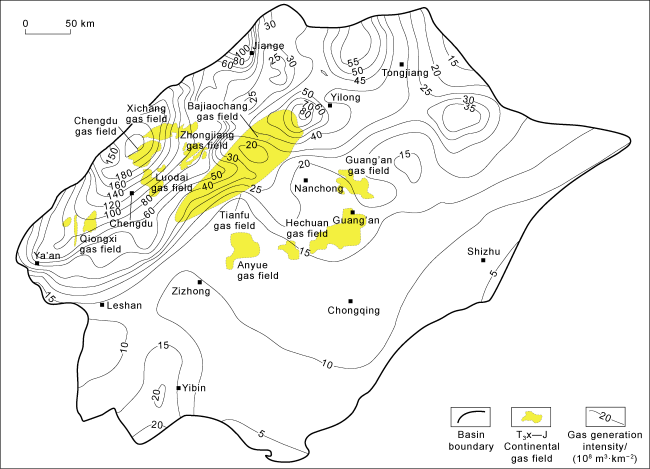
Fig. 2. Gas generation intensity of Xujiahe Formation coal-measure source rock and distribution of continental tight gas fields in the Sichuan Basin. |
Many large Carboniferous-Permian gas fields such as Sulige gas field in the Ordos Basin, and large Cretaceous gas fields such as Kela 2 and Kelasu in the Kuqa depression of the Tarim Basin are located in areas with gas generation intensity higher than 20×108 m3/km2 [6,48]. Development practices of Carboniferous-Permian natural gas reservoirs in the Ordos Basin found many gas-water wells and water wells where gas generation intensity is less than 20×108 m3/km2, indicating a complex gas-water relation [9].
Coal-formed gas fields in the Ordos Basin are mainly distributed in the Carboniferous-Permian formations where large-scale and gently sloping delta sedimentary systems are developed, and coal-bearing hydrocarbon source rocks and extensive tight sandstone reservoirs are interbedded, forming large-scale gas accumulation. Taking Sulige Gas Field as an example, frequent migration of delta plain underwater distributary channels, multi-stage interbeds and extensive distribution of Lower Permian He 8 sandstone reservoir provide a foundation for the development of the ultra-large gas field.
In the Kuqa Depression of the Tarim Basin, many coal-formed gas fields, such as Kela 2, Dabei, and Keshen have been discovered, where the Cretaceous sandstone has a total thickness of 200-300 m, and the giant evaporite rock as a regional cap ranges from 200 m to 2 500 m. These gas fields were almost formed during the Himalayan Orogeny. Rich gas sources, extensive and thick sandstone reservoirs, regional evaporite cap rocks and late gas accumulation are the key factors controlling the large coal-formed gas fields.
2. The important role of coal-formed gas in the natural gas industry of China
The establishment of the coal-formed gas theory opened a new field for natural gas exploration in China, and upgraded the guiding theory of natural gas exploration from a monistic view (oil-associated gas) to a dualistic view (oil-associated gas and coal-formed gas), promoting a rapid development period for China’s natural gas industry. Since 2000, proven initially-in-place and production of natural gas have grown significantly, which was contributed by coal-formed gas exploration and development.
2.1. Coal-formed gas exploration drives rapid growth in the natural gas reserves and production
2.1.1. Coal-formed gas is the major contributor to the growth of the natural gas reserves
Before the coal-formed gas theory was proposed in 1978, the total proven natural gas initially-in-place was 2284×108 m3 in China, and coal-formed gas accounted for 203×108 m3, or 8.89%. By the end of 2022, China’s cumulative proven initially-in-place exceeded 19×1012 m3, of which coal- formed gas reached 11×1012 m3, and accounted for approximately 55.3%. Over 40 years, the cumulative proven natural gas reserves in China increased by 86.1 times, and coal-formed gas reserves grew by 540.9 times, making it a major contributor to the growth of natural gas reserves.
The major gas fields of China are coal-formed gas fields. Before 1978, gas fields discovered in China were less than 10, of which only Weiyuan gas field was a large one, and no major coal-formed gas field were discovered. By the end of 2022, China had discovered 84 major gas fields, of which 51 are coal-formed gas fields, 40 have proven initially-in-place exceeding 1 000×108 m3, and 29 of the 40 are coal-formed gas fields. By the end of 2022, the proven gas reserves of large coal-formed gas fields accounted for 60.6% of the large gas fields and 51.8% of the total proven natural gas reserves in China. The growth of proven geological coal-formed gas reserves contributed to over a half.
2.1.2. Coal-formed gas is the major contributor to the growth of China’s natural gas production
In 1978, China’s natural gas production was 137×108 m3, of which coal-formed gas was 3.43×10⁸ m3, accounting for only 2.5%. By 2022, China’s natural gas production reached 2 200×108 m3, ranking the 4th globally, and coal-formed gas production accounted for about 1 270×108 m3, more than a half of the total. From 1978 to 2022, natural gas production increased by approximately 15 times, while coal-formed gas production increased by 369 times (Fig. 3 ), making coal-formed gas the primary driver of production growth.
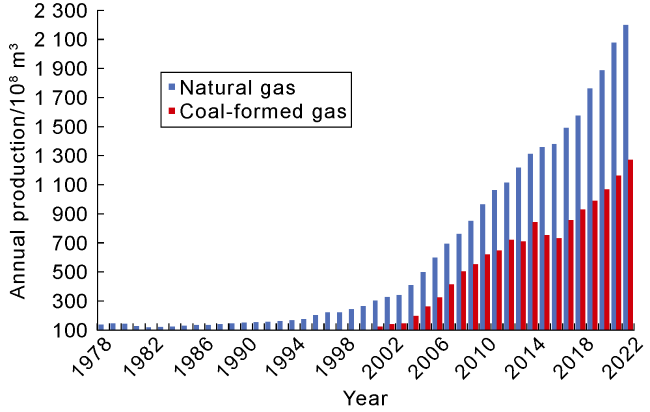
Fig. 3. Change of annual production of natural gas and coal-formed gas in China from 1978 to 2022. |
2.2. Coal-formed gas theory guided significant success in natural gas exploration in central and western large basins in China
Three typical super-large basins (Ordos, Tarim and Sichuan) have produced the highest gas production and have abundant remaining resources [51]. The coal- bearing formations in the Carboniferous-Permian in the Ordos Basin, the Triassic-Jurassic in the Tarim Basin and the Permian-Triassic in the Sichuan Basin provided favorable conditions for the accumulation of large coal- formed gas fields. However, before the establishment of the coal-formed gas theory, the natural gas exploration potential of the coal-bearing formations was not fully recognized. After understanding that “coal-bearing formations are good source rocks and coal-formed gas is a new field of exploration”, significant exploration success has been achieved in these basins.
2.2.1. The Ordos Basin
Gas fields discovered in the Ordos Basin are almost coal-formed gas fields. Except for Jingbian Gas Field where the gas reservoirs are mainly Ordovician dolomite, natural gas in other fields is generally concentrated in tight sandstone of the Permian Shanxi Formation and the Lower Shihezi Formation. The widespread Carboniferous-Permian coal-bearing source rocks provide abundant gas source for large coal-formed gas fields [52]. By the end of 2022, 18 coal-formed gas fields had been discovered in the Ordos Basin, and 13 of them had proven initially-in- place exceeding 1 000×108 m3, which is the most in China. With proven reserves of 2.07×10¹² m3, Sulige Gas Field is the largest in China in terms of proven reserves, annual production and cumulative production. In 2022, Sulige Gas Field produced natural gas of 305×108 m3, accounting for 13.9% in China (2 200×108 m3 totally).
2.2.2. The Tarim Basin
In the Tarim Basin, natural gas is mainly distributed in the Kuqa Depression where 8 coal-formed gas fields have been discovered, and 4 of them have proven initially- in-place exceeding 1 000×108 m3. Coal-formed gas is generated from the thick Triassic lacustrine-marsh and Middle-Late Jurassic lacustrine-fluviatile-marsh coal-bearing source rock, and mostly accumulated in the Cretaceous and a little in the Paleogene sandstone reservoir [53]. The Kela 2 Gas Field with gas reserves exceeding 1 000×108 m3 and reserve abundance of 59×108 m3/km2 is the first coal-formed gas field discovered in the Tarim Basin, and It is the source gas field of the west to east gas pipeline, and also the high-quality gas field with the highest reserves abundance in China at present. The Kelasu gas field is the first ultra-deep gas field (6 000-8 000 m) in China. In 2022, it produced natural gas of 115×108 m3.
2.2.3. The Sichuan Basin
The Sichuan Basin has orderly accumulation of both conventional and unconventional natural gas, with proven initially-in-place exceeding 4.5×10¹² m3 [54]. In recent years, significant progress has been made in both conventional and unconventional natural gas exploration in the basin, and 32 large gas fields have been discovered, boasting the most in China. Coal-formed gas fields in the Sichuan Basin were almost found in the braided channels and deltas of the Triassic Xujiahe Formation and the tight sandstone of the Jurassic Shaximiao Formation. The source rocks are primarily the coal-bearing Xujiahe Formation, and locally the Jurassic humic mudstone. 11 large coal-formed gas fields have been discovered, mostly in the central and western regions of the Sichuan Basin (Fig. 2 ), with proven initially-in-place exceeding 1.0×10¹² m3.
3. Favorable coal-formed gas exploration zones
3.1. Coal rock gas
Coal rock gas refers to natural gas that is either generated within the coal rock itself or migrates into the coal rock from other gas sources. It exists in both free and adsorbed states, and the content of free gas is high, which enables rapid gas production and industrial-scale extraction through reservoir modification. The abundant presence of free gas is the important feature of coal rock gas and is the main distinction with coalbed methane, as free gas is generally low or absent in shallow coalbed methane. China is one of the countries with the most abundant coal resources in numerous coal-bearing basins, such as Ordos, Junggar, Sichuan, Tarim, Songliao, Bohai Bay, Yinggehai, Turpan-Hami, and Qinshui basins. From the perspective of geological evolution, China has experienced 7 strong coal-forming periods, with the most significant periods being the Carboniferous-Permian in the north, the Permian in the south, the Early-Middle Jurassic in the northwest, and the Late Jurassic-Early Cretaceous in the northeast [55]. The coal seams formed during those periods are main hosts for coal rock gas.
3.1.1. The Jurassic Xishanyao Formation in the Junggar Basin
The Junggar Basin has two primary coal-bearing formations, the Xishanyao and Badaowan formations which were developed during the Jurassic period. The two formations are widespread and thick, and the coal rock gas in the coal seams deeper than 1 500 m is estimated to be around 15×1012 m3, indicating a great potential. The thickness of the Xishanyao Formation coal is typically 5-20 m, and even up to 85 m, which is thicker than the underlying Badaowan Formation.
In 2020, to explore new fields of coal rock gas and verify new coal rock gas accumulation models, PetroChina Xinjiang Oilfield Company selected a structural trap in the Xishanyao coal rock of the Baijiahai uplift and drilled Well CT1H [56]. The well showed gas flow just two days after fracturing stimulation, at maximum gas production of 5.7×10⁴ m3/d through a 12 mm choke, and 1×10⁴ m3/d through a 9 mm choke. The cumulative gas production was 1 284×104 m3 after testing 715 d. The breakthrough opened a new area for coal rock gas and promoted onshore exploration. It is a milestone on the way to coal rock gas.
The coal rock reservoirs in the Baijiahai uplift have porosity from 4.6% to 18.4%, with an average of 11.7%, and permeability of (0.24-36.97)×10-3 μm2, and 9.42×10⁻³ μm2 on average. These results demonstrate that low-rank coal rocks (Ro = 0.6%-0.8%) have large pores and fractures. The good reservoir properties make them a new type of important reservoir. The coal-formed gas in the Junggar Basin follows two accumulation models: “lower-source and upper-reservoir” and “self-source and self-reservoir”. In the northern part of the basin, where coal rocks are shallow and less mature, the primary gas source is the Carboniferous source rock, and gas migrates through faults and accumulates in the coal rock reservoirs. In the southern region where the coal rocks are deeper and highly mature (Ro>1.3%), the accumulation model follows “self-source and self-reservoir”. Both models in the two regions hold significant exploration potentials.
3.1.2. Carboniferous Benxi Formation in the Ordos Basin
In the Ordos Basin, the Carboniferous-Permian marine-terrestrial transitional sedimentary environment was widely distributed, and coal-bearing rocks were developed in the Benxi, Taiyuan, and Shanxi formations. These coal seams are stable in distribution, and up to 35 m thick. From top to bottom, the coal seams are divided into #1 to #10. The #8 coal seam in the Benxi Formation is typically 2-15 m thick, even up to 25 m locally, and covers approximately 19×104 km2. Coal rocks in the eastern part of the Ordos Basin are buried at about 1 500 m, gradually around 4 000 m towards the west, and becomes thin and flat, with small faults and structures locally.
The coal rock in the Benxi Formation is primarily bulk coal with original structures, and fractured coal locally. It consists mainly of bright coal and semi-bright coal, with a low ash content (average 15.2%) and a high fixed carbon content (over 70%). The microscopic composition is mainly vitrinite, constituting 79.2% on average. Pore analysis shows the average porosity of 4.85% and permeability of 2.45×10⁻³ μm2. The reservoir space is composed of mainly residual plant cell pores, gas bubble pores, cleats and micro-fractures, and a small amount of non-coal mineral intergranular pores and dissolution pores. Gas bubble pores are rich in matrix pores, and usually occur as clusters and bands, with pore diameters ranging from a few nanometers to several hundred nanometers. The matrix pore structures are complex, of which micropores account for 56.5%, macropores for 28.4%, and mesopores for 15.1%. Coal seams generally have cleat fractures, with fracture density of 106-323 fractures/cm2. Some fractures are filled with calcite, clay, or siliceous minerals. Deep coal seam reservoirs generally have a high gas content. According to underground cores, the gas content ranges from 12.5 m3/t to 33.7 m3/t, the free gas content is relatively high, averaged around 4 m3/t, and accounting for approximately 21.4%.
The lithology and sealing capacity of the top seal of coal rock are particularly important for preserving free gas. The Benxi Formation coal rocks have three types of seal-reservoir combinations: coal-mudstone, coal-limestone, and coal-sandstone. The mudstone and limestone are relatively tight, and provide a better sealability, so the coal rock gas peak value is generally over 80%, and even higher than 95% locally. In contrast, the sealability of sandstone is poor, and the peak value of gas measurement of the coal rock is generally below 40%.
Previous evaluation and estimate of the coalbed methane resources in China mainly focused on medium to shallow coal rocks [57-58]. Recent resource estimate on the deeper coal rocks (>1 500 m) in the Ordos Basin indicated that the #8 coal seam covering an area of 19×104 km2 has an estimated resource of 17.4×10¹² m3, and the #5 coal seam covering an area of 16×104 km2 holds 6×10¹² m3. The total coal-formed gas resource in the deeper layers (1 500-4 000 m) is expected to exceed 23×1012 m3.
The #8 coal seam in the Ordos Basin was evaluated based on the comprehensive analysis of coal rock thickness, sealing condition, coal rank, depth and structure, and by considering factors like gas content, reservoir properties and pressure. The results show that the Yulin-Jiaxian, Wushenqi, Hengshan, and Mizhi-Suide regions have the most favorable coal-formed gas accumulation conditions and are key exploration zones in the near future (Fig. 4 ). Inspired by the success of Well CT1H in the Junggar Basin [56], in early 2022, three risk exploration wells-NL1H, JN1H, and SD1H-were drilled in different depths and plays in the Ordos Basin. The former two wells were successful, showing an enormous potential for future exploration and development of coal rock gas in the basin.

Fig. 4. Comprehensive evaluation of coal rock gas of the Benxi Formation in the Ordos Basin (modified from Reference [59]). |
3.1.3. The Permian Longtan Formation in the Sichuan Basin
In the Sichuan Basin, coal seams are primarily in the Upper Permian Longtan Formation and the Upper Triassic Xujiahe Formation. The single coal seam in the Xujiahe formation is typically thinner than 1 m, and multiple seams occur vertically, and generally exceed 10 m in the cumulative thickness, even more than 30 m locally. The thickness gradually decreases from the Longmen Mountain foreland zone in the western Sichuan region to the central Sichuan region, and coal seams are sparse or absent in the eastern and southern Sichuan areas. Overall, the coal rock gas in the Xujiahe Formation holds a certain exploration potential.
The Longtan Formation coal seams were formed in a marine-terrestrial transitional shore-swamp environment and are mainly distributed in the central and southern Sichuan regions. The coal seams are buried at 2 000 m to 4800 m, shallower in the southern Sichuan basin than in the central area. The Longtan Formation is divided into three members: Long I, Long II, and Long III. Coal seams are primarily in Long I and Long II. In the central and southern Sichuan areas, the Longtan Formation has 8-15 coal seams, and the individual seam is 1 m to 4 m thick, and the cumulative thickness is between 8 m and 20 m [60]. The thermal maturity of the coal rock is high (Ro of 2.0%-2.5%), indicating a high-rank anthracite. The coal is black, with a silky luster, but the overall luster is weak. The coal structures are almost original. The pores are mainly organic pores, including cell cavities, gas pores, mold pores, and dissolution pores. The porosity ranges from 3.0% to 6.5%, with an average of 4.5%, indicating favorable reservoir conditions. The coal rock exhibits well-developed cleats that play a significant role in improving reservoir properties. The Longtan Formation coal rock has a high gas content measured from 10 m3/t to 25 m3/t. Vertically, the coal seams are associated with sandstone and mudstone to form various lithologic combinations as “mud-coal-mud” being the most favorable for coal rock gas. The formation pressure coefficient of the Longtan Formation is typically greater than 1.8, exhibiting significant overpressure characteristics.
Exploration practices in the Baijiahai area of the Junggar Basin for Jurassic coal rock gas indicate that coal rock gas can accumulate in structural highs, slopes and synclines regardless of structural controls. In the Sichuan Basin, coal seams in various structural positions of the Longtan Formation show good gas display, suggesting large distribution. Preliminary estimate suggests that coal rock gas in the Longtan Formation is mainly in two major favorable exploration areas: the Suining-Tongliang area and the Chongqing-Xishui area, covering nearly 10 000 km2 and with estimated resources of approximately 2×10¹² m3. By now, PetroChina has drilled wells NT1H and JT1H, aiming to explore the reservoir development and the content of overpressure coal rock gas at different depths. the two wells obtained industrial gas flow, demonstrating a huge exploration potential of coal rock gas in the Longtan Formation.
3.2. Conventional coal-formed gas in the Junggar Basin,
The Junggar Basin has two primary sets of coal-bearing source rocks. The first set is the Carboniferous source rock which mainly consists of mudstone and carbonaceous mudstone, and some interbeds of thin coal seams. The organic matter is of types II2-III. The average TOC (total organic carbon) of the carbonaceous mudstone is 19.10%, and the TOC of the mudstone is 1.59%, classifying it as a medium-rank source rock [61]. The top of the Carboniferous source rock has a current Ro value between 1.3% and 2.6%, indicating it has entered the high-to-overmature stage. The cumulative thickness of the source rock ranges from 50-300 m (Fig. 5 ), and that thicker than 100 m covers around 7 000 km2. The current gas generation intensity of the source rock exceeds 10×108 m3/km2 and covers more than 12 000 km2, indicating a potential to accumulate into medium to large gas fields. Kelameili gas field located in the eastern region is the only large gas field discovered in the Junggar Basin, and its natural gas is sourced from this set of source rocks [62-63]. The proven petroleum initially-in-place in Kelameili gas field amounts to 832.4×10⁸ m3.
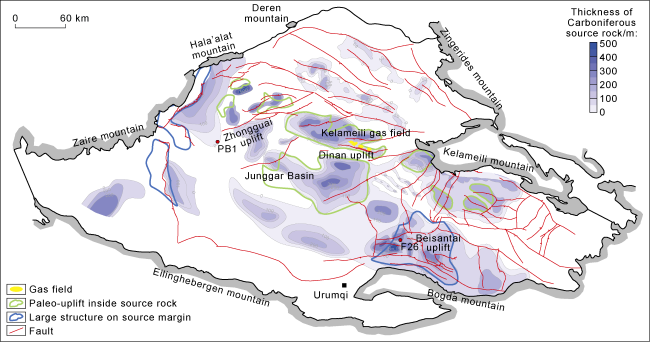
Fig. 5. Distribution of favorable exploration zones of self-source and self-reservoir gas plays in the Carboniferous of the Junggar Basin. |
The reservoir of the Carboniferous hydrocarbon system is mainly volcanic rock where coal-formed gas from the coal-source rocks in the same period accumulates, forming a self-source and self-reservoir play. This type of play can be further divided into two major kinds: ancient uplift inside source rock and large structure on source margin (Fig. 5 ). The intra-source ancient uplifts are mainly distributed in the central high of a hydrocarbon- generating sag, and represented by large volcanic structural traps, such as Mabei, Manan, Mosuowan and Baijiahai. They are large and deep, and attract gas accumulation in favorable volcanic reservoirs. Recently, a high industrial gas flow was obtained from Well PB1 drilled in the Carboniferous, further revealing an enormous potential. The large structures on source margin are mainly distributed in the northern and eastern uplift belts in the Carboniferous hydrocarbon-generating sag. Suffering from long-term weathering and erosion, weathered volcanic reservoirs were developed. Coal-formed gas generated in the hydrocarbon-generating depression transported and accumulated in the uplift zone through deep large fractures and unconformities. By now,Kelameili gas field has been discovered in the Dinan uplift, and gas reservoirs like F26 have been found in the Beisantai uplift, indicating a significant exploration potential.
The second set of hydrocarbon source rocks is from the Middle to Lower Jurassic, including coal, carbonaceous mudstone and lacustrine mudstone. The cumulative thickness of coal and carbonaceous mudstone is 50-350 m, and the lacustrine mudstone is 100-600 m. Their average TOC values are 72.0%, 19.1% and 1.39%, respectively, and all are medium to good. The organic matter is type II2-III, primarily generating gas. During the Himalayan period, the entire Junggar Basin was tilted toward north, and only the southern margin and slope regions entered the gas window. At present, the area where Ro>1.3% is approximately 1.6×10⁴ km2. In the southern margin and slope regions, the gas generation intensity is generally greater than 20×108 m3/km2, and in the middle of the southern margin, it exceeds 100×108 m3/km2, providing a solid resource foundation for the formation of large gas fields [48,64]. By now, medium-sized gas fields such as Mahe and Hutubi have been discovered in the middle section of the southern margin, with proven natural gas reserves of approximately 320×108 m3. The exploration rate is less than 2%, showing a significant exploration potential.
The controlling factors on the Jurassic petroleum system in the southern Junggar Basin include mature source kitchens, favorable facies belts, effective fault-reservoir- cap configurations and good preservation conditions. Based on these factors, two key favorable exploration areas are selected: the Dongwan structural belt in the middle section of the southern margin and the Tuobei- Qibei concealed triangle zone. The Dongwan structural belt is located at the center of the Jurassic mature source kitchen, with abundant hydrocarbon sources. The eastern and western structural highs and the Tunan anticline are located in the favorable facies belt of the Jurassic Kalaza Formation, where large-scale sandstone reservoirs were developed. The fault-reservoir-cap configuration is favorable, making it a potential effective gas play. In addition to the Dongwan anticline, the Tuobei-Qibei concealed triangle zone located in the overlap of multiple source rocks and large-scale sandstone reservoirs has favorable source, reservoir, and together with the sealability condition of the Boqi fault. The thrust-reverse fault-reservoir-cap configuration may form a potential effective gas play. Multiple large favorable structural traps were developed within 200 km on the eastern and western sides of the triangle zone, with a significant resource potential.
3.3. Tight gas
3.3.1. Triassic Xujiahe Formation tight gas in the Sichuan Basin
The coal-source rocks of the Xujiahe Fm. and widely distributed shallow-water delta sandstone consist of a favorable self-source and self-reservoir system. Based on comprehensive studies, including sedimentology, geochemistry, paleobiology and seismic responses, the Upper Triassic sequences were redefined, and the stratigraphic framework of the Xujiahe Formation was reconstructed. It is clear that the three-stage tectonic movement during the Indosinian Period controlled the Late Triassic sedimentation and tectono-stratigraphic paleo-geography in the Sichuan Basin, so three major sedimentary sequences were divided according to the basin evolution, namely late Triassic ocean-land transition, early and late foreland basins related to the Longmen Mountain.
Under the sequence framework, the sedimentary system of three major sedimentary sequences and the distribution of main source rocks (kitchen) were determined. It was determined that the delta sandbodies in the Late Triassic ocean-land transition period (T3x1-T3x2) were mainly developed in the northwest of Sichuan, and high-quality source rocks were developed, forming a superior source reservoir configuration of the front sandbodies of the T3x21 and the source rocks of T3x1 and T3x2 and the source rocks adjacent to the faults of Xu 3. When the early foreland basin related to the Longmen Mountain deposited (T3x31 and T3x32), strong source supply from east and south, and central large-scale deltaic sandstone promoted to the formation of a top source and bottom reservoir assemblage with T3x32 lateral lacustrine source rock and T3x1 and T3x2 source rocks. When the late foreland basin (T3x4, T3x5 and T3x6) deposited, algal and sapropelic organic matter that produced a large amount of hydrocarbon, and deltaic and beach-bar sandstones in T3x5 might form a self-source and self-reservoir assemblage in the transition zone between the western Sichuan and the central Sichuan. In addition, large deltaic sandstones in T3x4 and T3x6, and the source rocks in T3x31 and T3x5 might develop into a bottom source and top reservoir play (Fig. 6 ).
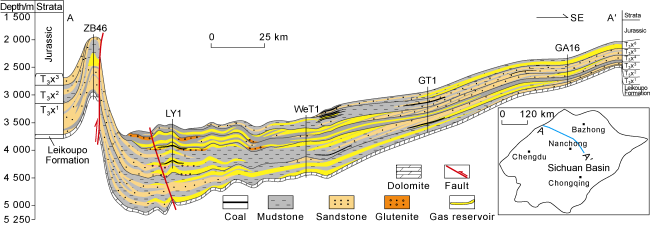
Fig. 6. The profile of source-reservoir combination of the Xujiahe Formation in western and central Sichuan Basin. |
Following a whole petroleum system, Xujiahe Formation plays and their distribution features were analyzed in the thrust, depression slope and uplift belts. Based on source-reservoir configurations, accumulation mechanisms, and gas reservoir types, it is proposed an orderly distribution of modified tight gas, source-reservoir integrated tight/shale gas, and lithological tight gas in the belts.
Generally, the favorable exploration zones developed during the late Triassic ocean-land transition period in the Xujiahe Formation are concentrated in the deltaic sand bodies in the northwest Sichuan Basin, where PetroChina’s Well WT1 obtained a high gas flow. The transitional zone between the western and the central Sichuan is the overlap of the upper and lower foreland basin exploration belts before the Longmen Mountain. Located close to the hydrocarbon-generating center, and with well-developed sand bodies and multiple favorable source-reservoir combinations, it is an advantageous exploration target.
3.3.2. Carboniferous-Permian tight gas in southern Ordos Basin
Earlier research and exploration of tight gas in the Upper Paleozoic strata in the Ordos Basin focused on the northern and southern parts where major channel sand bodies are well-developed. The key areas for future coal- formed gas exploration are mainly Carboniferous-Permian tight gas in the southwest of the basin (Fig. 7 ).

Fig. 7. Thickness contours of the Lower Permian H8 in the Ordos Basin. |
Previous sedimentary system studies based on a three- order sequence (or stratigraphic section) were usually on lithological comparison, which led to time-stratigraphic mismatches and could not reveal changes in sedimentary facies within the isochronous stratigraphic framework. Through the study on a four-order sequence framework and sedimentary system, it is clear that during the deposition of the H8 section of Lower Shihezi Fm., a unified catchment lake basin existed, with the southern basin developing “a progressive but uneven thick” sedimentary structure. Nine braided river deltas were developed within the lake area, and delta-front complex sand bodies, such as “mouth bar-underwater distributary channels”, were formed in the second layers of H81 and H82. These sand bodies have good reservoir properties and make up two favorable reservoir-cap combinations with the mudstone in the first layers of H81 and H82. Through typical well data analysis, it was revealed that gas reservoirs are existent in the H8 delta-front sand bodies which are underlain by thick coal-bearing source rocks of the Benxi and Shanxi formations. They are a “lower-source and upper reservoir” accumulation model with lithologic traps and minor structures controlling high gas production. The exploration area of the H8 delta-front sand bodies is approximately 38 000 km2, of which 23 000 km2 falls within PetroChina’s mining right. The gas reserves are estimated to be 8 000×108 m3, and it can effectively expand the exploration field and tamp the ballast effect of “increasing reserves and production” of the upper Paleozoic in the basin. After taking into account geological conditions, exploration degree, and seismic data, the Wuqi delta formed by the provenance in the north and the Huanxian delta formed by the provenance in the west of the basin are favorable exploration zones in the future (Fig. 7 ).
3.3.3. Carboniferous limestone tight gas in the Ordos Basin
The Carboniferous-Permian strata in the Ordos Basin were deposited in a coastal tidal flat sedimentary environment, which is conducive to the development of large- scale and stable limestone. After short atmospheric freshwater leaching, the limestone may become effective reservoir. The Carboniferous-Permian coal seams and dark mudstones vertically and extensively distributed, and a small amount of limestone source rock of the Taiyuan Formation, provided abundant hydrocarbon source for the limestone reservoir. However, the Taiyuan Formation limestone has not received significant attention although gas shows have been observed. Until to 2021, the Taiyuan Formation limestone was re-understood, including reservoir physical properties and hydrocarbon accumulation laws, and Well YT1H produced an industrial gas flow at over 500 000 m3/d [65]. The major breakthrough demonstrated a significant exploration potential of the Taiyuan Formation limestone.
The Taiyuan Formation is characterized by favorable sedimentary facies such as detrital shoals and biostromes, with detrital powdery crystalline limestone and algal-bound limestone forming the primary reservoir rocks. In the Hengshan-Zhidan region, detrital powdery crystalline limestone reservoirs are developed, and 4-10 m thick, and in the Jiaxian-Qingjian region, algal-bound limestone reservoirs are found, and 2-6 m thick [65]. Reservoir space such as dissolution pores, intercrystalline micropores, and microfractures are well-developed and stacked together. These limestone reservoirs are sandwiched between the primary coal-bearing source rocks of the Benxi and Shanxi formations, and coal-formed gas accumulates in the limestone reservoirs through fractures and faults, forming lithological gas reservoirs. The Hengshan-Jingbian area and the Zizhou-Qingjian area are considered favorable exploration zones of the Taiyuan Formation limestone, covering an area of about 15 000 km2. These areas represent the practical fields for increasing natural gas reserves and production in the Ordos Basin.
Recent comparative studies have found that the limestone of the Benxi Formation has similar reservoir conditions to those of the Taiyuan Formation. The limestone of the Benxi Formation deposited in a tidal flat environment, with cumulative thickness ranging from 2 m to 20 m. Especially, the Bangu limestone is very thick (2-15 m) and stable, and covers approximately 11 000 km2. Favorable facies belts, such as detrital flats and bioherms, were subjected to late dissolution, and evolved into good reservoirs. The reservoir space is made up of dissolution pores, microfractures and intercrystalline pores. The Benxi Formation limestone, like the Taiyuan Formation limestone gas reservoir, follows a “sandwich” model where the limestone reservoir is sandwiched between the #8 coal and mudstone of the Benxi Formation, and natural gas accumulates into the limestone reservoir through fractures, forming a lithologic gas reservoir. Although this limestone has not yet been explored as a primary exploration target, and the exploration degree is low, it showed active gas shows when re-developing some old wells. The Fugu-Shenmu-Yulin area where detrital flats and bioherms are well developed is considered a favorable exploration target for Benxi Formation limestone natural gas. The area covers approximately 4 500 km2, and contains geological gas reserves of up to 5 000×108 m3.
3.3.4. Tight gas in the Carboniferous-Permian strata of the Bohai Bay Basin
The Bohai Bay Basin and the Ordos Basin experienced similar paleogeographic environments during the Carboniferous-Permian period. From the Late Carboniferous to the Early Permian, coal-bearing strata of marine-terrestrial transitional facies developed, and during the Late Permian, large continental depression basins formed [65]. Compared with the significant results achieved in the Ordos Basin, only a few oil and gas fields were discovered in the Carboniferous-Permian tight gas reservoirs in the Bohai Bay Basin [66⇓-68], and the proven initially-in-place are far less than those in the Ordos Basin.
Although the Carboniferous-Permian strata in the Bohai Bay Basin experienced uplift and erosion during the Indosinian and Yanshanian periods, they are still thick (400-1 000 m) and widely distributed. Thick coal-bearing source rocks, tight sandstone reservoirs and overlying mudstone cap provided good conditions for coal-formed gas plays. The source rocks are primarily in the Carboniferous Benxi Formation and Taiyuan Formation, and the Permian Taiyuan and Shanxi formations, including coal and mudstone, thick in the north and south and thinner in the middle. The coal seams typically range from 5 m to 25 m thick, even 50 m in the Huanghua Depression. The dark mudstone with TOC from 1% to 3% is 100-400 m thick [3,69]. The organic matter of the source rocks is mainly of Types II2-III, and locally the exinite content is high, such as in the Wangguantun area of the Huanghua Depression, where the exinite content may be 20%, indicating a certain oil generation potential. The thermal maturity of the hydrocarbon source rocks varies significantly across different structural areas, but in general, the gas generation intensity is high. For example, the gas generation intensity in the Huanghua Depression is generally (20-80)×108 m3/km2, with a maximum of 100×108 m3/km2 [66].
The Carboniferous-Permian reservoirs are generally medium-low-porosity and low-permeability tight sandstone, mainly coarse sandstone of the Upper Shihezi Formation of the Permian. In comparison, the sandstones of the Lower Shihezi Formation and the Shanxi Formation are finer and with poorer physical properties [68]. In the Jizhong Depression, the sandstone in the Upper Shihezi Formation has a cumulative thickness of 80-150 m, while the Lower Shihezi Formation is 50-100 m thick. After two times of significantly uplifting during the Indosinian and the Yanshanian periods, the reservoir suffered atmospheric freshwater leaching, and the properties was improved to a certain degree. The overlying thick mudstone of the Permian Shiqianfeng Formation and that of the Paleogene Forth member of Shahejie Fm. acting as two sets of regional cap rocks, especially the mudstone directly overlying single sand bodies, provide favorable preservation conditions.
Based on source-reservoir-cap analysis, it is believed that the eastern Jizhong Depression, the southern Huanghua Depression, the southern Linqing Depression, the southern Jiyang Depression, and the central-eastern Bozhong Depression are favorable exploration areas for Carboniferous-Permian tight gas (Fig. 8 ). Future research will focus on the distribution of favorable sandstone reservoir, sweet spot prediction, and natural gas accumulation laws in favorable formations shallower than 4 500 m, in order to provide theoretical and technical support for making breakthrough to large-scale gas discoveries and increasing reserves and production of the Carboniferous-Permian gas reservoirs in the Bohai Bay Basin.
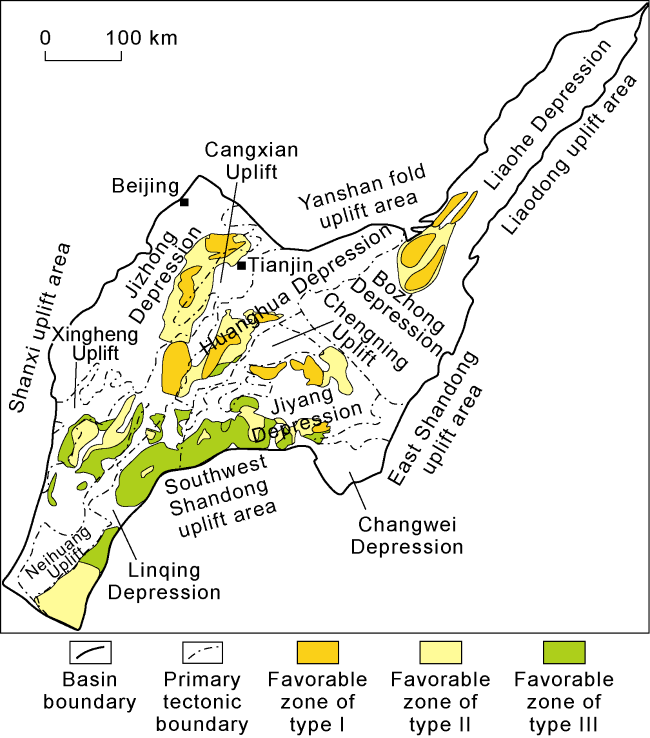


Fig. 8. Evaluation on favorable exploration zones of Permian tight sandstone gas in the Bohai Bay Basin (after Reference [69]). |
4. Conclusions
According to the theory of coal-formed gas, “coal-bearing strata almost generate gas, and oil as a secondary product; and coal-bearing strata are excellent source rocks for gas”. This theory opened a new domain for natural gas exploration.
Based on extensive sample analysis and simulation experiments, a gas genesis identification system was established based on three key indicators: stable isotopic composition, light hydrocarbon components, and biomarkers. This system plays a significant role in identifying gas genesis and comparing gas sources. Research on controlling factors for large gas fields, such as gas generation intensity higher than 20×108 m3/km2, has effectively guided the discovery of large gas fields in China.
Currently, proven coal-formed gas initially-in-place and annual production account for more than half the total proven initially-in-place and annual production of natural gas of China. The significant achievement supported successive discoveries of large gas fields, promoted increases in reserves and production of coal-formed gas in three major central and western basins (Ordos, Tarim, and Sichuan), and led to the rapid development of the natural gas industry of China.
Coal rock gas is one of the key fields for future coal- formed gas exploration. Important strata for coal rock gas exploration include the Jurassic Xishanyao Formation in the Junggar Basin, the Carboniferous Benxi Formation in the Ordos Basin, and the Permian Longtan Formation in the Sichuan Basin. Additionally, Carboniferous-Permian coal-bearing coal-measure tight gas in the southern Ordos Basin, the Bohai Bay Basin, and coal-measure tight gas in the Xujiahe Formation in the transitional zone between central and western Sichuan Basin are favorable exploration zones for conventional coal-formed gas of the coal-formed gas in the future.