Analysis of the current status of global oil, gas, and associated resources exploration in 2023

  • WEN Zhixin ,
  • WANG Jianjun , * ,
  • WANG Zhaoming ,
  • HE Zhengjun ,
  • SONG Chengpeng ,
  • CHEN Ruiyin ,
  • LIU Xiaobing ,
  • JI Tianyu ,
  • LI Zuxin
Expand
  • PetroChina Research Institute of Petroleum Exploration & Development, Beijing 100083, China

Received date: 2023-09-18

  Revised date: 2024-09-29

  Online published: 2025-01-03

Supported by

Major Science and Technology Projects of China National Petroleum Corporation(2023ZZ07-01)

Major Science and Technology Projects of China National Petroleum Corporation(2023ZZ07-02)

Major Science and Technology Projects of China National Petroleum Corporation(2023ZZ07-03)

Major Science and Technology Projects of China National Petroleum Corporation(2023ZZ07-05)

Copyright

Copyright © 2024, Research Institute of Petroleum Exploration and Development Co., Ltd., CNPC (RIPED). Publishing Services provided by Elsevier B.V. on behalf of KeAi Communications Co., Ltd. This is an open access article under the CC BY-NC-ND license (http://creativecommons.org/licenses/by-nc-nd/4.0/).

Abstract

Based on commercial databases from S&P Global and Rystad Energy and public information from oil companies around the world, a systematic analysis has been conducted on the global hydrocarbon exploration investment, award of exploration blocks, exploratory drilling, new conventional oil and gas discoveries, and exploration of associated resources in 2023. In 2023, the global hydrocarbon exploration investment increased steadily and the total number and area of awarded exploration blocks increased significantly. The decline in the number and success rate of high-impact exploration wells directly affected the quantity of additional oil and gas reserves discovered globally in 2023. In recent years, the deepwater areas of passive margin basins have been the major targets for seeking medium- and large-sized conventional oil and gas fields. In 2023, however, the newly discovered onshore reserves were equivalent to the newly discovered offshore reserves, and fine exploration in mature blocks achieved significant results. Oil companies continued to plan and perform unconventional oil and gas exploration activities and accelerated access to associated mineral resources such as natural hydrogen and helium and other emerging industries. For Chinese oil companies international exploration business, it is recommended to: (1) continue the upstream investment to strengthen upstream services for consolidating the strategic position of oil and gas resources; (2) uphold oil and gas exploration activities by further deploying exploration activities in the deepwater areas of passive margin basins, deeply exploring mature basins, closely following hotspot basins, and gaining access to frontier basins; (3) follow the principle of integrated development to plan the exploration of associated resources while exploiting conventional and unconventional resources; and (4) make technological innovations to develop and improve core technologies and promote the application of artificial intelligence.

Cite this article

WEN Zhixin , WANG Jianjun , WANG Zhaoming , HE Zhengjun , SONG Chengpeng , CHEN Ruiyin , LIU Xiaobing , JI Tianyu , LI Zuxin . Analysis of the current status of global oil, gas, and associated resources exploration in 2023[J]. Petroleum Exploration and Development, 2024 , 51(6) : 1465 -1479 . DOI: 10.1016/S1876-3804(25)60553-2

Introduction

During the period from 2020 to 2022, despite the combined effects of multiple factors such as the COVID-19 pandemic and geopolitical conflicts, the global oil and gas industry still showed signs of steady growth, and the global exploration investment was bottoming out[1-6]. In 2023, the number and reserves of new oil and gas discoveries around the world decreased year on year, and even though oil prices were low, oil companies continued their hydrocarbon exploration activities. Specifically, the global investment in conventional oil and gas exploration increased steadily, the total number and area of awarded exploration blocks increased significantly, the exploration workload remained stable, and the top seven major international oil companies in the world continued to strengthen their efforts in planning and implementing exploration activities in deep and ultra-deep water along the Rim of Africa and the Rim of Latin America (hereinafter collectively referred to as the “Two Rims”, as applicable). In recent years, oil companies have been continuously planning and implementing unconventional oil and gas exploration activities and accelerating their access to associated mineral resources such as natural hydrogen and helium and other emerging resources. In 2023, major oil and gas discoveries were made in mature basins such as Zagros Basin in Iran, Amu Darya Basin in Iran and Kutai Basin in Indonesia, as well as emerging basins such as Orange Sub-basin in Namibia and Guyana Basin in Guyana and Suriname.
Based on commercial databases from S&P Global and Rystad Energy and public information from oil companies around the world, this paper performed an in-depth and systematic analysis of the global hydrocarbon exploration investment, awarded exploration blocks, global exploration workload, characteristics of new oil and gas discoveries, and the status of associated resources exploration in 2023, investigated the general trend in the exploration of oil, gas, and associated resources around the world, and proposed detailed recommendations for Chinese oil companies to expand their overseas operations, so as to provide a useful reference for the formulation of national strategies and policies related to oil, gas and associated resources.

1. Overview, status and new discoveries of global conventional oil and gas exploration

1.1. Change in global investment in conventional oil and gas exploration
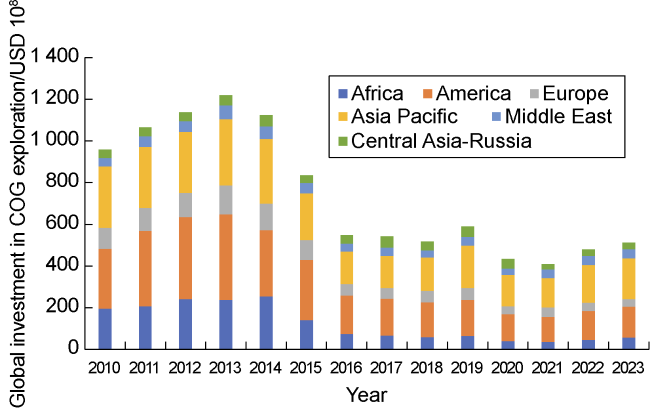
In 2023, the total global investment in conventional oil and gas (COG) exploration amounted to 510.8×10⁸ US dollars (USD), representing a year-over-year (YoY) growth of 6.7% [7] (Fig. 1), showing the same growth trend as that in 2022. The global investment in offshore COG exploration in 2023 was USD 271.9×10⁸, accounting for more than 50% of the total global investment in COG exploration [7]. Among the global investment in offshore COG exploration in 2023, for which the water depths corresponding to shallow-water, deepwater and ultra-deepwater areas are less than 500 m, 500-1 500 m, and greater than 1 500 m, respectively, the investment in shallow-water area was USD 143.5×10⁸, accounting for 52.8%, the investment in deepwater area was USD 52.1×10⁸, accounting for 19.1%, and the investment in ultra-deepwater area was USD 76.3×10⁸, accounting for 28.1%. Global exploration investment in mature basins was USD 346.5×10⁸, accounting for 67.8% and representing a YoY growth of 2.5 percentage points; the exploration investment in emerging basins was USD 7.1×10⁸, representing a YoY growth of USD 0.9×10⁸; the exploration investment in frontier basins was USD 157.2×10⁸, representing a YoY decrease of USD 2.8×10⁸. In terms of regional distribution, among the total global investment in COG exploration in 2023 (the trend of which is the same as that in 2022), the exploration investment in Asia Pacific was USD 194.3×10⁸, accounting for 38.0%; the investment in America was USD 147.3 ×10⁸ including USD 47.7×10⁸ in South America and USD 99.6×10⁸ in North America, accounting for 29%; and the amounts invested in Africa, the Middle East and Europe were relatively small, which were USD 57.6×10⁸, USD 43.7×10⁸ and USD 37.6×10⁸, respectively.
Fig. 1. Histogram of year distribution and regional distribution of global investment in COG exploration since 2010 [7].

1.2. Award of COG exploration blocks around the world
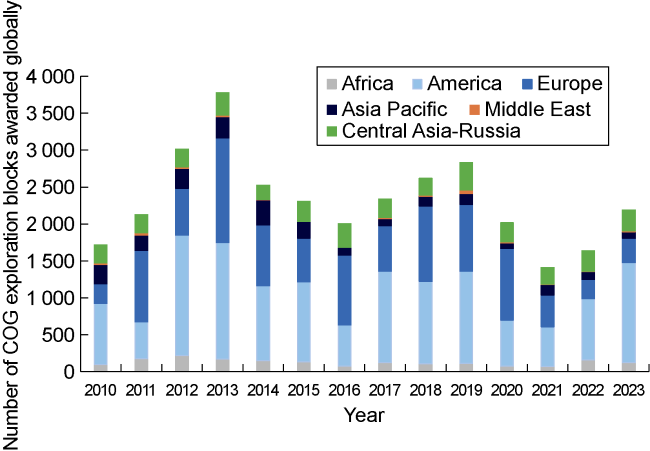
In 2023, the total number and area of COG exploration blocks awarded globally increased significantly and gradually recovered to pre-pandemic levels (Fig. 2). Specifically, the total number of COG exploration blocks awarded globally in 2023 was 2 192, representing a YoY growth of 78.2%, and the total area of COG exploration blocks awarded globally in 2023 was 120.5×10⁴ km2, representing a YoY growth of 22.3% [6].
Fig. 2. Histogram of the year distribution and regional distribution of COG exploration blocks awarded globally [6].
In terms of regional distribution, 1 354 awarded COG exploration blocks with a total area of 24.1×10⁴ km2 are located in America, including 1 104 blocks in the United States of America, which have a total area of 2.2×10⁴ km2 and account for 81.5% of the total number of COG exploration blocks awarded in America; 86 blocks with a total area of 37.1×10⁴ km2 are located in the Asia Pacific region, where Indonesia has the largest total area of awarded blocks, which is 14.0×10⁴ km2; 283 blocks are located in Central Asia-Russia, with a total area of 34.3×10⁴ km2, which are mainly concentrated in Russia, Uzbekistan and Kazakhstan, with 136 blocks and a total area of 15.2×10⁴ km2 in Russia, accounting for 44.3% of the total area of exploration blocks awarded in Central Asia-Russia; 121 blocks with a total area of 19.6×10⁴ km2 are located in Africa, where Morocco has the largest number and total area of awarded blocks; 333 blocks with a total area of 4.8×10⁴ km2 are located in Europe, which are mainly concentrated in Norway and the United Kingdom; only 15 blocks with a total area of 0.6×10⁴ km2 are located in the Middle East, which are mainly distributed in Israel and Iraq. Compared with 2022, there was no significant change in the proportion of the total area of COG exploration blocks awarded in Central Asia-Russia, Asia Pacific, Europe and the Middle East in 2023; the proportion of the total area of COG exploration blocks awarded in America in 2023 was 16 percentage points higher, which was 15 percentage points lower in Africa. Half of the exploration blocks awarded in 2022 were located in frontier basins, while only 30% of the exploration blocks awarded in 2023 were distributed in such basins. This trend indicates that, in 2023, the world’s major oil companies not only continued their exploration activities in frontier basins, but they also carried out exploration activities in mature basins and basins with the existence of petroleum plays had been verified. This is consistent with the fact that some oil companies have shifted their strategic focus to infrastructure-dominated exploration.
Offshore COG exploration blocks have attracted more attention than onshore ones. The total area of offshore exploration blocks awarded globally in 2023 was 64.2×10⁴ km2, accounting for 53% of the total and representing a YoY growth of 6 percentage points, in which shall-water, deepwater and ultra-deepwater exploration blocks accounted for 18%, 14%, and 21%, respectively [6]. In 2023, with the increase in the total area of COG exploration blocks awarded globally, the proportion of ultra-deepwater exploration blocks increased by 15 percentage points year on year, indicating that oil companies are optimistic about and attach high importance to the exploration prospects of ultra-deepwater areas.

1.3. Change in drilling workload of global COG exploration
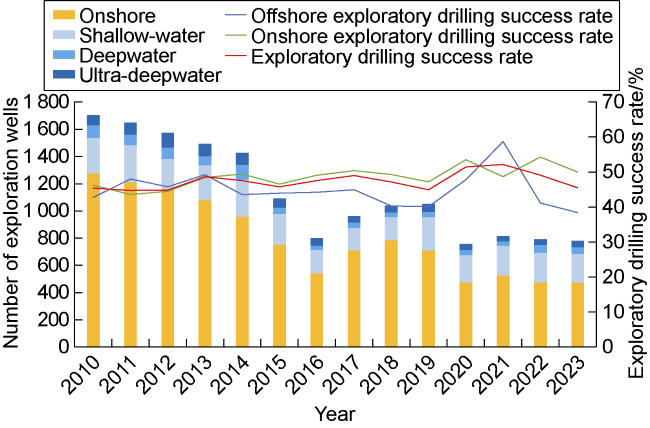
The total number of conventional exploration and appraisal wells drilled globally in 2023 was 1 297, which was 141 or 9.8% less than that in 2022. The number of exploration wells drilled globally in 2023 was 778, which was 12 less than that in 2022, and the proportion of these wells was 60.0%, which was 5 percentage points lower than that in 2022 [6] (Fig. 3). In terms of regional distribution, a total of 434 wells, including 234 exploration wells and 200 appraisal wells, were drilled in the Asia-Pacific region; America is second only to the Asia-Pacific region in the number of exploration and appraisal wells, with a total of 318 wells drilled, including 225 exploration wells and 93 appraisal wells; 168, 135, 132 and 110 wells were drilled in the Middle East, Africa, Europe, and Central Asia-Russia, respectively (Table 1).
Fig. 3. Histogram of the number and success rate of exploration wells drilled around the world during 2010- 2023[6].
Table 1. Statistics for the number and success rate of exploration wells drilled globally in 2023 [6]
Region Number of dry wells Number of gas wells Number of oil wells Number of wells with oil and gas shows Number of wells with undisclosed results Total number
of wells
Success rate/% Number of high-impact wells Success rate for high-impact wells/%
Africa 20 14 38 5 19 96 54.2 9 22.2
America 73 25 75 6 46 225 44.4 9 10.0
Europe 24 20 22 0 10 76 55.3 1 100.0
Asia Pacific 25 51 41 10 107 234 39.3 6 42.9
Middle East 5 7 22 0 42 76 38.2 2 50.0
Central Asia-Russia 1 9 30 0 31 71 54.9 0 0
Total 148 126 228 21 255 778 45.5 27 29.6
The global exploration success rate in 2023 was 45.5% (Table 1), which was slightly lower than that in 2022 (49.1%). The onshore exploration success rate in 2023 was 50.0% [6], representing a YoY decrease of 4.3 percentage points; the offshore exploration success rate in 2023 was 38.4% [6], representing a YoY decrease of 2.7 percentage points (Fig. 3).
The decline in the number and success rate of high- impact exploration wells (including exploration wells in frontier and emerging basins, for new petroleum plays, in areas with huge resource potential, and exploration wells under the focus of oil companies) directly affects the world’s newly discovered oil and gas reserves in 2023. In 2023, a total of 27 high-impact exploration wells were drilled globally, representing a decline of 7% over 2022, and commercial discoveries were made in 8 of these wells, representing a success rate of 29.6%, which was lower than 45% in 2022; the recoverable oil and gas reserves newly discovered in 2023 was 3.1×10⁸ t of oil equivalent (toe), representing a YoY decline of 36% (over 2022). For the 5 high-impact exploration wells drilled in emerging basins, commercial discoveries have been made in 3 wells, and the other 2 wells without commercial success are located in the Orange Sub-basin of offshore southwest Africa; while all high-impact exploration wells drilled in areas with large amounts of prospective resources and frontier basins have failed commercially, the recoverable reserves for these wells estimated before drilling amount to 14.3×10⁸ toe.

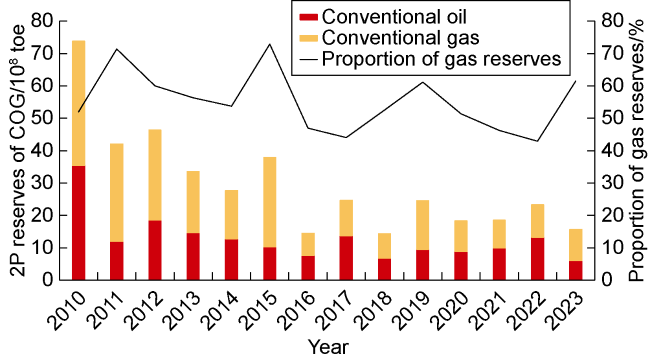
1.4. New global COG discoveries

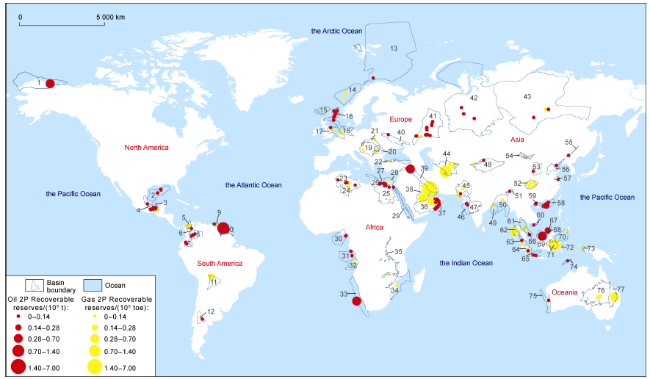
In 2023, 259 new COG fields were discovered globally (Figs. 4 and 5), with 2P recoverable reserves (the sum of proven and probable reserves) of 16.5×10⁸ toe, including 6.02× 10⁸ t of oil and 1.28×10¹² m3 of gas, and the 2P recoverable reserves decreased by 28.6% over 2022 [6]. The oil and gas reserves newly discovered in 2023 were mainly concentrated in the Middle East, where the 2P recoverable reserves amounted to 6.0×10⁸ toe, accounting for 36.4% of the world’s total; the 2P recoverable reserves in Asia Pacific and America were 4.6×10⁸ toe and 4.0×10⁸ toe, accounting for 27.9% and 24.2% of the world’s total, respectively [6]. The new oil and gas 2P recoverable reserves discovered in foreland basins in 2023 accounted for 47% of the world total newly discovered reserves, which were mainly distributed in the Shahini Gas Field and the Sehit Aybuke Yalcin Oil Field in the Zagros Basin and the Cheshmeh Shoor Gas Field in the Amu Darya Basin. These three fields were among the world’s top ten oil and gas discoveries in 2023. The newly discovered oil and gas recoverable reserves in passive margin basins account for 27% of the world total, which are mainly Lancetfish 1, Fangtooth SE 1 and Roystonea 1 oil/gas fields discovered in the Guyana Basin (which were among the world’s top ten oil and gas discoveries in 2023) and Jonker 1X Oil and Gas Field discovered in the Orange Sub-basin. The newly discovered oil and gas recoverable reserves in back-arc basins account for 20% [6]. The largest oil and gas discovery in 2023 was the Geng North 1 Gas Field located in the deep water area of the Kutai Basin in Indonesia (Table 2). As can be seen from Table 2, six of the world’s top ten oil and gas discoveries in 2023 were located in mature basins, and the other four discoveries were located in frontier basins, indicating that fine exploration in mature basins has achieved remarkable results.
Fig. 4. Histogram of global recoverable COG reserves discovered during 2010 to 2023 [6].
Fig. 5. Distribution of new oil and gas discovered around the world in 2023 [6].

1. North Slope Basin; 2.Deep Water Gulf of Mexico Basin; 3. Sureste Basin; 4. Veracruz Basin; 5. Lower Magdalena Basin; 6. Middle-upper Magdalena Basin; 7. Putumayo Basin; 8. Llanos Basin; 9. Trinidad Basin; 10.Guyana Basin; 11. Chaco Basin; 12. Neuquen Basin; 13. Barents Sea Platform; 14. Voring Basin; 15. Faroes-West Shetland Basin; 16. North Sea Basin; 17. Anglo-Dutch Basin; 18. Northwest German Basin; 19. Pannonian Basin; 20. South Carpathian Basin; 21. North Carpathian Basin; 22. Pontids Basin; 23. Tri-Ghadames Basin; 24. Illizi Basin; 25. Upper Egypt Basin; 26. Cyrenaica Basin; 27. Northern Egypt Basin; 28. Nile Delta Basin; 29. Red Sea Basin; 30.Niger Delta Basin; 31. Lower Congo Basin; 32. Kwanza Basin; 33. Southwest African Coastal Basin; 34. Mozambique Basin; 35. East African Rift System; 36. Rub' Al Khali Basin; 37. Oman Basin; 38. Central Arabian Basin; 39. Zagros Basin; 40. Dnieper-Donets Basin; 41. Volga-Urals Basin; 42. West Siberian Basin; 43. East Siberian Basin; 44. Amu-Darya Basin; 45. Indus Basin; 46. Bombay Basin; 47. Deccan Basin; 48.Tarim Basin; 49. Mahanadi Basin; 50. Bengal Basin; 51. Assam Basin; 52.Sichuan Basin; 53.Ordos Basin; 54. South Gobi Basin; 55. Yilan-Yitong Basin; 56. Bohai Gulf Basin; 57.Subei Basin; 58. Pearl River Mouth Basin; 59. Beibu Gulf Basin; 60. Cuu Long Basin; 61. Gulf of Thailand Basin; 62. North Sumatra Basin; 63. Central Sumatra Basin; 64. South Sumatra Basin; 65. West Java Basin; 66. Malay Basin; 67.Northwest Sabah Platform; 68. Brunei-Sabah Basin; 69.Zengmu Basin; 70. Celebes Basin; 71. Kutei Basin; 72. Banggai Basin; 73. Bintuni Basin; 74. Timor Basin; 75. Perth Basin; 76. Eromanga Basin; 77. Bowen-Surat Basins

Table 2. Statistics of the top ten COG discoveries in the world in 2023 [6]
Country Field Operator (oil company) Scale Area Field type Basin Formation 2P Recoverable
reserves/(108 toe)
Iran Shahini 1 NIOC Large Onshore Gas field Zagros Basin Upper Permian-
Lower Triassic
3.58
Iran Cheshmeh Shoor 1 NIOC Large Onshore Gas field Amu Darya
Basin
Upper Triassic 1.16
Indonesia Geng
North 1
Eni Large Ultra-deepwater Gas field Kutai Basin Upper Miocene-
Pliocene
0.83
Guyana Lancetfish 1 ExxonMobil Large Ultra-deepwater Oilfield Guyana Basin Upper Cretaceous 0.79
Guyana Fangtooth
SE 1
ExxonMobil Medium Ultra-deepwater Oil and gas field Guyana Basin Upper Cretaceous 0.54
USA Hickory 88Energy Medium Onshore Oil and gas field Alaska North Slope Basin Upper Cretaceous 0.54
Namibia Jonker 1X Shell Medium Ultra-deepwater Oil and gas field Southwest African Coastal Basin Upper Cretaceous 0.53
Suriname Roystonea 1 Petronas Medium Deepwater Oil and gas field Guyana Basin Upper Cretaceous 0.45
Turkey Sehit Aybuke Yalcin TPAO Medium Onshore Oilfield Zagros Basin Cretaceous 0.45
Indonesia Layaran 1 Mubadala Medium Deepwater Gas field North Sumatra Basin Lower Miocene 0.42

Note: The recoverable reserves (toe) of large, medium, and small oil and gas fields are more than 0.69×10⁸ t, (0.14-0.69)×108 t, and less than 0.14×10⁸ t, respectively.

In recent years, among the basins around the world, the Guyana Basin, Amu Darya Basin and Zagros Basin have been at the forefront of exploratory drilling. For example, in 2021, the Guyana Basin ranked sixth in offshore exploratory drilling, with 19 offshore exploration wells; and for onshore exploratory drilling, the Amu Darya Basin and Zagros Basin ranked third and 12th, respectively [3]. In 2022, the Guyana Basin, where 20 exploration wells were drilled, ranked seventh in terms of the number of offshore exploratory drilling; and for onshore exploratory drilling, the Amu Darya Basin with 50 onshore exploration wells and Zagros Basin with 20 onshore exploration wells ranked third and seventh, respectively[4].
For the regional distribution of newly discovered recoverable COG reserves, the Middle East ranks first, with 2P recoverable reserves of 6.0×10⁸ toe, which are much greater than those in other regions; the Asia-Pacific region ranks second, with 2P recoverable reserves of 4.6×10⁸ toe; the 2P recoverable reserves in America amount to 4.0×10⁸ toe; the 2P recoverable reserves in Africa are 1.1×10⁸ toe; both the newly discovered 2P recoverable reserves in Europe and those in Central Asia-Russia are less than 1×10⁸ toe, which are 0.6×10⁸ toe and 0.2×10⁸ toe, respectively [6].
The total 2P recoverable reserves of the world’s top ten new COG discoveries in 2023 were 9.3×10⁸ toe, accounting for 56.4% of the total newly discovered 2P recoverable reserves in 2023 [6]. Four oil and gas fields were discovered by national and international oil companies, and two fields were discovered by independent oil companies. For international oil companies, Eni discovered the Geng North 1 Gas Field in the ultra-deepwater area of the Kutai Basin in Indonesia; ExxonMobil discovered the Lancetfish 1 Oil Field and the Fangtooth SE 1 Oil and Gas Field in the Guyana Basin; Shell discovered the Jonker 1X Oil and Gas Field in the Orange Basin offshore Namibia. For national oil companies, National Iranian Oil Company (NIOC) discovered the Shahini 1 Gas Field in the Zagros Basin and the Cheshmeh Shour 1 Gas Field in the Amu Darya Basin; Petronas discovered the Roystonea 1 Oil and Gas Field in the Guyana Basin of offshore Suriname; TPAO (Turkish Petroleum Corporation) discovered the Sehit Aybuke Yalcin Oil Field in the Zagros Basin (Table 2).

2. Overview of global exploration of unconventional oil and gas and associated resources

2.1. Global unconventional oil and gas exploration

Since the success of multistage fracturing in horizontal wells in the USA, the era of unconventional oil and gas (UOG) exploration has begun. The great success of the Unconventional Oil and Gas Revolution in the USA has laid a solid foundation for its energy independence. Currently, global UOG exploration and production are expanding rapidly, and UOG resources have become an important part of the global oil and gas supply system. This section provides data related to global UOG exploration, except for exploration activities of onshore North America.
The total 2P recoverable reserves of UOG discovered globally, except the onshore areas of North America, in 2023 amounted to 90.8×10⁸ toe, including 7.2×10⁸ t of shale oil, 28.7×10⁸ toe of shale gas, 4.0×10⁸ t of tight oil, 29.2×10⁸ toe of tight gas, and 17.9×10⁸ toe of coalbed methane (CMB) [6]. Currently, UOG discoveries around the world, except the onshore areas of North America, are mainly concentrated in the Asia-Pacific and Middle East regions, and the 2P recoverable reserves in these two regions are 47.2×10⁸ toe and 27.6×10⁸ toe, respectively. The 2P recoverable reserves in the Asia-Pacific region are distributed primarily in China and Australia, where CBM and tight gas are the major types of UOG resources, with 2P recoverable reserves of 17.1×10⁸ toe and 15.2×10⁸ toe, respectively [6]. Shale gas and tight gas are the dominant types of UOG resources in the Middle East, with 2P recoverable reserves of 14.7×10⁸ toe and 11.1×10⁸ toe, respectively. Shale gas is mainly located in Saudi Arabia.
In terms of the total amount of investment in UOG exploration in 2023, America ranked first, followed by the Middle East and Asia-Pacific regions. USA investment in UOG exploration amounted to USD 131.0×10⁸, accounting for 84.0% of the global UOG exploration investment; Canada’s investment in UOG exploration was USD 10.5×10⁸, accounting for 6.7%; the UOG exploration investments of Saudi Arabia and Argentina were USD 5.4×10⁸ and USD 4.1×10⁸, respectively [7].
In 2023, 12 new UOG fields were discovered around the world (except the onshore areas of North America), with total 2P recoverable reserves of 6 625.8×10⁴ toe [6], among which the discovered reserves of tight gas account for 79%. These tight gas reserves are mainly distributed in the Canyon 2 Gas Field of the Bowen-Surat Basin in Australia, where the 2P recoverable reserves amount to 0.44×10⁸ toe. Newly discovered shale gas reserves are located primarily in the Sichuan Basin in China, and newly discovered CBM reserves are mainly distributed in the South Gobi Basin of Mongolia [6].

2.2. Exploration of associated resources around the world

Associated resources refer to various types of mineral resources that are discovered during hydrocarbon exploration and production and associated with hydrocarbons in terms of origin. Such resources are of high economic value, and some of them are very important strategic resources. This section investigates natural hydrogen and helium resources that are closely related to the oil and gas industry, with a focus on the trends in the exploration and development of natural hydrogen and helium resources by oil companies around the world.

2.2.1. Natural hydrogen

In 2023, “the hunt for natural hydrogen” was named by the magazine Science as one of the top ten scientific breakthroughs of the year, which shows that the academic circle has begun to pay attention to natural hydrogen. Natural hydrogen deposits are widely distributed around the world and have been found in many countries, including Mali, the USA, France, Russia, Australia, Oman, Spain and China [8-11].
Currently, global exploration and production of natural hydrogen are still in early stages, and the USA plays a leading role in this respect. Oil companies and oilfield service companies are actively engaged in strategic planning for natural hydrogen exploration and production, and start-ups are boosting the “hydrogen rush” and becoming the main forces in natural hydrogen exploration and production [12-15]. In May 2023, French scientists discovered the world’s largest natural hydrogen deposit in northern France, which may contain 600×104-2.5×10⁸ t of natural hydrogen. In the same year, venture capital amounting to USD 9 100×104 flowed to natural hydrogen start-ups, and the U.S. Department of Energy announced USD 20 million in funding for natural hydrogen research projects. For oil companies, Petrobras has invested BRL 20 million (approximately equal to USD 3.64 million) in studying the feasibility and related technologies of extracting natural hydrogen in Brazil; eight energy companies including bp, Chevron and Petrobras have joined the Natural Hydrogen Research Consortium created by United States Geological Survey (USGS) and Colorado School of Mines, which focuses on the study of natural hydrogen accumulation patterns and exploration methods, technologies and strategies; French oil services firm CGG has commenced a worldwide natural hydrogen screening project (in 2024) with a view to establishing a leading position in global natural hydrogen exploration[8-11].

2.2.2. Helium

The distribution of helium around the world is extremely uneven. Most of the world’s helium reserves are located in the Northern Hemisphere, while in the Southern Hemisphere, helium has been found only in Tanzania, South Africa, and Australia. The USA holds the most extensive helium reserves worldwide [16-19]. Currently, there are a wide variety of companies engaged in helium exploration and production, including international oil companies, national oil companies and start-ups, such as ExxonMobil, Gazprom, QatarEnergy, Sonatrach, Royal Helium and Helium One.
Helium discoveries that have attracted considerable attention in recent years are all located in Africa, which include the large helium-rich nitrogen field discovered in the Rukwa Rift in Tanzania and the helium discovery in the Virginia Gas Field in South Africa. In 2021, Well Tai-1/-1A drilled by Helium One in the Rukwa Rift in the western branch of the East African Rift System confirmed the existence of an effective helium-preserving reservoir with an effective seal, helium shows, with a helium concentration of 2.2%. In December 2023, a helium discovery was made in Well Tai-3 drilled by Helium One in Tanzania, with a helium concentration of 4.7% [6,20]. As evaluated by Helium One, the recoverable helium resources in the Rukwa Rift of the East African Rift System amounted to 39.08×10⁸ m3. In addition, the proven helium reserves in the Virginia Gas Field of South Africa exceeded 2×10⁸ m3.

3. Characteristics of new oil and gas discoveries globally

3.1. Large- and medium-sized oil and gas fields contribute greatly to the total newly discovered reserves

In 2023, 20 large- and medium-sized COG fields were discovered globally, accounting for 7.7% of the total number of newly discovered oil and gas fields, with 2P recoverable reserves of 12.1×10⁸ toe, accounting for 73.3% of the newly discovered 2P recoverable reserves [6]. In 2023, four large oil and gas fields, each with 2P recoverable reserves greater than 0.69×10⁸ t, were discovered around the world, while in 2022, nine large oil and gas fields were discovered globally. The recoverable 2P recoverable reserves of these four fields are 6.4×10⁸ toe, accounting for 52.9% of the total 2P recoverable reserves of large and medium-sized oil and gas fields discovered in 2023 and are mainly distributed in the ultra-deepwater areas of Iran’s Zagros Basin, Amu Darya Basin, Indonesia’s Kutai Basin, and Guyana Basin. A total of 16 medium-sized oil and gas fields with 2P recoverable reserves of (0.14-0.69)×108 t were discovered in 2023, contributing additional 2P recoverable reserves of 5.7×10⁸ toe, while in 2022, 22 medium-sized oil and gas fields were discovered.

3.2. The onshore reserves newly discovered are basically equal to the newly discovered offshore reserves

In 2023, 86 offshore COG fields and 173 onshore COG fields were discovered, and the newly discovered reserves of the former were almost the same as those of the latter. Specifically, the 2P recoverable reserves of onshore oil and gas discovered in 2023 amounted to 8.4×10⁸ toe, accounting for 50.9% of the total. These onshore oil and gas reserves were discovered through fine exploration in mature onshore basins such as the Zagros Basin and Amu Darya Basin. The 2P recoverable reserves of offshore oil and gas discovered in 2023 are 8.1×10⁸ toe, accounting for 49.1% of the total. Among these offshore oil and gas reserves, the 2P recoverable reserves discovered in ultra-deepwater areas amounted to 3.1×10⁸ toe, accounting for 38.3%, and the 2P recoverable reserves discovered in shallow-water and deepwater areas accounted for 34.6% and 27.1%, respectively [6].
Unlike the situation in 2021 and 2022 where the newly discovered reserves in deepwater to ultra-deepwater areas accounted for the majority of the world’s total newly discovered reserves, a considerable number of onshore oil and gas discoveries were made in 2023, which is closely related to the contribution of fine exploration in mature onshore basins. In addition, oil and gas discoveries made in deepwater to ultra-deepwater areas still played an important role in 2023, and six of the world’s top ten oil and gas discoveries in 2023 were discovered in deepwater to ultra-deepwater areas.

3.3. Fine exploration in mature basins has achieved remarkable results
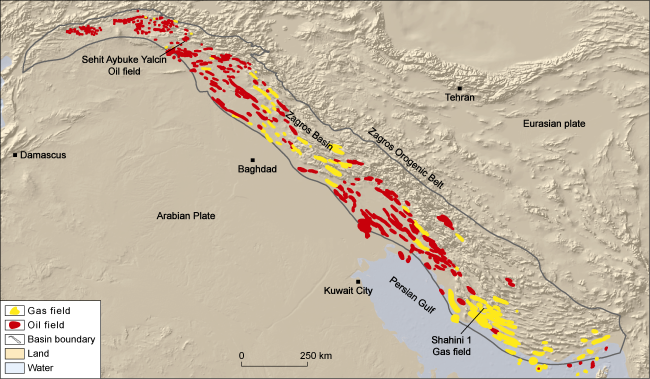
The major oil and gas discoveries made in the Zagros Basin and Kutai Basin in 2023 were the result of fine exploration in mature basins. As one of the foreland basins most enriched in COG resources in the world, the Zagros Basin has a long history of hydrocarbon exploration and production [21-22]. The first oil and gas field in the basin is the Chia Surkh Field discovered in Iraq in 1905. As of 2023, a total of 511 oil and gas fields had been discovered in the basin, with cumulative 2P recoverable reserves of 431.7×10⁸ toe. In recent years, natural gas discoveries have been made successively in the deep formations of the Zagros Basin, which further demonstrate the great exploration potential of mature basins. In 2023, two medium-large sized oil and gas fields were discovered in the Zagros Basin, namely, Shahini 1 Gas Field in Iran and Sehit Aybuke Yalcin Oil Field in Turkey (Fig. 6). The Shahini 1 Gas Field is the largest oil and gas discovery in the world in 2023, with 2P recoverable reserves of gas amounting to 4 361×108 m3 and total 2P recoverable reserves of oil and gas amounting to 3.58×10⁸ toe [6].
Fig. 6. Distribution of oil and gas fields in the Zagros Basin of Iran in the Middle East.
In the 1960s, Iran began to pay attention to the natural gas in the Permian-Triassic strata of southeastern Zagros. After 2000, with the advancement of technologies for seismic exploration in mountainous areas, Iran commenced natural gas exploration in the salt dome area in the central and eastern Fars section. In 2015, NIOC discovered the Pazan and Charak gas fields at the front of the fold belt in southern Zagros, where natural gas is stored in the Upper Permian-Lower Triassic carbonate reservoir within a long-axis anticlinal trap. The recoverable gas reserves of these two fields are 3 866×108 m3 and 3 455×108 m3, respectively. In 2019, Eram Gas Field was discovered in the same structural zone, with a total well depth of 4 632 m and 2P recoverable reserves of 3 682× 108 m3. Four years later, a large gas field named Shahini 1 Gas Field was discovered [6].

3.4. Deepwater areas have broad exploration prospects
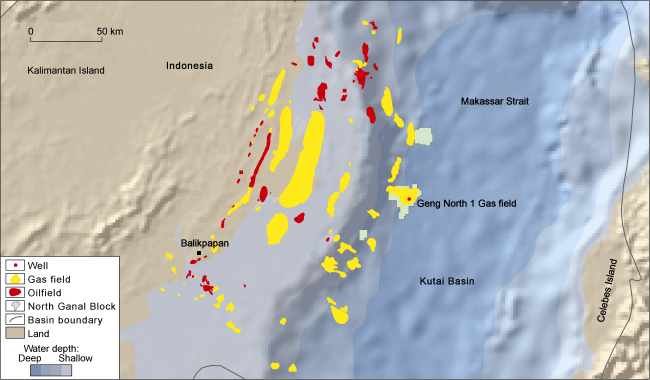
The largest offshore oil and gas discovery in 2023 is the Geng North 1 Gas Field located in the deepwater area of the Kutai Basin in Indonesia. This gas field is also the largest oil and gas discovery made in the Kutai Basin in Indonesia in the past 32 years (Fig. 7). The Kutai Basin is a back-arc basin dominated by natural gas. The main exploration targets in the deepwater area of the basin are the sandstone bodies of Upper Miocene basin-floor fans, followed by the sandstone bodies of slope channels, slope fans and turbidite fans. The Geng North 1 Gas Field has a water depth of about 1 947 m, with 2P recoverable reserves of natural gas amounting to 793×108 m3, and it is operated by Eni, which owns 88.26% of the equity [6]. It covers an area of about 170 km2, where the main structure is a structural-lithological composite trap and the Miocene sandstone reservoir is the primary pay zone, which is located at the distal end of the Mahakam Delta. Reservoir quality is the biggest risk factor before the drilling of Well Geng North-1. The discovery of this large gas field has reduced exploration risks in nearby blocks and boosted Eni’s confidence. Well Geng North-1 has been drilled to a depth of 5 025 m and tested to obtain a natural gas flow of 113.3×10⁴ m3 per day from the sandstone with a reservoir thickness of about 50 m. Since 1999, Unocal has revealed a large number of anticlines at depths ranging from 1 500 m to 2 130 m in the deepwater area of the Kutai Basin and then selected the sandstone bodies of basin-floor fans in these anticlinal zones as the main exploration targets. Before 2004, a series of deepwater oil and gas fields such as Gandang 1, Gendalo 1, Gada, Maha, Gehem 1, and Gula 1 were successively discovered [23-24].
Fig. 7. Current status of oil and gas exploration in the Kutai Basin of Indonesia in the Asia Pacific region and the location of Geng North 1 Gas Field in Indonesia, Asian-Pacific.
The discovery of the Geng North 1 Gas Field is another typical example of Eni’s dual exploration model. This model, which combines “risk exploration” and “capital operation”, enables Eni to quickly recover its investments and generate benefits through risk exploration, and high cash flows support Eni’s continued investment in the exploration of frontier areas and allow Eni to maintain a high level of investment intensity in frontier exploration even when oil prices are low, creating a virtuous cycle for Eni’s business in the upstream sector.
Eni won the bid for the North Ganal Block together with Equinor, Niko, Black Platinum and ENGIE in 2011 and discovered Lebah 1 Gas Field in 2012. This gas field has a water depth of 1 035 m and gas 2P recoverable reserves of 2.3×10⁸ m3, the reservoir is located in the Upper Miocene, and the net thickness of the gas-bearing sandstone layer is 3.7 m. Later, Eni continued to expand its equity ownership. It completed the acquisition of Neptune Energy in June 2023, after which its equity stake in the block reached 88.26%, and started drilling Well Geng North-1 in July 2023, made an oil and gas discovery in October 2023, and began to seek a partial transfer of its equity interests in the block in 2024 [6].

3.5. The UOG industry is developing rapidly, and oil companies are accelerating their strategic planning

The UOG reserves in the Middle East are increasing rapidly, Kazakhstan has enacted UOG-related regulations, and Argentina’s shale oil production has exceeded 1 000× 104 t [6]. The UOG industry has emerged from North America and is now rapidly developing across the globe, and oil companies around the world are accelerating strategic planning for UOG exploration.

3.5.1. Middle East

Factors such as the growing demand for natural gas and the decline in COG production have driven Middle East countries to accelerate the exploration and production of shale oil and gas. International oil companies, national oil companies, and international oil services companies have carried out cooperation with Saudi Arabia, the United Arab Emirates (UAE), Oman and Jordan in UOG exploration and production [6]. As of 2023, 92 UOG fields had been discovered in the Middle East, with total 2P recoverable reserves of 27.6×10⁸ toe.
Saudi Arabia is rich in shale gas and has huge potential in shale gas exploration and production. The Jafurah Sub-basin is the area with the richest shale gas in the Middle East, with technical recoverable shale gas reserves amounting to 5.7×10¹² m3. During the period from 2013 to 2015, through 3D seismic surveying and exploratory drilling in the Jafurah Sub-basin, Saudi Aramco discovered two giant shale gas fields in the sub-basin, namely, Al Hasa and Hazem, with total 2P gas recoverable reserves of 1.73×10¹² m3 [6]. International oil companies undertaking shale oil and gas projects in Saudi Arabia mainly include ExxonMobil, bp and Shell. Since 2013, Saudi Aramco has been developing shale oil and gas resources in collaboration with Schlumberger, Halliburton and Baker Hughes, achieving a shale gas production rate of 155.8×10⁴ m3 per day, and it has invested a total of USD 1 110×108 in the Jafurah unconventional gas development project.
The shale oil and gas resources in the UAE are mainly distributed in the Upper Jurassic Diyab Formation, Cretaceous Shilaif Formation, and Silurian Qusaiba Formation in the Rub’ al Khali Basin [25-27]. In May 2018, Baker Hughes provided drilling services to ADNOC (Abu Dhabi National Oil Company) for the exploration and development of shale oil and gas resources. In 2022, ADNOC awarded Block 1, an onshore UOG exploration block, to Petronas (100% equity) [6].
The shale oil and gas in Jordan are mainly distributed in the Silurian Batra Formation of the western Arabian Basin. Jordan signed memorandums of understanding with Petrobras, Shell and Eesti Energia for the evaluation and pilot testing of UOG resources in its domestic areas including the Azraq and Al-Jafr blocks.

3.5.2. North Africa

Due to their abundant shale oil and gas resources, North African countries have started to carry out shale oil/gas exploration and pilot tests, and oil companies are actively developing strategic plans for undertaking shale oil and gas projects in North Africa [6]. As of 2023, 21 UOG fields had been discovered in Africa, with total 2P recoverable reserves of 1.1×10⁸ toe.
The shale oil and gas resources in Algeria are distributed primarily in the Ghadames Basin, Illizi Basin and Timimoun Basin. Sonatrach has tested the shale oil/gas potential of the Devonian and Silurian formations in the In Salah II Block of the Timimoun Basin. This block covers an area of 2.2×10⁴ km2, where three exploration wells and four appraisal wells have been drilled, and hydraulic fracturing has been performed in shale gas fields such as Ahnet and Tinhert.
The shale oil and gas resources in Tunisia are mainly distributed in the Silurian Tannezuft Formation and Devonian Frasnian Formation shale of the Ghadames Basin. Shell, Eni, Anadarko and Winstar Resources carried out hydraulic fracturing in shale interval of the Tannezuft Formation in El Franig Oil Field in 2010. The peak daily oil production and peak daily gas production of the oil field are 301.4 t and 31.2×10⁴ m3, respectively. Two exploration wells have been drilled in the Borj El Khadra Sud Block of the Ghadames Basin [6].
The shale oil and gas resources in Morocco are mainly located in the Silurian shales in the Tindouf Basin. From 2011 to 2013, Petrobras, Cepsa, Anadarko and Eesti Energia evaluated the resource potential of shale oil and gas in Morocco and drilled 27 exploration wells in four blocks [6].

3.5.3. West Siberian Basin, Russia

As of 2023, a total of 127 UOG fields had been discovered by drilling new wells and old wells re-examination in the West Siberian Basin, with total 2P recoverable reserves of 2.44×10⁸ toe, in which 104 shale oil fields with 2P recoverable reserves of 2.19×10⁸ t mainly distributed in the central part of the basin. In 2014, international oil companies actively participated in shale oil exploration and production in Russia before sanctions were imposed against Russia [28]. Oil and gas companies such as ExxonMobil, Equinor, Shell, TotalEnergies and bp established joint ventures with Rosneft and Gazprom, to jointly carry out pilot tests for shale oil production [6], but they successively withdrew from the Russian market as sanctions were imposed against Russia.

4. Trends in the exploration of oil, gas and associated resources by the seven major international oil companies

4.1. Change in investments by the seven major international oil companies
In 2023, the seven major international oil companies (Shell, Equinor, ExxonMobil, Eni, TotalEnergies, bp and Chevron) invested a total of USD 78.4×10⁸ in overseas hydrocarbon exploration, which represents a YoY growth of 5.0% and accounts for 84.6% of their total exploration investment. The overseas exploration investments of Shell, TotalEnergies and bp in 2023 were USD 30.0×10⁸ (the highest) [7], USD 12.2×10⁸ and USD 11.1×10⁸, respectively. The overseas exploration investments of ExxonMobil, Eni, Equinor and Chevron in 2023 are less than USD 10×108, which were USD 8.7×10⁸, USD 6.0×10⁸, USD 5.8×10⁸ and USD 4.6×10⁸, respectively [7].
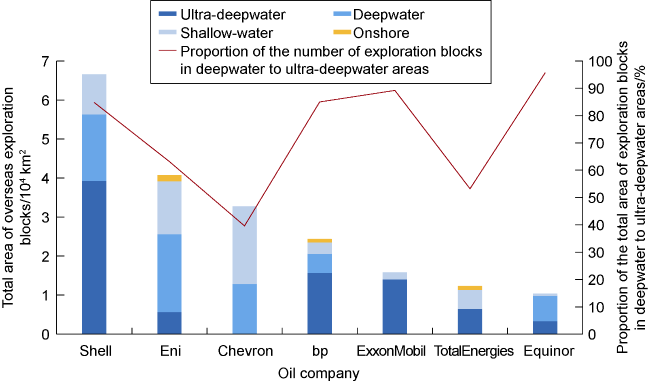
As of 2023, a total of 1 372 deepwater to ultra-deepwater oil and gas fields had been discovered around the world, with total 2P reserves of 2.19×10⁸ toe [30]. In recent years, breakthroughs have been made successively in hydrocarbon exploration in deepwater areas around the world, especially those along the Two Rims, and deepwater areas have become important sources of additional global oil and gas reserves. The total investment of the seven major international oil companies in offshore hydrocarbon exploration in 2023 accounted for 94% of their total overseas exploration investment, with the investments in deepwater to ultra-deepwater areas accounted for 72% of their total overseas exploration investment, indicating that they focus on hydrocarbon exploration in deepwater to ultra-deepwater areas (Fig. 8). Due to factors such as exploration results, risk preferences and the low-carbon transformation, the investment styles of the seven major international oil companies for overseas hydrocarbon exploration are different. For example, the investment style of bp, Chevron, and Equinor is prudent investing, and the amounts of their hydrocarbon exploration investments are relatively small; the investment style of Eni and TotalEnergies is active investing, these two companies mainly acquire exploration blocks through bidding, and the amounts of their hydrocarbon exploration investments are moderate; the investment style of ExxonMobil and Shell are proactive investing, and their hydrocarbon exploration investments are relatively high and mainly focused on deepwater areas. Given the aforementioned differences in investment style, the seven major international oil companies prefer to invest in hydrocarbon exploration in particular regions. For example, the key region for overseas exploration investments by Shell, bp, ExxonMobil, Eni and Equinor is America, where Shell, bp, Eni and Equinor focus on North America, while ExxonMobil focuses more on South America; TotalEnergies and Chevron’s investments in overseas hydrocarbon exploration are mainly concentrated in African countries, including Namibia, Angola, Nigeria [7].
Fig. 8. Histogram of the distribution (onshore/offshore) of overseas exploration blocks acquired by the seven major international oil companies in 2023 [6].

4.2. Similarities and differences of exploration blocks acquired by the seven major international oil companies

The seven major international oil companies have acquired a large number of overseas exploration blocks and persisted in carrying out hydrocarbon exploration independently. The total number of exploration blocks acquired by the seven major international oil companies in 2023 was 980, which was much greater than that in 2022 (436). The number of overseas exploration blocks acquired by the seven major international oil companies in 2023 was 615, accounting for 62.8% of the total number of exploration blocks acquired by them in the same year, and the total area of these overseas exploration blocks was 17.6×10⁴ km2. In 2023, the seven major international oil companies acquired 536 exploration blocks as operators, with a total area of 16.9×10⁴ km2, accounting for 96.1% of the total area of all overseas exploration blocks[6], which is consistent with their persistence in independent overseas exploration (Fig. 8). In terms of the distribution of overseas exploration blocks, the seven major international oil companies focused on different regions as preferred in 2023. For example, Eni continued to carry out in-depth exploration in the Eastern Mediterranean Region, while Shell, TotalEnergies and ExxonMobil closely followed exploration hotspots and continued with the strategic planning and implementation of exploration activities in the Guyana Basin. In terms of the method of acquiring overseas exploration blocks, the seven major international oil companies acquired overseas exploration blocks mainly through bidding, and the number of overseas blocks acquired through bid negotiation is relatively small. Only Chevron acquired 20 exploration blocks in the Lower Congo Basin in Angola through bid negotiation [6]. The advantage of acquiring exploration blocks through bidding is that oil companies can acquire multiple adjacent blocks at lower prices, access frontier basins in advance, and leverage early opportunities to make major oil and gas discoveries.

4.3. Situation of UOG exploration by the seven major international oil companies

In the Middle East, ExxonMobil, bp, TotalEnergies and Shell have been actively undertaking shale oil and gas projects in Saudi Arabia and Oman [6]. The TotalEnergies acquired the Ruwais Diyab shale gas block in the UAE (40% equity) in 2019, and aims to achieve daily gas production of 0.28×10⁸ m3 by 2030. In North Africa, Shell and Eni are actively participating in the evaluation and pilot testing of shale oil and gas resources in Algeria and Tunisia, and Sonatrach is negotiating with ExxonMobil and Chevron regarding the joint development of shale gas resources in Algeria.

4.4. Trends in the development of associated resources by the seven major international oil companies

Currently, start-ups are the major force in natural hydrogen exploration and production. Among international oil companies, bp and Chevron are relatively active in this respect and have joined the Natural Hydrogen Research Consortium created by USGS and Colorado School of Mines, which mainly focuses on the study of natural hydrogen accumulation patterns and exploration methods, technologies and strategies.
Among the seven major international oil companies, ExxonMobil still plays a dominant role in helium exploration and production, and as the largest helium producer in North America, it has a discourse right in the allocation of global helium supply quotas. In addition, it also has huge helium reserves. Its Riley Ridge Gas Plant in Wyoming provides 20% of the world’s helium supply, and its remaining helium reserves are enough to maintain helium production for 80 years.

5. Development strategies in overseas hydrocarbon exploration

Based on the analysis of the situation of global oil, gas, and associated resources exploration in 2023, four recommendations are made for Chinese oil companies to expand their operations in international hydrocarbon exploration.

5.1. Continue to invest in the upstream exploration

In 2023, oil companies began to strengthen efforts in the upstream sector of the oil and gas industry and steadily increased capital expenditures. The global investment in the upstream sector in 2023 amounted to USD 4 250.5×10⁸, representing a YoY growth of 18.8%, which has increased in three consecutive years and recovered to the pre-pandemic level. The total investment of the seven major international oil companies in the upstream sector in 2023 was USD 896.5×10⁸, representing a significant YoY growth of 25.7%. This trend shows that oil companies highly recognize and firmly support the strategic role of the oil and gas business, i.e., the oil and gas business is still the main business of oil companies. ExxonMobil, Chevron, and major national oil companies in the world have significantly increased their investments in the upstream sector of the oil and gas industry and now focus more on high-quality oil and gas assets. In the past decade, the proportion of the global exploration investment in the global investment in the upstream sector has fluctuated, but it still remains above 10%. Maintaining and increasing the proportion of hydrocarbon exploration investment is crucial for increasing oil and gas reserves and improving the reserve replacement ratio. For the next 10 to 15 years, oil and gas will still play an important role, and oil companies will continue to increase their investment in the upstream sector to maintain their leading position and stabilize oil production.

5.2. Continue to carry out oil and gas exploration

5.2.1. Deeply explore mature basins

In the past decade, a total of 3 114 new oil and gas discoveries have been made in mature basins around the world, with total 2P recoverable reserves of 260.8×10⁸ toe. The number of newly discovered oil and gas fields in 2023 accounted for 86.2% of the total number of oil and gas discoveries made in the past decade, and the oil and gas reserves of these fields accounted for 64.4% [6]. Mature basins and areas where oil and gas discoveries have been successively made mainly include the Amu Darya Basin, Arabian Basin, Zagros Basin, Gulf of Mexico Deepwater Basin and West Siberian Basin. To deeply explore mature basins, it is necessary to continue with the fine exploration of known areas while continuously expanding the exploration range to new formations and areas. All of the major oil and gas discoveries made in the Zagros Basin, Amu Darya Basin, and Kutai Basin in 2023 are the result of fine exploration of mature basins.

5.2.2. Closely follow hotspot basins

Chinese oil companies should strengthen efforts to acquire risk exploration blocks in offshore basins along the Two Rims. The areas along the Two Rims have huge resource potential, and a large number of oil and gas discoveries have been made in these areas [29-31]. The total oil and gas 2P recoverable reserves discovered along the Rim of Africa amount to 270.2×10⁸ toe, including 135×108 t of oil and 16.7×10¹² m3 of natural gas, among which the oil and gas reserves discovered in shallow-water, deepwater and ultra-deepwater areas account for 49%, 30% and 21%, respectively [6]. The total oil and gas 2P recoverable reserves discovered along the Rim of Latin America amount to 266×108 toe, including 192×108 t of oil and 9.2×10¹² m3 of natural gas [6], among which the oil and gas reserves discovered in shallow-water, deepwater and ultra-deepwater areas account for 48%, 14% and 38%, respectively. The data given above shows that the oil and gas reserves discovered in the offshore areas along the Two Rims are mainly distributed in deepwater to ultra-deepwater areas and account for more than 50% of the total, and the offshore areas along the Two Rims are favorable exploration areas with the largest number of hotspot basins.

5.2.3. Gain access to frontier basins as soon as practicable

The seven major international oil companies have taken proactive action to acquire exploration blocks in offshore areas along the Two Rims by various means and seized the initiative in the exploration of frontier basins in these areas. Specifically, they have acquired a total of 209 exploration blocks in the offshore areas along the Rim of Africa, with a total area of 56.4×10⁴ km2, among which the total area of exploration blocks acquired by them as operators accounts for 99.6% and the total area of deepwater and ultra-deepwater blocks acquired by them accounts for 94% [6]. In offshore areas along the Rim of Latin America, they have acquired 198 exploration blocks with a total area of 24.5×10⁴ km2, among which the total area of exploration blocks acquired by them as operators accounts for 77.3% and the total area of deepwater and ultra-deepwater blocks acquired by them accounts for 88% [6].
The results of a comprehensive evaluation suggest that offshore areas along the Two Rims have favorable geological conditions for hydrocarbon exploration and production [32-34], and there is potentially 10×108 toe of oil and gas 2P recoverable reserves to be discovered in tens of basins in these areas (Table 3).
Table 3. Favorable COG exploration areas along the Two Rims
Country Basin name Basin type Area Undiscovered recoverable
resources/(108 toe)
Key zones
Oil Gas
Mozambique Mozambique Basin Passive margin basin Frontier 4.0 23 Jurassic biogenic reefs, Cretaceous-Paleogene slope fans
Somalia Somali Basin Passive margin basin Frontier 3.0 32 Cretaceous-Paleogene slope fans/basin-floor fans
Benin Benin Basin Passive margin basin Frontier 6.4 Upper Cretaceous gravity flow sandstones
Malta/Liberia Senegal River Basin Passive margin basin Hotspot 6.0 23 Upper Cretaceous basin-floor fans
Namibia Orange Basin Passive margin basin Hotspot 15.0 10 Upper Cretaceous slope fans/Lower Cretaceous basin-floor fans
Brazil Santos Basin Passive margin basin Hotspot 133.0 21 Pre-salt biogenic reefs/post-salt gravity flow sandstones
Campos Basin Passive margin basin Hotspot 110.0 37 Pre-salt biogenic reefs/post-salt gravity flow sandstones
Foz do Amazonas Basin Passive margin basin Frontier 12.0 2 Upper Cretaceous gravity flow sandstones
Argentina Colorado River Basin Passive margin basin Frontier 11.0 1 Jurassic-Cretaceous rifts, slope fans, anticlines, etc.
Argentine Coastal Basin Passive margin basin Hotspot 18.0 6 Upper Cretaceous slope fans/Lower Cretaceous basin-floor fans
Suriname Guyana Basin Passive margin basin Hotspot 14.0 2 Upper Cretaceous slope fans
Currently, there are 1 223 co-operable blocks in the offshore areas along the Rim of Africa and 1 124 co-operable blocks in the offshore areas along the Rim of Latin America [6]. Chinese oil companies are recommended to take multiple active steps to enter favorable exploration areas, and speed up the process of expanding the exploration range from onshore areas to deepwater offshore areas, so as to achieve orderly succession of resources, and consolidate the foundation for developing oil and gas resources in the future.

5.3. Adhere to the principle of integrated development

While continuing oil and gas exploration activities, it is necessary to adhere to principle of integrated development of both COG and UOG resources and integrated development of oil, gas and associated resources.

5.3.1. Strengthen shale oil and gas exploration, and accelerate strategic planning and implementation of exploration activities in onshore COG-rich basins

For UOG resources around the world, the focus of strategic planning should be placed on large onshore COG- rich basins and three major areas, namely, the Jurassic, Cretaceous, and Silurian shale plays in the Middle East, the Silurian shale play in North Africa, and the Bazhenov Formation shale play in the West Siberian Basin. Since China has mature technologies for the exploration and development of shale oil and gas resources, Chinese oil companies can establish a foothold in existing oil and gas projects and accelerate the strategic planning and implementation of UOG exploration activities in the three major areas.

5.3.2. Establish a foothold in existing blocks and geographical advantages, and strengthen the evaluation of the potential and distribution of associated resources

For natural hydrogen, Chinese oil companies should conduct a survey of global natural hydrogen resources to clearly identify the potential of natural hydrogen resources and their prospects for development and utilization and complete technical preparations for natural hydrogen exploration and production.
For helium, Chinese oil companies should strengthen the collaborative evaluation and advance selection of global oil, gas, and helium resources and strive to achieve breakthroughs and generate economic benefits in new exploration areas. Africa has dual advantages offered by oil, gas, and helium resources and has great exploration potential due to the low degree of exploration. Therefore, Chinese oil companies can focus on Africa, strengthen the collaborative evaluation of oil, gas, and helium resources in Africa, and take proactive action to acquire high- quality new projects.

5.4. Persistently make scientific and technological innovations

The 100-year history of global oil and gas exploration shows that technological progress constantly drives the development of geological theories, and the development of technologies and theories supports the continuous expansion of the range of oil and gas exploration.
The application of artificial intelligence (AI) technologies has brought revolutionary changes to the global oil and gas industry. AI will reshape the future of oil and gas exploration and provide strong support for the development of new quality productive forces. It has been widely used in multiple fields of hydrocarbon exploration and production, including well logging, geophysical exploration, well drilling and completion, reservoir engineering and oil/gas field surface engineering. In addition, AI has become a new “arena” for oil companies around the world, and major domestic and foreign oil companies are vigorously promoting the deep integration of AI with hydrocarbon exploration and production [35]. Although considerable progress has been made, the integration of AI with hydrocarbon exploration and production is still in its early stages, and no disruptive results have been achieved in this respect. In such a context, Chinese oil companies should continuously strengthen the research, development and application of AI technologies in the oil and gas industry to enable industry renewal and develop new quality productive forces.

6. Conclusions

In 2023, the total number and reserves of new oil and gas discoveries around the world decreased over the previous year; the global investment in oil and gas exploration increased steadily; the total number and area of exploration blocks awarded to oil companies increased significantly; the number and success rate of newly drilled exploration wells basically remained stable with a slight decrease, in which the number and success rate of high-impact exploration wells declined significantly; oil companies successively carried out strategic planning for UOG and associated resources. Global oil and gas exploration in 2023 has four major characteristics: (1) large and medium-sized oil and gas fields contribute greatly to newly discovered oil and gas reserves; (2) the new oil and gas reserves discovered offshore are basically the same as the newly discovered onshore reserves; (3) fine exploration in mature basins has achieved remarkable results, deep water exploration has broad prospects; (4) UOG industry is developing rapidly with promising deep-water exploration. Oil companies accelerated strategic planning for UOG exploration.
International oil companies have still maintained their firm confidence strategic and focus for oil and gas exploration, and were less affected by external factors such as oil prices and the cyclical nature of new discoveries, attached great importance to exploration investment and capital operation, continued to deeply explore mature basins, carried out strategic planning for exploration activities in frontier areas in advance, focused on core business, and leveraged early opportunities with a view to making major oil and gas discoveries. Although fine exploration in onshore mature basins has achieved remarkable results, deepwater to ultra-deepwater areas are still the main fields for major oil and gas discoveries. Therefore, Chinese oil companies should speed up the process of expanding the range of overseas hydrocarbon exploration from onshore areas to deepwater areas, make overseas hydrocarbon exploration plan in advance to increase overseas oil and gas reserves, and carry out strategic planning in advance for the exploration and development of overseas UOG resources and associated mineral resources.
In the context of the ongoing energy transition, Chinese oil companies should continue to invest in the upstream sector of the oil and gas industry, continue to carry out oil and gas exploration, adhere to the principle of integrated development, persistently make scientific and technological innovations, take proactive action to access key basins along the Two Rims, and carry out strategic planning in advance for the exploration and development of overseas UOG and associated resources, so as to achieve orderly succession of resources, and contribute to ensuring national energy security and their high-quality development.
[1]
DOU Lirong, WEN Zhixin, WANG Jianjun, et al. Analysis of the world oil and gas exploration situation in 2021. Petroleum Exploration and Development, 2022, 49(5): 1033-1044.

[2]
LIU Xiaobing, JI Tianyu, LI Gang, et al. Situation and enlightenment of global oil and gas exploration. Petroleum Science and Technology Forum, 2023, 42(6): 61-68.

[3]
Research Institute of Petroleum Exploration and Development. Global petroleum E&D trends and company dynamics (2022). Beijing: Petroleum Industry Press, 2022.

[4]
Research Institute of Petroleum Exploration and Development. Global petroleum E&D trends and company dynamics (2023). Beijing: Petroleum Industry Press, 2023.

[5]
WANG Zhaoming, WEN Zhixin, HE Zhengjun, et al. Characteristics and enlightenment of new progress in global oil and gas exploration in recent ten years. China Petroleum Exploration, 2022, 27(2): 27-37.

DOI

[6]
IHS Markit. IHS energy: EDIN. (2024-01-01)[2024-06-30]. https://ihsmarkit.com/index.html.

[7]
Rystad Energy. Ecube. [2024-09-29]. https://www.rystadenergy.com/.

[8]
DOU Lirong, LIU Huaqing, LI Bo, et al. Global natural hydrogen exploration and development situation and prospects in China. Lithologic Reservoirs, 2024, 36(2): 1-14.

[9]
GAUCHER E C. New perspectives in the industrial exploration for native hydrogen. Elements, 2020, 16(1): 8-9.

[10]
MAIGA O, DEVILLE E, LAVAL J, et al. Characterization of the spontaneously recharging natural hydrogen reservoirs of Bourakebougou in Mali. Scientific Reports, 2023, 13(1): 11876.

[11]
TIAN Qianning, ZHANG Wei, WANG Haihua, et al. Non- negligible new energy in the energy transition context: Natural hydrogen. Geological Survey of China, 2022, 9(1): 1-15.

[12]
HAND E. Hidden hydrogen: Does Earth hold vast stores of a renewable, carbon-free fuel?. Science, 2023, 379(6633): 630-636.

DOI PMID

[13]
PADDISON L. They went hunting for fossil fuels. What they found could help save the world. (2023-10-29) [2024-09-29]. https://edition.cnn.com/2023/10/29/climate/white-hydrogen-fossil-fuels-climate/index.html.

[14]
JIN Zhijun, WANG Lu. Does hydrogen reservoir exist in nature?. Earth Science, 2022, 47(10): 3858-3859.

[15]
Gold Hydrogen. Significant concentrations of hydrogen and helium detected in the Ramsay 1 Well. (2023-10-31) [2024-09-29]. https://hydrogenwire.com/2023/10/31/significant-concentrations-of-hydrogen-and-helium-detected-in-the-ramsay-1-well/.

[16]
BOREHAM C J, EDWARDS D S, POREDA R J, et al. Helium in the Australian liquefied natural gas economy. The APPEA Journal, 2018, 58(1): 209-307.

[17]
DAI J X, NI Y Y, QIN S F, et al. Geochemical characteristics of He and CO2 from the Ordos (cratonic) and Bohaibay (rift) basins in China. Chemical Geology, 2017, 469: 192-213.

[18]
KIPFER R, AESCHBACH-HERTIG W, PEETERS F, et al. Noble gases in lakes and ground waters. Review in Mineralogy and Geochemistry, 2002, 47(1): 615-700.

[19]
QIN Shengfei, LI Jiyuan, WANG Jiamei, et al. Helium enrichment model of helium-rich gas reservoirs in petroliferous basins in China. Natural Gas Industry, 2022, 42(7): 125-134.

[20]
HAND E. Massive helium fields found in rift zone of Tanzania. Science, 2016, 353(6295): 109-110.

[21]
LIU Xiaobing, WEN Zhixin, WANG Zhaoming, et al. Structural characteristics and main controlling factors on petroleum accumulation in Zagros Basin, Middle East. Natural Gas Geoscience, 2018, 29(7): 973-981.

[22]
SEPEHR M, COSGROVE J W. Structural framework of the Zagros Fold-Thrust Belt, Iran. Marine and Petroleum Geology, 2004, 21(7): 829-843.

[23]
SALLER A, LIN R, DUNHAM J. Leaves in turbidite sands: The main source of oil and gas in the deep-water Kutei Basin, Indonesia. AAPG Bulletin, 2006, 90(10): 1585-1608.

[24]
SALLER A H, NOAH J T, RUZUAR A P, et al. Linked lowstand delta to basin-floor fan deposition, offshore Indonesia: An analog for deep-water reservoir systems. AAPG Bulletin, 2004, 88(1): 21-46.

[25]
MUSTAFA A, ABOUELRESH M O, ABDULRAHEEM A. Control of lithofacies and geomechanical characteristics on natural fracture systems in Qusaiba shale, rub’ Al-Khali Basin, Saudi Arabia. Arabian Journal for Science and Engineering, 2021, 46(6): 5817-5834.

[26]
ALAJMI M, ALOTAIBI A, ABOUD E, et al. Observations “detections” of shallow unconventional Qusaiba shale gas reservoirs north part of Saudi Arabia. Journal of Geoscience and Environment Protection, 2018, 6(5): 257-265.

[27]
HAKAMI A, İNAN S. A basin modeling study of the Jafurah Sub-Basin, Saudi Arabia: Implications for unconventional hydrocarbon potential of the Jurassic Tuwaiq Mountain Formation. International Journal of Coal Geology, 2016, 165: 201-222.

[28]
WANG Jing, LIU Kun. Russia’s tight oil resources potential and E&D status. International Petroleum Economics, 2017, 25(7): 80-88.

[29]
ZHANG Gongcheng, QU Hongjun, ZHANG Fenglian, et al. Major new discoveries of oil and gas in global deepwaters and enlightenment. Acta Petrolei Sinica, 2019, 40(1): 1-34.

DOI

[30]
WEN Zhixin, WANG Jianjun, WANG Zhaoming, et al. Analysis of the world deepwater oil and gas exploration situation. Petroleum Exploration and Development, 2023, 50(5): 924-936.

[31]
WEN Zhixin, TONG Xiaoguang, GAO Huahua, et al. Build- ups and hydrocarbon accumulation of the isolated carbonate platforms in the eastern Mediterranean. Petroleum Exploration and Development, 2021, 48(2): 279-289.

[32]
WEN Zhixin, XU Hong, WANG Zhaoming, et al. Classification and hydrocarbon distribution of passive continental margin basins. Petroleum Exploration and Development, 2016, 43(5): 678-688.

[33]
WEN Zhixin, TONG Xiaoguang, WANG Zhaoming, et al. Geological characteristics of oil and gas in passive continental margin basins. Beijing: Science Press, 2019.

[34]
DOU Lirong, WEN Zhixin, WANG Zhaoming, et al. Sedimentary build-ups of pre-salt isolated carbonate platforms and formation of deep-water giant oil fields in Santos Basin, Brazil. Petroleum Exploration and Development, 2024, 51(4): 829-840.

[35]
KUANG Lichun, LIU He, REN Yili, et al. Application and development trend of artificial intelligence in petroleum exploration and development. Petroleum Exploration and Development, 2021, 48(1): 1-11.

Outlines

/