

Introduction
Miscible flooding is a promising technology for enhancing oil recovery. Typically, miscible gas flooding is essentially to achieve gas-oil miscibility at ultra-low or zero interfacial tension for improving displacement efficiency and sweep efficiency, thus enhancing the oil recovery significantly [1⇓-3]. A lot of efforts have been put on study on the mechanism of miscible flooding and the methods for reducing miscible pressure and improving miscible effect in China and abroad [4⇓⇓⇓⇓⇓⇓-11]. In terms of mechanism, it is thought that the injected medium forms a miscible zone with oil through one or multiple contacts[12⇓⇓⇓-16]. Reduction of the minimum miscible pressure (MMP) [17⇓⇓⇓⇓-22] is mostly achieved by increasing gas injection pressure and reservoir pressure and adding miscible agents. Studies and practices have shown that both temperature rise and the content of impurity gas (N2, etc.) in the gas medium have adverse effects on reduction of MMP [23⇓⇓⇓⇓-28]. The above understanding on miscible flooding was obtained in experiments at the reservoir temperature less than 120 °C. Based on previous efforts of series of air injection experiments conducted on light crude oil, combined with simulation and field practices, the technical concept of air-injection thermal miscible flooding was proposed. Miscible displacement of thin oil by flue gas can be realized by injecting air into thin oil to form a high temperature environment above 200 °C, and the mechanism is dominated by distillation and volatilization miscibility but not thermal expansion and viscosity reduction [29].
To further understand the thermal miscible mechanism, high temperature and high pressure (HTHP) experiments were carried out in the slim tube [30]. It was confirmed that the miscible displacement of thin oil by flue gas can be realized under HTHP conditions, and the MMP is reduced greatly when the temperature rises to a certain value. It is found that under the same pressure, as the temperature rises, the displacement efficiency of flue gas shows the trend of a steady increase, a rapid rise to more than 90%, and a final slow increase. Rapid increase of displacement efficiency with temperature is believed to be closely related to the distillation phase transition of light components of thin oil with temperature.
Based on previous study, preliminary understanding on miscibility of flue gas and oil under different temperature and pressure conditions was obtained [30]. Nevertheless, there is no direct understanding on the dynamic process and characteristics of thermal miscibility. Moreover, the miscibility of different gas media with oil at high temperature and the possible miscibility of pure N2 with oil at high temperature are still not confirmed. To solve these problems, based on the basic definition of miscibility in thermodynamics, HTHP visualized pressure-volume-temperature (PVT) experiments are designed in this paper to investigate the miscibility of gas media and oil under different temperature and pressure conditions through visual observation of changes in two-phase interface. Furthermore, the concept of miscible temperature is introduced, i.e. the temperature required for gas-oil miscibility at a given pressure, which allows for a more accurate description of the mechanism of thermal miscible flooding. The proposed experimental method for investigating the mechanism of thermal miscible flooding provides a support for the theoretical research and field application of air-injection thermal miscible flooding in light oil reservoirs and also a new solution of miscible flooding with different gas media in medium- and high-temperature reservoirs.
1. HPHT visualized PVT experiment
1.1. Materials
The condensate oil in the gas cap of Kekeya field in the Tarim Basin, NW China was sampled. The surface degassed oil viscosity is 2 mPa·s, and the subsurface oil viscosity is 0.7 mPa·s. The oil components include C10- (40.30%), C11-C20 (59.47%), and C21-C30 (0.23%).
The gas used in this experiment is industrial pure CO2 and N2. They have the purity of more than 99% and are colorless and odorless inert gases under normal temperature and pressure conditions. The flue gas sample is a mixture of 15% CO2 and 85% N2.
1.2. Experimental setup
The experimental setup includes a PVT cylinder, a constant pressure controller, a constant temperature controller, a visualization system and a control system (Fig. 1 ). It records the process of oil-gas mixing in real time and accurately acquires the change of two-phase interface with pressure.
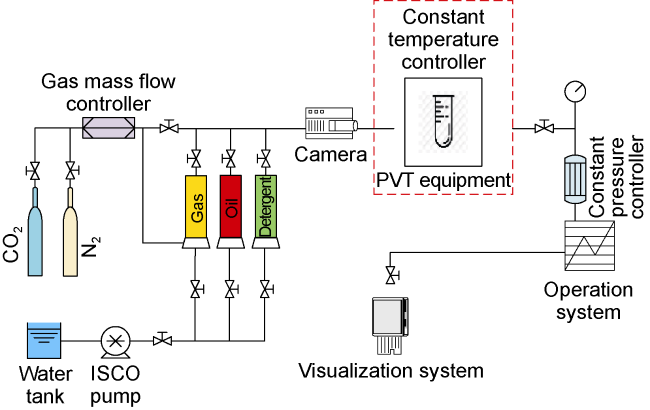
Fig. 1. Setup of the visualized PVT experiment. |
(1) PVT cylinder: The experimental process mainly occurs in the PVT cylinder with the length of 410 mm, the diameter of 131.2 mm, and the wall thickness of 39 mm. During the experiment, the oil and gas samples are injected into the PVT cylinder through valves. (2) Constant pressure controller: This system consists of plunger, motor, etc. The plunger placed in the PVT cylinder compresses the fluids (oil and gas) in the PVT cylinder under the driving of the motor, and controls the pressure in the cylinder according to the data from the pressure sensor. The measurement accuracy is 0.01 MPa, and the upper limit of pressure is 50 MPa. (3) Constant temperature controller: This system, consisting of thermocouples and temperature measuring sleeve, provides a stable temperature for the experiment. The experimental temperature is controlled by the heating sleeve, and the temperature at the measurement point is sensed by the internal thermocouple. The measuring accuracy is 0.1 °C, and the maximum temperature in the PVT cylinder reaches 250 °C. (4) Visualization system: This system consists of camera and imaging system. The camera is used to monitor the oil-gas interface in the PVT cylinder, by photographing the oil-gas interface in the PVT cylinder through a vertical high-pressure resistant sapphire glass, and transmitting the real time results to the computer for direct observation on the display screen. The imaging system displays the images captured by the camera, which facilitates specific analysis of the experimental phenomenon.
1.3. Experiment design and procedure
The purpose of this experiment is to investigate the miscibility of different gas media and oil under different temperature and pressure conditions. A total of 16 sets of experiments in 3 types were designed and completed (Tables 1-3). In each experiment, the miscible temperature is determined by the thermodynamic definition of miscibility, or the interface disappearance method, that is, the two-phase interface disappears when two phases are miscible. This method is more accurate and less time- consuming than the slim tube test in measuring the miscible pressure. Table 1 illustrates the scheme of studying the minimum miscible temperature (MMT) and rules of CO2 gas-oil miscibility from low pressure (10 MPa) to high pressure (20 MPa). Table 2 and Table 3 illustrate the schemes of studying the miscibility of flue gas-oil and N2-oil at high temperatures of 100-250 °C. The initial pressure was designed at 15 MPa in No. 2 and No. 3 experiments, where the gas samples used contain a high N2 content, making the MMT for N2-oil miscibility under low pressure much higher than the upper limit of the equipment.
Table 1. CO2-oil miscibility experiment |
| No. | Gas medium | Experimental pressure/MPa | Experimental temperature/°C | Oil sample |
|---|---|---|---|---|
| 1 | CO2 | 11 | 100-250 | Condensate oil |
| 2 | CO2 | 13 | 100-250 | Condensate oil |
| 3 | CO2 | 14 | 100-250 | Condensate oil |
| 4 | CO2 | 15 | 100-250 | Condensate oil |
| 5 | CO2 | 17 | 100-250 | Condensate oil |
| 6 | CO2 | 18 | 100-250 | Condensate oil |
Table 2. Fuel gas (15% CO2+85% N2)-oil miscibility experiment |
| No. | Gas medium | Experimental pressure/MPa | Experimental temperature/°C | Oil sample |
|---|---|---|---|---|
| 1 | 15% CO2+ 85% N2 | 15 | 100-250 | Condensate oil |
| 2 | 15% CO2+ 85% N2 | 18 | 100-250 | Condensate oil |
| 3 | 15% CO2+ 85% N2 | 25 | 100-250 | Condensate oil |
| 4 | 15% CO2+ 85% N2 | 30 | 100-250 | Condensate oil |
| 5 | 15% CO2+ 85% N2 | 35 | 100-250 | Condensate oil |
Table 3. N2-oil miscibility experiment |
| No. | Gas medium | Experimental pressure/MPa | Experimental temperature/°C | Oil sample |
|---|---|---|---|---|
| 1 | N2 | 15 | 100-250 | Condensate oil |
| 2 | N2 | 18 | 100-250 | Condensate oil |
| 3 | N2 | 25 | 100-250 | Condensate oil |
| 4 | N2 | 30 | 100-250 | Condensate oil |
| 5 | N2 | 35 | 100-250 | Condensate oil |
The experimental procedure is as follows: (1) Clean and vacuum the PVT cylinder. Take out the PVT cylinder, inject acetone to wash off the toluene in the cylinder, and then inject N2 to wash off the acetone in the cylinder, and finally vacuum the whole PVT cylinder. (2) Saturate with fluid. Place the cleaned PVT cylinder in the experimental system, inject gas from the top of the PVT cylinder through different valves, and inject oil from the bottom. After saturated with fluid, hold the cylinder for 3-5 min. (3) Increase the pressure to the target value. Use the constant pressure controller to increase the PVT cylinder pressure to a preset value, and use the constant temperature controller to increase the temperature in the PVT cylinder step by step. Meanwhile, observe and record the change of the oil-gas interface through the visualization system. The temperature is recorded as a MMT when the oil-gas interface disappears under this pressure. (4) Cool the cylinder to the initial temperature. Use the constant temperature controller to decrease the temperature in PVT cylinder to the initial value, and observe and record the change of the oil-gas interface through the visualization system. (5) After the experiment, the system pressure is reduced to the normal pressure. The valve is opened to release oil and gas in the cylinder. Toluene is injected to remove oil in the cylinder until the camera cannot detect any residual oil droplets.
To systematically expound the miscibility between different gas media and crude oil under different temperature and pressure conditions, the MMP experiments were performed on the miscibility of CO2, flue gas and N2 with crude oil at the temperature of 100-250 °C. During the experiments, once the system temperature reached the designed value, the pressure was increased gradually until the oil-gas interface disappeared, when the pressure was determined as the MMP. This experimental methodology is well established, so it will not be repeated but just be used for proving data support to the later discussion.
2. Results and analysis
2.1. CO2-condensate oil miscibility experiments
The relation between temperature and MMP was plotted according to results obtained in 5 sets of experiments under temperatures of 100, 120, 150, 180, 200, 230, 240 °C (Fig. 2 ). At the initial stage, the MMP of CO2 and oil increases linearly with the rise of temperature, while the MMP decreases rapidly when the temperature is higher than 200 °C. This result is consistent with that from foreign study on the MMP of CO2 and oil at different temperatures [31]. This indicates that temperature rise inhibits the CO2-oil miscibility at low temperature (lower than 200 °C) [30], but enhances the CO2-oil miscibility at high temperature.
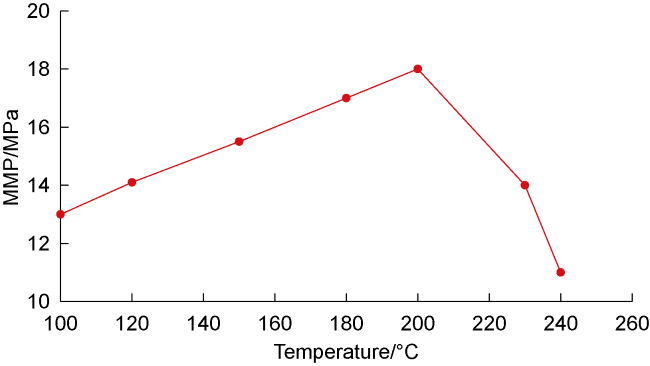
Fig. 2. Relationship between MMP and temperature in CO2-condensate oil miscibility experiment. |
The experiment under the pressure of 15 MPa (Fig. 3 ) is illustrated to investigate the miscible state at constant pressure and increasing temperature. At 100 °C, no two- phase interface is observed in the PVT cylinder, and CO2 and oil phases are in a miscible state. The temperature is increased to observe the interface change. At 120 °C, CO2 and oil phases are still in a miscible state. At 140 °C, CO2 starts to be separated from the oil phase, and some light components in the oil are evaporated into gas phase. At this time, an obvious oil-gas interface is observed in the PVT cylinder in an immiscible state. At 160-180 °C, the oil expands rapidly and occupies the main part of the cylinder, suggesting a rising interface. At 200 °C, the light hydrocarbon components C7-C16 in the oil are evaporated into gas phase, suggesting a falling interface. At 230 °C, the two-phase interface disappears and the oil-gas system reaches a miscible state again. The miscible zone is composed of supercritical CO2 and light hydrocarbons evaporated from the oil phase.
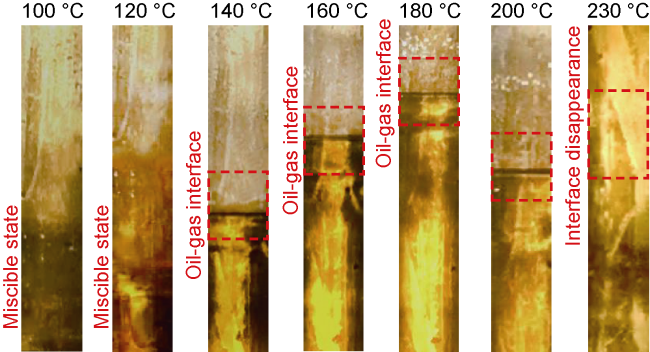
Fig. 3. Photos of CO2condensate oil miscibility experiments under 15 MPa. |
Analysis of the whole experiment process shows that under the pressure of 15 MPa and stepped temperature, the fluids in the PVT cylinder experience a variation from miscibility at low temperature (100 °C) to immiscibility (140-200 °C), and then to miscibility at high temperature (230 °C). In the CO2-condensate oil miscibility experiment, the initial pressure of 15 MPa at 100 °C exceeds the MMP of 13 MPa (Fig. 2 ), so the oil-gas system is in a miscible state. Under the same pressure and at low temperature (100-200 °C), CO2 and oil phases are not miscible when the temperature increasing to 140 °C, which can be defined as the maximum miscible temperature at low temperature range. At 200 °C, distillation and volatilization of light oil components play a leading role, and heating can promote the miscibility. At 230 °C, CO2 and oil phases reach a miscible state again, which can be defined as the MMT of CO2 and oil in high temperature range (higher than 200 °C). Once the temperature is higher than the MMT, miscibility can be realized, and temperature rise promotes miscibility. Analysis shows that CO2 and oil present different miscible states in two temperature ranges. The miscible state below 140 °C is resulted from CO2-oil interaction under the initial pressure, and miscibility is achieved through dissolution and extraction [32]. When the temperature is higher than 140 °C, the light hydrocarbon components are distilled and volatilized with the increase of temperature, which is a forced phase transition of light hydrocarbon components, and the miscibility with CO2 is finally formed. This process is more obvious in the N2 miscibility experiment.
2.2. Fuel gas (15% CO2+85% N2)-condensate oil miscibility experiment
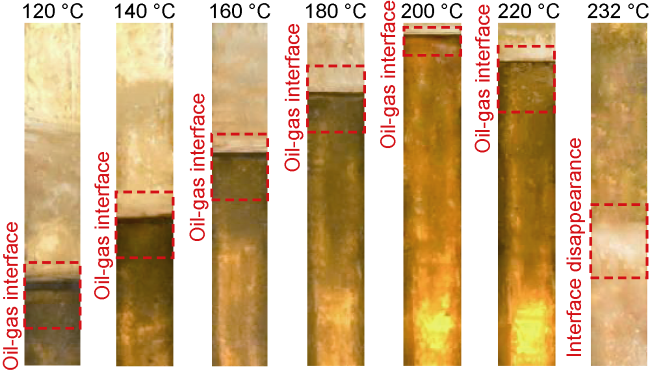
Fig. 4. Photos of fuel gas-condensate oil miscibility experiments under 18 MPa. |
The experiments under the pressure of 25 MPa (Fig. 5 ) show that the two-phase interface also firstly rises and then falls down with the increase of temperature. Finally, at 210 °C, the flue gas and condensate oil become miscible, and the two-phase interface disappears.
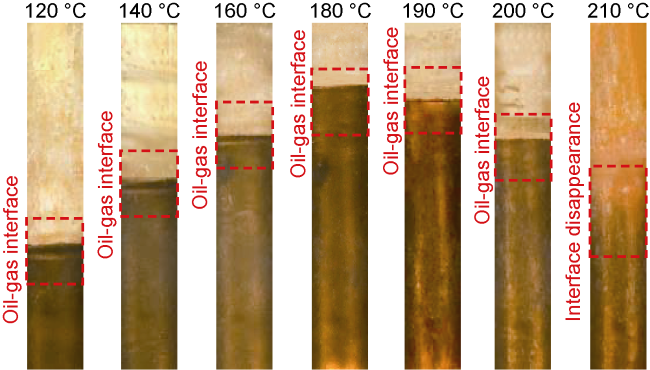
Fig. 5. Photos of fuel gas-condensate oil miscibility experiment under 25 MPa. |
The experimental results show that the interface of flue gas-condensate oil disappears, which reaching the miscible state under the pressure of 15, 18, 25, 30 and 35 MPa. The relationship between MMT and pressure is plotted in Fig. 6. It can be seen that the MMT decreases gradually with the increase of pressure. This result is similar to and thus verified by those of our HTHP slim tube experiments[30]. The miscible temperature and pressure obtained in this experiment are slightly higher than those in the slim tube experiment. Such deviation is reasonable because that the interface disappearance method defines miscibility based on the phase equilibrium angle, which represents a stringent condition. In the slim tube experiment, the criterion for miscibility is the oil displacement efficiency of more than 90% when the injected gas volume is 1.2 pore volumes, which emphasizes development and engineering.
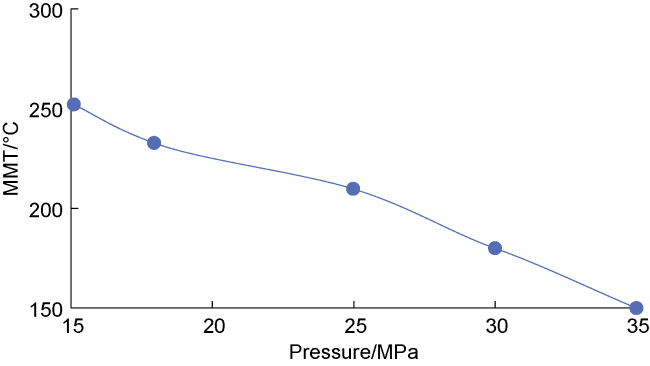
Fig. 6. MMT of CO2 and condensate oil under different pressures. |
2.3. N2-condensate oil miscibility experiment
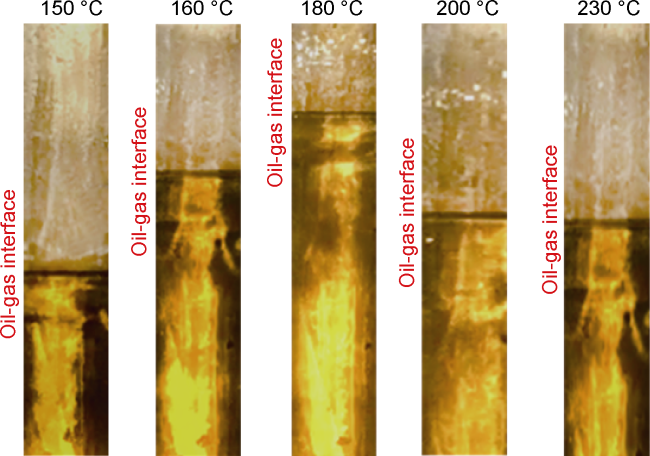
Fig. 7. Photos of N2-condensate oil miscibility experiments under 18 MPa. |
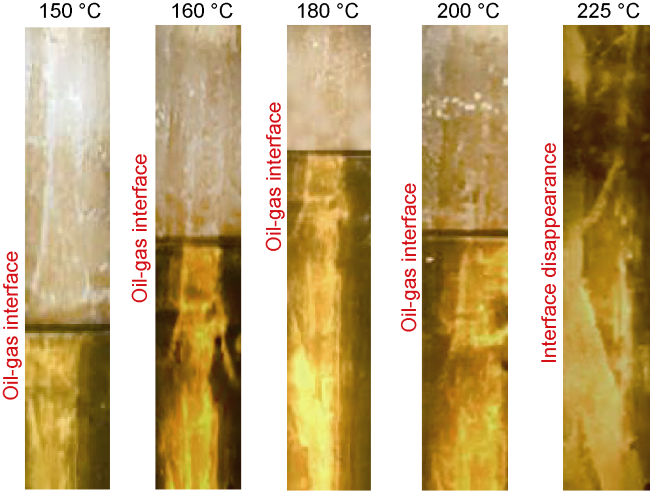
Fig. 8. Photos of N2-condensate oil miscibility experiments under 25 MPa. |
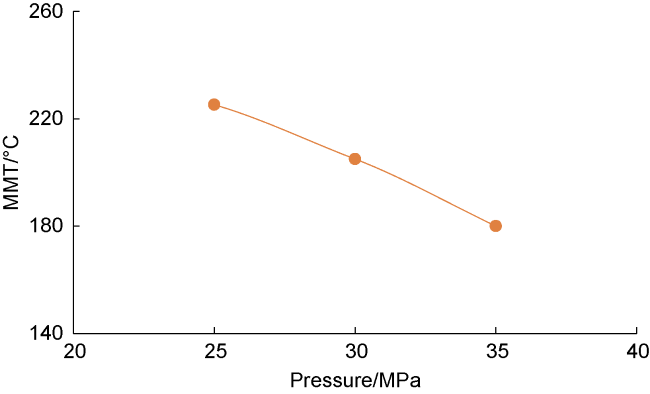
Fig. 9. MMT of N2 and condensate oil under different pressures. |
It should be noted that at room temperature (20 °C), N2 and oil are not miscible even when the pressure continues to increase, and the lower temperature or a higher miscible pressure causes higher difficulty in miscibility. Through the experiments in this paper, the conjecture about N2 miscibility with crude oil at high temperature[29-30] was confirmed. It is also verified that CO2 does not play a decisive role in miscibility of flue gas and N2 with crude oil at high temperature, and there are fundamental differences in mechanism of miscibility. At low temperature, with the weak dissolution and extraction of N2, miscibility can only be realized by the forced gas phase transition of light oil components at high temperature. CO2, with special properties, has a weakening dissolution and extraction capability from low temperature to high temperature, which is not conducive to CO2 miscibility; instead, the CO2 miscible pressure increases with the increase of temperature [33].
3. Discussion
3.1. Miscible zones at different temperatures
The CO2-condensate oil miscibility experiments revealed the CO2-oil miscibility in two temperature domains in the heating process. Here, the miscible zones formed at different miscible temperatures (100, 230 °C) under the pressure of 15 MPa are analyzed and compared. As shown in Fig. 3 , the miscible zone at 230 °C has more uniform color. Moreover, when the temperature increases gradually, the color of the miscible zone is more uniform, and it is inferred that the density of the miscible zone gradually decreases according to the comparison of pictures and videos.
The differences between miscible zones at low and high temperatures were investigated by simulation. Through PVTsim flash calculation, the fluid densities at the pressure of 15 MPa and the temperature of 100, 120, 140 and 230 °C were determined to be of 0.604, 0.538, 0.471 and 0.273 g/cm3, respectively. Analysis of experimental and calculation results shows that the behavior of CO2-oil miscibility is very different in the low and high temperature domains at the constant pressure in the heating process. At 100 °C, only a very few of C2-C6 light components in the oil suffers phase transition due to distillation, and the supercritical CO2 fluid and the distilled light hydrocarbon components form a liquid miscible zone with relatively high density (0.604 g/cm3). At 230 °C, C7-C16 components are distilled and transited to gas phase, and the supercritical fluid deviates further from the critical point, resulting in a reduction in gas density. Finally, the phase-transited components become miscible with the high-pressure compressed and high-temperature supercritical CO2. In this case, a miscible zone with low density (0.273 g/cm3) and features of gas phase is formed.
Traditional CO2 miscible flooding realizes miscibility by dissolution and extraction under the high pressure, and is characterized by a single liquid phase. In contrast, thermal miscible flooding reflects the distillation phase transition under the HTHP conditions and shows the characteristics of the gas phase transition. As shown in Fig. 2 , the MMP of CO2 and oil phases show an inflection point at 200 °C. The mechanism of high-temperature distillation phase transition is confirmed through analysis of the characteristics of miscible zone at different temperatures. The inflection point indicates a gradual change of miscible zone from supercritical liquid to supercritical gas with the increase of temperature. Change of the MMP with temperature is closely related to change of supercritical gas properties and distillation phase transition of oil.
3.2. Miscibility of different gas media and oil at high temperature
The results of miscible temperature experiments between different gas media and oil under different pressures were compared (Fig. 10 , only the experiments of CO2-condensate oil at high temperature are discussed). Under the same pressure, the miscible temperature is ranked as CO2 < flue gas < pure N2. CO2 gas is soluble in oil phase and can displace some light components in oil through dissolution and extraction. As the temperature rises, more light components are subject to phase transition, and the oil and gas phases are more likely to be miscible and with the lowest miscible temperature. Due to weak dissolution and extraction, pure N2 exhibits the highest temperature of miscibility with oil. The flue gas, containing a small amount of CO2, has a certain effect of promoting miscibility even if the dissolution and extraction capability of CO2 is weakened by temperature rise, so it has a lower miscible temperature than pure N2.
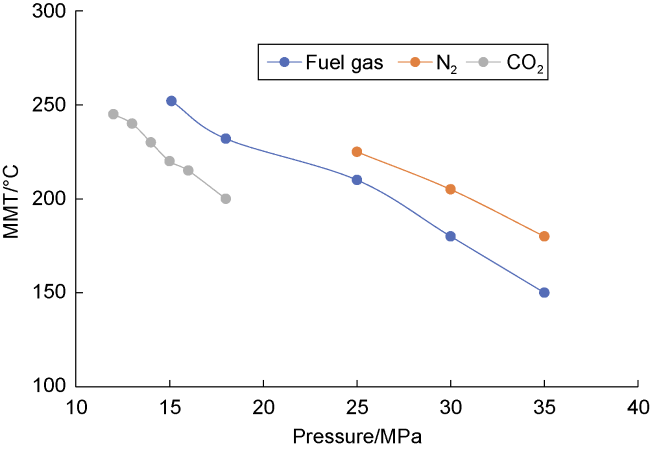
Fig. 10. MMT of different gas media with condensate oil under different pressures. |
The effect of temperature on miscibility was analyzed. At 200 °C, N2-oil miscibility occurs at 31.4 MPa, which is significantly higher than the flue gas-oil miscible pressure (27.0 MPa). At 250 °C, the flue gas-oil miscible pressure is 15.0 MPa, and the N2-condensate oil miscible pressure is 19.0 MPa. As the temperature rises, the miscible pressure of N2 approaches that of flue gas, indicating a weakened ability of CO2 to promote miscibility at high temperature, mainly because of the distillation and volatilization of light components into gas phase. The miscible pressure of different gas is closer at the higher temperature.
The pressure-mole fraction (p-x) of CO2, flue gas and N2 at different temperatures was simulated in PVTsim software. According to the p-x phase diagram of CO2 (Fig. 11 ), the CO2-oil miscible pressure shows a trend of rising followed by decreasing. In the process of temperature rise, the critical point of oil and gas system moves to the upper left first, and the critical pressure increases. Then, the critical point gradually moves towards the origin, and the transition to the gas phase is more likely to occur. The p-x phase diagrams of flue gas and N2 (Fig. 12 and Fig. 13 ) show that with the increase of temperature, the critical point moves gradually towards the origin as the gas-oil miscible pressure gradually decreases.
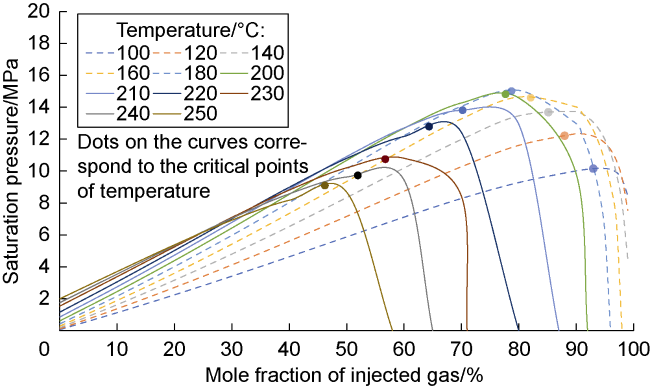
Fig. 11. p-x phase diagram of CO2 at different temperatures. |
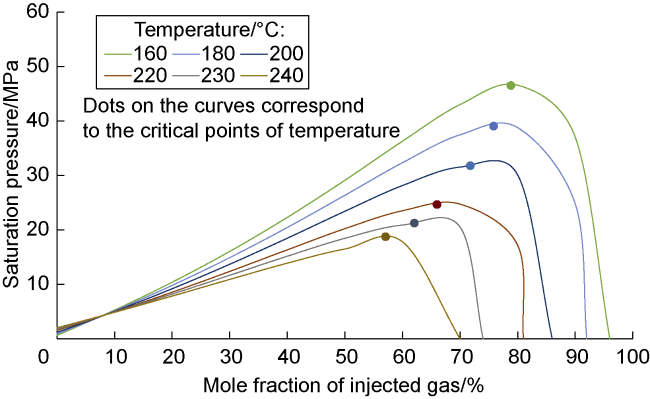
Fig. 12. p-x phase diagram of fuel gas at different temperatures. |
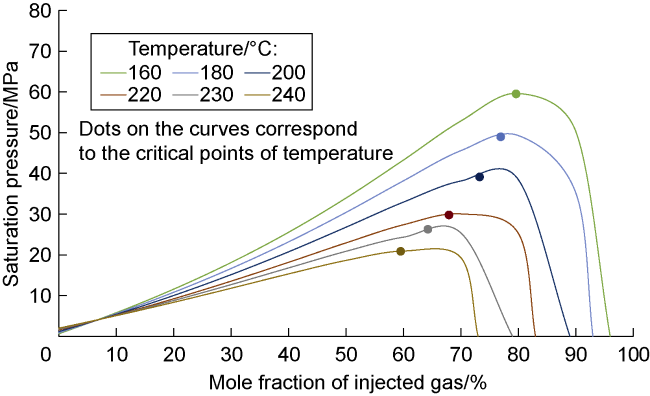


Fig. 13. p-x phase diagram of N2 at different temperatures. |
Above experimental results consolidate the insights on the mechanism of thermal miscible flooding, and also confirm the mechanism of distillation phase transition of light components in the process of thermal oxidation by air injection. Nevertheless, more experimental and theoretical studies are required on the characteristics and microscopic mechanism of fuel gas-light oil miscibility and the phase transition of oil-gas system at high temperature, so as to clarify the mechanism of phase transition of miscible components under thermal conditions.
In the development by traditional miscible flooding, such gases as flue gas and N2 are always labeled as impurity, making their potentials neglected. Under conditions of thermal phase transition of light oil, traditional immiscible gas can be miscible with oil to achieve efficient oil displacement, which provides a new solution of miscible flooding.
4. Conclusions
There are two miscible temperature domains in the CO2-oil system during the heating process at constant pressure. When the temperature is lower than 140 °C, the miscible zone shows liquid phase characteristics, and increasing temperature inhibits the miscible process. When the temperature is higher than 230 °C, the miscible zone tends to show the characteristics of gas phase, and the temperature rise is conducive to the formation of miscibility.
Under a constant pressure, when the temperature rises to a certain level, the two-phase interface between flue gas/N2 and oil disappears gradually, and the miscibility can be realized.
The mechanism of traditional CO2-oil miscibility is pressurized dissolution and extraction, while the mechanism of thermal miscibility is mainly distillation and volatilization of light oil components at high temperature. The latter provides a new method for efficient oil displacement with traditional immiscible gas media such as flue gas and N2.