Model construction and implementation of Ordos Energy Super Basin, NW China

  • JIA Ailin ,
  • CHEN Fangxuan , * ,
  • FENG Naichao ,
  • MENG Dewei ,
  • ZHENG Shuai
Expand
  • PetroChina Research Institute of Petroleum Exploration & Development, Beijing 100083, China

Received date: 2024-08-28

  Revised date: 2024-11-21

  Online published: 2025-01-03

Supported by

Project of Science and technology of PetroChina(2023YQX103)

Project of Science and technology of PetroChina(2023ZZ25)

Project of Science and technology of CNPC(2016DJ86)

Copyright

Copyright © 2024, Research Institute of Petroleum Exploration and Development Co., Ltd., CNPC (RIPED). Publishing Services provided by Elsevier B.V. on behalf of KeAi Communications Co., Ltd. This is an open access article under the CC BY-NC-ND license (http://creativecommons.org/licenses/by-nc-nd/4.0/).

Abstract

Taking the Ordos Basin as an example, this paper proposed that the construction of an energy super basin should follow the principle of “more energy, less carbon, and better energy structure”. The modeling workflow of energy super basin was built. Based on the resources/reserves, development status and infrastructures of the Ordos Basin, the development potential of the basin was evaluated, the uncertainties in the construction of energy super basin were analyzed, and the future vision and realization path of the Ordos Energy Super Basin were recommended. This study demonstrates that the Ordos Basin has the advantages of abundant energy sources, perfect infrastructures, well-matched carbon source and sink, small population density, and proximity to the energy consumption areas. These characteristics ensure that the Ordos Basin is a good candidate of the energy super basin. It is expected that the energy supply of the Ordos Basin in 2050 will reach 23×108 t of standard coal, and the proportion of fossil fuels in energy supply will decrease to 41%. The carbon emissions will decrease by 20×108 t compared to the emissions in 2023. The future construction of the basin should focus on the generation and storage of renewable energy, and technological breakthroughs for the carbon capture, utilization and storage.

Cite this article

JIA Ailin , CHEN Fangxuan , FENG Naichao , MENG Dewei , ZHENG Shuai . Model construction and implementation of Ordos Energy Super Basin, NW China[J]. Petroleum Exploration and Development, 2024 , 51(6) : 1628 -1640 . DOI: 10.1016/S1876-3804(25)60565-9

Introduction

The Ordos Basin is the second largest sedimentary basin in China, covering an area of 37×104 km2 [1]. Located in the inland heartland, it serves as the starting point of the overland Silk Road. As a region with significant potential for inland economic development, the Ordos Basin is being transformed into an energy super basin that synergistically develops fossil energy, renewable energy, and carbon capture, utilization and storage (CCUS). This can create a new economic corridor to support high-quality, sustainable local economic development, and also facilitate the national energy security.
The construction of the Ordos Energy Super Basin requires strategic control and macro-regulation at the national level. It is essential to coordinate the five provinces and regions of Shaanxi, Gansu, Ningxia, Inner Mongolia and Shanxi, integrating resources such as coal, oil and gas, wind, solar, geothermal, uranium and helium. By leveraging the basin’s comprehensive infrastructure, promoting clean energy substitution, and establishing a large-scale carbon capture and storage (CCS)/CCUS system, we can achieve the clean and low-carbon production and utilization of energy within the basin.
This paper addresses the key issues in constructing the Ordos Energy Super Basin. Firstly, it elucidates the concept of the energy super basin, followed by a systematic analysis of the reserves, current development status, and the potential of various resources in the Ordos Basin. The favorable conditions for constructing the Ordos Energy Super Basin and fundamental principles are summarized and proposed, and the model of the Ordos Energy Super Basin is built, with the discussions about the critical issues that need resolution and core technologies that require breakthroughs during the construction process. The aim is to provide scientific guidance and technical support for establishing the Ordos Energy Super Basin.

1. Connotation of the energy super basin

The concept of “energy super basin” originates from traditional super petroliferous basins, which possess the characteristics such as high reserves and production of fossil fuels, abundant and cost-effective renewable energy resources, strong capacity for large-scale energy storage and carbon capture and underground storage, and comprehensive infrastructures.
Abundant fossil and renewable energy resources are fundamental for developing an energy super basin and serve as a core factor in site selection. With the continuous advancement of fossil energy exploration and development in China, numerous large coal production bases and super-large oil and gas fields have been established [2]. Selecting regions rich in renewable resources around fossil energy bases for the construction of energy super basins can fully utilize the existing infrastructures for low-cost, high-efficiency basin transformation.
The massive energy storage capacity is critical for the effective operation of the energy super basin. The inherent variability of wind and photovoltaic power generation, influenced by day-night and seasonal differences, leads to mismatches between production and demand. Therefore, an energy super basin must host diverse energy resources and sufficient storage capacity against the fluctuations in energy demand.
The large-scale CCS capacity is one of the essential guarantees for building a “carbon-neutral” energy super basin. Given the substantial energy supply of an energy super basin, the energy production processes generate enormous greenhouse gas (GHG) emissions under the current energy structure. Achieving low-carbon and zero-carbon energy production and utilization is of great significance for realizing the “carbon peaking and carbon neutrality” goals.
Infrastructures for an energy super basin consist of four components: energy production facilities, energy storage facilities, energy transportation facilities and auxiliary facilities. Due to the diverse energy resources and massive energy supply in an energy super basin, the efficient storage and timely transportation of produced energy require infrastructures which are standardized and normalized, and would be preferentially digitalized and intelligent [3], thereby creating a smart energy super basin.

2. Reserves and development status of different types of resources in the Ordos Basin

2.1. Resources, development status and potential of fossil fuels

The Ordos Basin is rich in coal resources. The coal reserves buried shallower than 2 000 m exceed 2×10¹² t, accounting for over 1/3 of the total coal resources in China [4]. In 2023, the coal production in the Ordos Basin surpassed 16×108 t, representing more than 34% of the national coal output [5].
The basin boasts abundant oil and gas resources, exhibiting a spatial distribution pattern characterized by “half basin of oil and full basin of gas” in a planar view and “upper oil and lower gas” in a vertical view [6]. The primary types of oil and gas are mainly low-permeability, tight, and shale oil and gas [7-8], with distinctive characteristics of low permeability, low pressure, and low abundance [9].
The basin has oil initially-in-place and proved oil reserves of 201.25×10⁸ t and 73.98×10⁸ t respectively, and gas initially-in-place and proven gas reserves of 33.54× 10¹² m3 and 5.96×10¹² m3 respectively [10]. In 2023, the crude oil production reached 3 825×104 t, and the natural gas production was 742×108 m3. The total oil and gas production was 9 887×104 tons of oil equivalent (toe), making the basin the largest onshore oil and gas contributor in China [5].
Future exploration of crude oil in the basin will proceed at three levels: realistic, replacing and potential. It is estimated that, in the medium- to long-term, the proven oil reserves are 78.5×10⁸ t, including 45.0×10⁸ t shale oil (57.3%) and 20.0×10⁸ t tight oil (25.5%) [1]. The future development of crude oil in the basin will focus on fine water flooding techniques in mature oilfields, tertiary recovery technologies, and shale oil large-scale economic development techniques [11-12]. It is anticipated that the crude oil production in the basin will reach 4 000×104 t by 2035 and decline to 3 800×104 t by 2050.
The natural gas resources in the Ordos Basin are mainly endowed in two series of strata (Upper Paleozoic clastic rocks and Lower Paleozoic carbonate rocks) and in three types of reservoirs (low-permeability gas reservoirs, tight gas reservoirs, and weathering crust gas reservoirs)[13-17]. Future exploration and development will concentrate on five new areas, including the Taiyuan Formation limestone gas reservoirs, Paleozoic bauxite gas reservoirs, Ordovician sub-salt gas reservoirs, Ulalik Formation marine shale gas reservoirs and deep coalbed methane reservoirs [18]. The Ordos Basin is the largest coalbed methane basin in China, with the estimated resources of 23.52×10¹² m3. Deep coalbed methane is expected to become an important supplement for stabilizing and increasing natural gas production in the basin. The Ordos Basin is well-positioned for sustained production growth by effectively exploiting the remaining reserves of developed gas fields, development in new areas and fields, and tackling low- cost development technologies [19-20]. The production increasing rate and time to peak of different development entities are expected to align closely, with an anticipated production of 1 000×108 m3 around 2027, leading to the first super basin with a production capacity of 100 billion cubic meters in China. If deep coalbed methane is economically and widely developed, the peak gas production of the basin will exceed 1 500×108 m3 by 2035, accounting for roughly half of the national total output, and such production is expected to be stable until 2050 (Fig. 1).
Fig. 1. Expected natural gas production in the Ordos Basin.

2.2. Renewable energy potential and utilization status

The Ordos Basin is rich in wind and solar resources. According to the China Wind and Solar Energy Resources Bulletin 2023 [21], the average annual wind speed at a height of 100 m in the basin, which spans five provinces/regions as mentioned above, is approximately 5.65 m/s. The average wind power density is 220.42 W/m2, surpassing the national average. The annual available hours for wind energy in the basin range from 1 600 h to 2 300 h. The total solar radiation in the basin is 4 500-5 600 MJ/(m2·a), with an average annual utilization of about 3 000 h, placing it within a solar-rich zone [22-23].
Local cities and counties within the basin have actively developed photovoltaic (PV) and wind power generation by leveraging the abundant wind and solar resources. By the end of 2023, an incomplete statistical assessment indicates that the cumulative installed capacity of new energy in the basin exceeded 61 GW, with installed wind power capacity surpassing 29 GW and installed PV power capacity exceeding 32 GW. Additionally, major power enterprises, such as China Energy Investment Corporation Limited and China Huadian Corporation, have established new energy projects in the basin, with over 37 GW of installed renewable energy capacity under construction.
The Ordos Basin has widespread, well-preserved geothermal resource, corresponding to the geothermal field of medium to low temperature [24], with an average geothermal gradient of 2.93 °C/m. The geothermal resources are equivalent to approximately (503-871)×108 t of standard coal [25-26]. Geothermal resource is promising, although its utilization is still in the exploratory stage.

2.3. Potential of strategic resources

The Ordos Basin is an important uranium mining base in China, with uranium resources amounting to 86×104 t, holding the top position in proven uranium reserves in China [27]. The basin contains 6 uranium-enriched areas, featuring 1 ultra-large, 2 extra-large, and 2 large uranium deposits, along with several medium to small deposits and numerous uranium mineralized sites [28].
Helium is a non-renewable strategic scarce resource. Helium-containing natural gas is the only source for industrial helium. Natural gas with helium content exceeding 0.1% is deemed economically viable for industrial extraction [29]. In the Ordos Basin, the helium content in natural gas ranges from 0.03% to 0.20%, with the helium initially-in-place of approximately 13.86×10⁸ m3, accounting for 29.49% of the national total [30]. Typically, the Qingyang, Huanglong and Zhengning gas fields have helium contents exceeding 0.1% in natural gas, with a total helium initially-in-place of about 0.41×10⁸ m3. Although other gas fields do not meet industrial helium extraction standards, advancements in helium purification technology suggest significant potential for future development. Currently, some natural gas production enterprises are implementing helium extraction projects, which will substantially relieve the reliance on imported helium upon completion of China.

3. Favorable conditions for constructing the Ordos Energy Super Basin

3.1. Abundant energy resources

Abundant resources represent a fundamental condition for establishing an energy super basin. The Ordos Basin has rich fossil fuels and also high-quality renewable and strategic resources. Through the construction of the energy super basin, we can manage the diverse resources in an integrated way to maximize resource utilization and optimize development efficiency, thereby avoiding the waste of associated minerals during the extraction of primary minerals due to the overlapping mining rights.

3.2. Perfect infrastructures

The International Energy Agency, in its report Security of Clean Energy Transitions [31], notes that the construction of new infrastructure during the green and low-carbon transition incurs substantial costs; thus, maximizing the use of existing supporting infrastructure can facilitate a low-cost, high-efficiency transition.

3.2.1. Energy production facilities

In 1970, Well Qing 1 in the Changqing Oilfield obtained a high-yield industrial oil flow, marking the beginning of the Longdong oil campaign. In 1984, Xinhua News Agency issued a report There is coal sea in northern Shaanxi, high quality and easy exploitation, which opened the prelude of coal development in the basin. In 1989, the industrial gas flow from the Shaanshen 1 well ushered in the large-scale development of natural gas in the basin. Over more than half a century, the Ordos Basin has evolved to a standardized and large-scale coal, oil and gas production base with established infrastructures. Moreover, the existing fossil energy infrastructures can also be used for the development and utilization of other resources. For instance, oil and gas wells abandoned in exploration can be repurposed for extracting geothermal water, facilitating low-cost development of (mid-)deep geothermal resources [32].
The development of renewable energy in the basin has achieved remarkable results, gradually transitioning from traditional fossil energy to the integration of fossil energy and new energy. As of 2023, the cumulative installed capacity of new energy in the basin exceeded 61 GW, establishing a large-scale new energy industry base. The new energy development technology and equipment manufacturing supply chains were improved.

3.2.2. Energy storage facilities

The energy storage facilities of the Ordos Basin include gas storage, liquefied natural gas (LNG) peak-shaving station and energy storage power station. While the current energy storage systems are not fully established, the production entities are actively seeking opportunities, with numerous ongoing and planned projects (Table 1).
Table 1. Energy storage facilities in the Ordos Basin
Storage
facilities
Number of existing facilities Established storage
capacity
Ongoing and planned projects
Gas storage 2 14.5×10⁸ m3 2 gas storages under construction, with the expected working
capacity of 43.8×10⁸ m3/a after completion
LNG peak-
shaving station
3 4.5×10⁴ m3
Energy storage
power station
3 Maximum charging/ discharging power 0.12 GW, energy storage
capacity 0.21 GW·h
10 power storage projects under construction, with the total expected maximum charging/discharging power 1.34 GW and energy storage capacity 4.34 GW·h. 18 planned power storage projects, with total planned maximum charging/discharging power 9.09 GW and energy storage capacity 3.53 GW·h

Note: the established storage capacity of gas storages refers to the annual working capacity of the gas storage.

3.2.3. Energy transportation facilities

The crude oil gathering and transportation system in the Ordos Basin is efficient and stable. As of the end of 2023, China National Petroleum Corporation (CNPC) and Shaanxi Yanchang Petroleum (Group) Co., Ltd., as the primary crude oil producers, achieved an annual transportation and sales capacity of approximately 4 000×104 t.
The Ordos Basin is the core of the natural gas pipeline network in China, and the hub for 15 main gas pipelines, including the West-East Gas Pipeline and the Shaanxi- Beijing Gas Pipeline. CNPC has constructed 245 provincial/municipal natural gas pipelines and 175 gathering & transmission pipelines in the basin, which constitute a comprehensive and extensive gas pipeline network with a total length of 40 481 km, contributing transmission capacity of 1 500×108 m3/a [4].
The power grid in the basin is well-developed, including both outgoing ultra-high voltage (UHV) lines and internal industrial lines. According to the Outline of the 14th Five-Year Plan (2021-2025) for National Economic and Social Development and Vision 2035 of the People’s Republic of China [33], the “Jiziwan” clean energy base is deployed along the Yellow River during the 14th Five-Year Plan period. Specifically, 9 UHV AC/DC lines will be built, 6 of which have been put into use, and once fully completed, they are expected to provide a transmission capacity of 145 GW. The Changqing Oilfield has established a three-level power grid system centered on 110 kV power grid, with a backbone of 35 kV power grid and a foundation of 10 kV power grid, allowing it be covered by self-built power grids [34].

3.2.4. Ancillary facilities

To ensure the efficient and orderly operation of production, storage and transportation, ancillary facilities for inspection, maintenance, firefighting, and management are necessary. Some sites in the Changqing Oilfield are located in remote and dispersed areas, making management challenging. To address this issue, an intelligent ground control system has been established, enabling an operational model characterized by automated control, unattended operation and manual emergency control, which facilitates the low-cost and high-efficiency development of oil and gas fields [35]. The large capacity of fossil fuel production in the basin has brought significant economic benefit to the local areas. In addition to the self-contained firefighting facilities and capabilities, the oil, gas and coal production enterprises are supported with available infrastructure and capabilities kept by local governments to ensure the normal production.

3.3. Well-matched CCS/CCUS source and sink

The densely situated coal, oil, gas and chemical enterprises in the Ordos Basin generate a large volume and high concentration of carbon. Currently, the coal chemical projects under construction and completed emit over 4 000×104 t of CO2 with a volume fraction exceeding 80% every year. After simple treatment, the CO2 can meet geological sequestration requirements, substantially reducing the carbon capture costs [36]. It is estimated that the depleted oil and gas reservoirs and deep saline aquifers within the basin can effectively store over 150×108 t CO2 [37], providing an ample space for carbon sink. The reasonable source-sink matching pattern indicates a substantial potential for CCS/CCUS in the Ordos Basin.

3.4. Small population density

According to the population statistics of the main counties and cities in the Ordos Basin, the average population density is 69 people/km2 in the whole basin, and lower than 10 people/km2 in about 1/3 of the basin. This situation of sparse population in the vast area of the Ordos Basin allows for the siting for power generation with new energy sources, such as wind and solar, which requires a large land occupation, and also for the concentrated construction of large wind and PV power bases.
In densely populated areas, population migration can cause substantial economic costs and potential social issues [38]. Therefore, distributed wind and solar power generation is typically employed. For example, wind turbine generators or PV panels are installed at small plots of land, rooftops, and similar spaces, so that local residents may be influenced minimally. In sparsely populated areas, population relocation is relatively feasible and practical, and it is possible to establish large-scale new energy power generation bases. Compared to distributed wind and solar power generation, large integrated wind and solar base is more superior in scale, cost and technology. It plays a demonstrative role in the energy transition process.

3.5. Proximity to energy consumption areas

New energy power generation is typically compatible with transmission via UHV or extra-high voltage (EHV) lines. The economic transmission distance is generally 800 km for UHV, and 1 500 km or even longer for EHV. This study defines 800 km as the neighboring energy consumption radius, and considers the areas within 800 km from the Ordos Basin as the neighboring energy consumption areas. Accordingly, the energy supply from the basin can cover 14 provinces/regions/municipalities including Beijing, Tianjin, Chongqing, Shaanxi, Gansu, Ningxia, Inner Mongolia, Shanxi, Qinghai, Henan, Hebei, Shandong, Sichuan and Hubei, accounting for 44% of the national population and contributing 40% to the gross domestic product (GDP) of China [5]. This good alignment between energy supply and major consumption areas effectively stimulates urban energy consumption and regional economic development.

4. Model construction of the energy super basin

4.1. Principles and model construction workflow
The (model) construction of an energy super basin must follow the principles below: (1) More energy: The total energy supply during and after the construction of the energy super basin must exceed the current supply. (2) Less carbon: The energy super basin is highly consistent with the goal of “carbon neutrality”. It is designed to significantly reduce carbon emissions and provide a further solution to “carbon neutrality”. (3) Better energy structure: The energy structure of the energy super basin is more rational, with a substantial increase in the proportion of new and green energy.
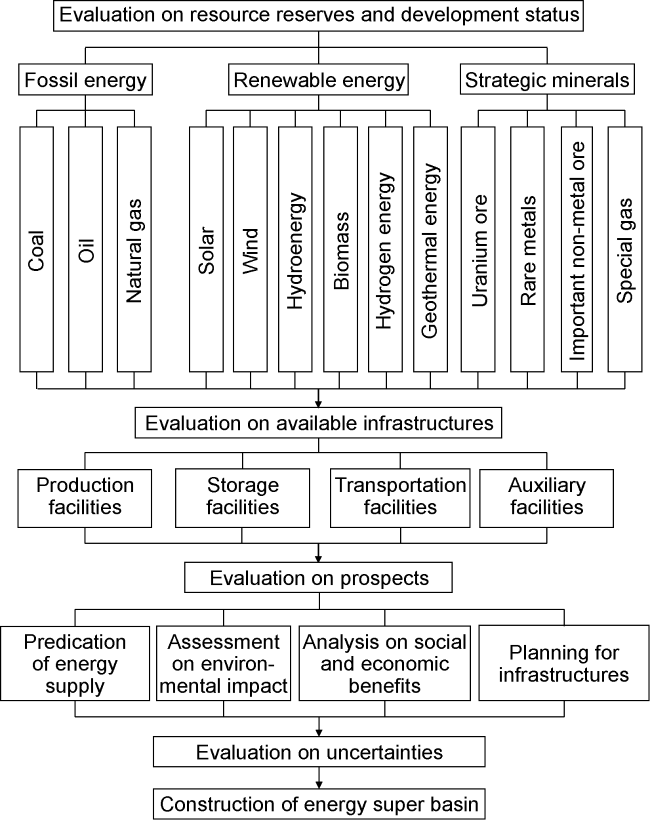
According to these principles, the basic workflow for constructing an energy super basin model is proposed (Fig. 2). Based on the resource endowment of the target basin, we can evaluate the reserves and development status of fossil fuels, renewable energy and strategic mineral resources, analyze the current state of infrastructures, and assess the future development potential of the energy super basin and the uncertainties during its construction. This workflow is applicable to the Ordos Basin, and also to other basins.
Fig. 2. Workflow of the energy super basin model construction.
Based on the resource reserves and development status, and available infrastructures in the Ordos Basin, the key parameters for the Ordos Energy Super Basin in 2035 and 2050 have been developed, as shown in Table 2. The standard coal coefficient, carbon emission intensity of energy production and carbon emission intensity of energy utilization are shown in Table 3.
Table 2. Key structural parameters of the Ordos Energy Super Basin
Year Energy supply Carbon emission/108 t CCS/CCUS carbon consumption capacity/ 108 t
Raw coal/
108 t
Oil/
104 t
Natural gas/
108 m3
New energy power generation/(108 kW·h) Uranium/
t
Total energy supply
in standard coal/108 t
Energy production Energy utilization
2023 16.0 3 825 742 1 107 410 17.13 2.27 32.32 0.032
2035 12.6 4 000 1 500 12 000 610 19.04 2.21 19.63 0.200
2050 9.8 3 800 1 500 36 000 920 23.01 1.93 12.08 0.500

Note: The supply data for fossil fuels in 2023 is the actual data. The supply of uranium is estimated based on the distribution of uranium reserves in China and the national output of uranium in 2023. The power generation of new energy is estimated based on the installed capacity of wind and PV in the basin (about 61 GW) with an annual effective power generation time of 1 800 h [4]. The data for CCS/CCUS carbon emission and consumption is cited from Reference [4]. The data for energy supply and CCS/CCUS carbon emission and consumption in 2035 and 2050 is cited from Reference [4] and the prediction from the author for the Ordos Basin. The carbon emissions are the amount of CO2 generated in the process of energy production and utilization, while the carbon emissions from plant construction, equipment manufacturing, energy transportation, refining, storage and other fields are not included.

Table 3. Conversion coefficients of energy supply and carbon emissions
Energy source Standard coal
coefficient
Carbon emission intensity
of energy production
Carbon emission intensity of energy utilization
2023 2035 2050
Coal 0.71 t/t 0.22 t/t 1.86 t/t 1.29 t/t 0.93 t/t
Oil 1.43 t/t 0.25 t/t 3.10 t/t 2.50 t/t 2.20 t/t
Natural gas 1.33×10⁻³ t/m3 4.00×10⁻⁴ t/m3 1.90×10⁻³ t/m3 1.60×10⁻³ t/m3 1.40×10⁻³ t/m3
New energy power generation 1.23×10⁻⁴ t/(kW·h) 0 0 0 0
Uranium 9.83×10⁵ t/t 1.20×10⁻² t/t 5.52×10⁻³ t/t 5.00×10⁻³ t/t 4.50×10⁻³ t/t

Note: The standard coal coefficients of coal, oil, natural gas, and electricity are provided in the General Rules for Calculation of the Comprehensive Energy Consumption (GB/T 2589-2020) [39]. Since the standard coal coefficient of uranium is not mentioned in Reference [39], when uranium is considered for nuclear power generation in this study, the uranium power generation capacity is determined by 35% of the efficiency of nuclear power plants and converted into standard coal equivalent. The data of carbon emission intensity of coal production, uranium mining, and nuclear power generation is obtained from references [40-41]. The data of carbon emission intensity of oil and gas production is cited from the reports Carbon Emission Intensity of Domestic Oil Production in China [42] and Carbon Emission Intensity of Domestic Natural Gas Production in China [43] released by China University of Petroleum (Beijing). According to the Life Cycle Assessment of Electricity Generation Options [44] released by the United Nations Economic Commission for Europe (UNECE), the carbon emissions from wind and PV power generation arise from equipment manufacturing, which are not accounted for in this study. The carbon emission intensity of fossil energy utilization is referenced from the Carbon Dioxide Emission Accounting Methods and Data Verification Forms [45] released by the National Development and Reform Commission, PRC.

4.2. Energy structure optimization

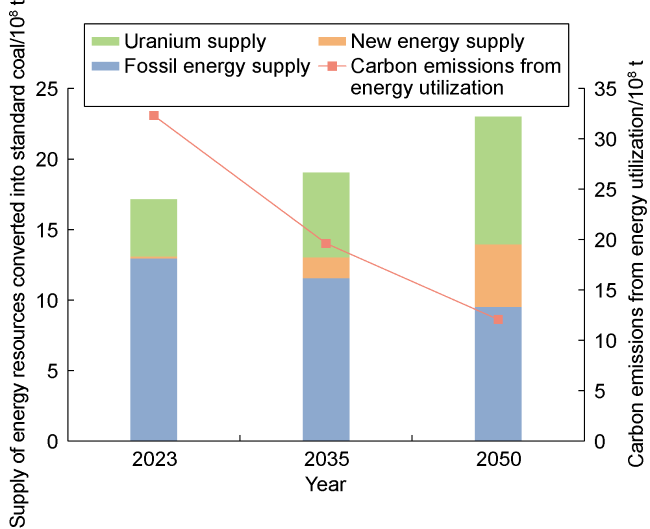
As shown in Table 2, the share of fossil energy in the basin’s energy supply is expected to gradually decline in the future, while the proportions of new energy and uranium will increase, resulting in an ongoing optimization of the energy structure. This transition will promote the increase in the total energy supply while reducing carbon emissions from energy utilization (Fig. 3).
Fig. 3. Energy structure and carbon emissions in the Ordos Basin.
In China, a country with rich coal, poor oil, and limited gas, coal remains the cornerstone of energy supply. In 2023, coal accounted for 67% of the total energy supply in the Ordos Basin, followed by a rapid decrease to 47% and 30% by 2035 and 2050, respectively (Table 2). This swift decline in coal production is inevitable during the energy transition of the basin. Oil is extensively applied in transportation, chemicals, building, agriculture, textiles, medicine and military, and a relatively high oil production is crucial for China’s energy security and industrial output. Given the current status and potential of oil development in the basin, oil production will slightly increase and then decrease and stabilize at approximately 3 800×104 t in the coming years. As the fossil fuel with the lowest carbon emissions per unit calorific value, natural gas is the only fossil energy source that can be produced and is producible in terms of resources and benefits in the energy structure transition of China. It is estimated that the peak production of natural gas will reach 1 500×108 m3 by 2035 and remain at this level to 2050 (Table 2).
The Ordos Basin features high average wind power density and solar irradiation intensity, as well as a vast land area with sparse population, which makes the establishment of large-scale new energy bases possible. In the future, the new energy power generation will rise rapidly and is expected to account for about 20% of the total energy supply of the basin in 2050 (Table 2).
In 2021, the demand for uranium was 9 563 t in China, with over 80% sourced from imports [46]. The Ordos Basin has the largest proven uranium reserves in China. Maintaining the sustained and increased production of uranium in the basin is a critical measure for ensuring China's strategic security regarding uranium resources. Based on the proportion of uranium resources in the Ordos Basin to the national total, the uranium production in the basin was estimated to be 410 t in 2023. With the initiation of some major uranium projects such as “National Uranium No. 1”, the future uranium production is expected to continuously rise, surpassing 900 t by 2050 (Table 2). Uranium will become an essential contributor to the basin's energy supply.

4.3. Reduction of carbon emissions

With the transition of the energy structure and the advancement of clean utilization technology in the basin, the carbon emissions from the energy utilization of the basin will decline significantly. Moreover, the natural carbon consumption capacity and CCS/CCUS technologies will further take down carbon emissions in the basin. Gradually, the Ordos Basin will move towards a “carbon neutral” energy basin.
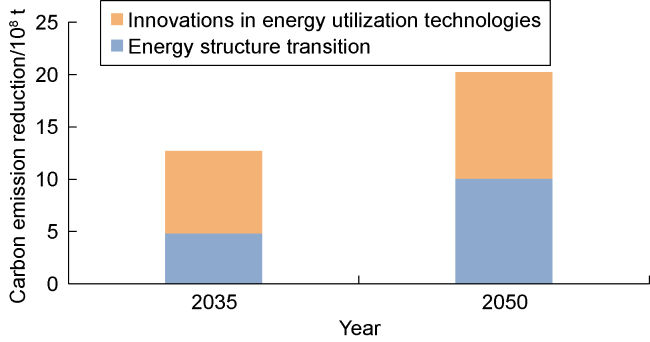
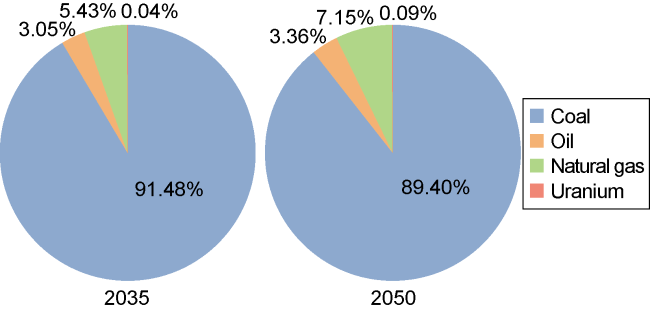
Based on Table 2 and Table 3, the reduction in carbon emissions due to the decreased fossil energy production is considered as the result of the energy structure transition, while the decline in carbon emissions due to reduced energy utilization is attributed to the innovations in energy utilization technologies. Compared to carbon emissions of energy utilization in 2023 (Figs. 4 and 5): (1) the carbon emissions will decrease by 12.69×108 t by 2035. Specifically, 38% of this reduction is attributed to the energy structure transition, totally due to the decline in coal production. The promotion of various clean energy utilization technologies significantly reduces the carbon emissions, with 91.48% contributed by the innovations in coal utilization technology. On one hand, coal supplies a large amount of energy. On the other hand, the CO2 concentration emitted by the coal chemical industry and coal-fired power sector is high. These situations make large-scale carbon capture feasible and cost-effective. Therefore, coal is superior to oil and natural gas in clean utilization technologies. (2) By 2050, the carbon emissions will decrease by 20.24×10⁸ t. Specifically, 50% of this reduction results from the energy structure transition, mainly driven by the significant decrease in coal's share and the promotion of new energy power generation. Coal will remain the primary contributor to carbon emission reduction due to clean energy utilization, accounting for 89.40%.
Fig. 4. Carbon emission reduction for energy utilization of the Ordos Basin relative to 2023.
Fig. 5. Carbon emission reduction by clean energy utilization technologies.
In recent years, in-situ leach uranium mining has become the key uranium extraction technique since it is low cost and environmentally friendly. As a typical process, supercritical CO2 extraction can efficiently recover uranium while effectively utilizing CO2, thereby reducing the carbon emissions to a certain extent during the uranium mining process. Industrial helium extraction is achieved by separating helium from natural gas. The helium is separated and purified during the gas processing phase, which enables green and low-carbon development of helium.
Currently, the carbon sink capacity of terrestrial ecosystems in China is approximately 13×108 t of CO2 equivalent per year [47]. Based on the area of the Ordos Basin, its carbon sink capacity of ecosystems is around 0.5×10⁸ t of CO2 equivalent annually, which accounts for 4.1% of the basin’s carbon emissions from energy utilization in 2050.
As a backstop technology for reducing carbon emissions, CCS/CCUS can reduce the content of GHG in the atmosphere while ensuring energy supply. The existing CCS/CCUS systems in the basin have an annual carbon consumption capacity of 0.032×10⁸ t of CO2 equivalent. Driven by technological innovation, policy support and market demand, it is expected that by 2050, the basin will establish a CCS/CCUS system with a carbon consumption capacity of 0.500×10⁸ t of CO2 equivalent, representing 4.1% of the projected carbon emissions from energy utilization in 2050.
In summary, the carbon consumption of the supercritical CO2 extraction technology for uranium, CCS/CCUS, and the natural environment is quite limited. The significant reductions in carbon emissions require energy structure transition and innovations in energy utilization technologies. The future efforts should focus on the development of zero- or low-carbon energy, such as renewable energy and uranium, and the upgrading of clean utilization technology in high CO2 emission industries, such as coal chemical processing and coal-fired power generation.

4.4. Regional economic development

According to statistics, the total GDP of the basin in 2023 was approximately 2.59×10¹² yuan, with significant disparities in per capita GDP among cities/counties. According to the classification of regional economic development level in China, the per capita GDP of developed areas exceeds 10×104 yuan, the per capita GDP of developing areas is (7-10)×104 yuan, and the per capita GDP of underdeveloped areas is below 7×10⁴ yuan. Accordingly, 62% of the cities/counties within the territory of the Ordos Basin are currently at an underdeveloped level (Fig. 6).
Fig. 6. Economic development level distribution of cities/counties within the territory of the Ordos Basin.
Based on the energy super basin model plan (Table 2), energy development is expected to greatly stimulate the economic growth in the basin (Table 4). Given an economic equilibrium among cities/counties within the Ordos Basin, it is projected that the per capita GDP could increase by 1.91×10⁴ yuan by 2035, which will lift 30% of the cities/counties from underdeveloped to developing level (Fig. 6). Moreover, the per capita GDP is expected to rise by 5.22×10⁴ yuan by 2050, allowing the entire population within the basin to reach the living standard of developing areas, and 68% of the cities/counties to upgrade to developed areas.
Table 4. Economic benefits from energy supply in the Ordos Basin
Year Economic benefit of coal/ 108 yuan Economic
benefit of oil/
108 yuan
Economic
benefit of natural gas/108 yuan
Economic benefit of power generation/
108 yuan
Total
benefits/
108 yuan
Energy benefits
per capita GDP/
104 yuan
Per capita GDP increase compared
to 2023/104 yuan
2023 6 857 1 186 913 6 781 15 737 6.13
2035 5 400 1 240 1 845 12 160 20 645 8.04 1.91
2050 4 200 1 178 1 845 21 920 29 143 11.34 5.22

Note: The prices of standard coal, oil, natural gas, and electricity are 600 yuan/t, 3 100 yuan/t, 1.19 yuan/m3 and 0.2 yuan/(kW·h), respectively.

5. Requirement for constructing the energy super basin

Table 5 provides the current facility construction status and future planning targets for the Ordos Basin, allowing for the assessment of the energy super basin construction progress. The data indicates that only 3 indicators meet the requirements, including the annual gas transmission capacity of natural gas pipelines, annual oil production and annual coal production. The remaining 6 indicators show significant gaps, including 3 indicators with the completion rates even blow 10%. This underscores that the construction of the Ordos Energy Super Basin is an arduous task.
Table 5. Planning and progress of construction of the energy super basin
Data item Annual carbon consumption capacity of CCS/CCUS/
104 t
Annual transmission capacity of power grid/ (1012 kW·h) Annual transmission capacity of natural gas pipelines/108 m3 New energy power storage capacity/(GW·h) Working gas capacity of underground gas storage/ 108 m3 New energy installed capacity/
GW
Annual
natural gas production/
108 m3
Annual oil produc-
tion/104 t
Annual
raw coal
produc-
tion/108 t
Target 5 000 3.6 1 500 400.0 150 2 000 1 500 3 800 9.8
Actual 320 1.2 1 500 4.5 58 61 742 3 825 16.0
Completion rate/% 6 33.3 100 1.1 38 3 49 101 163.3

Note: The targets for the transmission capacity of power grid and natural gas pipelines only account for the exporting energy generated in the Ordos Basin, but not the energy sources that are transported through the Ordos Basin from other regions. The actual transmission capacities of power grid and natural gas pipelines should be slightly higher than the targets.

5.1. Construction of energy production facilities

The output of coal, oil and natural gas in the Ordos Basin in 2023 was 16×108 t, 3 825×104 t and 742×108 m3, respectively. It is expected that the production of coal, oil and natural gas in the Ordos Basin in 2050 can reach 9.8×10⁸ t, 3 800×104 t and 1 500×108 m3, respectively. Compared to the present, both coal and oil production in the basin will decline in 2050. Therefore, the current production capacity is largely sufficient to cover energy needs in 2050, and the current level of technology will be able to support the construction of production facilities, even if new zones or blocks will be developed. Natural gas is expected to see a moderate increase in production and, as the cleanest fossil fuel, it is essential to offset the energy supply deficit caused by the reductions in coal and oil production. Future efforts should focus on enhancing recovery technologies for low-permeability, tight, and carbonate gas reservoirs, and efficient development technologies for deep tight gas and deep coalbed methane [48-50].
Wind and PV power generations are the primary focus for future infrastructure construction in the basin. Currently, the total installed capacity of new energy is 61 GW, as only 3.0% of the target (2 000 GW) by 2050. It is imperative for national and local governments to launch incentive policies for wind and PV power to ensure a smooth low-carbon transition in the basin.
In July 2024, the construction of China’s largest uranium project, “National Uranium No. 1”, was officially initiated in the Ordos Basin. This project integrates over 30 years of experience of in-situ leach uranium mining in China, strongly supporting the green, low-carbon, and digital intelligent development of uranium mining in the basin, which is crucial for ensuring the increasing uranium production.

5.2. Construction of energy storage facilities

According to the Opinions on Accelerating the Construction of Gas Storage Facilities and Improving the Market Mechanism for Ancillary Services for Gas Storage and Peak Regulation [51] jointly issued by the National Development and Reform Commission and the National Energy Administration, a gas supply company is required to maintain a gas storage capacity of no less than 10% of its annual sales volume. By 2050, the projected natural gas production in the basin is 1 500×108 m3, necessitating a corresponding gas storage capacity of 150×108 m3. Currently, the total working gas volume of the gas storages already built and under construction is 58×108 m3 in the basin. Moreover, eight depleted gas reservoirs have been selected for reconstruction into gas storages, and they are expected to contribute a working gas volume of 50×108 m3. Once the reconstruction is ultimately completed, the total working gas volume of the gas storages in the basin will exceed 100×108 m3. This implies a gap of about 50×108 m3 with the expected gas storage capacity by 2050. Therefore, more storage sites are required.
Different provinces/regions have slightly different requirements for the proportion of new energy storage configuration. For example, in Shaanxi Province and Ningxia Hui Autonomous Region, the energy storage configuration proportion is no less than 10% of the installed power generation capacity and the continuous energy storage time is no less than 2 h; in Inner Mongolia Autonomous Region and Gansu Province, the energy storage configuration proportion is no less than 15% of the installed power generation capacity and the continuous energy storage time is no less than 2 h. Shanxi Province does not have specific regulations. By 2050, the installed capacity of new energy in the basin is expected to reach 2 000 GW. Given the energy storage configuration proportion of 10% and the continuous energy storage time of 2 h, the required maximum charging/discharging power should be no less than 200 GW and the energy storage capacity should be no less than 400 GW·h. Currently, the maximum charging/discharging power and energy storage capacity of the built and under-construction energy storage facilities in the basin are 1.5 GW and 4.5 GW·h, respectively, indicating a significant storage gap. Therefore, as the installed capacity of new energy continues to increase, attention must also be paid to the installation of power storage to avoid the phenomenon of “abandoning wind and solar power”.

5.3. Construction of energy transportation facilities

The natural gas production in the basin is expected to be 1 500×108 m3 by 2050. Currently, the annual gas transmission capacity of existing gas pipelines in the basin is 1 500×108 m3, with widespread distribution of compressor stations, which can meet the transmission needs for natural gas in the basin.
The power generation capacity of new energy in the basin is expected to be 36 000 ×108 kW·h by 2050 (Table 2). Due to the limited electricity consumption within the basin, a significant amount of electricity needs to be transmitted externally. The power grid infrastructure in the basin is well-established. After the completion of the UHV backbone grid of the Yellow River “Jiziwan” clean energy base, the annual power transmission capacity can reach 12 000×108 kW·h. However, there remains a considerable gap compared to the projected external transmission capacity, necessitating accelerated grid construction within the basin to ensure adequate electricity transport capabilities.

5.4. Construction of CCS/CCUS systems

As an important petroliferous basin in China, the Ordos Basin has initiated several pilot tests for CCUS. In the Jiyuan Oilfield, for example, a CCUS integrated testing station with a CO2 injection capacity of 10×104 t is available. By far, nearly 20×104 t CO2 has been injected underground to increase oil production by 2.5×10⁴ t cumulatively, making the station a national demonstration project. CNPC is implementing three “million-ton CCUS projects” in Shaanxi, Gansu and Ningxia provinces, with expected carbon consumption of 320×104 t by 2025 and 1 000×104 t by 2030. In 2050, the carbon consumption capacity of CCS/ CCUS system in the basin is about 0.5×10⁸ t. Nearly 200 blocks in Changqing oilfield can realize CO2 miscible/near-miscible flooding. According to the calculation of 20% enhanced oil recovery, it is expected to increase recoverable oil reserves by nearly 4.0×10⁸ t, with a cumulative CO2 storage capacity of 12.5×10⁸ t, which can meet the carbon consumption capacity requirements of 0.4×10⁸ t/a.

6. Uncertainties in the construction of energy super basin

6.1. Construction of energy production facilities

It is planned that by 2050, the installed capacity of wind and solar power in the Ordos Basin will reach 2 000 GW, with the supporting storage capacity of 400 GW·h. So far, only 3% and 1% of these respective targets have been accomplished (Table 5), indicating a substantial gap from the plan. Traditional fossil energy development has left behind extensive geological data and supporting infrastructures. However, wind and solar power generation technologies and energy storage technologies started late, with insufficient data and supporting facilities. There is still much room for exploring such technologies suitable for the Ordos Basin, which brings additional uncertainties to the realization of the ultimate goal.
Geothermal resources in the basin are primarily used in planting, heating and tourism, and have become one of the important heating sources in the basin. Due to the high initial investment, long recovery period, and damage to groundwater systems, the geothermal resources in the basin have not been fully exploited. Future efforts should focus on the cost of geothermal utilization and the groundwater recharge technologies. A large number of wells abandoned in the oil and gas production areas can be re-commissioned for geothermal utilization. In 2021, the Jiyuan Oilfield successfully utilized geothermal energy through the modification of abandoned wells [52]. Nonetheless, such application is challenged by the geographical mismatch among abandoned wells, geothermal-rich areas, and concentrated heating zones. It is necessary to develop the technology for efficient long-distance transmission of geothermal energy.
Relying on abundant fossil energy in the basin, hydrogen can be produced through steam methane reforming, coal gasification and other processes [53]. In this respect, the basin has the advantages of sufficient resources, relatively mature technology and large-scale application. However, the process of (gray) hydrogen production from fossil energy sources leads to significant GHG emissions. Therefore, CCS is required to achieve low-carbon (blue) hydrogen production. The future hydrogen development in the basin will focus on blue hydrogen. Especially, hydrogen purification and supporting CCS technologies will be considered while reducing hydrogen production cost. The breakthrough of CCS is crucial to the mass and cost-effective blue hydrogen production [54].
For new energy utilization in the basin, top-level design is essential. Each phase will be planned carefully and implemented step by step. Furthermore, priority will be given to key technologies of new energy, thus achieving the quantitatively rapid growth and qualitatively effective improvement.

6.2. Uncertainties of CCS/CCUS technologies

With the steady progress of clean alternatives and new energy power generation, the CCS/CCUS consumption capacity of the basin is expected to be about 0.5×108 t by 2050. Currently, the carbon consumption capacity of the established and under-construction CCS/CCUS systems in the basin is 0.1×10⁸ t/a, as 20% of the plan. The widespread distribution of deep saline aquifers, depleted oil and gas reservoirs, and deep coal seams within the basin can meet the remaining carbon consumption requirements with relatively low construction difficulties.
Despite the ample space for carbon storage and utilization provided by the basin, CCS/CCUS technologies should be emphasized to ensure the stable sequestration and cost-effective utilization of CO2. By the end of 2010, Chinese first and Asian largest demonstration project of carbon sequestration in saline aquifer was established in the Ordos Basin, with a designed carbon storage capacity of 10×104 t/a. Currently, the carbon storage capacity of under-construction CCS projects remains at hundred- thousand to million-ton scale. The CO2 injection capacity has not been significantly improved and the core CCS technologies have yet to break through. Furthermore, the CO2 sequestration in saline aquifer does not generate economic returns. Policies are needed to subsidize CCS projects while low-cost carbon storage technologies are explored. The main CCUS technologies in the basin include CO2 injection for enhanced oil recovery (CO2-EOR) and CO2 injection for enhanced coalbed methane recovery (CO2-ECBM). CO2-EOR faces challenges such as tight reservoir rocks and low absolute net oil increments per well. CO2-ECBM needs to address the problem of reduced permeability due to matrix swelling after CO2 injection. The efficacy of CCUS technologies in boosting production is a key factor affecting CCUS promotion.

7. Conclusions

The traditional development mode for petroliferous basins can no longer meet the requirements for green and low-carbon development. It is necessary to transform into an energy super basin with integrated development of fossil energy, renewable energy and CCS/CCUS industry in the future. The Ordos Basin is rich in fossil energy, with coal reserves and production accounting for over 1/3 of the national total, making it the largest onshore oil and gas production basin in China. Additionally, it has abundant wind, solar and geothermal resources, with a cumulative installed capacity of new energy exceeding 61 GW. The basin is also rich in scarce resources strategically such as uranium and helium, with the proven uranium reserves ranking first in the country and helium in-place-initially accounting for approximately 1/3 of the national total. Moreover, the basin has well-developed infrastructures, well-match carbon source and sink, small population density, and proximity to energy consumption areas, providing favorable conditions for constructing an energy super basin. The construction of the Ordos Energy Super Basin is expected to set a replicable model for other petroliferous basins in their green and low-carbon transition.
The construction of an energy super basin should adhere to three principles: more energy, less carbon, and better energy structure. According to these principles, it is projected that the share of fossil energy in the basin will gradually decline while the proportion of new energy power generation and uranium energy supply will increase. It is estimated that by 2050, the total energy provided by coal, crude oil, natural gas, renewable energy power generation and uranium will be 23.01×10⁸ t of standard coal, and the carbon emissions from energy utilization will be 12.08×10⁸ t/a. The reduction in carbon emissions comes from the energy structure transition and the widespread use of clean utilization technologies.
Currently, the basin has complete fossil energy production and storage facilities, as well as well-developed oil and gas pipeline and power grid systems. The construction of the energy super basin should focus on two aspects: (1) At present, only 3% of the new energy installed capacity and 1% of the supporting energy storage capacity planned for 2050 have been built in the basin. A staged implementation will be necessary under the overall plan to accomplish these targets in a high-quality manner. (2) The basin possesses a large quantity of high-quality concentrated carbon sources, offering a significant potential for carbon storage and utilization. However, the CCS/CCUS technologies are still in the experimental phase, and their large-scale and efficient application is highly demanded.
The construction of an energy super basin is a systematic project. It requires an overall planning with clear targets, under the state’s guidance by top-level design and corresponding policies for economic support and legal protection, in order to achieve a synthetic development of different administrative regions, enterprises and energy types.
[1]
LIU Xianyang, LI Shixiang, ZHOU Xinping, et al. New fields, new types and resource potentials of petroleum exploration in Ordos Basin. Acta Petrolei Sinica, 2023, 44(12): 2070-2090.

DOI

[2]
ZOU Caineng, GUO Jianlin, JIA Ailin, et al. Connotation of scientific development for giant gas fields in China. Natural Gas Industry, 2020, 40(3): 1-12.

[3]
JIA Ailin, GUO Jianlin. Key technologies and understandings on the construction of smart fields. Petroleum Exploration and Development, 2012, 39(1): 118-122.

[4]
ZOU Caineng, LI Shixiang, XIONG Bo, et al. Connotation, pathway and significance of carbon neutrality “super energy system”: A case study of the Ordos Basin, NW China. Petroleum Exploration and Development, 2024, 51(4): 924-936.

[5]
National Bureau of Statistics. National data. (2021-03-12) [2024-10-14]. https://data.stats.gov.cn.

[6]
MI Lijun, ZHU Guanghui. Geological characteristics and exploration breakthrough in Linxing-Shenfu tight gas field, northeastern Ordos Basin. China Petroleum Exploration, 2021, 26(3): 53-67.

[7]
SUN Longde, ZOU Caineng, JIA Ailin, et al. Development characteristics and orientation of tight oil and gas in China. Petroleum Exploration and Development, 2019, 46(6): 1015-1026.

[8]
ZHANG Caili, LIU Xinshe, YANG Yajuan, et al. Petroleum exploration history and enlightenment of Changqing Oilfield in Ordos Basin. Xinjiang Petroleum Geology, 2021, 42(3): 253-263.

[9]
YANG Hua. A comprehensive survey on the history of oil and gas exploration and development in Changqing Oilfield. Journal of Xi’an Shiyou University (Social Science Edition), 2012, 21(1): 69-77.

[10]
JIA Chengzao. Prospects and five future theoretical and technical challenges of the upstream petroleum industry in China. Acta Petrolei Sinica, 2024, 45(1): 1-14.

DOI

[11]
HE Yonghong, XUE Ting, LI Zhen, et al. Development technologies for Triassic Chang 7 shale oil in Ordos Basin: A case study of Qingcheng Oilfield, NW China. Petroleum Exploration and Development, 2023, 50(6): 1245-1258.

[12]
GUO Qiheng, LI Shixiang, JIN Zhenkui, et al. Characteristics and exploration targets of Chang 7 shale oil in Triassic Yanchang Formation, Ordos Basin, NW China. Petroleum Exploration and Development, 2023, 50(4): 767-781.

[13]
JIANG Fujie, JIA Chengzao, PANG Xiongqi, et al. Upper Paleozoic total petroleum system and geological model of natural gas enrichment in Ordos Basin, NW China. Petroleum Exploration and Development, 2023, 50(2): 250-261.

[14]
JI Guang, JIA Ailin, MENG Dewei, et al. Technical strategies for effective development and gas recovery enhancement of a large tight gas field: A case study of Sulige gas field, Ordos Basin, NW China. Petroleum Exploration and Development, 2019, 46(3): 602-612.

[15]
JIA Ailin, WEI Yunsheng, GUO Zhi, et al. Development status and prospect of tight sandstone gas in China. Natural Gas Industry, 2022, 42(1): 83-92.

[16]
JIA Ailin, YAN Haijun, GUO Jianlin, et al. Development characteristics for different types of carbonate gas reservoirs. Acta Petrolei Sinica, 2013, 34(5): 914-923.

DOI

[17]
JIA Ailin, YAN Haijun. Problems and countermeasures for various types of typical carbonate gas reservoirs development. Acta Petrolei Sinica, 2014, 35(3): 519-527.

DOI

[18]
XI Shengli, YAN Wei, LIU Xinshe, et al. New fields, new types and resource potentials of natural gas exploration in Ordos Basin. Acta Petrolei Sinica, 2024, 45(1): 33-51.

DOI

[19]
JIA Ailin. Progress and prospects of natural gas development technologies in China. Natural Gas Industry, 2018, 38(4): 77-86.

[20]
JIA Ailin, HE Dongbo, WEI Yunsheng, et al. Predictions on natural gas development trend in China for the next fifteen years. Natural Gas Geoscience, 2021, 32(1): 17-27.

DOI

[21]
CMA Wind and Solar Energy Centre. China wind and solar energy resources bulletin. (2024-02-22) [2024-10-14]. https://www.cma.gov.cn/zfxxgk/gknr/qxbg/202402/t20240222_6082082.html.

[22]
ZHOU Yang, WU Wenxiang, HU Ying, et al. The temporal-spatial distribution and evaluation of potential solar energy resources in northwest China. Journal of Natural Resources, 2010, 25(10): 1738-1749.

DOI

[23]
SHEN Yi. The spatial distribution of solar energy and the comprehensive potential evaluation of regional exploitation and utilization in China. Lanzhou: Lanzhou University, 2014.

[24]
KONG Weizhen. Study on economic evaluation of geothermal energy developing and utilizing. Wuhan: China University of Geosciences, 2013.

[25]
WANG Guiling, ZHANG Wei, LIANG Jiyun, et al. Evaluation of geothermal resources potential in China. Acta Geoscientica Sinica, 2017, 38(4): 448-459.

[26]
LIN Wenjing, LIU Zhiming, WANG Wanli, et al. The assessment of geothermal resources potential of China. Geology in China, 2013, 40(1): 312-321.

[27]
FU Le, CHI Yanyan, WANG Jingjing, et al. Study on the ecological space control path of resources exploitation in Ordos Basin under the goal of “carbon peak and neutrality”. China Mining Magazine, 2023, 32(12): 39-50.

[28]
LI Ziying, QIN Mingkuan, CAI Yuqi, et al. Metalllogenic models and prospective analysis of sandstone-type uranium deposits in Ordos Basin. Uranium Geology, 2020, 36(1): 1-13.

[29]
CHEN Jianfa, LIU Kaixuan, DONG Qingwei, et al. Research status of helium resources in natural gas and prospects of helium resources in China. Natural Gas Geoscience, 2021, 32(10): 1436-1449.

DOI

[30]
HUI Jie, KANG Rui, ZHAO Weibo, et al. Helium characteristics and potential in the Ordos Basin. Natural Gas Geoscience, 2024, 35(9): 1688-1698.

DOI

[31]
International Energy Agency. Security of clean energy transitions. Paris: IEA, 2021.

[32]
LIU Runchuan, REN Zhanli, YE Hanqing, et al. Potential evaluation of geothermal resources: Exemplifying some municipalities and key strata in Ordos Basin as a study case. Geological Bulletin of China, 2021, 40(4): 565-576.

[33]
National Development and Reform Commission. Outline of the 14th Five-Year Plan (2021-2025) for national economic and social development and vision 2035 of the People’s Republic of China. (2021-03-12)[2024-10-14]. https://www.ndrc.gov.cn/fggz/fzzlgh/gjfzgh/202103/t20210323_1270102.html.

[34]
YANG Xuefeng, JI WEI, ZHOU Xingze, et al. Research and practice of new energy business development model in Changqing Oilfield. Petroleum Science and Technology Forum, 2023, 42(2): 40-48.

[35]
HUO Fuyong, WANG Han, ZHU Guocheng, et al. Research and application of intelligent control technology for shale oil central station in Changqing Oilfield. Oil-Gas Field Surface Engineering, 2022, 41(2): 1-5.

[36]
REN Xiangkun, CUI Yongjun, BU Xuepeng, et al. Analysis on CO2 storage potentiality in Ordos Basin. Energy of China, 2010, 32(1): 29-32.

[37]
YANG Hong, ZHAO Xisen, KANG Yulong, et al. Evaluation on geological sequestration suitability and potential of CO2 in Ordos Basin. Climate Change Research, 2019, 15(1): 95-102.

[38]
WANG Junhui. Influence of structural population migration on urbanization of three gorges reservoir area. Technology Economics, 2009, 28(6): 72-74.

[39]
State Administration for Market Regulation, Standardization Administration of the People’s Republic of China. General rules for calculation of the comprehensive energy consumption: GB/T 2589—2020. Beijing: Standards Press of China, 2020.

[40]
WU Feifei, KANG Jing, WANG Yan, et al. Research on accounting boundary and method of greenhouse gas emission of nuclear power plants life cycle. Radiation Protection, 2024, 44(1): 10-18.

[41]
ZHOU A T, HU J Y, WANG K. Carbon emission assessment and control measures for coal mining in China. Environmental Earth Sciences, 2020, 79(19): 461.

[42]
China Oil and Gas Industry Development Research Center of China University of Petroleum (Beijing), Institute of Carbon Neutrality and Energy Innovation Development of China University of Petroleum (Beijing). Carbon emission intensity of domestic oil production in China (I-Series- 2022I01). (2022-12-24)[2024-10-14]. https://www.cup.edu.cn/sba/docs/2022-12/a86a8ca1f4434640bdceb8e63dfa4b72.pdf.

[43]
China Oil and Gas Industry Development Research Center of China University of Petroleum (Beijing), Institute of Carbon Neutrality and Energy Innovation Development of China University of Petroleum (Beijing). Carbon emission intensity of domestic natural gas production in China (I-Series-2022I02). (2022-12-24) [2024-10-14]. https://www.cup.edu.cn/sba/docs/2022-12/234237214afd4ec09b386dbeee7c1595.pdf.

[44]
United Nations Economic Commission for Europe. Life cycle assessment of electricity generation options. (2021- 10-29) [2024-10-14]. https://unece.org/sed/documents/2021/10/reports/life-cycle-assessment-electricity-generation-options.

[45]
National Development and Reform Commission. Carbon dioxide emission accounting methods and data verification forms. (2016-05-25)[2024-10-14]. https://www.ndrc.gov.cn/xxgk/zcfb/tz/201605/W020190905516997176703.pdf.

[46]
LI Qiang, CHEN Qing, WANG Jibin, et al. Current situation of uranium resources in the world and suggestions on resource guarantee of nuclear power development in China. China Mining Magazine, 2023, 32(3): 1-9.

[47]
YU Guirui, ZHU Jianxing, XU Li, et al. Technological approaches to enhance ecosystem carbon sink in China: Nature-based solutions. Bulletin of Chinese Academy of Sciences, 2022, 37(4): 490-501.

[48]
HE Dongbo, JIA Ailin, WEI Yunsheng, et al. Theory and technology of balanced development of conventional gas reservoirs. Natural Gas Industry, 2023, 43(1): 76-85.

[49]
MA Xinhua, JIA Ailin, TAN Jian, et al. Tight sand gas development technologies and practices in China. Petroleum Exploration and Development, 2012, 39(5): 572-579.

[50]
LI Haiping, JIA Ailin, HE Dongbo, et al. Technical progress and outlook of natural gas development for the PetroChina. Natural Gas Industry, 2010, 30(1): 5-7.

[51]
National Development and Reform Commission, National Energy Administration. Opinions on accelerating the construction of gas storage facilities and improving the market mechanism for ancillary services for gas storage and peak regulation. (2018-04-26) [2024-10-14]. https://zfxxgk.ndrc.gov.cn/upload/images/202210/2022104149489.pdf.

[52]
YANG Jinlong, MEI Qiliang, CUI Junping, et al. Geothermal development potential of the oil and gas area in ERDOS basin and its prospects exploration. Inner Mongolia Petrochemical Industry, 2023, 49(11): 112-115.

[53]
CHEN F X, CHEN B L, MA Z W, et al. Economic assessment of clean hydrogen production from fossil fuels in the intermountain- west region, USA. Renewable and Sustainable Energy Transition, 2024, 5: 100077.

[54]
XU Lijun, SU Xin, ZHU Di, et al. Analysis of the technological development of the hydrogen energy industry in the context of dual-carbon targets. Journal of Xinjiang University (Natural Science Edition in Chinese and English), 2024, 41(4): 385-407.

Outlines

/