

Introduction
Shallow gas refers to natural gas stored in shallow strata. Although there is no unified definition of depth, it is generally used to distinguish from conventional medium to deep gas. Shallow gas is characterized by shallower burial, weak consolidation, diverse gas sources, and widespread distribution [1-2]. With shallow depth, low formation pressure, and relatively low resource abundance, shallow gas has long been underutilized as a primary natural gas resource. However, with the increasing demand on low-carbon and clean energy and advancements in extraction technologies, shallow gas development has gradually gained attention. The development of onshore shallow gas is relatively easier and began earlier, such as shallow gas in the Daqing placanticline [3-4]. Offshore shallow gas development, however, incurs higher costs and is often seen hazardous for offshore operations. When encountered during drilling, this type of gas is generally avoided or released. It is only in recent years that it has been gradually exploited [5-6]. By now, natural gas shallower than 300 m below the seabed under deeper water than 1 500 m (referred to as ultra-deepwater and ultra-shallow gas) has been scarcely investigated due to complex accumulation conditions. Compared to onshore and shallow-water and shallow gas, ultra-deepwater and ultra-shallow gas exhibits higher pressure, lower temperature and higher resource abundance, making it a new type of natural gas resource with a larger potential. Additionally, ultra-deepwater and ultra-shallow gas often coexists with natural gas hydrates (NGH), and the development of shallow gas reduces the formation pressure, and promotes hydrate decomposition. In conclusion, this research field may provide new insights and pathways for hydrate development, and has significant importance.
Fewer studies were conducted on ultra-deepwater and ultra-shallow gas. According to the IHS database, there are 55 gas fields discovered at depth less than 500 m, 80% of them are located in the South China Sea, the Norwegian Sea, the Bay of Bengal, and the North Sea, and 90% of them have geological reserves no higher than 200×108 m3. 11 gas fields have been put into production, including 9 in shallow waters, such as Ledong 22-1 gas field in China, and 2 in the deep waters of the Bay of Bengal (Dhirubhai 22 and Dhirubhai 29 fields put into production in the past 2 years). The water depth is from 1 400 m to 1 832 m and the reservoir depth is from 268 m to 300 m (Table 1 ). The primary reservoirs are sandstone and carbonate rocks from the Mesozoic to the Cenozoic. Structural and litho-structural traps are dominant. Fewer studies are available for the accumulation models and reservoir genesis of ultra-deepwater and ultra-shallow gas.
Table 1. Parameters in 11 producing offshore shallow gas fields worldwide (according to the IHS database) |
| Region | Country | Gas field | Water depth/ m | Burial depth of target layer/m | Area of gas field/km2 | Production status | Geological reserves/ 108 m3 | Recoverable reserves/ 108 m3 | Cumulative production/ 108 m3 | Recovery/ % |
|---|---|---|---|---|---|---|---|---|---|---|
| Bay of Bengal | India | Dhirubhai 22 | 1 400 | 275 | 5.50 | In production | 96.29 | 64.43 | / | 67 |
| India | Dhirubhai 29 | 1 832 | 243 | 10.08 | In production | 56.64 | 39.65 | / | 70 | |
| Myanmar | Zawtika | 146 | 354 | 128.15 | In production | 240.72 | 169.92 | 288.90 | ||
| South China Sea | China | Ledong 22-1 | 95 | 272 | 156.70 | In production | 318.88 | 166.84 | 142.18 | 52 |
| Brunei | Osprey | 71 | 204 | 18.10 | In production | 185.50 | 101.95 | / | 55 | |
| Indonesia | Arjuna APN | 100 | 366 | 135.48 | In production | 167.51 | 118.94 | 79.23 | 71 | |
| Indonesia | Maleo | 58 | 483 | 16.60 | In production | 108.47 | 99.12 | 86.55 | 91 | |
| North Sea | Netherlands | A12-FA | 30 | 352 | 64.66 | In production | 128.57 | 84.96 | 79.13 | 66 |
| Netherlands | B13-FA | 44 | 486 | 98.62 | In production | 63.01 | 50.27 | 48.76 | 80 | |
| Mediterranean Sea | Italy | Calpurnia | 72 | 498 | 2.51 | In production | 41.63 | 23.17 | 23.00 | 56 |
| Croatia | Izabela | 37 | 368 | 26.57 | In production | 15.58 | 11.02 | 10.52 | 71 |
As a broad deepwater to ultra-deepwater environment, the Qiongdongnan Basin is an important deepwater gas production area in the northern South China Sea, where large gas fields (Deepsea No.1 at middle formations and Baodao 21-1 at deep formations) have been discovered [7-8]. However, there are many scientific challenges to discover ultra-deepwater and ultra-shallow gas plays, such as unclear origins and resource potentials, high-quality reservoirs far from sediment sources, effective seals in shallow poorly lithified formation, and gas migration and enrichment law. In recent years, China National Offshore Oil Corporation (CNOOC) has investigated accumulation models and exploration technologies for ultra-deepwater and ultra-shallow gas in the Qiongdongnan Basin, resulting in the discovery of the first large ultra-deepwater and ultra-shallow gas field in China, Lingshui 36-1 gas field. Taking Lingshui 36-1 gas field as a case, this paper uses new 3D seismic and drilling data and considers the basic geology to analyze the gas sources, reservoirs, traps and seals, and migration and accumulation laws of ultra-deepwater and ultra-shallow gas, with the intent to provide a reference for gas exploration in ultra-deepwater and ultra-shallow fields and contribute to national energy strategy.
1. Geology of the Qiongdongnan Basin
The Qiongdongnan Basin located in the northern South China Sea is a Cenozoic rift basin on the Mesozoic basement. The basin trends northeast-southwest (Fig. 1a ) [9], and covers nearly 8×10⁴ km2. The water depth is 80 m to 3000 m, and the zone deeper than 300 m covers about 5×10⁴ km2. Structurally, the Qiongdongnan Basin is divided into several zones in the north-south direction, and blocks in the east-west directions. From north to south, there are four primary tectonic units; the Northern Depression, the Central Uplift, the Central Depression and the Southern Uplift, which include several secondary structural units (Lingshui sag, Beijiao sag, Lingnan low bulge) (Fig. 1b ).
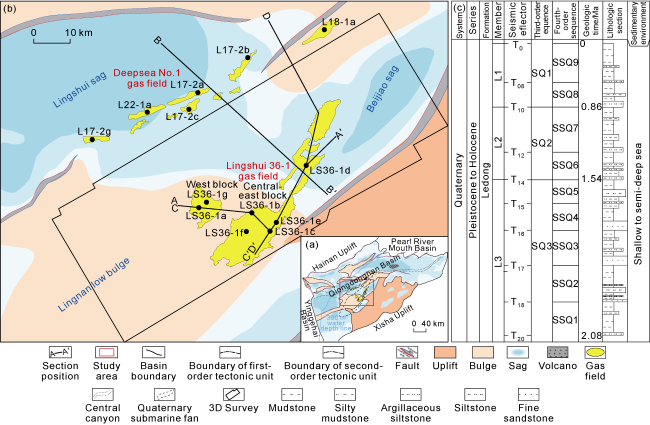
Fig. 1. Structural map of the Qiongdongnan Basin (a), location map of Lingshui 36-1 gas field (b), and comprehensive stratigraphic column of the Quaternary Ledong Formation (c). |
The Qiongdongnan Basin has experienced three major stages of tectonic evolution: rifting, rifting to subsiding, and subsiding. Vertically, it is a dual-interval structure featured by “bottom rift and top depression” [10]. During the rifting stage, the Eocene Lingtou Formation and the Lower Oligocene Yacheng Formation deposited. The former is lacustrine oil source rocks, and the latter is transitional (marine to continental) gas source rocks. The rifting stage created primary source rocks. During the transition stage from rifting to subsiding, the shallow marine Upper Oligocene Lingshui Formation deposited as large braided-river delta and (fan) delta which are primary middle to deep reservoirs [11]. Entering the subsiding stage, the Miocene Sanya Formation, Meishan Formation and Huangliu Formation, the Pliocene Yinggehai Formation and the Quaternary Ledong Formation deposited. The Central Depression began to shape as a semi-deep to deep marine sedimentary environment where gravity flow channels and submarine fans were developed. The Miocene to Pliocene formations are important reservoirs at shallow and middle depth [12-13]. The Quaternary Ledong Formation has recently attracted attention as an ultra-shallow exploration target.
The Quaternary Ledong Formation deposited when the basin subsided quickly. It is almost regional mudstone deposits, besides small deltas in the northern part and gravity flow deposits locally in the slope break zones and seabed plains. It is the primary reservoirs for ultra-shallow exploration [14]. Based on biostratigraphic data from drilled wells, lithological assemblages, seismic reflections, sea-level fluctuations in the South China Sea, and global glacial cycles, the Ledong Formation is divided into three third-order sequences and nine fourth-order sequences (Fig. 1c ).
2. Lingshui 36-1 gas field
Lingshui 36-1 gas field has advantages including shallow burial, good reservoir physical properties, extensive distribution, diverse gas sources, associated gas hydrates, and significant geophysical anomalies.
2.1. Basic geological characteristics
Lingshui 36-1 gas field is located on the Lingshui Low Uplift in the Qiongdongnan Basin, at water depth ranging from 1 500 m to 1 700 m. The primary target, namely the Quaternary Ledong Formation in lithological traps, is sandstone deposits in large deep-water submarine fans buried at 170 m to 300 m. Gas reservoirs are distributed northeast-southwest along the submarine fans. Each fan represents an individual gas reservoir ranging from 12 km2 to 155 km2. They are laterally zoned and vertically stacked, and with high gas saturation. The gas reservoirs are predominantly full of water or supported by edge water. According to well data, eight gas groups have been identified: L2I, L2II, L3I, L3II, L3III, L3IV, L3V, and L3VI on a large scale (Fig. 2 ).
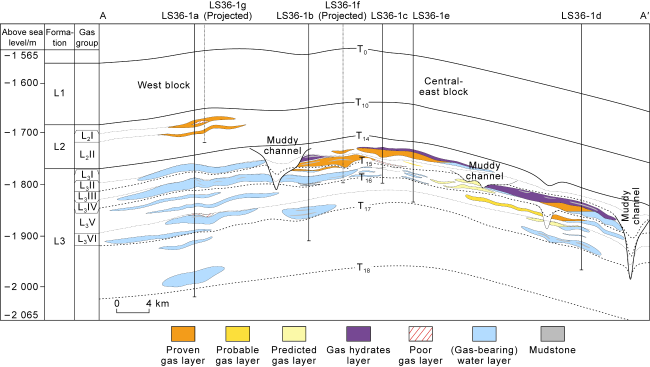
Fig. 2. Geological section of Ledong Formation gas reservoirs in Lingshui 36-1 gas field in the Qiongdongnan Basin (the section location shown in |
Specifically, two reservoir intervals were found in Lingshui 36-1 gas field: L2 and L3. The reservoirs are primarily siltstone and agillaceous sandstone, and some are fine sandstone. Affected by shallow burial and weak consolidation, the reservoirs exhibit high porosity and permeability. Borehole cores and sidewall cores show porosity ranging from 26.1% to 48.0%, and 38.9% on average, and permeability of (31.4-3 636.5)×10−3 μm2, and 983.7×10⁻³ μm2 on average, indicating high-porosity, medium-to-high permeability reservoirs.
According to well data, the difference in reservoir properties is mainly controlled by the evolutionary stages of the submarine fans and the depositional microfacies. Specifically, the sandstone depositing during the prosperous stage of the submarine fans is thicker and coarser, and the reservoir quality is better. In contrast, the sandstone depositing during the waning stage of the submarine fans is thinner and finer, and contains more mud, resulting in poorer reservoir quality. For example, Well LS36-1a encountered thick and coarse sandstone with low mud content, which belongs to the third member of the Ledong Formation depositing during the prosperous stage of the submarine fans. The distributary channel sandstone is fine to silty, with average porosity of 34.27%, mud content of 12.55% and good permeability. L2I and L2II are sheet sand depositing during the waning stage of the submarine fans. The sand bodies are smaller and thinner, only 2 m to 3 m thick each. The lithology is primarily argillaceous siltstone. The reservoir porosity is averaged 37.8%, the mud content is as high as 25.5%, and the permeability is poorer (Fig. 3 ).
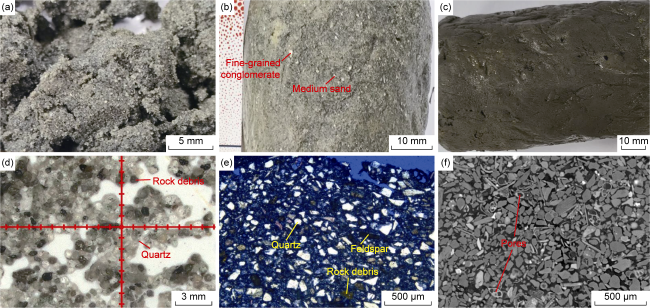
Fig. 3. Microscopic characteristics of sidewall cores of L3 reservoirs in Lingshui 36-1 gas field. (a) Loose, soft and uncemented gray siltstone with fine sand and 0.2-0.3 mm quartz, well sorted; 1 765.5 m; Well LS36-1c; sidewall core; (b) Loose, soft and uncemented gray siltstone with a small amount of fine to medium grains; 1 880.3 m; Well LS36-1d; sidewall core; (c) Blocky, weakly consolidated and well-formed gray mudstone; 1 952.0 m; Well LS36-1d; sidewall core; (d) Dominant fine quartz; 1 902.0 m; Well LS36-1a; washed cuttings; (e) Loose fine sandstone and a small amount of very fine sandstone dominated by quartz; 1 877.0 m; Well LS36-1a; cuttings thin section; (f) Grains show free and point contacts, weak compaction, angular to sub-angular, moderate to good sorting, and abundant bioclasts; 1 879.5 m; Well LS36-1d; core thin section. |
Two primary gas groups were tested. L3I was perforated 13.1 m, and obtained natural gas at 23.04×10⁴ m3/d, and the open flow is expected to 1 000×104 m3/d. L3II was perforated 10.3 m, and obtained natural gas at 28.94×10⁴ m3/d, and the open flow is expected to be 96.00×10⁴ m3/d. The two gas groups have commercial production capacity, and the proven gas reserves more than 1 000×108 m3 (Fig. 4 ).
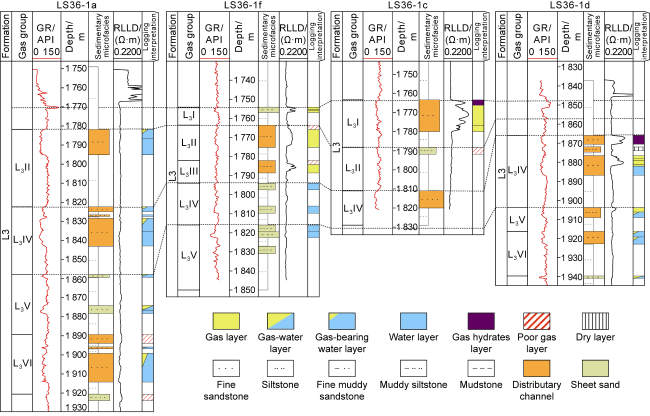
Fig. 4. Comparison of gas groups in drilled wells in Lingshui 36-1 gas field (the well locations shown in |
The natural gas in Lingshui 36-1 gas field is sourced from thermogenic and biogenic processes. Thermogenic gas is the result of thermal degradation of deep source rocks, while biogenic gas is originated from bacterial degradation of organic matter in shallow strata. Gas origin can be distinguished by analyzing methane carbon isotopic composition (δ13C1) and dryness coefficient (C1/C1-5). Biogenic gas is distributed in regions with smaller δ13C1 values and higher dryness coefficients, thermogenic pyrolytic gas is distributed in regions with larger δ13C1 values and lower dryness coefficients, and thermal cracking gas is between the two [15-16] (Fig. 5 ). Gas analysis indicates that methane is the primary component in different wells across Lingshui 36-1 gas field. The dryness coefficient ranges from 0.997 7 to 1.000 0, indicating dry gas. However, there are significant variations in the methane carbon isotopes, which may be caused by the differences in gas sources and migration conditions. Two wells were drilled in the western block of Lingshui 36-1 gas field. δ13C1 is -66.7‰ in Well LS36-1a and -55.2‰ in Well LS36-1g, suggesting primarily biogenic gas. Multiple wells drilled in the central and eastern blocks found δ13C1 ranging from -48.9‰ to -43.8‰, indicating thermogenic gas with a little biogenic gas. Furthermore, δ13C1 became lighter from structural low position (LS36-1d) to structural high position (LS36-1b/c), namely, lighter δ13C1 observed in structural high position (Table 2 ), indicating thermogenic gas migrates from structural low position to structural high position.
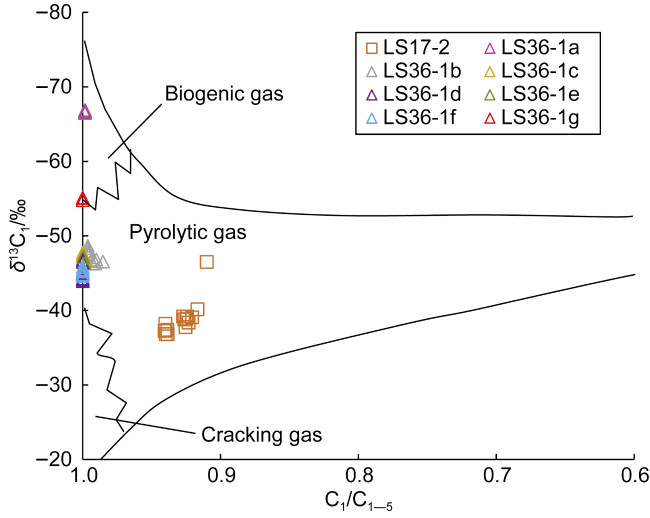
Fig. 5. Genetic identification of natural gas in Lingshui 36-1 gas field. |
Table 2. Composition and carbon isotope of natural gas in Lingshui 36-1 gas field |
| Well | Depth/m | Gas sampling method | Gas components/% | δ13C1/‰ | |||
|---|---|---|---|---|---|---|---|
| C1 | C2 | C3+ | C1/C1-5 | ||||
| LS36-1a | 404.7 | Cable-pressure sampling | 99.190 | 0.170 | 0.010 | 0.998 3 | -66.7 |
| LS36-1b | 204.2 | Cable-pressure sampling | 99.560 | 0.390 | 0.020 | 0.996 0 | -47.6 |
| LS36-1c | 195.1 | Cable-pressure sampling | 98.580 | 0.250 | 0.020 | 0.997 3 | -48.9 |
| LS36-1d | 239.8 | Cable-pressure sampling | 99.730 | 0.250 | 0.010 | 0.997 4 | -43.8 |
| LS36-1e | 205.2 | Cable-pressure sampling | 99.420 | 0.430 | 0.140 | 0.994 5 | -46.3 |
| LS36-1f | 189.6 | Cable-pressure sampling | 99.500 | 0.390 | 0.070 | 0.995 4 | -46.0 |
| LS36-1g | 170.8 | Cable-pressure sampling | 99.600 | 0.330 | 0.040 | 0.996 6 | -55.2 |
2.2. Geophysical characteristics
The ultra-deepwater and ultra-shallow strata are shallow, geologically young, and weakly consolidated, and both sandstone and mudstone have high porosity. When sandstone is saturated with water, the acoustic impedance between sandstone and mudstone is small, making it difficult to distinguish the two on seismic profiles. However, when sandstone contains gas, its P-wave velocity and density decrease rapidly, resulting in significant reduction in acoustic impedance, and a negative reflection coefficient on overlying mudstone, showing strong reflections in seismic data. When sandstone contains hydrates, its P-wave velocity increases significantly, making acoustic impedance raise, and a positive reflection coefficient on overlying mudstone, enhancing seismic reflections. Therefore, seismic reflections can qualitatively assess the gas-bearing potential of sandstone in ultra-deepwater and ultra-shallow formations. Additionally, when gas saturates sandstone, the formation often displays low VP/VS ratio, Class III-IV AVO anomaly and high-frequency attenuation. These properties allow for using petrophysical parameters and seismic inversion to help gas detection and prediction [17⇓⇓-20]. For instance in Well LS36-1c, the gas layers are characterized by low density, low P-wave velocity, low acoustic impedance, and low VP/VS ratio, while the hydrate-bearing layers show higher density, higher P-wave velocity, higher acoustic impedance, and higher VP/VS ratio (Fig. 6 ). In seismic data with positive polarity, the gas layers are reflected by low-frequency and strong-amplitude troughs, while the hydrate- bearing layers by low-frequency and strong amplitude peaks (Fig. 7a ). In seismic inversion data, the gas layers exhibit low acoustic impedance and low VP/VS ratio, while the hydrate-bearing layers correspond to high acoustic impedance and high VP/VS ratio (Fig. 7b, 7c ).
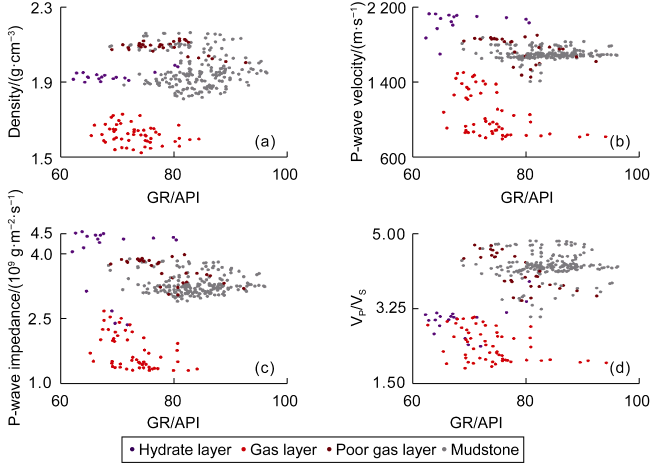
Fig. 6. Petrophysical analysis of deepwater ultra-shallow layers in Well LS36-1c. |
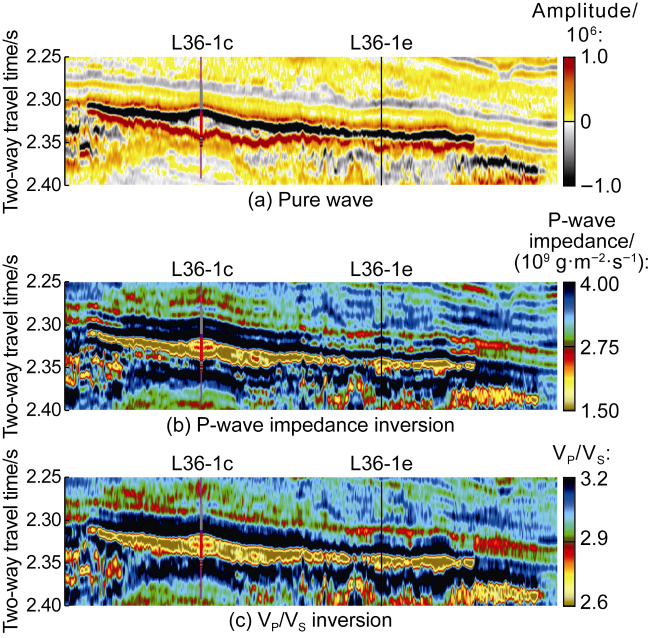
Fig. 7. Pre-stack inversion profiles across Well LS36-1c. |
The gas-bearing layers generally exhibit high resistivity (greater than 2 Ω·m), similar to the gas layers in middle reservoirs. Typical ultra-deepwater and ultra-shallow gas layers display logging responses characterized by high resistivity, low density, high AC, and low CN porosity (Figs. 3 and 6 ). Due to the increased gas saturation, the density of the gas layers decreases, and the CN porosity significantly decreases due to the “excavation effect”. The intersection of CN porosity and density is a key indicator for identifying ultra-deepwater and ultra-shallow gas layers. There is a positive correlation between resistivity and gas saturation in the study area, showing gas layers with high saturation exhibit high resistivity. In some wells, the highest resistivity reaches 91 Ω·m, corresponding to gas saturation of 82.2%. However, some gas layers exhibit resistivity below 2 Ω·m, with weak or no intersection between CN porosity and density. Pressure sampling confirmed that the lowest resistivity is 1.5 Ω·m, and the lowest gas saturation is approximately 20%. Previous studies suggested that low resistivity may be caused by factors such as high bound water content, low structural relief, near the gas-water contact, strong cation exchange conductivity, and drilling mud invasion [21-22]. In the study area, the fine reservoir has a higher clay content. The clay minerals exhibit strong adsorption, resulting in higher bound water content under weak compaction, and contributing to the low-resistivity gas layers. Additionally, some gas layers are located near the gas-water contact where lower gas saturation also contributes to low resistivity. Comprehensive analysis suggests that the gas layers have high bound water content and near the gas-water contact is the first factor causing low resistivity.
3. Conditions and mechanisms of ultra-deepwater and ultra-shallow gas accumulation
Taking Lingshui 36-1 gas field as an example, this section summarizes the accumulation conditions of ultra-deepwater and ultra-shallow gas reservoirs, including sufficient gas sources, good reservoirs and traps, effective cap rocks, efficient gas migration pathways, and favorable preservation conditions, and a new gas accumulation model is proposed, which is characterized by “double gas supply from deep and shallow sources, gas chimney and submarine fan as composite transport channels, three seals (deep mudstone, mass transport deposits (MTDs) and hydrate layers) and Quaternary submarine fans”.
3.1. Gas sources
Deep thermogenetic gas and shallow biogenic gas are two sources. Thermogenetic gas is the result of thermal degradation of organic matter in deep source rocks, which is primarily hydrocarbon gas. The volume of thermogenetic gas depends on the type, abundance and thermal maturity of organic matter, and the volume of source rock. Biogenic gas is mainly methane generated from the degradation of organic matter in shallow source rocks under the metabolic activities of various microbial populations. The volume of biogenic gas depends on the number of methane bacteria, the abundance of organic matter, the volume of source rock, and the temperature suitable for methane bacteria activity.
The deepwater source rocks are the Oligocene Yacheng Formation of marine-to-continental transition facies and the Miocene Lingshui Formation of marine facies. The TOC ranges from 0.4% to 2.1%, and averaged 0.86%. The organic matter is types II2-III. The gas generation potential is up to 55×1012 m3. The temperature suitable for methane bacteria activity is between 30 °C and 70 °C, which takes place in the marine mudstone in the Lingshui Formation, the Yinggehai Formation and the Huangliu Formation. Unfortunately, no suitable samples are available for biogenic gas simulation experiments. According to the analysis of organic carbon and pyrolytic data from shallow mudstone samples in the deepwater area of the Lingshui sag, the TOC is 0.3% to 1.8%, and averaged 0.58%, and the organic matter is of type III. Using the biogenic gas production model of the Miocene-Quaternary mudstone in the adjacent Yinggehai Basin [23], the simulated biogenic gas production in the deepwater area of the Qiongdongnan Basin is approximately 7×10¹² m3.
Additionally, the stable hydrate zone is favorable for long-term gas accumulation and preservation. Traditionally, it is believed that only a small portion of gas generated by source rocks accumulates in the traps on the migration path, but most gas eventually escapes into the air. This idea is only applicable for shallow-water accumulation, but not for deepwater gas which is different in migration and accumulation. The central depression of the Qiongdongnan Basin has gradually entered a deepwater environment since the Neogene, and the ultra-shallow layers have suitable conditions for hydrate development. Gas migrating into the stable layers is stabilized in the form of hydrates, especially in the ultra-deepwater area where the stable hydrate zone remains long, helping prevent gas escaping into the atmosphere.
3.2. Reservoirs and traps
Ultra-deepwater and ultra-shallow reservoirs are far from source rocks. The development of big gas fields depends on the presence of high-quality reservoirs. Ultra-deepwater and ultra-shallow formations are almost mudstone, but gravity flow sandstone transporting a long distance is primary reservoir, generally in gravity flow channels and submarine fans. Enclosed by mudstone, the deepwater gravity flow sandstone may form into lithologic and structural-lithological traps if effective seals are available.
In the Qiongdongnan Basin, two types of submarine fans were developed in the Quaternary Ledong Formation deepwater area: Hainan Island-sourced slope fan and Vietnam-sourced large channelized submarine fan. These are the most important reservoir types in the ultra-deepwater and ultra-shallow formations in the Qiongdongnan Basin. The Hainan Island-sourced slope fans are predominantly located in the northern continental slope, influenced by linear sources and slope geomorphology. They are scattered with NW-SE elongated, tongue-shaped, or lobe-shaped features. After the Late Miocene, source supply from the Hainan Island became insufficient, resulting in smaller, thinner slope fans with common physical properties. The large Vietnam- sourced channelized submarine fans are developed in the continental uplift, controlled by the source from the Vietnam Kontum uplift and restrictive ancient landforms. They are in a SW-NE elongated shape. Since the Late Miocene, the Qiongdongnan Basin has developed a restrictive paleogeomorphology high in the north and the south and low in the center, followed by an axial sedimentary system [24⇓⇓-27]. Since the Quaternary, as the global sea level declined rapidly, water systems such as the Thu Bon River in the Kontum Uplift sent a big volume of sediments into the basin through continental canyons, where the sediments accumulated into large channelized submarine fans on the top of the restrictive paleogeomorphology in the western deepwater area [14]. The Quaternary submarine fans have the longest axial length of approximately 150 km, and the largest width of up to 40 km, and cover over 3 000 km2. They are high-quality reservoirs. Based on the fourth-order sequence, the submarine fans are subdivided into six phases and three stages, including initial phase (SSQ1), flourishing phases (SSQ2-SSQ4), and declining phases (SSQ5-SSQ6), and tend to migrate southeastward (Fig. 8 ). The gas groups in Lingshui 36-1 gas field are primarily located in the fifth and sixth phases of submarine fans, and the reservoir microfacies are almost fan center distributary channels and sheet sands.
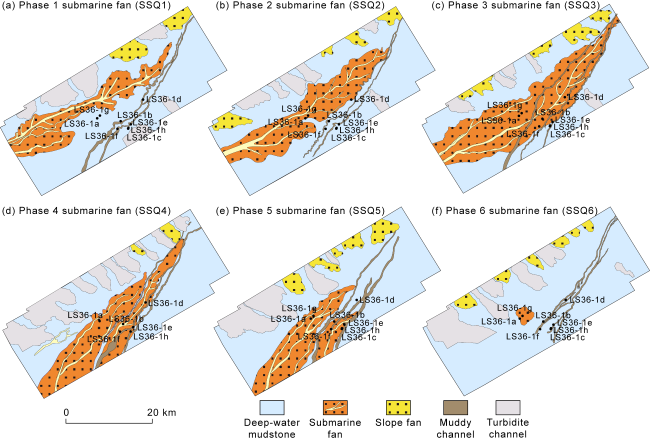
Fig. 8. Sedimentary facies of the Quaternary Ledong Formation in the Qiongdongnan Basin (see the 3D survey scope in |
In the ultra-deepwater and ultra-shallow formations in the Qiongdongnan Basin, traps are primarily lithologic and structural-lithologic, and some are low-relief anticlinal traps. The large Vietnam-sourced submarine fans are vertically developed into six phases, and multiple sand bodies developed every phase (Fig. 9 ). The sand bodies are stacked in multiple phases vertically, exhibiting complex connectivity. Laterally, they are fragmented by mudstone channels or massive turbidite deposits as lateral seals, and vertically capped by interlayer or regional cap rocks, forming extensive lithologic trap groups.
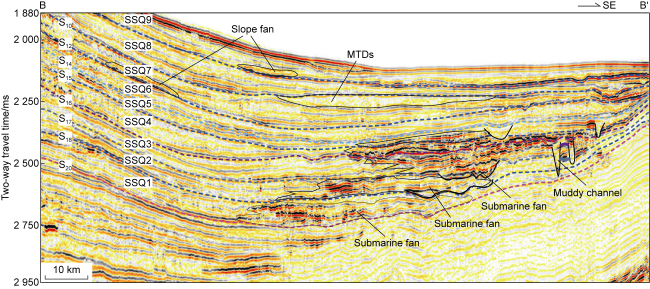
Fig. 9. Typical seismic profile of vertical sources to submarine fans in the Quaternary Ledong Formation, Qiongdongnan Basin (the section location shown in |
3.3. Cap rocks and sealing mechanisms
Traditional view suggests that uncemented or weakly cemented ultra-deepwater and ultra-shallow formations have limited sealing capabilities, so that natural gas is difficult to accumulate on a large scale. However, exploration practices have demonstrated that natural gas can accumulate substantially in these environments, and that uncemented or weakly cemented strata possess sealing capabilities. To evaluate these sealing capabilities, cap rocks and sealing mechanisms were investigated in ultra-deepwater and ultra-shallow formations.
Studies indicate that the ultra-deepwater and ultra-shallow formations have three types of effective cap rocks: deep-sea mudstone, mass transport deposits, and hydrate-bearing layers. Deep-sea mudstone deposits slowly and it’s pure, typically shows medium to weak amplitude, parallel and continuous reflections on seismic profiles. mass transport deposits is deposits from instable and collapsed slope sediments, generally appears as weak amplitude and chaotic reflections on seismic profiles. Hydrate layers where natural gas migrates to the hydrate stability zone and stores in reservoir pores in a solid state exhibit strong amplitude and continuous reflections on seismic profiles, often marked by Bottom Simulating Reflections (BSRs) (Fig. 10 ).
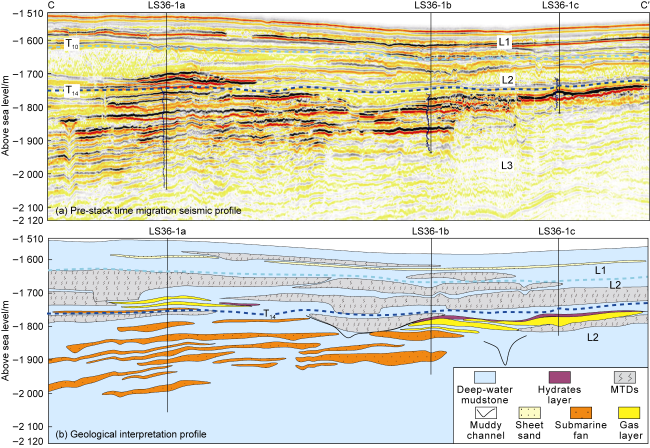
Fig. 10. Types and characteristics of ultra-shallow caprocks in ultra-deepwater area in the Qiongdongnan Basin (the section location shown in |
Furthermore, cap rocks can be categorized into interbedded and regional cap rocks according to their locations and thickness. Interbedded cap rock is mudstone between reservoirs, and thin and unstable in lateral distribution. Regional cap rock is the topmost cover on a gas field and stable in distribution. Most gas reservoirs in Lingshui 36-1 gas field are covered by regional cap rock, and a fewer are sealed by thick interbeds. The thickness and stability of cap rocks play a crucial role in gas accumulation in ultra-deepwater and ultra-shallow formations.
The sealing mechanisms of cap rocks in ultra-deepwater and ultra-shallow formations primarily involve capillary pressure and brine saturation. Capillary pressure sealing occurs when the gas buoyancy in reservoirs is less than the capillary pressure in cap rocks. Buoyancy depends mainly on hydrocarbon density and column height. Capillary pressure is influenced by hydrocarbon-water interfacial tension, wetting angle, and pore throats in cap rock. According to the borehole and sidewall cores, the deep-water mudstone is fine and pure, and more consolidated and adhesive than the sandstone (Fig. 3c ). With smaller pore throats and higher capillary pressure, the mudstone is effective to seal natural gas [28]. Compared to shallow-water environment, ultra-deepwater environment is featured by low temperature, high pressure and high pore-water interfacial tension. As gas density increases, buoyancy reduces, resulting in higher capillary pressure in deep-water mudstone than shallow-water mudstone at the same burial depth.
Brine saturation sealing occurs when the breakthrough pressure of mudstone increases. Core physical simulation experiments show that as formation water saturation increases, the breakthrough pressure of mudstone increases exponentially [29-30]. Comparative studies suggest that deep-water mudstone after saturated with seawater in Lingshui 36-1 gas field has a diffusion coefficient close to that of a conventional good cap rock, which significantly improves the sealing capability.
Mass transport deposits suffering from strong shear deformation and drainage during transport [31] exhibit higher density, lower porosity, and greater acoustic velocity than normal sedimentary mudstone, which can enhance its sealing capacity. Hydrate-bearing strata where hydrates fill the pores in a solid state not only significantly reduce formation porosity but also greatly increase formation hardness and breakthrough pressure, effectively sealing natural gas. Several wells have discovered gas beneath hydrate-bearing strata (Fig. 2 ). Generally, capillary pressure is the dominant sealing mechanism, and brine saturation is a supplementary factor in the study area.
3.4. Gas migration
Natural gas migration in the ultra-deepwater and ultra-shallow formations is diverse. Native biogenic gas can directly enter and accumulate in traps through diffusion. Allochthonous biogenic gas or thermogenic gas migrates through vertical pathways such as faults, gas chimneys and fractures, or large sand bodies, unconformities, which form a composite migration framework.
In the Qiongdongnan Basin, two gas migration ways were identified in the ultra-deepwater and ultra-shallow formations:
(1) Vertical migration. Deep-water faults are almost developed in the Paleogene strata, but only a few faults in the Neogene connecting deep hydrocarbon source rocks. Studies indicate that relying solely on diffusion is inefficient for gas migration, so that it is difficult for natural gas to accumulate substantially in a short period. Vertical pathways such as gas chimneys and vertical fractures are essential for gas migration [10-11]. Influenced by recent tectonic movements, gas chimneys and vertical fractures are widely distributed in the Lingshui sag, the Linnan low bulge, and the Songnan low bulge [32]. Seismic reflections typically appear as irregular and columnar diffuse bands (Fig. 11 ). Attributes like ant body reflect dense microfractures in the diffuse bands. Seismic velocity analysis indicates low velocities at the peripheries of these features, highlighting their role as crucial migration pathways. Biogenic gas encountered in Lingshui 36-1 gas field primarily transports into traps through these gas chimneys and vertical fractures.
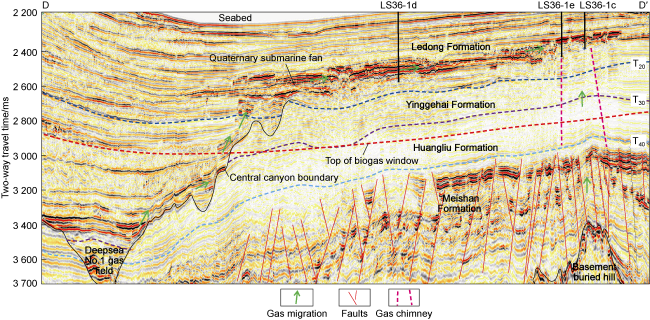
Fig. 11. Seismic section showing natural gas migration in Lingshui 36-1 gas field (the section location shown in |
(2) Composite migration. Composite migration pathways are formed by combining lateral migration routes, such as large sand bodies and unconformities, with vertical migration pathways like faults, gas chimneys, and fractures. Drilling results confirm that the primary component of gas in Lingshui 36-1 gas field is deep thermogenic gas. However, there are no mature source rocks on the Linnan low bulge above the gas field, and the field is located far from the sag center. How does thermogenic gas migrate over a long distance to accumulate in the target area? A unique gas transport way in the ultra-deepwater and ultra-shallow formations has been identified based on the detailed characterization of migration paths: lateral migration through the central canyon sandstone and continuously stacked accumulation. Since the Miocene, the central canyon system along the axis of the Qiongdongnan Basin has developed successively and migrated southeastward under the control of ancient geomorphology. The canyon contains large submarine fans and turbidite channel sandstone, including the submarine fan in the Meishan Formation, canyon channel in the Huangliu Formation, restrictive submarine fan in the Yinggehai Formation, and weakly restrictive submarine fan in the Ledong Formation. These sandstones are large, laterally continuous, and stacked, forming a unique lateral relay migration channel from the mid-deep to ultra-shallow formations in the central canyon system. Deep thermogenic gas enters the central canyon through vertical migration pathways such as faults, gas chimneys, and fractures, and then migrates through the distinctive lateral relay transport channels to the ultra-shallow Ledong Formation submarine fans, and eventually accumulates into the lithologic traps on the structural ridges on the tops of the submarine fans (Figs. 1a and 11 ). Geochemical analysis shows that gas in Lingshui 36-1 gas field is almost thermogenic gas from deep mature source rocks, besides a small amount of biogenic gas. Moreover, Lingshui 36-1 gas field shares a gas source with the Deepsea No. 1 gas field in the Central Canyon, confirming the composite transport system.
4. Accumulation models and resource prospects
Compared to the ultra-shallow gas reservoirs in Ledong 22-1 gas field in the Yinggehai Basin, the accumulation of ultra-deepwater and ultra-shallow gas in Lingshui 36-1 gas field in the Qiongdongnan Basin is very different.
(1) Sedimentary environment and reservoir types. In the shallow water area, the continental shelf is a sandy environment with reservoirs mainly consisting of delta and offshore sandbar deposits. In contrast, the ultra- deepwater environment is characterized by muddy sediments, with reservoirs primarily composed of gravity flow deposits such as submarine fans and channels.
(2) Cap rock types and sealing mechanisms. In the shallow water area, the cap rock is mudstone, while in the ultra-deepwater area, the cap rocks are not only deepwater mudstone but also mass transport deposits and hydrate-bearing strata, which enhance the sealing capability under low-temperature and high-pressure conditions.
(3) Trap types. The shallow water area is rich in sand, typically has structural traps that are almost anticlinal. In the ultra-deepwater area, sediments are almost mud, traps are lithological, with some low-relief structural traps.
(4) Pressure and temperature. The temperature is lower and the pressure is higher in the ultra-deepwater area than in the shallow water area. The gas abundance is higher, which was confirmed by PVT experiment finding the gas volume factor from 210 to 240 in the ultra-deep-water setting.
(5) Gas escape and preservation: In the shallow water area with sandy sediments and without hydrate stability zones, gas is more likely to escape to the seabed. Conversely, in the ultra-deepwater area, mudstone and hydrate stability zones are not only helpful to carbon sequestration, but also prevent gas from escaping.
In conclusion, ultra-deepwater and ultra-shallow gas shows a greater exploration potential.
Based on this study, the accumulation model for ultra-deepwater and ultra-shallow gas in the Qiongdongnan Basin is summarized as follows: Deep mature thermogenic gas source and shallow biogenic gas source provide a robust foundation for large gas fields. Large submarine fans are primarily siltstone and mudstone reservoirs in the Quaternary Ledong Formation, weakly cemented, and of high porosity and permeability. Lithological trap groups controlled by submarine fans are vertically stacked and laterally blocked. Deep-water mudstone, mass transport deposits and hydrate- bearing strata act as regional or interlayered cap rocks. The former is thick and effective, while the latter is thin and less stable. Vertical and composite transport systems ensure effective gas migration. The vertical system (including gas chimneys and fractures) is primarily for biogenic gas, while the composite system (lateral migration routes like large sand bodies and unconformities and vertical migration pathways such as faults and gas chimneys) is primarily for thermogenic gas. New ultra-shallow traps formed recently (less than 0.5 Ma) are still receiving gas, where the gas-water transition zone is long and gas is not completely differentiated from water. After migrating for a long distance, gas eventually accumulates into the structural ridges on the submarine fans. In conclusion, the gas accumulation model in Lingshui 36-1 gas field is featured by “double gas sources, two gas transport systems, three seals, late dynamic and fan ridge accumulation”, which supports an exploration strategy for all shallow, middle and deep structures in the Qiongdongnan Basin (Fig. 12 ).
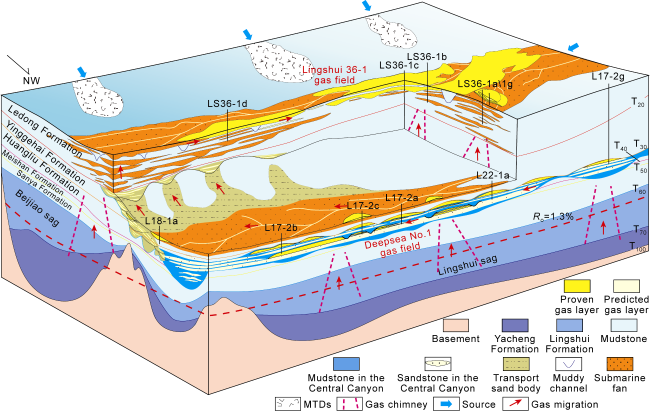


Fig. 12. Gas accumulation model of the ultra-shallow reservoirs in the deepwater area in the Qiongdongnan Basin. |
Lingshui 36-1 gas field has proven reserves exceeding 1000×108 m3, demonstrating the exploration value of the ultra-deepwater and ultra-shallow reservoirs. China has vast deepwater territorial formations primarily located in the South China Sea such as the Qiongdongnan, Pearl River Mouth, Taixinan, Liyue, Nanweixi, and Beikang Basins, with substantial ultra-shallow resources. Preliminary evaluations suggest that the potential gas resources in the Qiongdongnan Basin exceed 3 000×108 m3, 800×108 m3 in the Pearl River Mouth Basin, and 20 000× 108 m3 in the Liyue and Nanweixi Basins, which are important exploration targets. Additionally, there are rich hydrate resources. Utilizing ultra-shallow gas to develop hydrates is promising, and important for clean energy supply. A large sandstone reservoir exceeding 3 000 km2 discovered in the Qiongdongnan Basin is suitable for CO2 storage into hydrates and saline aquifers, and of practical significance for theoretical research and achieving “dual carbon” goals [33-34].
5. Conclusions
The Lingshui 36-1 gas field in the Qiongdongnan Basin is the first ultra-deepwater and ultra-shallow gas field discovered in China. The primary target is the deepwater submarine fans of the Quaternary Ledong Formation, containing siltstone and argillaceous siltstone reservoirs with high to very high porosity and moderate to very high permeability. Over 99% of the natural gas is methane, with δ13C1 ranging from -66.7‰ to -43.8‰, and from thermogenic and biogenic gas sources. Drilling data had confirmed that the gas reservoirs are primarily located below the regional cap rocks. One sand body is an independent reservoir with high gas saturation, and the traps are full of gas. Associated hydrates were also found.
Key conditions for gas accumulation in ultra-deepwater and ultra-shallow formations include: (1) deep mature thermogenic gas and shallow biogenic gas contribute to the gas reserves; (2) gravity flow deposits including submarine fans and channels provide effective reservoirs; (3) lithological traps; (4) deep-sea mudstone, mass transport deposits and hydrate layers as reginal and interlayered caprocks; (5) vertical and composite migration systems; (6) stable geological setting including thick regional mudstone and hydrate stability zones for oil and gas preservation.
The ultra-deepwater and ultra-shallow gas accumulation model in the Qiongdongnan Basin is characterized by “double gas sources, composite transport system (gas chimneys and submarine fans), three seals (deep-sea mudstone, mass transport deposits and hydrate layers), late dynamic and fan ridge accumulation”. This model offers valuable insights for future exploration and development of similar fields.