

Introduction
The Ordos Basin is a typical superimposed basin on the craton in the west of North China plate, with many sets of hydrocarbon-bearing strata. At present, the largest oil and gas production base in China has been built in this basin. In the Ordovician Majiagou Formation in the central-eastern part of the basin, carbonate-gypsum salt combination is well developed with large sedimentary thickness and wide distribution area, being one of the important target strata for marine carbonate gas exploration in the basin [1⇓-3].
In the early stage, the natural gas exploration in the Lower Paleozoic mainly focused on the natural gas reservoir in ancient weathering crust at the top of the Majiagou Formation represented by the Jingbian gas field[1⇓⇓⇓⇓⇓⇓-8]. The exploration of subsalt and deep layers in the Majiagou Formation is still in the stage of continuous exploration [1⇓-3,9⇓⇓⇓ -13]. Years of drilling results have proved that the Ordovician subsalt strata, especially the fourth Member of Majiagou Formation (Ma 4 Member for short), has the great potential for large-scale natural gas exploration due to the widely distributed dolomite with good physical properties, in which the reservoir space is dominated by dissolved vugs and intercrystalline pores. However, only a few exploration wells have low gas production, and the overall geological understanding and exploration degrees remain lower.
Previous researchers have carried out a series of studies on the lithofacies paleogeographic pattern, sedimentary facies types and distribution and reservoir-forming models of the Ordovician subsalt structures in the basin[1⇓⇓-4,9⇓⇓⇓⇓⇓⇓⇓ -17], but there are still some disputes and limitations. Whether there are large-scale reservoir-forming geological conditions and exploration potential in Ordovician subsalt strata need to be further explored and clarified. Among them, lithofacies paleogeographic features, distribution of high-energy granular beach, effective hydrocarbon supply mode and potential, main reservoir-forming controlling factors and favorable exploration zones are the keys to restricting the breakthrough of exploration.
Based on a large number of drilling, well logging and seismic data, and the study on the reconstruction of the tectonic-sedimentary evolution, key controlling factors on reservoir formation in the Ordos Basin, this paper systematically analyzes the control effect and influence of the development and evolution of the central paleo-uplift on the subsalt deposition, reservoirs and hydrocarbon accumulation of the Majiagou Formation, and establishes the new model of large-scale hydrocarbon supply from the Upper and the Lower Paleozoic, the composite hydrocarbon migration systems by faults, fractures and dolomites with high porosity and permeability, the large- scale hydrocarbon accumulation in extensive dolomite lithologic traps, hydrocarbon enrichment in high parts of local structures. It provides a scientific basis for understanding about natural gas accumulation in subsalt Ma 4 Member and promoting exploration breakthroughs.
1. Exploration breakthroughs and natural gas characteristics of Ordovician subsalt Ma 4 Member
1.1. Exploration history of subsalt strata
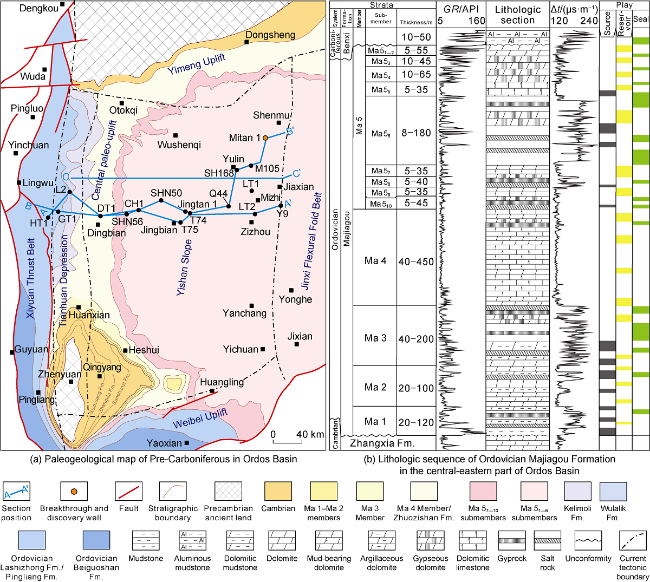
The Ordovician Majiagou Formation is mainly developed in the central-eastern part of the Ordos Basin (Fig. 1 a). The longitudinal lithologic sequence is a set of interactive combination of multicycle carbonate rocks and gypsum-salt rocks. Thick gypsum-salt rocks are well developed in Ma 56 submember. Due to the good sealing effect of this set of gypsum-salt rocks, two sets of natural gas plays (reservoir-forming combination) of "suprasalt" and "subsalt" are well developed (Fig. 1 b). For the Ma 51-5 submembers of "suprasalt" play, it mainly develops gas reservoirs in paleokarst weathering crust [2,12] with a high degree of exploration. Several giant gas fields, such as Jingbian and Daniudi, with gas reserves more than one trillion cubic meters have been found. For the Ma 57 submember to Ma 1 Member of "subsalt" play, it has lower exploration degree and insufficient geological understanding. At present, only the karst weathering crust type gas-rich area has been found in Ma 57-10 submembers in the denuded karst area of the eastern side of the central paleo-uplift. In the gypsum-salt sedimentary area in the eastern part of the basin, more than 20 exploration wells have been deployed successively in recent 30 years, and only few of them have obtained industrial gas flows in Ma 57-9 submembers. No great hydrocarbon exploration breakthrough has been made from Ma 4 to Ma 1 members. Especially, most exploration wells produced only water from the relatively developed dolomite reservoir in Ma 4 Member. A small number of exploratory wells produced low gas production, but not reached the commercial productivity.
1.2. Major exploration breakthroughs and natural gas characteristics
At the beginning of 2020, inspired by the new understanding that paleo-uplifts control the sedimentary facies, reservoirs and hydrocarbon accumulation, the favorable areas were comprehensively evaluated and optimized, and two risk exploration wells (Well Mitan 1 and Well Jingtan 1) were drilled to mainly explore the gas-bearing property of extensive dolomite lithologic trap in subsalt Ma 4 Member, and simultaneously explore the Ma 57 submember, Ma 59 submember and Ma 2 Member.
Both Well Mitan 1 and Well Jingtan 1 encountered thicker gas reservoirs in the Ma 4 Member. Among them, Well Mitan 1 has encountered three gas layers with a total thickness of 24.6 m and four gas-bearing layers with a total thickness of 10.7 m in the middle-lower part of the Ma 4 Member. The reservoir lithologies are mainly porphyritic calcareous dolomite and porphyritic dolomitic limestone. The reservoir space is mainly intercrystalline pores with porosity of 2.5%-8.5%. In June 2021, pre-acid slick water and ceramsite were used for fracturing, and the production was conducted by "one point method". The daily gas production was 8.4×10⁴ m3 by 15 mm orifice plate, and the calculated open flow was 35.2×10⁴ m3, with H2S content of 50.13 g/m3 and formation pressure coefficient of 1.5. Well Jingtan 1 has encountered 9.2 m of gas-bearing layer in the Ma 4 Member, 2.1 m of gas layer and 5.0 m of gas-bearing layer in the Ma 56 submember, and 2.3 m of gas-bearing layer in the Ma 57 submember. The reservoir lithologies are mainly porphyritic calcareous dolomite and porphyritic dolomitic limestone. The reservoir space is mainly composed of intercrystalline pores, fractures and dissolved pores, with porosity of 2.1%-6.7%. However, due to the excessive H2S content of 385.30 g/m3 in the formation and serious casing acid corrosion, the well was forced to shut in (Table 1 ).
Table 1. Comprehensive well logging interpretation results and gas production test data of Well Mitan 1 and Well Jingtan 1 |
| Well | Layer | Lithology | Comprehensive well logging interpretation | Pore type | Porosity/ % | Permeability/ 10-3 μm2 | Mid-depth of perforated interval/m | Formation pressure coefficient | Daily gas production/ 104 m3 | H2S content/ (g·m-3) | Conclusion |
|---|---|---|---|---|---|---|---|---|---|---|---|
| Mitan 1 | Ma 4 Member | Dolomite | 3 gas layers of 24.6 m; 4 gas-bearing layers of 10.7 m | Intercrystalline pore, intergranular pore, microfracture | 2.50- 8.50 | 0.004- 1.690 | 2700.0 | 1.5 | 8.4 | 50.13 | Commercial gas layer |
| Jingtan 1 | Ma 4 Member | Dolomite | 4 gas-bearing layers of 9.2 m | Intercrystalline pore, fracture and dissolved pore | 0.29- 8.97 | 0.120- 0.210 | 3808.5 3848.0 | 385.30 |
The natural gas in Well Mitan 1 is mainly composed of methane, with drying coefficient of 0.946. The compari son between the natural gas of Well Mitan 1 and that from the weathering crust gas reservoir at the Ordovician top of the source rock of Upper Paleozoic coal measures[10] shows that their component characteristics are very similar. The average carbon isotopic composition of methane of natural gas in Well Mitan 1 is -44.8‰ (Table 2 ), which is lighter than that of weathering crust gas reservoir at Ordovician top and sandstone gas reservoir in the Upper Paleozoic (-39.50‰ to -32.43‰) [18], but their carbon isotopic compositions of ethane are similar (-25.48‰ to -22.59‰)[18]. According to the data of natural gas component and carbon isotope composition, the natural gas in Well Mitan 1 has the similar characteristics of coal-type gas, but also some differences at the same time. On the one hand, it may be related to isotopic gravity fractionation during hydrocarbon expulsion and migration of Upper Paleozoic coal measures source rock[18]. On the other hand, it reflects that the natural gas in Well Mitan 1 is not from a single source, and there may be mixed gas supply from the Lower Paleozoic marine argillaceous rocks.
Table 2. Characteristics of natural gas composition and carbon isotope component of perforated interval in Ma 4 Member of Well Mitan 1 |
| Parameter | Value | Parameter | Value |
|---|---|---|---|
| CH4 content | 93.625% | HC content | 98.599% |
| C2H6 content | 3.077% | Drying coefficient | 0.946 |
| C3H8 content | 0.967% | δ13C1 | -44.8‰ |
| iC4H10 content | 0.526% | δ13C2 | -25.3‰ |
| nC4H10 content | 0.305% | δ13C3 | -23.4‰ |
Well Mitan 1 is the first well with commercial gas flow in natural gas exploration in the subsalt Ma 4 Member of the Ordos Basin in recent 30 years, making a historic breakthrough in this domain. It has been confirmed that large-scale hydrocarbon accumulation might occur in the Ma 4 Member in Mizhi zone in the eastern part of the basin. At present, it is predicted that the favorable exploration area of the Ordovician subsalt Ma 4 Member is 2.4×10⁴ km2, which is expected to be a new layer for natural gas exploration in the central-eastern part of the Ordos Basin and realize the exploration concept of "looking for another Jingbian gas field below the current Jingbian gas field ".
2. Central paleo-uplift controlled the lithofacies paleogeographic pattern of the basin during the sedimentary period of the Ordovician Majiagou Formation
The central paleo-uplift of the Ordos Basin is a large low-uplift structure developed during the Early Paleozoic period. The main body was located in Dingbian-Wuqi- Qingyang-Huangling region, which was roughly in an "L" shape on the plane [12,20]. It originated from the bedrock paleo-uplift at the edge of the Proterozoic rift trough, the embryonic shape was developed in the Late Cambrian. The central paleo-uplift flourished in the Ordovician and disappeared in the Late Permian [4,8,20⇓⇓⇓ -24]. It played an important role in controlling the lithofacies paleogeography during Ordovician in the Ordos Basin.
During the sedimentary period of the Ordovician Majiagou Formation, the Ordos Basin was in the marine carbonate platform sedimentary environment of craton margin under the background of back-arc extension. In addition, with the basin being controlled by near north- south shear-compression stress [24], the development of the central paleo-uplift reached its peak. It separated the North China Sea and the Qinqi Sea, and controlled the tectonic paleogeographic environment and lithofacies of the central-eastern part and the southwest margin of the basin (Figs. 2 and 3 ). Large lagoon sedimentary system was mainly developed in the central-eastern part of the basin, and platform margin sedimentary system was mainly developed around the basin [1-2,23].
During the sedimentary period of the Ma 1 Member, transgression began in the basin. Gradually overlying towards the central paleo-uplift, the Ma 1 Member widely developed in the central-eastern part of the basin, with major lithology of dolomite and gypsum-salt rock. During the sedimentary period of the Ma 2 Member, the transgression scale was further expanded, and was widely developed except for in Qingyang and Yimeng paleo-uplifts. In the central paleo-uplift, dolomite was dominated, while dolomite and limestone were dominated in the central-eastern part of the basin. During the sedimentary period of the Ma 3 Member, the sea level fluctuated many times, and the central paleo-uplift was exposed intermittently. The Ma 3 Member was widely developed except in Qingyang and Yimeng paleo-uplifts. In the central paleo-uplift, argillaceous dolomite was dominated, while gypseous dolomite and gypsum-salt rocks were dominated in the central-eastern part of the basin. During the sedimentary period of the Ma 4 Member, the transgression scale reached the peak, the Ma 4 Member was widely distributed in the central-eastern part of the basin, with major lithology of dolomite and limestone. The central paleo-uplift turned into underwater low uplift, with obvious characteristics of carbonate buildup and very thick hummocky dolomite deposits. During the sedimentary period of the Ma 5 Member, the sea level fluctuated in several stages, and the central paleo-uplift was exposed intermittently, forming the cyclic deposits of residual dolomite and gypsum-salt rocks in the central-eastern part of the basin.
As described above, under the sedimentary background controlled by the central paleo-uplift, the Majiagou Formation in the central-eastern part of the basin was characterized by the interactive deposition of evaporation platform facies and limited-open platform facies. Vertically, multiple sets of lithologic sequences of alternating interbedding of gypsum-salt rock in salinized lagoon subfacies and dolomite and limestone of tidal flat subfacies [11]. Horizontally, from the central paleo-uplift to the east, dolomite gradually thinned and changed into limestone or gypsum-salt rocks (Figs. 1 and 2 ). During the sedimentary period of the Majiagou Formation in the southwest margin of the basin, slope facies deposition was dominated, and the water body gradually deepened longitudinally, with dolomite, limestone and calcareous mudstone developed. The lithology change was not obvious horizontally (Fig. 2 ).
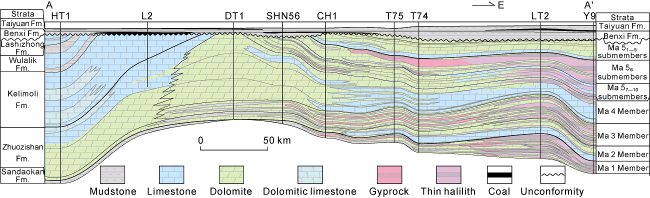
Fig. 2. EW-trending section of Ordos Basin during the sedimentary period of Carboniferous Taiyuan Formation (see |
In addition, the central paleo-uplift controlled the lithofacies paleogeographic environment during sedimentary period of the Majiagou Formation, and also controlled the karst paleogeomorphology at the end of the Ordovician (Figs. 2 and 3 ). From the Late Ordovician to the Middle Carboniferous, the basin was uplifted as a whole, and the top of the Majiagou Formation was weathered and denuded for 120-150 Ma. From the current truncation characteristics of the strata at the top of the Majiagou Formation, the paleogeomorphology in the central- eastern part of the basin had presented peneplanation features when it received the Late Carboniferous deposits again. The central paleo-uplift was denuded to the Ma 4 Member. The eroded and exposed strata became younger eastward. A series of karst paleogeomorphology such as karst highland, karst slope and karst basin were formed. The "drape-style" sedimentation of the Late Carboniferous-Early Permian strata made the submembers of the Majiagou Formation in the central-eastern part of the basin contact with the overlying Carboniferous-Early Permian coal measures layer by layer due to truncation [4⇓-6].
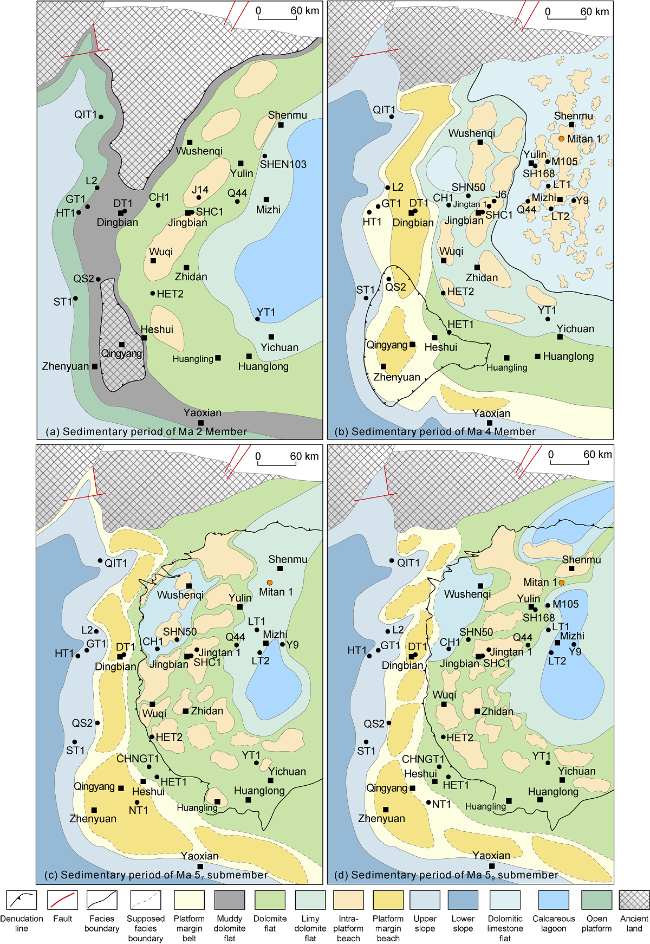
Fig. 3. Lithofacies paleogeography maps of main sedimentary periods of Ordovician Majiagou Formation in Ordos Basin. |
3. Paleotectonic-sedimentary evolution background laid a good foundation for large-scale hydrocarbon accumulation in subsalt strata
3.1. Paleotectonic background controlled the deposition of granular beach facies inside the platform of multi-layer system in subsalt strata in central-eastern part of the basin
The central paleo-uplift controlled the development of the platform margin beach during the sedimentary period of the Ma 4 Member, and affected the development of the mounds and beaches in the intra-platform of the eastern central paleo-uplift.
In the sedimentary period of the Ma 4 Member, controlled by the formation and evolution of the central paleo-uplift, two underwater low uplift belts, Wushenqi- Jingbian and Shenmu-Mizhi, were developed in the central-eastern part of the basin (Fig. 4 ), distributed in near SN direction on plane. The Wushenqi-Jingbian underwater low uplift zone is 60-80 km wide from east to west, and 150-200 km long from north to south, covering an area of about 1.2×10⁴ km2, with deposited dolomite of 100-150 m in thickness. The Shenmu-Mizhi underwater low uplift zone is 40-60 km wide from east to west, and 80-120 km long from north to south, covering an area of about 0.9×10⁴ km2, with total deposited dolomite thickness of 30-60 m in Ma 4 Member. The two low underwater uplift zones controlled the internal differences of paleogeomorphology in the central-eastern part of the basin, forming the alternated uplift-depression pattern.
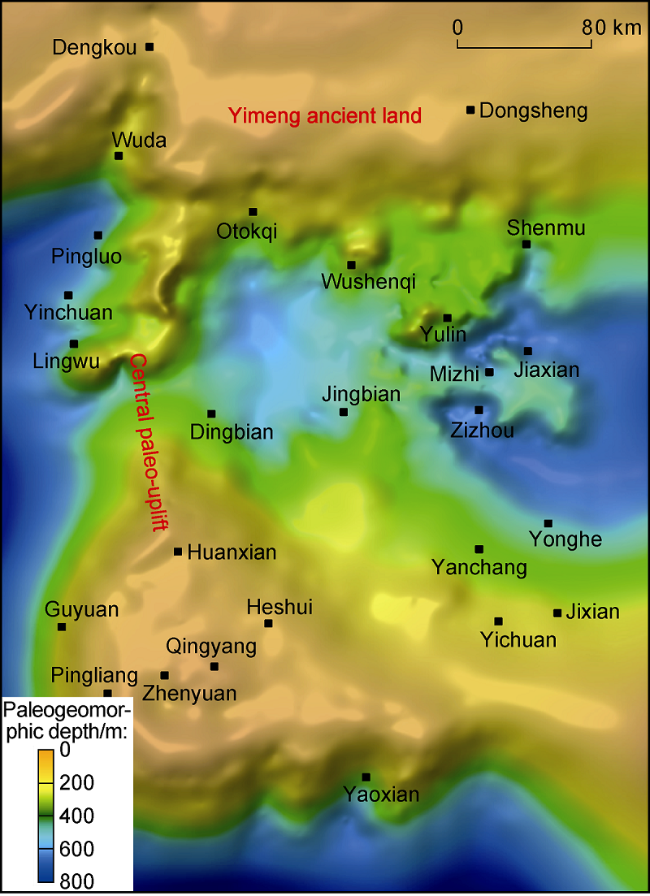
Fig. 4. Paleogeomorphology before deposition of Ma 4 Member in Ordos Basin. |
During the depositional periods of Ma 2 Member, Ma 4 Member, Ma 57 submember and Ma 59 submember, controlled by sea level fluctuation, intra-platform beach facies deposits were developed in annular and clustered shape in the low uplift belts in the eastern part of the basin (Fig. 3 ). The intra-platform beach deposits of Ma 2 Member were mainly distributed in Yulin-Jingbian- Zhidan-Heshui belt, which was distributed in banded shape along the east side of the central paleo-uplift (Fig. 3 a). The inter-beach deposit was dominated by muddy dolomite flat deposits, gradually changed to the limy dolomite flat-calcareous lagoon eastward. The intraplatform granular beach deposits of the Ma 4 Member were mainly distributed in Wushenqi-Jingbian and Shenmu- Mizhi regions, which were distributed in a north-south banded shape as a whole. The inter-beach deposits in Wushenqi-Jingbian were dominated by limy dolomite flat deposits, while the inner-beach between Shenmu- Mizhi was dominated by limy dolomite flat (Fig. 3 b). The intra-platform beach deposits in Ma 57 submember and Ma 59 submember were mainly distributed in Yulin-Jingbian- Zhidan region along the east side of the central paleo- uplift in annular shape, dominated by limy dolomite flat. As the water body in the sedimentary environment gradually deepens eastward, dolomitic limestone flat and calcareous lagoon deposits were developed (Fig. 3 c, 3d).
During the sedimentary period of the Majiagou Formation, due to the development of intra-platform beach in the central-eastern part of the basin, the subsalt longitudinal multi-layer superimposed and transversely connected granular beach groups were developed. The area of single beach in Ma 4 Member was about (0.1-0.4)×104 km2, and the area of beach groups reached 2.4×10⁴ km2. The area of single beach in Ma 57 submember and Ma 59 submember was about (0.1-0.3)×104 km2, and the area of beach groups reached 2.5×10⁴ km2, which laid a material foundation for the formation of large-scale dolomite reservoir (Fig. 3 ).
3.2. Paleotectonic-sedimentary evolution background is favorable for the formation of large updip lithologic pinch-out traps
Controlled by the development of the central paleo- uplift, the dolomite strata of the Majiagou Formation became thin gradually towards the east of the basin, and finally changed into limestone or gypsum-salt rocks, which provided necessary lateral sealing conditions for the formation of extensive dolomite lithologic traps.
Under the background that the dolomite in the central-eastern part of the basin became thin gradually eastward and changed into limestone or gypsum-salt rocks under the control of the central paleo-uplift, the two underwater low-uplift beach belts (Wushenqi-Jingbian and Shenmu-Mizhi) provided favorable paleogeomorphic environment for the development of local extensive dolomite lithologic traps. In the granular beach facies belt, the silty-fine-grained dolomite with good reservoir conditions was formed by dolomitization. The water energy in the low-lying area between the uplifts was relatively low, and the deposits were mainly muddy dolomite flat, dolomitic limestone flat and calcareous lagoon deposits. These deposits were tight in lithology, which could laterally seal the dolomites in the low-uplift belt, resulting in formation of lithologic traps.
During the Indosinian-Yanshanian period, the basin was controlled by the three regional dynamic systems, namely the Paleo-Asian Ocean, the Paleo-Tethys Ocean and the Circum Pacific Ocean. The periphery convergence and collision orogenesis resulted in the formation and development of Lüliang uplift, Liupanshan thrust belt and Yinshan magmatic belt. Under the influence of this geodynamic background, the basin was uplifted as a whole, and structural inversion occurred. The central paleo-uplift was depressed, and the Yishan slope monoclinic structure, which was higher in the east and lower in the west [17-18], was formed. In Wushenqi-Jingbian and Shenmu-Mizhi underwater low uplift belts, dolomite reservoirs well developed, forming upward dipping lithologic pinch-out traps, which were located at the relatively high part of the current Yishan slope structure and became favorable areas for natural gas migration and accumulation (Fig. 5 ).
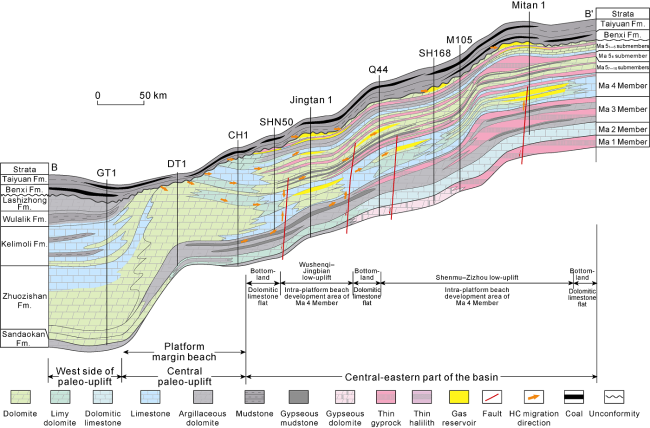
Fig. 5. EW-trending geological section and natural gas accumulation model of Ordovician in the present basin (see |
3.3. Uplifting of the central paleo-uplift and tectonic inversion provide an effective hydrocarbon supply window for subsalt gas reservoirs
During the Late Ordovician, the Ordos Basin was uplifted as a whole, and suffered from weathering and denudation up to 120-150 Ma [1-2,9 -10]. In the central paleo-uplift area, a denuded region formed with nearly 6×10⁴ km2 in area. The Ma 4 Member was denuded and exposed extensively. To the Late Carboniferous, the basin was subsided again, receiving the overlying deposit of the Upper Paleozoic coal measures source rocks (Fig. 3 ). The coal measures source rocks directly contacted with the high- porosity and high-permeability karst dolomites of the Ma 4 Member in the extensive denudation zone of the central paleo-uplift, as provided the necessary conditions for the transformation from the denuded zone in the central paleo-uplift into the subsalt high efficient large-scale hydrocarbon supply window after the overall west-dipping of the eastern part of the basin during the Indosinian-Yanshanian period.
The hydrocarbon expulsion of the Upper Paleozoic coal measures source rocks began in the Middle Yanshanian period (Early Jurassic) and reached its peak in the Early Cretaceous [25], at this time, the structural pattern with high east and low west of the Yishan slope had been basically finalized. The multi-layer subsalt dolomite lithologic traps in the central-eastern part of the basin were located in the structural updip direction, and the extensive hydrocarbon supply window generated in the denuded zone of the Ma 4 Member in original central paleo-uplift was located in the structural downdip direction, which provided favorable conditions for large-scale natural gas migration and accumulation. During the hydrocarbon generation and expulsion peak from the Upper Paleozoic coal measures source rock, high hydrocarbon generation intensity produced huge pressure [18]. Driven by hydrocarbon generation and pressurization, a large amount of natural gas migrated into the high-porosity and high-permeability rocks of the Ma 4 Member through the hydrocarbon supply window area in the central paleo-uplift, and then continued to migrate laterally along the complex migration system of fault-fracture-dolomite with high porosity and high permeability. The buoyancy was the main driving force for the continuous migration of natural gas, with the updip direction as the main migration direction. So far, the denudation area in the central paleouplift had formed an efficient window of lateral hydrocarbon supply for extensive lithologic traps in the subsalt multi-layer system (Figs. 5 and 6 ).
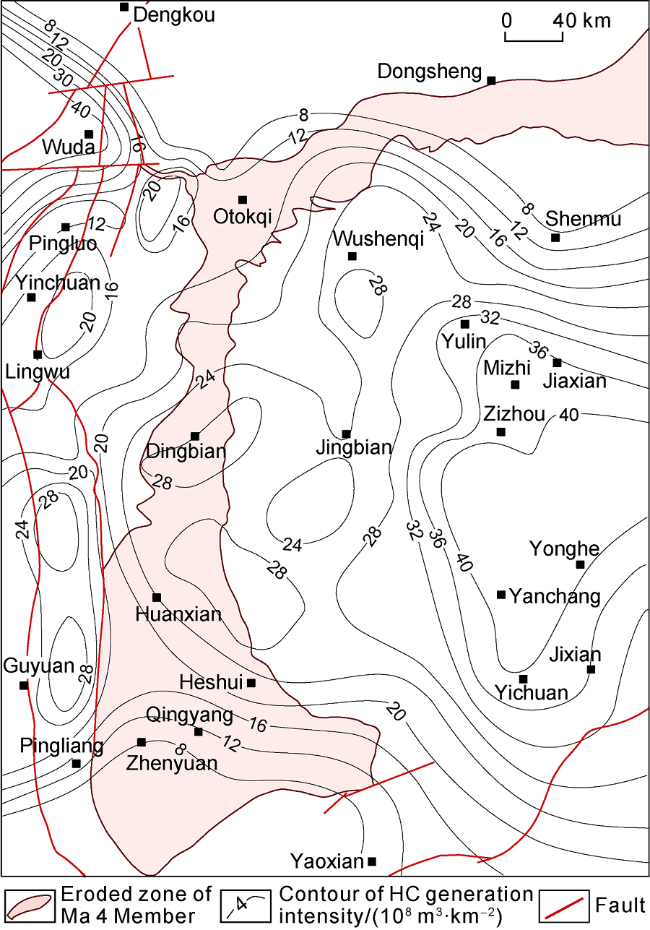
Fig. 6. Hydrocarbon generation intensity of Upper Paleozoic in Ordos Basin. |
The hydrocarbon generation intensity of the overlying coal measures source rock in the central paleo-uplift was (16-28)×108 m3/km2. Among which, the direct hydrocarbon supply window of Ma 57-10 submember and Ma 4 Member was 80-120 km wide from east to west, and 350-400 km long from north to south, with a total area of nearly 6×10⁴ km2. During the main hydrocarbon accumulation period, the high-quality source rock in the Upper Paleozoic provided continuous large-scale lateral hydrocarbon supply for the subsalt reservoir through the efficient hydrocarbon supply window in the central paleo-uplift, which was a necessary guarantee for the large-scale hydrocarbon accumulation of the subsalt multi-layer dolomites.
4. Hydrocarbon accumulation condition and exploration direction of natural gas in Ordovician subsalt Ma 4 Member
4.1. Hydrocarbon accumulation condition for natural gas in Ma 4 Member
4.1.1. Dual source hydrocarbon supply from Upper and Lower Paleozoic
The natural gas accumulation in the Ma 4 Member has the advantage of double supply sources from the Upper and Lower Paleozoic source rocks. The Upper Paleozoic coal measures source rock was the main source for natural gas accumulation in the Lower Paleozoic. The source rocks were high in organic matter abundance and thermal evolution degree, and the kerogen was mainly Type Ⅲ, with high gas generation potential [1,9,13,17]. The Lower Paleozoic Ordovician subsalt marine argillaceous rocks were also high-quality source rocks, which were controlled by lithofacies paleogeography. In Ma 1-Ma 3 members and Ma 57-9 submembers, organic-rich laminar argillaceous rock or algal lump and algal dolomite were dominant in lithology. The hydrocarbon kitchens of the Ma 57-9 submembers were widely distributed, basically along the east side of the paleo-uplift, with larger hydrocarbon generation intensity in Jingbian, Wushenqi and Shenmu etc. (Fig. 7 a). The hydrocarbon kitchens of the Ma 1-Ma 3 members were mainly distributed in two low-lying areas in the central-eastern part of the basin (Fig. 7 b). The measured TOC of the Lower Paleozoic marine source rocks is mainly 0.10%-0.50%, with an average value of 0.31%, and the highest value of 3.24%. After being recovered by organic acid salt, the average TOC could reach 0.58%. Vertically, the marine source rocks were thin interlayers. The single layers were thin in thickness, but large in number [25], with the cumulative thickness of 40 m, and the maximum hydrocarbon generation intensity of 6×10⁸ m3/km2 (Fig. 7 ). They could act as an important supplement to the gas source in subsalt strata [13,22⇓ -24,26 -27].
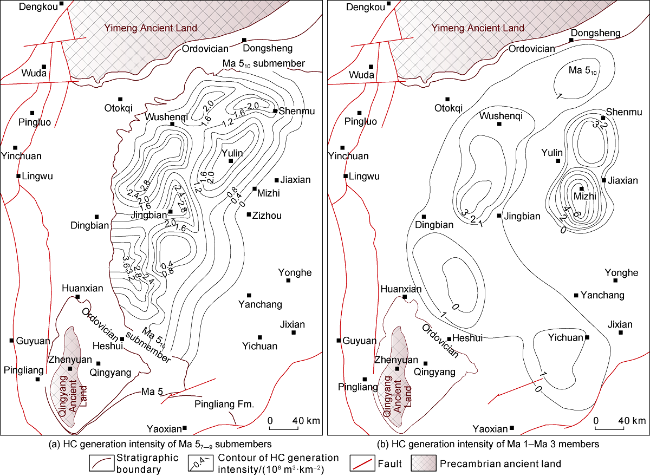
Fig. 7. Hydrocarbon generation intensity of Lower Paleozoic in Ordos Basin. |
For the gas source in the Upper Paleozoic coal measures, the natural gas entered from the hydrocarbon supply window in the low part of structures, and migrated laterally along the high-porosity and high-permeability dolomite-fracture composite migration system of the Majiagou Formation. The source-reservoir configuration was mainly the type of “upper source and lower reservoir”. For the gas sources of the Lower Paleozoic Ma 57-9 submembers and Ma 1-Ma 3 members, natural gas migrated vertically or laterally along fault, and forming the source-reservoir configuration type of “upper source and lower reservoir” and “lower source and upper reservoir”, respectively (Fig. 5 ).
4.1.2. Composite migration through faults, fractures and high-porosity and high-permeability dolomite
According to traditional view, the internal structure of the Ordos Basin was simple, and the fault development was very poor since Phanerozoic [28]. The latest researches showed that the Caledonian fault system was developed in the Paleozoic of the basin, which controlled hydrocarbon accumulation [26,29]. During the Caledonian period, affected by regional tensile stress, the Proterozoic basement faults were active in inheritance, which controlled the uplift-depression pattern in the central-eastern part of the basin during the sedimentary period of the Majiagou Formation (Fig. 8 ). During Indosinian-Yanshanian period, affected by regional compressive stress, the Caledonian faults were activated, and stress was released, resulting in formation of micro faults and fractures [28]. The physical properties of dolomite reservoir were improved effectively. Due to the larger thickness and higher brittleness of the Ma 4 Member dolomite, the physical properties of dolomite reservoirs were improved obviously by faults, which was favorable for the enrichment and accumulation of natural gas [26].
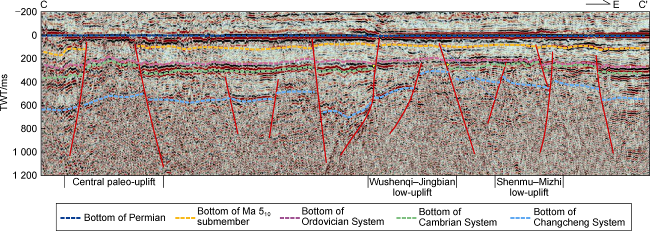


Fig. 8. EW-trending seismic section of Ordos Basin (see |
The high porosity and high permeability Ordovician subsalt dolomite strata were not only favorable reservoirs, but also highly efficient migration carriers. The combination of fault-fracture and dolomite with high porosity and high permeability could form an efficient composite migration system for both vertical and lateral hydrocarbon migration, thus improving the migration efficiency of hydrocarbons.
4.1.3. Low-amplitude structure-dolomite lithologic traps are favorable areas for natural gas migration and accumulation
Through integrated study about the geological conditions for hydrocarbon accumulation, combined with the understanding that paleo-uplifts control the sedimentary facies and reservoirs in Ordovician subsalt strata, it is believed that the low-amplitude structure-dolomite lithologic traps in subsalt Ma 4 Member had favorable conditions for natural gas enrichment and accumulation. Both the Upper and Lower Paleozoic source rocks could supply large-scale hydrocarbons. The underwater low-uplift granular beaches could form excellent reservoirs with large area with the thick-layer gypsum-salt rock in the Ma 5 Member as regional cap rock [14]. The dolomites were sealed by tight limestone, forming lithologic traps. Faults, fractures and dolomite with high porosity and high permeability could form composite migration system. Oil and gas were enriched and accumulated in the updip high parts of the structures.
During the Yanshanian Period, the basin tilted westward, and lithologic updip pinch-out traps formed from the dolomites of the Ma 4 Member. From the Himalayan Period to present, the basin structures were adjusted and finalized, forming the current Yishan slope background. The dolomite lithologic traps in the Ma 4 Member were gradually changed into low-amplitude structural-lithologic updip pinch-out traps. Therefore, from the Yanshanian Period to the present, the lithologic traps of the Ma 4 Member are always in the updip direction of the structural slope, being favorable areas for natural gas migration and accumulation. Natural gas migrated along faults, fractures and dolomite with high porosity and high permeability, and sealed by the upper caprocks and lateral sealing, finally enriched and accumulated in local structural highs.
4.2. Favorable exploration targets of subsalt Ma 4 Member
The intra-platform granular beach developed in the Ordovician Majiagou Foramation under the background of low uplift is a favorable facies belt for the development of dolomite reservoir and traps in the east of the basin, and the structural updip direction is a favorable area for natural gas migration. The drilling data show that, controlled by the current structural pattern, water is mainly distributed in the west, and natural gas is mainly distributed in the east of the Ordovician subsalt strata. Although the reservoir properties and reservoir-cap configuration are better in the thick dolomites of the Ma 4 Member developed in the platform margin beach facies belt in the central paleo-uplift, the Ma 4 Member and deep layers are dominated by water due to the fact that the main body of the sedimentary facies belt is in the relatively low part of the central depression belt and Yishan slope. This also proves that the updip direction is a more favorable gas migration and accumulation area under the current tectonic background. In the east of the central paleo-uplift, the paleo low-uplift belts of Wushenqi-Jingbian and Shenmu-Mizhi are not only the development areas of dolomite reservoir in the intra-platform granular beach facies, but also the favorable directions of gas migration from the Upper and Lower Paleozoic source rocks with larger exploration potential.
In Well Mitan 1 drilled in Shenmu-Mizhi area, high- yield commercial gas flow has been obtained, which has proved that in Mizhi area in the east of the Ordos Basin, large-scale hydrocarbons have accumulated in the dolomite updip pinch-out lithologic traps of the Ma 4 Member. Based on the calculation results of the favorable reservoir area of Ma 4 Member, it is predicted that the favorable exploration area is 1.1×10⁴ km2 in Shenmu-Mizhi area, and 1.3×10⁴ km2 in Wushenqi-Jingbian low-uplift belt. Ma 4 Member is expected to be a new series of natural gas reserves replacement in the Ordos Basin.
The geological understanding that the central paleo- uplift has controlled the sedimentary facies, reservoirs and hydrocarbon accumulation, and the exploration deployment of Well Mitan 1 can provide theoretical guidance and experience reference for the oil and gas exploration of the strata with similar geologic conditions in Ma 2 Member, Ma 57 submember and Ma 59 submember. In the central-eastern part of the basin, the total distribution area of multi-layer superimposed dolomite in Ma 57 submember, Ma 59 submember, Ma 4 Member and Ma 2 Member has exceeded 5×10⁴ km2. Calculated according to the resource abundance of 0.5×10⁸ m3/km2, it is predicted that the natural gas resources of the subsalt multi-layer are over one trillion cubic meters [23]. Hence it has the resource basis for the formation of giant gas province.
5. Conclusions
The Ordovician central paleo-uplift separated the North China Sea and the Qilian Sea, and controlled the tectonic paleogeographic pattern of the Ordos Basin. During the sedimentary Period of the Ma 4 Member, the central paleo-uplift was in platform margin belt, with deposits of very thick hummocky granular beach facies dolomite. The underwater low-uplift belts associated with the central paleo-uplift controlled the large scale development of intra-platform granular beach. The subsalt multi- layer dolomites became thin eastward, and changed into limestone or gypsum-salt rock. It is obvious that the paleo- uplift controlled the sedimentary facies and reservoirs.
During the Late Caledonian period, the Ordos Basin was uplifted as a whole, and suffered from weathering and denudation for 120-150 Ma, resulting in the formation of extensive regional unconformity. In the central paleo-uplift belt, the uplifting amplitude was relatively high, exposing the Ma 4 Member-Changcheng System strata. To the Late Carboniferous, the Ordos Basin subsided and received deposits overlaid by extensive Carboniferous-Permian source rocks, forming an area of near 6×10⁴ km2 as hydrocarbon supply window.
During the Indosinian-Yanshanian periods, tectonic transformation occurred in the Ordos Basin, the central paleo-uplift was depressed, and the eastern part of the basin was tilted westward as a whole. The denudation area of high-porosity and high-permeability dolomites in the central paleo-uplift became efficient hydrocarbon supply window, with an denuded area of 6×10⁴ km2, which provided favorable conditions for the hydrocarbon supply from the Upper Paleozoic coal measures source rocks to extensive lithologic traps of subsalt multi layers through the dolomite with high porosity and high permeability in the central paleo-uplift.
During the sedimentary period of the Majiagou Formation, two underwater low-uplift belts (Wushenqi- Jingbian and Shenmu-Mizhi) associated with the central paleo-uplift facies were developed in the eastern part of the basin, and the granular beach facies dolomite inside the platform were deposited. The combined migration system of intraplatform granular beach facies dolomite and the NE-SW trending faults which were developed at the end of Caledonian period controlled the enrichment and accumulation of natural gas.
For the Ordovician subsalt Ma 4 Member of eastern part of the Ordos Basin, there were double sources for hydrocarbon supply (the Upper and the Lower Paleozoic), and the combined migration system of faults, fractures and dolomite with high porosity and high permeability; hydrocarbons were enriched and accumulated in local low-amplitude tectonic-lithologic traps. Wushenqi-Jingbian area and Shenmu-Mizhi area are favorable areas with great resources potential, and also favorable exploration targets.