

Introduction
Reactivation of pre-existing structures is commonly observed in numerous petroliferous basins or sea areas, such as the Bohai Bay Basin [1], the Tarim Basin [2-3], the Phitsanulok Basin [4], the Bohai Sea [5], etc. According to the study results of outcrops in field investigations, seismic data, and physical simulation, it is found that the reactivation of the pre-existing structures strongly affected the basin structure and evolution mainly in three aspects. (1) The reactivation of pre-existing structures is an important factor for promoting fault growth and propagation [6⇓-8]. (2) The reactivation of pre-existing structures affected the position of nucleation point of late newly developed faults [9]. (3) The reactivation of pre-existing structures changed or disturbed the regional stress field, resulting in fundamental change in the regional deformation characteristics and structural styles [9⇓⇓-12]. For instance, in the Bohai Bay Basin of China, the basin evolution in the Cenozoic was strongly affected by the reactivation of the pre-existing TanLu fault zone, thus leading to the inherited structures of the basement strike-slip fault deformation in some parts of the basin. Subsequently, extensive transfer zones were formed, affecting the growth of new faults [1]. However, previous studies about the reactivation of pre-existing faults primarily focused on the inherited activities of low-angle normal and reverse faults in rift systems [13⇓⇓⇓-17], lacking of the studies related to strike-slip faults in rift basins. The main reasons for this phenomenon are in the following two aspects. First, due to the unique mechanical mechanism of strike-slip faults and multiple types of associated structures, it is difficult to judge the formation mechanism of these strike-slip faults. Second, in an intercontinental extension or compression stress field, strike-slip faults may interact with newly developed fault zones in adjacent regions, resulting in extremely complicated deformation characteristics.
In the Bohai Bay Basin, a great number of pre-existing faults with different strikes are developed in the Pre-Cenozoic basement [18]. Among them, the reactivation of NW- trending strike-slip faults in the Cenozoic controlled the complex tectonic deformation in the local areas of Bohai Bay Basin [19-20], with obvious partitioning effect. For instance, in the Nanpu sag, the reactivation of the NW-trending fault (F4) controlled the formation and evolution of No.4 structural zone in the sag [21⇓⇓-24]. In recent years, the reservoir evaluation results have demonstrated that the No.4 structural zone in the Nanpu sag has great exploration potential in shallow layers, with oil and gas shows in several oil wells, but hydrocarbons are only relatively rich in structural high position. The No.4 structural zone in the Nanpu sag is characterized by its complicated structural styles. In this structural zone, the fault property, the deformation characteristics, and spatial fault patterns are different during different periods. However, there is no clear understanding about some problems related to the pre-existing basement fault (F4), which controlled the evolution of No.4 structural zone. For example, how the fault (F4) reactivated in the Cenozoic; how the fault controlled the formation and evolution of No.4 structural zone; how the fault interacted with its adjacent No.2 and No.3 structural zones? Obviously, due to the poor understanding about these problems, the regional hydrocarbon exploration has been restricted.
The No.4 structural zone in the Nanpu sag includes the No.4 fault zone and its related tectonic deformations. Particularly, the No.4 fault zone refers to the pre-existing strike-slip fault (F4) in the basement and its associated secondary faults. In this study, we select the No.4 structural zone in the Nanpu sag as the study area and analyze the deformation characteristics of reactivation and growth pattern in the Cenozoic, based on the analyzing results of structural styles and the determination of faulting phases. Further, combined with the physical simulation sandbox experiment, we study the relationship between the reactivation of the fault zone and the evolution of its adjacent No.2 and No.3 fault zones, according to the geometry and displacement features of the faulting deformation. Through establishing the identification chart of the deformation mechanism of reactivation of pre-existing faults caused by the oblique extension, we have made clear about the formation mechanism and deformation pattern of the F4 fault during different faulting phases. Finally, we investigate the influence of the fault reactivation on regional hydrocarbon reservoirs, for the purpose of revealing the relationship between the pre-existing fault reactivation and hydrocarbon accumulation in the Bohai Bay Basin, thereby guiding the hydrocarbon exploration potential appraisal and prospect evaluation.
1. Geological setting
The Bohai Bay Basin, situated and developed in the North China block, is a Mesozoic-Cenozoic rift basin[25-26], developed mainly from the Late Jurassic to the Early Cretaceous. Under the NW-SE extension, a series of NE- and NNE-trending extensional structures and NW-trending transform structures are developed in the basin[27-28]. Among them, the Nanpu sag is located in the north of the basin (Fig. 1 a), bounded by the NW-trending Baigezhuang fault in the eastern boundary and the NE- and NNE-trending Xinanzhuang fault in the northern margin, both of which have been active since Mesozoic[29]. In addition, several other pre-existing faults are also developed, including the NNE-trending faults F1, F1-5, F2, F3, and F3-1, the NEE-trending fault F5, and the NW-trending fault F4 (Fig. 1 b). The tectonic evolution of the Nanpu sag in the Cenozoic is characterized by multi-episode development. The complex tectonic pattern in the depression was formed due to multiple phases of regional extensions with different directions and the superposition of multiple tectonic systems[21,30 -31]. Several genetic models of the Nanpu sag have been proposed by previous studies [21,30⇓⇓ -33]. However, it is difficult to explain the spatial fault distribution, plane pattern, and faulting activities with a unified stress field. Based on fault interpretation and simulation experiments, Tong et al., [24] and Liang et al. [34] proposed a superimposed pattern of multiphase extension from different orientations. They believed that during the Cenozoic, the stress field transformation occurred from NW-SE extension to N-S extension. With this model, the complicated formation mechanism can be reasonably interpreted. Therefore, the evolution of the Nanpu sag can be divided into three stages, namely the rift episode I, the rift episode II, and the post-rift stage.
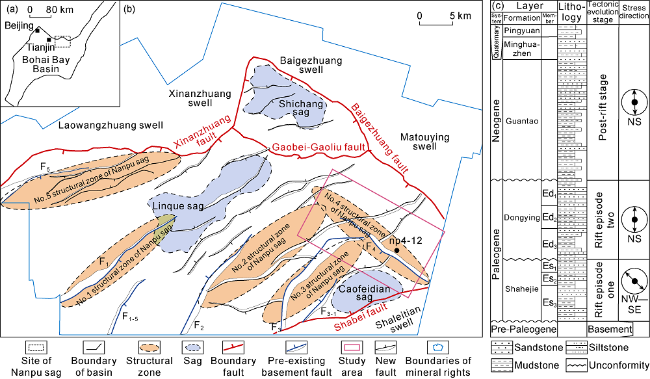
Fig. 1. Structural location of Bohai Bay Basin (a), general structural units of the Nanpu sag (b) and comprehensive stratigraphic column of the Nanpu sag (c) (modified according to Reference [24] ). Es3—the 3rd member of Shahejie Formation of Paleogene; Es2—the 2nd member of Shahejie Formation of Paleogene; Es1—the 1st member of Shahejie Formation of Paleogene; Ed3—the 3rd member of Dongying Formation of Plaeogene; Ed2—the 2nd member of Dongying Formation of Plaeogene; Ed1—the 1st member of Dongying Formation of Plaeogene. |
The Nanpu sag has an unsymmetrical triangle graben structure, controlled by the Xinanzhuang fault, the Baigezhuang fault, and the Shabei fault. The sag is connected to the Laowangzhuang and Xinanzhuang uplift in the north, the Shaleitian uplift in the south, and the Baigezhuang and Matouying uplift in the east. Inside the sag, NNE- and NW-trending pre-existing basement faults and NE- and EW-trending Cenozoic faults are developed, controlling the formation of three subsags and five complex structural zones. Overall, the tectonic framework of Nanpu sag is characterized by a “five uplifts and three subsags” pattern. The NW-striking No.4 structural zone is located in the southeast of the Nanpu sag (Fig. 1 b).
On the basis of the angular unconformities at the bottom interface of the third member of Paleogene Shahejie Formation (Es3), the bottom interface of the Paleogene Dongying Formation, and the bottom interface of the Neogene Guantao Formation, the Nanpu sag can be divided into 4 structural layers in ascending order [31], namely the Pre-Cenozoic basement layer, the Paleogene first rifting episode structural layers (the Shahejie Formation or Es), the second rifting episode structural layers (the Dongying Formation or Ed) and the Neogene depressional structural layer (the Guantao-Minghuazhen formations or Ng-Nm) (Fig. 1 c).
2. Evidence of the reactivation of the F4 fault in the Nanpu sag
Through analysis of the static structural styles, the dynamic activities, and the restoration of the interaction between No. 4 fault zone and No.2 and No.3 fault zones by throw back-stripping, we provide reliable evidence for validating the reactivation of the F4 fault as a pre-Cenozoic basement preexisting fault in the Cenozoic.
2.1. Geometrical characteristics of No.4 fault zone
2.1.1. Planar distribution
The No.4 fault zone is controlled by the NW-trending fault F4. On the top interface of the basement, fault F4 is manifested as a straight fault extending linearly (Fig. 1 b). In the shallow layers, the No.4 fault zone is manifested as an imbricated fan structure composed of several right- stepping en echelon faults. The southern end of the fault gradually terminates along the strike of the fault F4, while the northern end splays and interlaces with the No.2 and No.3 fault zones (Fig. 2 a). From bottom to top, both the length and width of the fault zone increase. The overall feature is consistent with the geometric characteristics of the imbricated fan structure, consisting of some small- interval en echelon fault segments, generated by the reactivation of pre-existing high-angle strike-slip fault in the caprock. Furthermore, from south to north, the fault throw, scale, and the width of the fault zone all gradually increase, exhibiting a horsetail pattern (Fig. 2 a). Meanwhile, the deformation associated with the strike-slip motion gradually decreases, while the corresponding extension gradually increases.
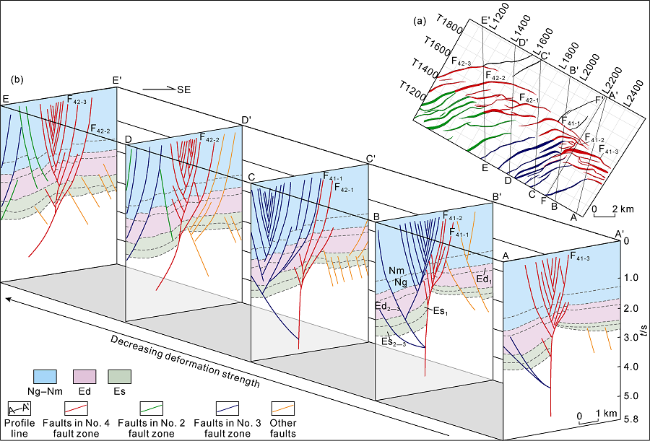
Fig. 2. Fault planar distribution map (a) and cross section patterns (b) of the bottom boundary of Minghuazen Formation in No. 4 structural zone in the Nanpu sag. Ng—Neogene Guantao Formation; Nm—Neogene Minghuazhen Formation. |
2.1.2. Cross section patterns
In the cross section, the No.4 fault zone is manifested as a negative flower structure. The southern end is characterized by a large fault throw, cutting downward through the basement. In the deeper part, the fault is nearly vertical, bifurcating upward into several fault branches, forming a flower or half-flower structure. As a pre-existing basement fault, the outermost boundary fault, combined with the nearly vertical fault section, forms a chair-shape structure. The thickness of the strata on both sides of the fault is visibly different. Particularly for the Shahejie Formation, the western strata are thicker than the eastern strata, with strong deformation and small width of the fault zone, indicating a prominent strike-slip feature (Fig. 2 b, AA°, BB°, and CC°). To the north, the fault throw gradually decreases, cutting downward through the basement as well. However, in the deeper structure, the dip angle gradually decreases with a west dip direction. The fault segment, together with the newly developed fault segment in the shallow structure, forms a negative flower structure. The western and eastern strata of the Shahejie Formation have similar thickness, indicative of weak deformation (Fig. 2 b, DD°, EE°). In this region, the width of the fault zone increases, showing an obvious extension feature. Additionally, the No.4 fault zone interacts with the No.2 and No.3 fault zones in the shallow structure, but with different faulting patterns. In detail, the No.2 and No.3 fault zones are characterized by listric faults in the cross section, forming “Y” patterns that indicate an extensional fault system (Fig. 2 b, BB°, CC°). In contrast, in the cross-section, the No.4 fault zone is flower or half-flower structures, belonging to a strike-slip fault system.
2.2. Displacement of the No.4 fault zone
Based on the seismic interpretation results and structural sequence interface, we compute the active throw and the stratum thickness of the hanging wall and footwall of fault F4 in different periods and complete the “displacement-distance” curve, the “throw-depth” curve, and the expansion index curve. Finally, we determine the growth manner, faulting phase, and faulting intensity of fault F4, providing reliable evidence for the reactivation of fault F4 in the Cenozoic.
As the master fault of the No.4 structural zone in the Nanpu sag, the faulting activity of fault F4 was distinctly different during different deposition periods in the Cenozoic. Fig. 3 shows that the fault can be divided into multiple fault segments, conforming to a “two segments and multiple sub-segments” growth mode. According to the displacement-distance curve of the interfaces from Es3 to Es1, there is an obvious segment point on the top interface of the pre-Cenozoic groups (the bottom interface of Es3). Fault F4 consists of two segments, namely F41 and F42. In particular, F41 includes a branch fault F41-2 in its northern part. The gray and red shallow zones representing the displacement differences in Fig. 3 are the active throws of F41-2 on the bottom interface of Es3 and Es1. During the deposition of the Shahejie Formation, the southern part of F41 had the largest active throw that gradually decreased from south to north, subsequently forming a branch fault at its end where the throw reaches 0. Namely, the fault grew from south to north. Unlike F41, F42 had its maximum throw in the central part, and the throw gradually decreased to both ends. In addition, based on the displacement-distance curve of the bottom interfaces of Ed and Nm, it is clearly that the extension of F4 fault increased, forming six fault segments on the bottom interface of Ed1 in the shallow structure. The southern 3 fault segments (F41-1, F41-2, and F41-3) are characterized by large fault throws, while those 3 segments in the northern part (F42-1, F42-2, and F42-3) have small throws.
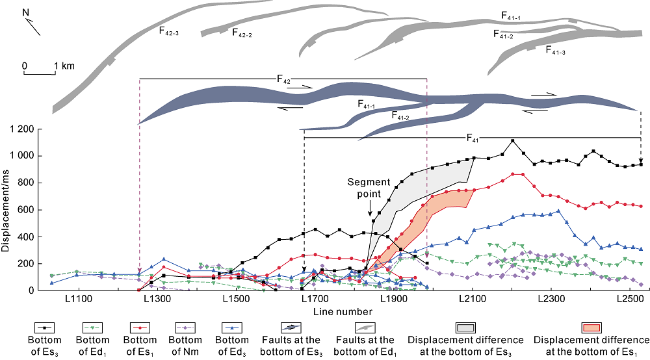
Fig. 3. Displacement-distance curve of fault F4 in Nanpu sag. |
The faulting intensity and phase of the different segments of F4 fault are also different. In this study, we select typical cross sections from different positions from south to north for interpretation (Fig. 4 c), and complete the corresponding throw-depth and expansion index curves. The results show that both the southern F41 (Fig. 4 b) and the central part of F42 (Fig. 4 c) in the north are long-term active faults. From bottom to top, the accumulated fault throw gradually increases, the throw gradient remains positive, and the expansion index is greater than 1. However, during the deposition of Es and Ed, the expansion index of F42 was visibly smaller than that of F41, indicating that the faulting intensity gradually decreased from south to north. In the northern end of F4 fault (the northern segment of F42), there is a maximum value in the throw-depth curve (Fig. 4 d). The nucleation point is located in Ed, indicating that the starting time of faulting was in the depositional period of Ed, and the activity time of F4 fault gradually became late northward.
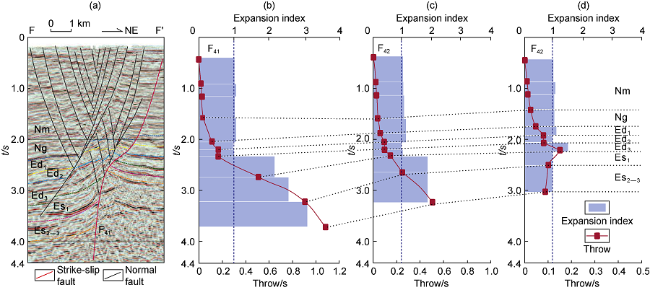
Fig. 4. Throw-depth curve and expansion index curve of F4 fault in Nanpu sag (section location shown in |
The aforementioned analysis suggests that F4 fault was reactivated in the Cenozoic. During the deposition of Es, two main faults were developed. The southern fault F41 has an obvious strike-slip feature, with large throw and nearly vertical fault surface. The northern fault F42 has only slight strike-slip feature, with small throw and dip angle. During the deposition of Ed, six fault segments were developed. Among them, the southern F41 had the largest deformation intensity, with both strike-slip and extension characteristics. By comparison, the deformation intensity of the northern F42 was smaller. Its end continued to propagate towards the north with a dominant extensional deformation. During the deposition of Ng-Nm, the displacement gradually decreased from south to north until the northern end, only manifested as extensional deformation.
2.3. Interaction relationship between No. 4 fault zone and No.2 and No.3 fault zones in the Nanpu sag
At present, the No.4 fault zone is interlaced with the No.2 and No.3 fault zones in the Nanpu sag. The displacement-distance curve of cross-zone faults shows that the fault throws have an obvious low value, which is indicative of the segment point. According to the fault throw back-stripping, the cross-zone fault was generated by the segmental growth and connection of different segments during the deposition of Ng or Ed1 (Fig. 5 a-c). Furthermore, the segment point positions of the cross-zone fault are mainly in the “strike-diverting” parts. Namely, after passing the segment point, the strike changed from NWW to NEE, and the fault gradually terminated at the NE-trending fault zone (Fig. 5 d). Therefore, there should be a structural transition zone between No.4 fault zone and No.2 and No.3 fault zones. The arc-shaped zone to the east of the transition zone was the No.4 fault zone, while No. 2 and No.3 fault zones were situated to the west of the transition zone (Fig. 5 d). The along-strike cross section shows that all the newly developed secondary faults within the No.4 fault zone gradually terminated at the F4 fault plane in Ed (Fig. 5 e).
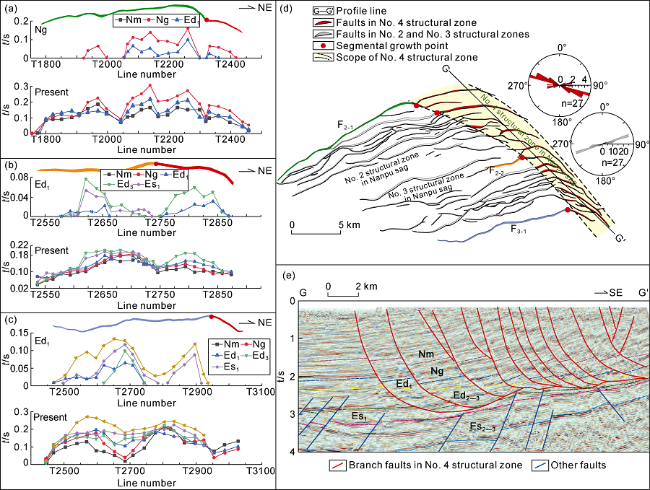
Fig. 5. Diagram of interaction between No. 4 fault zone and No. 2 and No. 3 fault zones in Nanpu sag. (a) Displacement- distance curve and throw-stripping curve of F2-1; (b) Displacement-distance curve and throw-stripping curve of F2-2; (c) Displacement-distance curve and throw-stripping curve of F3-1; (d) Plane division and rose diagram of No. 4 fault zone, No. 2 and No. 3 fault zones; (e) A seismic profile along the strike of No. 4 fault zone. |
The above analysis indicates that the evolution of No.4 fault zone was controlled by the reactivation of F4 fault, which was not an isolated activity. Instead, it was an intense interaction under a unified stress field between No.4 fault zone and the adjacent No.2 and No.3 fault zones. The three fault zones were developed independently during the deposition of Es and Ed, controlled by different fault systems. During the later deposition of Ng or Ed1, the three zones were hard-linked, forming the current structural styles.
3. Formation mechanism of the reactivation of F4 fault
Since the Cenozoic, multi-episode tectonic activities have occurred in the Nanpu sag. The reactivation of F4 fault has led to the en echelon pattern, fault segmentation, and the multi-phase feature of the No. 4 fault zone. In this study, we analyze and validate the formation mechanism of the reactivation through data statistics, theoretical analysis, and the structural physical simulation experiment.
3.1. Dynamic background of the reactivation of F4 fault
The regional stress regime for the reactivation of the Pre-Cenozoic basement fault in the Nanpu sag and the late fault development in Paleogene has always been controversial [29,32]. Based on the study results about transformation mechanism of regional stress through analysis of balanced cross section, numerical simulation, and physical simulation experiments, it is found that under the background of tectonic evolution pattern transformation of Bohai Bay Basin, the Paleogene tectonic evolution of Nanpu sag is characterized by multi-episode development, which is the result of the superimposed deformation of two phases of oblique extension. The extensional direction changed from NW-SE during the deposition of Es to N-S during the deposition of Ed [34⇓-36]. The initial deposition stage of Ed was the critical period of tectonic regime transformation, which may be caused by the subduction direction change of the Pacific Plate to the Eurasian Plate at 36 Ma ago[1,37]. During the deposition of Es, the NW-SE extension controlled the formation of the NE-trending master faults. The NNE- and NE-trending segments of the Xinanzhuang fault, the Baigezhuang fault, and the NNE-trending basement faults were all reactivated. Due to the influence of boundary faults and pre-existing faults, different structural zones had different stress field characteristics. In detail, the NW-SE extension produced regional extension stress field in the NNE-trending No.1 structural zone and generated regional sinistral strike-slip stress field in the NW-trending No.4 structural zone, leading to sinistral strike-slip deformation on F4 fault. Due to the fact that the displacement was mainly concentrated on F4 fault, a vertical structure and a linear faulting pattern are observed in the cross section and plane, respectively. During the deposition of Ed, affected by the N-S extension, a handful of E-W and NEE-trending faults were generated inside the Nanpu sag. The faulting intensity of the E-W segment of the Xinanzhuang fault increased. Furthermore, the NNE-trending No.1 fault zone oblique intersected with the N-S extension through a counterclockwise 35°-40° angle, producing a dextral transtension stress field. By contrast, the NW-trending F4 oblique intersected it with a clockwise 45° angle, thus forming a sinistral transtension stress field, with sinistral strike-slip and extension deformations at the same time. As a result, many secondary en echelon faults were generated in the overburden rock, forming a flower structure in the cross section. During the deposition of Ng-Nm, substantial E-W secondary faults were generated, and the faulting intensity of F4 fault increased due to the oblique extension.
3.2. Reactivation mechanism of F4 fault in the Nanpu sag
The reactivation of F4 fault in the Nanpu sag was closely related to the regional stress state. During the deposition of Es, the stress direction was parallel to F4 fault. However, during the deposition of Ed, the stress field rotated, and the NW-trending F4 fault was in a non-dominant direction of strike. As the pre-existing structure in the basin, it was easy to be reactivated [38-39].
During the deposition of Ed, the NW-trending F4 fault oblique intersected with the nearly N-S extension, with both strike-slip component and dip-slip component. Whether the deformation of F4 fault is caused by the extension stress field or by the strike-slip stress field has become the most concerned question. It is well accepted that under oblique extension, structural styles similar to strike-slip (especially transtension) deformations can also be generated, but the corresponding stress state of the two types of deformation is different. This depends on the direction of the primary stress σ2. Oblique extension refers to the situation that the pre-existing basement fault is reactivated under the Anderson stress state of normal faults (σ1 vertical, σ2>σ3, σ3 horizontal). By contrast, transtension refers to the situation that the deformation zone is partitioned and simultaneously possesses both strike-slip and dip-slip components, under the Anderson stress state of strike-slip faults (σ2 vertical, σ1 and σ3 horizontal). In this study, we establish the oblique-extension-direction kinematic model of the pre-existing basement fault (Fig. 6 a) and introduce kinematic vorticity (Wk) to represent the weighting factor of pure shear and simple shear [40] (Fig. 6 b):
${{W}_{k}}=cos\theta $
When 55°≥θ>45°, 1≥Wk>0.81, the ε2 direction is vertical, and the deformation belongs to simple-shear-dominated strike-slip/transtension; when θ=55°, Wk=0.81, the ε2 direction alters; when 90°≥θ>55°, 0.81>Wk≥0, the ε2 direction remains horizontal, and the deformation belongs to pure-shear-dominated orthogonal extension/oblique extension (Fig. 6 b).
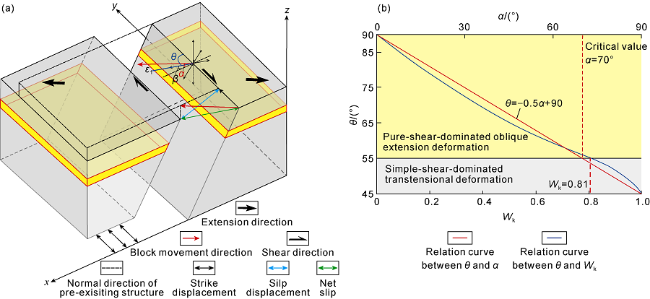
Fig. 6. Stress decomposition model diagram of reactivity of pre-existing structural (a) and identification chart of deformation mechanisms of reactivation of pre-existing faults in the extensional field (b). |
Through the validation from theoretical analyses and physical simulation experiments, it is found that when the extension direction and the pre-existing structure boundary formed a cross-cutting pattern, the maximum instantaneous horizontal tensile axis (ε1) of the regional stress field was induced to be the included angle (i.e. α) of the relative motion direction of the block and the pre-existing boundary [41] (Fig. 6 a):
$\beta =0.5\alpha $
$\theta =-0.5\beta +90$
According to Eq. (1) and Eq. (3), when α=90°, only strike-slip deformation occurred; when 70°<α<90°, simple-shear-dominated transtension associated with regional stress field occurred on the pre-existing structure; when α=70° (critical value), the direction of ε2 changed from vertical to horizontal; when 0°<α<70°, pure-shear- dominated oblique extension associated with regional stress field occurred on the pre-existing structure; when α=0°, orthogonal extension occurred.
Based on the relationship between θ (the included angle between the maximum instantaneous horizontal tensile axis and the shear zone), α (obliquity), and Wk (kinematic vorticity), we establish a reactivation identification chart (Fig. 6 b) under the extension of the direction of oblique intersecting pre-existing structure. During the deposition of Es in which the NW-trending Cenozoic pre-existing F4 fault extended in the NW-SE direction, the relative motion direction of the two walls was parallel to the extension direction, producing strike-slip stress and strike-slip deformation. During the deposition of Ed-Ng-Nm, under the N-S extension, the angle between the relative motion direction and the pre-existing structure was 45°. In this situation, F4 fault was reactivated and pure-shear-dominated oblique extension occurred.
3.3. Physical simulation of the reactivation of F4 fault
Numerous studies have been conducted through physical simulation experiments about the reactivation of pre-existing faults. In this study, on the basis of the actual fault development, we design the experiment whereby the reactivation of F4 fault and its interaction with adjacent faults are simulated. The experiment model is a simplified pre-existing basement fault model. In the experiment, we attached a rigid foam to a soft rubber. The boundary between the foam that had a dip angle of 80° and the rubber was used to simulate the reactivated NW-trending fault in the Shahejie Formation. The fault extended obliquely under the N-S extension. It should be noted that there is no other pre-existing structures in the remaining parts of the rubber; thus, we could simulate both the orthogonal extension deformation in the area unaffected by pre-existing structures and the interaction deformation with F4 fault. Regarding the experiment material, we chose dry sand whose deformation conformed to the Mohr Coulomb failure criterion. In addition, the internal friction angle is set to 31°, similar to that in the strata[42]. The experimental facility and basement configuration are shown in Fig. 7 a-7b, and the experimental process is shown from Fig. 7 c to 7h.
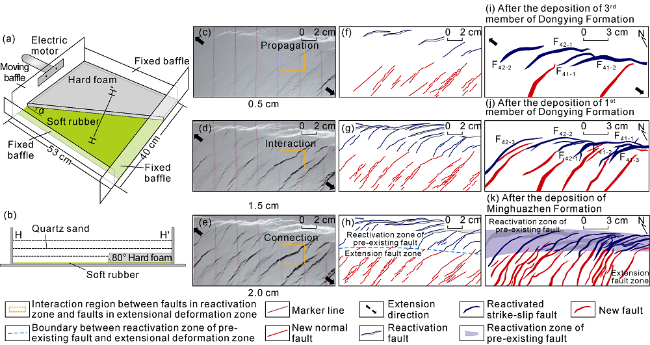
Fig. 7. Experimental equipment and results for simulating the evolution of No. 4 fault zone and its interaction with No. 2 and No. 3 fault zones in Nanpu sag. (a) Experimental equipment; (b) Diagrammatic cross-section (section location shown in |
The results obtained from the experiment are reflected in two aspects. (1) Under the effect of the N-S extension, two types of fault zones are generated in the areas with and without the pre-existing NW-trending fault, namely, the reactivation fault zone and the extensional fault zone (Fig. 7 c-7h). The former is deformed and extended obliquely; the entire fault shows an en echelon pattern along the pre-existing structure (Fig. 7 c-7f). This fault zone is simultaneously characterized by strike-slip and extensional displacements, with a partition feature. Specifically, the strike-slip displacement is mainly concentrated in the relatively narrow fault zone. As the displacement increases, the en echelon faults gradually terminate at the southern end and splays at the northern end. Meanwhile, the strike gradually turns to be parallel to the vertically extensional direction and the fault displacement mechanism changes from strike-slip to extension (Fig. 7 d-7h). By comparison, the latter is deformed and extended orthogonally throughout the entire region. The strike is normal to the extension direction (Fig. 7 d, 7f). As the displacement increases, the fault number increases as well. The displacement and fault length also increase (Fig. 7 e, 7h). (2) Under the effect of the uniform stress field, the two fault zones are developed independently in the initial deformation period (Fig. 7 c, 7f). As the displacement increases, the extension length of the newly developed faults in the extensional fault zone increases (Fig. 7 d, 7g), with its end interacting with the bending fault in the reactivation fault zone (i.e. yellow rectangle in Fig. 7 d). As the displacement further increases, the width of the reactivation zone increases, and the displacement and length of the fault increase as well (Fig. 7 e, 7h). The ends of the faults interact and connect with each other (i.e. yellow rectangle in Fig. 7 e). Such phenomena are consistent with the “grew separately, contacted and connected,” process (Fig. 7 i-7k) according to the aforementioned analyses.
4. Control of reactivation of the pre-existing strike-slip faults on hydrocarbon accumulation
4.1. Control on vertical hydrocarbon migration
Due to the reactivation of the basement pre-existing strike-slip faults, the fault propagated upward and grew, playing a significant role in connecting hydrocarbon sources. In the study area, due to the reactivation of the F4 fault, the basement fault propagated upward and penetrated the overlying caprock. In addition, it induced the formation of new en echelon faults in the cap rock, and caused vertical lap joint with the pre-existing faults in the basement. Both of them communicated well with the primary source rocks in the lower Es1 and Es3, providing the hydrocarbon migration channels to shallow layers (Fig. 8 ). The oil reservoirs in the southern part of the No. 4 structural zone are primarily distributed in multiple layers around the strike-slip reactivation zone. Hydrocarbon is enriched in Es1 to Nm, indicating that the reactivation of the F4 fault controlled the vertical cross-layer hydrocarbon migration and adjusted the hydrocarbon accumulation location. For the Well np4-12, hydrocarbon shows have been observed in Ed2 and Ng. In order to verify whether there is a paleo-reservoir in Ed1, which was adjusted to the shallow layer at the later stage, the debris samples from Well np4-12 at Ng, Ed1 and Ed2 of the were collected, and the quantitative grain fluorescence analysis (Q) [43] and quantitative fluorescence analysis on extract (Qe) [43] were conducted. Both analytical techniques belong to the reservoir quantitative fluorescence technology, which can quantitatively detect the fluorescence intensity and spectral characteristics of the adsorbed hydrocarbons on the surface of the reservoir particles and the oil inclusions inside the particles. The techniques are used to identify the reservoir's hydrocarbon-bearing properties, distinguish between the present and ancient oil layers, etc. The results indicate that the Q index of the tested samples is greater than 4, and the Qe index is less than 20 (Fig. 8 ), indicating that a paleo-reservoir has existed in Ed1. The vertical hydrocarbon migration occurred during the later period.
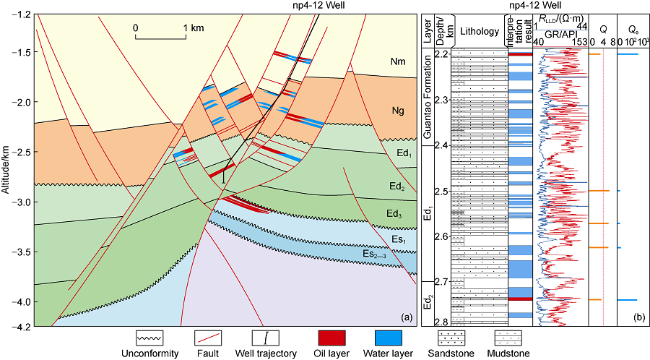
Fig. 8. Reservoir profile (a) and comprehensive histogram (b) of Well np4-12 in No. 4 structural zone of Nanpu sag. |
4.2. Control on distribution of sand bodies
Due to the reactivation of strike-slip faults in the basement, the en echelon faults were developed in shallow layers. The transition zone formed by the superimposed faults was an important channel for the water system into the basin, which controlled the distribution of sand bodies. Several right-step en echelon fault segments were developed due to F4 fault reactivation and fault growth. Due to the strong oblique extension, a sinistral right-step extensional transition zone was formed at the superimposed part. Considering the relationship between the fault distribution and the sand configuration in Ed2, the structural transition zone formed in the fault superimposed zone is apparently located in the channel development zone, forming fan delta sand (Fig. 9 ). Therefore, the transition zone formed due to the reactivation of the F4 fault controlled the position of the sand into the basin. The sand extended to the deep part of the lake basin along the vertical fault strike after entering the basin from the transition zone.
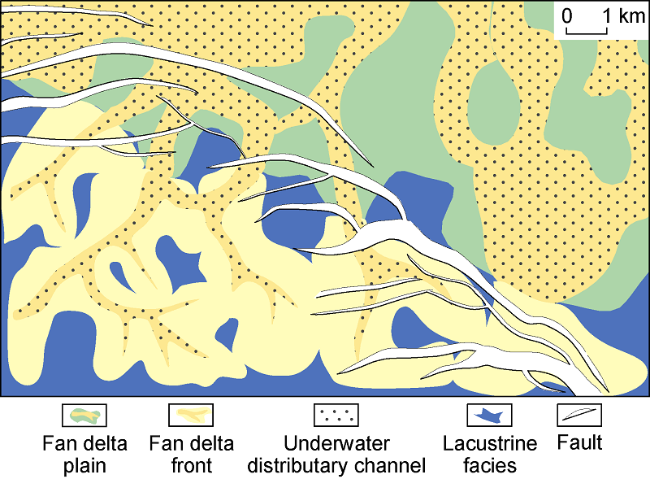
Fig. 9. Sedimentary facies distribution map of the second member of Dongying Formation of No. 4 structural zone in Nanpu sag. |
4.3. Control on the formation of favorable traps
The reactivation of the basement pre-existing strike- slip faults in the Cenozoic controlled the formation of two types of fault traps, namely the strike-slip fault trap and the extensional fault trap. The strike-slip fault trap is mainly developed in Ed-Nm, distributed in the northern part of the No. 4 fault zone. The trap formation is controlled by two factors: (1) Due to the large dip angle of the F4 fault basement, the upward propagation of the fault caused the uplift and deformation of the formation (Fig. 8 ). (2) Due to the F4 fault reactivation during the deposition of Ed to Nm, oblique extension deformation occurred, forming en echelon fault. Together with the basement fault, a "chair-shape" fault type was formed. They jointly controlled the "anticlinal negative flower structure" in the hanging wall, providing space for hydrocarbon accumulation. The extensional fault trap is primarily distributed in Ed2 to Nm. It is distributed on the plane at the tectonic transition zone where the No. 4 fault zone interacted with the adjacent No. 2 and No. 3 fault zones. In Fig. 10 a, the JJ° profile along the fault strike indicates that the footwall strata were uplifted at the "bend" of the connected fault strike (Fig. 10 b). A series of fault-block traps have been developed (Fig. 10 a), which are favorable locations for hydrocarbon accumulation.
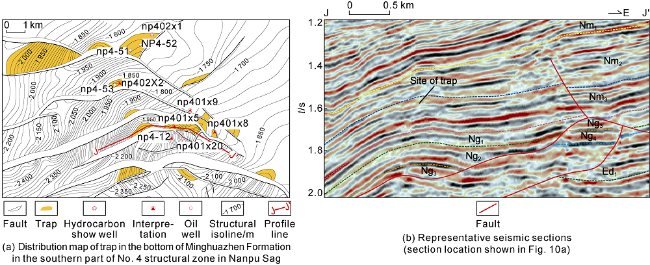


Fig. 10. Distribution of traps in the southern part of No. 4 structural zone in Nanpu sag. |
In conclusion, the control effects of the basement pre-existing strike-slip faults reactivation on the hydrocarbon accumulation of the Neogene include three aspects: (1) As the hydrocarbon migration channel, it is favorable for the hydrocarbon accumulation in shallow layers. (2) Control the distribution of sand bodies. (3) Control the formation of shallow traps, favorable for hydrocarbon accumulation in shallow layers.
5. Conclusions
In the Nanpu sag, the pre-existing strike-slip fault (F4) in the pre-Cenozoic NW-trending basement reactivated in the Cenozoic, resulting in formation of the No. 4 fault zone. The No. 4 fault zone is characterized by a multi-segment and en echelon arrangement. It grows from south to north, with strike-slip deformation dominated in the south and extensional deformation dominated in the north.
The Cenozoic No. 4 fault zone has a different fault system from the adjacent No. 2 and No. 3 fault zones. The physical simulations have confirmed that the fault zones have been developed under a unified stress field, and experienced the process of “independent growth-mutual contact-interaction connection”, eventually forming the current tectonic type.
According to the correlation between the angle between the maximum instantaneous horizontal tensile axis and the shear band, the obliquity, and the kinematic vorticity, an identification chart is established to determine the deformation mechanism of pre-existing faults reactivation under the extension of oblique intersection with pre-existing structure. During the deposition of the Shahejie Formation, the NW-trending pre-Cenozoic basement fault (F4) reactivated due to the influence of strike-slip action. Fault reactivation occurred under the influence of oblique extension during the deposition of the Dongying Formation. The change of deformation type is related to the change of the stress field orientation caused by the subduction direction of the Pacific Plate to the Eurasian Plate during the deposition of the Paleogene Dongying Formation.
The controlling effects of pre-existing strike-slip faults reactivation at the late stage on the hydrocarbon accumulation include: (1) As an oil-source fault, it controlled the vertical cross-layer hydrocarbon migration. (2) It controlled the formation of strike-slip transfer zone, controlling the distribution of sand bodies. (3) It grew upward and interacted with faults in neighboring areas, controlling the formation of two types of traps, favorable for hydrocarbon accumulation.
Nomenclature
GR—natural gamma-ray, API;
n—number of faults;
Q—quantitative grain fluorescence index;
Qe—quantitative grain fluorescence on extract index;
RLLD—resistivity of deep Laterolog, Ω·m;
t—two-way time, s;
Wk—kinematic vorticity;
α—inclination, (°);
β—angle between maximum instantaneous horizontal tensile axis (ISAmax) and normal of pre-existing structure boundary, (°);
θ—angle between maximum instantaneous horizontal tensile axis (ISAmax) shear band, (°);
σ1—maximum principal stress, MPa;
σ2—middle principal stress, MPa;
σ3—minimum principal stress, MPa;
ε1—maximum instantaneous horizontal tensile axis;
ε2—middle instantaneous horizontal tensile axis.