

Introduction
The second member of the Paleogene Kongdian Formation (Kong 2 Member) in the Cangdong Sag, Bohai Bay Basin is an important shale oil producing interval. The characteristics of mixed sedimentation, complex lithologies and strong heterogeneities lead to the development of complicated and diverse storage space types in the Kong 2 Member [1-3]. Adequate understanding the characteristics of pore distribution patterns, pore volume distribution, storage capacity, and three-dimensional (3D) pore structures of shales of different lithofacies in the Kong 2 Member would be helpful in identifying high- quality reservoir intervals and reducing shale oil exploration and development risks.
Shales in the Kong 2 Member have been previously studied in terms of pore type, pore size distribution, 3D pore structures, and oil mobility. Scanning Electron Microscope (SEM) observation shows that the Kong 2 Member (Ek2) shales mainly develop intergranular pores, intergranular fissures, dissolution pores and bedding-parallel fractures [4-7]. High-pressure mercury intrusion experiments show that the pore-throat diameters of the Ek2 shales are mainly less than 20 nm [8-9] and nitrogen isotherm adsorption experiments indicate that pores with diameters less than 100 nm provide the major storage space [8-10]. Nano X-ray CT experiments show that the 3D structures and connectivity of pores of the massive dolomitic shales and massive hybrid shales are the best, followed by the laminated felsic shales, while those of the laminated hybrid shales and laminated dolomitic shales are quite poor [1]. Nuclear magnetic resonance (NMR) experiments reveal that the laminated felsic shales have the highest movable fluid saturation, followed by the hybrid shales, with dolomitic shales having the lowest fluid saturation [2].
However, there are still three key outstanding issues in the characterization of shale storage space in the Kong 2 Member that remain unresolved: (1) Although the pore types developed in the Ek2 shales have been previously studied via SEM observation, there lacks comprehensive description and classification of the overall distribution patterns of the storage spaces (the overall structural patterns of the pore spaces and their matching relationships with mineral compositions), and the corresponding relationship between different lithofacies types and storage space types is unclear. (2) SEM observation shows that the Ek2 shales mainly develop pores with diameters of several hundred nanometers to several microns. However, the characterization by high pressure mercury injection method and low-pressure nitrogen adsorption method shows that the storage space is mainly provided by pores with diameters of less than 100 nm [8-10]. The above experimental results are inconsistent with pore sizes revealed by SEM examination [11-18]. (3) Nano X-ray CT technology has been used for 3D characterization of shale storage spaces in the Kong 2 Member, but the actual application results indicate that the resolution of this technology is quite limited, and the 3D structures of shale storage spaces in the Kong 2 Member cannot be adequately characterized. In addition, this technique requires samples to be prepared by drilling columnar rocks at sub-millimeter scales, which cannot guarantee accurate positioning to the imaging target area at the micro-nano scales, resulting in the characterization results not necessarily matching the type of lithofacies to be studied.
In view of the above problems, this research uses SEM and automatic mineral identification and characterization system (AMICS) to systematically study the storage space distribution patterns developed in the Ek2 shales. The pore space contribution is calculated based on the large SEM image mosaics, solving the problem that the low-pressure nitrogen adsorption experiment and the high-pressure mercury injection experiment cannot effectively reflect the real pore space contribution distribution. A novel large volume focused ion beam scanning electron microscope (LV-FIB-SEM) 3D reconstruction technology is adopted to overcome the shortcomings of nano X-ray CT technology in characterizing the 3D structures of the storage spaces of the Ek2 shales.
1. Samples and methods
Field emission scanning electron microscope (FE-SEM) was used to characterize more than 40 shale samples from the Kong 2 Member. The storage spaces discussed here include void pores and oil-bearing pores. The naming principle of storage spaces follows the protocol of "lithology + genesis + morphology". Seven representative samples were selected for systematic and in-depth qualitative and quantitative characterization. Four of the most characteristic samples were then selected for 3D reconstruction using the LV-FIB-SEM technique. The samples investigated mainly include felsic minerals such as albite and quartz, carbonate minerals such as dolomite and calcite, and clay minerals including illite and chlorite (Table 1 ). The felsic mineral content ranges from 6.45% to 84.08%, with an average of 47.09%. The carbonate mineral content is from 9.37% to 88.96%, with an average of 33.29%. The clay mineral content is mostly less than 30%, between 3.33% and 30.49%, with an average of 18.12%. Taking felsic minerals, carbonate minerals and clay minerals as three major mineral categories, and subdividing the lithofacies according to whether the contents of the three major mineral categories are greater than 50%, the samples studied include 3 felsic shale types, 2 hybrid shale types and 2 dolomitic shale types, covering the main storage space types in the Ek2 shales. The vitrinite reflectance (Ro) values of the studied samples are generally of 0.7%-1.0%, indicating that the maturity of the organic matter is at an oil generation stage. The organic matters observed are primarily oil or bitumen.
Table 1. Mineral compositions and storage space types of samples from the Kong 2 Member, Cangdong Sag, Bohai Bay Basin |
| Samples | Well | Depth/ m | Mineral compositions/% | Lithofacies | Code | Storage space type | |||||||
|---|---|---|---|---|---|---|---|---|---|---|---|---|---|
| Albite | Orthoclase | Quartz | Dolomite | Calcite | Illite | Chlorite | Others | ||||||
| G-1 | GXX4 | 4137.78 | 67.07 | 8.42 | 8.59 | 7.32 | 3.19 | 1.89 | 1.44 | 2.08 | Felsic shale | I | Felsic intergranular micron pores |
| G-2 | GXX4 | 4105.68 | 52.44 | 14.72 | 8.76 | 4.33 | 5.04 | 9.16 | 2.06 | 3.49 | Felsic shale | II | Felsic intergranular fissures |
| G-3 | GXX8 | 3044.03 | 33.47 | 15.09 | 8.19 | 16.43 | 0.58 | 1.20 | 23.40 | 1.64 | Felsic shale | III | Felsic intergranular pores |
| G-4 | GXX8 | 3269.62 | 37.54 | 1.64 | 8.60 | 17.05 | 3.87 | 29.27 | 1.22 | 0.81 | Hybrid shale | IV | Mixed intergranular pores and fissures |
| G-5 | GXX4 | 4087.15 | 13.64 | 21.84 | 3.75 | 31.22 | 1.56 | 2.56 | 24.33 | 1.10 | Hybrid shale | V | Mixed intergranular pores |
| G-6 | GXX8 | 3118.75 | 10.20 | 7.87 | 1.37 | 51.48 | 2.01 | 0.53 | 26.22 | 0.32 | Dolomitic shale | VI | Cay-bearing dolomitic intergranular pores |
| G-7 | GXX8 | 2985.17 | 2.56 | 1.55 | 2.34 | 85.40 | 3.56 | 1.23 | 2.33 | 1.03 | Dolomitic shale | VII | Dolomitic intergranular pores |
SEM observation, analysis of large SEM image mosaics and AMICS mineral identification are relatively mature and robust techniques [19-22], all of which were used extensively in this study. The novel LV-FIB-SEM 3D reconstruction method is here introduced to address the challenging dilemma between sample sizes and detection resolution in digital core analysis. The basic process is the same as that of the commonly used 10 μm × 10 μm × 10 μm 3D FIB-SEM model reconstruction [23-26]: (1) Use a Zeiss Crossbeam 550 FIB-SEM to reconstruct a volume of 75 μm × 65 μm × 65 μm. (2) After rotating the sample stage by 54° and completing the focusing of the electron beam and ion beam, a trapezoidal trench was dug with the gallium ion beam of 30 kV and 65 nA, and two ear trenches were dug with a gallium ion beam of 30 kV and 30 nA. (3) Rough and fine polishing were then performed on the cross section of the sample by an ion beam with a low voltage and current, to ensure that the image acquisition area of the sample can be sharply displayed. (4) Consecutive slices with individual thickness of 30 nm were cut by ion beam of 30 kV and 7 nA, with the new cutting surface then being imaged by SEM via an electron beam of 1 kV and 500 pA. The pixel size of the captured SEM image is 30 nm × 30 nm. The process of digging the trapezoidal trench, digging the ear trenches, rough and fine polishing would take about 19 hours for each sample. The process of continuous slicing and imaging would take about 45 hours per sample.
2. Types of storage space
According to the SEM observation and AMICS scan results, seven types of storage space were identified among the samples analyzed, including three types of felsic storage spaces: (I) felsic intergranular micron pores, (II) felsic intergranular fissures and (III) felsic intergranular pores; two types of mixed storage spaces: (IV) mixed intergranular pores/fissures and (V) mixed intergranular pores; two types of dolomitic storage spaces: (VI) clay-bearing dolomitic intergranular pores and (VII) dolomitic intergranular pores.
2.1. Felsic intergranular micron pores
Felsic intergranular micron pores are relatively large, irregular and polygonal, with straight borders and well-defined corners (Fig. 1 a). Micron pores refer to granular pores up to micron sizes, with average pore size of 1-5 μm. Bitumen in the intergranular pores has been partially lost, showing asymmetrical coating on the grains with "one side is thick while one side is thin" or "one side is coated with bitumen while the other side is absent of bitumen" (Fig. 1 b). An important feature of this type of storage space is that there are almost no clay minerals within the intergranular pores with the bitumen appearing to be quite pure. As shown in the AMICS scan result, felsic minerals occupy the majority of the area, with fewer carbonate minerals and almost no clay minerals (Fig. 1 c).
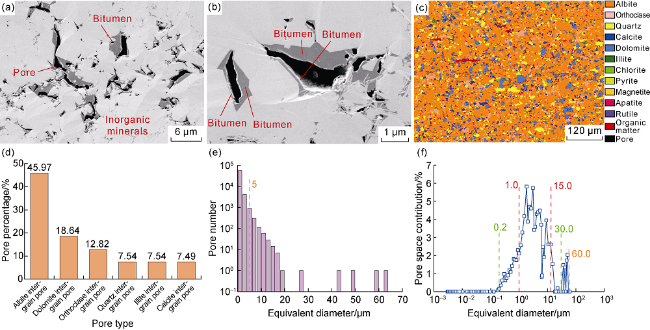
Fig. 1. Felsic intergranular micro pores of Kong 2 Member shales and their characteristics in Cangdong Sag (Sample G-1, Well GXX4, 4137.78 m, Kong 2 Member). (a) Distribution patterns of storage space; (b) Close-up view of the storage space; (c) Pseud-colored AMICS scan image showing two-dimensional distribution of mineral components; (d) Pore type proportion derived from AMICS scan results; (e) Distribution of pores of different diameters calculated from large SEM image mosaics; (f) Pore space contribution derived from large SEM image mosaics. |
Based on the AMICS scan results, the contact area between pores and their surrounding minerals were statistically counted, the proportion of pore types can then be quantified from the perspective of pore-mineral conjunctive relationships. This type of storage space is dominated by albite intergranular pores, accounting for 45.97% of the total pores. Dolomite intergranular pores account for 18.64%. The proportions of intergranular pores of orthoclase, quartz, illite and calcite are 12.82%, 7.54%, 7.54% and 7.49%, respectively (Fig. 1 d). Large SEM image mosaics were used to calculate the 2D visual porosity, pore equivalent diameter distribution and pore space contribution, which have the advantage of adequately characterize the oil/bitumen-bearing storage space. After image segmentation of void pores and oil/bitumen-bearing pores, the calculated 2D visual porosity is 10.06%, indicating a good storage capacity. The amount of pores less than 5 μm in diameter is predominant, and the number of pores gradually decreases as the pore diameter increases (Fig. 1 e). The main storage space is provided by pores with equivalent diameter of 0.2-30.0 μm, of which pores with equivalent diameters of 1-15 μm contribute the most (Fig. 1 f). There is also an apparent peak at the equivalent diameter of 30-60 μm. This peak corresponds to the large sedimentary kerogen, rather than void pores or bitumen.
2.2. Felsic intergranular fissures
This type of storage space mainly comprises intergranular fissures and is usually filled with bitumen. The intergranular fissures are interconnected with each other to form a widely distributed fissure network (Fig. 2 a). Small amounts of clay minerals are visible within the intergranular fissures (Fig. 2 b). The slit-like pores and the sparse occurrence of clay minerals are the main features for identifying this type of storage space. Bitumen is usually well preserved with distinct round or sub-circular organic pores (Fig. 2 a, 2b). Clay minerals (green areas) distributed between the matrix mineral grains are visible in the AMICS scan image (Fig. 2 c).

Fig. 2. Felsic intergranular fissures of Kong 2 Member shales and their characteristics in Cangdong Sag (Sample G-2, Well GXX4, 4105.68m, Kong 2 Member). (a) Distribution patterns of storage space; (b) Close-up view of storage space; (c) Pseud-colored AMICS scan image showing two-dimensional distribution of mineral components; (d) Pore type proportion derived from AMICS scan results; (e) Distribution of pores of different diameters derived from large SEM image mosaics; (f) Pore space contribution derived from large SEM image mosaics. |
Illite and chlorite intergranular fissures account for 39.87% and 29.77% of all pores, respectively, forming the main storage space (Fig. 2 d). Intergranular pores associated with albite and orthoclase account for 19.96% and 8.53%, respectively. Intergranular pores are rarely associated with calcite and quartz, accounting for only 0.97% and 0.90%, respectively. The visual porosity of this type of storage space is 12.90%, which is the best in all types of storage space. Since the storage space is mainly slit-like, the maximum Feret diameter (the distance between two parallel tangent lines through two farthest points of the object in specific direction) is used to characterize the maximum length of the fissures in its maximum extension direction. The number of intergranular fissures with Feret diameters less than 2.5 μm is the largest, and the number of intergranular fissures gradually decreases with increasing pore diameter (Fig. 2 e). The storage space (pore volume) is dominantly provided by intergranular fissures with Feret diameters of 0.1-80.0 μm, in which fissures with Feret diameters of 1-80 μm contribute the most (Fig. 2 f).
2.3. Felsic intergranular pores
As shown in Fig. 3 a-3b, this type of storage space is composed mainly of intergranular pores of clay minerals and pores between clay minerals and some other brittle minerals. Compared with the type II storage space, this type of storage space is filled with more clay minerals. In addition, the intergranular pores are also filled with carbonate minerals, mainly rhombic dolomite. Due to an increase in the pore-filling minerals, the porosity in this type of storage space is significantly reduced compared with the type I storage space. The dominant pore diameter is decreased to tens of nanometers to hundreds of nanometers. There also lacks well-developed interconnected fissure network as seen in the type II storage space.
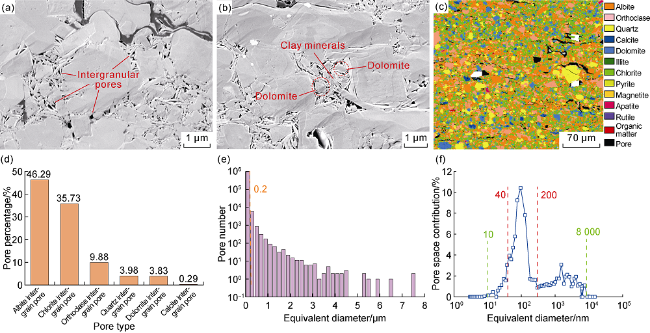
Fig. 3. Felsic intergranular pores of Kong 2 Member shales and their characteristics in Cangdong Sag (Sample G-3, Well GXX8, 3044.03m, Kong 2 Member). (a) Distribution patterns of storage space; (b) Close-up view of storage space; (c) Pseud-colored AMICS scan image showing two-dimensional distribution of mineral components; (d) Pore type proportion derived from AMICS scan results; (e) Distribution of pores of different diameters derived from large SEM mosaics; (f) Pore space contribution derived from large SEM image mosaics. |
The relatively increase in the carbonate and clay minerals has caused a significant reduction of the amount of felsic minerals in the AMICS scan image (Fig. 3 c). The intergranular pores associated with albite account for 46.29% of the total pores, including pores between albite and clay minerals; Intergranular pores associated with chlorite and orthoclase account for 35.73% and 9.88%, respectively; while intergranular pores associated with other minerals account for less than 9% (Fig. 3 d). This is consistent with the fact observed from SEM images that the intergranular pores of clay minerals and the pores between clay minerals and matrix minerals are the main pore types. The visual porosity of this type of storage space is only 2.95%, indicating a quite poor storage capacity. The storage capacity of this type of storage space has been greatly reduced by the large amounts of fillings in the intergranular pores. The equivalent diameter of intergranular pores is in the range of 0.01-8.00 μm, among which pores smaller than 0.2 μm are dominant (Fig. 3 e). Pores with equivalent diameters of 0.04-0.20 μm contribute the most to the total pore space, while pores with equivalent diameters of 0.2-8.0 μm also contribute to the pore space (Fig. 3 f).
2.4. Mixed intergranular pores and fissures
This type of storage space is composed mainly of pores and fissures between clay minerals and matrix minerals. Fissures are dominant, while pores are also relatively well developed (Fig. 4 a, 4b). The content of clay minerals in the storage space is high, and clay minerals are not distributed in the intergranular pores of matrix minerals as in type II and type III storage spaces. Clay minerals wrap matrix mineral grains displaying good ductility, resulting in the matrix minerals not touching each other or only partially in contact (Fig. 4 a, 4b). Clay minerals are sparsely distributed in the type II storage space, while clay minerals in this type of storage space are significantly increased and pervasively distributed (Fig. 4 a, 4b). Carbonate mineral grains such as dolomite are no longer mixed with clay minerals filling intergranular pores (Fig. 3 a, 3b), but appear as matrix minerals together with albite, quartz and other matrix grains (Fig. 4 c).
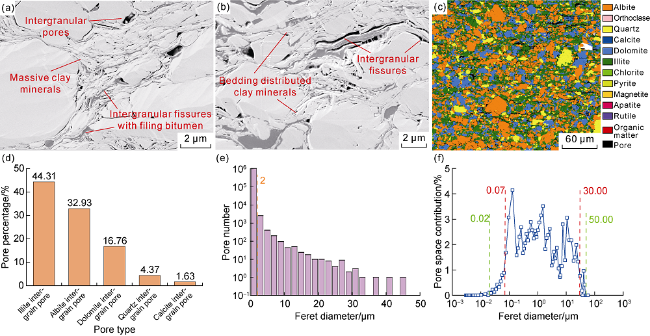
Fig. 4. Mixed intergranular pores/fissures of Kong 2 Member shales and their characteristics in Cangdong Sag (Sample G-4, Well GXX8, 3269.62m, Kong 2 Member). (a) Distribution patterns of storage space; (b) Close-up view of storage space; (c) Pseud-colored AMICS scan image showing two-dimensional distribution of mineral components; (d) Pore type proportion derived from AMICS scan results; (e) Distribution of pores of different diameters derived from large SEM image mosaics; (f) Pore space contribution derived from large SEM image mosaics. |
Illite intergranular pores account for 44.31% of the total pores in this type of storage space, followed by albite intergranular pores accounting for 32.93%, dolomite intergranular pores accounting for 16.76%, while intergranular pores associated with other minerals only accounting for 6% (Fig. 4 d). Since a large number of intergranular fissures are developed in this type of storage space, the Feret diameter was used for quantitative analysis. The number of pores/fissures with diameters less than 2 μm is the largest, and the number of pores/fissures between 2 μm and 45 μm gradually decreases (Fig. 4 e). It is worth noting that the content of clay minerals in this type of storage space is very high, up to 30.49% (Table 1 ). Theoretically, the storage capacity of this type storage space should be low, but the visual porosity is relatively high, approximately 9.31%. This may be related to the unique distribution pattern of clay minerals. Clay minerals wrap the matrix minerals, increasing the formation probability of intergranular fissures (Fig. 4 b), thus increasing the storage space. The storage space is mainly provided by pores/fissures with Feret diameters of 0.02-50.00 μm, of which the pores/fissures of 0.07-30.00 μm contribute the most (Fig. 4 f). The intergranular pores of tens of nanometers and fissures of tens of micrometers all have a large contribution to the storage space, unlike the concentrated pore space contribution of type I and type III storage spaces (Figs. 1f and 3f).
2.5. Mixed intergranular pores
This type of storage space consists mainly of numerous sub-circular chlorite intergranular pores with bitumen filling (Fig. 5 a, 5b). A large amount of chlorite is distributed among the brittle mineral grains such as dolomite and orthoclase (Fig. 5 b, 5c), resulting in the absence of brittle mineral-associated intergranular pores. Chlorite associated intergranular pores account for 46.66% of the total pores (Fig. 5 d), which is followed by orthoclase, dolomite, albite-associated intergranular pores, accounting for 28.72%, 15.09% and 8.25%, respectively. The visual porosity of this type of storage space is 4.55%, indicating a moderate storage capacity. Pores smaller than 100 nm are dominant, and the number of pores decreases gradually with increasing pore size (Fig. 5 e). The storage space is mainly provided by pores with equivalent diameters of 40-700 nm, among which pores of 100-400 nm contribute the most to the total pore space (Fig. 5 f).
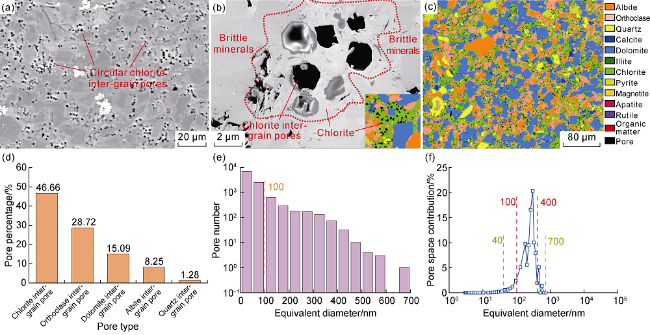
Fig. 5. Mixed intergranular pores of Kong 2 Member shales and their characteristics in Cangdong Sag (Sample G-5, Well GXX4, 4087.15 m, Kong 2 Member). (a) Distribution patterns of storage space; (b) Close-up view of storage space; (c) Pseud-colored AMICS scan image showing two-dimensional distribution of mineral components; (d) Pore type proportion derived from AMICS scan results; (e) Distribution of pores of different diameters derived from large SEM image mosaics; (f) Pore space contribution derived from large SEM image mosaics. |
2.6. Clay-bearing dolomitic intergranular pores
This type of storage space consists mainly of dolomite intergranular pores, which are usually triangular. In addition, some intergranular pores associated with chlorite and pores between chlorite and dolomite are also developed with bitumen filling the pores (Fig. 6 a, 6b). The feldspar content is greatly reduced and dolomite becomes the dominant mineral type (Fig. 6 c). Dolomite intergranular pores account for 51.36% of the total pores, chlorite intergranular pores account for 31.83%, while orthoclase and albite intergranular pores account for 10.26% and 5.72%, respectively, with minor amount quartz-associated intergranular pores (Fig. 6 d). The visual porosity of this type of storage space is 6.32%, indicating a relatively good storage capacity. The number of pores with diameters smaller than 200 nm is the largest, and the number of pores larger than 200 nm decreases gradually with increasing equivalent diameter (Fig. 6 e). The storage space is primarily provided by pores with equivalent diameters of 8-2000 nm, of which pores with equivalent diameters of 80-700 nm contribute the most (Fig. 6 f).
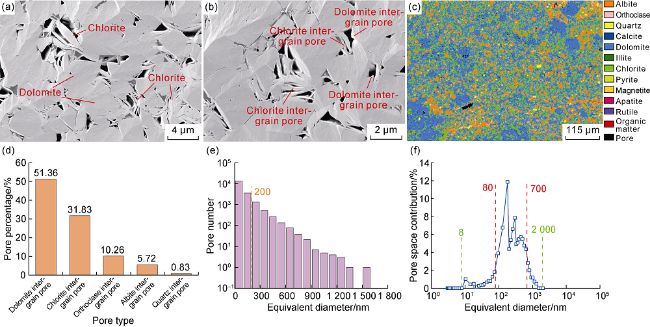
Fig. 6. Clay-bearing dolomitic intergranular pores of Kongdian Formation shale and their characteristics in Cangdong Sag (Sample G-6, Well GXX8, 3118.75 m, Kong 2 Member). (a) Distribution patterns of storage space; (b) Close-up view of storage space; (c) Pseud-colored AMICS scan image showing two-dimensional distribution of mineral components; (d) Pore type proportion derived from AMICS scanning results; (e) Distribution of pores of different diameters derived from large SEM image mosaics; (f) Pore space contribution derived from large SEM image mosaics. |
2.7. Dolomitic intergranular pores
This type of storage space comprises mainly dolomite intergranular pores, with a triangular pore geometry and almost no clay minerals (Fig. 7 a, 7b). The dolomite intergranular pores account for 97.81% of the total pores (Fig. 7 c, 7d). The visual porosity of this type of storage space is 7.90%, indicating a relatively good storage capacity. The number of pores with equivalent diameters less than 200 nm is the largest, and the number of pores decreases gradually with increasing equivalent diameter (Fig. 7 e). The storage space is provided by pores with equivalent diameters of 7-2000 nm, among which pores with equivalent diameters of 50-600 nm contribute the most (Fig. 7 f).

Fig. 7. Dolomite intergranular pores of Kong 2 Member shales and their characteristics in Cangdong Sag (Sample G-7, Well GXX8, 2985.17 m, Kong 2 Member). (a) Distribution patterns of storage space; (b) Close-up view of storage space; (c) Pseud-colored AMICS scan image showing two-dimensional distribution of mineral components; (d) Pore type proportion derived from AMICS scan results; (e) Distribution of pores of different diameters derived from large SEM image mosaics; (f) Pore space contribution derived from large SEM image mosaics. |
3. Large-volume FIB-SEM 3D reconstruction
The LV-FIB-SEM 3D reconstruction was adopted here for the first time to characterize the 3D pore structure of shales with strong heterogeneities. LV-FIB-SEM 3D reconstruction allows us to investigate heterogeneous shale pore network models at representative scale with high spatial resolution. According to the lithofacies and the geometry of the storage space, four most representative types of storage space were selected to carry out LV-FIB-SEM 3D reconstruction. Among them, the storage space of the felsic intergranular micron pore has unique micron-scale pores; the felsic intergranular fissure is the only storage space comprising mainly fissures; the mixed intergranular pores have special sub-circular geometries; and the clay-bearing dolomite intergranular pores develop the most typical granular pore network.
3.1. Felsic intergranular micron pores
A LV-FIB-SEM 3D model of 73.5 μm × 52.5 μm × 38.1 μm was obtained after image processing including alignment, cropping and removing image artifacts (Fig. 8 a). The 3D storage space model was obtained by extracting void pores and oil/bitumen-bearing pores (Fig. 8 b). The overall connectivity of the pore network is good. The close-up view images of the 3D pore network show that the intergranular pores are irregular and granular (Fig. 8 c), and the throats are mainly in the shape of pipe columns with different diameters and lengths (Fig. 8 d). Therefore, the pore network of this storage space is composed of certain amounts of "irregular and granular" pores connected by a series of "tubular" throats.
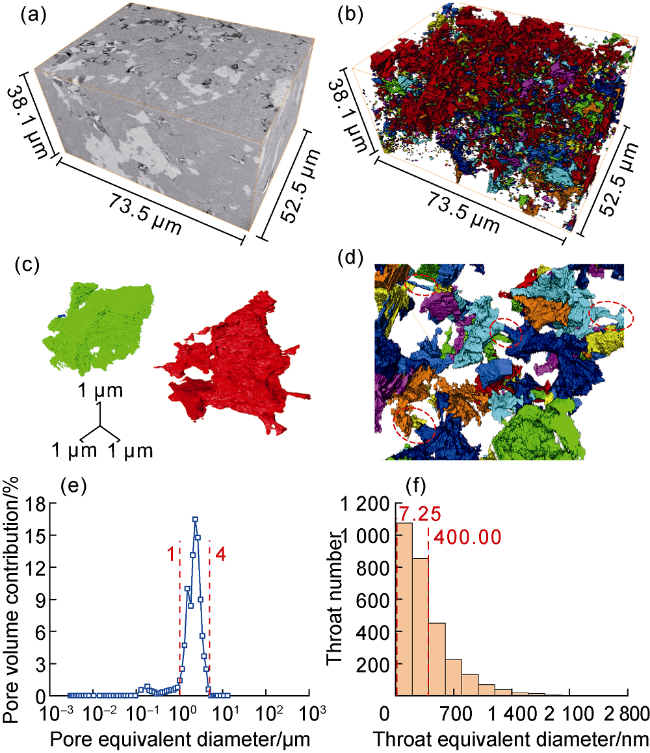
Fig. 8. Three-dimensional pore structure of felsic intergranular micron pores. (a) LV-FIB-SEM 3D reconstruction model with a spatial resolution of 30 nm; (b) 3D model of storage space composed of disconnected pore clusters in different colors; (c) Irregular and granular pores forming pore networks; (d) Tubular throats with different diameters and lengths; (e) Pore volume contribution derived from 3D model of storage space; (f) Distribution of throats of different equivalent diameter derived from 3D model of storage space. |
According to the segmented 3D pore network, the calculated porosity of the model is 9.32%. The main pore volume is provided by pores with equivalent diameters of 1-4 μm (Fig. 8 e). Compared to 2D images, 3D models have the advantage of calculating pore throat diameters and pore coordination numbers. The diameter of cylindrical throats is in the range of 7.25-2740.00 nm, predominantly in the range of 7.25-400.00 nm (Fig. 8 f). The pore throat diameter is relatively large, which would be conducive to shale oil flow. The pore coordination number is in the range of 1-20, with an average of 3.18, indicating that there are many interconnecting channels between pores, showing an excellent connectivity. The pore volume fraction of the largest interconnected pore cluster is 4.41% (the red pore cluster in Fig. 8 b), accounting for 47.31% of the entire pore space, indicating that the pore interconnected domain is generally large in this type of storage space.
3.2. Felsic intergranular fissures
The size of the LV-FIB-SEM 3D model for this type of storage space is 59.67 μm × 53.26 μm × 28.72 μm. The intergranular fissures are all filled with bitumen, and the matrix minerals are in point contact or non-contact (Fig. 9 a). The 3D model of storage space shows that intergranular fissures are interconnected to form a large percolation network, with only a few small isolated pores (Fig. 9 b). This type of pore network would be quite conducive to the percolation of shale oil. In order to dissect the structural morphology of the storage space more clearly, the pore network model is locally magnified. The magnified model shows that there are many hollow areas in the pore network, representing the spatial distribution of mineral grains (Fig. 9 c). This indicates that bitumen completely encapsulates the mineral particles and the mineral particles are not in contact with each other (Fig. 9 d). The abstract model of the intergranular fissure network is illustrated by Fig. 9 e.
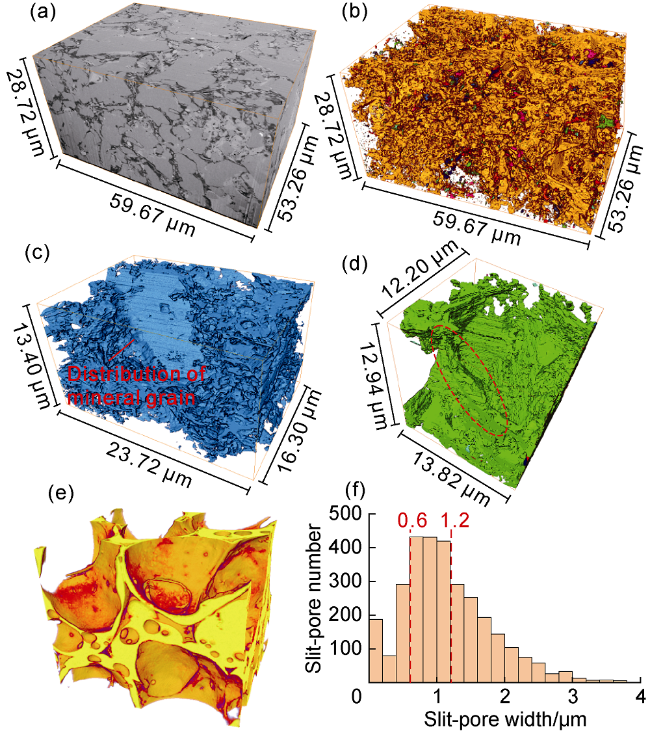
Fig. 9. Three-dimensional pore structure characteristics of felsic intergranular fissures. (a) LV-FIB-SEM 3D reconstruction model with a spatial resolution of 30 nm; (b) 3D model of storage space composed of connected fissures; (c) Local magnified pore network showing a mineral grain (hollow area) being completely wrapped by fissures; (d) Local magnified pore network showing a fissure between mineral grains; (e) Abstract schematic diagram of an intergranular fissure network; (f) Distribution of fissures of different widths derived from 3D model of storage space. |
Since this type of storage space does not have a typical pore throat structure, its pore volume distribution, throat diameter distribution and coordination number cannot be calculated. The model porosity is 11.92%, indicating a good storage capacity. The volume fraction of the largest interconnected pore cluster is 11.46%, accounting for 96.14% of the total pore volume, demonstrating an overwhelmingly large interconnected domain. The storage space is composed mainly of certain amounts of connected intergranular fissures. Intergranular fissures are quite important percolation channels with widths of 0.6-1.2 μm (Fig. 9 f). This type of storage space has a good storage capacity, good connectivity and wide percolation channels, making it an excellent high-quality storage space.
3.3. Mixed intergranular pores
The size of the LV-FIB-SEM 3D model is 59.94 μm × 39.27 μm × 30.03 μm. The storage space is dominated by sub-circular chlorite intergranular pores (Fig. 10 a). Pore clusters are usually connected by several or a dozen sub-circular pores (Fig. 10 b). Although the pore clusters are close to each other, they are not interconnected over a large area to form large-domain pore networks as shown in Fig. 8 b and Fig. 9 b. The three-dimensional structure of pore clusters is "string-like stacking" (Fig. 10 c), or similar to "cluster-like stacking" (Fig. 10 d).
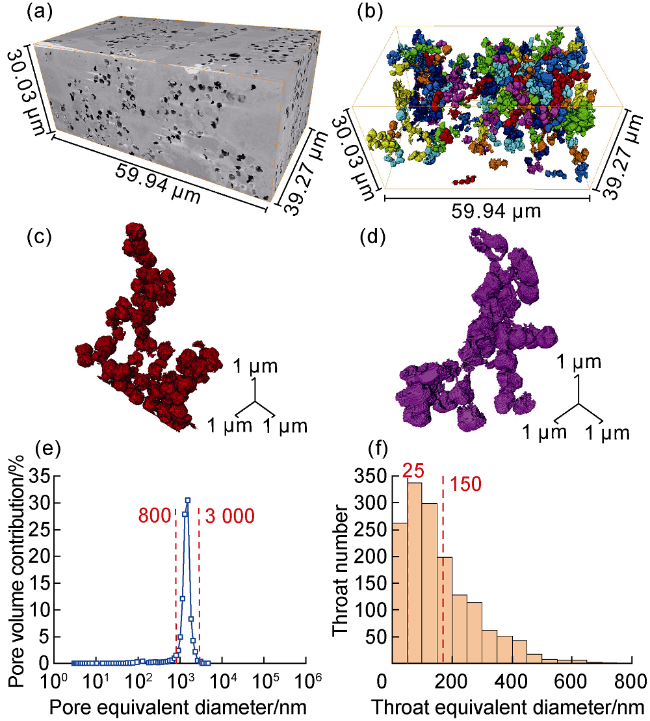
Fig. 10. Three-dimensional pore structure of mixed intergranular pores. (a) LV-FIB-SEM 3D reconstruction model with a spatial resolution of 30 nm; (b) 3D model of storage space composed of pore clusters; (c) String-packed pore clusters; (d) Tufted pore clusters; (e) Pore volume contribution derived from 3D model of storage space; (f) Distribution of throats of different diameters derived from 3D model of storage space. |
The model porosity is 5.59%, and the main pore volume is provided by pores with equivalent diameters of 800-3000 nm (Fig. 10 e). The equivalent diameter of pore throats is mainly in the range of 25-150 nm (Fig. 10 f). The minimum and maximum coordination number of pores are 1 and 6, respectively, with an average of 1.66. The lower coordination number reflects fewer interconnected channels, which is consistent with that the pores are usually only connected with nearby 1-2 pores (Fig. 10 b). The volume fraction of the largest connected pore cluster is 0.15%, only accounting for 1.31% of the total pore volume, indicating that the pores are only connected over a small domain.
3.4. Clay-bearing dolomite intergranular pores
The size of the LV-FIB-SEM 3D model is 75.53 μm × 37.68 μm × 42.24 μm. The storage space is dominated by dolomite intergranular pores and pores between dolomite and chlorite (Fig. 11 a). Pores are connected to each other to form a large pore network (Fig. 11 b). Close-up view images show that the intergranular pores of dolomite are triangular pyramid-shaped of different sizes (Fig. 11 c). The pore throats are bent slices of varying lengths, thicknesses, widths, and curvatures (Fig. 11 d). Therefore, the pore network is formed by interconnecting the "triangular pyramid-shaped" pores via "bent slice-shaped" throats.
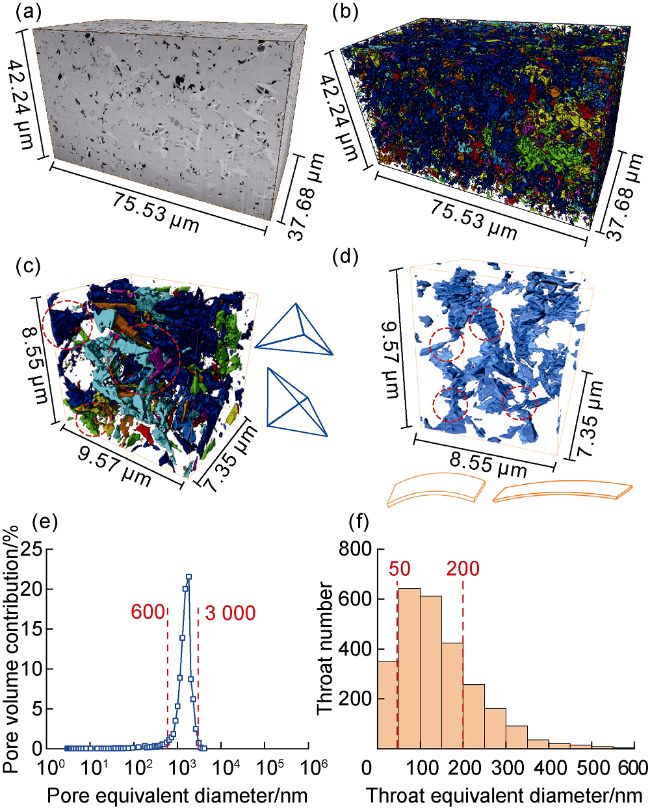
Fig. 11. Three-dimensional pore structure of the clay-bearing dolomitic intergranular pores. (a) LV-FIB-SEM 3D reconstruction model with a spatial resolution of 30 nm; (b) 3D model of storage space composed of connected pores; (c) Pores in a shape of triangular pyramid; (d) Throats in a shape of bent slice with different thicknesses and curvatures; (e) Pore volume contribution derived from 3D model of storage space; (f) Distribution of throats of different diameter derived from 3D model of storage space. |
The model porosity is 10.17%, and the main pore volume is provided by pores with equivalent diameters of 600-3000 nm (Fig. 11 e). The equivalent diameter of the pore throats is mainly in the range of 50-200 nm (Fig. 11 f). The minimum and maximum coordination number of pores are 1 and 12, respectively, with an average of 2.48, suggesting the presence of numerous connecting channels between pores. In the pore network model, the volume fraction of the largest interconnected pore cluster is 7.18%, accounting for 70.59% of the total pore volume, indicating a large interconnected pore domain.
4. Storage space
The mineral contents for the seven storage space types proposed in this paper are compared and analyzed. They show a good variation pattern among the three major shale categories in the Cangdong Sag. The content of carbonate minerals gradually increases from Type I to Type VII, while the content of felsic minerals gradually decreases, and the content of clay minerals firstly increases and then decreases (Fig. 12 ). Among the seven types of storage space, the content of felsic minerals and carbonate minerals exceeds 80% at the maximum and close to 6% at the minimum, respectively. The clay mineral content reaches a maximum of 30.49% and with a minimum content of 3%. The relative ratios of the three major mineral groups for the seven storage space types contain all the typical ratios, indicating that the seven storage space types proposed in this paper can account for all the main storage spaces present in the Ek2 shales. The samples corresponding to the seven storage spaces were sequentially from the prodelta to the center of lake basin. During drought periods, the input from terrestrial sources and the depth of water decrease, increasing salinity would cause the precipitation of dolomite, forming dolomitic shales (types VI and VII storage spaces). During the wet periods, the input from terrestrial sources would increase, developing felsic shales (types I, II and III storage spaces). Over the transition periods between drought and wet, hybrid shales would be developed (types IV and V storage space)[27].
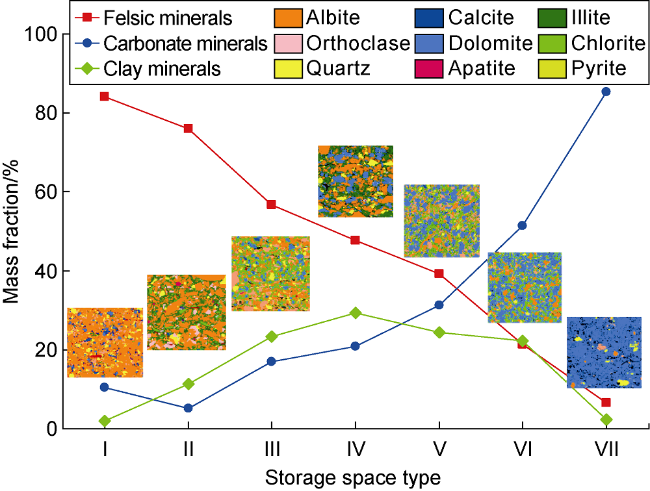
Fig. 12. Variations of three major mineral groups for the seven storage space types. |
The visual porosities of the intergranular fissures, intergranular pores/fissures and intergranular micron pores are all higher than 9% (Fig. 13 a). Among them, the felsic intergranular fissures have the largest visual porosity (12.90%). This storage space type is usually developed in laminated felsic shales, which is consistent with exploration findings that shale oil is mostly abundant in laminated felsic shales [3,6]. The felsic intergranular micron pores have the second highest visual porosity of 10.06%, while the mixed intergranular pores/fissures have a visual porosity of 9.30%. The storage capacity of the storage space dominated by intergranular fissures and micron pores is generally greater than that of the storage space of the intergranular pores. The visual porosities of the intergranular pore type storage space are all less than 9.00% (Fig. 13 a), and decreases gradually in the order of dolomite type (7.90%), clay-bearing dolomite type (6.32%), mixed type (4.55%), and felsic type (2.95%). This trend is consistent with previous findings that dolomitic shales and hybrid shales have better storage capacity than felsic shales [7].
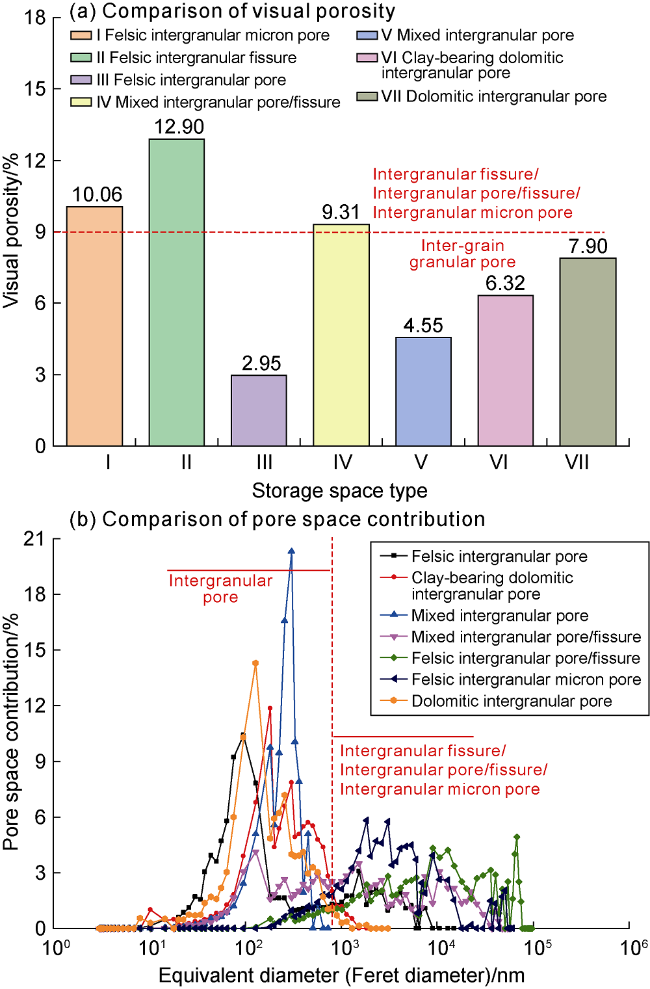


Fig. 13. Visual porosity and pore space contribution of different types of storage space. |
Among all the storage spaces, the type of felsic intergranular fissure has the best storage capacity. When the storage space is of intergranular pore, dolomitic shales have the best storage capacity, followed by hybrid shales, while felsic shales have relatively weak storage capacity. The quality of the storage capacity is affected by the distribution patterns of the storage space: (1) The storage capacity of the intergranular fissure type storage space is usually greater than that of the intergranular pore type storage space. (2) In the storage space type of intergranular pore, when the content of fillings such as clay minerals in the intergranular pores is high, the visual porosity is generally low. (3) Higher contents of clay minerals do not necessarily lead to lower storage capacity. If clay minerals are wrapping matrix minerals with good ductility, a large number of fissures may be generated to improve the storage capacity, such as the Type IV storage space.
The key parameters for the seven types of storage space can be used to reflect and compare the seven types of storage space (Table 2 ). For the connectivity of different types of storage spaces, the largest interconnected pore cluster is present in the storage space type of felsic intergranular fissure, which accounts for 96.14% of the total pore volume, demonstrating that this storage space type has the largest pore connectivity domain and thus the best connectivity (Table 2 ). The average pore coordination number of the storage space type for the clay-bearing dolomite intergranular pores is 2.48, and the ratio of the largest interconnected pore cluster to the total pore volume is up to 70.59%, indicating that it is the second best type of storage space in terms of pore connectivity. LV-FIB-SEM 3D reconstruction analysis has not been carried out for the storage type of dolomite intergranular pores, and thus the relevant connectivity evaluation parameters are unknown. However, since the pore structure of this pore type is similar to the storage space type of clay-bearing dolomite intergranular pores, it is assumed that they should have the same level of pore connectivity. The coordination number of the storage space type of mixed intergranular pores is 1.66, and the volume fraction of the largest pore cluster size is 1.31%. The values of the two evaluation parameters are both low. Combined with SEM images (Fig. 10 b), it is considered to belong to a storage space type with poor overall connectivity but good local connectivity. Based on the visual porosity, it is inferred that the pore connectivity for the storage space type of the felsic intergranular pores (2.95% visual porosity) is the worst, and the pore connectivity for the storage space type of mixed intergranular pores/fissure (9.31% visual porosity) is good.
Table 2. Summary of key evaluation parameters of 7 storage space types |
| Code | Storage space type | Visual porosity/ % | Main pore diameter/ μm | Main throat diameter/ nm | Average coordination number | Proportion of the largest connected pore/% | Main pore type |
|---|---|---|---|---|---|---|---|
| I | Felsic intergranular micron pore | 10.06 | 1.00-15.00 | 7.25-400.00 | 3.18 | 47.31 | Albite intergranular pore |
| II | Felsic intergranular fissure | 12.90 | 1.00-80.00 | 600.00- 1200.00 | 96.14 | Illite intergranular fissure, Albite intergranular fissure, fissure between illite and albite | |
| III | Felsic intergranular pore | 2.95 | 0.04-0.20 | Albite intergranular pore, Chlorite intergranular pore, pore between albite and chlorite | |||
| IV | Mixed intergranular pore and fissure | 9.31 | 0.07-30.00 | Illite intergranular pore/fissure, Albite intergranular pore/fissure, pore/fissure between illite and albite | |||
| V | Mixed intergranular pore | 4.55 | 0.10-0.40 | 25.00-150.00 | 1.66 | 1.31 | Chlorite intergranular pore |
| VI | Clay-bearing dolomitic intergranular pore | 6.32 | 0.08-0.70 | 50.00-200.00 | 2.48 | 70.59 | Dolomite intercrystal pore, pore between chlorite and dolomite |
| VII | Dolomitic intergranular pore | 7.90 | 0.05-0.60 | Dolomite intercrystal pore |
5. Conclusions
The Kong 2 Member shales in the Cangdong Sag, Bohai Bay Basin comprise seven major storage space types, covering the main storage space types of felsic shales, hybrid shales and dolomitic shales in the Ek2 reservoirs. The felsic intergranular fissure type has the best storage capacity and percolation structure, and is the most favorable reservoir type. When the storage space is dominated by intergranular pore structure, dolomitic shales have the best storage capacity, followed by hybrid shales and felsic shales.
Pore-mineral contact areas derived from AMICS scan results can be used to effectively quantify the pore types and their spatial distribution. The computation of pore diameter distribution and pore space contribution based on large SEM image mosaics allows an effective characterization of oil bitumen-bearing storage spaces. The novel LV-FIB-SEM 3D reconstruction technology adopted in this study can adequately address the dilemma of large model size and high spatial resolution required for characterizing the 3D structures of storage spaces in heterogeneous continental shales.