

Introduction
The concept of transition zone was first introduced by Dahlstrom CDA in 1970 when he studied the geometry of fold-thrust faults in compressional deformation [1] and was applied to extensional structures by Morley CK in 1990 [2]. Transition zones play an important role in hy-drocarbon exploration in extensional basins [3⇓-5]. The transition zone is subject to extensional or strike-slip tectonic action, and it is easy to form large tilting or ridge-like tectonic traps [6]. In particular, the pressurized strike-slip transition zone, which often forms large nose-like tectonic and reversal anticline structural traps due to local compression. At the same time, its main fault is characterized by compression or compressional-torsion, which is good for oil and gas lateral sealing conditions [7]; the part of the main boundary fracture of the transition zone with small change in topographic height is the main source of injection, which can benefit the development of large reservoirs [8-9]; the main control fault of the transition zone is adjacent to the hydrocarbon producing sag, which is in the higher part of the structure for a long time and is a favorable direction for oil and gas migration[9⇓-11].
The Qiongdongnan Basin is a typical Cenozoic extensional basin of continental margin in the northern South China Sea. Due to the limitation of data, early exploration was mainly focused on shallow water area (the current water depth is less than 300 m), except for the discovery of Y13-1 gas field in the Paleocene field of Yanan sag in the western area [12], basically no good discovery; since 2010, there have been important exploration results in deep-water exploration, but the discovered large and medium-sized deep water gas fields are mainly distributed in the Ledong-Lingshui area in the western area However, the discovered large and medium-sized deep-water gas fields are mainly located in the central canyon Ying-Huang Formation waterway-subsea fan field of the Ledong-Lingshui sag in the western region, such as LS17-2 and LS18 [13-14]. Around Songnan-Baodao sag in the eastern region, whether in deep-water or shallow water, gas reservoirs have been found with small scale, high CO2 content and the exploration effect is poor. The most critical is that the hydrocarbon gas enrichment mechanism and the main control factors of reservoir formation in medium and large gas fields are not well understood.
The Songnan-Baodao sag is the most strongly Cenozoic tectonically active sag in the Southeast Qionghai Basin, and has similar geological conditions to the Bohai Sea, and also has a dual geological background of extension and strike slip, and has geological conditions for the development of large fault transition zones. However, whether and where the fault transition zone is developed in this sag if so, how does it control the hydrocarbon accumulation and enrichment in this area, and whether the transition zone can be a breakthrough for the next oil and gas exploration in this sag, have aroused great attention of the author. In response to the above questions, the previous research results are scarce [15]. This study draws on the author's research ideas on the transition zone in the Bohai Sea, using the newly acquired 3D seismic and drilled well data in the study area to carry out a new round of petroleum geological research, to systematically dissect the sag structure and fracture system in the Songnan-Baodao sag, to identify a series of fracture transition zones in the northern part of the Baodao sag, and to study the effect of the fracture transition zones on the formation of large and medium-sized gas fields. We will also study the role of fault transition zones in controlling hydrocarbon source rocks, entrapments, reservoirs, oil and gas migration and non-hydrocarbon components in the formation of medium and large gas fields, so as to clarify favorable exploration directions and fields and promote the discovery of large gas fields.
1. Basic natural gas geological conditions in the Songnan-Baodao sag
The Qiongdongnan Basin is a Cenozoic extensional basin in the northern part of the South China Sea, controlled by the interaction of regional tectonics such as the South China Sea spreading, the Pacific Plate and the Indo-Chinese Massif rotation. It is divided into primary tectonic units such as the Northern sag, the Central Uplift, the Central sag and the Southern Uplift, and secondary tectonic units such as the Yanan sag, the Ledong sag, the Lingshui sag, the Songnan sag, the Baodao sag, the Changchang sag, the Songnan Low Bulge and the Lingnan Low Bulge from north to south (Fig. 1 a). The Songnan-Baodao sag is located in the eastern part of the basin. It is a sag structure with a northern break and a southern superelevation, and is the most strongly tectonically active sag of the Cenozoic [16⇓-18]. Controlled by three major stages of tectonic evolution: Eocene-Late Oligocene three-act rifting, early Miocene-Mid Miocene regional thermal subsidence and accelerated thermal subsidence since Late Miocene, the sag is characterized by a double-layered structure of lower faulting and upper bending in the longitudinal direction. In the early rifting period, the basin developed a diffuse skip-shaped half graben structure controlled by high-angle fractures of upper crustal brittle extension, which controlled the development of Eocene terrestrial lake basin-filled oil-bearing source rocks at the basin margin; in the middle rifting period, the crustal brittle and ductile differential extension formed a wide and deep fracture feature controlled by low-angle detachment fractures, which controlled the sag boundary and depositional center, and the sedimentary environment was transformed into barrier bay and shallow sea facies. Two sets of confirmed main hydrocarbon source rocks were developed, which were marine terrestrial transitional facies III terrestrial high abundance organic matter and marine facies II2 marine sapropelic organic matter. In the late rifting stage, the basin was evolving in the break-arrest basin, with coastal and shallow marine phases dominating, and large braided river deltas or (fan) deltas were developed at the edge of the sags, which can be used as good reservoirs; Since Miocene, the basin has entered a depression stage, which is a post fracture thermal subsidence period and an accelerated subsidence period, and mainly depositing semi-deep-sea and deep-sea marine facies mudstone (Fig. 1 b) [19⇓⇓⇓⇓-24]. Through years of exploration, several reservoir-forming assemblages have been discovered, including the Mesozoic Subduction Mountains, the delta-submarine fan of the Paleozoic Yacheng Formation-Lingshui Formation (fan), and the submarine fan of the Miocene Sanya Formation-Meishan Formation [25⇓-27]. However, the scale of the discovered gas reservoirs is small, the gas components are highly variable, and no breakthrough in exploration scale has been obtained. In the northern slope area, the hydrocarbon content of the Paleocene Lingshui Formation in the B gas-bearing structure ranges from 12.0% to 79.2%, mostly below 50%, with dry components and dry coefficients of 0.9-1.0; the hydrocarbon gas content of the Middle Neogene Sanya Formation in the BD31 and ST36 gas-bearing structures found in the sag zone ranges from 96.6% to 98.7%, with wet components and dry coefficients of 0.87-0.91. The Fault depression - fault depression transition period formed by the North-East and North-East-East series of faults added during the conversion period respectively did not attract much attention from researchers in the early exploration of the Songnan-Baodao sag [15], with the application of new 3D seismic and re-recognition of the drilled well data in recent years, the fracture transition zone has also attracted the attention of exploration researchers [16]. In the north of Songnan-Baodao sag, many NE trending faults control the formation of transition fault terrace belts, which play an important role in controlling hydrocarbon accumulation.
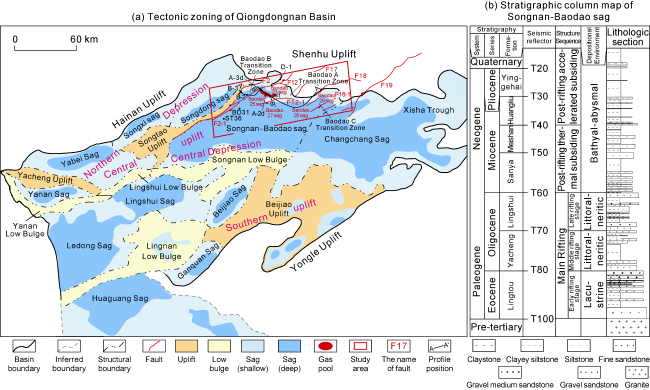
Fig. 1. Tectonic zoning and composite stratigraphic column of the Southeast Qiongdong Basin. |
2. Characteristics of the transition zone in the Songnan-Baodao sag and its controlling effect on gas accumulation
2.1. The basic characteristics of the transition zone
A transition zone refers to the tectonic deformation belt where one main fault transmits strain and maintains strain balance, and transmits strain to another main fault along the strike of the fault by branch positive faults, uplifts, strike slopes, etc. [3-4]. According to the classification of transition zones, there are different classifications according to different standards, which can be divided into the same direction type and reverse type according to the geometric shape; According to the location of faults, they can be divided into proximity type, overlap type, parallel type and collinear type [5].
The Songnan-Baodao sag is mainly developed with NE, NEE and near EW faults, and their strikes have certain regularity in spatial distribution. From west to east and from the margin to the sag in the basin, the strike of the fault changes from NE to NEE and near east-west. From west to east, main fault assemblages such as F2/F2-1, F12/F12-1, F17, F18/F18-1 and F18-2 are identified successively (Fig. 2 ). The main faults F2, F12 and F18 are transferred to the other main faults F2-1, F12-1 and F18-1/18-2 through the strike slope zone, and then the Baodao B transition zone, Baodao A transition zone and Baodao C transition zone were formed respectively. The Baodao B transition zone is controlled by the F2 and F2-1 main faults, forming an oblique transition fault-step belt (Fig. 2 a-1, 2b-1). The width of the fault-step is small, and the step features a NE right type oblique array in plane, and shows a compound Y shape in profile. The main F2 and F2-1 faults continued to be active from Oligocene to Middle Miocene and Pliocene respectively (Fig. 2 c-1-1, 2c-1-2). The Baodao A transition zone is controlled by F12 and F12-1 main faults, forming a parallel transition fault-step belt (Fig. 2 a-2, 2b-2), which is a NE-NEE oblique array in plane, and is parallel in the profile. The F12 and F12-1 main faults continued to be active from Oligocene to Pliocene and Middle Miocene respectively (Fig. 2 c-2-1, 2c-2-2). The Baodao C transition zone is controlled by F17, F18, F18-1 and F18-2 main faults, forming an overlapped transition fault-step belt (Fig. 2 a-3, 2b-3). The northern step has a large width, and features a NE oblique array in plane, and is parallel in profile. The main faults continued to be active from Oligocene to early or Middle Miocene (Fig. 2 c-3-1, 2c-3-2).
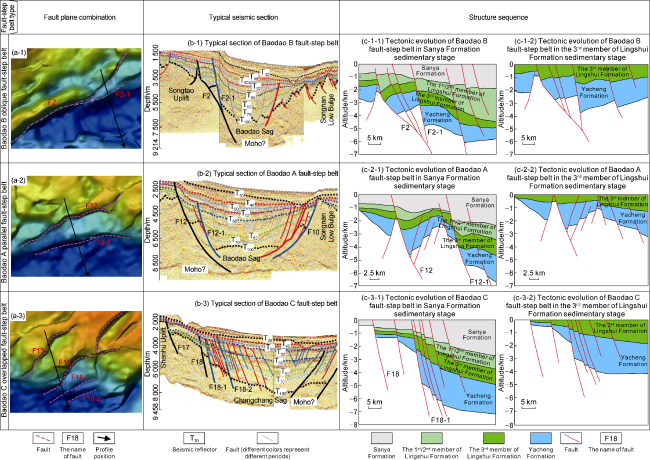
Fig. 2. Comparison map of transition zone characteristics in northern Songnan-Baodao sag. |
It is found that transition zones were formed in Lingshui Formation in the late depositional stage, and the main faults are reciprocal changes which controls the change of depositional strata thickness (Fig. 3 ) by comparing the tectonic evolution with the main controlling faults activity in transition zones (quantitative characterization of fault activity rate which refers to the rate about the formation thickness difference of fault downthrown side and upthrown side to the depositional time). The activity of F2 fault, F2-1 main fault, in Baodao B transition fault-step belt, is stronger in the Yacheng and Lingshui formations in the depositional stage, and F2 fault activity stronger than the F2-1 in Lingshui Formation in the depositional stage than in Yacheng Formation in the depositional stage, and then control the thickness of Yacheng Formation and Lingshui Formation in downthrown side are thicker, meanwhile the thickness of Lingshui Formation is obviously thicker than that of Yacheng Formation, alone depression direction showed a trend of thinning. During the Miocene Sanya Formation - Meishan Formation sedimentary period, the two faults showed weak activity (Fig. 3 a). The F12 and F12-1 main faults in Baodao A transition fault-step belt are more active in the Oligocene Yacheng Formation and Lingshui Formation sedimentary stage. The activity of F12 fault is stronger than F12-1 fault in Yacheng Formation sedimentary stage, and is weaker than F12-1 fault in Lingshui Formation sedimentary stage, which leads to the thickness of Yacheng Formation and Lingshui Formation is significantly thicker. The activity of the two faults was still strong in the early Miocene, but weakened significantly in the middle and late Miocene, and the activity of F12 fault was slightly stronger than that of F12-1 fault (Fig. 3 b). The F17, F18, F18-1 and F18-2 main faults in Baodao C transition fault-step belt are more active in the Oligocene Yacheng Lingshui Formation sedimentary stage, and the F18 fault is generally stronger than the F18-1 fault, and is stronger in the Lingshui Formation sedimentary stage than in the Yacheng Formation sedimentary stage, which controls the thickness of Yacheng- Lingshui Formation in the F18 fault downthrown side, and the thickness of the Yacheng Formation is significantly thicker than that of the Lingshui Formation. In the early Miocene, the F18 and F18-1 faults had small spacing and weakened activity, and were basically inactive in the Middle and late Miocene (Fig. 3 c).
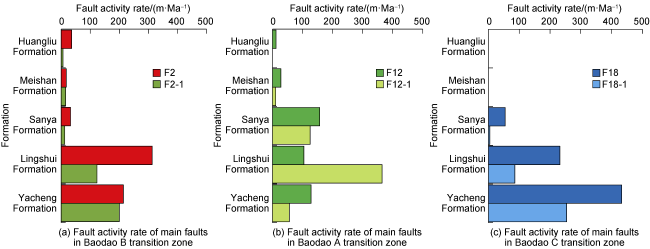
Fig. 3. Comparison of main fault activity in the northern transition zone of Songnan-Baodao sag. |
2.2. The control effect of transition zone on natural gas accumulation
The regional transition zone controls the development of source rocks, the formation of traps, the distribution of reservoirs and the migration of oil and gas [6,9,28]. The main faults in the transition zone control the rotation and tilting of the fault block, and developed nose-like structure traps. The differential activity of the main faults in the transition zone controls the development of the delta of the Paleogene Yacheng and Lingshui formations sedimentary stage. The multistage fault activities in the transition zone control the formation of tectonic ridges and extend into the main sag, and the convergence background is superior. The northern transition fault-step belt is a "gold belt" for natural gas accumulation in the Songnan-Baodao sag, which has developed two sets of high-quality source rocks of the delta and Marine facies of the Paleogene Yacheng Formation, the large delta reservoir of Lingshui Formation and the lithologic trap under the background of the large nose-like structure.
2.2.1. Controlling hydrocarbon source distribution and hydrocarbon generation potential
The northern transition fault-step belt in the Songnan-Baodao sag is close to the provenance area of the Shenhu Uplift and the Hainan Uplift, and the supply of terrestrial organic matter is sufficient. In the early Oligocene, the water body of the third member of the Yacheng Formation sedimentary stage was shallow and mainly continental sedimentary. The terrigenous organic matter carried by the large-scale delta was controlled by the main faults and transported into the sag, forming a large delta group in the transition fault-step belt and its periphery. Influenced by regional transgression, the water body of the second member of Yacheng Formation sedimentary stage was deep, limited injection of terrigenous organic matter, and developed Marine mudstone mainly contributed by Marine organic matter. Baodao A transition fault-step belt A-1 well drilling has revealed two sets of hydrocarbon source rocks (Fig. 4 ), the TOC value of the third member of Yacheng Formation delta front source rocks is 0.54%-1.00%, maceral is given priority to with terrigenous vitrinite and inertinite, Ⅲ kerogen, achieves the high-mature stage today, its Ro value is about 1.3%, which shows former delta hydrocarbon source rock is more superior quality. The second member of Yacheng Formation reveals a thick layer of Marine mudstone with gray black of which TOC value greater than 1%. The microscopic fabric is mainly humus and sapropel, II2-III kerogen, and the current thermal evolution level is close to high maturity, with Ro value of about 1.15%-1.25%.
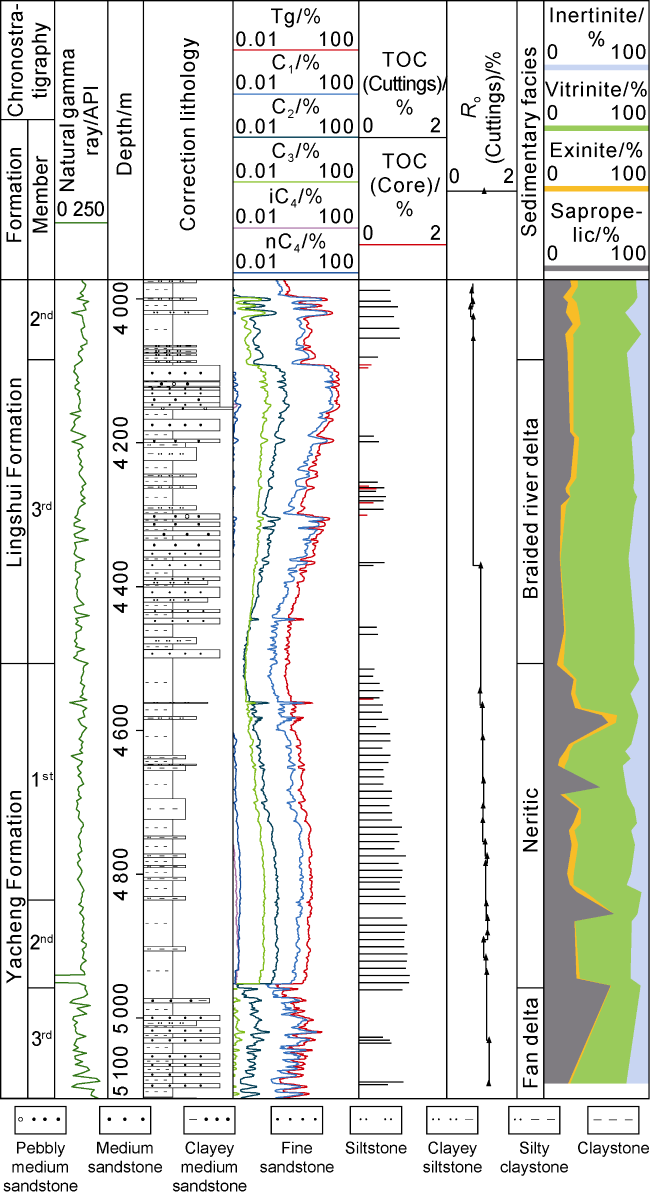
Fig. 4. Comprehensive bar chart of geochemical characteristics of Well A-1 in Baodao A transition fault-step belt. |
In the early rifting stage Yacheng Formation sedimentary period, the activity of main faults controls the hydrocarbon source rock distribution and terrigenous organic matter input, from west to east, from Baodao B transition fault-step belt- Baodao A transition fault-step belt-Baodao C transition fault-step belt, main faults activity increased and provenance closer, Yacheng Formation of the corresponding thickness of hydrocarbon source rocks, delta scale showed a trend of increase. The activity of main faults in Baodao B transition fault-step belt is stronger in Yacheng Formation, and the thickness of Yacheng Formation is huge. Because Baodao B transi-tion fault-step belt is relatively far from the two provenance areas of Shenhu Uplift and Hainan Uplift, delta is relatively underdeveloped, only in F2 fault downthrown side local development, F2-1 fault downthrown side control Baodao 25 sag mainly Marine mudstone hydrocarbon source rock distribution, mainly Marine mudstone hydrocarbon source rock of which the TOC value is basically less than 1%. Due to the large thickness and deep burial of Yacheng Formation, the gas generation intensity of Baodao 25 Sag is (8.5-60.0) × 108 m3/km2, and the hydrocarbon source quality is medium. The main F12 and F12-1 faults of the Baodao A transition fault-step belt control the distribution of source rocks in the Baodao 21 and 27 sag, respectively. Well A-1 drilling revealed two sets of source rocks of delta and Marine mudstone (Fig. 5 a), with TOC values of 0.9%-1.2% and hydrocarbon generation potential of 2.8-4.5 mg/g. Relatively, the F12-1 fault is more active than the F12 fault in Yacheng Formation sedimentary stage. The Baodao 21 sag in the F12 fault downthrown side, so the thickness of Yacheng Formation is thicker, but the buried depth is relatively shallow, and the gas generation intensity is about 10 × 108 m3/km2. The Baodao 27 sag in the F12-1 fault downthrown, so the thickness of Yacheng Formation is thicker, and the buried depth is larger. The gas intensity is (20-80) × 108 m3/km, and the hydrocarbon source quality is good. The main faults F18 and F18-1/2 faults in the Baodao C transition fault-step belt control the distribution of source rocks in the Baodao 28 and 29 sags, and the activity of the main faults is generally stronger than that of the Baodao A and B transition fault-step belt. The thickness of Yacheng Formation source rocks and the scale of delta in the sag surrounding are larger (Fig. 5 b). The thickness of Yacheng Formation in the F18 fault downthrown side is thicker, but the burial is generally shallow. The gas intensity is about 10 × 108 m3/km2. Baodao 28 sag in F18-1/2 fault downthrown side, so the delta of Yacheng Formation is large in scale and thickness. The gas generation intensity is (20-100) × 108 m3/km, and the hydrocarbon source quality is superior.
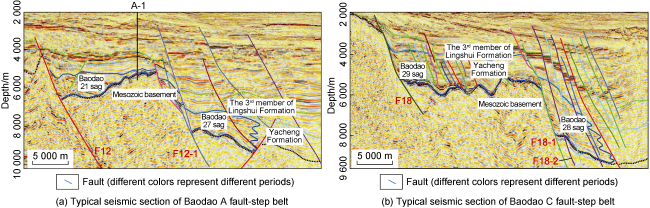
Fig. 5. Typical seismic profile of the transition fault-step belt in northern Baodao Sag. |
2.2.2. Good for the formation of complex traps in the context of large nasal structures
Tensioning and tensioning faults are mainly developed in the transition fault-step belt in the northern Songnan- Baodao sag, and several groups of NEE main faults control the rotational tilt and differential rise and fall of the fault blocks, stretch in the regional stress field under the action of right, the difference between the stick of NE fault to the stretch azimuth Angle is small, with local compression torsion characteristics and multiple nose- like structure in transition fault-step belt development background.
Baodao B transition fault step belt is controlled by F2 and F2-1 main faults. Under the right lateral effect of the stretching stress field, stress concentration occurred. Multiple secondary faults were developed in the narrow fault step. After the fault nose structure of the second step was transformed by faults, multiple fault block traps of Baodao B were formed (Fig. 6 a). The trap scale was small, and F2-1 control ring fault continued to be active in the Pliocene. In addition, F2 fault was weak in the sedimentation period of Sanya Formation, and the thickness of the sedimentary cover of Sanya Formation was relatively thin, the preservation conditions of traps were poor Baodao A transition fault-step belt was controlled by F12 and F12-1 faults, and the strong activity of F12 fault controlled the rotation and tilting of its southern strata. Local extrusion occurred along with the inclined extension of F12-1 fault, which was eroded by the mud channel in the later stage, forming the lithological combination trap under the nose-like structure background of Baodao A transition fault-step belt (Fig. 6 b). The F12-1 fault stopped its activity in the Middle Miocene. F12 fault was active strongly in the sedimentary period of Sanya Formation, which resulted in a thick cap layer and a better trap preservation condition. The Baodao C transition step-fault belt is controlled by F18, F18-1 and F18-2 faults, and the strong activity of F17 fault controls the rotation and tilting of the southeastern strata. The local extrusion of F18, F18-1/F18-2 faults occurred in the diagonal extension, resulting in the formation of nose-like structural trap in Baodao C transition fault-step belt. Development group of the east-west fault trap further reform, forming series faulted nose-fault block traps in Baodao C transition step-fault belt (Fig. 6 b), and in early Miocene epoch to stop activities of faults controlling traps, and the activity of F-18 fault stronger in Baodao C transition fault-step belt than that of in Baodao C in Sanya Formation sedimentary period, Sanya Formation cap rock thickness is thicker, trap condition is better.
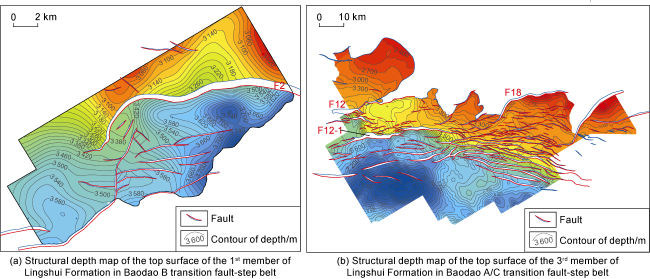
Fig. 6. Structural map of the top surface of Lingshui Formation in the northern transition fault-step belt of Baodao Sag. |
2.2.3. Forming the large-scale delta sand body controlled by multistage fault steps
Transition fault-step belt in the northern part of the Songnan-Baodao sag controlled the formation of large (fan) deltaic reservoirs of the Paleogene Lingshui and Yacheng formations. The provenance of Hainan Uplift in the west and Shenhu Uplift in the east injected along the codirectional transition belt and gentle slope formed by the differential activities of F2, F12 and F18 faults, and formed multi-stage and multi-branch (fan) delta reservoirs in the transition fault-step belt (Fig. 7 ). The activity of F2 fault, by contrast, is stronger than that of F12 and F-18 faults during the period of Lingshui Formation sedimentary period, and the thickness of Lingshui Formation controlling the Baodao B transition fault step belt is significantly thicker than the Baodao A and C transition fault step belt. However, because it is far away from the provenance area of Hainan Uplift in the north and Shenhu Uplift in the east, the delta scale is not large, and delta front and pre delta deposits are mainly developed. Compared to Baodao B transition fault-step belt, Baodao A, C transition fault-step belt is closer to Shenhu Uplift provenance, and enjoys adequate source supply. Large delta sedimentary sand bodies are developed. After long distance migration, the sorting is good. The activity of F18 fault is stronger than that of F12 fault during the Lingshui Formation sedimentation period. The delta scale of the Baodao C transform fault step belt is larger and widely distributed than that of the Baodao A transform fault step belt.
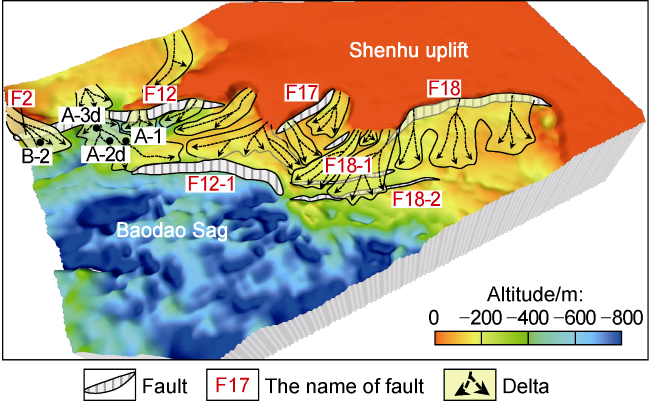
Fig. 7. Distribution map of paleogeomorphology and delta sedimentary sand body of the third member of the Lingshui Formation in the northern transition fault-step belt of Baodao Sag. |
The third member of the Lingshui Formation in the Baodao B transition fault-step belt developed a delta influenced by the provenance of the Hainan Uplift in the northwest, and the delta front or pre-delta deposition advanced through the F2 fault. The B-3 drilling revealed a thick mudstone intermixed with fine siltstone with a sand content of about 25%. The C-M plot of particle size showed the development of SR-RQ-QP segment with typical tractive flow deposition characteristics. The probability curve has suspension and jump segments, and the suspension content is high (Fig. 8 a, 8d), which indicates insufficient source supply. The activity rate of F12 fault in Baodao A transition fault-step belt is low in the middle and east sections while forming the transition slope. The northwest source is injected along the transition slope of the middle and west section of F12, and continues to advance in the downthrown side of F12 syn-sedimentary fault, forming the subaqueous distributary channel, estuary bar and front mat sand microfacies of the west branch large braided river delta. The microfacies lithology of the underwater distributary channel is gravel coarse/medium/fine sandstone, the mouth bar microfacies is mainly fine sandstone, and the front matte sand microfacies is mostly (argillaceous) siltstone. The C-M diagram of particle size shows the development of SR-RQ-QP segment, with typical traction flow deposition characteristics, and the probability curve is two- stage, with suspension and transition. The slope is higher and the sorting is better (Fig. 8 b, 8c, 8e, 8f). The particle size of the A-2d well is generally thicker than that of the A-1 well, and the hydrodynamic condition is stronger, reflecting that the source injection direction is from the A-2d well area to the A-1 well area. The conversion slope of the eastern section of the F12 fault controlled the provenance injection of the eastern Shenhu Uplift into the eastern section, and multiple (fan) leaf bodies are formed under the influence of local micropaleo high landform separation. The source of Shenhu Uplift in the Baodao C transition fault-step belt formed a number of conversion slopes and injected along the F17 and F18 faults, forming a number of large delta leaf bodies. The scale of conversion slopes in this belt is larger than that of Baodao B and A transition belt and the delta is predicted to be larger than that of Baodao B and A transition belt.
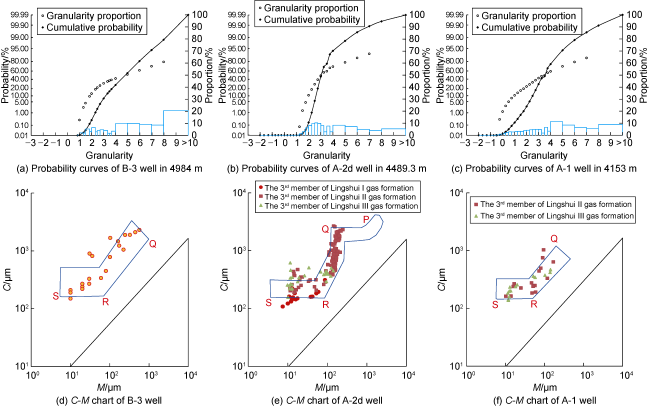
Fig. 8. Grain size probability curve and C-M diagram of drilling reservoir in the northern transition fault-step belt of Baodao Sag. C—particle diameter with a cumulative mass fraction of 1%, μm; M—median particle size, μm. |
2.2.4. Formation of high efficiency convergence near the central structural ridge of hydrocarbon generation
The Songnan-Baodao sag transition fault-step belt is adjacent to the hydrocarbon generation center Baodao, 25, 27, 28 and 21 sag formed under the control of main faults. The transition fault-step is controlled by several main along faults, forming a multi-stage tectonic ridge, which enjoys the advantages of hydrocarbon generation depressions, highly efficient convergence and accumulation of large structural ridges (Fig. 9 ). It is a favorable area of gas migration and accumulation.
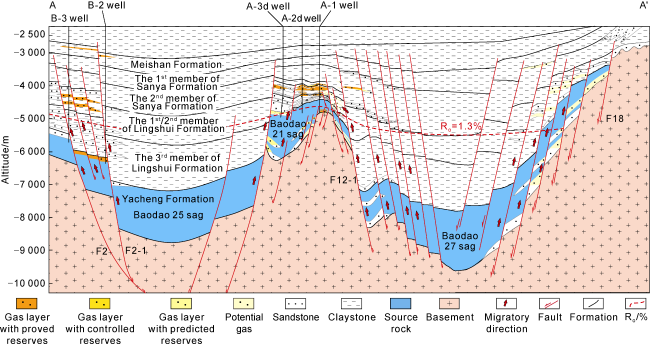
Fig. 9. Natural gas accumulation model map of the northern conversion step-fault zone in Baodao Sag (the profile location is shown in |
The step width of Baodao B transition fault-step belt is small, and the structural ridge is not obvious. It mainly receives hydrocarbon supply from Baodao 25 sag, and natural gas migrates vertically through F2 and F2-1 faults, and then migrates laterally along the sand body to form reservoirs (Fig. 9 ). The δ13C1 value of natural gas in Paleogene Lingshui Formation of gas-bearing structure B is about -38.8‰ - -35.3‰ (Fig. 10 a), showing the characteristics of high-mature coal-type gas. The homogenization temperature of the drilling reservoir in structure B (Fig. 11 ) shows that the reservoir of Lingshui Formation developed three periods of oil and gas charging. The first period is the Early Miocene, about 9.0-14.4 Ma, and the second period is the Miocene, 4.2-5.5 Ma, dominated by gas with high CO2 content (the homogenization temperature of the inclusions is 160-190 °C). The late period is from the Pliocene from 1.8 Ma, which confirms the favorable migration conditions in this area. However, the deep part of the F2 fault in this area communicates with the mantle (Fig. 2 b-1), and the activity time of the migration controlling F2-1 fault is late. Influenced by the deep CO2 migration and charging, the late natural gas injection is hindered, resulting in the formation of small-scale gas reservoirs with high CO2 content.
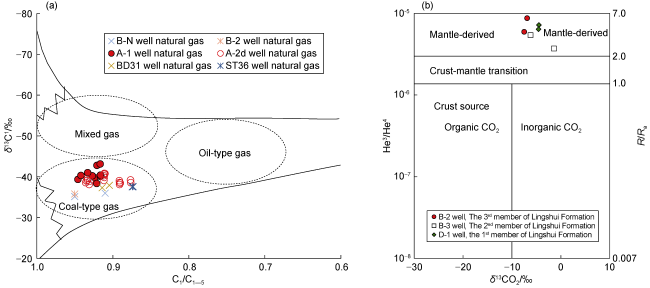
Fig. 10. Identification map of natural gas genesis (a) and CO2 genesis (b) of discovered gas-bearing structures in the Songnan-Baodao sag. |
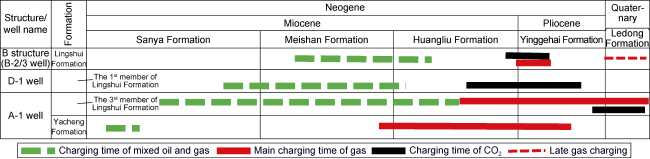
Fig. 11. Comparison map of hydrocarbon accumulation periods in the northern transition fault-step belt of Baodao Sag. |
The step width is big in Baodao A transition fault-step belt, and develops multi-stage tectonic ridge, the west side of acceptable Baodao 27, 25, 21 sags for hydrocarbon, dominant on the east side accept Baodao 27, 21 for hydrocarbon, gas by tectonic ridges, along the vertical migration, F12-1 fracture along the sand body after short distance lateral accumulation, the fault stop activities earlier, is conducive to gas preservation (Fig. 9 ). Drilling revealed that the δ13C1 value of natural gas was δ45.1‰-δ38.6‰ (Fig. 10 a), which is characteristic of high-mature coal-type gas. The reservoir inclusions of Well A-1 recorded multiple periods of charging. The Lingshui Formation developed mixed oil and gas from 7.8 Ma to 20.0 Ma, high-mature natural gas from 7.8 Ma to now, and CO2 from 2 Ma. The Yacheng Formation is developed by oil charging at 21-22 Ma and natural gas charging at 3-11 Ma (Fig. 11 ).
The Baodao C transition fault-step belt has a large step width and developed multistage structural ridges, which mainly received hydrocarbon supply from Baodao 27 and 28 sags. Natural gas accumulated through large structural ridges, migrated vertically along the horizontal faults, and then migrated laterally along the sand body to form reservoirs (Fig. 9 ). Source rock connected faults are highly active during 13.6-23.0 Ma. Matching with the hydrocarbon generation peak of Baodao 27 and 28 sags, the fault controlling traps stops activity after 13.6 Ma, and the late preservation condition is good. The main accumulation period is predicted to be 13.6-23.0 Ma.
2.2.5. Well matching of main fault combination and accumulation time controls hydrocarbon gas enrichment
In the north slope of the Songnan-Baodao sag, the composition of the drilled natural gas varies greatly and the non-hydrocarbon CO2 content is high. The CO2 content of the first member of Lingshui Formation in Well D-1 located in the uplift area is as high as 97%, and the δ13CCO2 is -7.5‰ - -3.6‰. The CO2 content of Lingshui Formation in the structure B drilled in the Baodao B transition fault-step belt is 83.5%-87.9%, δ13CCO2 is -7.5‰- 3.6‰, and the He3/He4 value of the noble gas component is (1.78-8.80)×106. According to the CO2 genesis discrimination chart, the CO2 in the study area is determined to be of inorganic mantle origin (Fig. 10 b). Combined with the homogenization temperature analysis of reservoir inclusions, the homogenization temperature of CO2 associated saline inclusions is distributed between 160 °C and 190 °C, which is higher than that of hydrocarbon inclusions, indicating that CO2 was charged later, during the late Miocene to Pliocene (Fig. 11 ).
By comparing the development and activity time of the main faults in each transition fault-step belt (Figs. 2 and 3 ), it is concluded that the distribution of CO2 in the study area is related to whether the main faults in the transition fault-step belt have deep and major faults communicating with the mantle or the combination mode and activity time of deep and major faults. Contrast found that control Baodao B transition fault-step belt of F2 fault deep, deep to extension stretches to the Moho, communication with the earth's Mantle, at the same time control migration F2-1 fault deep fault that fault and secondary fault and F2 fault show "Y" type combination in profile, and the fault continued to be active to the Huangliu Formation sedimentary period, and the CO2 large-scale filling time matching. The mantle-derived CO2 migrated upward along deep and large faults to destroy the early hydrocarbon gas reservoirs. The closer it is to the deep and large F2 fault or F2-1 fault combined with F2 fault, the higher the CO2 content is. Well D-1 in the
uplift area directly communicated with the deep and large F12 fault, and the CO2 content was extremely high. Although the F12 fault in Baodao A transition fault-step belt extends deep, the main migration fault F12-1 and F12 fault are parallel in profile and not combined together, and the F12-1 fault stops activity earlier than the large-scale CO2 charging time. It is considered that the area is less affected by CO2 on the whole and is closer to the area near the F12 fault. Due to the local development of secondary micro faults and F12 fault combination, there is a certain risk of developing CO2. The main fault F18-2 in Baodao C transition fault-step belt stops to shallow and deep time early, but almost sag F18-2 in the direction of fracture to deep, deep and sustained activity to the Huangliu Formation sedimentary period, comprehensive analysis of the area near sag zone there is a risk of CO2 and to the north of fault terrace F17 thunder and fracture F18-1, predict the CO2 content in general is relatively low.
3. Exploration breakthroughs and potential of medium and large gas fields in the transition zone
3.1. Discovery and basic characteristics of Baodao 21-1 gas field in the transition zone
The transition fault-step belt in the northern part of Baodao sag has the advantages of source control, circle control, storage control and transportation control of the conversion overlapping fault. Among them, the Baodao A and C transform fault zone has the advantage of developing "two types of high-quality source rocks, deltaic and marine mudstone of the Paleozoic Yacheng Formation, large deltaic reservoirs of the Lingshui Formation and large lithological traps in the context of large nose-like structures", which is an important part for the formation of large and medium-sized gas fields. The drilling of the Baodao A formation in the Baodao A transition fault zone has resulted in the drilling of several wells in the Paleoproterozoic to encounter gas layers of over 100 meters, and the testing of unobstructed flow rate in the thick layer of the Lingshui Section of the Lingshui Section of over one million cubic meters [16], has revealed three high-quality reservoir formations in the Lingshui Section of the Paleoproterozoic, the Lingshui Section of the Lingshui Section of the Yacheng formation, of which the main gas formation is the Lingshui Section of the Lingshui Section IIa and IIIa (Fig. 12 ).
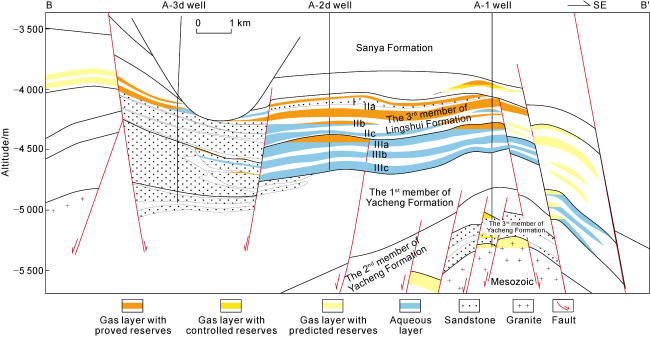


Fig. 12. Baodao A transition fault-step belt Baodao 21-1 gas field gas reservoir profile (see |
The Baodao A transition fault-step belt is adjacent to the large source of the Shenhu uplift, and the source is injected along the fracture conversion slope, and the supply is sufficient. The main gas formation IIa and IIIa of the third member of Lingshui Formation develop a large braided river delta submerged divergent river sand reservoir that is transported over a long distance. The reservoir lithology is dominated by pebbly medium fine sandstone. The reservoir is characterized by medium-low porosity, medium-low permeability, and a combination of inter- and intra-grain pores. The reservoir rocks of gas formation IIa are better sorted and have better physical properties than those of Well A-1 in the distant source area, with an average porosity of about 13%, permeability of (1.40-11.80) × 10-3 μm2, and piezometric flow rate of 1.30-38.20 μm2/(Pa•s); the reservoir rocks of Well A-2d in the near source area are poorly sorted and have deviated in physical properties from those of Well A-1, with a porosity of 11.8% and permeability ((0.05-8.26) × 10-3 μm2, and the measured flow rate is 0.01-2.63 μm2/(Pa•s); the reservoir rocks of Well A-3d in the near-source area are poorly sorted, and the physical properties are also deviated from those of Well A-1 (Table 1 ), with an average porosity of 11.0% and a permeability of (0.11-5.00) × 10-3 μm2. The physical properties of wells 1 and 2d in the IIIa gas formation are similar to those in the far-source area, with an average The porosity is about 11%, the permeability is (0.05-8.61) × 10-3 μm2, and the pressure flow rate is 0.02-2.90 μm2/(Pa•s). The Baodao A transition fault-step belt develops large lithologic traps in the delta of the Paleocene of the third member of Lingshui Formation (fan) in a mud-rich background and warped tectonic background, and the main trunk fracture connects the mature hydrocarbon source rocks of the Baodao 27, 25 and 21 pits, which control the efficient transmission and conduction of hydrocarbon gas into the reservoir. The drilling reveals that the gas component is mainly hydrocarbon gas, with hydrocarbon gas content ranging from 46.6% to 99.4%, and the non-hydrocarbon CO2 content is significantly lower than that of the wells drilled in the Baodao B transition fault-step belt, basically less than 50%. The gas-oil ratio in the test section of Well A-1 is 20 190 m3/m3, and the relative density of condensate is 0.826, which is a typical wet gas reservoir. In comparison, the A-3d well near the F12 fracture has wetter gas, relatively higher CO2 content, lighter methane carbon isotope composition and lower maturity than the other wells, with a maturity of about 1.6%, confirming the contribution of Baodao 21 pits; the A-1 and A-2d wells have higher maturity, with a maturity of about 1.5%-2.1%, confirming the contribution of mainly Baodao 27 and 25 pits.
Table 1. Table of gas reservoir parameters of Baodao 21-1 gas field in Baodao A transition fault-step belt |
| Formation | Well number | Depth/ m | Average porosity/% | Penetration rate/ 10-3 μm2 | Pressure flow measurement/(μm2·(Pa·s)-1) | |
|---|---|---|---|---|---|---|
| Third member of Lingshui Formation | IIa | Well A-1 | 4060-4140 | 13.0 | 1.40-11.80 | 1.30-38.20 |
| Well A-2d | 4180-4250 | 11.8 | 0.05-8.26 | 0.01-2.63 | ||
| A-3d well | 4100-4235 | 11.0 | 0.11-5.00 | |||
| IIIa | A-1, A-2d wells | 4270-4480 | 11.0 | 0.05-8.61 | 0.02-2.90 | |
3.2. Exploration potential of natural gas
The discovery of Baodao 21-1 gas field in Baodao A transition fault zone confirms that the reservoir formation conditions in the Songnan-Baodao northern transition zone are good, and it is adjacent to the hydrocarbon generation center of Songnan-Baodao sag, which develops II2-III type high-quality hydrocarbon source rocks and has strong hydrocarbon generation capacity. In addition, large tectonic ridge convergence and large deltaic reservoir formation controlled by transformation fault zone are developed in the northern transformation zone, which is a favorable natural gas accumulation area. Taking the discovery of Baodao 21-1 large gas field as an opportunity, we move forward to explore Baodao C fault zone and implement exploration in Baodao C structure, which also develops several large (fan) deltaic reservoirs of the third member of Lingshui Formation and Yacheng Formation of the Paleozoic System, and develops tectonic + lithological traps with high north and low south, and locally develops broken back slope and broken nose structure, with multiple sets of horizontal and vertical superposition, and has the reservoir formation mode of “Baodao sag, 27 and 28 sags, convergence of large tectonic ridges, and vertical transport and agglomeration of trench source fractures”. This tectonic zone is a tectonic-lithologic trap formation in the nose-like tectonic background controlled by the large braided river deltaic sand bodies in the low and high stages of the three sections of the Lings, respectively, and a series of reverse faults and normal faults, and is divided into three potential areas in the west, middle and east, with great resource potential.
4. Conclusions
The main faults in the north of Songnan-Baodao sag are generally in right row oblique arrangement, and the fault activity controls the differential rise and fall, forming Baodao B, Baodao A, and Baodao C transition fault step belts from west to east. The step width of the Baodao A and C transition fault step belt is larger than that of the Baodao B transition fault step belt, and the fault activity stops earlier. The main faults controlling the fault step are in parallel combination on the profile, which is different from the "Y" type combination of the main faults of the Baodao B transition fault step belt on the profile.
The activity of the main trunk fault of the transition zone in the early Oligocene Yacheng Formation sedimentary period controls the hydrocarbon generation and potential, and several hydrocarbon generation depressions are developed from west to east; the F2, F12 and F18 faults start to move in the Oligocene, and under the action of right rotation of the stress field, local extrusion occurs in the bent section of the early faults under the background of tension-torsion, forming a compound trap closure in the background of large nose-like structure, and the scale of the trap closure to the east Baodao A and Baodao C was larger than that of Baodao B traps; the provenance of Hainan Uplift or Shenhu Uplift is injected along the isotropic transition zone and gentle slope zone controlled by multi-level faults to form large deltaic sand bodies; the large tectonic ridge formed by the main faults is close to hydrocarbon generation center and converges efficiently; the combination mode and activity time of main faults control hydrocarbon gas enrichment.
Baodao A transition fault-step belt is adjacent to hydrocarbon generation sags Baodao 27, 25 and 21 sags. The provenance of the developed uplift area is injected along the conversion slope of the middle and west section of F12 fault and the gentle slope section of the east section, forming a number of large braided river delta lobes in the west and east branches. The main fault F12/F12-1 fault converges, trench source fractures and deep large fractures are distributed in parallel combination, which are less influenced by the mantle source CO2 and are the dominant convergence area of hydrocarbon gas. The drilling of Baodao 21-1 reveals the thick gas layer, realizes the large gas field discovery, and drives the new field of exploration in the northern transition fault-step belt of Baodao Depression.