

Introduction
Classical petroleum geological theory holds that the period of significant exhumation or uplift after deep burial of the basin is an important period of cooling and depressurization, during which hydrocarbon generation and expulsion processes of source rocks will stop or decrease in efficiency significantly. Accordingly, most previous studies considered this stage mainly as a period of adjustment and finalization of formed hydrocarbon reservoirs, when the possibility of large-scale reservoir accumulation again was low. Although some researchers have tried to explore the accumulation of hydrocarbons during the uplift of the basin, there are few literatures reporting on large-scale accumulation of hydrocarbons in the uplift process [1⇓⇓⇓-5]. Zhao et al. suggested that the coal-measure source rocks of the Triassic Xujiahe Formation in the Sichuan Basin experienced significant desorption and expulsion events during the uplift since the late Cretaceous, and pointed out that if gas migration and accumulation processes did exist in the uplifting environment, it must be a major progress in the understanding of gas reservoir accumulation mechanism [2].
In recent years, a few researchers have revealed that the expansion of gas volume in tight stratum during uplifting can trigger a series of geological effects, and suggested that this might induce hydrocarbon migration and accumulation events in some basins during the uplifting[3⇓⇓⇓⇓⇓⇓⇓⇓⇓-13]. First, rapid and significant uplifting of source rocks in the late stage can bring about large-scale hydrocarbon expulsion. For example, in the Illizi Basin, Algeria, the Lower Silurian source rocks expelled about 9.12×10¹² m3 gas when they were uplifted from a depth of 3.3 km to a depth of 2.0 km since the Permian [5]. Second, after tight sandstone gas reservoirs were formed during the burial period, gas migration driven by gas expansion during the uplift may trigger important adjustment of reservoirs. For a sandstone gas reservoir with normal pressure sealed by mudstone, the pore fluid pressure decreases by only about 1 MPa when the burial depth is lifted from 3000 m to 1500 m. As a result, the reservoir with normal pressure transforms into an overpressure reservoir with a pressure coefficient of up to 2.0 [13]. Such a large volume expansion effect will certainly have strong impacts on the formation mechanism, pressure field, gas-water distribution, and gas enrichment pattern of the tight gas reservoir undergoing significant uplift [3,9⇓⇓⇓⇓⇓⇓ -16]. Third, the change of stress state during the uplift of shale and tight sandstone systems would trigger the opening of pre-existing pore and fracture networks formed in the burial period and the creation of new fractures, thus effectively improving the reservoir quality and the transport and conduit system, and promoting further gas migration and accumulation. In the shallow formations at the foreland margin of the Appalachian Basin, tectonic uplift was strong enough to make the pre-existing NW-trending tectonic joints further extend and expand to form the present-day widespread E-NE-trending joints and gas in the Marcellus shale migrate again during the uplift phase[9]. Although these three geological effects and the resulting reservoir events have been identified in only a few basins, they must be common and their influences on the accumulation of tight sandstone gas during the uplift phase cannot be ignored.
Substantial uplift of late structure is an important feature in the formation and evolution of major tight sandstone gas basins in central and western China. The Ordos Basin has undergone differential uplift and erosion of 200 to 2000 m from west to east since the Late Cretaceous. The Sulige gas field in this basin, with total gas resources of about 6.0×10¹² m3 and proved gas reserves of 4.77×10¹² m3, is the largest gas field discovered in China[17-18]. Although important progress has been made in the researches on the formation mechanism and enrichment law of gas reservoirs there since the discovery of Sulige gas field in 2000, the researches mainly focused on the gas migration and accumulation events during the burial period [15,17⇓⇓⇓⇓⇓⇓⇓ -25], while the influence of the significant formation uplift since the Late Cretaceous on the formation mechanism and gas-water distribution of the gas reservoir has not been examined in depth. Therefore, to provide a geological basis for further exploration and development of the gas field, and to provide a reference for the study on formation of tight gas reservoirs in similar geological setting, the 8th member of the Middle Permian Lower Shihezi Formation (He 8 Member for short) was taken as an example to investigate this issue based on a large amount of geochemical and production data, and theoretical calculations systematically.
1. Geological setting
The Sulige gas field is located in the Ordos Basin, straddling three first-order tectonic units, namely, the Yishaan slope, the Tianhuan depression and the Yimeng uplift, with an exploration area of about 5.5×10⁴ km2 [17-18] (Fig. 1 ). The Yishaan slope where the main part of the gas field is located has gentle and stable structure, few faults and folds, and is a west-dipping monocline high in the east and low in the west, high in the north and low in the south, with a dip angle of less than 1° and a gradient of 3-10 m/km [17]. The Paleozoic in this gas field consists of Upper Ordovician Majiagou Formation (O1m), Upper Carboniferous Benxi Formation (C2b), Lower Permian Taiyuan Formation (P1t) and Shanxi Formation (P1s), Middle Permian Lower Shihezi Formation (P2x) and Upper Shihezi Formation (P2sh), and Upper Permian Shiqianfeng Formation (P3q). The major gas pays in the Sulige gas field are the quartz sandstone, clastic quartz sandstone and clastic sandstone of large ramp deltas in the 1st member of the Shanxi Formation (Shan 1 Member for short) and He 8 Member [17]. The gas pays have poor physical properties and strong heterogeneity. With a porosity ranging of 5.0%-21.8% (median of 9.7%) and a permeability of (0.1-561.0)×10-3 μm2 (median of 0.38×10⁻³ μm2) [22], they are typical low-permeability-tight sandstone gas layers. Correlation of the gas there and source rocks shows that the gas originates from the swamp facies coal and coal-measure dark mudstone of the Benxi, Taiyuan and Shanxi formations widely distributed throughout the basin. Among them, the coal seams are 0.4 m to 27.0 m thick (8.8 m on average), and the dark mudstone layers are 0.8 m to 99.4 m thick (34.97 m on average). Both the coal and mudstone have high abundance and mainly type III organic matter, strong capacity and long duration of hydrocarbon generation [15,20,21 -22,24]. The regional caprocks are the thick mudstone layers from He 7 Member to Shiqianfeng Formation.
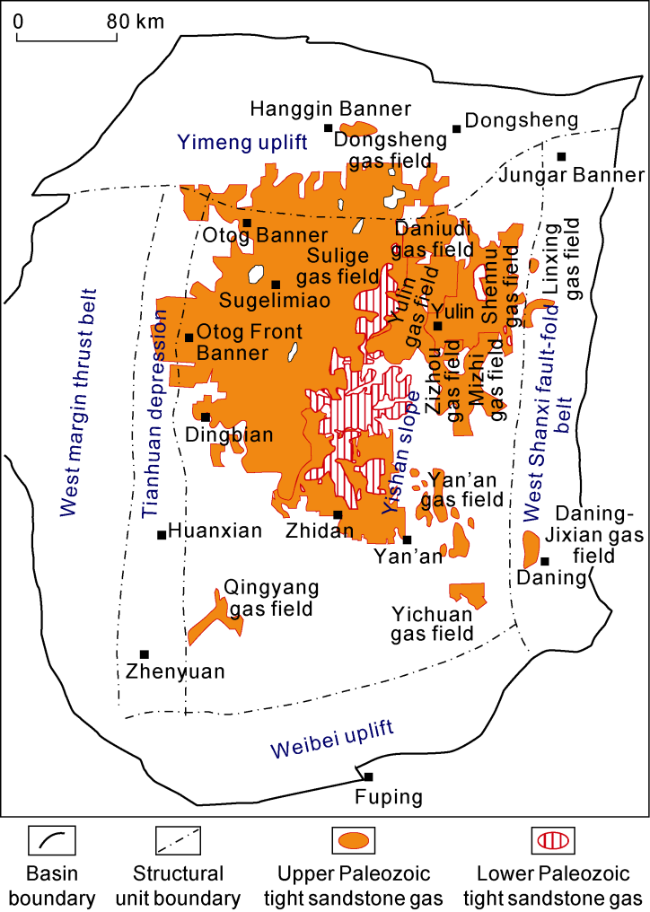
Fig. 1. Division of tectonic units and distribution of gas fields in Ordos Basin. |
2. Gas expansion effect caused by late tectonic uplift
2.1. Gas expansion and definition of expansion pressure
The gas expansion pressure/effect discussed herein refers to the expansion pressure and expansion effect generated by expansion of free gas, which has a high compression/expansion coefficient, stored in rock pores and fractures during the tectonic uplift due to pressure unloading of the overlying strata. The volume expansion of gas caused by the unloading of formation uplift does not originate from the increase of gas content, which is different from the expansion effect caused by the increase of gas content due to hydrocarbon generation of organic matter in source rocks or massive filling of gas or cracking of crude oil in the reservoir commonly referred to in previous studies [26⇓⇓⇓⇓-31], and is also different from the release of desorbed gas from source rocks in the process of cooling and depressurization along with formation uplift.
2.2. Main geological processes in the uplift stage and gas expansion pressure calculation model
Many studies have shown that geological processes closely related to pressure evolution during late tectonic uplift in sedimentary basins mainly include temperature and pressure increase of the strata before uplift, temperature drop during uplift, pressure drop of the overlying strata, pore rebound and gas volume expansion [2-3,5,9⇓⇓⇓⇓⇓⇓ -16], which are present in both source rocks and reservoirs (Fig. 2 ).
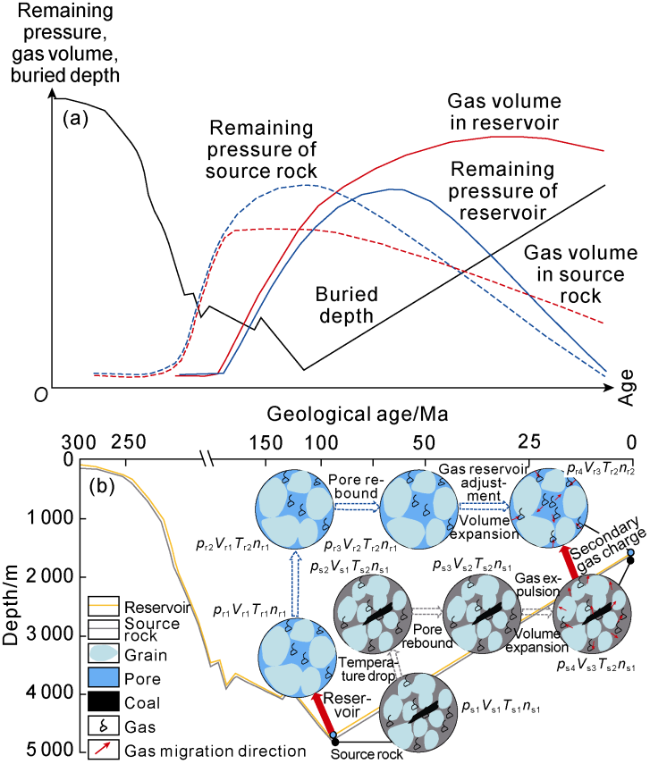
Fig. 2. Schematic diagram of gas volume expansion and related geological processes triggered by formation uplift since the Late Cretaceous in Sulige gas field (source rock part modified from Ref. [16]). |
where, pr4 is equal to pr1 minus the pressure reduction due to temperature drop, the pressure reduction due to pore rebound, and the reservoir capillary force to be overcome in the gas migration driven by the expansion pressure. Accordingly, Eq. (1) can be rewritten as:
where, pr2 is the reservoir pore fluid pressure after the pressure drop due to temperature drop, which can be calculated by the actual gas state equation; prc is the reservoir capillary pressure, which can be obtained from measurement; Δpr is the reservoir pore fluid pressure reduction due to pore rebound, which can be calculated by the Tiab and Donaldson method [32].
where, Crb and Crr are the reservoir pore compression coefficient and skeleton compression coefficient, respectively, which can be calculated by the method introduced in Reference [33]; Δσ is the variation of confining pressure (overlying formation pressure), which can be obtained according to the actual uplift and denudation thickness and density of the formation.
The gas expansion pressure induced by formation uplift can be calculated by the following equations.
pe=p0-pw-pt-pj
pe=pr2-Δpr–pj
where, pj is the hydrostatic pressure after uplift, which can be calculated with the true burial depth.
The calculation methods of temperature/pressure reduction and gas expansion volume in source rocks during uplift are the same as those in the reservoir, and the symbols marked with "s" in Fig. 2 represent the corresponding parameters of source rocks, which will not be repeated here.
2.3. Calculation of gas volume expansion ratio and expansion pressure
The gas expansion volume and pressure in source rocks and reservoirs were calculated with the data of more than 30 wells in the gas-rich zone (with mainly gas and only a small amount of water in local parts produced in drill-stem test) and gas-water zone (with both gas and water produced) of the Sulige gas field. The results show that due to formation uplift since the Late Cretaceous, in the reservoirs, the volume of gas has expanded by 4%-15% (6%-15% or 10.31% on average in the gas-rich zone; 2%-9% or 5.2% on average in the gas-water zone); the gas expansion pressure ranges from 5 MPa to 17 MPa (8-7 MPa or 12 MPa on average in the gas-rich zone; 5-11 MPa or 8.5 MPa on average in the gas-water zone), as shown in Fig. 3 . Meanwhile, in the source rocks, the volume of gas has expanded by 2%-16% (7%-15% or 11.35% on average in the gas-rich zone; generally less than 10% in the gas-water zone); the gas expansion pressure mainly ranges from 9 MPa to 23 MPa (14-23 MPa or 17.5 MPa on average in the gas-rich zone; 9-17 MPa or 13.2 MPa on average in the gas-water zone), as shown in Fig. 3 . It should be noted that the volume expansion ratio and expansion pressure calculated by the above methods are the net increase after the effects of temperature drop and pore rebound are subtracted, that is, the actual volume expansion ratio and expansion pressure of gas are larger than the above calculated values.
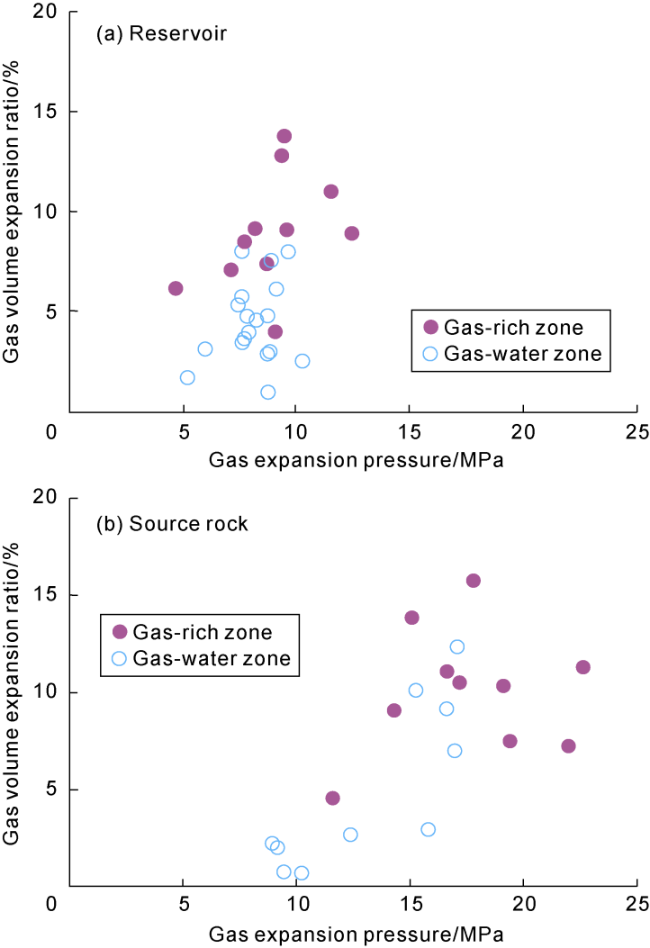
Fig. 3. Correlation between gas volume expansion ratio and expansion pressure induced by formation uplift in Sulige gas field. |
The tectonic uplift process since the Late Cretaceous has triggered strong gas volume expansion in both the reservoirs and source rocks. The strong volume expansion would inevitably have an important impact on the gas reservoirs formed during the burial period. Taking the reservoir in the gas-rich zone as an example, the average volume expansion ratio of gas is 10.31%, which means that the uplift process has caused a 10.31% increase of gas volume in the gas field without considering the dissipation. More importantly, the gas expansion pressure triggered by the uplift process would drainage further the formation water in the reservoir on the basis of the gas reservoir formed during the burial period, leading to an increase of gas saturation. In other words, the gas-water zone might transform into gas zone. When produced, pure gas rather than water and gas would be extracted. This change in the nature and product type of gas zone may outweigh reserve increase in practical significance for gas field development.
3. Discussion on accumulation effect caused by gas volume expansion
3.1. Secondary gas expulsion and charging & accumulation effects caused by gas expansion in source rock
When the expansion pressure of gas triggered by the uplift of source rock is greater than the threshold pressure of gas itself and the surrounding rock, the gas would expel again and further migrate driven by the expansion pressure. Comprehensive analysis shows that a large part of the gas expelled from the source rock at this stage would migrate into the reservoir to accumulate. The gas expulsion of source rock and charging into the reservoir in the uplifting environment are called secondary gas expulsion and secondary charging & accumulation effects, respectively, in order to distinguish from those in the burial period.
3.1.1. The source-reservoir gas expansion pressure difference is greater than the migration resistance
The calculation results in Section 2.3 also show that the gas expansion pressure in the source rocks of the uplifting environment is greater than that in the reservoir, especially in the gas-rich zone where the difference of gas expansion pressure between source rock and reservoir is generally greater than 5 MPa, and reaches up to 14 MPa (Fig. 4 ). Combined with the hydrocarbon migration and accumulation dynamics during the burial period and the information about pre-existing fracture opening and rupture pressure of rocks in the fracturing process of the gas reservoir [17,20,22], it can be inferred that the uplifting environment allows the gas to accumulate in the reservoir after overcoming the migration resistance under the driving of expansion pressure. The comparison results of the source-reservoir gas expansion pressure difference, reservoir gas saturation, and water-gas ratio (WGR) in drill-stem test also show that with the increase of the source-reservoir gas expansion pressure difference, the gas saturation in the gas-rich zone goes up significantly, most wells in this zone produced hardly any water, and the few wells producing water had a WGR of less than 1 m3/104 m3. By contrast, in the gas-water zone, with the increase of the source-reservoir gas expansion pressure difference, the gas saturation shows less increase, but the WGR shows a decreasing trend (Fig. 4 ).
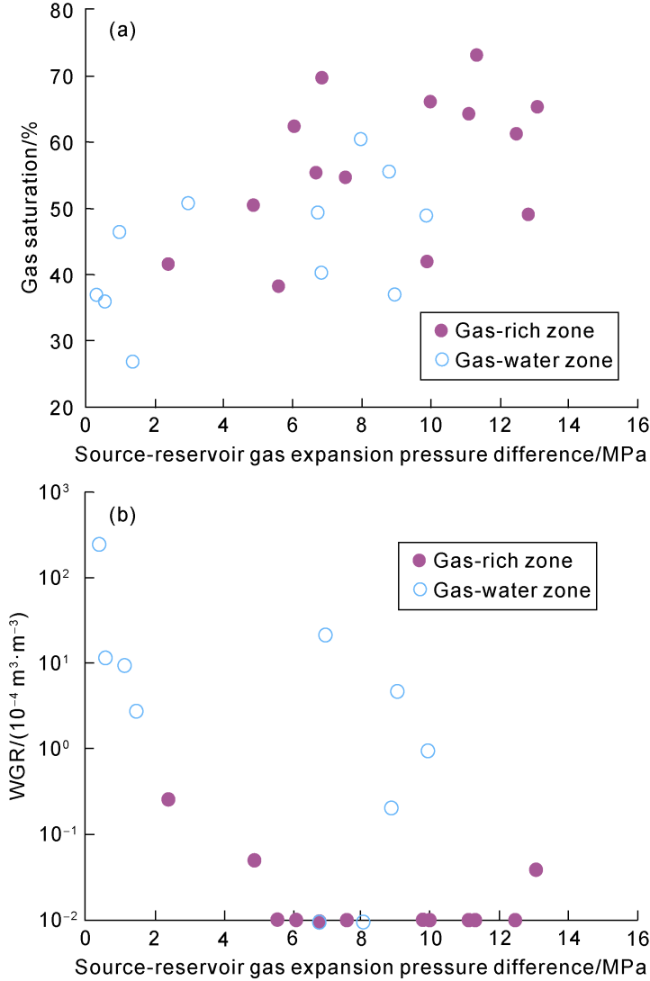
Fig. 4. Correlations between the source-reservoir gas expansion pressure difference triggered by formation uplift and the reservoir gas saturation and water-gas production ratio in formation testing of Sulige gas field. |
3.1.2. Fluid inclusions with low homogenization temperature and high methane content occurred in the reservoir
Components of hydrocarbon fluid inclusions and temperature-pressure characteristics of their symbiotic aqueous inclusions record the fluid composition and reservoir temperature-pressure state during hydrocarbon charging. In this work, petrographic observations, laser Raman analysis of fluid components, and homogenization temperature and freezing point temperature measurements, and salinity calculations were done for fluid inclusions in 64 samples from the He 8 Member of 22 wells in the Sulige gas field. The results show that samples from four wells in the area with great late uplift in the eastern part of the Sulige gas field contain some fluid inclusions with high methane contents, and their symbiotic aqueous inclusions have low homogenization temperatures of mainly 80-100 °C. For example, at 2471.7 m of Well T36, the laser Raman analysis of hydrocarbon inclusions in the quartz grain microfractures of the reservoir shows that the hydrocarbon inclusions are pure methane inclusions, but the homogenization temperature of the symbiotic aqueous inclusions is 86 °C (Fig. 5 ).
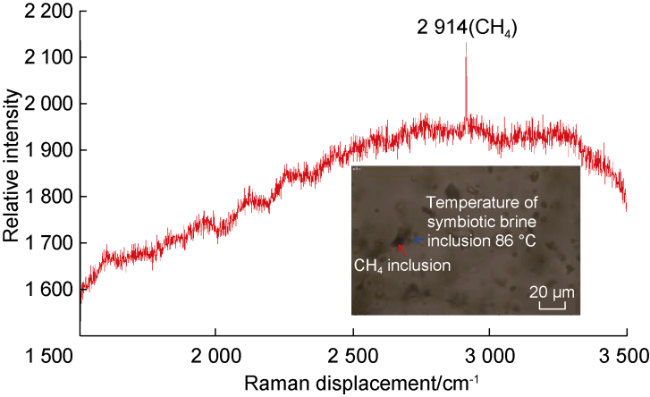
Fig. 5. Laser Raman spectral characteristics of CH4 inclusions and homogenization temperature of their symbiotic aqueous inclusions in samples from Well T36. |
Gas components are influenced jointly by the hydrocarbon generation process and subsequent secondary alteration processes (e.g., migration fractionation, and mixing etc.) [34-35]. As far as the hydrocarbon generation process is concerned, the Carboniferous-Permian coal- measure source rocks in the Sulige gas field mainly generated the gas with high content of methane or even pure methane in the shallow-burial biogas stage and the deep-burial high maturity stage. The inclusions with high methane contents and low homogenization temperatures in the Sulige gas field seem to tally with the characteristics of shallow-burial biogas, but this is not true according to careful analysis. Restricted by the survival temperatures of bacteria, the formation temperatures of biogas are less than 80 °C. Since the reservoir in He 8 Member is located above the source rock, its burial depth is smaller than the source rock. If the inclusions with high methane contents and low homogenization temperatures recorded the biogas charging process, the reservoir temperature would be even lower. Actually, the homogenization temperature of fluid inclusions in the reservoir is higher than 80 °C. In addition, no evidence of biogenic gas source has been found in the Sulig gas field, and even in the Paleozoic gas reservoirs throughout the Ordos Basin, so it is not consistent with the actual gas source of the reservoir if the low homogenization temperature of the brine inclusions is taken as the evidence of biogenic gas. In terms of secondary transformation processes, migration fractionation is one of the important processes that can result in gas with high methane content, but in the process of gas migration, with the increase of migration distance, the methane content usually increases while the stable carbon isotope composition becomes lighter, but the stable carbon isotope composition of methane in the study area becomes heavier (see details later). Therefore, it is also less likely that the high methane content in the inclusions is caused by migration fractionation.
The gas with high methane content in fluid inclusions must come mostly from the gas generated in the high maturity stage of source rocks. However, this part of high maturity gas with mostly methane was not expulsed and migrated into the reservoir to accumulate at the deep burial and high temperature stage of its generation, but was only expulsed and migrated into the reservoir to accumulate driven by the expansion pressure during the late source rock uplift. At this time, the reservoir became shallow due to tectonic uplift and dropped in formation temperature; as a result, the aqueous inclusions symbiotic with the hydrocarbon inclusions have lower homogenization temperatures. In addition, because the reservoir had densified and been charged with gas before uplift, the formation water was less in amount and activity, and the formation of a large number of inclusions in the stratum usually requires a relatively active fluid environment. Therefore, in the shallow burial stage after uplift, it is difficult for inclusions to form in large numbers as in the burial stage, so there are fewer such inclusions in the reservoir. Although inclusions with low homogenization temperatures and high methane contents were only found in He 8 Member of four wells, the discovery of these inclusions in the eastern part of Sulige gas field with larger uplift amplitude is sufficient to prove the existence of secondary hydrocarbon expulsion of source rock and secondary gas charging & accumulation process during the uplift stage.
3.1.3. Secondary hydrocarbon expulsion and charging in the uplift stage increases the methane content and drying coefficient of gas
The gas composition of hydrocarbon fluid inclusions was further compared with the present-day composition of gas in the reservoir. The results also show that the present-day gas reservoir in the He 8 Member in the gas-rich zones in central and eastern Sulige gas field has higher drying coefficient than the hydrocarbon fluid inclusions, while the gas reservoir in the gas-water zone in western Sulige gas field has lower drying coefficient than the hydrocarbon fluid inclusions (Fig. 6 ).
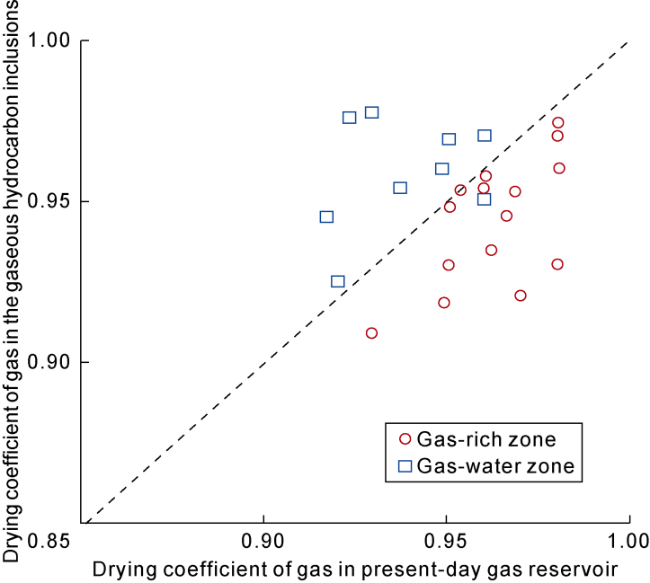
Fig. 6. Comparison of drying coefficients of gas in the gaseous hydrocarbon inclusions and gas in present-day gas reservoirs of Sulige gas field. |
A comprehensive analysis suggests that the difference in secondary gas charging and accumulation triggered by uplift since the Late Cretaceous between the western and central-eastern parts of the Sulige gas field may be the main reason behind the different relationships between the present-day drying coefficients of the reservoirs and that of hydrocarbon fluid inclusions in the two areas. As mentioned above, the gas composition of fluid inclusions represents the gas composition at the time of bulk gas charging & accumulation, and mainly records the gas migration and accumulation characteristics in the burial stage, except for a few inclusions with low homogenization temperatures and high methane contents. The present-day gas composition of the gas reservoir is the result of massive gas migration & accumulation in the burial stage and reservoir adjustment in the uplift stage, so the formation processes in both the burial and uplift stages will lead to differences in gas composition. In the gas-water zone in the western part of the Sulige gas field, due to the limited extent of late tectonic uplift, the volume expansion of gas caused by the uplift process was small, and the gas charged secondarily into the reservoir was less than the gas dissipated. Besides, methane preferentially dissipated during the uplift process. Therefore, the present-day gas in the reservoir has drying coefficient smaller than that of the hydrocarbon fluid inclusions. In the central-eastern part of Sulige gas field, the late tectonic uplift was intense, the volume expansion of gas was large, the gas charged secondarily into the reservoir was more than the gas dissipated, and the gas charged secondarily was high maturity gas composed of mostly methane, so the gas in the present-day reservoir has higher drying coefficient than the hydrocarbon fluid inclusions.
3.1.4. Methane content increases and carbon isotopes become heavier with the increase of erosion thickness and elevation
Besides fluid inclusions, geochemical parameters such as gas components and stable carbon isotopic compositions of present-day reservoir also record the secondary gas charging & accumulation process of the gas reservoir in the uplift stage since the Late Cretaceous. Figs. 7 and 8 show the correlations between methane content, methane and ethane carbon isotopes and the erosion thickness and present-day elevation of the reservoir since the Late Cretaceous in the Sulige gas field.
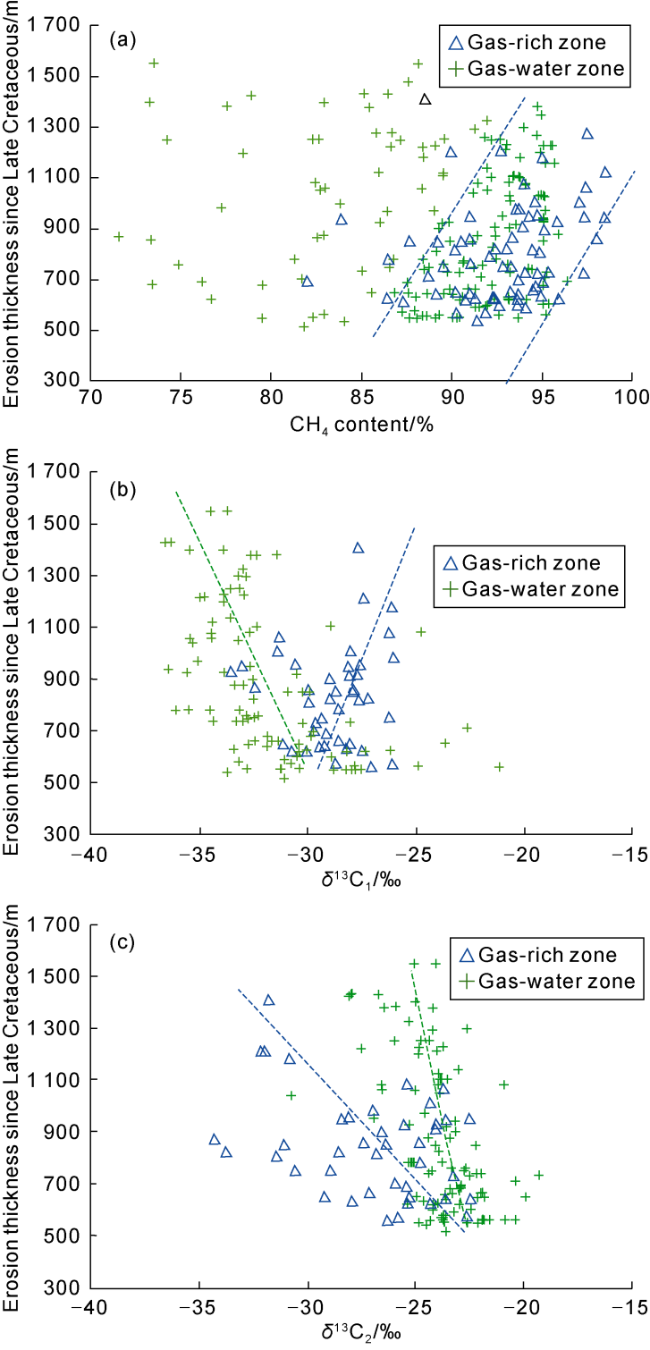
Fig. 7. Methane content, methane carbon isotope and ethane carbon isotope vs. formation erosion thickness since the Late Cretaceous in the Sulige gas field. |
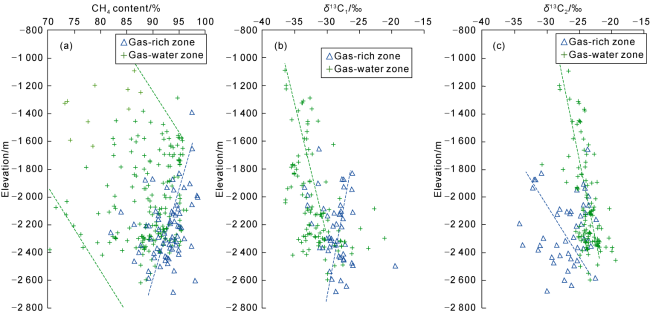
Fig. 8. Methane content, methane carbon isotopic and ethane carbon isotopic compositions vs. elevation of the middle of the gas reservoir in Sulige gas field. |
The increase of thermal evolution degree (maturity) of source rock during gas generation and the migration fractionation effect caused by increase of migration distance after the formation of gas both can lead to increase in methane content and thus drying coefficient of gas. The difference of the two is that the former can make the stable carbon isotopes turn heavier, while the latter makes the stable carbon isotopes turn lighter [34-35]. The relationship between methane content and erosion thickness in the gas-water zone is not obvious, but the methane content tends to decrease with the drop of elevation, and the carbon isotope compositions of methane and ethane become lighter with the increase of erosion thickness and elevation (Figs. 7 and 8 ), which apparently is not consistent with the law of migration fractionation, but similar to the law of maturity change. The areas with lower elevation and higher erosion may represent the areas with shallower ancient burial depth and lower maturity of source rocks before uplift, so the gases in these areas have lower methane contents and higher contents of heavy hydrocarbons such as ethane, and lighter carbon isotope compositions of methane and ethane correspondingly.
The situation in the gas-rich zone is more complicated. On the one hand, the methane content of the present-day gas reservoir increases but the stable carbon isotope composition becomes heavier with the increase of erosion thickness and the present-day elevation of the reservoir (Figs. 7 and 8 ), which is also inconsistent with the law of migration fractionation. At the same time, it is contrary to the common belief that the gas components and stable carbon isotope composition are controlled by the maturity of source rock, and the greater the burial depth, the higher the maturity, and the heavier the stable carbon isotope composition is. On the other hand, stable carbon isotope composition of ethane becomes lighter with the increase of erosion thickness and present-day elevation of the reservoir (Figs. 7 and 8 ), which is exactly opposite to the variation pattern of stable carbon isotopic composition of methane.
According to the comprehensive analysis of the variation pattern of methane content and stable carbon isotope composition of the gas-rich zone in the Sulige gas field with erosion thickness and the present-day elevation of the reservoir, in addition to the gas accumulation in the burial stage, a large amount of methane-dominated high-maturity gas charged into the reservoir in the uplift stage. The higher the uplift and the greater the erosion thickness in the late stage, the greater the expansion pressure of source rock, and the more highly mature gas expelled and migrated into the reservoir in the uplift stage. Thus, the gas in the present-day reservoir there shows an increase in methane content but heavier stable carbon isotope composition. The lighter carbon isotope composition of ethane may be related to the low content of ethane and other heavy hydrocarbons in the high maturity gas, so the gas charged in the uplift stage has little influence on this indicator, which mainly reflects the characteristics of the reservoir formed in the burial stage. This is also in good agreement with the geological setting that the vitrinite reflectance (Ro) of source rocks in the gas-rich zones is generally greater than 1.5%.
The variation pattern of reservoir geochemical parameters with erosion thickness and present-day elevation of the reservoir in the gas-water zone indicates that the gas migration and charge in the reservoir mainly happened in the burial stage, while the charging of high maturity gas in the uplift stage has little influence on the reservoir in this area. In the gas-rich zone, a large amount of methane-based high maturity gas charged again into the reservoir in the uplift stage.
3.2. Adjustment and re-accumulation effects caused by gas expansion in the reservoir
Gas reservoirs formed in the burial stage exist mostly as lenticular lithologic reservoirs sealed by tighter mudstone or sandstone in all directions, and the whole Sulige gas field is a quasi-continuous gas accumulation consisting of numerous small- and medium-sized lithologic gas reservoirs adjacent to each other [17-18,22,24 -25]. Under this background, as the breakthrough pressure of the caprocks and blocking mudstone is higher than the reservoir expulsion pressure, the gas expansion pressure triggered by the formation uplift since the Late Cretaceous first drove the gas to the adjacent pores with lower capillary force according to the principle of minimum resistance for hydrocarbon migration at microscopic scale, and meanwhile, the water in the pores was displaced out; as a result, the water cut of the reservoir went down, bringing about the uplift-stage adjustment of the reservoir formed in the burial stage.
When the internal adjustment of the gas reservoir was still unable to consume all the expansion pressure triggered by the uplift, the remaining expansion pressure would drive the gas to migrate into the caprock and shield layers to dissipate; on the other hand, if the remaining expansion pressure was large enough or even exceeded the fracture pressure of the caprock, the caprock would break, leading to the destruction of the gas reservoir. In general, under the effect of secondary charge of gas expelled from source rock into and expansion of gas in the reservoir, the gas expansion triggered by uplift since the Late Cretaceous in the Sulige gas field has led to the reservoir adjustment and re-accumulation such as increase of gas saturation, gas-bearing area, and gas column height. The main evidence and signs are introduces as follows.
3.2.1. The magnitude of late stage uplift is positively correlated with reservoir gas saturation and negatively correlated with WGR and water production
Erosion thickness and present-day elevation are important parameters reflecting the extent of uplift erosion since the Late Cretaceous, and their correlations with reservoir gas saturation and product type can reflect the influence of late basin uplift on the gas reservoir.
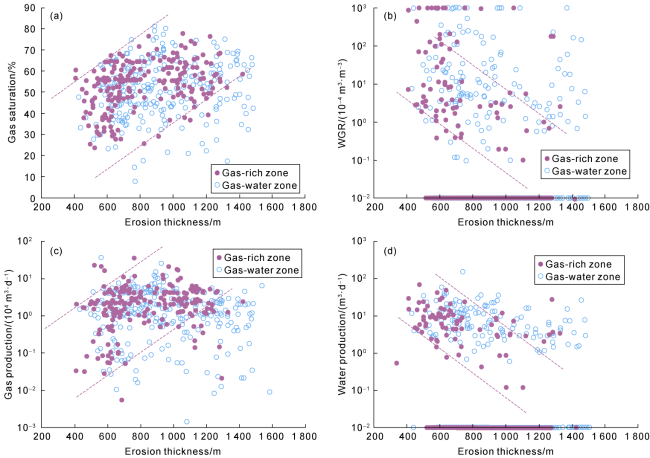
Fig. 9. Erosion thickness since Late Cretaceous vs. gas saturation, WGR and gas production of Sulige gas field. |
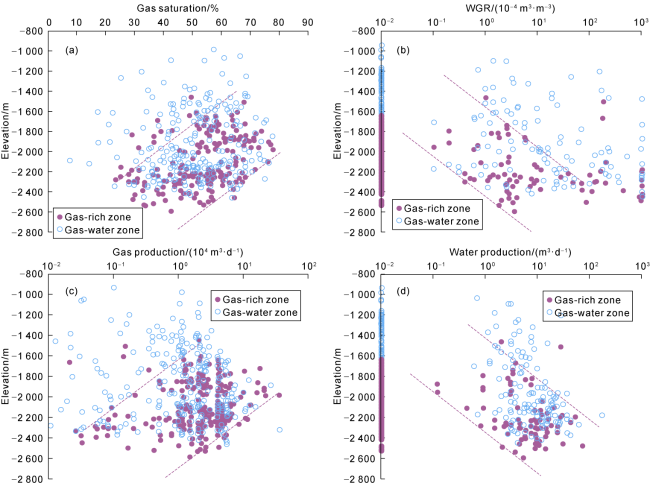
Fig. 10. Present-day elevation vs. gas saturation, WGR and gas production of the reservoirs in Sulige gas field. |
Firstly, systematic statistical analysis of a large number of wells in a wide scope shows that the production of gas and water in the Sulige gas field are not controlled by the present-day structures. A detailed statistical analysis was made on the gas production of many exploratory wells and some development wells in the Sulige gas field as well as the present-day structures (Fig. 11 ). The results show that the gas production tends to increase and then decrease with the increase of present-day elevation, and the gas production is highest near the elevation of about -2000 m. Strangely, the water production tends to increase slightly with the increase of present-day elevation in eastern Sulige gas field, and there is no obvious correlation between water production and present-day elevation in other blocks. The correlation between WGR and present-day elevation is not obvious. Thus, it can be seen that the distribution and output of gas and water in the Sulige gas field are hardly controlled by the present-day structures.
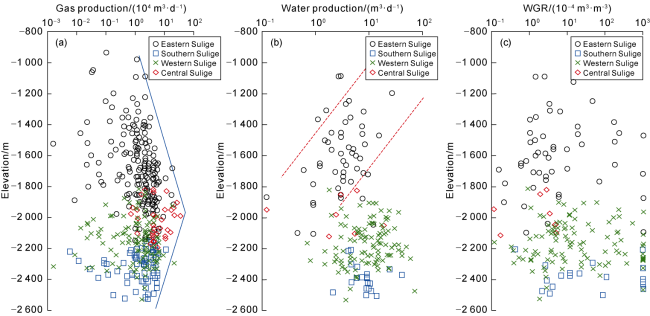
Fig. 11. Present-day elevation vs. gas production, water production and WGR of reservoirs in Sulige gas field. |
Secondly, the geological conditions for gas-water differentiation induced by structures are not sufficient, and the differentiation result doesn’t occur. The driving force of structure-induced gas-water differentiation is buoyancy, and the result is that the structure is relatively rich in gas at the high part while formation water at the low part, and when the gas-water differentiation is thorough, edge/bottom water and clear gas-water contact will be formed. The important condition for structure-induced gas-water differentiation is that the reservoir has good physical properties and connectivity, in other words, the gas and water zones are in the same connected pressure system; otherwise it is difficult for buoyancy to take effect. A detailed analysis of the reservoir characteristics, connectivity of gas and water zones, and pressure system in the gas-water zone of the western part of Sulige gas field shows that the reservoir is tight and heterogeneous, and gas and water zones are complex in pressure systems and mostly in different pressure systems, reflecting inadequate conditions for buoyancy effect [21-22,24 -25,36 -37]. In addition, the signal result of buoyancy effect, edge/bottom water and clear gas-water contact do not exist in Sulige gas field [17-18,21 -22,24 -25,36 -37].
3.2.2. Reservoir adjustment and re-accumulation driven by gas expansion led to pressure field adjustment, and present-day pressure coefficient is positively correlated with gas content of reservoir
The reservoirs in the Sulige gas field are tight, complex in gas-water distribution, and low in pressure coefficient, representing typical normal pressure tight sandstone gas reservoirs. Although this gas field has low pressure nowadays, it was overpressure at the key moment of formation at the end of Early Cretaceous [17-18,21 -22,24 -25]. In fact, all present-day low-pressure gas reservoirs evolve from overpressure gas reservoirs in the main hydrocarbon charging period.
As for the causes of low pressure of the Upper Paleozoic reservoirs in the Sulige gas field and the Ordos basin, previous studies suggested that temperature drop due to tectonic uplift was the main factor, while gas dissipation, pore rebound and pressure sequestration caused by late "eastward lift and westward fall" also contributed to various degrees [22,25]. In addition to the Upper Paleozoic in the Ordos Basin, tight sandstone reservoirs in the Cretaceous of San Juan, Raton and Denver basins, Lower Silurian of Appalachian Basin, Ordovician of Risha area in eastern Jordan, and Cambrian and Ordovician of Ahnet Basin in Algeria all have low pressure [38]. Studies in recent years show that besides temperature drop due to erosion and unloading triggered by formation uplift, gas re-migration due to volume expansion, internal adjustment and dissipation are the main causes of low pressure in reservoirs of sedimentary basins [3,6,10⇓ -12,39⇓ -41], and this is also true for the Upper Paleozoic in the Ordos Basin [16].
Main control factors for the present-day low-pressure in the Sulige gas field were analyzed with a large number of drilling, logging and pressure data. The results show that the present-day formation pressure and pressure coefficient are best correlated with gas saturation, daily water production and WGR. Specifically with the increase of pressure coefficient, gas saturation increases, WGR decreases and daily water production decreases, and this pattern is more obvious in the gas-rich zone than in the gas-water zone (Fig. 12 ). Thus, the present-day pressure coefficient of Sulige gas field is closely related to the present-day gas content of the reservoir after uplift adjustment. On the other hand, if the gas loss and temperature drop caused by the uplift and erosion unloading since the Late Cretaceous are the main reasons for the formation of low pressure in the Sulige gas field, then the areas with greater uplift and erosion must have had greater gas loss and temperature drop, and correspondingly, in these areas, methane content would be lower and the stable carbon isotope composition would turn heavier. However, this phenomenon is does not appear in either the gas-rich or gas-water zones of the Sulige gas field. Therefore, the present-day pressure field characteristics of the Sulige gas field, like the reservoir gas content, are the result of the adjustment of gas reservoirs formed in the burial stage driven by gas expansion pressure in the uplift stage. Ultimately, in the eastern part of the Sulige gas field with larger uplift and erosion degree, wells produce mainly pure gas; while in the western part with smaller uplift and erosion, most wells produce gas and water, and some even produce pure water.
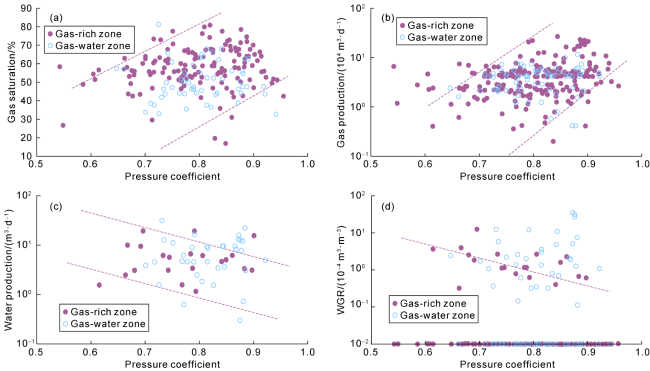
Fig. 12. Present-day pressure coefficient vs. gas production, gas saturation and WGR of gas reservoirs in Sulige gas field. |
3.3. Gas accumulation model
Based on the analysis of gas adjustment and secondary charging & accumulation characteristics driven by gas volume expansion in the uplift stage since the Late Cretaceous in the Sulige gas field, combined with results of studies on gas reservoir formation and enrichment mechanisms in recent years [15,17⇓⇓⇓⇓⇓⇓⇓ -25], an accumulation model of two stages (burial and uplift) of the quasi-continuous tight sandstone gas reservoir in the Sulige gas field has been established.
In the burial stage, dual driving forces, dual direction migration, dual flow direction reservoir accumulation model worked, i.e., the expansion and molecular diffusion force induced by hydrocarbon concentration gradient during hydrocarbon generation of source rock were the major forces driving gas migration; overpressure flow driven by hydrocarbon generation pressurization and molecular diffusion flow driven by hydrocarbon concentration gradient are the main modes of gas migration, and gas driven by hydrocarbon generation pressure and molecular diffusion force charged into lithologic traps after vertical and short distance lateral migration to accumulate [17-18,21 -22,24 -25].
In the uplift stage, gas volume expansion drove gas adjustment and secondary accumulation. The gas expansion pressure triggered by the uplift was the main driving force of gas migration. Driven by the expansion pressure, on the one hand, the gas already gathered in the reservoir in the burial stage again migrated and adjusted to the pores not filled or not fully filled by gas, eventually leading to the increase of gas-bearing area, gas column height and gas saturation of the reservoir; on the other hand, for the source rocks mostly covered by tight sandstones with lower threshold pressure than themselves, gas was mainly expulsed from source rocks and migrated into reservoirs, thus resulting in secondary gas charging into the reservoirs and further increase of gas content of the reservoir (Figs. 2 and 13 ). In this stage, both the internal adjustment of gas reservoir formed in the uplift stage and the secondary hydrocarbon expulsion process of source rock would lead to the decrease of remaining pressure in the formation (Fig. 2 ).
For tight sandstone gas adjustment driven by gas volume expansion induced by formation uplift, first, the adjustment depends on the reservoir filling level before uplift. For a reservoir not or less filled before uplift, the gas made into the reservoir would first further fill large pores with low capillary pressure and drainage formation water out of the reservoir, until the entire reservoir was fully filled, so signs of this process are rise of gas column height and gas-bearing area (Fig. 13 ). If the gas expansion pressure was still high after the whole reservoir was filled, it would further drive the gas into small pores with higher capillary pressure at this time, making the gas saturation in the reservoir increase. For the gas reservoir mostly or fully filled before uplift, the volume expansion of gas caused by formation uplift would make the reservoir increase in gas saturation and continuity (Fig. 13 ). Secondly, the adjustment accumulation of tight sandstone gas due to gas volume expansion induced by formation uplift also depends on the uplift height and the magnitude of the expansion pressure resulted from the uplift. Generally, gas expansion pressure induced by small uplift height is limited, and thus can hardly cause significant changes in gas saturation or gas column height/gas-bearing area. A typical example is the Pinedale tight sandstone gas field in the northern Green River Basin [3]. But even small changes in gas-bearing saturation can still have great significance for the economic recovery of tight sandstone gas. Shanley et al found that the tight sandstone gas reservoir had a gas-phase permeability jail, and only when this jail was broken, would the reservoir reach economical productivity [42]. Since a small increase in gas saturation can make the effective gas-phase permeability increase significantly, even if a small uplift in deep reservoirs does not result in a large increase in gas-bearing saturation, it can make the effective gas-phase permeability increase and thus change the distribution of economic gas over the region [3,42].
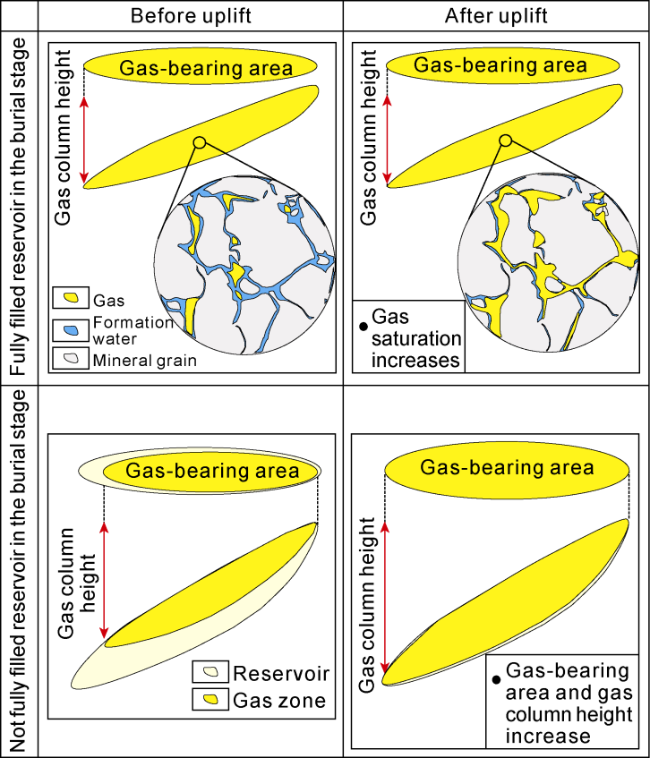


Fig. 13. Two-stage (burial and uplift) gas accumulation model of Sulige gas field. |
For the Sulige gas field, comprehensive analysis indicates that secondary gas charging and reservoir adjustment driven by gas expansion due to late formation uplift in the gas-water zone in the western part appears in the form of increase in gas column height/gas-bearing area, while in the gas-rich zones in the central-eastern part, mainly in the form of increase in gas-bearing saturation. In the gas-water zone, a large number of wells have high water production and a small number of wells even produce with water solely, indicating that reservoirs in this area have more free water and low gas-filling degree even today. The gas and gas-water reservoirs in the gas-water zone generally have a porosity greater than 5% and permeability greater than 0.1×10⁻³ μm2, while the gas and gas-bearing reservoirs in the gas-rich zone have a porosity as low as 2% and permeability as low as 0.01×10⁻³ μm2. With limited data available and limited study degree, the contribution of secondary filling and adjustment accumulation is hard to evaluate quantitatively, and can be taken as the content of follow-up study.
It is worth noting that, according to the results of current domestic and international studies, gas expansion during uplift is common across the world, but stringent geological conditions are required for the gas expansion to result in effective secondary filling and gas adjustment like those in the Illizi Basin and Sulige gas field [3⇓-5,9⇓⇓⇓ -13,16]. In tight formations, the geological bodies hosting hydrocarbons are more confined, so gas expansion during uplift is more likely to accumulate to a certain scale; besides, these formations often had low degree of gas filling and water displacement by gas in the burial stage, so gas driven by the expansion pressure is more likely to migrate into and accumulate in these formations. Compared with tight formations, in formations with good physical properties, such as conventional reservoirs, the gas expansion pressure is easy to release and difficult to build up, so it is difficult to make the gas saturation increase further, and the results of gas expansion often appear as increase of gas-bearing area and column height in unfilled gas reservoirs at the burial stage, but gas expansion would cause no obvious adjustment and accumulation effect in filled gas reservoirs (with gas filling to spill point).
The magnitude of expansion pressure induced by uplift is another important factor determining the intensity of secondary hydrocarbon expulsion from source rock and adjustment and accumulation in reservoir. The paleopressure and degree of gas saturation before uplift and the magnitude of uplift are the main factors affecting the magnitude of the expansion pressure in the uplifting environment. Studies in recent years [16,29] have shown that deep formation overpressure in petroliferous basins is mainly triggered by hydrocarbon generation expansion and its pressure transmission process. Therefore, geological conditions such as larger burial depth, source rocks at peak gas stage and larger scale before uplift were more likely to bring about larger pressure and gas saturation in the formations, and then the secondary hydrocarbon charging and accumulation of gas in the reservoir would be more obvious in the later significant uplift process.
Secondary gas charging and accumulation effect is more likely to occur in interbedded source-reservoir assemblage and assemblage with source in close contact with reservoir than in assemblage with source and reservoir widely apart from each other in the uplifting environment. Similar to those in the burial stage, the assemblages of interbedded source rock-reservoir and source rock adjacent to reservoir exhibited extensive and diffusive hydrocarbon migration and charging in the uplifting stage, with no need of dominant transport conduit. Besides, due to short migration distance, they have high accumulation efficiency, for example, in the Sulige gas field and Illizi Basin in Algeria. But for the assemblage with source rock-reservoir far apart from each other, the existence of dominant transport system, driving force for long-distance transport and gas dissipation during transport would significantly reduce the secondary gas filling and reservoir adjustment effect in uplifting environment.
The proposed adjustment and re-accumulation effect of gas driven by gas expansion pressure induced by late stage uplift in the Sulige gas field can help deepen the understanding on the formation mechanisms of "gas- rich" sweet spots in the discovered tight sandstone gas fields of the Ordos Basin, and also provide an important theoretical support for the search of large-scale reserves in the greatly uplifted area at the edge of the basin, especially in the areas with low maturity where large-scale reservoirs are unlikely to form in the burial stage. Also, this can provide a theoretical basis for effective exploration in similar basins.
4. Conclusions
The uplift and erosion unloading of the Sulige gas field since the Late Cretaceous triggered relatively strong gas expansion effect in both source rocks and reservoirs. The expansion effect is greater in source rocks than in reservoirs vertically, and greater in gas-rich zones than in gas-water zones horizontally. The expansion effect/pressure of gas is the major driving force for gas adjustment and secondary charging during the uplift period.
The volume expansion of gas in source rock leads to the expulsion of gas from the source rock and charge into the reservoir, causing secondary accumulation effect. This is mainly evidenced by: the source-reservoir gas expansion pressure difference is greater than the migration resistance; inclusions with low homogenization temperature and high methane content are developed in the reservoir; further charging after secondary hydrocarbon expulsion in the uplift stage increases the methane content and drying coefficient of gas; methane content increases and carbon isotopes become heavier with the increase of erosion thickness and elevation. This is especially distinct in gas-rich zones.
The expansion of gas in the reservoir leads to the adjustment of gas saturation, gas-bearing area and gas column height inside the reservoir. This is mainly evidenced by: with the increase of erosion thickness and elevation, the gas saturation increases, the WGR and water production decreases in Sulige gas field, and this is especially remarkable in the gas-rich zone; the present-day gas reservoirs have pressure coefficients decreasing in a regular pattern with the increase of burial depth, and both the low pressure and normal pressure are the results of the adjustment of reservoirs.
It is inferred that the Sulige gas field was formed in burial and uplift stages. In the burial stage, the gas migration and accumulation were driven by overpressure resulted from hydrocarbon generation; in the uplift stage, the overpressure caused by gas volume expansion drove adjustment in the gas reservoir and secondary gas charging and accumulation, which made the gas saturation, gas column height or gas-bearing area of the reservoir formed in the burial stage increase further. In general, the adjustment and secondary gas charging & accumulation in the uplift stage of gas-rich zones is greater than that in gas-water zones. With limited data available and limited research level, the contribution of secondary charge and adjustment to reservoir formation in the uplift stage is difficult to evaluate quantitatively, and should be one of the contents of the follow-up studies.
Nomenclature
Cg—gas compression coefficient, MPa-1;
Crb—reservoir pore compression coefficient, MPa-1;
Crr—reservoir skeleton compression coefficient, MPa-1;
nr1—amount of gas substance before reservoir uplift, mol;
ns1—amount of gas substance before source rock uplift, mol;
nr2—the amount of gas substance after reservoir uplift and adjustment, mol;
ns2—the amount of gas substance after gas expansion and expulsion induced by uplift in source rock, mol;
pr1—pore fluid pressure before reservoir uplift, MPa;
ps1—pore fluid pressure of the source rock before uplift, MPa;
pr2—pore fluid pressure of the reservoir after temperature drop and uplift, MPa;
ps2—pore fluid pressure in source rock after temperature drop and uplift, MPa;
pr3—pore fluid pressure in reservoir after pore rebound induced by uplift, MPa;
ps3—pore fluid pressure in source rock after pore rebound induced by uplift, MPa;
pr4—pore fluid pressure in reservoir after gas reservoir adjustment induced by uplift, MPa;
ps4—pore fluid pressure in source rock after gas expulsed out due to gas expansion, MPa;
prc—reservoir capillary pressure, MPa;
prh—hydrostatic pressure of reservoir after uplift, MPa;
Δpr—pore fluid pressure drop due to reservoir pore rebound, MPa;
pe—gas expansion pressure, MPa;
p0—paleopressure at late Early Cretaceous, MPa;
pw—pore fluid pressure drop due to temperature drop, MPa;
pt—pore fluid pressure drop due to pore rebound, MPa;
pj—hydrostatic pressure after uplift, MPa;
Tr1—absolute temperature of reservoir before uplift, K;
Ts1—absolute temperature of source rock before uplift, K;
Tr2—absolute temperature of reservoir after uplift, K;
Ts2—absolute temperature of source rock after uplift, K;
Vr1—volume of gas in reservoir before uplift, m3;
Vs1—volume of gas in source rock before uplift, m3;
Vr2—volume of gas in reservoir after pore rebound induced by uplift, m3;
Vs2—volume of gas in source rock after pore rebound induced by uplift, m3;
Vr3—volume of gas in reservoir after gas reservoir adjustment induced by uplift, m3;
Vs3—volume of gas in source rock after gas expulsed out of source rock due to expansion, m3;
Zr1—gas deviation factor before reservoir uplift, dimensionless;
Zr3—gas deviation factor after reservoir uplift, dimensionless;
ϕ—reservoir porosity, %;
Δσ—variation amount of confining pressure (overlying formation pressure), MPa;
δ13C1—stable carbon isotope composition of methane, ‰;
δ13C2—stable carbon isotope composition of ethane, ‰.