

Introduction
Deep and ultra-deep layers have become a significant field with the continuous breakthrough in oil and gas exploration [1⇓⇓-4]. In recent years, many breakthroughs of oil and gas exploration of deep and ultra-deep clastic rock have been made in Kuqa thrust belt of Tarim Basin [5⇓⇓⇓⇓-10] and southern margin of Junggar Basin [11], which reveals a good prospect of oil and gas exploration in the foreland basin of Tianshan mountains. A large number of microfractures are developed in deep and ultra-deep high- quality clastic rock reservoirs, which play an important role in improving reservoirs quality and transporting oil and gas [12⇓-14]. Some researches show that the permeability of reservoirs with effective microfractures is 10 to 1 000 times that of reservoirs without them [15]. Microfractures have an important impact on distribution of high-quality reservoirs and accumulation of oil and gas.
Microfractures in deep-ultra-deep reservoirs of Kuqa thrust belt have been studied in detail. (1) The genesis, formation period and distribution of microfractures in Kuqa thrust belt of Tarim Basin have been discussed [16⇓-18], and it is believed that the development of microfractures is closely related to the late rapid burial process [19]. Both the southern margin of Junggar Basin and the Kuqa thrust belt have the geological background of late rapid. However, the current researches on the characteristics, genesis of microfractures and its impact on the improvement of deep-ultra-deep clastic rock reservoirs in the southern margin of Junggar Basin are still insufficient. (2) Many studies have discussed the relationship between microfractures and reservoirs quality. However, most conclusions are qualitative and lack the support and analysis of simulation experimental data [16⇓-18,20 -21]. (3) Although it has been proved by physical modeling experiments that microfractures can improve the seepage capacity of reservoirs [22-23], the samples used in the experiments are not enough, and the heterogeneity of clastic rock reservoirs is not fully considered. The experimental results are unable to reflect the improvement effect of microfractures on clastic rock reservoirs. Further experiments need to be carried out to find out how much the seepage capacity of reservoirs with different diagenetic intensities can be improved by microfractures and how much porosity of the reservoirs can be increased under the combined effect of acidic fluid and microfractures.
Well GT1 in west of the southern margin of Junggar Basin tested daily oil production of 12.13 million cubic meters in the clastic rock reservoir of Cretaceous Qingshuihe Formation. This reservoir has the microscopic characteristics of massive microfractures and strong oil-gas fluorescence in the microfractures. These phenomena further reveal that microfractures play an important role in the migration and accumulation of deep and ultra-deep oil and gas in the southern margin of Junggar Basin [20-21]. Meanwhile, the clastic rock reservoir of Qingshuihe Formation has strong heterogeneity, and how to reveal the effect of microfractures on reservoirs with different diagenetic intensities has become a crucial issue for promoting oil and gas exploration in deep and ultra-deep strata. Low-mature sandstones in the same period as the high-yield interval of Well GT1 were exposed to the outcrop area of southern margin of Junggar Basin by geological investigation [24], providing suitable samples for revealing the relationship between microfractures and deep and ultra-deep clastic rock reservoirs quality through diagenetic physical simulation experiments. In this study, low-mature sandstone samples from the outcrop area were collected to carry out modeling experiments of diagenesis under variations of temperature, pressure and diagenetic fluid conditions similar to the geological burial history to find out the improvement effect of microfractures on quality of reservoirs with different diagenetic intensities from a quantitative perspective and the significance of microfractures on the development of deep and ultra-deep reservoirs in the "late rapid burial process". This study is expected to provide geological guidance for the selection of favorable oil and gas exploration areas in this area and provide reference for studying the development mechanisms of reservoirs by physical modeling experiment of diagenesis.
1. Geological setting
The southern margin of Junggar Basin is located at the junction of Junggar Basin and North Tianshan Mountains. It is bordered by Zhayler Mountain to the west, Bogda Mountain to the east, Yilinheibiergen Mountain to the south, and the Central Depression to the north [11,25] (Fig. 1 a). The study area is located in the Gaoquan structural belt of Sikushu sag at the southern margin of Junggar Basin (Fig. 1 b). There are 3 sets of caprocks, the Cretaceous Tugulu Group (K1tg), the Paleogene Anjihaihe Formation (E2-3a) and the Neogene Taxihe Formation (N1t), and thus 3 reservoir-caprock assemblages (upper, middle and lower) developed in the study area [26]. The target interval is the Lower Cretaceous Qingshuihe Formation at the burial depths between 5000-6000 m. During the deposition of Qingshuihe Formation, this area experienced a wide range of lake transgression, the upper part of this formation is a set of semi-deep to deep lake facies regional mudstone, and below the mudstone is sandy conglomerate of fan delta facies [11,20] (Fig. 1 c).
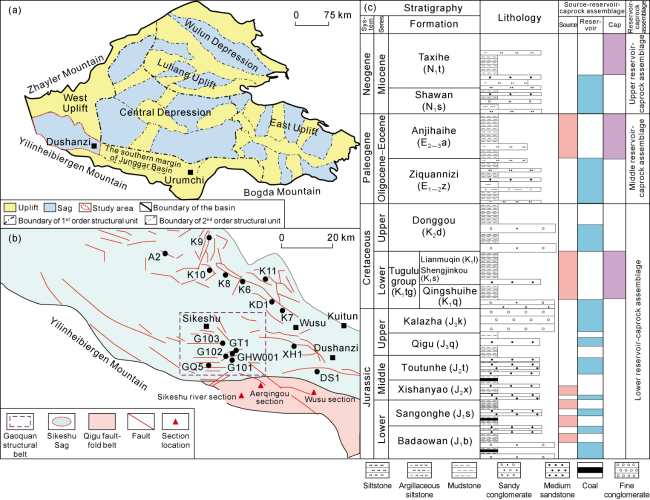
Fig. 1. Stratigraphic column of reservoir-caprock assemblages and structural location of Sikeshu Sag, southern margin of Junggar Basin. (a) Location map of Sikeshu Sag at the southern margin of Junggar Basin; (b) Well locations and fault distribution in the Sikeshu Sag; (c) Composite columnar section of reservoir-caprock assemblages in the Sikeshu Sag. |
2. Reservoirs in the study area
2.1. Microfracture characteristics and reservoir types
The clastic rock reservoirs of Cretaceous Qingshuihe Formation in the study area are affected by mechanical compaction and tectonic compression [20-21], and two types microfractures can be observed in the casting thin sections. The small-scale microfractures come in two forms: (1) Some small-scale microfractures are in irregular net, mainly distributed in the clastic particles, and have no directionality, narrow width and short extension and irregular bay-shape dissolution spots around (Fig. 2 a, 2b); (2) the other small-scale microfractures are distributed around clastic particles, narrow in width and limited in extension (Fig. 2 c, 2d). The large-scale microfractures have the capacity of cutting through gravels and sand grains into two parts (Fig. 2 f). These microfractures have large widths and long extensions. Moreover, they occur in several groups and show some directionality (Fig. 2 e, 2f). The unique combination of microfractures of the two scales, especially the large-scale microfractures, may have strong impact on hydrocarbon migration and accumulation in deep and ultra-deep clastic rock reservoirs at the southern margin of Junggar Basin.
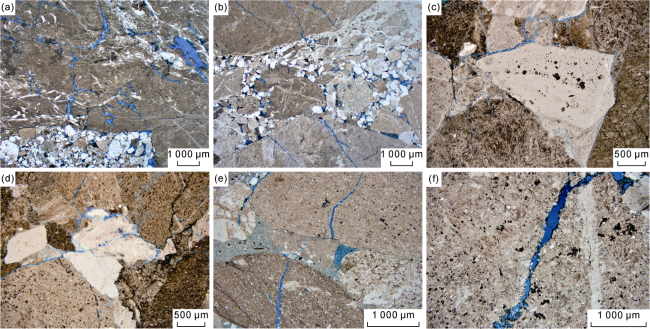
Fig. 2. Microfractures in clastic reservoirs of Qingshuihe Formation at the southern margin of Junggar Basin. (a) Well GHW001, 5829.04 m, small-scale microfractures in tuff debris, cast thin section; (b) Well GHW001, 5829.96 m, small-scale microfractures in gravel, cast thin section; (c) Well G103, 5905.90 m, small-scale microfractures around particles, cast thin section; (d) Well G103, 5907.75 m, small-scale microfractures at the edge of particles, cast thin section; (e) Well GHW001, 5829.32 m, large-scale microfractures cutting through multiple gravels in several groups with obvious directionality, cast thin section; (f) Well GHW001, 5833.96 m, large-scale microfractures cutting the gravel into two parts, cast thin section. |
Based on the characteristics of microfractures, the number of matrix pores and the intensity of cementation, it is believed that the clastic rock reservoirs of Qingshuihe Formation have multiple types of pore-fracture assemblages, which means that they have strong heterogeneity. The study shows these reservoirs can be divided into 3 types. Type-I reservoirs are dominated by primary intergranular pores and microfractures (Fig. 3 a, 3b), with weak compaction and cementation. This type of reservoirs has residual intergranular pores as main storage space, rich microfractures, and low cement content. The type-II reservoirs have largely dissolution pores and microfractures as storage space (Fig. 3 c, 3d), stronger compaction and cementation, and apparent association between the microfractures and secondary pores. The type-III reservoirs have microfractures as major storage space, strong cementation, and dissolution occurring only in the microfractures (Fig. 3 e, 3f).
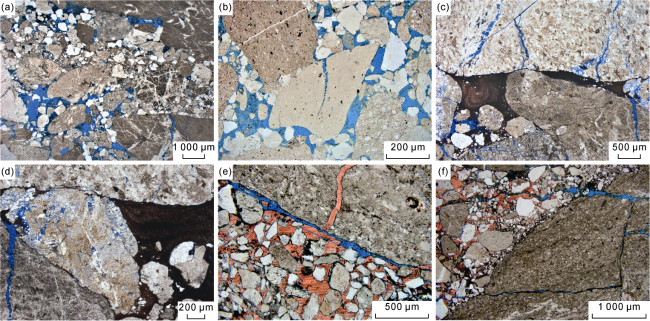
Fig. 3. Reservoir space characteristics of clastic reservoirs in the Qingshuihe Formation in the west of southern margin of Junggar Basin. (a) Well GHW001, 5829.04 m, reservoir rock with intergranular pores and microfractures cutting through grains, cast thin section; (b) Well GHW001, 5828.19 m, microfracture cutting through the particle, cast thin section; (c) Well G101, 6020.83 m, microfractures associated with dissolution pores, cast thin section; (d) Well G101, 6020.83 m, microfractures associated with dissolution pores, cast thin section; (e) Well G101, 6018.60 m, reservoir rock with microfractures cutting through calcite cement and no intergranular pores developed, cast thin section; (f) Well G101, 6018.60 m, reservoir rock with microfractures cutting through calcite cement, cast thin section. |
2.2. Reservoir physical properties
The deep clastic rock reservoirs in Qingshuihe Formation of the study area with poor physical properties in general belong to low porosity and low permeability ones. They have a porosity range from 2.10% to 7.70%, an average porosity of 4.61%; a permeability ranges from 0.03×10⁻³ μm2 to 7.66×10⁻³ μm2, and an average permeability of 1.78×10⁻³ μm2.
According to the development degree of microfractures and the correlation between porosity and permeability, the clastic rock reservoirs of Qingshuihe Formation can be divided into matrix type and fracture type. The matrix type reservoir has poor correlation between porosity and permeability (Fig. 4 ); while the fracture type reservoir has good correlation between porosity and permeability (Fig. 4 ), indicating that the permeability of this kind of reservoir is closely related to its porosity. Statistics show that a considerable proportion of Qingshuihe Formation clastic rock reservoirs in the study area show close correlation between storage space and microfractures.
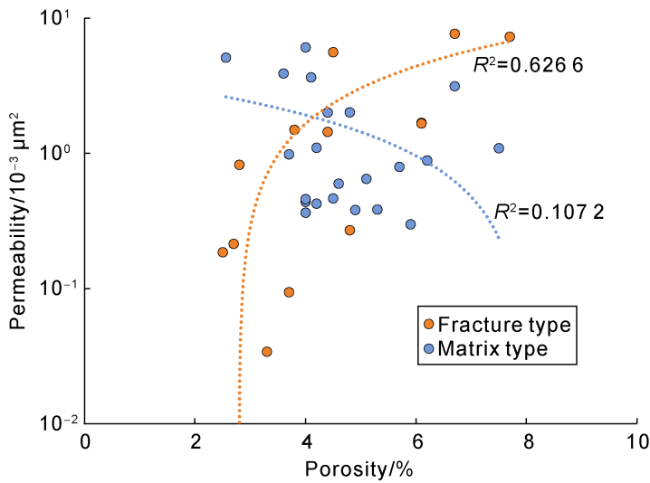
Fig. 4. Porosity and permeability correlation of clastic rock reservoirs of Qingshuihe Formation in the west part of southern margin of Junggar Basin. |
2.3. Formation time of microfractures
There are gas hydrocarbon inclusions and associated hydrocarbon-bearing brine inclusions in the clastic rock reservoirs of Qingshuihe Formation in the study area, which are mainly distributed in large-scale microfractures and quartz overgrowths (Fig. 5 a-5d). The peak values of homogenization temperatures of non-hydrocarbon brine inclusions in large-scale microfractures range from 70 °C to 80 °C (Fig. 5 e), which indicates that formation time of the large-scale microfractures ranges from 8 Ma to 12 Ma (Fig. 6 ) corresponding to the late rapid burial stage (Fig. 6 ). In addition, the peak values of homogenization temperatures of hydrocarbon-bearing brine inclusions in the large-scale microfractures and quartz overgrowths are 80-100 °C (Fig. 5 e, 5f), which implies that large-scale organic acid and hydrocarbon charging happened in deep and ultra-deep clastic rocks of Qingshuihe Formation during 8-9 Ma (Fig. 6 ). The above study results show that the formation of the large-scale microfractures and the charging of organic acids in Qingshuihe Formation took place in the same period.
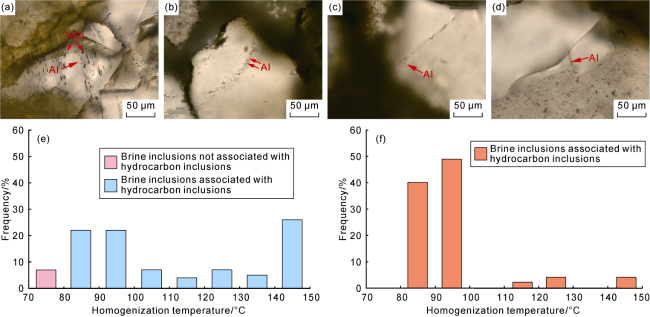
Fig. 5. Characteristics and homogenization temperatures of fluid inclusions in clastic reservoirs of Qingshuihe Formation in the west part of southern margin of Junggar Basin. (a) Well GHW001, 5820.89 m, brine inclusions associated with natural gas inclusions in microfractures of quartz; (b) Well GHW001, 5828.19 m, brine inclusions in secondary microfractures of quartz; (c) Well GHW001, 5828.19 m, brine inclusions in the quartz overgrowth; (d) Well GHW001, 5828.19 m, brine inclusions in quartz overgrowth; (e) Homogenization temperatures of brine inclusions in the microfractures of quartz particles; (f) Homogenization temperatures of brine inclusions in quartz overgrowth |
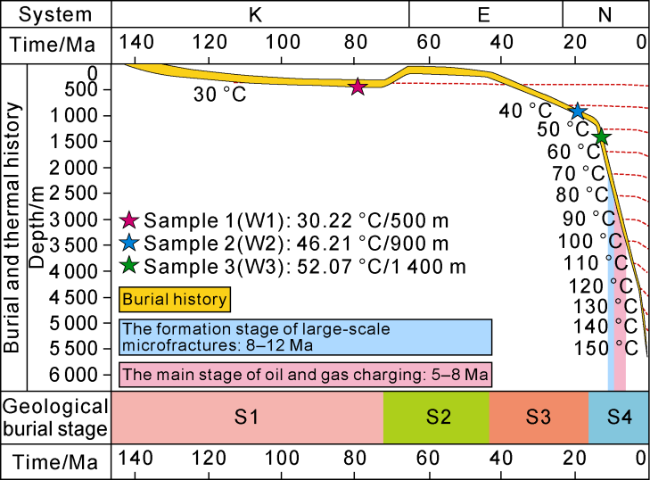
Fig. 6. Burial history and hydrocarbon charging history of Qingshuihe Formation in the west part of southern margin of Junggar Basin. |
3. Physical modeling of diagenesis
3.1. Experimental samples
Three groups of sandstone samples in the experiments (named W1, W2 and W3 respectively) were collected from Qingshuihe Formation of Sikeshu River section located 17 km south of Well GT1.
Eq. (1) was used to calculate the precipitation temperature of calcite cements by converting the data of oxygen isotope into temperature [27]. The calculation process is also based on the superposition of the latitude distribution of δ18O in modern atmospheric freshwater and the latitude distribution of the study area [28] (the value of δw was 8‰). The calculation results show that the precipitation temperatures of calcite cements in the three groups of experimental samples are 30.22, 46.21 and 52.07 °C, respectively (Fig. 6 ).
T=16.9-4.2(δ18O-δw)+0.13(δ18O-δw)2
According to the burial and thermal evolution history, the study area experienced a geological burial process of long-term shallow burial and late rapid burial, which can be divided into four stages (Fig. 6 ): (1) the long-term shallow burial stage (S1) from 70 Ma to 140 Ma when the Qingshuihe Formation was buried at about 500 m deep and had paleotemperatures close to 30°C; (2) the tectonic uplift stage from 40 Ma to 70 Ma (S2), when this formation was uplifted near surface; (3) the steady continuous deep burial stage of 14-40 Ma (S3), when the formation temperatures were 30 °C to 50 °C; (4) the late rapid burial stage from 14 Ma to present (S4), when the formation temperatures are 50 °C to 150 °C. The reservoirs were normal in pressure during S1-S3 stages, but have pressure coefficients soaring to 2.16 in S4 stage[29].
The calcite precipitation temperature of Sample W1 was 30.22 °C, which corresponds to the end of S1 (Fig. 6 ). This sample has good particle sorting, shallow burial depths, weak compaction, rich intergranular pores and small-scale microfractures, and lower degree of calcareous cementation (Fig. 7 a, 7b), similar to the type-I reservoir (Fig. 3 a, 3b). The calcite precipitation temperature of Sample W2 was 46.21 °C, which corresponds to the S3 in the burial history (Fig. 6 ). Sample W2 has the characteristics of poor particle sorting, strong calcareous cementation and few microfractures (Fig. 7 c, 7d), which is similar to the type-III reservoir (Fig. 3 c, 3d). The calcite precipitation temperature of Sample W3 was 52.07 °C, which corresponds to the S4 in the burial history (Fig. 6 ). The Sample W3 has the characteristics of poor particle sorting, strong calcite cementation and relatively developed microfractures (Fig. 7 e, 7f), which is similar to the type-II reservoir (Fig. 3 e, 3f).
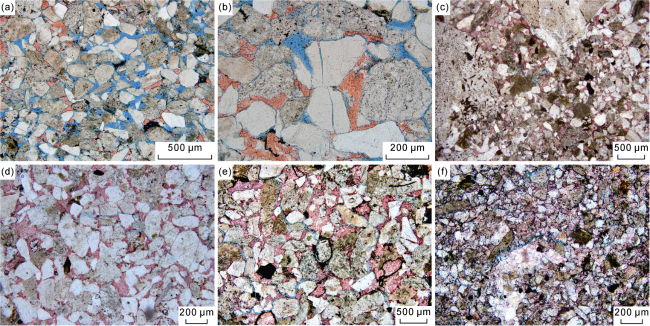
Fig. 7. Microscopic characteristics of sandstone samples from Qingshuihe Formation outcrop in the west part of southern margin of Junggar Basin. (a) Sample W1, with rich intergranular pores and calcareous cementation in local parts, cast thin section; (b) Sample W1, with small-scale microfractures in or around grains, cast thin section; (c) Sample W2, with strong calcareous cementation no microfractures, cast thin section; (d) Sample W2, with strong calcareous cementation and no fractures, cast thin section; (e) Sample W3, with strong calcareous cementation and small-scale microfractures around grains, cast thin section; (f) Sample W3, with strong calcareous cementation and small-scale microfractures around grains, cast thin section. |
Based on the microscopic characteristics, carbon and oxygen isotope data, regional burial history and classification standard for diagenetic stages of clastic rocks (SY/T 5477-2003), all the 3 groups of experimental samples from the outcrop deposited at ground temperatures of less than 65 °C, which indicates that all the samples are in the early diagenetic stage A. But the isotopes of calcite in the samples show that the calcite in them precipitated at different temperatures, which means the 3 groups of samples are in different burial stages and different in diagenetic time. Simply put, the experimental samples selected in this study are "in the same diagenetic stage, but in different burial stages". Meanwhile, the reservoirs in the study area have three types of reservoir space combinations, namely, intergranular pore-microfracture (with no cementation), dissolution pore-microfracture (with some cementation), and pure microfracture (with strong cementation) (Fig. 3 ). The three groups of experimental samples in this study have the potential to evolve into the above three types of reservoir space combinations respectively (Fig. 7 and Table 1 ). Therefore, carrying out physical modeling experiment of diagenesis on the low-mature sandstone samples taken from the outcrop area can give us some insight into the effect of microfractures on deep clastic rock reservoirs of different diagenetic intensities.
Table 1. Comparison of core and outcrop samples from Qingshuihe Formation in the west part of southern margin of Junggar Basin |
| Characteristics of core samples | Characteristics of outcrop samples | Remark | ||||||
|---|---|---|---|---|---|---|---|---|
| Reservoir type | Type I | Type II | Type III | Outcrop sample type | Sample W1 | Sample W2 | Sample W3 | |
| Diagenetic microscopic characteristics | Rich in intergranular pores, low in cementation degree, and rich in microfractures | Rich in secondary pores, high in cementation degree and rich in microfractures | With few pores, high cementation degree and abundant microfractures | Diagenesis and reservoir space characteristics | Rich in intergranular pores and low in cementation degree | High in cementation degree | High in cementation degree and rich in microfractures | W1 has the potential to evolve into type I reservoir W2 has the potential to evolve into type III reservoir W2 has the potential to evolve into type II reservoir |
| Reservoir space combination | Microfracture+ intergranular pore | Microfracture+ dissolution pore | Microfracture | |||||
3.2. Experimental set-up
The experiments were conducted with the physical modeling system independently designed and constructed by the Petroleum Geology Research and Laboratory Centre of the Research Institute of Petroleum Exploration and Development. This modeling system consists of 6 reaction furnaces (with the maximum working temperature of 550 °C, the maximum lithostatic pressure of 275 MPa, and the maximum fluid pressure of 120 MPa), a set of fluid injection and collection unit, 2 pressure pumps and a central computer control system [24]. The experimental system can increase temperature and pressure or decrease temperature and pressure to model the burial and uplift of stratum. The central computer control system can adjust the change rate of temperature and pressure to control the extent of burial and uplift to simulate the actual geological burial history as far as possible. The pressure pumps can supply different pressures to the 6 reaction furnaces separately to approximate the actual variations of pressure in the geological burial history. The fluid injection and collection device can realize uninterrupted replacement, supply and collection of different diagenetic fluids.
3.3. Design of experimental parameters
Before setting the experimental parameters, we must know the specific burial stages of the experimental samples, then the initial depth of each sample at its burial stage was taken as the starting point of the modeling experiment to carry on the trend of burial history. The experiment on Sample W1 started from the temperature and pressure at the initial depth (earth's surface) of S1. The experiments on Sample W2 and Sample W3 started from the temperatures and pressures at the initial depth of S3 and S4 respectively (Fig. 6 ).
The experimental temperatures were designed according to the geothermal gradient of 25 °C/km of Qingshuihe Formation. When the simulated depth increased by 1000 m, the lithostatic pressure of modeling system was increased by 27.5 MPa. According to this law, the experimental lithostatic pressures were designed. Constrained by the geological burial history and based on the correspondence relation of 1 day to 10 Ma, the experimental time of 3 reaction furnaces were designed (Sample W1: 14 days, Sample W2: 4 days, Sample W3: 1.4 days). The experimental fluids were meteoric freshwater and organic acid. Meteoric freshwater was used in S1-S3 (shallow burial stage), and organic acid was used in S4 (rapid burial stage). The formulation of acid fluid referred to the results of previous researches [30-31]. The Qingshuihe Formation began to develop overpressure at the end of Paleogene [32] and has a pressure coefficient of 2.16 currently. The empirical formula from previous research [33] (0.0098 × pressure coefficient × actual burial depth) was used to calculate the values of pore fluid pressure in different experimental stages (Table 2 ).
Table 2. Parameters of the physical modeling experiments of diagenesis |
| Experimental stage | Fluid type | Simulated depth/m | Temperature/°C | Lithostatic pressure/MPa | Pressure coefficient | Pore-fluid pressure/MPa | Simulated time/day | Sample NO. and reaction furnace NO. | ||
|---|---|---|---|---|---|---|---|---|---|---|
| S0 | Meteoric freshwater | Earth's surface | 220.0 (20.0+200.0) | 55.00 | 1.00 | 0.0 | 7.0 | Reaction furnace NO.1 (Sample W1) | ||
| S1 | 200 | 227.5 | 63.25 | 2.0 | ||||||
| 500 | 232.5 | 68.75 | 5.0 | |||||||
| S2 | Meteoric freshwater | 100 | 225.0 | 55.00 | 1.0 | 3.0 | ||||
| S3 | Meteoric freshwater | 1 000 | 245.0 | 82.50 | 9.8 | 2.6 | Reaction furnace NO.2 (Sample W2) | |||
| 1 200 | 250.0 | 88.00 | 12.0 | |||||||
| S4 | 2 000 | 270.0 | 110.00 | 2.16 | 42.0 | 1.4 | Reaction furnace NO.3 (Sample W3) | |||
| Organic acid | 2 600 | 285.0 | 126.50 | 55.0 | ||||||
| 4 000 | 320.0 | 165.00 | 85.0 | |||||||
| 5 000 | 345.0 | 192.50 | 106.0 | |||||||
| 6 000 | 370.0 | 220.00 | 120.0 | |||||||
In addition, the temperature and pressure compensation of 200 °C and 55 MPa were adopted in the modeling experiments according to previous physical modeling experiments of diagenesis in the study area [34]. The reasons for adopting the above compensation scheme include: (1) Because of the limited time of the physical modeling experiments, the experimental parameters are compensated to make the diagenetic phenomena more obvious. (2) From the perspective of time scale, although the experimental samples have consolidated into rocks, but are still in the stage of early diagenesis, and still need tens to dozens of million years to complete the geological burial history of Qingshuihe Formation. From the perspective of water-rock reaction, if the modeling of 1 day is equivalent to the diagenetic effect of 10 Ma, the temperature and pressure of the experiment need to be compensated to promote the evolution the samples in the early diagenetic stage. (3) High temperatures can enhance the dissolution effect of organic acids. Selecting 200 °C as the compensation temperature can reduce the activation energy required for water-rock chemical reaction and strengthen the dissolution effect of organic acids.
With the above designs, on the one hand, the diagenetic physical modeling experiments aimed to explore the relationship between the late rapid burial process and the deep and ultra-deep microfractures in the study area, especially to find out whether large-scale microfractures are related to the late rapid burial process. On the other hand, the experiments were to find out the reformation effects of rapid burial of the same intensity, organic acid charging of the same concentration and time, and the same intensity of overpressure environment on rock samples of different diagenetic intensities, to make clear the significance of late rapid burial process for the reformation of deep-ultra deep heterogeneous clastic rock reservoirs through comparison.
3.4. Analysis of experimental results
3.4.1. Changes in rock microscopic features
According to observations of cast thin sections, Sample W1 and Sample W3 had small-scale microfractures before experiment, but had large-scale microfractures which are consistent with the characteristics of microfractures in the study area after the experiment (Fig. 8 ). To facilitate the following analysis, microfractures of the two scales above are defined as follows: (1) The small-scale microfracture is narrow in width and limited in extension, and often appears in clastic particle or around the edge of clastic particle (Fig. 2 a-2d and Fig. 7 b-7f). (2) The large-scale microfracture is characterized by large width (5 times that of small-scale one), longer extension and obvious directionality, and cuts through the clastic particle (Fig. 2 e, 2f).
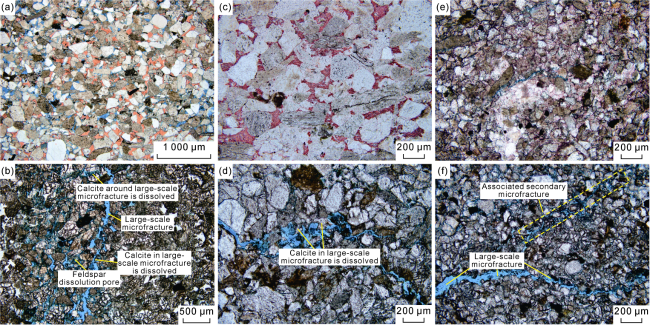
Fig. 8. Comparison of microscopic characteristics of outcrop samples before and after the physical modeling experiment. (a) Microscopic characteristics Sample W1 before experiment, cast thin section; (b) Microscopic characteristics of Sample W2 before experiment, cast thin section; (c) Microscopic characteristics of Sample W3 before experiment, cast thin section; (d) Microscopic characteristics of Sample W1 after experiment, cast thin section; (e) Microscopic characteristics of Sample W2 after experiment, cast thin section; (f) Microscopic characteristics of Sample W3 after experiment, cast thin section. |
Before the experiment, the Sample W1 had clastic particles and calcite cements intact, and intergranular pores and small-scale microfractures relatively developed (Fig. 8 a). After the experiment, it had several large-scale microfractures with large width, straight shape and good directionality formed. The large-scale microfractures cut through particles, gave rise to massive associated secondary microfractures and formed good connection with the early microfractures. Both particles and calcite cement around the microfractures were dissolved noticeably (Fig. 8 b).
The Sample W2 had particles and calcite cements intact, no small-scale microfractures and rare pores before the experiment (Fig. 8 c). After the experiment, it had large-scale microfractures with the same characteristics as those of Sample W1 turning up, but dissolution only in the large-scale microfractures, and hardly any dissolution around large-scale microfractures (Fig. 8 d).
The Sample W3 had intact particles and calcite cements and small-scale microfractures developed, but no intergranular pores before the experiment (Fig. 8 e). After the experiment, it had several large-scale microfractures coming up and calcite cements in and around the large-scale microfractures dissolved, but the degree of dissolution of calcite was lower than that of the Sample W1 (Fig. 8 f).
3.4.2. Changes in diagenetic fluid concentration
As calcite is commonly seen in the experimental samples, and Ca2+ ions concentration in the produced fluid changed significant, Ca2+ ion was selected to analyze the changes of fluid concentration.
The Ca2+ concentration curve of Sample W1 shows that Ca2+ concentration increased significantly in S1 + S2 stages, reached 358 mg/L after 10 d into the experiment, 393 mg/L in S3 stage, and 451 mg/L in the S4 stage (Fig. 9 a).
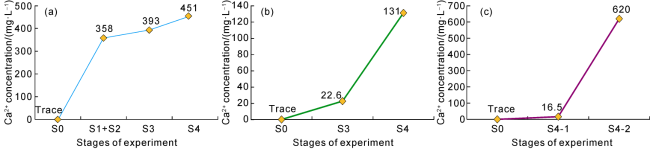
Fig. 9. Changes of typical ion concentration of different samples in physical modeling experiment of diagenesis. (a) Ion concentrations at different stages of experiment on Sample W1; (b) Ion concentrations at different stages of experiment on Sample W2; (c) Ion concentration at different stages of experiment on Sample W3. |
The experiment of normal burial stage (S3) and late rapid burial stage (S4) was done on Sample W2. The concentration of Ca2+ in S3 stage was low, and was only 22.6 mg/L after 2.6 d into the experiment. At the S4 stage, the dissolution intensity increased, and the concentration of Ca2+ reached 131 mg/L after 1.4 d into the experiment (Fig. 9 b).
The experiment of late rapid burial stage (S4) was done on Sample W3. According to the charging time of organic acid, the experiment was divided into the organic acid charging stage (S4-1) and the post-charging stage (S4-2). The organic acid dissolution in S4-1 stage was weak, and the concentration of Ca2+ was only 16.5 mg/L after 0.7 d into the experiment. The dissolution intensity was stronger at S4-2 stage, and the concentration of Ca2+ reached 620 mg/L after 0.7 d into the experiment (Fig. 9 c).
3.4.3. Variations of reservoir physical properties
The Sample W1 had remarkable changes in physical properties before and after the experiment. Its porosity increased by 14% from 11.61% before the experiment to 13.45% after the experiment. Its permeability increased by 55% from 0.49×10⁻³ μm2 before the experiment to 1.07×10⁻³ μm2 after the experiment (Table 3 ).
Table 3. Comparison of physical property parameters of the samples before and after experiment |
| Sample NO. | Before experiment | After experiment | |||||
|---|---|---|---|---|---|---|---|
| Porosity/ % | Permeability/ 10-3 μm2 | Porosity/ % | Permeability/ 10-3 μm2 | Porosity increase amplitude/% | Permeability increase amplitude/% | ||
| Sample W1 (S1-S4 stages) | 11.61 | 0.49 | 13.45 | 1.07 | 14 | 55 | |
| Sample W2 (S3-S4 stages) | 11.58 | 1.56 | 12.13 | 1.86 | 5 | 16 | |
| Sample W3 (S4 stage) | 10.45 | 0.39 | 11.62 | 0.69 | 10 | 43 | |
The Sample W2 had smaller variations in physical properties. Its porosity increased by 5% from 11.58% before the experiment to 12.13% after the experiment. And its permeability increased by 16% from 1.56×10⁻³ μm2 before the experiment to 1.86×10⁻³ μm2 after the experiment (Table 3 ).
The Sample W3 had a porosity increase of 10% from 10.45% before the experiment to 11.62% after the experiment; and a permeability increase of 43% from 0.39×10⁻³ μm2 before the experiment to 0.69×10⁻³ μm2 after the experiment (Table 3 ). In summary, the samples had bigger variations in permeability than porosity. Moreover, Sample W1 and Sample W3 had significant variations in physical properties, while Sample W2 had smaller changes in porosity and permeability (Table 3 ).
4. Discussion on reforming effect of microfractures on deep clastic reservoirs with different diagenetic intensities
4.1. Impact of microfractures on permeability of clastic reservoirs with different diagenetic intensities at rapid burial stage
The outcrop samples before experiments show that the reservoirs at buried depths of less than 1000 m contain just a limited number of small-scale microfractures. After experiencing the late rapid burial stage (S4) in the experiments, all the outcrop samples had large-scale microfractures coming up, indicating that the late rapid burial stage is the main developmental period of large-scale microfractures in the Qingshuihe Formation of the study area. Penetrating and cutting the particles and cements adequately, the late large-scale microfractures with large widths and good connectivity are typical effective microfractures (Fig. 8 ).
Sample W1, Sample W2 and Sample W3 represent type-I, type-III and type-II reservoirs in the study area, respectively. Therefore, the three sets of diagenetic physical modeling experiments can approximately represent the evolution of the three types of reservoirs. According to the experimental results, although the Sample W1, Sample W2 and Sample W3 were reformed by microfractures, they have different improvements in physical properties, especially in permeability (Table 3 ).
The experimental results of Sample W1 show that the type-I had abundant intergranular pores and small-scale microfractures before the late rapid burial stage (Fig. 7 a, 7b). After the rapid burial, it has a low loss of intergranular pores under the influence of overpressure, so the large-scale microfractures generated in the late rapid burial process can effectively connect with the early intergranular pores and small-scale microfractures, not only expanding the reservoir space but also forming an effective microfracture network (Fig. 8 b), which increases the seepage capacity of type-I reservoir in the deep and ultra-deep burial stage. Therefore, the late rapid burial process has the most remarkable improvement on the permeability of this kind of reservoir. According to the changes of physical properties of experimental samples before and after the experiment, the Sample W1 has a permeability increase of 55%, which is the most remarkable among the 3 kinds of experimental samples (Table 3 ).
The experimental results of Sample W2 and Sample W3 show that the type-II and type-III reservoirs have stronger calcareous cementation and no early small-scale microfractures developed (Fig. 7 c-7f). But the strong calcareous cementation increases the brittleness of the reservoirs, and thus the possibility of fracturing under the action of strong stress. Therefore, large-scale microfractures were generated in the late rapid burial process, cutting and breaking the calcite cement in the reservoirs badly, and making the reservoirs change from the "tight cemented state" to "segmented state" (Fig. 8 d, 8f), which results in increase of the seepage capacity of the reservoirs. But with few intergranular pores, these two types of reservoirs are less affected by overpressure, and have less improvement in permeability than Sample W1 due to large-scale microfractures. This has been proved by the permeability increase values of the experimental samples before and after experiments. The Sample W2 had a permeability increase of only 16% after the experiment (Table 3 ). With some small-scale microfractures, the Sample W3 had a permeability increase of 43% after the experiment (Fig. 7 e, 7f), significantly higher than the permeability increase of Sample W2 (Table 3 ).
Although the late rapid burial process is conducive to the formation of large-scale microfractures, but the early diagenetic intensity and reservoir space characteristics determine the improvement degree of the late rapid burial process on the reservoir. For example, the permeability increase of Sample W1 with weak cementation, primary pores and small-scale microfractures is 1.5 times that of Sample W3 with strong cementation and small-scale microfractures, and 3.5 times that of Sample W2 with strong cementation (Table 3 ).
4.2. Impact of microfractures on dissolution of clastic reservoirs with different diagenetic intensities during rapid burial process
The formation of large-scale microfractures took place at the same time as the charging of organic acids (Fig. 5 e, 5f). Organic acids entered the reservoirs along the large-scale microfractures and dissolved the calcite cements and clastic particles in and around the microfractures. This is like a special "fracturing-acidizing field", creating favorable conditions for migration and storage of oil-gas in deep clastic reservoirs.
The 3 types of reservoirs had wide differences in physical properties before rapid burial, leading to different dissolution intensities of acidic fluid to the reservoirs after the rapid burial. Sample W1 represents type-I reservoir with a large number of intergranular pores and small-scale microfractures before rapid burial stage (Fig. 7 a, 7b), meteoric freshwater dissolved the reservoir first (Fig. 9 a, S1+S2 and S3 stages), laying foundation for the dissolution in the late rapid burial stage. The large-scale microfractures and associated secondary microfractures formed in the late rapid burial stage are connected with the early small-scale microfractures, not only forming good migration channels but also improving the seepage capacity of this kind of reservoir. Moreover, due to organic acid charging in the late stage, a large number of secondary pores were created (Fig. 8 b and Fig. 10 ), as a result, this kind of reservoir had the highest total concentration of ions (Fig. 9 a, S4 stage). According to the analysis of experimental data, the rapid burial process can make the permeability and porosity of ultra-deep type-I clastic reservoir increase by more than 50% and nearly 20% respectively (Table 3 ). Therefore, the significance of late large-scale microfractures for type-I reservoir is to enhance the reservoir performance, make the good reservoir even better and increase petroleum accumulation ability of this type of reservoir.
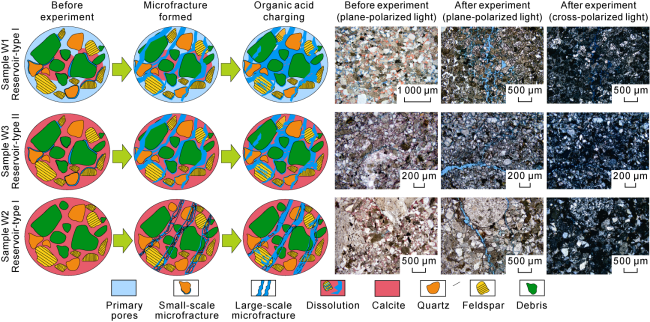


Fig. 10. Reformation models of microfractures to different types of clastic reservoirs of Qingshuihe Formation in the west part of the southern margin of Junggar Basin. |
Sample W2 and Sample W3 represent type-III and type-II reservoirs with strong cementation before entering rapid burial stage (Fig. 7 c-7f). Strong calcareous cementation increases the brittleness of these reservoirs and makes it easier to develop microfractures in the reservoirs. During the rapid burial stage under very fast burial rates, large-scale microfractures and associated microfractures would cut and break the cements and clastic particles on their way (Fig. 8 d, 8f), and organic acid after injected would dissolve the cements and clastic particles along the large-scale microfractures (Fig. 10 ). Therefore, type-II and type-III reservoirs also can become reservoirs with relatively good quality under the reformation of late stage microfractures. Hence, the significance of late large-stage microfractures for type-II and type-III reservoirs is to make them have the capacity to store oil and gas.
For Sample W2 with no small-scale microfractures initially, acid fluid was difficult to spread around, resulting in dissolution only inside large-scale microfractures (Fig. 8 d). Therefore, the Sample W2 had the lowest total ion precipitated among the 3 samples (Fig. 9 b), and smaller dissolution area than Sample W3 (Fig. 8 d, 8f and Fig. 10 ), and increment of reservoir porosity of only 5% (Table 3 ). The Sample W3 also had strong calcareous cementation but some small-microfractures initially different from Sample W2. In this sample, late large-scale microfractures and associated microfractures were connected with early small-scale microfractures to form a microfracture network; the organic acid easily diffused around along the microfracture network. Consequently, this sample has total ion precipitated (Fig. 9 c) and dissolution area larger than Sample W2 (Fig. 8 d, 8f and Fig. 10 ), as well as more significant improvement in quality than Sample W2, with a porosity increment of 10% (Table 3 ). From the experimental results of Sample W2 and Sample W3, it can be seen that the presence of early small-scale microfractures controls the dissolution intensity of the type-II and type-III tightly cemented reservoirs. If the reservoir has early small-microfractures developed (Sample W3), the large-scale microfractures formed in the late rapid burial stage can make the permeability of the tightly cemented reservoir increase by more than 40%. Meanwhile, together with late organic acid charging, make porosity of the reservoir increase by 10% (Table 3 ). If the reservoir has no early small-microfractures developed (Sample W2), the late large-scale microfractures have a limited improvement on the tightly cemented reservoir, and the dissolution intensity of organic acids would be limited too.
5. Implications for deep oil and gas exploration
The results of the physical modeling experiments show that the late rapid burial process is conducive to the formation of large-scale microfractures and secondary microfractures associated with them which can improve the seepage capacity of deep and ultra-deep reservoirs. Therefore, it is necessary to accurately reconstruct the burial history of the work area in the oil-gas exploration process, to find out whether similar burial history exist in the work area (Fig. 6 ), especially in the foreland basins. Meanwhile, the improvement of ultra-deep reservoir properties caused by microfractures formed in rapid burial process often depends on the reservoir’s quality before the rapid burial stage. The sedimentary facies have a significant control effect on reservoir quality, and in turn the subsequent diagenetic evolution process [35-36]. Therefore, on the premise of confirming the existence of rapid burial process, delineating the distribution of favorable sedimentary facies is the key for searching the potential high-quality sweet spots.
Based on results of this study, we have come up with a new idea of oil and gas exploration for ultra-deep strata at the southern margin of Junggar Basin, namely selecting favorable areas based on burial history and selecting zones based on sedimentary environment. First, burial history reconstruction is the key for revealing the formation of ultra-deep high-quality reservoirs. Secondly, reservoir characteristics, and type and distribution of favorable sedimentary facies can be figured out by analyzing the data of well logging and seismic. Why should the study of sedimentary facies be done after the burial history? Because although the favorable sedimentary facies can provide more primary pores, if there was no favorable burial history, the diagenetic system would only become more and more close, and the seepage capacity of the diagenetic fluid would reduce constantly too. Finally, the reservoir would be densified under the influence of compaction and cementation, and unable to form high-quality reservoir.
6. Conclusions
The deep clastic reservoirs of Qingshuihe Formation in Gaoquan area, southern margin of Junggar Basin have microfractures of two scales, and three types of pore-fracture combinations, intergranular pore-microfracture (type-I), secondary dissolution pore-microfracture (type-II) and microfracture (type-III). The large-scale microfractures were mostly created in the late rapid burial stage, and soon after their formation, organic acids charged into the reservoirs.
The results of the diagenetic physical modeling experiments show that the early diagenetic intensity and pore-fracture combination of the clastic reservoir determine the improvement degree of large-scale microfractures to the reservoir quality during the late rapid burial process. If the clastic reservoir had intergranular pores and small-scale microfractures developed before the rapid burial stage, and large-scale microfractures generated in the rapid burial process would effectively connect the early small-scale microfractures and significantly improve the physical properties of the reservoir with the scale charging of organic acid in the late stage. If the reservoir had strongly cemented before rapid burial stage, the development of early microfractures determines the improvement degree of the large-scale microfractures to the reservoir quality during the rapid burial process. If the reservoirs had small-scale microfractures developed before the rapid burial stage, the large-scale microfractures and organic acid dissolution would improve the reservoir quality significantly during the rapid burial stage. If otherwise, late large-scale microfractures and organic acids would have limited improvement to the reservoir quality.
Nomenclature
T—precipitation temperature of carbonate cement, °C;
δ18O—oxygen-18 isotope value of carbonate cement, ‰;
δw—oxygen-18 isotope value of pore water, ‰.