

Introduction
In the current field of oil and gas exploration, marine carbonate reservoirs play an extremely important role in both reserves and production increase [1⇓⇓-4]. The Permian Changxing Formation reef shoal in the Sichuan Basin has been one of the hotspots of oil and gas exploration for marine carbonate reservoirs due to its wide sedimentary range, large thickness and multiple stages of deposition[5⇓-7]. After years of research and practice, predecessors have made great achievements in the platform edge zone of the Kaijiang-Liangping trough, and have successively discovered many large- and medium-sized gas reservoirs such as Dukouhe, Luojiazhai, Puguang and Tieshan [8⇓-10], with the cumulative proved reserves of more than 4000×108 m3 [11]. The research on the platform area of the Changxing Formation began in the 1980s. Qiang et al. first discovered platform reefs in the Laolongdong area of Beibei [12]. Subsequently, platform reef gas reservoirs such as Bandong, Shuanglong, Wolonghe and Zhangjiachang in the eastern Sichuan Basin were discovered, and wells such as MX1 and WJ1 in the central Sichuan Basin have been successively put into industrial production. Then the intra-platform reef-shoal reservoir in the Changxing Formation has thus become an important exploration target [13-14]. In recent years, the exploration idea of "shifting from structural low to structural high" has still been used for the reef-shoal gas reservoirs in the platform. Taking the platform area on the southern part of the Kaijiang-Liangping trough as an example, predecessors have predicted the distribution of the intra-platform depression based on the regional structural analysis [15], and discussed its control on the paleogeomorphology [16], reservoirs [17], and oil and gas accumulation [18]. Compared with the narrow, long and stable platform margin zone, the plane distribution of the reef-shoals is unstable although the area within the platform is vast, showing complex stacking law vertically. Besides, the reservoirs demonstrate strong heterogeneity longitudinally and horizontally, resulting in many difficulties in the prediction of the distribution of gas reservoirs within the platform [19-20]. At present, there have been relatively few studies on the spatiotemporal distribution characteristics of bioclastic shoals in the platform of the Changxing Formation in the central Sichuan Basin. However, it is the main factor which determines the distribution of reservoirs in the region and controls the formation of natural gas reservoirs. Using core, logging, seismic and regional background data, and on the basis of third-order sequence boundary identification, this paper establishes an isochronous well-seismic sequence correlation framework, defines the typical sedimentary architecture of the intra-platform shoal under the constraint of the sequence framework, analyzes the vertical and horizontal development and distribution of the intra-platform shoal, and establishes the sedimentary evolution model of the shoal. It is expected that these works are useful to improve the efficiency of natural gas exploration in the Changxing Formation, promote the process of regional exploration and development in the central Sichuan Basin, and provide a reference for natural gas exploration in the intra-platform area of Sichuan Basin in the future.
1. Regional geological background
Structurally, the study area is located in a gentle slope zone of the central Sichuan palaeo-uplift, and geographically, it is located in the south of Nanchong City, the north of Dazu County and Anyue County, reaching Hechuan District of Chongqing City in the east and Lezhi County in the west (Fig. 1 ). The study area is fully covered by 3D seismic data, with an area of about 6500 km2. Many wells have been drilled in this area, and there are more than 140 exploration wells with complete data, laying a solid foundation for detailed and comprehensive seismic and geological interpretation.
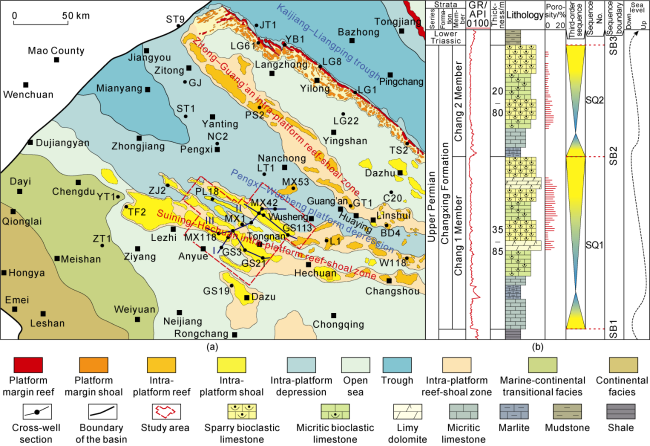
Fig. 1. Comprehensive stratigraphic column and sedimentary pattern of the Late Permian in the study area and its periphery [17]. |
From the Paleozoic to the Early Triassic, Sichuan Basin was dominated by marine carbonate deposits. After the Middle and Late Triassic, the Indosinian Movement led to the regional uplift of the basin, and clastic rocks began to widely deposit [17,21⇓ -23]. During the Middle Devonian to the Early Triassic, the tensile fracture movement occurred in the western margin of the Upper Yangtze block, which was named the "Emei taphrogeny" by Luo Zhili [24]. In the Late Permian, the Emei taphrogeny reached its climax, and the mantle plume rapidly uplifted, and the paleo- continent rising in its axis dropped and tilted to the northeast, impacting on the adjacent crust. At the same time, the expansion of the limited southern Qinling ocean basin towards the continental margin and basement fault striking NW-SE in the middle and upper Yangtze continent resulted in an overall tensile stress background in the northern margin of the upper Yangtze block [25⇓⇓⇓-29]. Under the action of tensile stress, the Late Permian in the Sichuan Basin presented a geomorphic differentiation pattern of "three uplifts and three depressions". The "three depressions" refer to the western Hubei-Chengkou trough, the Kaijiang-Liangping trough and the Pengxi- Wushengtai platform depression in sequence from northeast to southwest. Liu Shugen and Wang Yigang et al. conducted a systematic study of several large subsidence units in the Early Paleozoic and Late Paleozoic zones and described them as intracratonic depressions. The concept of "tension trough" was proposed[25]. The Pengxi-Wusheng platform depression was formed in the middle-late stage of the deposition of the Changxing Formation and died in the early stage of the deposition of the Feixianguan Formation. The strike of the Pengxi- Wusheng platform depression is basically consistent with the northern Kaijiang-Liangping trough, generally in NW-SE direction. On the two sides of the platform depression, there are respectively Suining-Hechuan intra-platform reef-shoal belt and Zitong-Guang'an intra-platform reef-shoal belt (Fig. 1 ). The Central Sichuan area is located in the main area of the reef and shoal zone in the Suining-Hechuan. The Changxing Formation in this area is 55-140 m thick, and is divided into the first member and the second member upwardly. Lithologically, the Changxing Formation is mainly composed of sparry bioclastic limestone, micritic bioclastic limestone, micritic limestone and marlstone, and calcareous dolomites locally (Fig. 1 ).
2. Sequence stratigraphic division and correlation
According to the background of sea level change and previous research results, the Changxing Formation of the Upper Permian in the Sichuan Basin can be divided into two intact third-order sequences (SQ1 and SQ2), which are composed of transgressive systems tracts (TSTs) and highstand systems tracts (HSTs) [14,19]. The division of the Changxing Formation is mainly based on the principle of sequence division. The dichotomy method is mainly used in the Central Sichuan Basin, that is, the first and second members of the Changxing Formation correspond to SQ1 and SQ2 respectively (Fig. 1 ). At present, the division scheme of the top and bottom sequence boundaries of the Changxing Formation is relatively unified. However, limited by core data and affected by the shape of logging curves, there is no final conclusion for the internal third-order sequence boundaries. Based on the systematic analysis of cores, thin sections, logging and seismic data, and combining the characteristics of electrical property, lithology, reservoir and spectral trend, this paper carries out sequence boundary identification and isochronous sequence stratigraphic correlation of the Changxing Formation in the Central Sichuan Basin.
The spectrum trend attribute analysis technology (INPEFA), first proposed by Nin et al. in 2005, is an effective method to identify geological sequences of different levels using logging curves [30]. This method makes a series of special changes to the logging curve, and finally generates an INPEFA curve that can directly reflect the information of sea level estuary fluctuation [31]. The INPEFA curve greatly eliminates the impact of different levels of cyclic stacking and complex geological processes, and reduces the uncertainty of manual sequence division [32].
2.1. Sequence boundaries
Three key sequence boundaries can be identified in the Changxing Formation of the Central Sichuan Basin, which are SB1 (the bottom boundary of the Changxing Formation), SB2 (the boundary between Chang 1 Member and Chang 2 Member) and SB3 (the top boundary of the Changxing Formation). The main types of interfaces are locally exposed unconformity interface and lithofacies conversion interface [33-34].
SB1 is the interface between the black-gray shale of the Upper Permian Longtan Formation and the micrite limestone of the Changxing Formation, which is the lithofacies conversion interface. With the rapid transgression of the third-order cycle, the continental sedimentary range of the Longtan Formation contracted to the coastline of the Kangdian old land, and marine carbonate rocks began to deposit in the central Sichuan Basin. On the conventional logging curves, the natural gamma (GR) curve changes from serrated high values to box-shaped low values (Fig. 2 ), reflecting the sudden deepening of the water column, the reduction of terrigenous input, and the acceleration of carbonate deposition rate. Seismically, it is represented by strong trough reflection from high wave impedance to low wave impedance (Fig. 3 ).
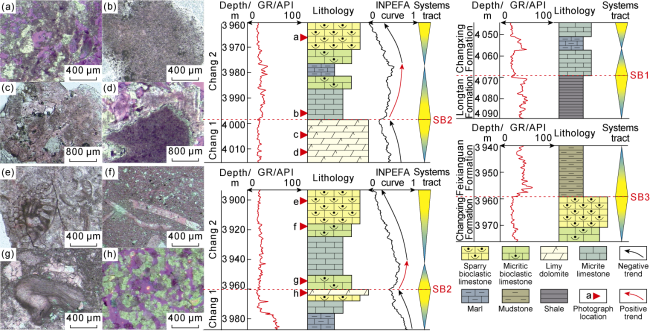
Fig. 2. Lithology, electrical property and spectrum trend of the sequence boundary of the Changxing Formation in the Central Sichuan Basin. (a) Sparry bioclastic limestone with dissolution pores, Changxing Formation, Well MX202, 3967 m; (b) Mudstone limestone, Changxing Formation, Well MX202, 3998 m; (c) Limy dolomite, Changxing Formation, Well MX202, 4006 m; (d) Limestone dolomite with intercrystalline pores, Changxing Formation, Well MX202, 4012 m; (e) Sparry bioclastic limestone with foraminiferal fossils, Changxing Formation, Well MX1, 3900 m; (f) Micritic bioclastic limestone with a small amount of bioclastics, Changxing Formation, Well MX1, 3917 m; (g) Micrite bioclastic limestone, Changxing Formation, Well MX, 3953 m; (h) Limestone dolomite with intercrystalline dissolution pores, Changxing Formation, Well MX1, 3962 m. |
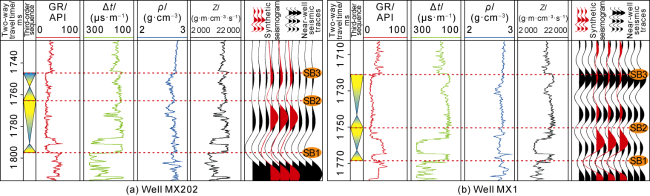
Fig. 3. Seismic response characteristics of sequence boundary in wells MX202 and MX1. |
SB2 is the boundary between the Chang 1 Member bioclastic limestone and the Chang 2 Member micritic limestone. It is a sequence boundary of the internal third-order cycle in the Changxing Formation, and an unconformity interface locally exposed. On the conventional logging curve, GR curve changes from box-shaped low values to serrated medium-high values. The spectrum trend line displays a positive inflection point from negative to positive trend (Fig. 2 ). There are evident changes in the lithology, lithofacies and reservoir characteristics before and after the inflection point. It displays trough reflections on the seismic profile. Due to the small difference between wave impedances of the upper and lower strata, the boundary has weak amplitude (Fig. 3 ).
SB3 is the boundary between the Changxing Formation bioclastic limestone and the Feixianguan Formation mudstone, which is an unconformity locally exposed. The SB3 interface shows the conversion from box-shaped low values to serrated high values on GR logging curve. The spectrum trend line has a positive inflection point from negative trend to positive trend (Fig. 1 ). Seismically, it is represented by strong peak reflections from low wave impedance to high wave impedance on seismic profile (Fig. 3 ).
2.2. Sequence stratigraphic correlation
On the basis of the identification of key sequence boundaries, this paper took the third-order sequence as a unit to establish a representative isochronal well-seismic stratigraphic correlation framework, and carried out comparative analysis of stratigraphic sequence in the Changxing Formation in the Central Sichuan Basin (Fig. 4 ).
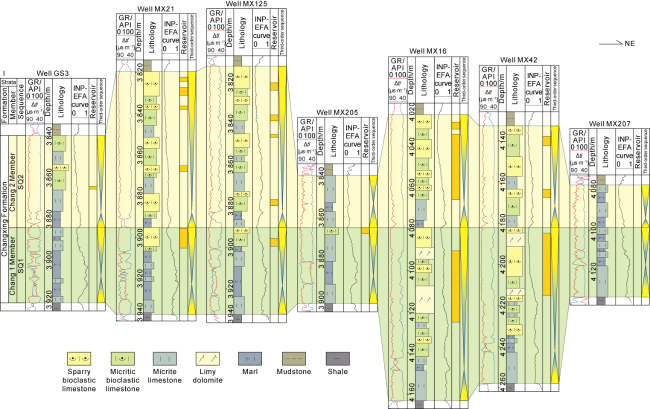
Fig. 4. Cross-well correlation section of Changxing Formation sequences in the Central Sichuan Basin (SB2 is flattened; section location in |
The characteristics of sequence development in the Changxing Formation in Central Sichuan Basin demonstrate evident zonation, which is distinguished by significant differences in sequence thickness, lithology, electrical property and reservoir characteristics. First of all, the Changxing Formation in the study area generally presents a trend of "thin and thick", with the thickest of 140 m and the thinnest of only about 55 m. SQ1 in the north of the study area is relatively thick, 65-80 m, which is a thickened zone. SQ1 in the south is generally thin, only about 40 m. During the depositional period of the SQ2, the thickened zone in the north was continuously developed and the stratum in the south was rapidly deposited, finally forming the thickness differentiation trend of "two thicknesses and three thinnesses". In terms of lithology and electrical property, SQ1 of the thickened zone in the south of the study area is mainly composed of micrite limestone and marl. The GR curve displays serrated medium-high values. However, SQ1 in the northern thickened zone is mainly composed of bioclastic limestone as a whole, and limy dolomite is developed at the top of the highstand systems tract (HST) in some areas. The GR curve is stable and generally less than 20 API. The thickened zones in the north and south of the study area were dominated by bioclastic limestone during the deposition period of the SQ2, and the GR curve is stable and with low values gradually decreasing upwardly. In terms of reservoir, stable and thick reservoirs are developed in the middle and upper parts of the highstand systems tract of the third-order sequence in the northern thickened zone, with a thickness of 40 m. However, thin interbedded reservoirs are mainly developed in the HSTs of the SQ2 in the southern thickened zone, with strong vertical heterogeneity.
In terms of seismic response characteristics, SB3 above the thickened zone displays peak reflections with weak amplitude, and there is a significant waveform difference between the southern thickened zone and the northern thickened zone. The interior of the Changxing Formation in the northern thickened zone is characterized by "one peak and one valley", which is a quasi-continuous sub-parallel reflection structure. That of the Changxing Formation in the southern thickened zone is characterized by "double peaks and double valleys" or complex wave reflections, which is a quasi-continuous parallel reflection structure as a whole. In addition to the thickened zone, the SB3 in other areas shows peak reflections characterized by medium-strong amplitude, and the interior is a continuous parallel reflection structure with strong amplitude. In terms of geomorphology, at the end of the deposition of the SQ1, the northern high zone displays evident uplift characteristics, which is a geomorphic highland in the study area. At the end of the deposition of the SQ2, coupled with the rapid uplift in the southern part, a geomorphic differentiation pattern of "two uplifts and three depressions" was finally formed. The characteristics of overlapping can be observed at the edge of the uplift zone (Fig. 5 ).
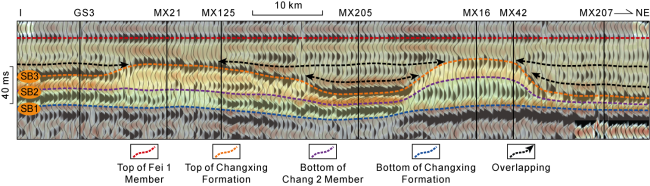
Fig. 5. Seismic correlation section of Changxing Formation sequences in the central Sichuan Basin (the top boundary of Fei 1 Member is flattened). |
2.3. Plane sequence distribution
On the basis of sequence boundary identification, well- seismic combination was used to track and interpret the sequence boundary of 3D seismic data in the whole region, and the time-depth conversion was conducted using logging data to obtain plane distribution map of stratigraphic thickness of the third-order sequence (Fig. 6 ). The stratigraphic thickness of the two third-order sequences of the Changxing Formation in the Central Sichuan Basin generally displays the characteristics of NE-SW zonation and NW-SE differentiation on plane.
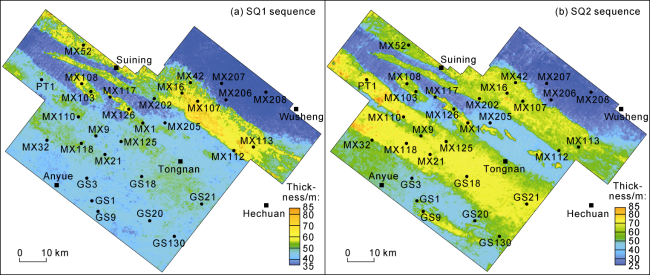
Fig. 6. Stratigraphic thickness distribution of SQ1 and SQ2 of the Changxing Formation in the Central Sichuan Basin. |
The thickness distribution of SQ1 is shown in Fig. 6 a. Except that the thickness in the Pengxi-Wusheng platform depression on the northeast part is less than 35 m, the study area as a whole displays a trend of "thick in north and thin in south". Adjacent to the edge of the platform depression, there is an evident NW-SE zonal thickened area along wells MX113 to MX52. The sequence thickness is generally more than 60 m. The sedimentary thickness of SQ1 in the south of the study area is relatively thin, 35-45 m generally, and there is no evident stratigraphic thickened area. Only some areas display relatively small stratigraphic thickening such as wells MX1, MX118 and MX110, which is the embryonic form of the southern high zone.
The thickness distribution of SQ2 is shown in Fig. 6 b, indicating the thickness differentiation trend of the Changxing Formation was further intensified. The thickness of SQ2 generally presents a zonal distribution with "two thicknesses and three thinnesses" in NW-SE direction. The northern thickened zone (covering wells MX113-MX52) was successively developed, with a thickness of about 55 m. In the area of wells GS21-PT1 in the south, SQ2 was significantly thickened, with a thickness of more than 50 m. It is nearly parallel to the thickened zone at the edge of the platform depression. The thickness of SQ2 in Pengxi-Wushengtai depression is still the thinnest, less than 30 m. The sequence thickness between the two thickened zones and in some areas in the southwest of the study area is relatively small, less than 45 m.
3. Sedimentary facies and sedimentary architecture
3.1. Types and characteristics of sedimentary facies
According to previous studies, the Late Permian-Early Triassic in the Sichuan Basin was a regional gentle slope trending SW-NE [6]. With the continuous rise of sea level, terrigenous clastic deposits shrunk toward the southwest of the basin, and carbonate deposits gradually expanded. The Changxing Formation inherited the geomorphology of the Longtan Formation in the early stage of sedimentation and became a sedimentary system of carbonate slope. By the middle-late deposition stage of the Changxing Formation, the intracratonic rifting was intensified and the geomorphic differentiation pattern of "alternating uplifts and depressions" was formed, making the Sichuan Basin gradually evolve into rimmed carbonate platforms [35]. Based on the comprehensive analysis of petrological characteristics, paleontological characteristics and previous research results, it’s considered that the Changxing Formation in the Central Sichuan Basin was mainly composed of gentle slope facies at the early stage of deposition. The open platform facies was developed at the middle and late deposition stages, which can be further divided into three sedimentary subfacies: intra-platform shoal, inter-shoal sea and intra-platform depression.
The intra-platform shoal is developed in the area with relatively high paleogeomorphology in the open platform, with shallow sedimentary water body and strong energy. The Changxing Formation in the Central Sichuan Basin is mainly composed of bioclastic beach deposits formed by rapid accumulation of biological particles in the process of wave and tide transport on the paleogeomorphic highlands due to mechanical crushing. The rock is mainly bioclastic limestone, which also includes sparry bioclastic limestone and micritic bioclastic limestone (Fig. 7 ).
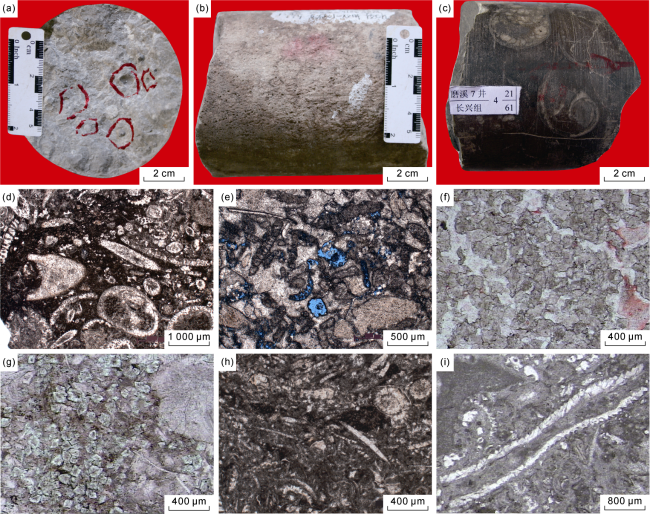
Fig. 7. Macroscopic and microscopic sedimentary characteristics of the Changxing Formation intra-platform shoals in central Sichuan Basin. (a) Sparry bioclastic limestone with brachiopod fossils, Changxing Formation, Well GS001-X21, 3713.47 m, core sample; (b) Sparry bioclastic limestone with acicular dissolution pores, Changxing Formation, Well GS001-X21, 3728.22 m, core sample; (c) Micritic bioclastic limestone with gastropod biofossils, Changxing Formation, Well MX7, 3652.48-3652.65 m, core sample; (d) Sparry bioclastic limestone, Changxing Formation, Well GS001-X21, 3765.60 m, plane-polarized light; (e) Sparry bioclastic limestone with moldic pores and intragranular dissolution pores, Changxing Formation, Well GS001-X21, 3729.71 m, blue cast thin section, plane-polarized light; (f) Limy dolomite with intergranular dissolution pores, Changxing Formation, Well MX1, 3962.00 m, plane-polarized light; (g) Limy dolomite with hypidiomorphic powder crystal structure, Changxing Formation, Well MX3, 3787.26 m, plane-polarized light; (h) Micritic bioclastic limestone, Changxing Formation, Well GS001-X21, 3741.69 m, plane-polarized light; (i) Micritic bioclastic limestone, Changxing Formation, Well MX3, 3784.45 m, plane-polarized light. |
The intra-shoal sea is a relatively deep area between the intra-platform shoals in the open platform. The sediments are mainly dark micrite limestone, frequently with the development of horizontal beddings. In the process of relative sea level fluctuation, the sedimentary interface in some regions fluctuated frequently near the wave base surface, resulting in the inter-shoal sea and the intra-platform shoal often overlapping vertically in the form of alternate interbeds.
The intra-platform depression is mainly developed with dark marl and micrite limestone. The Pengxi- Wusheng platform depression is located in the northeast of the study area and is the product of Late Permian cratonic rifting extending toward the platform. Similar to the Kaijiang-Liangping trough, the Pengxi-Wusheng platform depression was in a hungry sedimentary environment, with the Changxing Formation of only 55 m. However, the thickness of the reef and shoal zones on both sides of the platform is only about 110 m. The significant thickness difference is an important basis for the identification of the platform depression.
3.2. Sedimentary architecture of intra-platform shoal
On the basis of above sedimentary facies identification and the analysis of single well sedimentary facies, combined with various available data, the sedimentary architecture of the intra-platform shoal is discussed from the perspective of the characteristics of individual bioclastic shoals and the vertical stacking style of multiple shoals.
3.2.1. Sedimentary architecture of single shoal
A well-developed single intra-platform bioclastic shoal is generally in the form of flat mound. From the inside to the outside of the shoal, three units can be identified including shoal core, shoal edge and inter-shoal sea (or platform depression) (Fig. 8 ). The shoal core is located in the middle of the shoal body, which is the main component of the shoal body. It is the sedimentary product of the prosperous development stage of shoal-building organisms. It is mostly sparry bioclastic limestone with a grain-supported structure, characterized by gray to gray-white color and high particle content (more than 60%). It is often dominated by large foraminifera and brachiopods (Fig. 7 a, 7d, 7e). The shoal edge is located in the transitional zone between the shoal body and the outer inter-shoal sea or platform depression. It is characterized by finger-like interpenetration or interaction between grainstone shoal facies and micritic limestone of inter-shoal sea facies. The grainstone is mainly dark gray micritic bioclastic limestone, with a relatively low content of bioclastic particles which are mainly gastropods, algal debris and crusts (Fig. 7 c, 7h, 7i). Affected by high-frequency sea level fluctuation and local environmental changes, the top of the shoal body is often dolomitized, which results in the formation of limy dolomite. The dolomite grains are in semi-idiomorphic powder crystal structure under the microscopic observation (Fig. 7 f, 7g). Sometimes, affected by quasi-synchronous karstification, dissolution pores, such as moldic pores, intragranular dissolution pores or intergranular dissolution pores may appear (Fig. 7 b, 7e, 7f), which are constructive for the formation and reconstruction of reservoir space for oil and gas. Based on the description of the compositional units and characteristics of the single shoal body, this paper selects a single shoal sedimentary cycle for research. Through the interpretation of logging data and the analysis of seismic data, it is recognized that the sedimentary thickness of the single bioclastic shoal body in the Changxing Formation platform in central Sichuan is about 10 m. The extension length parallel to the distribution direction of the facies belt is about 8 km, and the width perpendicular to the distribution direction of the facies belt is about 2 km.
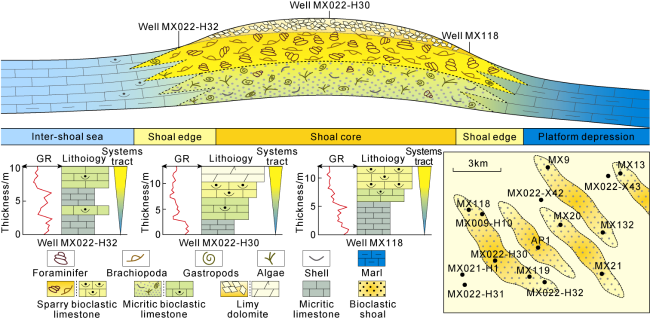
Fig. 8. Cross section of sedimentary architecture of the intra-platform bioclastic shoal and plane distribution of single shoal body. |
3.2.2. Stacking style of multiple shoal bodies
Under the same sea level fluctuation and cycle background, the paleogeomorphology in the deposition period determines the regional hydrodynamic strength and the change trend of water energy in the process of sea level fluctuation, which is the main factor controlling the vertical stacking style of the shoal bodies in the platform. Under the constraints of the sequence stratigraphic framework, the authors identified two different vertical stacking styles of the intra-platform shoal in the Changxing Formation of the Central Sichuan area through the systematic analysis of the sedimentary facies at multiple sites and multiple wells (Fig. 9 ).
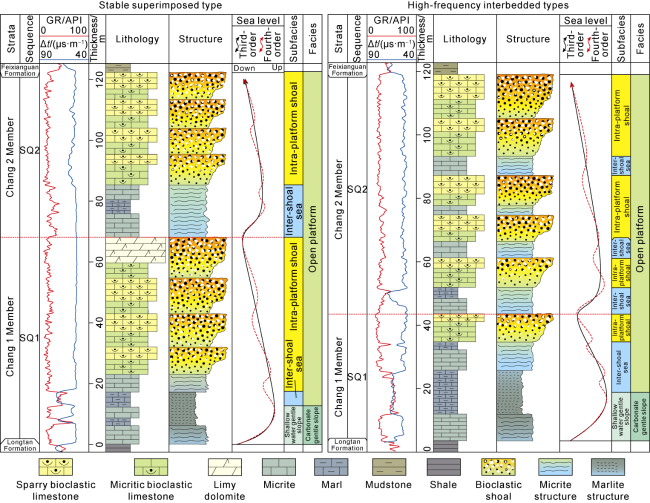
Fig. 9. Vertical stacking style of intra-platform shoals in the Changxing Formation of Central Sichuan Basin. |
(1) Stable superimposed type: In the stable superimposed sedimentary sequence, the intra-platform shoal is mainly developed in the HSTs of two third-order sequences. The TST of SQ1 is gentle carbonate slope deposits, and the HST is dominated by intra-platform shoal deposits with a thick set of bioclastic limestone of 50-60 m. At this time, the high-frequency secondary cycles controlled the vertical stacking of multiple single shoal bodies, displaying evident multi-period upwardly-coarsening rhythmic characteristics. There was no low-energy sediment interval in the process of shoal body accumulation. In the TST of SQ2, inter-shoal sea subfacies was developed as a result of water body deepening and energy weakening, about 10 m in thickness. With the increase of water energy, the HST of SQ2 began to evolve into intra-platform shoal deposits again, and copied the stacking mode of SQ1 HST shoal bodies, with a cumulative thickness of about 40 m. The sedimentary sequence was developed in the geomorphic highland during deposition period, and the sedimentary interface was located above the wave base for a long time, which generally reflects a continuous shoal building process under a stable shallow water and high energy environment. Due to the fact that the sea level had been at a low level for a long time, the third-order cycle HST was easy to be exposed, and the shoal bodies were transformed by strong diagenesis to form stable and thick reservoirs.
(2) High frequency interbedded type. In the high-frequency interbedded sedimentary sequence, the intra- platform shoals were mainly developed in the HST of SQ2. During the deposition period of SQ1, the water body was relatively deep, and the gentle slope and inter-shoal sea subfacies were developed, and the intra-platform shoals were only developed at the end of the HST. During the HST of SQ2, the relative sea level has declined generally, and the water body energy has gradually increased. Under the action of high-frequency secondary cycles, a high-frequency interbedded sedimentary sequence of intra-platform shoal and inter-shoal sea was formed. The intra-platform shoal was developed in the middle-upper part of the cycle, and the lower part of the cycle developed the low-energy inter-shoal sea subfacies. The sedimentary sequence was developed in the secondary geomorphic highland in the depositional period, and the sedimentary interface was located near the wave base surface, which generally reflects an episodic shoal forming process of the oscillatory water environment under the background of early low energy to late high energy. As the sea level presented multi-level periodic changes, the high-frequency oscillatory water body caused the sedimentary interface to be intermittently exposed above the sea level and thin reservoirs were formed under the exposed surface due to the leaching of meteoric fresh water.
In the stable superimposed sedimentary sequence, the intra-platform shoal was continuously deposited vertically, with small difference in the wave impedance. Therefore, the internal strata of the Changxing Formation were characterized by "one peak and one valley", which shows quasi-continuous and sub-parallel reflections with weak amplitude. However, in the high-frequency interbedded sedimentary sequence, the intra-platform shoal and inter-shoal sea subfacies were superimposed with each other, and the wave impedance of the strata was quite different. Therefore, the interior of the Changxing Formation is characterized by "double peaks and double valleys", showing quasi-continuous and parallel reflections with medium-weak amplitude (Fig. 5 ).
4. Development and distribution law of intra-platform shoals in sequence stratigraphic framework
On the basis of above sequence stratigraphic correlation and facies sequence identification, through well-seismic section correlation and fine interpretation of seismic sequence interfaces, combined with single-well data analysis, core observation and seismic attribute analysis, the vertical and horizontal development and distribution laws of the intra-platform shoals in sequence stratigraphic framework of the Changxing Formation in the Central Sichuan Basin were studied and the sedimentary evolution model of the intra-platform shoals was established.
4.1. Vertical distribution of intra-platform shoals within the sequence stratigraphic framework
Through comparative analysis of typical well-seismic profiles (Figs. 10 and 11 ), it is found that the Changxing Formation in Central Sichuan Basin develops gentle slope facies and open platform facies upwardly. According to the relative positions of the development of the shoal belt, it can be roughly divided into the shoal belt at the edge of the platform depression and the shoal belt at the southern part of the platform depression.
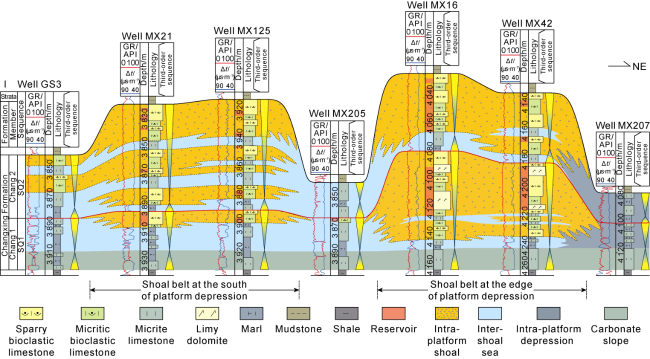
Fig. 10. Cross-well sedimentary facies section of the Changxing Formation in the Central Sichuan Basin (SB1 is flattened; see section location in |
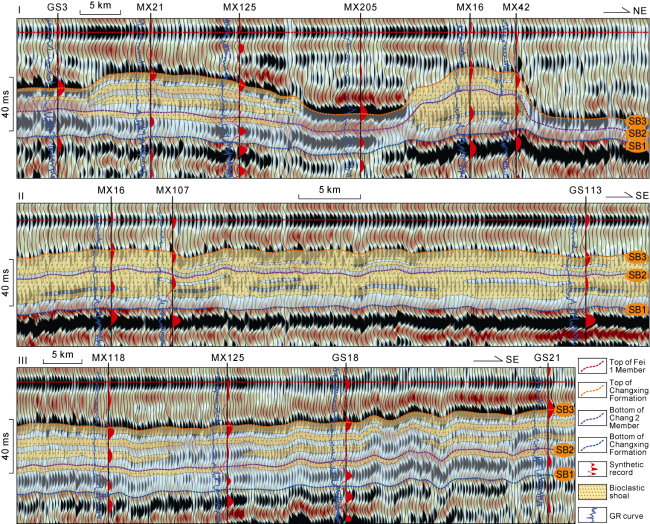
Fig. 11. Seismic profile interpretation of 3 survey lines in Central Sichuan Basin (see section location in |
Due to the relatively high original sedimentary landform, the shoal belt at the edge of platform depression was mainly developed with stable superimposed sedimentary sequences. Vertically, it is composed of two stages of shoal formation which is mainly composed of sparry bioclastic limestone and limy dolomite. The shoal body in a single stage is stable in scale, with thick vertical superimposition and good horizontal continuity. It gradually pinches out on both sides and transits to the inter-shoal sea (platform depression) subfacies.
Due to the low original sedimentary landform, the shoal belt on the southern part of platform depression mainly shows the development of high-frequency interbedded sedimentary sequence, which is composed of four shoal-forming stages vertically. The lithology is mainly micritic bioclastic limestone, and the top of the cycle was developed with sparry bioclastic limestone. The thickness of the shoal body in a single stage is relatively thin, showing rapid changes longitudinally. The plane continuity of the shoal body was poor at the initial stage of sedimentation, and at the late deposition stage of SQ2 HST, the shoal belt gradually extended to the south and tended to be continuous under the continuous decline of relative sea level.
4.2. Plane distribution characteristics of intra-platform shoals within the sequence stratigraphic framework
The reef shoal is a thick and massive geological body with a hummocky uplift shape, which is rapidly accumulated on the micro-paleogeomorphic highland, showing no bedding inside. The reef shoal body is mainly composed of granular limestone and biological framework limestone, which is easily transformed by constructive diagenesis to form high-quality reservoir with good permeability. Therefore, the geological body is generally different from the surrounding strata in geophysical response characteristics. According to the abovementioned characteristics, this paper extracts the attributes of coherence and root mean square amplitude of the top interface of the Changxing Formation (Fig. 12 ).
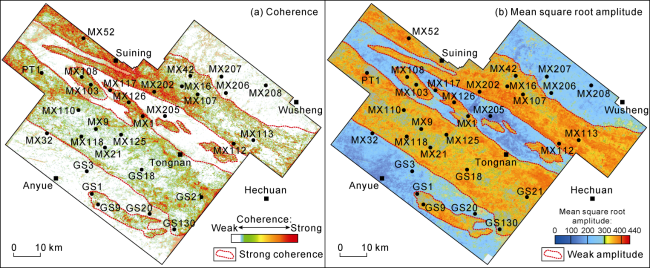
Fig. 12. Plane distribution of seismic attributes of the top of the Changxing Formation in Central Sichuan Basin. |
The plane variation trend of the coherence and root mean square amplitude of the top interface of the Changxing Formation in the Central Sichuan Basin is basically the same. The areas with strong coherence and weak amplitude are distributed as belts, which are highly consistent with the distribution of stratigraphic thickness. The shoal belt at the edge of the platform depression is characterized by strong coherence attribute, weak amplitude, clear shoal boundary and evident change of attribute. It is revealed that the shoal zone mainly develops high frequency interbedded sedimentary sequence. The Changxing Formation is characterized by good physical property on the whole, unstable internal reflection interface, and poor stratification. The shoal belt on the southern part of the platform depression is similar to the shoal belt on the edge of the platform depression, and also shows the characteristics of "weak amplitude in the interior and strong coherence in the boundary". However, towards the core of the shoal belt on the southern part of the platform depression, the characteristic of strong coherence was weakened, indicating the dominance of high-frequency interbedded sedimentary sequence in the shoal belt. The Changxing Formation is stable in the internal reflection interface and has high quality sedimentary bedding.
According to previous research results and new 3D seismic data, the intra-platform shoals in the Central Sichuan Basin were mainly developed in the transitional zone or intra-platform slope break zone between the open platform and the intra-platform depression of the Changxing Formation (Fig. 1 ). The shoals can form both continuous intra-platform shoal belts and scattered point shoals on plane. According to the sequence plane distribution characteristics and sedimentary facies analysis results of the Changxing Formation in the study area, and the comprehensive analysis of seismic attributes, the plane distribution law of sedimentary microfacies of each sequence was further studied (Fig. 1 3).
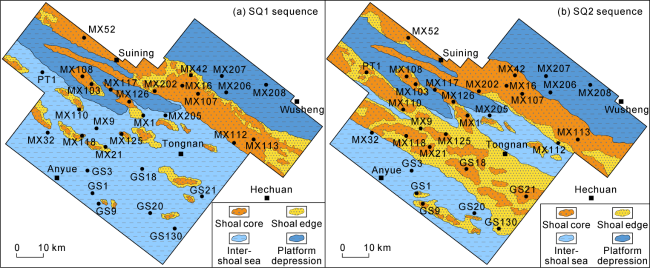
Fig. 13. Plane distribution of sedimentary facies of SQ1 and SQ2 of the Changxing Formation in the Central Sichuan Basin. |
During the deposition period of SQ1, the intra-platform shoals were mainly developed in the area around wells MX113-MX52. The shoal zone extended from the northern part of Hechuan area to Suining area in the direction of NW-SE, which was basically consistent with the extension of the facies zone controlled by the overall structural pattern of the basin. At this time, Tongnan and Anyue areas on the southern part of the study area were basically low-energy inter-shoal sea subfacies, which were limited by hydrodynamic conditions. The Wusheng- Pengxi area in the north and some areas in the south of Suining were affected by the Late Permian rifting, with the development of intra-platform depression subfacies (Fig. 13 a).
During the deposition period of SQ2, under the joint action of sea level fluctuation and palaeogeomorphology, the intra-platform shoals migrated to the southern part of the platform depression while keeping successive superimposition, resulting in more significant sedimentary differentiation in the Central Sichuan Basin. Wells MX113-MX52 in the north of the study area inherited the paleogeography at the end of SQ1 deposition, characterized by strong water energy, continuous accumulation of shoal bodies, and dominant shore core microfacies. With the overall decline of relative sea level, intra-platform shoals were widely deposited along wells GS21 to PT1. However, compared with the edge of the platform depression in the south of the study area, it was relatively low during the deposition period geomorphologically. Therefore, the shoal core microfacies was developed in a small scale, and dominated by shoal edge microfacies (Fig. 13 b).
4.3. Sedimentary evolution process of intra-platform shoals
The sedimentary evolution of the intra-platform shoals in the Changxing Formation is divided into two stages, namely, early shoal-forming period on the platform depression margin and late shoal-forming period within the platform depression (Fig. 14 ). In TST of SQ1, micrite limestone and marl were widely deposited in the study area, and developed into a gentle carbonate slope. In the middle to late stage of SQ1 deposition, intracratonic rifting gradually extended to the platform, resulting in the initial Pengxi-Wusheng platform depression. With the continuous decline of sea level, the northern high zone located at the edge of the platform depression took the lead in receiving intra-platform shoal sediments near the wave base due to the high original terrains, resulting in the early shoal zone at the edge of the platform depression. The geomorphy in the south of the study area was low, and the hydrodynamic conditions were not enough to meet the extensive deposition of bioclastic particles. Therefore, it is mainly inter-shoal sea subfacies, and only local microgeomorphic highlands have thin intra-platform shoals developed at the end of the HST.
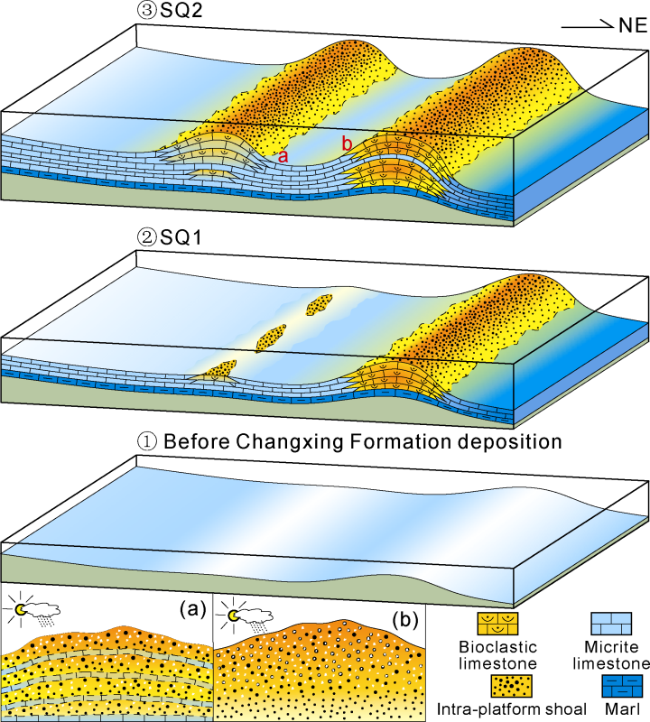


Fig. 14. Sequence deposition process and development model of intra-platform shoals of the Changxing Formation in Central Sichuan Basin. |
In the early stage of SQ2 deposition, due to the rise of sea level, the inter-shoal sea subfacies was developed at the bottom of the Chang 2 Member. In the HST of SQ2, most areas had evolved into a high-energy shallow water environment and entered the stage of platform shoaling except for the Pengxi-Wusheng platform depression and local geomorphic depressions. The high zone at the edge of the platform depression inherited the paleogeography of SQ1, and entered the second shoal-forming period on the basis of the early shoal zone. However, due to the limitation of carbonate accommodation, the deposition rate of shoal did not increase. At that time, the hydrodynamic conditions of the micro-paleogeomorphic highlands on the southern part of the study area were enhanced. The accommodation was sufficient, which created a good condition for rapid accumulation of bioclastic particles. Under the control of multi-level sea level fluctuation cycles, the multi-stage shoal bodies were vertically superimposed and stacked along the directional micro-paleogeomorphic highlands, forming shoal belts on the southern part of the platform depression.
From the perspective of reservoir formation, the southern part of the study area was in a low energy environment in the early stage, and changed into a frequently oscillatory water environment in the middle to late stage. The water energy changed rapidly, the exposed time per stage was short, and the diagenetic transformation was weak, so that thin interbedded reservoirs were developed (Fig. 14 a). The shoal belts of platform depression on the northern part of the study area had been in a stable shallow water environment for a long time. The two stages of shoal bodies underwent relatively strong diagenetic transformation, therefore it was thick for a single set of reservoir (Fig. 14 b).
5. Conclusions
Two intact third-order sequences were developed in the Changxing Formation in the Central Sichuan Basin, whose boundary is characterized by good isochronism and traceable correlation. The sequence thickness of the Changxing Formation in the study area is evidently different. The SQ1 is thick in the north and thin in the south generally and shows a thickness zoning trend of "two thicknesses and three thinnesses". The Changxing Formation in the Central Sichuan Basin is mainly composed of intra-platform shoal, inter-shoal sea and intra-platform depression subfacies. A single intra-platform shoal generally has three units, namely, shoal core, shoal edge and inter-shoal sea (platform depression) from the inside to the outside. The shoal body displays two typical sedimentary sequences, namely, stable superimposed and high-frequency interbedded types vertically. The stable superimposition sedimentary sequence was developed in the shoal belt on the margin of the platform depression, which is composed of two shoal-forming periods, and developed in highstand systems tracts of SQ1 and SQ2, respectively. The shoal belt in the southern part of the platform depression was developed with high-frequency interbedded sedimentary sequence, which is composed of four shoal-forming periods in the highstand systems tract of the SQ2 sequence. During the deposition period of SQ1, the intra-platform shoals were mainly developed on the platform depression edge in the northern part of the study area, and the inter-shoal sea was mainly developed in the southern part. During the deposition period of SQ2, the relative sea level declined, and intra-platform shoals were widely deposited, forming two intra-platform shoal belts which are nearly parallel.
Nomenclature
GR—natural gamma, API;
Z—wave impedance, g•m/(cm3•s);
ρ—density, g/cm3;
Δt—interval transit time, μs/m.