

Introduction
The Anyue Gas Field, located in the Gaoshiti and Moxi areas of the central Sichuan Basin, is the first giant natural gas field in China with proved gas reserves of more than 1 trillion cubic meters (11 709×108 m3) and annual production of more than 10 billion cubic meters in Cambrian and Sinian carbonate rocks [1]. Multiple layers of high-quality source rocks, reservoirs and cap rocks are developed in this field, presenting a hydrocarbon accumulation pattern of multiple gas layers alternately superimposing in three dimensional space [2⇓⇓⇓⇓⇓-8]. The supe-rior petroleum geological conditions are attributed to the following two factors: (1) tectono-sedimentary differentiation of trough and carbonate platform during the Sinian and Cambrian, which is distributed respectively in the east and west part of the gas field; and (2) the Central Sichuan Paleo-Uplift that developed from Cambrian to pre-Permian. Numerous studies have discussed the above two issues from the aspects of tectono-sedimentary evolution process and their impacts on hydrocarbon accumulation [4,7,9⇓⇓⇓⇓⇓⇓ -16].
As researches deepen on the structural deformation and petroleum geology of the Gaoshiti-Moxi area, some problems emerge. It is the Tongnan secondary negative structure, which has attracted little attention but has a profound impact on the natural gas distribution in the area. It differentiated from the hinterland of the Gaoshiti- Moxi Paleo-Uplift from Cambrian to pre-Permian. Then, the negative structure continuously developed during the Mesozoic to Cenozoic [17], and divided the Gaoshiti-Moxi area into independent structural highs in the north and south respectively. Affected by this, the gas and water distribution in the Gaoshiti, Moxi and Tongnan areas is complex, and the differentiated accumulation of oil and gas is also significant. Although previous studies have noticed the negative structure [13], and have qualitatively classified it as “depression” [17], the in-depth research on its deformation characteristics, structural attributes, and evolution process is still inadequate, and its role of hydrocarbon accumulation and adjustment in this area has also mistily understood. This research uses high precision 3D seismic data, and comprehensive qualitative-quantitative structural analysis methods to study the Tongnan negative structure, so as to determine its structural attributes, and clarify its evolution process, then to have an integrated discussion on its significance of oil and gas exploration and development of the area.
Combined with this study and previous understanding on the structural attributes of the Tongnan negative structure [17], it is believed that the Tongnan negative structure experienced multi-phase and multi-regime structural superimposing deformation before and after the formation of the P/AnP (Permian/pre-Permian) unconformity. It is not recommended to purely call it as “depression” or “syncline”. Generally, the “Tongnan negative structure” is applied in this study.
1. Geological setting
The Sichuan Basin is a giant superimposed sedimentary basin with complex geological conditions and huge hydrocarbon resource potential. It experienced multiple tectono-sedimentary cycles and owns superior geological conditions for the reputation of a super basin [1,6,8]. In the geological history, the Sichuan Basin has experienced a series of events, including the formation of the unified basement during Paleoproterozoic to Mesoproterozoic, the intracontinental rift during the early Neoproterozoic, the post-rift depression during the late Neoproterozoic, and the intracratonic depression and the Mianyang- Changning extension trough (also known as the erosional extension trough) rifting event during the late Neoproterozoic to Cambrian [6,18 -19]. Then, from the early Paleozoic to the late Triassic, the basin experienced multiple extension-convergence tectonic cycles, and the tectono- sedimentary environment alternately switched between stable intracratonic depression and paleo-uplift denudation, resulting in massive hiatus of Paleozoic and Mesozoic [10-11,20 -21]. From the late Triassic to present, the orogenic belts on boundaries of the Sichuan Basin pushed and propagated into the basin, overturning the early marine tectono-sedimentary background, and established the basin-mountain tectonic pattern at present [6]. The result is the formation of the five tectonic units: The Western Sichuan Depression Belt, the Micang Mountain-Daba Mountain Fold and Thrust Belt, the Eastern Sichuan High- Steep Fold Belt, the Southern Sichuan Low-Steep Fold Belt, and the Central Sichuan Gentle Fold Belt (Fig. 1a ).
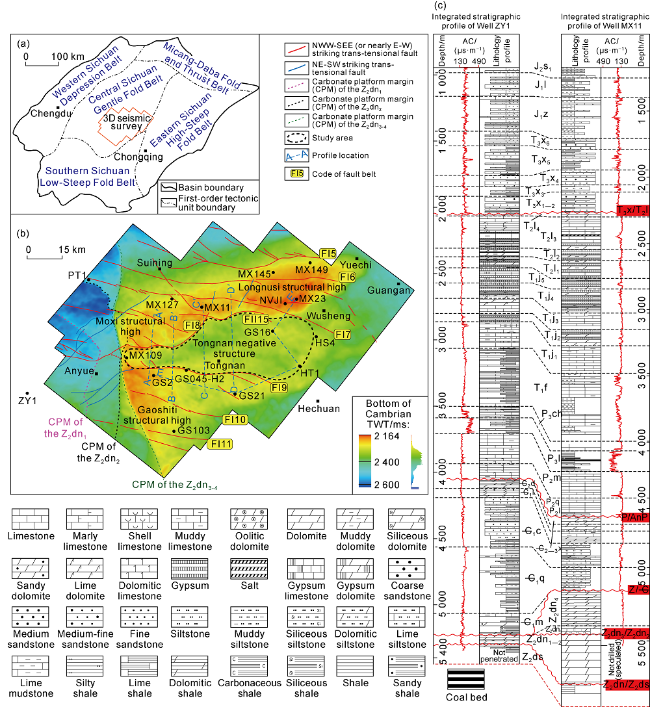
Fig. 1. Tectonic outline map and integrated stratigraphic profile. (a) Tectonic location of the Sichuan Basin and study area; (b) Distribution of the secondary structural units and trans-tensional faults; (c) Integrated stratigraphic profiles of typical wells in the central Sichuan Basin [23]. Z2ds—Doushantuo Formation; Z2dn1-2—1st-2nd members of the Dengying Formation; Z2dn3-4—3rd-4th members of the Dengying Formation; —C1q—Qiongzhusi Formation; —C1c—Canglangpu Formation; —C1l— Longwangmiao Formation; —C2d—Douposi Formation; —C2-3—Middle-Upper Cambrian; P2l—Liangshan Formation; P2q—Qixia Formation; P2m—Maokou Formation; P3l—Longtan Formation; P3ch—Changxing Formation; T1f—Feixianguan Formation (including T1f1, T1f2, T1f3, T1f4, refers to the 1st, 2nd, 3rd, 4th member respectively, the following is as the same); T1j—Jialingjiang Formation (including T1j1, T1j2, T1j3, T1j4, T1j5); T2l—Leikoupo Formation (including T2l1, T2l2, T2l3, T2l4); T3x—Xujiahe Formation (including T3x1, T3x2, T3x3, T3x4, T3x5, T3x6); J1z—Ziliujing Formation; J1l—Lianggaoshan Formation; J2s1—Lower Shaximiao Formation. |
The Tongnan secondary negative structure is located in the central Sichuan Basin (Fig. 1a -1b). Drilling revealed that the Devonian, Carboniferous, Cretaceous and Cenozoic are missed in this area, and the residual strata are Sinian-Silurian and Permian-Jurassic (Fig. 1c ). The Sinian is composed of Doushantuo Formation and Dengying Formation from the bottom to top. Among them, the Dengying Formation is the most important reservoir in this area, which includes four lithologic members. The lower 1st and 2nd members and the upper 4th member are featured by the development of algal mounds and grain beaches in the carbonate platform margin and intra- platform. And the dominant lithologies are algal dolomite, algal psammitic dolomite and stromatolite dolomite, and locally muddy dolomite also developed, which was deposited in deeper water between beaches. The 3rd member of the Dengying Formation in the central section is featured by the development of dark mudstone or dolomitic siltstone, indicating deeper water environment [16]. The Cambrian constitutes the Maidiping Formation, Qiongzhusi Formation, Canglangpu Formation, and Longwangmiao Formation of the Lower Cambrian and the Douposi Formation, Xixiangchi Formation of the Middle-Upper Cambrian from the bottom to top. In the Anyue Rift Trough, the Maidiping Formation and Qiongzhusi Formation are mainly composed of dark shale and thin interlayers of siltstone, which are the most important source rock of Anyue Gas Field [3,8]. Besides, the Canglangpu Formation in the area deposited in tidal-flat facies and with siltstone, medium-fine sandstone and thin interlayers of mudstone developing. And the Longwangmiao Formation and the Middle-Upper Cambrian are composed of carbonate rocks in platform facies. As a result, the Canglangpu Formation, Longwangmiao Formation and the Middle-Upper Cambrian are important reservoirs in this area. As for the Ordovician and Silurian, they are nearly absent in the central Sichuan Basin, which distributes surrounding the core of the Central Sichuan Paleo-Uplift in a “skirt-like” manner. The top denudation surface of the Cambrian-Silurian is directly covered by the Permian, forming a regional truncation unconformity of P/AnP (Fig. 1c ), which is the witness of the Central Sichuan Paleo-Uplift [10,11,13] and the key for the formation of karst and fractured carbonate reservoirs in the Longwangmiao Formation. The Permian and the Middle-Lower Triassic above the unconformity deposited in relatively stable marine facies, and then it had transferred into terrestrial deposition since the late Triassic (Fig. 1c ).
In geological history, the Tongnan negative structure was located in the hinterland of Gaoshiti-Moxi Paleo- uplift before the Permian [13], and in the northern slope of the Luzhou Paleo-uplift during the Indosinian [6,20], and in the northeastern gentle slope area of the Weiyuan anticline during the Yanshan and Himalayan periods. During the whole geological evolution processes, the Gaoshiti- Moxi area was weakly deformed because it was located in a stable intracontinental deformation zone. However, it is just in this region where the Tongnan negative structure differentiated, trans-tensional (strike-slip) fault system developed [22⇓-24] (Fig. 1b ), and multi-phase paleo-uplifts happened [10,11,13,20], leading to the regional superimposing deformation by multi-phase and multi-regime intracontinental structures.
2. Data and methods
Key data used in this study include 3D pre-stack time or depth migration seismic data, and drilling and logging data, among which the 3D seismic data bin is 20 m×20 m. The pre-stack time migration seismic data is mainly applied to trace stratigraphic interfaces and construct 3D surface models (mapping grid is 100 m×100 m). The pre-stack depth migration seismic profiles are mainly used for structural interpretation, balanced profile restoration and area-depth strain (ADS) analysis so as to reveal the structural features of the Tongnan negative structure, and determine its structural attributes and evolution process. Well data is used to present stratigraphic configuration and hydrocarbon production layers, which is the basis for the discussion of hydrocarbon geological conditions.
The ADS method is a quantitative analysis method which is widely used in strain analysis of compressional thrust structures and extensional structures. It can be applied to determine the depth of fault detachment surface, and to explore the strain of pre-growth strata and growth strata, and then to acquire the deformation stage and structural activity rate and their changes [25⇓-27]. The ADS method is also available to study the Tongnan negative structure between Gaoshiti and Moxi areas, but there is a lack of referential ADS analysis model. Through analyzing the deformation characteristics of the Tongnan negative structure, a depression structure model with deformation similarity is created through geometric and kinematic forward simulation based on normal fault propagation related fold algorithm with tri-shear model[28-29].
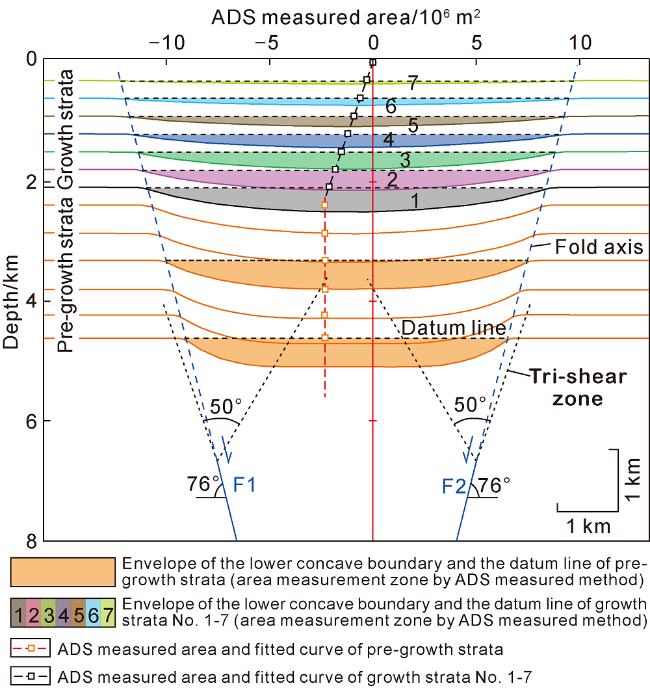
Fig. 2. Area-depth strain (ADS) analysis model for depression structure controlled by tri-shear normal faults. |
3. Deformation and structural attributes of the Tongnan negative structure
3.1. Deformation in surfaces
The Tongnan negative structure is located between the Gaoshiti and Moxi-Longnüsi structural highs. It appears in key surface maps obviously. But there are also deformation differences in the deep and shallow surfaces (Fig. 3 ).
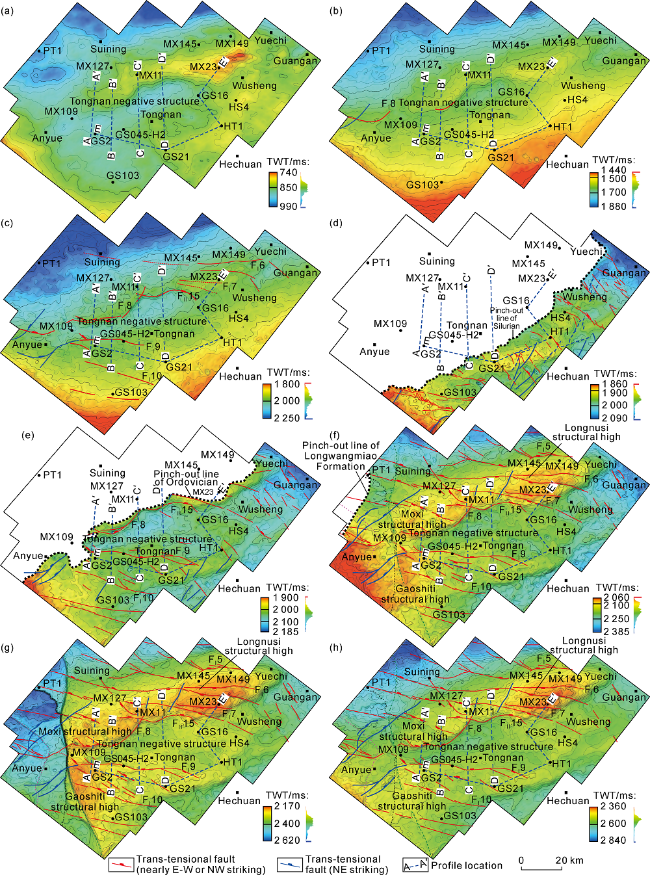
Fig. 3. Time-domain structural maps of typical reflection interfaces in the Gaoshiti and Moxi areas (Location refers to |
On structural maps of the bottom of Sinian Dengying Formation, the bottom of Cambrian and the bottom of Longwangmiao Formation, the Moxi-Longnüsi structural high and the Tongnan negative structure are nearly E-W or NEE-SWW trending, and they are bounded by the arc-shaped FI8 and FII15 trans-tensional fault belts (Fig. 3f-3h ). The Moxi- Longnüsi structural high has a broad flat-roof area, which inclines to the north along wells MX127-MX145-MX149. Toward south of the Moxi-Longnüsi area, crossing the FI8 and FII15 fault belts, the Tongnan negative structure occurs. It is narrower in the west with a north-south width of 8-10 km between wells MX109 and GS045-H2, and wider in the east of well GS045-H2 with north-south width widening from 10 km to 20-30 km. In addition, the eastern boundary of the Tongnan negative structure is roughly composed of local structural highs in wells HS4, HT1 and GS21. Crossing the eastern and southern boundary, the structural elevation deepens gradually, and transforms into slope (Fig. 3f-3h ). More observations on typical structural surface maps reveal the major zone of the Tongnan negative structure is between wells MX109 and GS16, and the structural relief between the northern and southern structural highs and the negative structure is 400-600 m (Fig. 3e-3h ).
Crossing the FI9 fault zone at the south of the Tongnan negative structure, the Gaoshiti structural high appears. It is generally higher in the northwest area and dips to the southeast. At the bottom of the Cambrian, its western boundary is the carbonate platform margin of the 3rd-4th members of the Dengying Formation and the northern boundary is the FI9 fault belt, as a result the Gaoshiti structural high is a triangle belt with a high point at the northwest corner (Fig. 3g ). While at bottoms of the Longwangmiao Formation and Ordovician, the west of the platform margin marks higher elevation (Fig. 3e , 3f ).
In structural maps of middle-shallow interfaces, such as the bottom of Permian, the bottom of the 4th member of Feixianguan Formation, and the bottom of Jurassic Dongyuemiao member, the Moxi-Longnüsi structural high and the Tongnan negative structure are also E-W or NEE-SWW trending (Fig. 3a -3c). The boundary between them is also arc-shaped, the geometry and position of which is consistent with the boundary observed in deep surfaces (Fig. 3e-3h ). Whereas, compared with the Moxi- Longnüsi structural high, the Tongnan negative structure has an elevation relief of only −300 m to −200 m, which is significantly less than that measured from deep surfaces. Besides, comparing with deep interfaces, the flat-roof area of the Moxi-Longnüsi structural high is narrower in shallow surfaces, like the bottom of Permian, the bottom of the 4th member, Feixianguan Formation, and the bottom of Jurassic Dongyuemiao member. And, the Gaoshiti area is no longer a significant structural high (Fig. 3 ).
3.2. Deformation characteristics in profiles
Structural interpretation of four typical seismic profiles across the Tongnan negative structure reveals differential structural deformation between the deep and shallow sections as well as between the east and west parts. In AA' and BB' profiles in the west part, the deformation characteristics in the upper and lower strata of the P/AnP unconformity are significantly different. Below the unconformity, the Sinian, Cambrian and residual Ordovician record stronger concave deformation, and the deeper and older strata present a larger depression and stronger deformation. While above the unconformity, the Permian, Triassic and Jurassic present a smaller depression degree and weaker deformation (Fig. 4a , 4b ). In the CC' and DD' profiles, the depression degree in the upper and lower strata of the P/AnP unconformity is similar and folding deformation occurs in all strata (Fig. 4c , 4d ). The above indicates that, comparing with the west of the Tongnan negative structure (represented by the AA' and BB' profiles), the east (represented by the CC' and DD' profiles) experienced stronger concave deformation after Jurassic. And the Tongnan negative structure finally formed after two stages of structural superimposing deformation before and after the formation of the P/AnP unconformity.

Fig. 4. Structural interpretation of typical profiles AA° (a), BB° (b), CC° (c) and DD°(d) in the Gaoshiti and Moxi area. Pt3-1—Neoproterozoic stratum 1; Pt3-2—Neoproterozoic stratum 2; Pt3-3—Neoproterozoic stratum 3. The above three sets of strata are all undetermined formations. Locations refer to |
Then the vertical and horizontal scales of the AA', BB' and CC' profiles are adjusted to 1:1. It could be observed that the Tongnan negative structure below the P/AnP unconformity is characterized by the deformation of normal fault and related tri-shear fold (Fig. 5 ), which is comparable with the forward simulation model in Fig. 2 . Accordingly, before the formation of the P/AnP unconformity, the deformation of the Tongnan negative structure was controlled by the tri-shear propagation folding of deep normal faults, and developed into a weakly deformed extension depression (Fig. 5 ). Subsequently, during the Devonian and Carboniferous periods, the Central Sichuan Paleo-Uplift was at its peak period [6], and the Gaoshiti-Moxi area suffered from strong uplift and denudation, which led to massive missing of Silurian, Ordovician and Cambrian, as well as the localized residue of Ordovician in the Tongnan depression with a dish shape. After the Jurassic, the Tongnan depression was deformed again by the second stage structure, causing syncline deformation in Permian, Triassic and Jurassic, and strata below the P/AnP unconformity again experienced strengthened concave deformation.
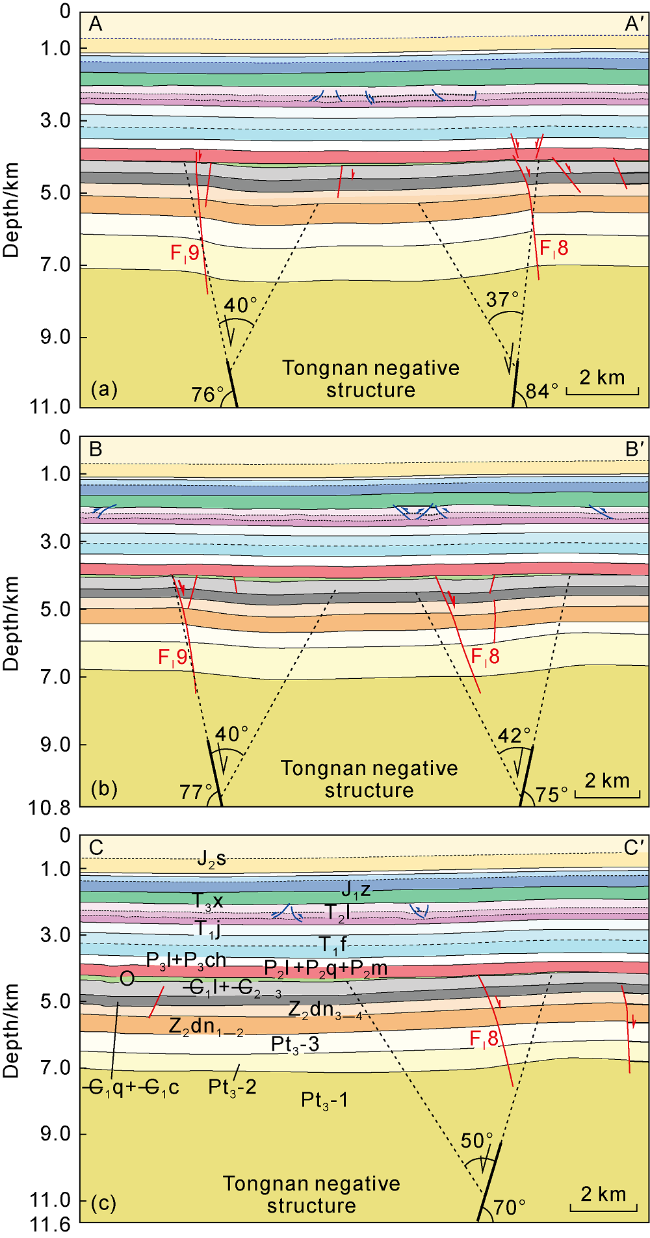
Fig. 5. Tri-shear deformation of the Tongnan negative structure in the Gaoshiti-Moxi area. Aspect ratio (V:H) is 1:1, the original profiles refer to |
In addition to the Tongnan negative structure, trans-tensional faults developed in the Gaoshiti-Moxi area also deserve special attention (Fig. 3c -3h). In AA' and BB' profiles, the top ends of trans-tensional faults generally terminate below the P/AnP unconformity. Even though the faults breakthrough the unconformity, their fault throws are also saltate below and upon the P/AnP unconformity, showing larger fault throws below the unconformity and smaller fault throws above it (Fig. 4a , 4b). This indicates that the main deformation of these trans-tensional faults occurred before the Permian.
4. Formation and evolution of the Tongnan negative structure
A qualitative-quantitative study on typical profiles clarifies the evolution process of the Tongnan negative structure with methods such as balanced profile restoration, ADS analysis, and forward geometric and kinematic simulation. While conducting balanced profile restoration, a precondition should be confirmed: Before and after structural deformation, the area of strata in vertical section should maintain conservation, and the strata should not be squeezed into or out of the section, and thickness of the strata should be constant.
After analyzing the deformation of the Tongnan negative structure, two phenomena are noteworthy. Firstly, there are trans-tensional strike-slip faults (FI8, FI9, and the FII15) developed on the southern and northern boundaries of the negative structure. Although researches have pointed out these faults experienced shear deformation, no obvious strike-slip displacement ever recorded by the platform margin of the Dengying Formation [23-24] (Fig. 3f-3g ), indicating strike-slip displacement of these faults is limited and the faults present no features of large strike-slip faults. This means the trans-tensional faults on the southern and northern sides of the Tongnan negative structure did not influence the area of strata in vertical section, which is constant in general. Secondly, the Triassic Jialingjiang and Leikoupo formations present plastic deformation, like salt detachment folds, in which the area of strata in vertical section is not constant, which leads to differential deformation between weak salt layer and the upper rigid strata. As a result, differences in structural deformation styles appear, even though deformation in the salt layer and the upper strata developed at the same time.
4.1. Balanced profile restoration
The BB' and CC' profiles are selected for balanced restoration. After flattening a mark interface on top of the Ziliujing Formation, the fold deformation in the Jurassic is nearly eliminated, but there is still weak concave deformation remained in the Permian and Triassic. Besides, the concave deformation in the Cambrian and Sinian under the P/AnP unconformity decreased at the same time. The above changes are more obvious in CC' profile (Fig. 6a1-6a2 , 6b1-6b2 ). Then a concernment is that the residual concave deformation in the Permian and Triassic was a coetaneous structure with the syncline deformation that developed in the Jurassic. This is because the plastic deformation in the Jialingjiang-Leikoupo Formations could lead to differential structural deformation between the salt and the under rigid layers, and the deformation in sub-salt layers could not be completely eliminated by flattening the supra-salt layers. Therefore, in consideration of the compressional tectonic background generated by the thrusting of the surrounding orogenic belt, as well as the deformation characteristics in horizontal surfaces and vertical profiles (Figs. 3a-3c and 4 ), it is considered the concave deformation observed in the Permian-Jurassic is a compressional syncline that formed after the deposition of Jurassic, which has different structural attributes from the early extensional depression that developed before the formation of the P/AnP unconformity.
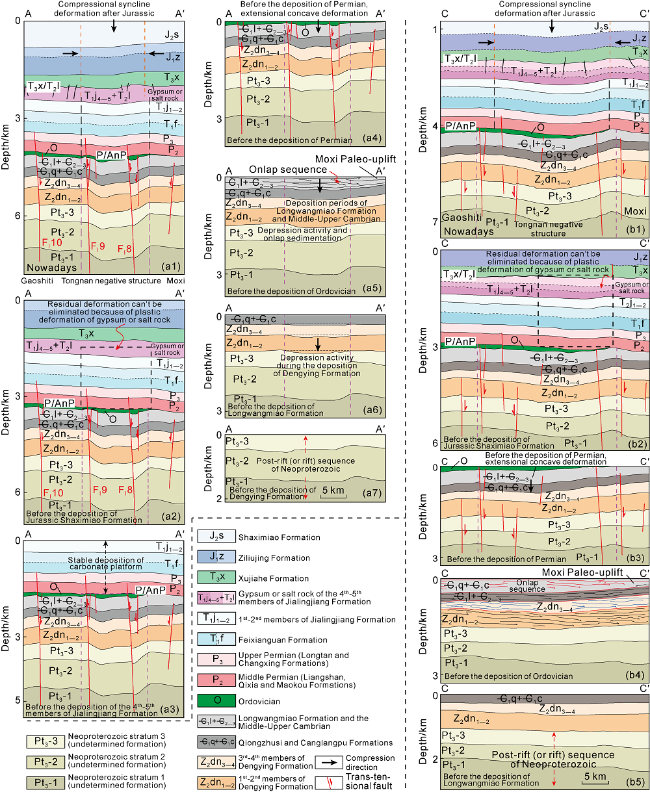
Fig. 6. Structural balanced restoration of typical profiles (AA' and CC' profiles) in the Tongnan negative structure. Based on horizon flattening and eliminating fault throw method. Original profiles refer to |
Then restore the BB' profile to the period before the deposition of the 4th-5th members of Jialingjiang Formation, it can be observed that the underlying Permian and Triassic become flat, which corresponds to the stable carbonate platform deposition background during this period (Fig. 6a3 ). Then, the two profiles are restored to the bottom of Permian, which reveals the trans-tensional faults and the Tongnan depression are well preserved under the P/AnP unconformity (Fig. 6a4 , 6b3 ). Then stripping the Ordovician, eliminating the fault throw and flattening the bottom of Ordovician, the concave geometry in the bottom of Longwangmiao Formation is obviously weakened. Meanwhile, it is found that the Longwangmiao Formation and the Middle-Upper Cambrian overlap to the Moxi structural high (Fig. 6a5 , 6b4 ). These indicate that strong extensional depression occurred in the Tongnan area during the deposition of the Longwangmiao Formation and the Middle-Upper Cambrian until the end of Ordovician.
After that, flattening the bottom of the Longwangmiao Formation so as to striping the Longwangmiao Formation and the Middle-Upper Cambrian, it can be observed the concave magnitude of the Tongnan depression has greatly decreased (Fig. 6a6 ). And in CC' profile, the concave shape of the Tongnan depression has nearly eliminated (Fig. 6b5 ). With further flattening and stripping to the bottom of Dengying Formation, the Neoproterozoic post-rift depression sequence shows an undulant appearance (Fig. 6a7 ).
Through integrated structural interpretation and balanced profile restoration analysis, the formation and evolution process of the Tongnan negative structure can be summarized as two stages. The first is the extensional depression that occurred during the deposition period of the Dengying Formation and until the pre-Permian, which is controlled by multi-phase tri-shear activation of pre-existing basement normal faults. The dominating depression activities occurred in the deposition periods of the Longwangmiao Formation, Middle-Upper Cambrian and until the end of Ordovician. The second is compressional syncline that happened after the deposition of Jurassic, and controlled by regional tectonic compression.
Through ADS quantitative analysis of the four selected profiles, it can be estimated that the contribution of the
compressional syncline deformation of the second stage to the total deformation of the Tongnan negative structure is about 25% in profile AA', 20% in profile BB', 40% in profile CC', and 50% in profile DD'. This reflects that the compressional syncline deformation in the second stage is weaker in the west and stronger in the east. This is consistent with the results observed from the balanced profile restoration of profiles AA' and CC' (Fig. 6 ).
4.2. Area-depth strain (ADS) analysis of typical profiles
The above analysis demonstrates that the Tongnan negative structure was formed by the superimposing of two stages of deformation which presents different structural regimes. It also clarifies the deformation characteristics and process of the later compressional folding (Fig. 6a 1-6a2, 6b1-6b2). However, the depression activity before the Permian still lacks of in-depth cognition. Therefore, ADS analysis method is adopted to conduct further quantitative research.
Before applying ADS analysis, profiles should be firstly stripped back to the bottom of Permian by flattening (vertical shear) algorithm, which is to eliminate the superimposed compressional syncline of the second stage. Secondly, the throws of the trans-tensional faults should be eliminated to avoid its influence on ADS analysis results. Because the vertical throws of trans-tensional faults are not on the same magnitude as the relief of the Tongnan depression, and the incline direction of the FI8 fault is opposite to that of the north wing of the Tongnan depression, which is an antithetic fault (Fig. 4a , 4b ). Therefore, the trans-tensional faults could not dominate the formation of the Tongnan depression, but they secondarily modified it.
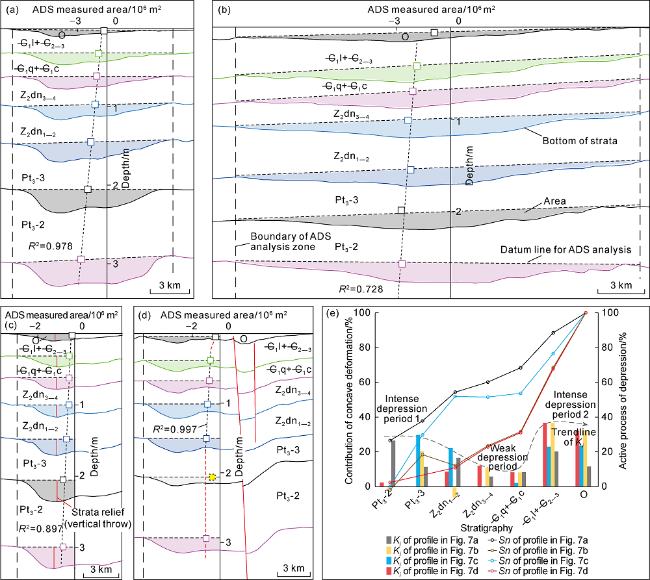
Fig. 7. ADS measured analysis of typical profiles in the Tongnan Depression. (a) ADS measured analysis of the whole depression zone in AA’ profile (original profile refers to |
In order to further investigate the activation process of the Tongnan depression during the Neoproterozoic to the pre-Permian, a set of deformation stripping algorithms are applied to calculate the deformation increment and its contribution to the cumulative deformation of the Tongnan depression. The algorithms are as follows:
The deformation increments of each strata during their deposition periods:
$\Delta {{A}_{i}}\text{=}{{A}_{i}}-{{A}_{i\text{+1}}}\text{ (}i\text{=0, 1, 2, }\cdots,n\text{)}$
The contribution of deformation increments to cumulative deformation of the Tongnan Depression:
${{K}_{i}}\text{=}\frac{\Delta {{A}_{i}}}{{{A}_{\text{0}}}}\text{ (}i\text{=0, 1, 2, }\cdots,n\text{)}$
In this study, we take the cumulative depression deformation of the deepest buried bottom of the Pt3-2 as the referring benchmark. The measurement results show that there are differences in deformation degrees that occurred during the deposition period of the Pt3-2 in different profiles. In the profile shown in Fig. 7a , the deformation contribution of the Pt3-2 reached a high value, the Ki is about 25% (Fig. 7e ); while in profiles shown in the Fig. 7b and Fig. 7c-7d , the depression deformation did not occur during the Pt3-2 deposition period, the Ki is ±2% (Fig. 7e ). Through analyzing and comparing the results of balanced profile restoration of AA' and CC' profiles, it is found that the bottom of the Pt3-2 in the AA’ profile had a concave shape before the deposition of the Dengying Formation, representing the early prototype of the Tongnan depression, but this phenomenon is not obvious in CC' profile (Fig. 6a 7, 6b5). This indicates that there exists a difference in the activity intensity between the east and west of the Tongnan depression during the Pt3-2 deposition period. Later, during the deposition periods of the Pt3-3 (Neoproterozoic stratum 3, undetermined formation), and the 1st-2nd and 3rd-4th members of the Dengying Formation (Z2dn1-2 and Z2dn3-4), as well as the Qiongzhusi and Canglangpu Formations (—C1q+—C1c), the deformation process of the Tongnan depression presents a regularity with Ki value decreasing from 10%-30% (during the deposition periods of the Pt3-3 and Z2dn1-2) to less than 10% (during the deposition periods of the Z2dn3-4, —C1q+—C1c) (Fig. 7e ), indicating the depression activity gradually weakened, and the deposition periods of the Z2dn3-4 and —C1q+—C1c were trough periods of depression activity. Then, the depression enhanced distinctly during the deposition periods of the Longwangmiao Formation and the Middle-Upper Cambrian, and until the end of Ordovician, with the Ki values increasing to 20%-35%.
Based on the above ADS quantitative analysis results of profiles, the active process of the Tongnan depression was calculated and plotted, the algorithm is as follows:
${{S}_{n}}\text{=}\sum\limits_{i\text{=}0}^{n}{{{K}_{i}}}\text{ }\left( n\text{=0, 1, 2, }\cdots \text{; }i\text{=0, 1, 2, }\cdots,n \right)$
The results show that in the AA' profile, the Tongnan depression experienced three stages of activations with varying “strong-weak-strong” deformation (Fig. 7e ). Firstly, during the Pt3-3 to Z2dn1-2 deposition periods, the depression activity was relatively strong, the Sn reached 55%. Secondly, during the Z2dn3-4 and —C1q+—C1c deposition periods, the depression activity significantly weakened. Thirdly, during the —C1l+—C2-3 deposition periods and until the end of Ordovician, the activation strengthened again (Fig. 7e ). In the BB’ and CC’ profiles, the depression activity mainly occurred during the —C1l+—C2-3 deposition period and until the end of Ordovician, and the depression process increased rapidly from 30% to 100%.
4.3. Verification by structural geometric forward simulation
To verify the reliability of the above ADS analysis results, ADS area data and stratum relief data measured from the southern half of the Tongnan depression in AA' profile were compared. The stratum relief is equivalent to the throw of the tri-shear normal fault that controlled the depression deformation, which is obtained by measuring the elevation relief between the lowest point of the depression and the highest point of its boundary (Fig. 7c ).
Comparation of the two sets of parameters indicates the contribution to the total depression deformation (Ki) in each deformation periods calculated by ADS method has the same variation with the relief incremental ratio (Ri) calculated by stratum relief method (the algorithm of the Ri is consistent with the algorithm of Ki, here is omitted). And the depression activity process (Sn) calculated by the two methods also have the same variation (Table 1 ). Then the stratum relief of the bottom of Pt3-2 is -290 m in AA' profile, and is taken as the total fault slip (throw) of the deep tri-shear normal faults (Fig. 7c ). By multiplying with the Ki, the total fault slip is assigned to different deposition periods (Table 1 ), which is applied to drive the forward structural geometric simulation (Fig. 8 ).
Table 1. Comparison of ADS analysis data and relief data of strata in the southern half of Tongnan Depression in AA' profile |
| Strata bottom | ADS area (Ai)/m2 | ADS area increments (ΔAi)/m2 | Stratum relief/m | Stratum relief increments/m | Contribution to depression deformation by ADS method (Ki)/% | Stratum relief increment ratio (Ri)/% | Depression process (Sn, by ADS method)/% | Depression process (by stratum relief method)/% | Fault displacement (D)/m |
|---|---|---|---|---|---|---|---|---|---|
| O | −230 439 | −230 439 | −112 | −112 | 23.4 | 38.6 | 100.0 | 100.0 | −68/−112 |
| —C1l+—C2-3 | −455 866 | −225 427 | −147 | −35 | 22.9 | 12.1 | 76.6 | 61.4 | −66 |
| —C1q+—C1c | −476 683 | −20 817 | −162 | −15 | 2.1 | 5.2 | 53.7 | 49.3 | −6 |
| Z2dn3-4 | −473 383 | 3 300 | −162 | 0 | −0.3 | 0 | 51.5 | 44.1 | 1 |
| Z2dn1-2 | −691 450 | −218 067 | −207 | −45 | 22.2 | 15.5 | 51.9 | 44.1 | −64 |
| Pt3-3 | −983 424 | −291 974 | −290 | −83 | 29.7 | 28.6 | 29.7 | 28.6 | −86 |
| Pt3-2 | −983 647 | −223 | −290 | 0 | 0 | 0 | 0 | 0 | 0 |
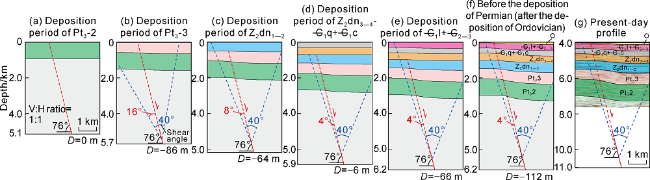
Fig. 8. Comparison of forward structural geometric simulation profiles (a-f) and present-day profile (g). D—Vertical fault displacement. |
The analysis of fold axis presents the dip angles of the tri-shear normal faults in the deep section of the southern half of AA' profile is about 76°. In footwall, the Pt3-2, Pt3-3, and Z2dn1-2 involved into tri-shear deformation to different degrees, while the Z2dn3-4, —C1q+—C1c, —C1l+—C2-3, and the Ordovician do not (Fig. 8g ). Then, with multiple sets of forward simulation driven by the above parameters, the deflection angles of tri-shear zone relative to the fault are set as 16° (before the deposition of Z2dn1-2), 8° (during the deposition of Z2dn1-2), and 4° (after the deposition of Z2dn1-2) (Fig. 8 ). Subsequently, the fault slips (throws) calculated by relief method and ADS method (Table 1 ) could accurately control the displacements of tri-shear normal faults in different deformation periods. After multiple rounds of forward simulations, the fault displacement at the last stage of deformation (before the deposition of Permian) is adjusted from -68 m to -112 m (Table 1 ). Then a forward simulation profile is created which is almost consistent with the present-day profile (Fig. 8f , 8g ). The adjustment of the fault displacements before the deposition of Permian is because of the apparent denudation at the top of the Ordovician, where the ADS area may be smaller than the real deformation magnitude, which may result in a smaller fault slip while calculated by ADS method. Therefore, the vertical fault displacements calculated by stratum relief method is referred.
The forward structural simulation reproduces the deformation process of the Tongnan depression from the Pt3-3 deposition period to the pre-Permian (Fig. 8 ). The results show that two intense activation periods were the Pt3-3 to Z2dn1-2 deposition period (Fig. 8b , 8c ) and the —C1l+—C2-3 deposition period until the end of Ordovician (Fig. 8e , 8f ), and a weak or none deformation period is the Z2dn3-4 to —C1q+—C1c deposition period (Fig. 8d ). This is consistent with the results of balanced profile restoration and ADS analysis. Therefore, it is verified that the ADS analysis is an available quantitative method on the study of structural activation process of the Tongnan depression.
5. Geological significances of petroleum
It has been proved that the Tongnan negative structure experienced two stages of structural superimposing deformation which present different structural attributes. Before the formation of the P/AnP unconformity, the Tongnan area was controlled by deep tri-shear normal faults’ activation and developed into extensional depression, whose deformation process had reached 50%-80% of the total deformation of the Tongnan negative structure. Then, approximately after the Jurassic, the Tongnan area was dominated by regional structural compression and resulted in syncline deformation. The two stages of structural superimposing deformations have profoundly influenced the structural pattern, and laid basic petroleum geological conditions in the Tongnan area.
5.1. The controlling of extensional depression activity on the carbonate deposition and reservoir physical properties of the Dengying Formation
The balanced restoration of AA' and CC' profiles (Fig. 6 ), ADS analysis (Fig. 7e ) and forward structural simulation (Fig. 8 ) all indicate that intense depression activity occurred in the Tongnan area during the deposition periods of Pt3-3 to Z2dn1-2, and the depression activity weakened during the deposition periods of Z2dn3-4 to —C1q+—C1c. In addition, through the analysis of stratum relief, the bottom of Z2dn1-2 presented an depression or subsidence of 64 m to 45 m in this period (Table 1 ), which reached about 10% of the total thickness of Z2dn1-2 (about 500 m). Therefore, it is inferred that the depression activity during the deposition of the Z2dn1-2 might affect the differential distribution of microfacies on the carbonate platform to a certain degree, which might also lead to compaction of shoal dolomite reservoir in Z2dn1-2. The weak depression activity during the deposition of Z2dn3-4 might not have the same effect.
The drilling results of well GS21 in this area show that the Z2dn2 and Z2dn4U (the upper sub-member of the 4th member, Dengying Formation) revealed gas layer, poor gas layer, and gas-containing water layer through well logging interpretation, but they are dry layers by oil and gas test. Besides, well logging interpretation of Z2dn4L (the lower sub-member of the 4th member, Dengying Formation) in well GS16 mainly revealed dry layer, while the well logging interpretation of the Z2dn4U revealed water layer, gas-water layer and gas layer, and industrial gas flow had achieved in the gas layer. Compared with the Gaoshiti area (well GS2) and Longnüsi area (well MX23), the dolomite reservoirs of the Z2dn1-2 and Z2dn3-4L in the Tongnan area seem to be denser, and it is more likely to reveal dry layers and poor gas layers (Fig. 9 ). This maybe is because of the densification of carbonate reservoirs, and the deposition and distribution of the carbonate microfacies might have been affected by the Tongnan depression activations.
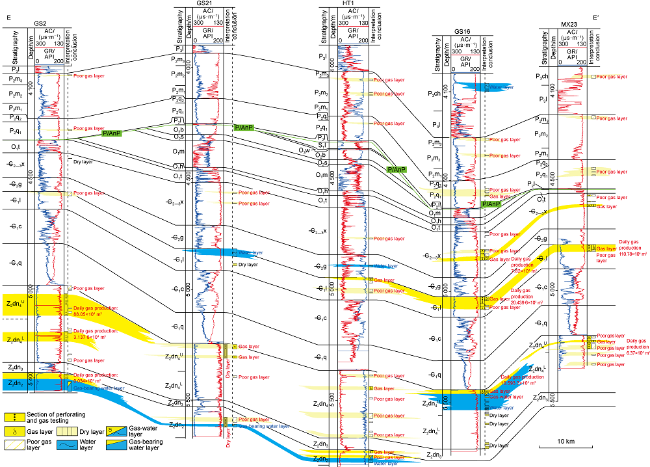


Fig. 9. Well-tie profile of GS2-GS21-HT1-GS16-MX23 and the distribution of gas and water (see the profile position in |
5.2. Formation and evolution of the Tongnan negative structure controls hydrocarbon migration, accumulation and present-day gas-water distribution
Before the Permian, the Tongnan negative structure experienced a stage of extensional depression activity, which caused the Tongnan area becoming a lower structure relative to the Gaoshiti and Moxi-Longnüsi areas, resulting in a structural relief of about -300 m (Table 1 ). Subsequently, during the Permian to Jurassic, the Tongnan depression was further buried. This process was accompanied by the thermal maturity of source rocks in the Doushantuo Formation, lower Cambrian, Permian and other strata. Previous studies indicated that the primary oil generation in this area occurred in the Permian to Triassic, and then the source rocks reached the windows of wet gas and dry gas generation during the Early-Middle Jurassic, and the late Jurassic-Cretaceous respectively. Meanwhile, the crude oil also cracked into gas with the increasing of strata temperature [4,8,30]. The study demonstrates that after the extensional depression activity, the Gaoshiti, Moxi and Longnüsi areas came to a higher elevation position, and became the most potential target for hydrocarbon migration and accumulation, but the Tongnan depression is equivalent to a pass-by way or transient zone for hydrocarbon migration and accumulation, which makes it unfavorable for long-term hydrocarbon preservation. But, some local structural highs in the Tongnan negative structure, such as well zones of GS16, GS21, and HT1, could also become oil and gas traps. Industrial oil and gas breakthrough in the Z2dn4U of well GS16 indicates the potential (Fig. 9 ).
After the Jurassic, the Tongnan area experienced the stage of compressional syncline deformation, which lead to superimposed reformation on the deep Tongnan depression, and resulted in the relief of deep strata dropping to -600 m to -400 m relative to the southern and northern structural highs (Figs. 3 and 4 ). As a response, oil and gas continuously migrated into the Gaoshiti and Moxi-Longnüsi structure highs, leading to further hydrocarbon accumulation, and the Tongnan negative structure was still the pass-by area for hydrocarbon migration and accumulation. With the continuous adjustment of gas and water distribution in the Tongnan area, it is more likely to encounter water layer in Dengying Formation, leading to the failure of drilling targets. The drilling results of wells GS16, HT1 and GS21 had indicated the risk (Fig. 9 ).
5.3. Tongnan negative structure zone could be a potential exploration filed for oil and gas
In the Tongnan negative structure, except for the discovery of gas layer at the top of the Z2dn4, there are also achievements of industrial gas flows of 20.439 6×10⁴ m3/d and 7.82×10⁴ m3/d from the central-upper section of the Longwangmiao Formation and the central section of Xixiangchi Formation. Moreover, at the Longnüsi structural high to the north of Well GS16, a high-yield gas flow of 110.78×10⁴ m3/d was obtained from the Longwangmiao Formation in Well MX23. The above indicates there is a considerable oil and gas potential in the Longwangmiao Formation and Xixiangchi Formation in the Tongnan negative structure.
Another formation worth attention is the Ordovician. Horizon tracking result (Fig. 3 ), and seismic profile interpretation (Fig. 4 ) and well-tie profiles (Fig. 9 ) all indicate the residual Ordovician distributes in the Tongnan negative structure with uneven thickness, of which the top is truncated by the P/AnP unconformity, and the denudation pinch-out line nearly distributes along the north boundary of the Tongnan negative structure (Fig. 3c ). While comparing the Ordovician in this area with the Longwangmiao Formation in Anyue and Moxi-Longnüsi areas, it is clear the above two layers present similar geological conditions. The Longwangmiao Formation experienced intense erosion during the formation of the P/AnP unconformity, leading to the development of the widely distributed karst weathering reservoirs and the largest single-body marine carbonate gas reservoir in China, which was discovered in 2014, with proven natural gas reserves of 4403.83×108 m3 [31]. Therefore, in the Tongnan and adjacent areas, it is considered that the carbonate layers of the Honghuayuan Formation and Baota Formation of Ordovician under the P/O (Permian/Ordovician) unconformity have basic geological conditions for the formation of karst weathering reservoirs. As a consequence, it is hopeful to acquire major oil and gas discoveries in the Ordovician, and it is a new oil and gas exploration region worth attention.
6. Conclusions
Through composite structural interpretation based on high-precision 3D seismic data, with a series of qualitative and quantitative methods, such as balanced profile restoration, area-depth strain (ADS) analysis, and forward numerical structural geometric simulation, this research has a comprehensive study on the deformation characteristics, structural attributes and the superimposing evolution process of the Tongnan negative structure. It points out that the geological structure and the formation and evolution of the Tongnan negative structure have great significance on oil and gas exploration and development.
In strata above and below the P/AnP unconformity, the Tongnan negative structure demonstrates apparent differential structural deformation. And trans-tensional (strike-slip) faults also developed in this area. This makes the area presenting a feature of superimposing deformation dominated by multi-phase and multi-regime intracontinental structures.
The Tongnan negative structure experienced two stages of structural superimposing modification which present different structural attributes. The first is extensional depression during the deposition of the Sinian Dengying Formation to the pre-Permian, which is dominated by multi-phase tri-shear activity of the preexisting deep normal faults. The primary depression episodes occurred from the end of the late Proterozoic to the deposition of the 1st-2nd members of the Dengying Formation, and from the deposition of the Longwangmiao Formation to Middle-Upper Cambrian until the end of Ordovician. During the deposition of the 3rd-4th members of Dengying Formation and the Qiongzhusi-Canglangpu Formations, the depression activity was weak. The second stage of the deformation is dominated by the compressional syncline under a regional tectonic compression background, which deformed the early extensional depression more strongly in the east and weakly in the west.
The two stages of structural superimposing reworking in the Tongnan negative structure have profoundly influenced the petroleum geological conditions of the area. It controlled the hydrocarbon migration and adjustment and present-day gas and water differential distribution between the Tongnan negative structure and the Gaoshiti and Moxi-Longnüsi structural highs.
The carbonate layers inside the Ordovician are limitedly distributed in the Tongnan negative structure and truncated by the P/AnP unconformity on the top, which have basic geological conditions for the formation of weathering karst carbonate reservoirs, and could be a new petroleum exploration and development target deserving attention.
Nomenclature
Ai—cumulative deformation of the lower stratum numbered i, m2;
Ai+1—cumulative deformation of the upper stratum adjacent to the stratum i, numbered i+1, m2;
A0—the maximum identifiable cumulative deformation in the Tongnan depression, m2;
Ki—contribution of the deformation increments to the cumulative deformation of Tongnan depression during the deposition of each strata, %;
Sn—cumulative contribution of the depression deformation after the deposition of n sets of strata, %;
ΔAi—deformation increments during the deposition of each sets of strata, m2.