

Introduction
The Central African Shear Zone (CASZ), extending from the Gulf of Guinea in the west to the Red Sea in the east, is a lithospheric transformation zone with a length of 4000 km [1], whose basement is a lithospheric vulnerable zone formed in the Pan-African tectonic motion [1⇓⇓⇓-5]. With the break-up of the Gondwana continent during the Mesozoic and the Cenozoic [2⇓⇓⇓⇓⇓⇓⇓-10], Africa separated from its peripheral plates successively and accordingly the Mid Atlantic, South Atlantic, Indian Ocean opened and expanded in turn, inducing activation of the CASZ and formation of a series of Meso-Cenozoic rift basins striking near E-W and NW-SE directions called “the central African rift basin group” in the interior as well as the south and north flanks of the CASZ, respectively [1⇓⇓⇓-5,8 -9]. Medium-large oil and gas fields have been discovered in the highly explored basins located at the south and north flanks of the CASZ, such as the Muglad, Melut and Bongor basins, uncovering abundant hydrocarbon resources in the central African rift basin group [1⇓⇓⇓-5,8⇓ -10]. Different from the typical intracontinental passive rift basins in the south and north flanks of the CASZ like the Muglad Basin [7⇓-9,11⇓⇓⇓⇓⇓ -17] caused by the transition of shear stress to extension stress, the Doseo Basin in the interior of the CASZ experienced chronical strike-slip and multiphase inversion transformation [1⇓-3,7⇓ -9,18] and thus possessed more complicated tectonic features. At present, the genetic mechanism of the Doseo Basin is still controversial. Some scholars believed that the dextral strike-slip motion of the Borogop fault with a right-step extension in the horizon led to formation of a series of dextral and right-step pull-apart basins during the early Cretaceous, i.e. the Doba, Doseo and Salamat Basins, etc., occurring successively along the Borogop fault from west to east and thus the pull-apart activity induced by the dextral and right-step strike-slip motion of the Borogop fault led to formation of the Doseo Basin [8-9,19⇓ -21]. However, other researchers suggested that the Doseo Basin was formed due to the nearly N-S extensional rifting before the strike-slip motion of the CASZ and was chronically transformed by the subsequent strike-slip motion [7,17 -18]. In addition, a few scholars thought that the Doseo Basin was formed as a transitional basin for coordination of movement of the peripheral continental blocks and its evolution was controlled by the mantle convection [22-23]. Moreover, there are multiple interpretations about inversion genesis mechanism of the Doseo Basin, such as the transition of the CASZ from dextral to sinistral strike-slip motion [2-3,9,20], the convergence between Africa and Eurasia [1,5,7 -8,19], the change of the movement direction of the sub-plates in the interior of the Africa plate [18], and the direction variation of the mantle convection [22-23], etc. In addition, the studies on the basin tectonic activity periods, strike-slip fault and tectonic inversion features and their genetic mechanism are still in exploratory stage and a rational basin evolution model has not been established yet. The above controversial cognitions of the Doseo Basin are caused mainly by the puzzled understanding of the basin structures, unconformities, inversion structures and faults studied by predecessors based on regional geological and geophysical data [8⇓-10,17⇓⇓⇓⇓⇓ -23], such as outcrop, gravity and magnetic as well as a few 2D seismic data etc., displaying the lack of high-precise seismic and drilling data.
CNPC International (Chad) CO., LTD has carried out large-scale exploration in the eastern Doseo Basin and obtained considerable seismic and drilling data since 2020, which provides data support for analysis of the tectonic features of the basin. Using the latest continuous 3D seismic data, 2D skeleton seismic lines and drilling data, this paper precisely analyzed the unconformities, faults and inversion structures, revealed the fault, tectonic inversion and basin genetic mechanisms, and founded the basin evolution in the eastern Doseo Basin based on fine seismic interpretation. The study achievements are expected to provide geological theory basis for oil and gas exploration in the Doseo Basin.
1. Overview of the basin geology
The Doseo Basin is located in the western section of the CASZ and is separated from the Doba Basin on the west and the Salamat Basin on the east by F1 (Fig. 1a ). The Doseo, Doba and Salamat Basins constitute the called “South Chad Basin” [1]. The Doseo Basin is composed of the Eastern Depression and the Western Depression. The study area in this paper is located in the Eastern Depression and can be divided into two secondary tectonic units, namely the Western Sag and the Eastern Sag (Fig. 1b ). The subsidence and deposition centers of the basin occurred in the Western Sag while the alternative subsag-uplift structural pattern appears in the Lower Cretaceous of the Eastern Sag where three tertiary positive tectonic unites, i.e. the Northern steep slope, Central low uplift and Southern gentle slope, and three tertiary negative tectonic unites, namely the Kibea, Kedeni and Southern subsags occur from north to south successively with a general NEE-SWW strike (Fig. 1b ). Three secondary tectonic units are developed in the Northern steep slope, namely the Ximenia, Kibea and Celtis structural belts (Fig. 1b ). A series of the echelon narrow-long nose-shaped uplifts striking NE-SW direction are developed in the Ximenia and Kibea structural belts and obliquely intersect with F1 (Fig. 1b ). In the east, F1 is split into the northeastern section and the eastern section which slightly bends leading to formation of the Celtis fault-step belt (F1 and F2) (Fig. 1b ). The Central low uplift, an uplift in the Eastern sag, separated from the Northern steep slope and the Southern gentle slope by the Kibea subsag and the Kedeni subsag, respectively, is buried and disappeared in the Western sag and diverges in the eastern margin of the basin, displaying a dumbbell shape narrow in the middle and broad in the east and the west (Fig. 1b ). In addition, a main strike-slip fault (F3) is developed along the core of the Central low uplift (Fig. 1b ). The Southern gentle slope is a folded monocline upraising towards south (Fig. 1b ). In its highest part, a NEE-SWW striking fault (F4), whose downthrown wall develops a subsag called the Southern subsag, is occurred with a south dipping (Fig. 1b ). F5 dipping to north is developed along the northern flank of the basin south- marginal uplift and ends towards east at F4 (Fig. 1b ). The Doseo Basin is separated from the Salamat Basin by F6 and the eastern section of F1, and the northeastern section of F1 splits the sags of the Salamat Basin from its slopes (Fig. 1b ).
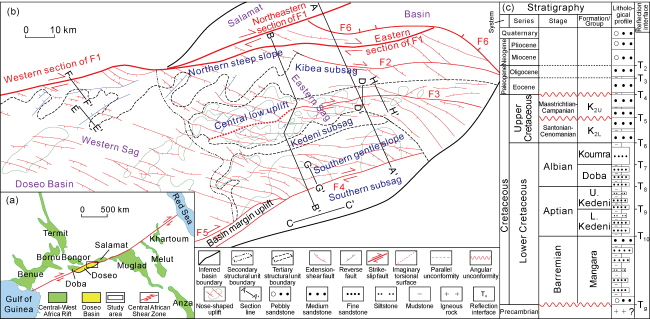
Fig. 1. (a) Tectonic position, (b) tectonic units and (c) stratigraphic characteristics of the eastern Doseo Basin. |
The Lower Cretaceous, Upper Cretaceous and Cenozoic were developed in the study area [1,19,24 -25], however, the basement has not been drilled yet (Fig. 1c ). The Lower Cretaceous consists of the Mangara Group, Kedeni, Doba and Koumra Formations from bottom to top successively[1,24 -25] (Fig. 1c ). The geological age of the Kedeni and Doba Formations is the Early Cretaceous Aptian-Albian and thus it is indicated that the geological age of the principal part of the Mangara Group could be the Barremian [1,25]. The drilling data reveal that thick fluvial-deltaic sandstone interlayered by thin lacustrine mudstone was developed in the top of the Mangara Group and thus it is inferred that an intact sedimentary circle of lacustrine transgression to lacustrine regression was developed in the Mangara Group during the rifting stage [1] (Fig. 1c ). In addition, a completed sedimentary circle of lacustrine transgression to lacustrine regression was also developed from the Kedeni, Doba and Koumra Formations to the Upper Cretaceous (Fig. 1c ). Lacustrine mudstone interbedded by deltaic and underwater fan sandstone formed during transgression was developed in the Kedeni Formation, and lacustrine mudstone interbedded by deltaic and underwater fan sandstone formed during early regression was developed in the Doba Formation, and fluvial and lacustrine coarse sandstone interlayered by thin mudstone formed in medium-late regression was developed in the Koumra Formation and the Upper Cretaceous, respectively (Fig. 1c ). Additionally, sandstones in the fluvial-shore and shallow lacustrine facies as well as alluvial plain-fluvial facies were developed in the Paleogene and the Neogene-Quaternary, respectively (Fig. 1c ).
2. Stratigraphic unconformity
Based on the calibration of seismic horizons using the synthetic record method, four stratigraphic unconformities were recognized and analyzed in the study area through identification of the instructive seismic reflections, such as truncation, overlap, denudation, erosion and growth strata, combined with analysis of well logging and mud logging data (Figs. 2 -5 ).
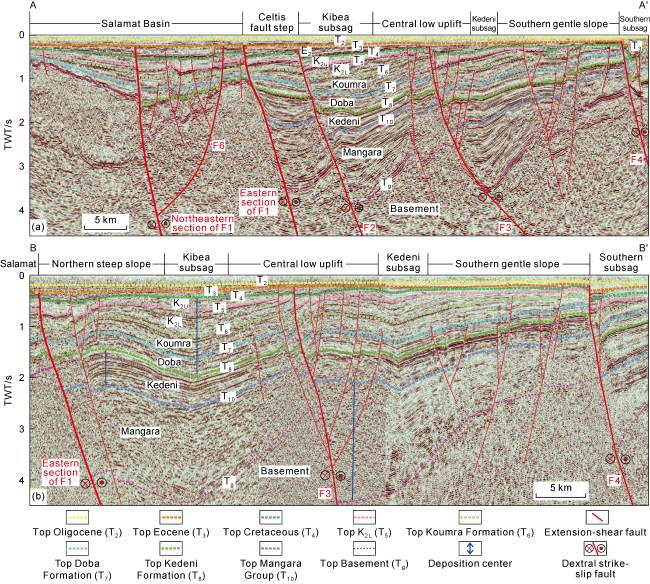
Fig. 2. Seismic-geological structure sections of the study area (see |
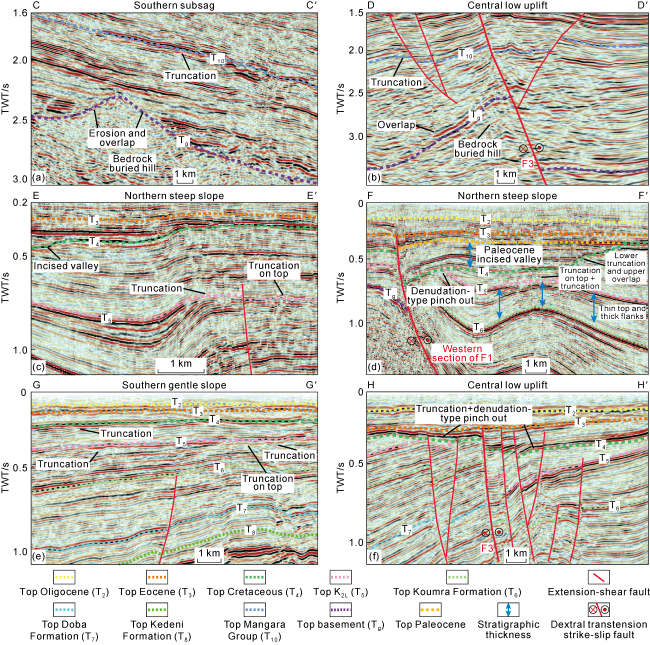
Fig. 3. Seismic reflection characteristics of the main unconformities in the study area (see |
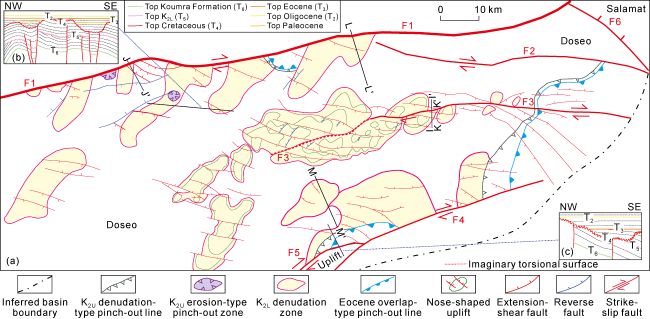
Fig. 4. Distribution of the stratigraphic denudation and the deposition lacuna in the study area. |
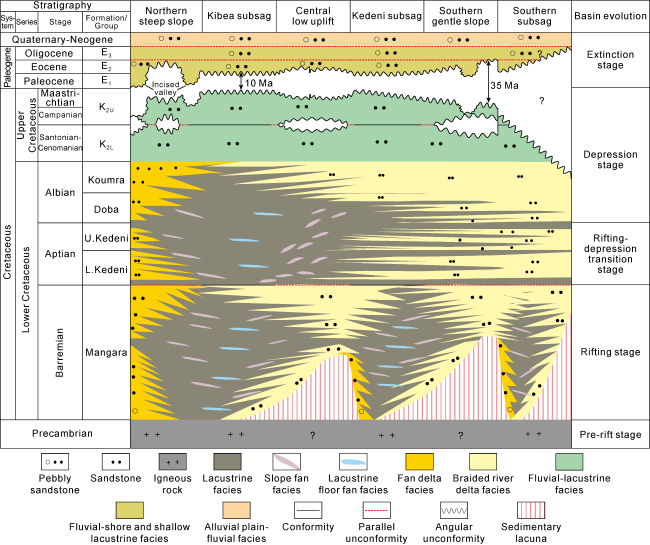
Fig. 5. Tectonic-stratigraphic framework of the study area (based on drilling and seismic data). |
2.1. Top basement unconformity (Tg)
Tg is a high-amplitude seismic reflection interface displaced by the depression-controlling fault and the subsag-controlling faults dipping to south in the interior of the basin (Fig. 2 ) and shows a fluctuant seismic reflection configuration with appearance of overlap on its top and truncation under its bottom in the southern subsag of the basin margin (Fig. 3a ). Tg is overlaid by a set of parallel and continuous seismic reflection waves with mid-low frequencies and thickness thinning in a wedge from north to south, suggesting that the deposition of the Mangara Group was controlled by the depression-controlling fault and the subsag-controlling faults and was underlaid by a set of chaotic, low amplitude and poor stratification seismic reflection waves possibly corresponding to the Precambrian basement formed in the Pan-African tectonic movement (Fig. 2a ). Therefore, Tg is calibrated as the top basement unconformity.
2.2. Top Mangara Group unconformity in Lower Cretaceous (T10)
Four dustpan-shaped rifts faulting in the north and overlapping in the south occur under T10 and a united wedge-shaped depression with thickness thinning from north to south appears on T10 (Fig. 2 ), suggesting that T10 is the transformation interface of the basin structure separating the rifting deposition from the rift-depression transition deposition and the depression deposition. The top of the Mangara Group mainly consists of thick sandstone confirmed by drilling and truncation reflection underlying T10 can be found in the seismic section (Fig. 3b ), which indicates that with attenuation of the rifting tectonic activity, the dustpan-shaped rifts were nearly filled up and thus suffered from exposure and denudation at the latest sedimentary stage of the Mangara Group.
2.3. Top unconformity (T5) of lower Upper Cretaceous (K2L)
The unconformity of T5 merely occurs in the NE-SW to NNE-SSW striking nose-shaped uplifts (Figs. 4a and 5 ) whose tops and flank high portions are truncated and gradually transits to conformity in the lower part of the uplifts (Fig. 3c-3e ). The truncation of the unconformity is intensive in the Southern gentle slope and the Northern steep slope (Fig. 3c , 3e ) and is relatively relieving in the Central low uplift (Fig. 3f ). Additionally, formation of the unconformity is controlled by the development of the uplifts trending NE-SW to NNE-SSW direction.
2.4. Top Cretaceous unconformity (T4)
T4 is an angular unconformity developed most extensively in the study area (Fig. 4 ). The strata underlying T4 are folded and deformed, but the Cenozoic strata overlying T4 have no compression deformation (Fig. 3c -3f). The high-angle unconformity of T4 overlapped by the overlaid Cenozoic and truncating the underlaid Cretaceous occurs mainly in the Northern steep slope, the Central low uplift and the Southern gentle slope (Figs. 3c-3f and 4b-4c ) where the incised valley fills overlying T4 were developed extensively during the Paleocene (Figs. 3c-3d , 4b and 5 ). The largest incised valley appears in the Ximenia structural belt with almost extinction of the upper part of the Upper Cretaceous (K2U) due to intensive fluvial erosion which also causes erosion of K2L (Figs. 3d , 4a and 5 ). However, T4 transits to the low-angle unconformity in the western sag, the Kibea subsag and the Kedeni subsag (Fig. 2b ). Moreover, the most intensive upraising and denudating occur in the southern margin of the basin (Fig. 4a , 4c ). The denudating pinch-out of K2U, displayed by truncation of T5 by T4 and leading to denudation of K2L, and the overlapping pinch-out of the Eocene (T3) on T4, occur in the eastern and the western marginal high parts of the Southern gentle slope and the slope area of the eastern basin margin (Figs. 4a , 4c and 5 ). Besides, the stratigraphic pinch-out above and below T4 also occurs in the Kibea structural belt (Fig. 4a ). The above analysis results suggest that the unconformity should be formed at the latest Cretaceous and then underwent exposure and denudation of ~10 Ma resulting in denudation-type lacuna of the top of the Cretaceous and deposition-type lacuna of the main deposition of the Paleocene which only occurs in the incised valley (Fig. 5 ). Moreover, the unconformity should not be covered by deposition until the Oligocene indicating that the exposure lasted ~35 Ma in the southern basin margin and the Kibea structural belt in the northern margin (Fig. 5 ).
3. Faults and inversion structures
On the basis of delicate seismic interpretation, four phases of faults and two phases of inversion structures were identified (Figs. 6 -8 ).
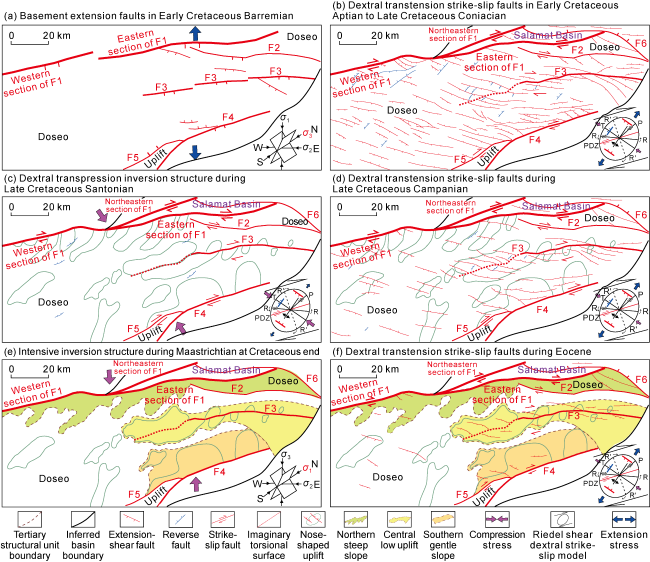
Fig. 6. Plane structure distribution of four stages of faults and two stages of structure inversions in the study area (based on 2D/3D seismic data). PDZ—Main strike-slip displacement zone; R—Riedel shear; R°—Reverse Riedel shear; P—P-shear symmetrical to R-shear; σ1—Maximum principal stress; σ2—Middle principal stress; σ3—Minimum principal stress. |

Fig. 7. Division of activity stages of faults in the study area (see |
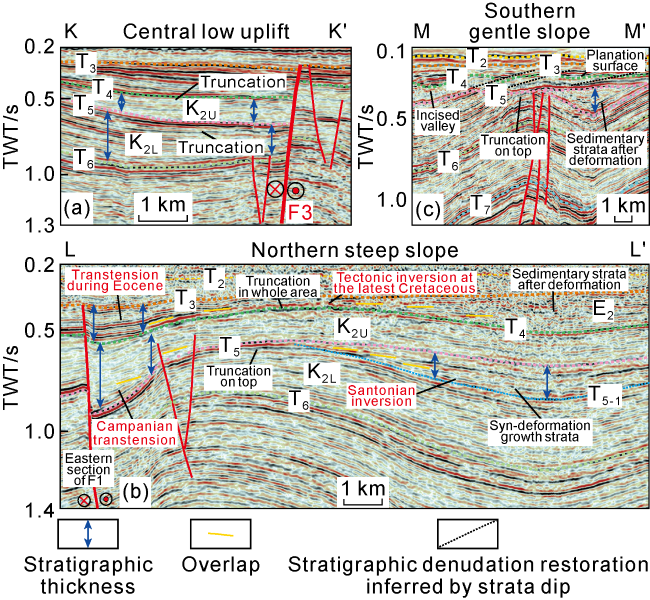
Fig. 8. Seismic-geological characteristics of Santonian and the latest Cretaceous tectonic inversions in the study area (see |
3.1. Basement extension faults in Early Cretaceous Barremian (deposition stage of Mangara Group)
During the Barremian, the Eastern Sag developed the basement extension faults mainly composed of F1-F4 dipping southwards, however, the Western Sag mainly developed the basement extension faults of the south- dipping F1 and the north-dipping F5 in its north and south edges, respectively (Figs. 6a and 7 ). F1, the primary depression-controlling fault, only developed its eastern section and western section in the Eastern Sag and the Western Sag, respectively (Fig. 6a ). F5, terminating towards east at F4, was the secondary sag-controlling fault with the gradual disappearance of the vertical fault-distance towards east and F2-F4 were the tertiary subsag-controlling faults (Fig. 6a ). The rift structure between the Eastern sag and the Western sag varied significantly and separated by the south-marginal uplift. In the Eastern sag, four dustpan-shaped rifts faulting in the north and overlapping in the south occurred on the basement and were composed of the Celtis, Kibea, Kedeni, and Kedeni South rifts controlled by F1-F4, respectively (Fig. 2a ). In the Western sag, the dustpan-shaped rifts, however, transited to one integrated graben-shaped rift which was the subsidence center of the basin and was controlled by F1 in the north and F5 in the south (Fig. 6a ). The NEE-SWW to near E-W strike of F1-F5 indicates that the principal extension stress was near N-S (Fig. 6a ). During the Barremian, the paleotectonic form of the Central low uplift was a tilted fault block buried at the end of the rifting stage (Fig. 2a ).
3.2. Dextral transtension strike-slip faults in Early Cretaceous Aptian to Late Cretaceous Coniacian (deposition stage from Kedeni Formation to K2L)
The control of F1-F4 on deposition of the Kedeni Formation still continued during the Aptian, however, the dustpan-shaped rifts had nearly disappeared (Fig. 2 ). Meanwhile, a considerable amount of echelon extension-shear faults, trending NW-SE to NWW-SEE directions and intersecting with F1 at an acute angle, and a few of reverse faults striking NE-SW direction, began to be developed in the basin (Figs. 6b and 7 ), which suggests that F1 started to transit from an extension fault to a dextral transtension strike-slip fault. Therefore, the northeastern section of F1 began to be active and replaced the eastern section of F1 as one section of the main shear fault of F1 in the strike-slip stage (Fig. 6b ). Moreover, F3 also transited to the dextral transtension strike-slip fault confirmed by the intersection of a large number of echelon extension-shear faults and a small amount of reverse faults with F3 at an acute angle, which consisted of the negative flower structure belt composed of the western, middle, and eastern sections. In the western section, the echelon extension-shear faults striking NW-SE were able to be split to the north line dipping to south and the south line dipping to north and a few reverse faults also occurred. Although the strata in the western section were twisted by intensive dextral transtension shear stress, F3 did not displace the strata horizontally because the dextral shear stress was released and the increased deposition thickness improved the shear-resistance ability of the strata in the western section (Fig. 6b ). The echelon faults transited toward east to the narrow and bended middle section where the fault plane and the horizontal displacement of F3 were distinct and the negative flower structural shape in the seismic section consisting of F3 and its associated faults trending NWW-SEE appeared (Figs. 2b and 6b ). Horsetail-shaped fault combination with NW-SE to E-W strike and arc-shaped distribution was developed in the eastern section where the fault plane and the horizontal displacement of F3 were obvious and the associated faults of F3 intersecting with F3 in the profile displayed a “Y” shape (Figs. 2a and 6b ). The associated faults of F2, F4, and F5 did not have a flower or “Y” shape in the profile (Fig. 2 ), however, a large number of extension-shear faults trending NW-SE obliquely intersected with F4 and F5 on plane (Fig. 6b ) and the stratigraphic thickness of the upper walls and the lower walls of F2 and F4 varied unregularly with horizontal displacement characteristics (Fig. 2 ), suggesting that F2, F4, and F5 also transited to dextral transtension strike-slip faults.
Dextral transtension strike-slip fault system in the Doseo Basin had not been interrupted until the Santonian inversion age since it was developed in the Aptian age (Fig. 7a ).
3.3. Dextral transpression inversion structure in Late Cretaceous Santonian
Echelon, narrow-long nose-shaped uplifts trending NE-SW to NNE-SSW directions were developed extensively in the study area (Fig. 8 ). Tops and flank high parts of the uplifts were truncated by T5 and the thickness of the growth strata occurring in K2L decreased from the tops to the flanks of the uplifts (Fig. 8a ), which indicates that the basin underwent NE-SW compression in the middle stage of the Late Cretaceous leading to the syn-deposition nose-shaped uplifts trending NE-SW to NNE-SSW directions (Fig. 6c ). T5-1, overlapped by overlying deposition of the upper part of K2L, can be identified at the southern flank of the uplift in the Kibea structural belt and merges with T5 at the top of the uplift (Fig. 8b ). The thickness of K2L under T5-1 decreased from the south flank to the north flank of the uplift (Fig. 8b ), which suggests that sedimentation of K2L under T5-1 was controlled by paleogeomorphology during the tectonic quiet period. However, the strata between T5-1 and T5 had a tectonic relief that was consistent with the underlying strata and pinch out toward the top of the uplift due to overlapping, indicating that the strata between T5-1 and T5 were growth strata recording the tectonic inversion (Fig. 8b ). Therefore, the tectonic inversion took place during the late depositional period of K2L, responding to the regional tectonic event called the “Santonian tectonic inversion” [16⇓-18].
The Santonian tectonic inversion was characterized mainly by folding deformation and triggered a few echelon reverse faults striking NE-SW (Fig. 6c ). In the Northern steep slope, both the echelon nose-shaped uplifts and the reverse faults intersected with F1 at an acute angle, indicating that their formation was caused by NW-SE contraction component from the dextral transpression shear motion of F1 (Fig. 6c ). F3 also transited to the dextral transpression shear fault and the Central low uplift underwent NW-SE compression, triggered by the transpression shear stress of F1. The embryo of the present Central low uplift was thus formed appearing as a series of nose-shaped uplift structural belts intersecting obliquely with F3 (Fig. 6c ). Only a few reverse faults were developed and thus positive flower structures were not developed in the Central low uplift (Fig. 6c ). Due to compressional deformation induced by NW-SE contraction component from F1, the eastern and the western large-scale nose-shaped uplifts trending NNE-SSW were developed in the middle and the high parts of the Southern gentle slope (Fig. 6c ). Additionally, one nose-shaped uplift trending NE-SW were developed in the lower part of the western section of the Southern gentle slope, and its top and flank high parts were truncated intensively (Figs. 6c and 8c ). One small sag occurred in the middle of the west edge of the Southern gentle slope because of violent folding and deflecting action and should not be filled up until the earliest Campanian, which suggests that the life period of the small sag represents the duration of T5 unconformity induced by the Santonian tectonic inversion (Fig. 8c ).
During the Santonian tectonic inversion period, the intensity of fold deformation and truncation was the greatest in the Southern gentle slope followed by the Northern steep slope and was the weakest in the Central low uplift (Figs. 2b and 8 ).
3.4. Dextral transtension strike-slip faults in Late Cretaceous Campanian
During the Campanian, the reoccurrence of the echelon extension-shear faults trending NW-SE indicates that F1 transited to a dextral transtension shear fault again (Figs. 6d , 7a and 8b ). The dextral transtension strike-slip fault system during the Campanian basically inherited the characteristics of that in the first stage but the associated extension-shear faults in the Campanian age were remarkably fewer than those in the first stage (Figs. 6d and 7a ), suggesting that the shear stress intensity of F1 in the Campanian age was significantly weaker than that in the Early Cretaceous. Due to transtension shear of F3, negative flower structures on the Santonian nose-shaped uplifts occurred in the Central low uplift (Figs. 6d and 7a ) where the thickness of K2U increased from the flanks to the tops of the uplifts (Fig. 8a ). In addition, the faults formed in the Campanian age cut the Santonian inversion structures (Fig. 6d ).
3.5. Intensive compression inversion structure at the end of Cretaceous
The thickness of K2U has no obvious variation from the southern flank to the top of the nose-shaped uplift in the Kibea structural belt and the Eocene horizontally overlap and pinch out at T4 on the southern flank of the uplift, suggesting that the Eocene is not syn-deformation growth strata (Fig. 8b ). Therefore, the tectonic inversion should take place at the latest Cretaceous. The Cretaceous underwent intensive elevation-denudation in the study area induced by the latest Cretaceous inversion, which led to the regional unconformity on top of the Cretaceous (Fig. 4a ). Under the near N-S compression, intensive fold deformation and elevation-denudation were developed in the Central low uplift and induced that the near E-W structural form was superimposed on the Santonian structures thus leading to the present Central low uplift (Fig. 6e ).
The tectonic relief of the nose-shaped uplifts was further enhanced in the Northern steep slope caused by the latest Cretaceous inversion. In the Kibea structural belt, K2L pinched out at top of the nose-shaped uplift due to fierce denudation (Fig. 4a ). Meanwhile, the structural form paralleling to the strike of F1 was superimposed on the parts of the Santonian nose-shaped uplifts close to F1 (Fig. 6e ). In addition, the intensive elevation and denudation (Figs. 6e and 8c ) as well as the denudation-type pinch-out underlying T4 and the overlap-type pinch-out overlying T4 (Fig. 4a and 4c ) were developed in the southern edge of the basin.
During the latest Cretaceous inversion, the fold deformation intensity of the Central low uplift was the most intensive followed by the Northern steep slope and the tectonic activity in the Southern gentle slope was characterized by intensive elevation and denudation (Fig. 2b ).
3.6. Dextral transtension strike-slip faults during the Eocene
The dextral transtension strike-slip fault system appeared again and basically inherited the pattern of that in the Campanian age (Figs. 6f and 7a ). However, the associated extension-shear faults during the Eocene were further fewer than that during the Campanian (Figs. 6f and 7a ), indicating that the shear stress intensity of F1 during the Eocene was significantly weaker than that during the Campanian. Most of the active faults during the Eocene were inherited ones which cut into the Eocene or terminated underlying T3 and incised the Santonian and the latest Cretaceous inversion structures (Figs. 6f and 7a ).
4. Discussion on tectonic genetic mechanism and basin evolution
4.1. Tectonic genetic mechanism
4.1.1. Genetic mechanism of the basin
Long-term strike-slip movement transformed the original appearance of the Doseo Basin in the interior of the CASZ and thus resulted in considerable controversy on the basin genetic mechanism [1⇓⇓⇓-5,7⇓ -9,17⇓⇓⇓⇓⇓ -23]. Some scholars suggest that effective dextral and right-step combination of the principal strike-slip fault (Borogop) with a dextral and right-step extension on plane induced translational pull-apart of two sides of the bended section of the Borogop fault, thus triggering formation of the Doseo Basin. Therefore, these scholars consider that the growth of the Doseo Basin was caused by the strike-slip pull-apart motion perpendicular to the short axis of the basin called the Celtis fault-step belt and classify the Doseo Basin as a pull-apart basin [8-9,19⇓ -21]. However, this paper indicates that the near N-S basement extension occurred before the near E-W strike-slip movement in the CASZ and it was the basement extension during the Barremian that led to the Doseo rift basin (Figs. 6a and 9a ). Moreover, the bended section of the Borogop fault had no control on the sedimentation during the main strike-slip movement stage besides controlling deposition of the Mangara Group and the Kedeni Formation (Fig. 2a ) and the above-mentioned law of control on deposition kept the same in the straight section and the bended section (Fig. 2 ). The pull-apart motion perpendicular to the bended section of the Borogop fault thus should not occur during the strike-slip stage. In addition, formation of the central African rift basin group was induced by rifting and displacing of the sub-plates in Africa but Mantle plume upwelling and igneous rocks evoked by the upwelling were not developed in the CASZ, which has been confirmed by petroleum exploration [1⇓⇓⇓-5,7⇓ -9,11⇓⇓⇓⇓⇓ -17]. The view that the Doseo Basin is a transitional basin triggered by mantle convection [22-23] thus remains unconvinced. In consequent, the growth of the Doseo Basin was caused by the stretching movement perpendicular to the long axis of the basin and the Doseo Basin is an intracontinental passive rift basin confirmed by the evidences provided in this paper.
Different from the Muglad basin which grew continuously during the strike-slip movement induced by transition of the shear stress to the extension stress in the south flank of the CASZ [4,17 -18,21], the Doseo rift basin had occurred before the strike-slip movement of the CASZ and its rifting growth in N-S direction gradually ceased since the beginning of the strike-slip motion in near E-W direction (Fig. 9b , 9c ). Thus, the strike-slip movement of the Borogop fault did not cause the pull-apart growth of the Doseo Basin in E-W direction and F1-F5 had no control on deposition of the Doba Formation and its overlying strata. On the contrary, the basin subsidence center and the sedimentation center migrated from the downthrown walls of F1-F5 to the basin center, indicating that tectono-thermal subsidence dominated the subsidence in the Doseo Basin during the strike-slip motion, displaying depression characteristics (Fig. 2b ).
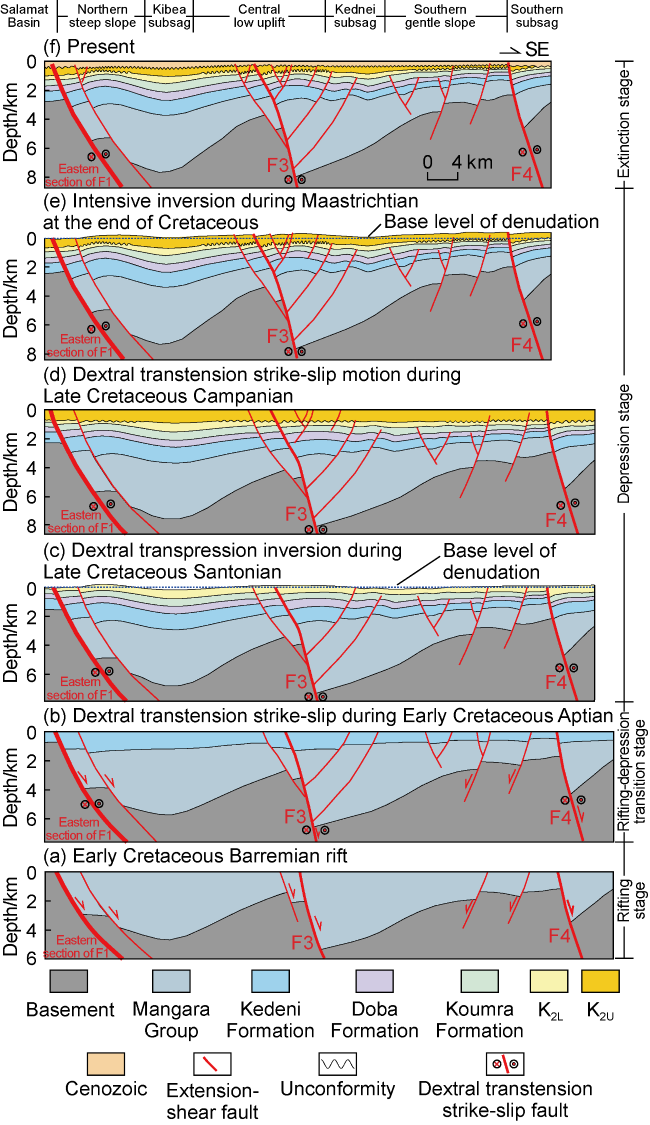
Fig. 9. Tectonic evolution profile trending near N-S direction of the study area (according to the BB’ seismic section, see |
The faults trending NWW-SEE direction in the Salamat Basin extend parallel to the sag-controlling fault named F6 spreading along the short axis of the Salamat Basin (Fig. 1b ), which suggests that strike-slip displacement in near E-W direction transited to extensional displacement in NNE-SSW direction at the bended section of the Borogop fault thus leading to the Salamat pull-apart basin. It can be deduced that the strike-slip displacement of the Borogop fault approximately equals to the length of the long axis of the Salamat Basin, namely the length of the northeastern section of F1. The Doba Basin, which is also located at the flank of the CASZ, should have the same basin genetic mechanism with the Muglad Basin evidenced by development of the Early Cretaceous rift and the Late Cretaceous rift in the Doba Basin. Due to feeble activity of the western section of the CASZ during the Cenozoic, the Cenozoic rift was not developed in the Doba Basin. As a result, the Doseo, Salamat, and Doba Basins have different genetic mechanisms and only the Salamat Basin is a pull-apart basin.
In conclusion, the Doseo Basin is an early aborted intracontinental passive rift basin transformed by the strike-slip movement and the tectonic inversion and is characterized by the feature of short rifting and long depression. In the rift-depression transition stage and the depression stage, the Doseo Basin was transformed by long-term strike-slip movement and two stages of tectonic inversions (Fig. 9b-9e ).
4.1.2. Genetic mechanism of strike-slip faults
A large amount of echelon extension-shear faults and a few of reverse faults were developed in the Doseo Basin triggered by the dextral transtension of the principal shear fault F1. According to the Riedel dextral simple shear model, the extension-shear and the reverse faults were generated by the extension-shear component and the contraction component of F1, respectively. With the anticlockwise rotation of the strike from NW-SE to E-W, the strike-slip displacement component of the extension- shear faults gradually increased. Meanwhile, the subsag- controlling faults F2-F3 as well as the subsag-controlling fault F4 and the sag-controlling fault F5 transited to the R-type shear faults (Riedel syn-directional shear faults) intersecting with the principal displacement zone at an acute angle of 10°-30° whose vertex points to the displacement direction of the local plate [26] and the P-type shear faults roughly symmetrical with the R-type shear faults relative to the principal displacement zone and intersecting with the principal displacement zone at an acute angle whose vertex points to the displacement direction of the opposite plate [26], respectively (Fig. 6b-6d , 6f ). Dextral transtension strike-slip fault system thus appeared in the Doseo Basin and consisted of the main trunks including the main shear fault (F1), R-type shear faults (F2-F3), and P-type shear faults (F4-F5) as well as the branches showing as the echelon strike-slip associated faults (Fig. 6b , 6d and 6f ).
The lasting activity of the CASZ was controlled by the dextral shear opening of the equatorial south Atlantic[2-3,10,17 -18,27⇓⇓ -30] and caused long-term and inherited development of the strike-slip fault system in the Doseo Basin. The quantity of the strike-slip associated faults active in each period indicates that the strike-slip transformation intensity gradually weakened during the Cretaceous, which is consistent with the opening process of the equatorial south Atlantic from the intracontinental rift basin, the intercontinental rift basin to the embryonic ocean basin suggesting gradually attenuated tectonic-activity intensity. The rapid expansion of the Indian Ocean and the opening of the Red Sea successively triggered the reactivation of the CASZ and thus led to the development of the Cenozoic rifts in the eastern section of the CASZ since the Eocene, such as the Muglad Basin [2⇓-4,7⇓ -9,11⇓⇓⇓⇓⇓ -17]. However, the active intensity in the western section of the CASZ was significantly weaker than that in the eastern section and the Doseo Basin only underwent feeble dextral transtension strike-slip transformation during the Eocene. In addition, the development of the dextral transtension strike-slip fault system in the Doseo Basin was interrupted by the Santonian tectonic inversion and the latest Cretaceous tectonic inversion. Taking the two interruptions of the fault activity period caused by the tectonic inversions as dividing basis of fault activity phases especially for the long-term and inherited faults, the strike-slip faults in the Doseo Basin thus can be divided to three phases of faults, i.e., the Aptian-Coniacian faults, the Campanian faults, and the Eocene faults, in combination with the stratigraphic ages displaced by faults (Fig. 7 ).
4.1.3. Genetic mechanism of tectonic inversion
No rotational inversion took place in F1 proved by the characteristics of the strike-slip faults in the Doseo Basin (Fig. 6 ). Rotational inversion of the CASZ [2-3,9,20] and motion direction variation of the sub-plates within the Africa plate [18] thus are unable to interpret the genetic mechanism of tectonic inversion rationally. Moreover, the genetic interpretation of the inversion in mantle convection direction variation [22-23] is also contrary to the nature of the Doseo passive rift basin. This paper uncovered that the Doseo Basin experienced two stages of tectonic inversions. The first-stage inversion is characterized by occurrence of the echelon nose-shaped uplifts trending NE-SW to NNE-SSW direction and intersecting with F1-F5 at an acute angle (Fig. 6c ), which exhibits dextral shear transpression feature that is coincident with the regional tectonic setting of the convergence of Africa and Eurasia [31⇓-33] leading to the transition of the CASZ from transtension to transpression. Meanwhile, it was the NW-SE contraction stress induced by the dextral transpression of F1 that resulted in fold deformation of the Doseo Basin during the first-stage inversion. In addition, the second-stage inversion is featured by integral elevation-denudation and folding deformation of the Doseo Basin (Fig. 6e ). The structures triggered by the second-stage inversion are parallel to the long axis of the basin (the Central low uplift is the most typical) (Fig. 6e ), suggesting that the direction of the maximum principal stress is perpendicular to the long axis of the Doseo Basin (Fig. 6e ). The second-stage inversion thus is caused by the compression stress generated from the convergence of Africa and Eurasia.
At present, the age of the second-stage inversion is still controversial. Some scholars suggest that the second-stage inversion occurred during the Paleogene rather than the Santonian when intensive tectonic inversion took place in the Bongor Basin [1]. On the contrary, the intensive Santonian inversion in the Bongor Basin had little impact on the Doseo Basin [1,34 -35]. The intensive inversions of the Doseo Basin and the Bongor Basin should be controlled by synchronous tectonic event because the geotectonic positions of the Doseo Basin and the Bongor Basin are both within the control area of the western section of the CASZ and are about 50 km apart from each other. The Doseo Basin is located within the CASZ, so it underwent intensive strike-slip transformation. Because the Bongor Basin is located in the north flank of the CASZ, however, the dextral transpression inversion of the Doseo Basin could appear in the form of compression inversion during the Santonian. Due to the strong erosion of the Upper Cretaceous caused by fierce denudation, however, the interpretations about the inversion of the Bongor Basin are multiple. Because the convergence intensity of Africa and Eurasia at the latest Cretaceous was much greater than that during the Santonian [7,31⇓ -33], both the most intensive inversion of the Doseo Basin and the Bongor Basin should take place at the latest Cretaceous. Additionally, syn-deformation growth strata did not occur in the Doseo Basin during the Paleogene (Fig. 8b ). In contrast, incised valleys overlying the top of the Cretaceous were developed extensively in the Doseo Basin during the Paleocene (Figs. 3d and 4b ), which testifies that the age of the second-stage inversion was earlier than the Paleocene. In conclusion, the second-stage inversion of the Doseo Basin occurred at the latest Cretaceous. It was the second-stage inversion that led to the exposure and the intensive paleogeomorphology relief of the basin, which provides provenance and accommodation space for the development of the incised valleys during the Paleocene when the Cretaceous was denudated at the structural highs and the clastic rocks from the Cretaceous accumulated at the structural lows through the incised valleys.
4.2. Basin evolution
4.2.1. Early Cretaceous Barremian rifting stage
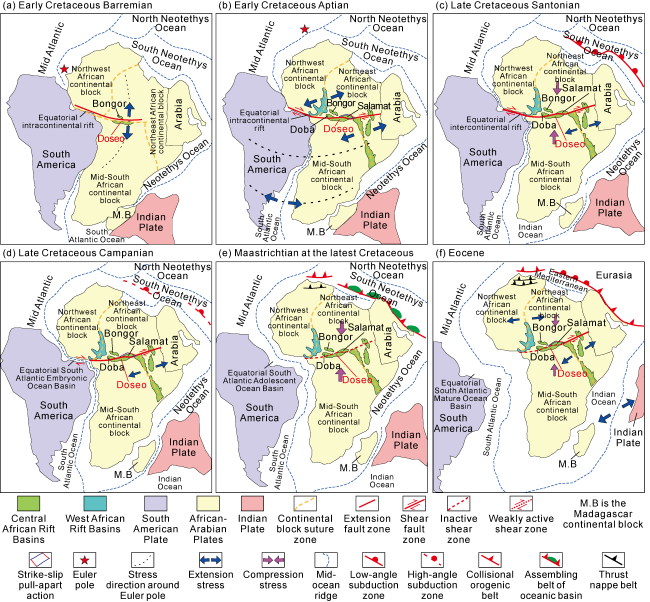
At the beginning of the Early Cretaceous, the African and South American continents started to split from south to north triggered by activity of the Tristan mantle thermal plume in the West Gondwana continent [3,7 -8,21,27 -28], which thus induced reactivity of the lithosphere in the Central Africa. Based on regional gravity and paleo-magnetic data, Fairhead [17-18] restored the positions and the stress fields of the African plate and the South American plate, which reveals that the Euler pole, the intersection point of the axis passing through the center of the sphere and rotated by motional plates on the sphere with the spherical surface, was located at the west to the West Africa or the east to Somalia during the Barremian (Fig. 10a ). According to the model of the paleo-plate position and the paleo-plate motion restored by Fairhead, the western section of the CASZ experienced near N-S extension evidenced by thinning of the crust underlying the rift basin group in the western section of the CASZ confirmed by the Moho-scale Bouguer gravity anomaly [17-18]. The regional extensional stress field in the CASZ during the Barremian restored by Fairhead is consistent with that uncovered by this paper which led to the development of the basement extension faults trending near E-W direction in the Doseo Basin (Figs. 6a , 9a and 10a ). Therefore, it was the near N-S extensional stress that led to the Doseo rift basin in the initial stage of the opening of the South Atlantic.


4.2.2. Early Cretaceous Aptian rifting-depression transition stage
During the Aptian, the equatorial south Atlantic began to be gestated [2-3,27⇓ -29]. In order to coordinate the differences between the expanding of the Mid Atlantic and the South Atlantic, the equatorial south Atlantic opened in a dextral shear form [10,17 -18,27 -28,30], that is, the Northwest African sub-plate and the Northeast African sub-plate moved towards the right relative to the South American plate and the Mid-South African sub-plate (Fig. 10b ). The tectonic stress in the CASZ thus transited from the near N-S extension during the Barremian to the near E-W dextral transtension shear (Fig. 10b ). Moreover, the sedimentary period of the Kedeni Formation was right in the transition phase of the extensional stress field to the strike-slip stress field and thus the Doseo Basin possessed the rifting-depression transition characteristics during the Aptian when F1-F5 still had control on deposition of the Kedeni Formation but the shape of the dustpan- shaped rifts faulting in the north and overlapping in the south had basically disappeared accompanied by appearance of a united lake basin due to connection of the faulted lake basins previously separated from each other and the dextral transtension strike-slip fault system began to be developed in the Doseo Basin (Fig. 9b ).
4.2.3. Early Cretaceous Albian-Late Cretaceous depression stage
With transition of the tectonic stress field from extension to shear in the CASZ [2-3,7⇓⇓ -10,17⇓⇓⇓ -21], the rifting growth of the Doseo Basin in near N-S direction ended during the Albian and thus the subsidence center migrated from the downthrown walls of the depression-controlling faults, the sag-controlling faults, and the subsag-controlling faults to the basin center, which indicates that tectono- thermal subsidence dominated the subsidence in the Doseo Basin whose evolution thus entered into the depression stage characterized by occurrence of the dextral transtension strike-slip faults and the tectonic inversion structures (Fig. 9 c-9e). The above tectonic characteristics of the Doseo Basin in the depression stage was consistent with the regional tectonic setting of the dextral shear opening of the equatorial south Atlantic (Fig. 10c-10e ). Initial oceanic crust ages of the equatorial south Atlantic are 80-110 Ma before present from north to south [17-18] uncovered by the seafloor magnetic anomaly strips, which suggests that the shear opening of the equatorial south Atlantic continued from the Aptian to the Campanian thus leading to the long-term and inherited development of the strike-slip faults in the Doseo Basin (Fig. 9b-9d ), only shortly interrupted by the Santonian inversion (Fig. 9c ). At the latest Cretaceous, the Doseo Basin underwent intensive tectonic inversion (Fig. 9e ).
As a result of the northward subduction of the south Neotethys Ocean beginning with the Santonian, the African-Arabian plates began to converge towards Eurasia. The regional unconformity within the Upper Cretaceous and the Syrian arc fold belt with a length of ~1000 km thus occurred in the Levant margin and the eastern margin of the North Africa triggered by the convergence between the African-Arabian plates and Eurasia during the Santonian [31⇓-33]. The unconformity within the Upper Cretaceous and the fold deformation of the Cretaceous, occurring in the Levant margin and the eastern margin of the North Africa, were also extensively developed in the Doseo Basin (Fig. 9c ). It is indicated that the Santonian inversion in the Doseo Basin could be related to the plate convergence taking place in the north margin of Africa. Meanwhile, the dextral shear opening of the equatorial south Atlantic continued during the Santonian [10,17 -18]. In consequent, under the combined action of the convergence between Africa and Eurasia and the dextral strike- slip motion of the CASZ, the Doseo Basin experienced dextral transpression inversion (Fig. 10c ) thus leading to the echelon nose-shaped uplifts trending NE-SW direction to NNE-SSW direction and the unconformity in the high parts of those uplifts (Fig. 9c ). During the Campanian, the convergence between Africa and Eurasia attenuated possibly caused by increasing of the Neotethys subduction angle [31⇓-33] and thus the dextral transtension strike-slip motion reoccurred in the CASZ (Fig. 10d ), which triggered that strike-slip faults reappeared in the Doseo Basin and cut the Santonian nose-shaped uplifts (Fig. 9d ).
At the latest Cretaceous, the equatorial south Atlantic had completely opened appearing in the form of a narrow oceanic basin and the differential expansion between the Mid Atlantic and the South Atlantic disappeared because they had been connected by the equatorial south Atlantic[2,11,21,29] (Fig. 10e ). The expansion of the equatorial south Atlantic thus no longer affected the activity of the CASZ; moreover, the rapid expansion of the Indian Ocean[2⇓-4,21] and the opening of the Red Sea [2⇓-4] had not occurred yet, in consequent, the CASZ entered a short dormant period (Fig. 10e ). At the latest Cretaceous, the closure of the back-arc ocean basins on the subduction belt, however, took place because of reinforcing of the subduction intensity of the south Neotethys and the subsequent collision of those oceanic crust fragments with the northern margin of the African-Arabian plates occurred (Fig. 10e ), leading to extensive appearance of the top Cretaceous unconformity in the east of the North Africa and the Levant margin [7,31⇓ -33]. Meanwhile, collision of the Iberian continental blocks and the Adriatic continental blocks with Eurasia induced intensive orogeny of the Pyrenees-Alps in the southern margin of Europe and the Atlas in the northwestern margin of Africa [7,32] (Fig. 10e ). The intensive convergence of Africa and Eurasia at the latest Cretaceous thus triggered fierce elevation-denudation and fold deformation in the Doseo Basin, which induced the regional tectonic unconformity on top Cretaceous and superimposition of the near E-W structural configuration on the Santonian inversion structures. Consequently, the tectonic pattern was finally shaped in the Doseo Basin (Figs. 9e and 10e ).
4.2.4. Extinction stage during Cenozoic
During the Eocene, the rapid expansion of the Indian Ocean triggered faint dextral transtension strike-slip motion of the CASZ [2⇓-4,21] and consequently resulted in the development of the thin Eocene and the dextral transtension strike-slip fault system in the Doseo Basin (Fig. 10f ) which cut the Santonian inversion structures and the latest Cretaceous inversion structures (Fig. 9f ). With the continuous convergence of Africa and Eurasia [7,31⇓ -33] and the cease of tectonic activity in the western section of the CASZ, tectonic subsidence in the Doseo Basin stopped since the Oligocene, leading to being filled up of the basin (Fig. 9f ).
5. Conclusions
Four stratigraphic unconformities, i.e., top Basement (Tg), top Mangara Group (T10), top of lower Upper Cretaceous (T5) and top Cretaceous (T4), were developed in the study area. T10 is the transformation interface of the basin structure separating the rifting deposition from the rift-depression transition and the depression deposition. The structural unconformity T5 is developed in the high parts of the nose-shaped uplifts striking NE-SW to NNE-SSW directions. T4 is a regional tectonic unconformity.
Four faulting stages, i.e., Barremian extension stage, Aptian-Coniacian strike-slip stage, Campanian strike-slip stage, and Eocene strike-slip stage, were developed in the study area. The basement extension faults controlled the development of the rifts. Dextral transtension strike-slip faults, whose active history could be divided into the above three stages, were characterized by inherited activity but gradually weakened intensity. The principal shear fault (F1) controlled the development of the strike-slip fault system composited of F1, R-type shear faults (F2-F3) and P-type shear faults (F4-F5) as trunks as well as the echelon strike-slip associated faults as branches.
Two stages of tectonic inversions, i.e., the Santonian inversion and the latest Cretaceous inversion, were developed in the study area. The Santonian dextral transpression inversion caused folding deformation of the basin, thus inducing formation of the echelon nose- shaped uplifts trending in NE-SW direction to NNE-SSW direction and the unconformity of T5. The latest Cretaceous intensive inversion triggered that the basin underwent violent elevation-denudation and folding deformation, which led to the regional unconformity of T4 and the superimposition of the near E-W structural configuration on the Santonian inversion structures. The tectonic pattern of the basin thus was finally shaped. In addition, those two stages of inversion structures were both cut by late faults.
The Doseo Basin was an early aborted intracontinental passive rift basin transformed by the strike-slip motion and the tectonic inversions and underwent four evolutional stages with the characteristics of short rifting and long depression, i.e., Barremian rifting stage, Aptian rifting-depression transition stage, Albian-Late Cretaceous depression stage, and Cenozoic extinction stage, under the control of the tectonic movements between Africa and its peripheral plates. The initial splitting between the African and South American continents induced the rifting of the Doseo Basin and thus led to the embryonic Doseo rift basin. Subsequently, the strike-slip activity of the CASZ caused by the dextral shear opening of the equatorial south Atlantic induced that the Doseo Basin entered the depression evolutional stage through the rift-depression transition stage and experienced long-term strike-slip transformation. The active intensity of the strike-slip faults gradually attenuated in the Doseo Basin because the splitting intensity between the African and South American continents varied in the equatorial section over time. Under the combined action of the dextral strike-slip motion and the convergence between Africa and Eurasia, the dextral transpression inversion took place in the Doseo Basin during the Santonian. At the latest Cretaceous, the complete separation of the African plate from the South American plate in the equatorial section caused the CASZ entered a short dormant period and the fierce convergence between Africa and Eurasia led to the violent compression inversion of the Doseo Basin. During the Eocene, the rapid expansion of the Indian Ocean triggered faint dextral transtension strike-slip motion of the CASZ and thus made that strike-slip faults with feeble activity were developed in the Doseo Basin once again. With the continuous convergence of Africa and Eurasia and the cease of tectonic activity in the western section of the CASZ, the Doseo Basin was filled up and extinct since the Oligocene.