

Introduction
Black carbon (BC) is a relatively stable and ubiquitous carbon compound composed of aromatic hydrocarbon polymers and elemental carbon or carbon with a graphite structure. It is an impure carbon compound resulting from the incomplete combustion of combustible materials, including charcoal, coke, soot, elemental carbon, and pyrocarbon [1⇓-3]. Scott proposed a variety of definitions for BC [4], incorporating both macro- and micro-charcoal [5⇓⇓-8]. At present, research on BC has focused on environmental fields. Paleobotanists and coal petrologists generally believe that recognizable charcoal in BC is the product of ancient wildfires [4,9⇓⇓⇓ -13] and BC is the “key” to understanding ancient climate and environments [14-15]. Since the first wildfire was identified in the Late Silurian [16], no evidence of wildfires has been found in the Triassic, especially the Early and Middle Triassic [17]. For example, no evidence of wildfires has been discovered in the Eastern Tethys region where the Ordos Basin is located during the Middle Triassic.
Total organic carbon content (TOC) is generally regarded as a key parameter for selecting and evaluating favorable oil and gas exploration zones in the petroleum industry. For example, TOC should be higher than 4% for selecting shale oil plays in North America, and higher than 2% in China. In addition, TOC should be more than 6% for shale oil in the in-situ conversion process [18⇓⇓-21]. As an important parameter for evaluating source rocks, TOC includes organic matter not only from lower biological sources contributed by marine and lacustrine shallow water, but also BC from land and rivers or even airflow [1,2,8]. Chemically, TOC contains not only convertible carbon (CC, e.g., kerogen) which can be degraded into petroleum, but also residual or dead carbon (RC) that cannot generate hydrocarbon [3,22]. In particular, some studies found that the proportion of BC in TOC in some samples exceeded 50% [2,23], so that BC is an indispensable component in the evaluation of source rocks [22].
The Ordos Basin has developed the Yanchang Formation which is rich in organic matter in the Middle Triassic[24-25]. At the same time, as the target for oil and gas exploration shifted to unconventional oil and gas in shale formations in the past 10 years, the Chang 7 Member has become not only the largest shale oil and tight oil province in China but also a hot spot of shale oil research and the most active area of exploration [26⇓⇓-29]. The evaluation of source rocks in the Yanchang Formation in the Ordos Basin is crucial for the evaluation of resource potential and the selection of favorable exploration zones for shale oil and conventional oil. This study found that the TOC of shale is relatively high locally, but oil and gas discoveries and output are not satisfactory, affecting future assessment and enlargement of shale oil potential in the Ordos Basin.
This study selects the Chang 7 shale in the Ordos Basin with the highest organic matter abundance in China to analyze BC through high-precision dating, qualitative and quantitative analysis in three wells in different sedimentary systems, and achieve three objectives. First, characterize BC and charcoal with recognizable structures in the Chang 7 shale. Second, quantify BC and its distribution. Third, quantify TOC and alternative indicators for shale oil sweet spot evaluation.
1. Geologic setting
The Middle Triassic in the Ordos Basin was located in the East Tethys at paleolatitude of approximately 15-30°N. Located on the northern side of the Qinling Mountains and as the most important hydrocarbon-bearing basin in China [25], the basin has developed strata ranging from the Great Wall System to the Quaternary, with a sedimentary thickness of 5 000 m to 10 000 m and an area of approximately 25×104 km2 [33]. At the beginning of the Early Permian, the Ordos Basin uplifted to dry land, and deltaic-lacustrine deposits began accumulating while seawater gradually withdrew. Following the sedimentary system of the Late Permian, the Early and Mesozoic Triassic consist of fluvial-lacustrine and deltaic-lacustrine sediments (Fig. 1 ) [24,34], especially the Middle Triassic terrestrial sediments that are very continuous are conducive to studying BC and source rock.
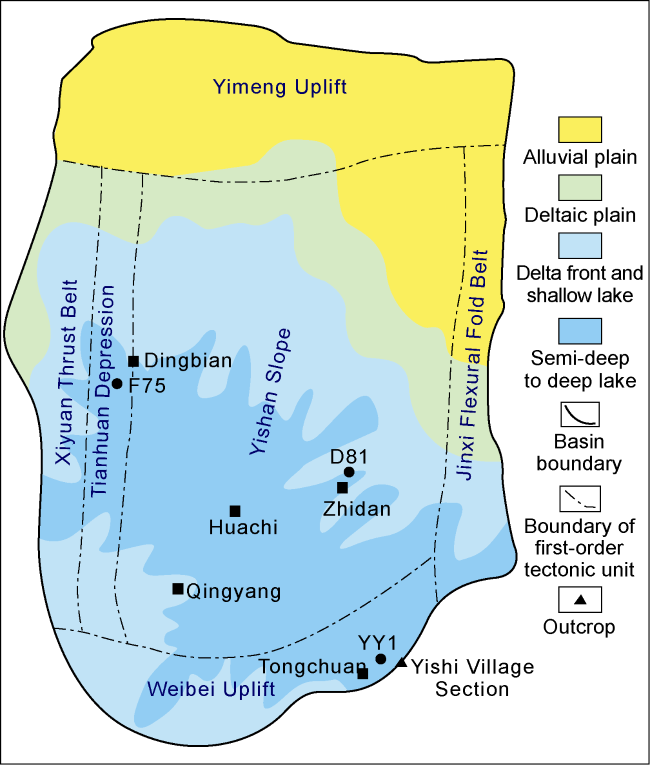
Fig. 1. Sedimentary facies of the Chang 7 Member in the Ordos Basin. |
The Triassic in the Ordos Basin includes the Lower Triassic Liujiacun Formation (T1l) and Shangshagou Formation (T1h), the Middle Triassic Zhifang Formation (T2z), and the Middle-Upper Triassic Yanchang Formation [35]. The Yanchang Formation is divided into 10 members, which are Chang 10 to Chang 1 members from the bottom up. Chang 10-Chang 7 members represent the Middle Triassic [24-25]. Chang 7 Member was deposited in the maximum flooding period as a sedimentary system dominated by deep-semi-deep lacustrine facies in the southern-central part of the basin. These high-quality source rocks and gravity quicksands are targets for shale oil and tight oil exploration [36-37]. The TOC of the Chang 7 shale is high, generally from 6% to 22%, and the highest at 30%-40%. With the advantages of strong hydrocarbon generation and close accumulation, oil distribution in the Chang 7 shale is widespread, making it a hot spot for shale oil research [38⇓-40].
2. Samples and experimental methods
2.1. Samples
Samples for BC separation, quantification, and SEM characterization were taken from different sediment systems of the Yanchang Formation in three wells. They are Chang 7 samples belonging to deltaic and semi-deep to deep lacustrine subfacies. The lacustrine shale is approximately 20 m thick in the southeast well YY1 and the northeast well D81, and over 100 m in the northwest well F75. Totally 44 samples were taken, including 19 samples from Well YY1, 5 from Well D81, and 20 from Well F73 (Fig. 2 ). At the dating laboratory of Massachusetts Institute of Technology, the U-Pb age of a tuff sample at 243.36 m in Well YY1 was determined to be (241.36±0.12) Ma using the isotope dilution thermal ionization mass spectrometry (ID-TIMS) [25], and the latest date at shallower 155.70 m in the well is (240.72±0.07) Ma, indicating the lacustrine shale belongs to the Middle Triassic Ladinian.
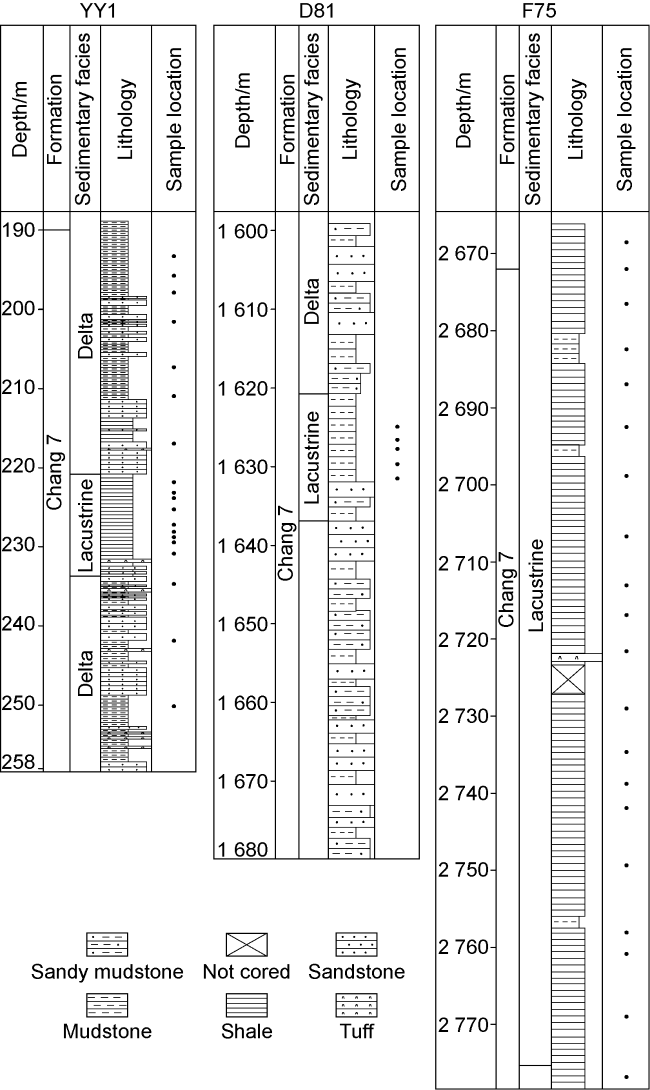
Fig. 2. Chang 7 sample locations in three wells. |
2.2. Experimental methods
The dichromate oxidation method was used to separate and quantify the BC in the Chang 7 Member [41]. First, removed carbonates and silicates from the powdered sample by using 6 mol/L HCl, 6 mol/L HCl +22 mol/L HF, and 6 mol/L HCl, in order. Then a 0.5 mol/L K2Cr2O7 + 2 mol/L H2SO4 solution was used to oxidize the treated sample at 55 °C for 300 h to remove the organic matter. The K2Cr2O7 + H2SO4 solution, reaction time, and temperature were determined after comparative experiments on different types of kerogens and charcoal. They are effective for eliminating three types of kerogen, but have a minimal impact on BC, so these conditions are the best for separating BC from low to medium mature shale (Ro <1.0%)[42]. The experiment residues contain black carbon, including charcoal and atmospheric BC particles [41]. The BC content in the residues was determined using an elemental analyzer (Elementar Vario EL CUBE, Hanau, Germany) and following a standard high-temperature (950 °C) combustion procedure, and every data point was repeated for reliability. The morphology of the BC was observed under a Hitachi S8010 SEM system equipped with a secondary electron (SE) and a back-scattered electron detector (BSED).
TOC analysis was performed using a LECO CS230 carbon and sulfur analyzer according to the GB/T 19145-2003 national standard. First, use an electronic balance to weigh ~10 mg of the sample powder, place in a porous porcelain crucible and heated in a muffle furnace at 1 000 °C for 2 h. Second, add enough 12.5% HCl and heated the sample on an electric heating plate at 60°C until the complete reaction. Third, place the crucible in a filter container and use distilled water to rinse the sample every 0.5 h to 1 h for 3 d. Fourth, place the crucible in a dry furnace at 60 °C, and then measure the organic carbon after cooling.
Rock-Eval pyrolysis was conducted at PetroChina Key Laboratory of Petroleum Geochemistry following the GB/T 18602-2012 specification. 30-50 mg of sample powder was pyrolyzed in a Rock-Eval 6 crucible, and parameters including free hydrocarbon (S1), pyrolytic hydrocarbon (S2), CO2 (S3) and Tmax were obtained. Then hydrogen index (HI) and oxygen index (OI) were calculated using S2, S3 and TOC.
3. Experimental results
3.1. Basic geochemical parameters
Organic matter in the Chang 7 shale is unevenly distributed; however, the TOC of most samples from wells YY1, D81 and F75 is higher than 2%, and the hydrocarbon generation potential (S1+S2) exceeds 10 mg/g, indicating excellent high-quality source rocks. A few samples from F75 have TOC between 1% and 2%, and hydrocarbon generation potential (S1+S2) between 6 mg/g and 10 mg/g, classifying them as good source rocks (Fig. 3a ). Some samples from YY1 have TOC less than 1.0%, and S1+S2 between 2 mg/g and 6 mg/g, indicating they are intermediate source rocks. According to the TOC-S2 scatters map, the organic matter in the Chang 7 shale in the three wells is type II (Fig. 3b ).
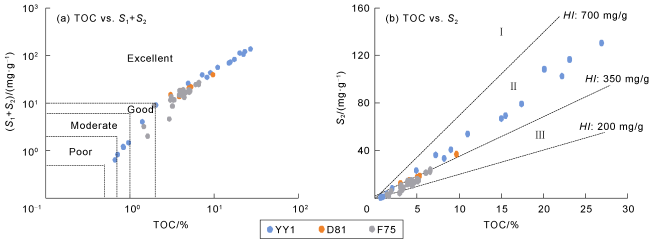
Fig. 3. Relationship between TOC vs. (S1+S2) and S2 of Chang 7 Member source rocks. |
According to the HI-OI and HI-Tmax relations, the organic matter of the shale samples from YY1 and D81 is Type II1 and that from F75 samples is Type II2 and some samples from YY1 contain Type III organic matter (Fig. 4 ). All the shale samples from the three wells are immature to early mature. The samples from D81 are a little more mature than the samples from F75, while the samples from YY1 are immature. This finding is consistent with the observation of outcrops in the study area [39].
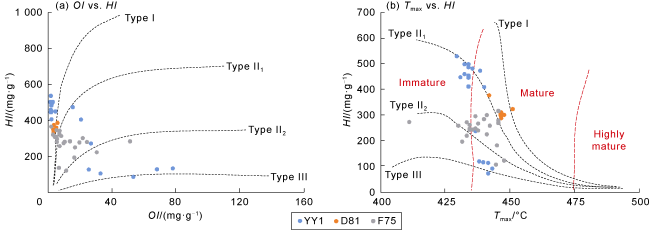
Fig. 4. Relationship between OI, HI, and Tmax of Chang 7 Member source rocks. |
3.2. The morphology of black carbon in Chang 7 shale
The BC in the Chang 7 shale in three wells are microparticles, generally less than 180 μm [4]. Under a microscope, the shapes and sizes of the BC particles are similar (Figs. 5 and 6 ). the edges are angular, the roundness is medium and the sortability is poor to moderate. Some BC particles retain the morphological characteristics of original plant fragments piror to burning. The particle sizes vary greatly, mostly between several microns and tens of microns, and some 100 μm. Most BC particles are like plates and flakes (Fig. 5a , 5b). The roundness of the small particles is better than the large ones, and the former tend to aggregate (Fig. 5c ).
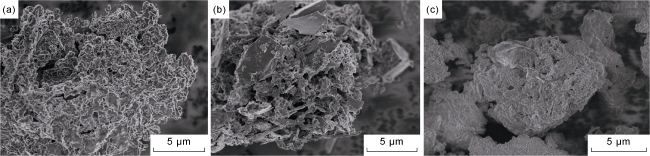
Fig. 5. SEM images of black carbon in Chang 7 shale. (a) BC aggregates in Chang 7 shale, 221.8 m, Well YY1; (b) BC aggregates in Chang 7 shale, Well D81, 1 628.4 m; (c) amorphous BC aggregates, Well F75, 2 721.95 m. |
BC structures are divided into six types according to morphology. (1) Irregular flaky BC. It has a rough surface and spaced and dense micro-pores (generally less than 1 μm, Fig. 6a ). This kind of BC structure is very similar to the pinnules of a fern found in the Early Cretaceous in Kallenhardt, Germany [43]. (2) Ellipsoidal BC. It is porous, with a smooth surface and connected with dendrites, and the pores are several micrometers (Fig. 6b ). (3) Sheet BC with a complete angular structure. Compared with the first and the second types, the number of pores in sheet BC is small but the pore size is large (approximately 5 μm, Fig. 6c ). (4) Dendritic massive BC with complete texture, similar to the plant fragments proposed by Stoffyn-Egli et al.[44] (Fig. 6d ). (5) Cork fragment, a common plant structure (yellow circle in Fig. 6f ), much like the Gymnospermous charcoal found in the Middle Triassic in Pirmasens, South Germany [45]. (6) Clastic BC, smooth and blocky, with no or a few isolated pores (Fig. 6f ). The morphological differences of these BCs are related to the types of plants. It is believed that most BCs are the products of incomplete burning of plants, and a few may be the residues of volcanic activity [4].
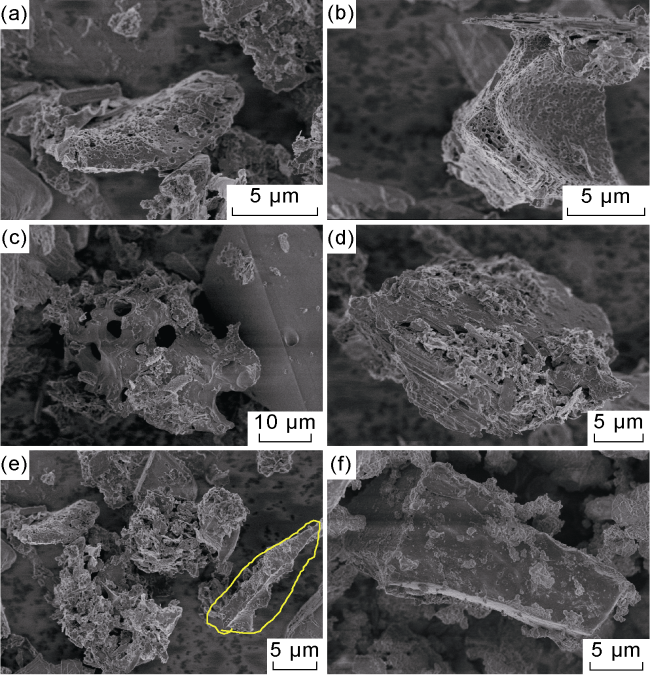
Fig. 6. SEM images of BC in Chang 7 shale at 225.10 m in Well YY1. (a) Irregular flaky BC; (b) ellipsoidal BC; (c) flaked BC with an angular structure; (d) dendritic massive BC with complete texture; (e) cork fragment; and (f) clastic BC. |
3.3. BC quantification
The BC content (wb) in the Chang 7 shale in the Ordos Basin is different vertically and laterally (Fig. 7 ). The BC content in Well YY1 in the southeast is from 0.1% in the deep interval to 6% in the middle and then falls to less than 0.1% in the shallow interval. The highest BC content is 6% in the middle, where the wb/TOC ratio exceeds 20%, attributed to the consistently highest points of BC and TOC. Their second-highest points are also consistent, with a wb/TOC ratio close to 20%. In other intervals, the wb/TOC ratio is around 10%. In Well D81 in the northeast, the BC content ranges from 0.1% in the deep interval to a maximum of 6% in the middle, then drops to less than 0.1% in the shallow interval, with the wb/TOC ratio being slightly lower than that in Well YY1. The highest wb/TOC ratio is from 5% to 10%, and the rest is below 5%. The BC content in Well F75 in the northwest is from below 0.1% to 0.2% and then falls to below 0.1%. The wb/TOC ratio is stable at approximately 5%, including two relatively high peaks (Fig. 7 ).
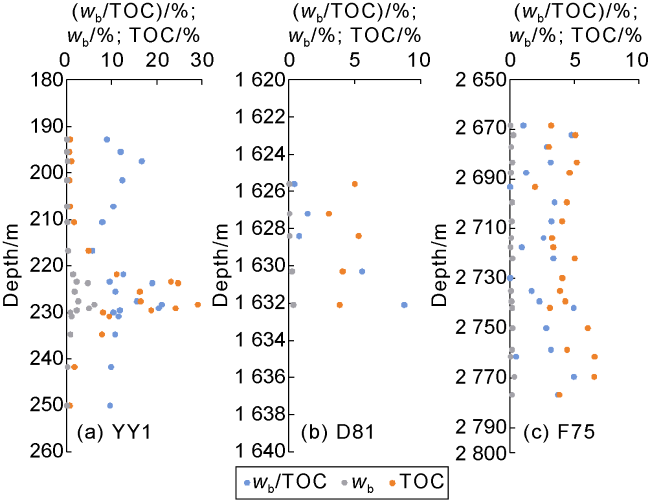
Fig. 7. TOC, wb, and wb/TOC in Chang 7 shale in three wells in the Ordos Basin. |
According to wb and wb/TOC ratio, laterally, the highest BC content takes place in the southeast where Well YY1 is located, while the BC content in the northeast where Well D81 is located and in the northwest where Well F75 is located is relatively low; vertically, the highest BC content takes place in the shale section with the most abundant organic matter, which is up to 6%, and contributes to TOC by 20%. In summary, the influence of BC on TOC in the Chang 7 shale from the largest to the smallest is from the southeastern to the northeastern, and to the northwestern. The influence of BC should be considered when evaluating the source rocks in the southeast.
4. Discussion
4.1. BC significance on climate and environment
A large amount of BC was found in the Chang 7 shale section in the Ordos Basin, greatly updating the existing database of ancient wildfires in the Middle Triassic. The traditional view is that the largest known extinction in the Phanerozoic, which occurred at the end of the Permian, not only had a serious impact on the marine ecosystem but also caused a heavy blow to the continental ecosystem [46⇓-48]. This led to extensive plant extinction and missing BC records, namely a “gap” in BC development. Recent studies have found that the extinction event at the end of the Permian had a lesser impact on terrestrial biota, especially plants, than on marine organisms [49⇓-51]. Although the number of places where BC was found has been increasing since the Anisian Stage of the Middle Triassic, reports of BC in the Middle Triassic are still rare worldwide [52-53], resulting in a vague picture of the land plants in this period [51-52]. According to our statistics, there are only three known records of BC from the Middle Triassic Ladinian worldwide: southern Germany [30], the Cuyana Basin in Argentina [31], and the Ritberg area in northern Italy [32]. The discovery of BC with an obvious charcoal structure is the first in the East Tethys region on the eastern side of the Pangaea, which not only adds to the record of wildfires during this period but also provides basic data for further exploration of paleo-oxygen levels, paleovegetation, and paleoclimatic studies in the eastern Tethys region (Table 1 ).
Table 1. Ladinian black carbon discoveries worldwide |
| Basin/Region | Country | Age | Type | Reference |
|---|---|---|---|---|
| Ritberg | Italy | Ladinian | Macro-charcoal | [32] |
| Cuyana Basin | Argentina | Ladinian | Macro-charcoal | [31] |
| Franconia | Germany | Ladinian | Macro-charcoal | [30] |
| Ordos Basin | China | Ladinian | Micro-charcoal | This study |
For the “BC gap” or “BC depression” in the Early and Middle Triassic, ABU Hamad et al. concluded some possible causes [54], such as lower oxygen concentration than the combustion threshold, lack of combustible plants, or no deposits suitable for preserving BC [4,45]. The Ladinian BC discovery in the Ordos Basin provides evidence for the reconstruction of paleovegetation and paleoclimate. In terms of paleovegetation of the Middle Triassic, studies have found that plants existed during the Middle Triassic, and even amber fossils have been discovered [32]. In particular, on outcrops near our study area, a large number of new species of plant fossils have been found, with the BC containing a large number of micropores being very similar to in-situ SEM photos of the plants [55], confirming that there were combustion conditions during the Middle Triassic Ladinian Stage in the Ordos Basin. In addition, some studies attributed the scarcity of wildfires during the Early Triassic to extremely low oxygen concentration and the subsequent increase in pieces of evidence of wildfires during the Middle and Late Triassic to a rise in oxygen concentration [56]. Despite different geochemical models for recovering the oxygen concentration in the Triassic atmosphere [57⇓⇓⇓⇓-62], this study believes that the oxygen concentration had reached the threshold (greater than 15%), so oxygen was not a factor controlling the ignition and spread of wildfires [54,63]. The three sites of BC discovery also indirectly support that oxygen concentration was above the combustion threshold during the Ladinian Stage. BC has been evidence of widespread fires at the transition between the Cretaceous and the Tertiary and has served as an indicator of atmospheric oxygen concentration [64⇓-66]. Indeed, in the early 19th century, scientists recognized that plant fossils were the key to understanding paleoclimate and paleoenvironment [14-15]. The BC in Well YY1 provides a basis for future paleobotanical research. Further studies will not only enhance our understanding of the terrestrial plants, climate, and atmospheric oxygen concentration in the eastern Tethys region during the Middle Triassic (Fig. 8 ), but also address the scientific issues pertinent to the regional earth system as reflected in the BC records of fires [12⇓⇓⇓-16].
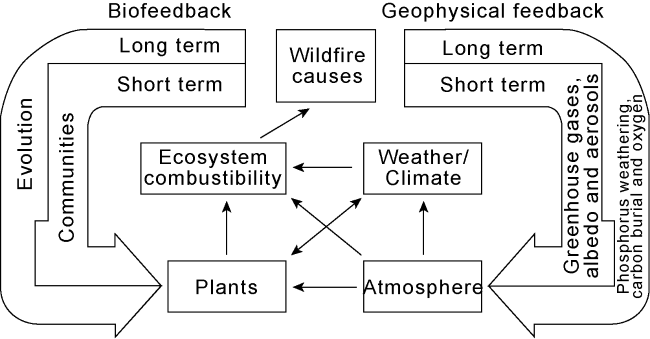
Fig. 8. Wildfire causes and impacts on biological and geophysical processes (adapted from Reference [67]). |
The BC content in Well YY1 is the highest, and that in the other two wells is low, which may reflect the propagation path and preservation conditions of BC [68]. However, given the propagation and deposition law of BC, the propagating distance of coarse BC particles is short, since the depositional location is close to the fire source area. In comparison, the propagating distance of fine BC particles is far, and the depositional location is far from the fire source area. The particle size of BC can reflect the distance from the fire source area. According to the BC content, the high BC flux in the southeast is near wildfires, while the northwestern low BC flux is far from wildfires. In addition, the BC content in the Yangtze region is related to the distribution of volcanic ash, that is, volcanic activity has a positive correlation with BC [3]. Coincidentally, volcanic ash in the Chang7 member is the most developed in Well YY1 where the BC content is the highest. More than 180 layers of volcanic ash were identified in the nearby YSC profile [69]. It is speculated that the wildfires may be related to intense volcanic activities. BC particles may move with river and air, but the preservation conditions is still unclear.
4.2. Influence of black carbon on source rock evaluation
BC originates from combustion, while kerogen is the product of a long-term and low-temperature geochemical process [7,70]. As a part of organic matter, BC is primarily aromatic or elemental carbon, with very stable chemical properties, but no hydrocarbon generation ability [3,22]. The differences in genesis, chemical properties, and geological evolution between BC and kerogen determine their completely different contribution to oil and gas generation.
Spatially, the BC content exceeds 6% in the Chang 7 section with high TOC in Well YY1 in the southeastern (Fig. 7a ), accounting for over 20% of the TOC, which is significantly higher than that in the northeastern and the northwestern. To evaluate source rocks and select favorable shale oil zones in the Ordos Basin, it is necessary to consider the spatial differences caused by BC. In the northwestern part of the basin, kerogen is dominant and capable of hydrocarbon generation, while the amount of BC is very small. In the southeastern part, kerogen with the ability of hydrocarbon generation and BC without the ability of hydrocarbon generation are mixed, so that the original shale that should have been classified into Type I or II1 in terms of organic matter was assessed as Type II or even Type III due to the presence of BC. The HI and OSI are reduced due to the contribution of BC. In summary, considering the distribution difference of BC, two points should be analyzed when investigating the Chang 7 shale: (1) the source of organic matter and TOC; and (2) the content of BC. The contribution of BC should not be overlooked; overwise, errors may arise when comparing TOC across different regions or evaluating the hydrocarbon generation potential per unit of organic carbon. Most importantly, variations in HI and OI will consequently impact the evaluation of the organic matter.
From a perspective of geological history, it’s believed that BC is not abundant in the Triassic, especially the Early-Middle Triassic. BC is the most abundant in the Carboniferous-Permian and the Cretaceous (Fig. 9 ) [12]. A large amount of BC was found in Lower Cambrian shale in the Yangtze area [3]. Considering the strong temporal and spatial differences in the development of BC throughout geological history, it’s inferred that formations since the Silurian when plants began to colonize the land widely contain BC. If BC were found in the Middle Triassic when wildfires and BC were relatively rare, source rocks developed when wildfires and BC were frequent may contain BC. The wb/TOC may exceed 50% in some samples [2,23]. It should be noted that while the presence of BC can elevate the TOC values, but cannot enhance the hydrocarbon generation potential. Therefore, BC may make the quality of source rocks overestimated, and consequently affect the selection of favorable shale oil and gas exploration zones based on TOC [18⇓⇓-21].
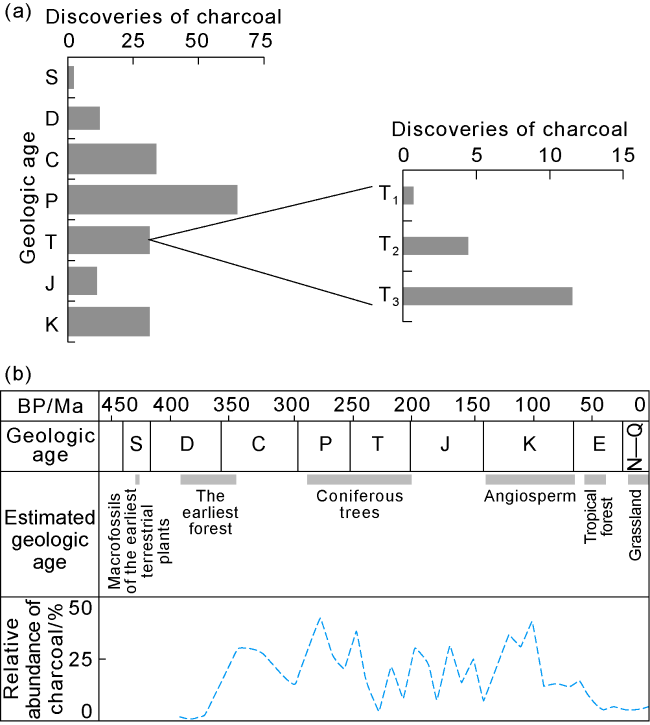
Fig. 9. Discoveries of charcoal (a) and relative abundance of charcoal (b). Fig. a adapted from references [12,30⇓-32]; Fig. b adapted from Reference [70]; S—Silurian; D—Devonian; C—Carboniferous; P—Permian; T—Triassic; J— Jurassic; K—Cretaceous; E—Paleogene; N—Neogene; Q—Quaternary; T1—Early Triassic; T2—Middle Triassic; T3— Late Triassic. |
According to the evaluation standard SY∕T 5735-2019 for shale source rocks, TOC=0.5% indicates good source rocks and TOC>2% means excellent source rocks. The BC with high abundance poses a great challenge to the evaluation of source rocks in the southeastern Chang 7 Member in the Ordos Basin. At the same time, considering the extensive development of BC over the geological history, low-TOC source rocks without BC may be regarded as invalid, and non-source rocks with high BC as high-quality according to the applicable evaluation methods and standards. It is suggested to take TOC and wb to evaluate source rocks.
It’s necessary to re-understand TOC composition and their respective role in oil generation, adsorption, retention and hydrocarbon expulsion, and be careful when selecting favorable shale oil sweet spots based on TOC. In recent years, the exploration zones of shale oil and gas have been in organic-rich shale sections [26⇓⇓-29], where not only micro- to nano-scale inorganic pores but also nano-scale organic pores were found in a large quantity[71-72]. S1 represents the oil content in shale and S1/TOC>100 mg/g is an index to describe movable shale oil [73-74]. However, it remains to be determined whether the free hydrocarbon S1 in shale exists in micro-pores with a large number within BC. This study attempts to analyze the role of BC in shale oil storage and expulsion based on the BC content, TOC content, and pyrolysis parameters in Well YY1. The TOC in kerogen includes four parts: BC, residual carbon, activated carbon and petroleum carbon, which follow the relationships expressed in Eqs. (1)-(3). In the liquid window (Ro is 0.6% to 1.2%), wb remains almost unchanged during the maturation process (Fig. 10 ). Activated carbon (wa) decreases after generating oil, and becoming residual carbon, so that wr (the mass fraction of residual carbon) will increase with the increase of maturity. wo represents petroleum carbon. The dashed line in Fig. 10 means unclear content change with increasing maturity. wa (the content of activated carbon) is the first parameter for using in-situ conversion production for low-medium mature shale oil [18,69].
$ W_{\mathrm{a}}=0.083\left(S_{2}+S_{3}\right)$
$ w_{\mathrm{r}}=T O C-w_{\mathrm{b}}-\left(w_{\mathrm{a}}+0.083 S_{1}\right)$
$ \text { TOC }=w_{\mathrm{b}}+w_{\mathrm{r}}+W_{\mathrm{a}}+w_{0}$
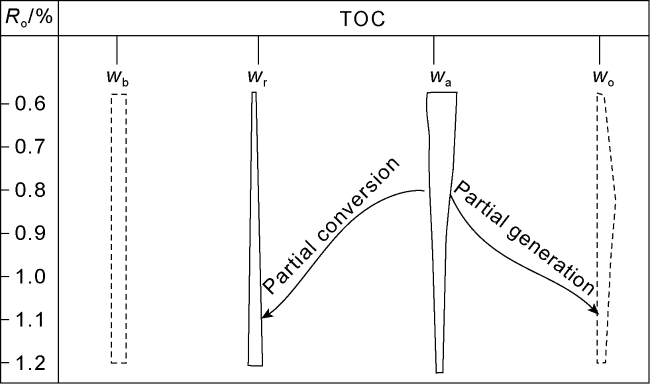
Fig. 10. Composition of the TOC of shale and the changing trend of the liquid window. |
4.3. The contribution of BC micro- and nano-pores to shale reservoir space
Although BC has no hydrocarbon generation ability, whether the charcoal that has a large number of micron-pores can become effective reservoirs is worth further exploration. In this study, S1 represents the residual hydrocarbon in the source rock after hydrocarbon generation. Analyzing the relationships between TOC, wa, wb, wr, and S1 (Fig. 11 ), this study found that the maximum square of the correlation coefficient between wa and S1 is 0.899 2. In addition, because gas may be lost when crushing the sample, volatile light components may become less, so S1 represents the residual hydrocarbon left in the source rock. The composition of S1 is similar to activated carbon and is capable of hydrocarbon generation, so adsorption results in the best correlation between them[75-76]. Although the square of the correlation coefficient between wb and S1 is the lowest, the value 0.697 8 is not very bad. The lost gas when sampling and crushing is free hydrocarbon that may be from the micro-pores in BC. The possibility should be further studied. The uneven development of pores in BC may account for the low correlation coefficient observed between wb and S1. The relationship between BC and kerogen is not as clear as previously thought and needs additional geochemical analyses [12].
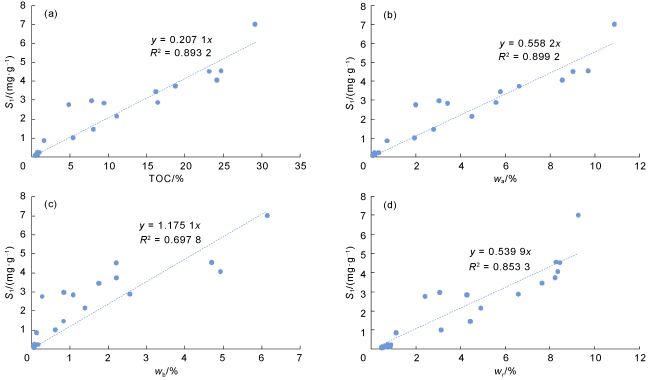


Fig. 11. Relationships between S1 and carbon parameters of Chang 7 shale in the Ordos Basin. |
4.4. Application of black carbon research
If the shale in the southern and southwestern areas where volcanic ash is distributed contains BC, the distribution area of BC is about 3×10⁴ km2. If the average thickness of the BC-rich section is 10 m, the average content of BC is 3%, and the average density of the shale section is 2.3 g/cm3, the product of these four parameters gives the total amount of BC in the distribution area of the Chang 7 shale, which is 207×108 t. In Well YY1, the wb/TOC ratio is 20%, so the HI (the ratio of S2 to TOC) and the OSI (100 times the ratio of S1 to TOC) should be 1.25 times the original. The recalculated values are comparable with those without BC. The amount of hydrocarbons generated is the product of six parameters: the area, thickness, and density of source rock, TOC, TOC recovery coefficient, and oil yield per TOC. Although the oil yield per TOC represents the ratio of oil yield to unit TOC, and the TOC in the calculation formula cancels out, the oil yield is calculated as S2,o−S2. Therefore, due to the presence of BC reducing S2,o, the actual estimate of hydrocarbon generation is affected. Taking BC as 20%, the HI of Type I organic matter drops from the original 600 mg/g to 500 mg/g, and the average HI at the mature stage is 300 mg/g, so the hydrocarbon generation reduces by about 30%. If in-situ converting shale oil in the southeastern area where the shale is of medium to low maturity, 20% BC that has no hydrocarbon generation should be considered. The amount of hydrocarbon generation and expulsion from the shale at the medium to high maturity stage in the central area should be reassessed.
5. Conclusions
Through the study of BC in the Chang 7 shale from three wells in the Ordos Basin, some insights have been gained into the qualitative and quantitative analysis of BC, paleoclimate, and shale oil evaluation, thus initiating research on the role of BC in the generation, expulsion, and accumulation of shale oil.
This marks the first discovery of BC in the Middle Triassic in the Ordos Basin. The discovery of BC indicates that both oxygen content and plant conditions in the Eastern Tethys during the Middle Triassic supported the occurrence of wildfires, providing new evidence for the reconstruction of paleo-oxygen concentrations and paleovegetation. Multiple layers of volcanic ash in the BC-rich sections confirmed that volcanic activities occurred, providing geological conditions conducive to wildfire occurrence.
The study found that in the geological history, periods without wildfires or BC deemed by previous studies have abundant BC, it is inferred that geological history with wildfires has more influence. It is suggested that an objective understanding of the composition of organic carbon in source rocks is necessary, as relying solely on TOC as a key parameter for evaluating source rocks and shale oil may pose risks. In other words, shale sections with TOC meeting the standard may not be effective source rocks or unconventional shale oil targets, but those with low TOC may be effective, or even high-quality. It is necessary to re-examine the activated carbon in shale that can generate oil and gas. It is proposed to take TOC and wb as evaluation parameters for source rocks.
In the southeastern part of the Ordos Basin, 20% BC should be considered to evaluate the source rocks and favorable shale oil zones in the Chang 7 shale, while the impact of BC in the northwest and the northeast is relatively small. TOC is composed of four quantitative parameters: wb, wa, wr and wo. To evaluate source rocks, it is recommended to use the activated carbon index (TOC-wb). For in-situ conversion of shale oil at low to medium maturity, wa is an effective index. To select favorable shale oil zones at medium to high maturity, wo is the best. These parameters not only enable a quantitative assessment of the organic matter composition in shale, the hydrocarbon generation potential of source rocks, their maturity, and the expulsion and retention characteristics of shale oil, but also play a crucial role in reconstructing the paleoclimate during source rock development and identifying sweet spots for shale oil exploration.
Acknowledgments
Thanks to Professor Hong Lu and Jianzhong Song, Guangzhou Institute of Organic Geochemistry, China Academy of Sciences; Petroleum Exploration Lab of PetroChina Changqing Oilfield Company for sampling; and Dieter Uhl, Senckenberg Research Institute and Natural History Museum in Germany for helping identify black carbon fossils in typical samples.
Nomenclature
S1—free hydrocarbon content in rocks, mg/g;
S2,o—original cracked hydrocarbon content, mg/g;
S2—cracked hydrocarbon content, mg/g;
S3—the amount of CO2 produced by pyrolysis of organic matter, mg/g;
TOC—total organic carbon content in shale, %;
wa—mass fraction of active carbon with hydrocarbon generation ability in TOC, %;
wb—mass fraction of black carbon in TOC, %;
wo—mass fraction of carbon from mature shale oil, %;
wr—mass fraction of residual carbon in TOC, %.