

Introduction
Pore-throat structure and oil mobility have been research hotspots for unconventional tight and shale reservoirs in petroleum exploration and development. These factors serve as critical parameters for hydrocarbon resource estimation, recoverable reserve evaluation, favorable area selection, and development planning [1⇓⇓⇓⇓⇓⇓-8]. Therefore, studying the pore-throat structures and oil mobility characteristics of the reservoirs in the same formation in hydrocarbon-bearing basins, including conventional and unconventional “full-particle-sequence” reservoirs, not only guides conventional and unconventional oil and gas exploration and development but also provides essential theoretical support for enriching the understanding of orderly, coexisting conventional and unconventional hydrocarbons and the accumulation mechanisms of the whole petroleum system.
Since 2007, oil and gas exploration in the Permian Fengcheng Formation in Mahu Sag of the Junggar Basin has revealed a complete sequence of orderly hydrocarbon accumulation in conventional and unconventional “full-particle-sequence” reservoirs [9⇓-11]. The Permian Fengcheng Formation represents the ancient alkaline lacustrine hydrocarbon source rock with the highest quality in the Junggar Basin. From inside to outside source areas, various hydrocarbon-bearing reservoirs were developed, including conventional sandy conglomerate reservoirs separated from sources, unconventional tight reservoir near sources, and self-generating and self-storing unconventional shale reservoirs [12-13]. The conventional sandy conglomerate reservoirs primarily comprise lithological reservoirs such as conglomerate and sandy conglomerate. The unconventional tight reservoirs mainly include lithological reservoirs such as sandy conglomerate, argillaceous sandstone, calcareous sandstone and dolomitic sandstone. The unconventional shale reservoirs include sandy mudstone, calcareous mudstone, and dolomitic mudstone. These reservoirs with various grain sizes are distributed orderly, and form typical “full-particle-sequence” reservoirs and comprehensive hydrocarbon accumulation in the Fengcheng Formation of the Mahu Sag[14⇓-16]. In general, conventional reservoirs have larger pores and throats, and the effect of capillary pressure is significantly weaker than that of buoyancy, so hydrocarbon accumulation requires updip seals. Unconventional reservoirs, such as tight and shale reservoirs, have smaller pores throats. The smaller pore-throats result in dynamic sealing through their capillary pressure, enabling the formation of “self-sealing” continuous unconventional hydrocarbon accumulation [17-18]. The Fengcheng Formation in the Mahu Sag develops full particle sequence reservoirs; however, the pore-throat structures and “self-sealing ability” are unclear from inside to outside source areas. With the advancement of exploration and the recognition of differences between oil-and gas-bearing basins, the previously proposed thresholds of 1 000 nm and 10 nm for pore-throat radii to distinguish conventional, tight, and shale reservoirs are no longer applicable to the full-particle-sequence reservoirs of the Fengcheng Formation in the Mahu Sag. Furthermore, there is hardly systematic research and report on the pore-throat structures and oil mobility of full particle sequence reservoirs in the same formation. These issues notably hinder the exploration and development of various types of hydrocarbon accumulations in the conventional and unconventional “full-particle-sequence” reservoirs in the Fengcheng Formation. Hence, detailed studies on the pore-throat structures and oil mobility characteristics of reservoirs with different grain sizes in the Fengcheng Formation are urgently needed.
By systematically selecting core samples from reservoirs with various grain sizes in the conventional-to-unconventional reservoirs of the Fengcheng Formation in the Mahu Sag and using crude oil samples from Well M56X in the same formation, this study performs experimental analyses such as casting thin sections, low-temperature nitrogen adsorption, high-pressure mercury injection, nuclear magnetic resonance (NMR) T2 spectra, contact angle measurements, and oil-water interfacial tension tests. On the basis of these experimental results, the pore-throat structures and oil mobility characteristics of samples from conventional-unconventional reservoirs are analyzed and the relationship between pore-throat size and centrifugal pressure required to displace crude oil under varying temperature conditions is determined. These findings aim to provide insights for the efficient exploration and development of hydrocarbons in Fengcheng Formation reservoirs while also enriching the understanding of the orderly coexistence of conventional and unconventional hydrocarbon sources and the accumulation mechanisms of the whole petroleum system.
1. Regional geology
The Mahu Sag located in the northwestern part of the Central Depression in the Junggar Basin, northern Xinjiang, and covering about 5 200 km2 is one of the most significant hydrocarbon-generating sags in the basin. It connects with the Shiyingtan Uplift, Yingxi Sag and Sangequan Uplift on northeast, Dabasong Uplift and Xiayan Uplift on southeast, borders Zhongguai Uplift on southwest and Wuxia-Kebai Fault Zone on west (Fig. 1 ). From the Carboniferous to the Early Permian, the northern Xinjiang region transitioned from a marine basin to an intracontinental basin, at the same time, the marine depositional environment gradually disappeared, while intracontinental orogenic belt features became increasingly prominent [19-20]. During the Early Permian, intense extension occurred following large-scale collision triggered by the complete closure of the remnant ocean in West Junggar. The extension led to a short-term intracontinental rift basin along the front of the orogenic belt, accompanied by extensive volcanic eruption and intrusion [19]. As a result, the lower interval of the Permian is extensional while the upper is compressional in the Junggar Basin [21]. The Permian formations in the Mahu Sag include the Jiamuhe Formation, Fengcheng Formation, Xiazijie Formation and Upper-Lower Wuerhe Formation [22]. The Fengcheng Formation deposited in the extensional faulting stage [23-24] and became the most important hydrocarbon source rocks on the northwestern margin of the basin. To date, two major oil provinces, Kebai-Wuxia and Mahu western slope, have been discovered, with proved petroleum initially-in-place of 1.79×10⁹ t [10].

Fig. 1. Structural location of the Mahu Sag and planar sedimentary facies distribution of the Fengcheng Formation. |
The Fengcheng Formation is the primary hydrocarbon source rock in the Mahu Sag, with sedimentary thickness of 150-1 000 m, burial depth of 3 800-6 282 m, TOC from 0.36% to 4.01%, Type I and Type II kerogen, and Ro from 0.56% to 1.66%. As typically ancient alkaline lacustrine deposits [25-26], the formation is divided into three members from bottom to top: first to third members of the Fengcheng Formation (P1f1, P1f2, P1f3) (Fig. 2 ). The Fengcheng Formation developed a set of saline lacustrine mixed sediments (in a semi-close environment), including saline shale, dolomite and clastic rock of stable lacustrine facies and fan delta facies (Fig. 1 ). The deposition of the Fengcheng Formation was accompanied by volcanic activity that contributed volcanic materials confined to the periphery of the sag. The nappes on the western margin were eroded into fan deltas nearby [27-28]. The sediments include terrigenous clastics, volcanic materials and authigenic carbonates. Laterally from the margin to the center, the lithology changes from conglomerate to dolomitic silty-fine sandstone, dolomitic mudstone, mudstone and salt rock. Hydrocarbon shows in varied degrees have been observed in all the lithological reservoirs, indicating orderly hydrocarbon accumulation in conventional, tight and shale reservoirs [8,16,29]. Vertically, multiple lithologies are frequently interlayered. The lower part of P1f1 is dominated by pyroclastic, while the upper part is characterized by organic-rich mudstones and dolomites during the lacustrine transgression. During the P1f2 depositional period, high salinity and limited external input lead to localized development of coarse-grained clastics and the deposition of organic-rich dolomite and mudstone, with typical alkaline mineral deposits developed in the sag center. In the deposition of P1f3, external input increased and water salinity reduced [30-31] (Fig. 2 ).
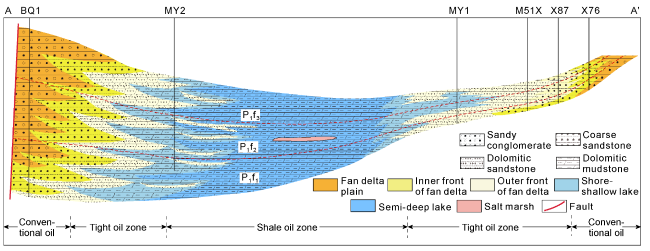
Fig. 2. Sedimentary facies of the Fengcheng Formation in the Mahu Sag (section location shown in |
2. Fengcheng Formation reservoirs
2.1. Macroscopic distribution
The Fengcheng Formation in the Mahu Sag hosts conventional and unconventional reservoirs (including tight and shale reservoirs), forming a “full particle sequence” orderly distribution across the plane (Fig. 1 ). During the depositional period of the Fengcheng Formation, erosion of nappes along the western margin provided terrigenous clastic sediments that rapidly accumulated into fan deltas. The northern, western, southwestern, southeastern and northeastern parts of the sag developed distinct fan deltas, including the Mabei Fan, Maxi Fan, Manan Fan, Xiayan Fan, and Madong Fan, respectively [18]. Under the influence of jointing control of sedimentation and diagenesis, the conventional reservoirs are gravel and sandy conglomerate in the fan delta plains and the inner fronts of fan deltas along the sag margin. Under the control of buoyancy and updip seal, hydrocarbon accumulated in these conventional reservoirs, such as in wells BQ1 and X76 [10,16]. The tight oil reservoirs are argillaceous sandstone, calcareous sandstone and dolomitic sandstone, with the last dominated. They deposited in the outer front of fan deltas and shore-shallow lakes on the sag slope, which are adjacent to hydrocarbon source rocks laterally or vertically. With capillary sealing, rich hydrocarbons accumulated in these tight reservoirs and have been found in wells X87 and M51X [10,16]. The shale oil reservoirs are sandy mudstone, calcareous mudstone and dolomitic mudstone. The dolomitic mudstone is dominant and with rich organic matters. These reservoirs depositing in shore-shallow lakes and semi-deep lakes within the sag represent a self-sourced, self-sealing hydrocarbon accumulation system [10,16], as exemplified by Well MY2. The sedimentary thickness on the western side of the Fengcheng Formation of Mahu Sag is considerably greater than that on the eastern side, and the lateral particle sequence change on the western side is more rapid. On the plane, conventional and unconventional reservoirs are orderly distributed as circles, with conventional sandy conglomerate reservoirs on the margin, tight oil reservoirs dominated by dolomitic sandstone on the slope, and shale oil reservoirs dominated by dolomitic mudstone in the center.
2.2. Petrological characteristics
Using cast thin sections, the reservoirs from the Fengcheng Formation was classified by grain size and mineral composition. The lithologies identified include sandy conglomerate, calcareous sandstone, dolomitic sandstone, sandy mudstone, calcareous mudstone, dolomitic mudstone and dolomitic shale (Figs. 3 and 4 ). The sandy conglomerate reservoirs primarily comprise lithic fragments, quartz, chert and alkali feldspar, with particle sizes ranging from 0.4 mm to 11.0 mm. These sediments exhibit poor sorting, subrounded to rounded shapes, and grain-supported textures and are cemented by materials such as siliceous, calcareous, tuffaceous and ferruginous cements (Fig. 4a ). The calcareous sandstone reservoirs are dominated by quartz, feldspar, and metamorphic lithic fragments, with particle sizes ranging from 0.16 mm to 0.50 mm. These sediments also exhibit poor sorting, subangular to subrounded shapes, and grain-supported textures and are cemented by calcareous and argillaceous materials (Fig. 4b ). The detrital grains in dolomitic sandstone reservoirs primarily comprise quartz, feldspar, chert and felsic metamorphic lithic fragments, with particle sizes ranging from 0.06 mm to 1.50 mm, moderate sorting, subangular to subrounded shapes, and grain-supported textures. The cements include calcareous, siliceous, argillaceous and ferruginous materials (Fig. 4c, 4d ). Sandy mudstone reservoirs are dominated by clay particles (matrix), and a small proportion of sandy detrital grains. The detrital grains comprise anhedral quartz, feldspar and chert. The clay matrix is stained brown, and the reservoirs are cemented by calcite (Fig. 4e ). Calcareous mudstone reservoirs are also dominated by clay particles (matrix), and a small amount of sandy detrital grains, and cemented by calcite (Fig. 4f ). Dolomitic mudstone/shale reservoirs primarily comprise clay particles (matrix), and a minor proportion of sandy detrital grains. The feldspar and quartz grains are anhedral and exhibit a high degree of alteration, and dolomite serves as the primary cement (Fig. 4g, 4h ).
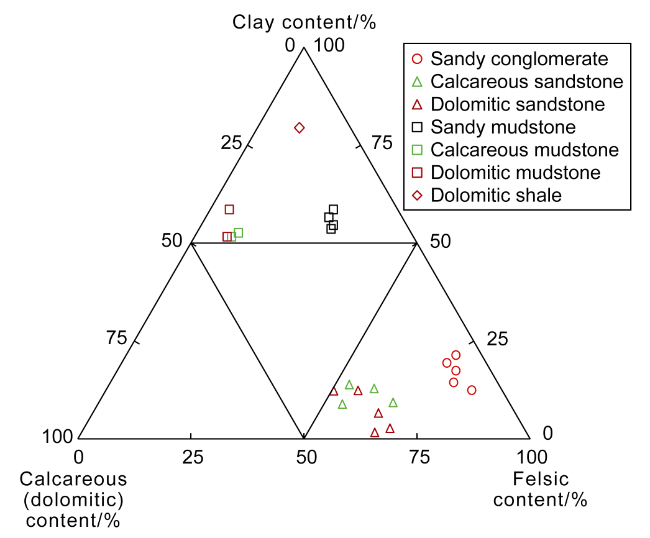
Fig. 3. Ternary diagram of lithology in the Fengcheng Formation reservoirs of Mahu Sag. |
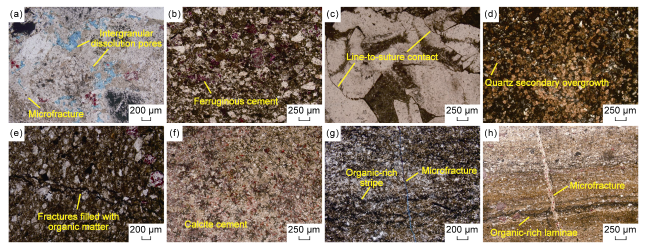
Fig. 4. Cast thin sections of reservoirs with different grain sizes from the Fengcheng Formation in the Mahu Sag. (a) Sandy conglomerate, Well X203, 4 835.87 m; (b) Calcareous sandstone, Well M49, 4 821.75 m; (c) Dolomitic coarse sandstone, Well JS1, 6 278.17 m; (d) Dolomitic fine sandstone, Well M59X, 5 735.85 m; (e) Sandy mudstone, Well X203, 4 723.83 m; (f) Calcareous mudstone, Well M49, 4 503.61 m; (g) Dolomitic mudstone, Well M59X, 5 739.85 m; (h) Dolomitic shale, Well M49, 4663.43 m. |
2.3. Reservoir space
Cast thin section analysis reveals that the primary pore types in sandy conglomerate reservoirs from the Fengcheng Formation are intergranular dissolution pores and microfractures. Some sandy conglomerate reservoirs exhibit relatively abundant intergranular dissolution pores with good connectivity (Fig. 4a ). Dolomitic sandstone reservoirs generally develop grain-edge fractures, but intergranular dissolution pores are undeveloped and with poor connectivity (Fig. 4c, 4d ). Reservoirs of sandy mudstone, calcareous mudstone, dolomitic mudstone and dolomitic shale have microfractures, which are usually filled with organic matter and carbonate minerals, and intergranular dissolution pores are absent, resulting in poor connectivity (Fig. 4e-4h ).
2.4. Limits of physical properties of conventional and unconventional reservoirs
A conventional and unconventional hydrocarbon accumulation model is summarized based on the hydrocarbon accumulation characteristics of the Fengcheng Formation in the Mahu Sag. Reservoir properties such as porosity, permeability, and throat size exhibit a decreasing trend with increasing burial depth. This trend sequentially crosses thresholds for conventional-tight transition, buoyancy-driven migration, hydrocarbon generation, and natural gas self-sealing, corresponding to conventional oil reservoirs, conventional-unconventional transitional oil reservoirs, tight oil reservoirs, shale oil reservoirs, tight gas reservoirs and shale gas reservoirs. Without hydrodynamic force and abnormal pore fluid pressure, oil droplets within the reservoir pores are primarily influenced by driving force (the difference between buoyancy and gravity) and capillary resistance (Eqs. (1) and (2)) [32-33]. When the driving force dominates (i.e., Fd > Fc), oil droplets migrate upward and accumulate under sealing conditions of caprocks, forming conventional oil accumulations. When the driving force equals the capillary resistance (i.e., Fd ≈ Fc), oil droplets remain in a force-balanced state, resulting in conventional-unconventional transitional oil reservoirs. When the capillary resistance dominates (i.e., Fd < Fc), oil droplets are blocked in pores by the capillary force, resulting in tight oil reservoirs [32-33].
${{F}_{\text{d}}}=\frac{4}{3}\pi {{R}^{3}}\Delta \rho g\sin \alpha $
${{F}_{\text{c}}}=2\pi r\sigma \cos \theta $
Using the evaluation methods of driving force and resistance acting on oil droplets within reservoir pores (Eqs. (1) and (2)), combined with experimental analysis of the oil-water interfacial tension and contact angle of the Fengcheng Formation crude oil at 30, 50 and 70 °C (Table 1 ), the driving force and capillary resistance of Fengcheng crude oil in pores with various throat sizes were constructed, and the throat size limit between conventional and tight reservoirs, and the corresponding porosity and permeability (Fig. 5 ) were estimated. At 30, 50 and 70 °C, the capillary resistance experienced by Fengcheng crude oil within pores of various throat sizes was very similar. When the throat is about 0.7 µm, the driving force acting on oil droplets is equal to the capillary resistance (Fig. 5a ), indicating that the top limit of the throat in tight reservoirs is about 0.7 µm. Using the relationships between porosity, permeability and maximum throat radius, the top limits of porosity and permeability of tight reservoirs are about 8% and 0.1×10⁻³ μm2, respectively (Fig. 5b , 5c).
Table 1. Crude oil density, oil-water interfacial tension (IFT) and contact angle of the Fengcheng Formation in Well M56X |
| Temperature/ °C | Crude oil density/ (g∙cm−3) | IFT/ (mN∙m−1) | Contact angle/(°) | ||
|---|---|---|---|---|---|
| Conventional reservoir | Tight reservoir | Shale reservoir | |||
| 30 | 0.873 | 25.032 | 16.470 | 17.601 | 18.564 |
| 50 | 0.867 | 22.248 | 14.730 | 15.347 | 15.515 |
| 70 | 0.841 | 20.115 | 12.978 | 14.540 | 14.561 |
Note: The contact angle represents the average measurement results for each type of reservoir. |
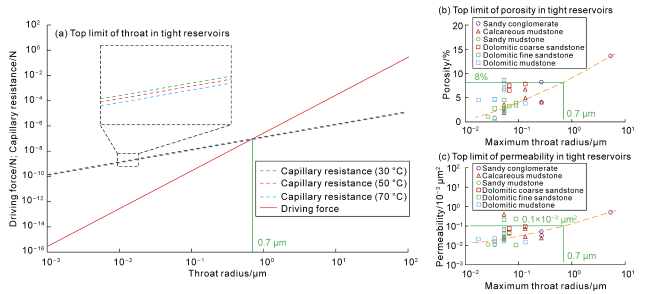
Fig. 5. Driving force and capillary resistance of Fengcheng Formation crude oil in pores and top limit of physical properties of tight reservoirs in the Mahu Sag. |
After determining the limits of physical properties, the porosity, permeability, maximum throat radius, average throat radius and displacement pressure from high-pressure mercury intrusion experiment were statistically analyzed for conventional-unconventional reservoirs of the Fengcheng Formation (Table 2 ). The porosity, permeability, maximum and average throat radii exhibited a decreasing trend. In other words, as the physical properties became poor, the fluid flow became weak.
Table 2. Physical properties and other parameters of the Fengcheng Formation reservoirs in the Mahu Sag |
| Reservoir type | Lithology | Porosity/% | Permeability/ 10−3 μm2 | Maximum throat radius/µm | Average throat radius/µm | Displacement pressure/MPa | Number of samples | |
|---|---|---|---|---|---|---|---|---|
| Conventional reservoir | Conglomerate | 8.00-17.70 (12.12) | 0.531-81.000 (3.401) | 0.135-3.014 (1.140) | 0.050-0.097 (0.067) | 2.61-14.64 (5.80) | 10 | |
| Sandy conglomerate | 8.00-13.90 (11.35) | 0.413-43.604 (1.796) | 0.154-2.690 (1.003) | 0.051-0.093 (0.065) | 2.74-13.78 (5.95) | 5 | ||
| Unconventional reservoir | Tight reservoir | Sandy conglomerate | 4.10-7.90 (6.11) | 0.023-0.104 (0.062) | 0.053-0.268 (0.110) | 0.009-0.025 (0.017) | 2.74-13.77 (10.32) | 3 |
| Calcareous sandstone | 4.48-5.50 (5.06) | 0.042-0.161 (0.100) | 0.052-0.134 (0.107) | 0.022-0.029 (0.026) | 5.50-13.77 (8.26) | 5 | ||
| Dolomitic sandstone | 2.31-7.84 (4.48) | 0.009-0.230 (0.077) | 0.021-0.268 (0.076) | 0.007-0.049 (0.017) | 2.72-34.43 (13.31) | 4 | ||
| Shale reservoir | Sandy mudstone | 0.85-6.90 (3.16) | 0.011-0.016 (0.013) | 0.018-0.134 (0.085) | 0.006-0.024 (0.014) | 5.48-41.53 (16.57) | 4 | |
| Calcareous mudstone | 1.93-6.73 (4.25) | 0.024-0.392 (0.109) | 0.027-0.067 (0.044) | 0.007-0.020 (0.012) | 11.03-27.55 (18.73) | 5 | ||
| Dolomitic mudstone | 0.70-7.90 (4.45) | 0.012-0.056 (0.025) | 0.053-0.134 (0.114) | 0.014-0.044 (0.027) | 5.48-13.78 (7.57) | 6 | ||
| Dolomitic shale | 0.70-2.09 (1.40) | 0.012-0.064 (0.038) | 0.050-0.053 (0.052) | 0.009-0.014 (0.011) | 13.76-13.78 (13.77) | 2 | ||
Note: Values in parentheses indicate the average. |
3. Pore-throat structure
Dominant pore types in reservoirs with different grain sizes in the Fengcheng Formation of the Mahu Sag were analyzed on cast thin sections. High-pressure mercury intrusion was employed to analyze the pore volume associated with connected throats of varying sizes in each reservoir type. Based on experimental results obtained from the low-temperature nitrogen adsorption, high-pressure mercury intrusion, and saturated organic solvent experiments, and the NMR T2 and signal amplitude were converted into pore size and pore volume, respectively [34-35]. First, cumulative pore volume versus pore-throat radius curves were obtained from low-temperature nitrogen adsorption and high-pressure mercury intrusion experiments. Second, using the ratio of throat radius to NMR T2, and considering porosity of reservoir samples, the NMR T2 spectra were converted into cumulative pore volume versus pore-throat radius curves. Then the curves from the two methods were compared using the least-squares method, and the optimal ratio was determined when the error was minimum or less than a fixed threshold. Finally, using the optimal ratio and porosity, the NMR T2 and signal amplitude were converted into pore size and corresponding pore volume or pore fluid volume, respectively.
3.1. Conventional sandy conglomerate reservoirs
Intergranular pores, dissolution pores and microfractures are observable in the conventional sandy conglomerate reservoirs of Fengcheng Formation in Mahu Sag (with porosity greater than 8% and permeability greater than 0.1×10⁻³ μm2), and pores are relatively abundant and connected (Fig. 4a ). Results from high-pressure mercury intrusion experiments indicate that the throat radius is generally less than 5.5 µm, and the connected pore volume at different grain sizes exhibited two major peaks (Figs. 6a and 7 , Table 3 ). The pore radius distribution range is relatively large, and the pore volume exhibited two major peaks, too (Fig. 8a ).
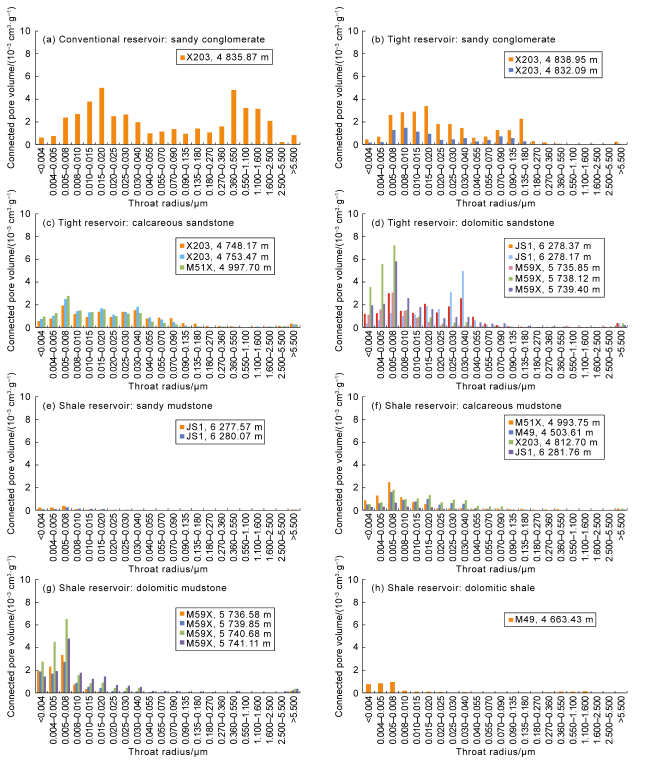
Fig. 6. Connected pore volume at different throat sizes of reservoirs from the Fengcheng Formation in the Mahu Sag. |
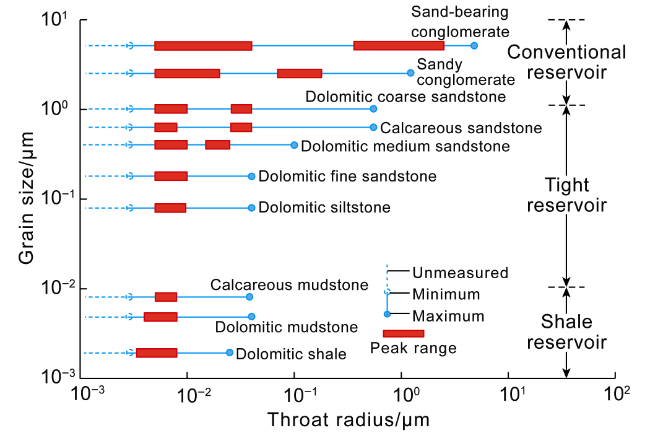
Fig. 7. Throat size distribution of the Fengcheng Formation reservoirs in the Mahu Sag. |
Table 3. Throat and pore size distribution of the Fengcheng Formation reservoirs in the Mahu Sag |
| Reservoir type | Lithology | Throat radius | Previous range[36]/µm | Pore radius | |||
|---|---|---|---|---|---|---|---|
| Distribution range/µm | Peak range/µm | Distribution range/µm | Peak range/µm | ||||
| Conventional reservoir | Sandy conglomerate | <5.50 | 0.005-0.040, 0.350-2.500 | >1.00 | 0.002-50.000 | 0.10-0.50, 1.00-5.00 | |
| Unconventional reservoir | Tight reservoir | Sandy conglomerate | <0.55 | 0.005-0.020, 0.070-0.200 | 0.01-1.00 | 0.002-20.000 | 0.02-0.05, 0.20-0.50 |
| Calcareous sandstone | <0.55 | 0.005-0.008, 0.0250-0.040 | |||||
| Dolomitic sandstone | <0.55 | <0.010, 0.030-0.040 | 0.002-20.000 | 0.02-0.05, 0.20-0.50 | |||
| Shale reservoir | Calcareous mudstone | <0.09 | 0.005-0.020 | <0.01 | 0.002-1.000 | 0.02-0.05 | |
| Dolomitic mudstone | <0.09 | 0.004-0.008 | 0.002-0.500 | 0.02-0.05 | |||
| Dolomitic shale | <0.04 | <0.008 | 0.002-0.200 | 0.02-0.05 | |||
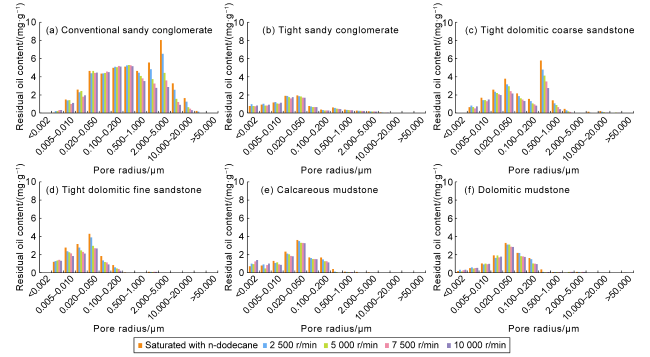
Fig. 8. Residual oil characteristics of reservoir samples with different grain sizes after saturation with organic solvents from the Fengcheng Formation, Mahu Sag. |
3.2. Tight reservoirs
The tight reservoirs of Fengcheng Formation in Mahu Sag are mainly sandy conglomerate, calcareous sandstone and dolomitic sandstone, with porosity less than 8% and permeability less than 0.1×10⁻³ μm2. Intergranular pores, dissolution pores and microfractures are observable, but their connectivity is significantly weaker than the conventional sandy conglomerate reservoirs. The grains exhibit line-to-suture contacts and commonly display quartz secondary overgrowth (Fig. 4b-4d ). Results from high-pressure mercury intrusion experiments indicate that the throat radius distribution of sandy conglomerate, calcareous sandstone and dolomitic sandstone reservoirs shifts toward smaller sizes in comparison with conventional reservoirs. For all three lithologies, the connected pore volume associated with various throat sizes exhibit two major peaks (Figs. 6b-6d and 7 , Table 3 ). Both the pore radius distribution of the sandy conglomerate and that of the dolomitic sandstone are from 0.002 µm to 20.000 µm, with two distinct peaks. Compared with conventional reservoirs, the peak values shift toward smaller pore sizes (Fig. 8b-8d , Table 3 ).
3.3. Shale reservoirs
The shale reservoirs of Fengcheng Formation in Mahu Sag are mainly sandy mudstone, calcareous mudstone, dolomitic mudstone and dolomitic shale. Cast thin section observation revealed rich microfractures filled with organic matter (Fig. 4e-4h ). High-pressure mercury intrusion experiment found that the throat radius distribution range of sandy mudstone, calcareous mudstone, dolomitic mudstone, and dolomitic shale reservoirs further shifted toward smaller sizes. Each lithology exhibits a single dominant throat radius peak (Figs. 6e-6h and 7 , Table 3 ). Similarly, the pore radius distribution range notably shifts toward smaller sizes, and a peak similar to that of tight reservoirs appeared for a lithology (Fig. 8e and 8f , Table 3 ).
The throat and pore radius and peak ranges of typical samples of the conventional, tight and shale reservoirs in the Fengcheng Formation shift toward smaller sizes as grain size decreases, in a half funnel shape (Figs. 7 and 9 ). The throat and pore radius distribution ranges of the conventional, transitional and coarser-grained tight reservoirs are wide and with two peaks, while those of the finer-grained tight and shale reservoirs shift toward smaller sizes and with only one peak. Taking 0.7 µm as the throat threshold between conventional and tight reservoirs (Fig. 5 ), it is evident that the grain size decreases from conventional to tight and shale reservoirs. As the grain size decreases, the connected pore volume of large throats and the large pore volume decrease while the connected pore volume of small throats and the small pore volume increase. Consequently, the distribution and peak ranges of both throat and pore sizes shift toward smaller sizes as grain sizes decrease (Figs. 6 -9 ).
4. Occurrence of crude oil in the reservoirs
4.1. Occurrence of residual oil in reservoirs with different particle sizes
Oil washing and drying pretreatment were conducted for reservoir samples with various grain sizes from conventional and unconventional reservoirs in the Fengcheng Formation of the Mahu Sag (25-mm-diameter cylindrical cores). NMR T2 spectra were then measured under different conditions of drying, saturating with organic solvents, and centrifuging at various rotational speeds (2 500, 5 000, 7 500 and 10 000 r/min for 4 h). Using the method of converting NMR T2 spectra into pore size and pore volume [34-35], the organic solvent content within pores of different sizes under saturated and centrifuged conditions was determined. This enabled the quantification of saturated oil content in pores of different sizes under laboratory conditions, as well as that of the residual oil content in pores at various centrifugation speeds.
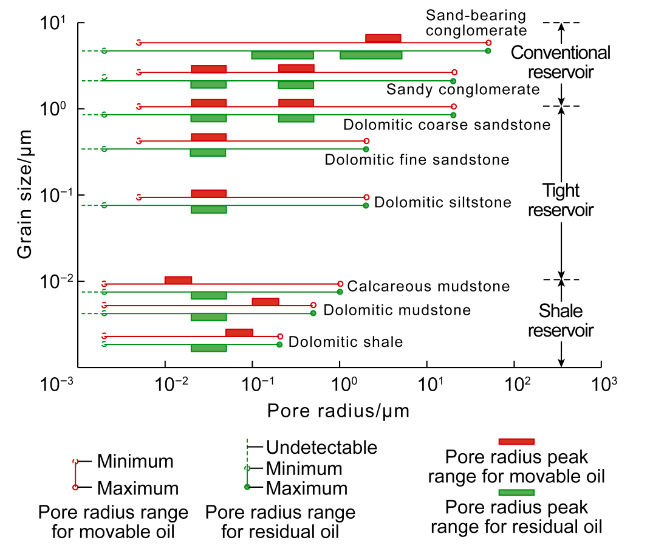
Fig. 9. Pore radius distribution for occurrence of residual oil and movable oil in Fengcheng Formation reservoirs with different grain sizes. |
As the rotation rate increases (resulting in higher centrifugal pressure), the residual oil volume in pores larger than the peak pore radius with residual oil decreases, while that in pores smaller than the peak pore radius begins to fluctuate (Fig. 8 ). This is because at higher centrifugal pressure, some crude oil in large pores became movable. However, NMR T2 signals of adsorbed oil and bound oil in large pores were interpreted to residual oil in smaller pores. Generally, reservoirs with better physical properties and larger grain sizes exhibited a more pronounced decrease in residual oil volume with increasing centrifugal pressure after oil saturation. These samples also tended to have higher residual oil volume.
4.2. Occurrence of movable oil in reservoirs with different particle levels
With known residual and saturated oil volumes after saturating the reservoir samples with organic solvents, the movable oil volume in pores of different sizes can be estimated at different rotation rates, as well as the cumulative movable oil volume and corresponding percent.
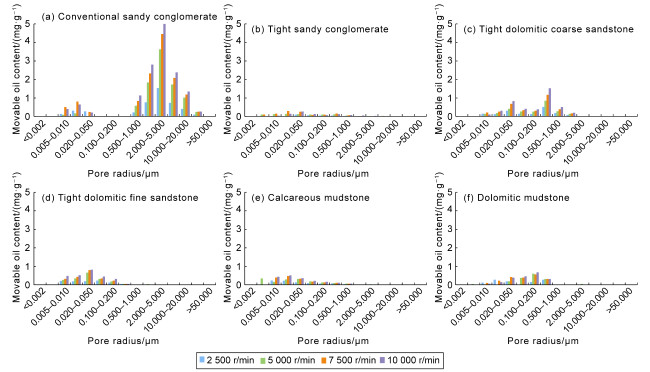
Fig. 10. Movable oil characteristics of reservoir samples with different grain sizes after saturation with organic solvents from the Fengcheng Formation, Mahu Sag. |
Table 4. Occurrence characteristics of residual oil and movable oil of reservoir samples with different grain sizes after saturation with organic solvents from the Fengcheng Formation, Mahu Sag |
| Reservoir type | Reservoir lithology | Occurrence characteristics of residual oil at 10 000 r/min | Occurrence characteristics of movable oil at 10 000 r/min | |||||
|---|---|---|---|---|---|---|---|---|
| Residual oil content/(mg∙g-1) | Residual oil percentage/% | Pore radius distribution of movable oil/µm | Peak pore radius distribution of movable oil/µm | Residual oil content/ (mg∙g−1) | Residual oil percentage/ % | |||
| Conventional reservoir | Sandy conglomerate | 25.14 | 72.86 | 0.005-50.000 | 2.00-5.00 | 9.36 | 27.14 | |
| Unconventional reservoir | Tight reservoir | Sandy conglomerate | 5.82 | 81.37 | 0.005-20.000 | 0.02-0.05, 0.20-0.50 | 1.33 | 18.63 |
| Dolomitic sandstone | 7.27 | 73.78 | 0.005-20.000 | 0.02-0.05, 0.20-0.50 | 2.58 | 26.22 | ||
| Shale reservoir | Sandy mudstone | 6.64 | 77.48 | 0.005-2.000 | 0.02-0.05 | 1.93 | 22.52 | |
| Calcareous mudstone | 6.07 | 73.58 | 0.002-1.000 | 0.01-0.02 | 2.18 | 26.42 | ||
| Dolomitic mudstone | 5.11 | 76.93 | 0.002-0.500 | 0.10-0.20 | 1.53 | 23.07 | ||
| Dolomitic shale | 7.64 | 95.99 | 0.002-0.200 | 0.05-0.10 | 0.32 | 4.01 | ||
As the rotation rate increases (resulting in higher centrifugal pressure), the movable oil volume in pores larger than the peak pores decreases, while that in pores smaller than the peak pores begins to fluctuate (Fig. 10 ). This is because some crude oil in large pores was expelled at higher centrifugal pressure, but the NMR T2 signals of adsorbed oil and some bound oil in the large pores were attributed to residual oil in smaller pores. Consequently, the movable oil volume interpreted in small pores based on NMR T2 spectra fluctuated. For reservoir samples with different grain sizes saturated with organic solvents, the movable oil volume increases with centrifugal pressure (Fig. 10 ), especially for conventional sandy conglomerate reservoirs. Generally, reservoirs with better physical properties and larger grain sizes exhibit higher movable oil volumes, while those with poor physical properties and smaller grain sizes show lower movable oil volumes after saturation.
4.3. Driving pressure of crude oil in throats of reservoirs with different grain sizes
In the simulation of the driving pressure under reservoir conditions with centrifugal pressure, when the capillary pressure equals the centrifugal pressure, the throat radius corresponding to the capillary pressure of the reservoir samples represents the upper limit of the throat radius for residual oil occurrence and the lower limit of the throat radius for movable oil occurrence at the centrifugation rate. Centrifugal pressure [37] and capillary pressure follow Eqs. (3) and (4) [32-33]:
${{p}_{\text{1}}}=1.097\times {{10}^{-10}}\Delta \rho L\left( {{R}_{\text{l}}}-\frac{L}{2} \right){{R}_{\text{ev}}}^{2}$
${{p}_{\text{c}}}=\frac{2\sigma \cos \theta }{r}$
Centrifugal pressure is related to parameters such as density difference between fluids, length of the rock sample, outer rotation radius of the centrifuge and rotational speed. Capillary pressure is related to parameters such as oil-water interfacial tension, contact angle and throat radius.
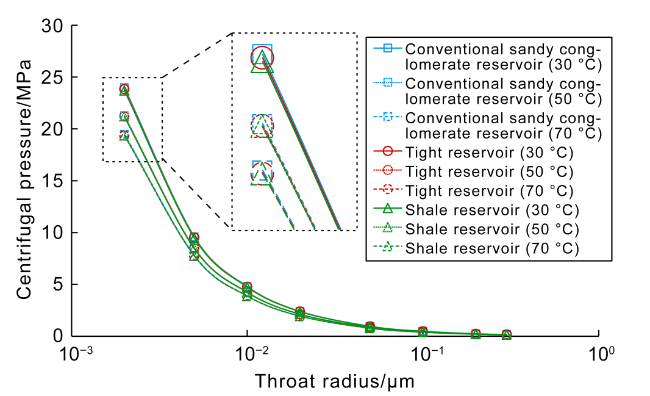


Fig. 11. Driving pressure characteristics of crude oil in throats with different sizes in reservoir samples of various grain sizes from the Fengcheng Formation, Mahu Sag. |
5. Conclusions
With gradual decrease in reservoir grain size, the reservoir properties are deteriorated, the connected pore volume associated with large-sized throats and the volume of large pores exhibit a decreasing trend, and throat and pore distribution and peak ranges shift toward smaller sizes. For the tight reservoirs, the top limit of throat radius, porosity and permeability are about 0.7 µm, 8% and 0.1×10⁻³ µm2, respectively.
With decrease in reservoir grain size, the pore radius range and the peak pore radius range for the occurrence of residual oil and movable oil shift toward smaller sizes. For reservoirs with better physical properties and larger grain sizes, the amount of residual oil decreases more significantly with increasing centrifugal pressure, and these samples tend to have higher residual oil content. Moreover, the increase of movable oil content with increasing centrifugal pressure is more pronounced in these reservoirs.
At different temperature, the driving pressure decreases with increasing throat radius in three distinct stages: rapid decrease, gradual decrease and stabilization. The centrifugal pressure required to drive oil through throats of the same size decreases with increasing temperature and increasing throat radius, and increases with increasing grain size. The difference in driving pressure for reservoirs with different grain sizes diminishes with temperature rise and throat radius increase. According to the experimental analysis, the deep shale oil in the Fengcheng Formation of the Mahu Sag exhibits a notable potential for exploration and development.
Nomenclature
Fc—capillary resistant on oil droplets in pores, N;
Fd—driving force on oil droplets in pores, N;
g—gravitational acceleration, m/s2;
L—length of rock sample, m;
pl—centrifugal pressure, MPa;
pc—capillary pressure, Pa;
r—throat radius, m;
R—pore radius, m;
Rl—outer radius of the centrifuge, m;
Rev—rotation rate, r/min;
T2—transverse relaxation time, ms;
α—formation dip angle, (°);
θ—contact angle of oil on rock surface, (°);
σ—interfacial tension, N/m;
Δρ—density difference between fluids, kg/m3.