

Introduction
In recent years, significant breakthroughs have been made to the exploration and development of unconventional natural gas in coal reservoirs deeper than 1 500 m. These advancements have accelerated the research and development of geological theories of gas accumulation and horizontal well volume fracturing technologies, and drove the industry into a new frontier [1-2]. Data from a lot of exploration and development wells have confirmed the unique geological characteristics of deep coal reservoirs, including adsorbed gas over-saturation and extremely low permeability. The free gas proportion is relatively high, and industrial value of deep coalbed methane has risen significantly, and some wells rapidly produced gas after reservoir stimulation, highlighting substantial potential of exploration and development [3-7].
Burial depth is a critical factor influencing reservoir-forming parameters [8-9]. Objectively, from shallow to deep strata and from basin margin to interior, the sealing property tends to be better. Deep coal seams may develop into adsorbed gas over-saturation reservoirs where free gas may follow the law of trap-controlled enrichment [10-11]. Theoretically, an inflection point exists on the volume of saturated adsorbed gas in coal reservoirs with depth. Below the inflection depth, saturated adsorbed gas volume gradually becomes less, resulting in a geological phenomenon that the adsorbed gas dominates shallow seams while adsorbed gas and free gas coexist in deep seams [3,12 -13]. However, the inflection depths according to the statistical analysis of measured gas content in field or simulated in high-temperature and high-pressure isothermal adsorption experiments are inconsistent with that in practical development [14-17]. For instance, the inflection depth in the Zhengzhuang block in the southern Qinshui Basin is 800-1 000 m and that is 1 200 m in the Yanchuan south block in the eastern Ordos Basin, but almost no free gas was found in deep seams according to production data [3,18]. Furthermore, exploration in Daning- Jixian, Shenfu blocks of Erdos Basin, Jinhong block of Qinshui Basin, and the central Sichuan Basin found continuously increasing gas content with depth, which contradicts with the theoretical prediction of gas content decline or stabilization in deep seams. This suggests that deep coalbed methane possesses unique geological characteristics and gas enrichment mechanisms [6,19 -20]. A comprehensive analysis integrating the characteristics of coal reservoir and fluid is essential to establish a unified gas accumulation model spanning shallow to deep systems, by clarifying fluid system types, origins, geological boundaries, and the primary factors controlling gas accumulation within coal reservoirs,to guide coal-bearing gas exploration.
In recent years, high-yield gas flows have been observed from multiple development wells targeting Upper Paleozoic coal seams across various blocks in the Ordos Basin, including Daning-Jixian, Daniudi, Linxing-Shenfu, Shenmu- Jiaxian, Yulin, Mizhi and Nalinhe, and substantial exploration and development data have been collected [21-24]. Based on the test and experimental data from exploration well cores in the central-eastern Ordos Basin, and considering the geochemical data of fluid, structure and reservoir depth, this study reveals the fluid characteristics, gas accumulation control factors and accumulation modes in coal reservoirs, with the intent to provide theoretical supports for precise evaluation of deep resources and effective gas development.
1. Geological setting
The Ordos Basin has undergone multiple phases of tectonic movements, including the Lüliang, Jinning, Caledonian, Hercynian, Indosinian, Yanshan and Himalayan orogenies, which have shaped its present tectonic framework characterized by interior stability, tectonically active margin, north-south uplifting, western thrusting and eastern lifting [25]. The current basin structure consists of six first-order tectonic units: northern Yimeng Uplift, southern Weibei Uplift, Western Margin Thrust Belt, Tianhuan Depression, central Yishan Slope and Jinxi Flexure Belt along the eastern margin [22-24] (Fig. 1 ).
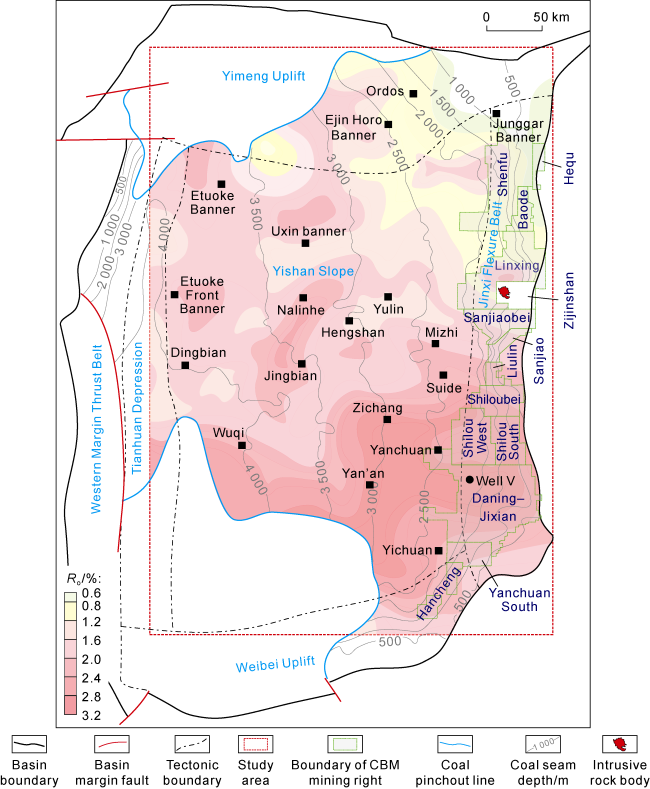
The Jinxi Flexure Belt located along the eastern margin is a narrow and long north-south trending zone characterized by eastward tilting and westward plunging. This area exhibits diverse structural styles, intense uplift and denudation, significant tectonic deformation and well-developed fault systems. In contrast, the Yishan Slope in the central basin dips gently westward, with less faulting and locally developed low-amplitude, nose-like structures. The Upper Paleozoic coal-bearing strata include the Carboniferous Benxi Formation and the Permian Taiyuan and Shanxi formations from bottom to top. No. 5 and No. 8 coal seams, which are wide and stable across the basin, serve as primary targets for coalbed methane and coal-rock gas exploration. The depth of coal seams increases progressively from east to west, and exceeds 4 000 m in the Tianhuan Depression [22-24]. Regional coal metamorphism is primarily controlled by deep burial process, with vitrinite reflectance (Ro) generally increasing from north to south (Fig. 1 ).
2. Coal reservoir fluid characteristics
2.1. Classification of coal reservoir fluid systems
Based on the gas content measurements from wireline core drilling and pressure-preserved coring (air-dried basis), combined with the Langmuir equation [26] and isothermal adsorption experiments at formation temperature, in-situ saturated adsorbed gas content, adsorbed gas saturation, and free gas content of coal reservoirs can be estimated. Measured data revealed that adsorbed gas saturation of the coal reservoirs in the Ordos Basin increases continuously with depth, and the threshold depth is 1 500-1 800 m for adsorbed gas oversaturation of different rank coals (Fig. 2 ). At depth shallower than 1 500 m, adsorbed gas is undersaturated in most coal reservoirs. Adsorbed gas saturation progressively increases with depth. From 1 500 m to 1 800 m, although sparsely sampled, adsorbed gas tends toward oversaturation. The corresponding structural zone is between the central slope of the Jinxi Flexure Belt and the west-dipping gentle slope [21,27]. Below 1 800 m, adsorbed gas saturation exceeds 100% in most seams, except that localized zones exhibit adsorbed gas undersaturation. Free gas content typically ranges from 1 m3/t to 8 m3/t, and exceeds 10 m3/t in some seams. Notably, some coal reservoirs with Ro<2.0% demonstrate adsorbed gas saturation exceeding 150%, while higher-rank coals with Ro>2.5% generally have adsorbed gas saturation below 130%.
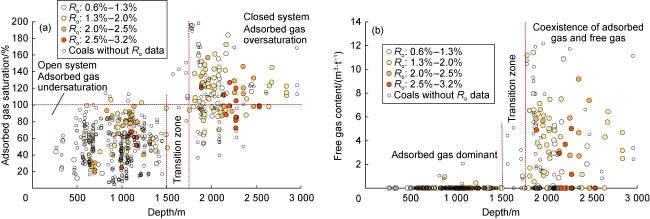
Fig. 2. Vertical variations in adsorbed gas saturation (a) and free gas content (b) of the Upper Paleozoic coal reservoirs in the Ordos Basin. |
The analysis of formation water salinity, hydrochemical types, and CH4 carbon isotopic composition from exploration wells in the Ordos Basin found the interval from 1 500 m to 1 800 m is a critical transition zone between open fluid system in medium-shallow depths and closed fluid system in deep depths (Fig. 3 ). At depth shallower than 1 500 m, an open fluid system dominates, and it is characterized by hydrodynamic conditions influenced by surface runoff infiltration within recharge- flow-weak flow zones. Water invasion is strong, and the formation water salinity is low and slightly increases with depth. The hydrochemical types are predominantly NaHCO3 and NaCl. Free gas has been completely lost, whereas adsorbed gas is variably mixed with secondary biogenic methane. These features collectively define a water-rich system with adsorbed gas undersaturation (Fig. 3 ). Below 1 800 m, a closed fluid system prevails, characterized by limited structural modification and minimal water invasion during tectonic uplift process. The formation water is predominantly CaCl2, with salinity increasing rapidly with depth. According to carbon isotopic compositions, the CH4 is of thermogenic origin, indicating no material exchange with external systems during reservoir evolution and subsequent preservation stages. The closed system exhibits features such as adsorbed gas oversaturation, free gas enrichment, thermogenic gas predominance and high water salinity (Fig. 3 ).
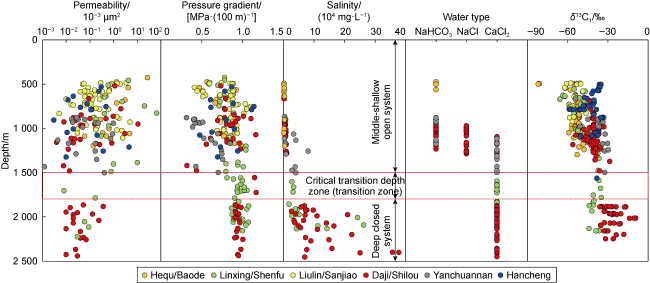
Fig. 3. Vertical changes of coal permeability, pressure gradient, formation water salinity, water type, and CH4 carbon isotope in different regions of the Ordos Basin. |
2.2. Formation mechanism of deep closed fluid system
The enrichment of CH4 in different occurrence states fundamentally relates to preservation conditions. The relative uniformity in threshold depth for adsorbed gas oversaturation and free gas content across variable coal ranks reveals distinct dynamic mechanisms between adsorbed and free gas accumulation. Adsorbed gas accumulation depends on molecular adsorption force, while free gas preservation is controlled by fluid pressure and capillary forces within pores and fractures in reservoirs and surrounding rocks [28-30]. In the Ordos Basin, distinct vertical pressure gradients distributions exist in different structural zones (Fig. 3 ). In complex structural zones shallower than 1 500 m, fluid leakage and pressure dissipation occur due to intense structural uplift and erosion, reduction of overburden load, enlargement of pore space, damage to sealing conditions and altered hydrodynamic conditions. These processes result in discrete pressure gradients that generally increase with depth, dominated by under-pressure reservoirs. Below 1 500 m, reservoir pressure transition toward to normal conditions and is characterized by convergent and uniform pressure gradients. Unlike conventional gas reservoirs, coal seams function dualistically as both source rocks and reservoirs. Except for the Baijiahai Uplift in the eastern Junggar Basin, no external gas recharge has been documented elsewhere [6]. Consequently, coal reservoirs rely on their own sealing capacity to retain internal fluids and prevent the invasion by external fluids. The self sealing mechanism in water-bearing reservoirs operates through capillary force, and is controlled by interfacial tension, pore-throat radius and wettability angle. Smaller pore radii generally result in greater capillary pressure [31-32]. Under deep (deeper than 1 800 m) and high stress, coal reservoirs enhance self-sealing capacity through intense compression-induced fracture closure and porosity-permeability reduction [6,33 -35]. Microscopic pore-throats sizes and poor pore connectivity significantly amplify the capillary force, creating a sharp interface between infiltrating surface fluids and indigenous reservoir fluids, which impedes fluids exchange on both sides, with weak surface runoff infiltration and minimal degree of secondary fluid alteration. The interface acts as an impermeable barrier to prevent upward gas migration, and preserves free gas within the reservoir. The highest permeability measured by well testing is approximately 0.1×10⁻³ μm2 at 1 500-1 800 m depth (Fig. 3 ).
Whether a fluid system is closed or open is both dynamic and relative. The critical transition depth or boundary between present-day open and closed is the result of multiple geological processes. Tectonic and thermal anomalies, post-uplift subsidence and prolonged erosion may disrupt the sealing integrity and trigger reorganization of the fluid system. The geological evolution histories for reservoir vary among basins or regions, the depth threshold also changes accordingly. For example, rapid crustal uplift in the Qinshui Basin in the middle to late Yanshan period was accompanied by strong magmatic activity, potentially explaining the undersaturation in deep and ultra-low-permeability reservoirs. Additionally, the pressure coefficient of the deep coal reservoirs is approximately equivalent to those in sandstone reservoirs of the Benxi Formation, indicating that some Upper Paleozoic strata belong to a unified gas bearing system. The vertical stratigraphic boundary (regional cap) and internal structure of the closed system significantly influence the distribution of natural gas reservoirs among different formations [36].
3. Controlling factors for gas accumulation in coal reservoirs
Gas accumulation in coal reservoirs is governed by the jointing effects of multiple geological factors, including tectonics, sedimentation and hydrogeology. Key controls encompass both reservoir properties, such as coal petrology, thermal maturity, hydrocarbon generation intensity, cleat- fracture development degree, porosity, permeability and gas adsorption capacity, and environmental conditions, including burial depth, temperature, pressure, structural configuration, formation water mobility, fault conductivity and roof sealing capacity. Building on geological insights into deep coal reservoirs and gas enrichment conditions in the Ordos Basin [23-24], this study selects the extensively explored central-eastern basin sector as a case to investigate the impacts of thermal maturity, coal quality, roof lithology and formation temperature on gas-bearing property.
3.1. Thermal maturity of coal reservoirs
Isothermal adsorption experiments conducted on cores from exploration wells revealed an inverse U-shaped relationship between Langmuir volume and Ro, which peaked at Ro≈4.0% before declining. The Langmuir pressure distribution was significantly scattered but generally increased with Ro (Fig. 4 ). The phenomenon is primarily caused by the physicochemical modification during coalification, including changes in fixed carbon content, aromatic structures, organic maceral composition, pore size distribution and specific surface area [37-39]. Fig. 5 illustrates depth-dependent gas content variations of different rank coals under deep burial metamorphism. The gas content generally increases with depth, and higher-rank coals demonstrate superior gas-bearing property at equivalent depths. Below 1 800 m, the gas content is generally less than 20 m3/t when Ro<1.5%, and coals with 1.5%£Ro£2.0% have gas content at 15-25 m3/t, and high- rank coals with Ro>2.0% boast gas content at 20-35 m3/t.
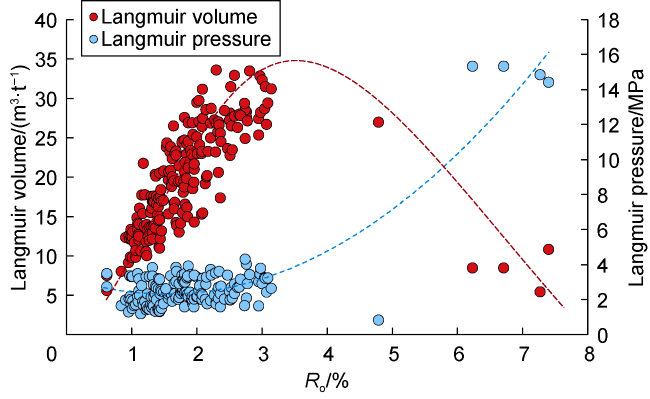
Fig. 4. Correlations between the thermal maturity of coal reservoirs and Langmuir volume/pressure in the Upper Paleozoic of the Ordos Basin. |
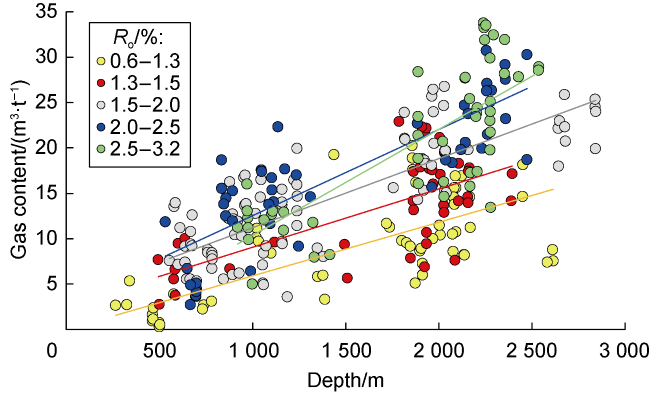
Fig. 5. Variation of measured gas content of coals at different ranks with depth in the Upper Paleozoic of Ordos Basin. |
3.2. Coal quality and roof lithology
Below 1 800 m, the gas content distribution in coals of equivalent maturity is significantly scattered due to variations in ash yield, demonstrating an inverse correlation whereby higher ash yields correspond to lower gas contents (Fig. 6a ). This negative relationship is consistently observed across different cored intervals within the same well (Fig. 6b ). According to statistical results at depth greater than 1 800 m, coal seams with gas content exceeding 25 m3/t generally have ash yield less than 20%, and Ro greater than 2.0%. When the ash yield is 20%-30%, the gas content is less than 20 m3/t; and when the ash yield is over 30%, the gas content is generally less than 15 m3/t (Fig. 6c ). Table 1 presents the test result of pressure-preserved coring of coal seam 8# in the Carboniferous Benxi Formation from the whole section of Well V. The upper interval (2 274.04-2 277.03 m) has low ash yield (avg. 10.4%), high Langmuir volume (avg. 30.9 m3/t), high gas content (avg. 24.3 m3/t) and low water saturation (avg. 16.5%), exhibiting a superior gas storage capacity. In contrast, the lower interval (2 277.51-2 281.22 m) demonstrates higher ash yield (avg. 30.5%), lower Langmuir volume (avg. 22.74 m3/t), higher Langmuir pressure (avg. 3.8 MPa), lower gas content (avg. 18.7 m3/t) and higher water saturation (avg. 52.6%), indicating diminished gas accumulation capacity.
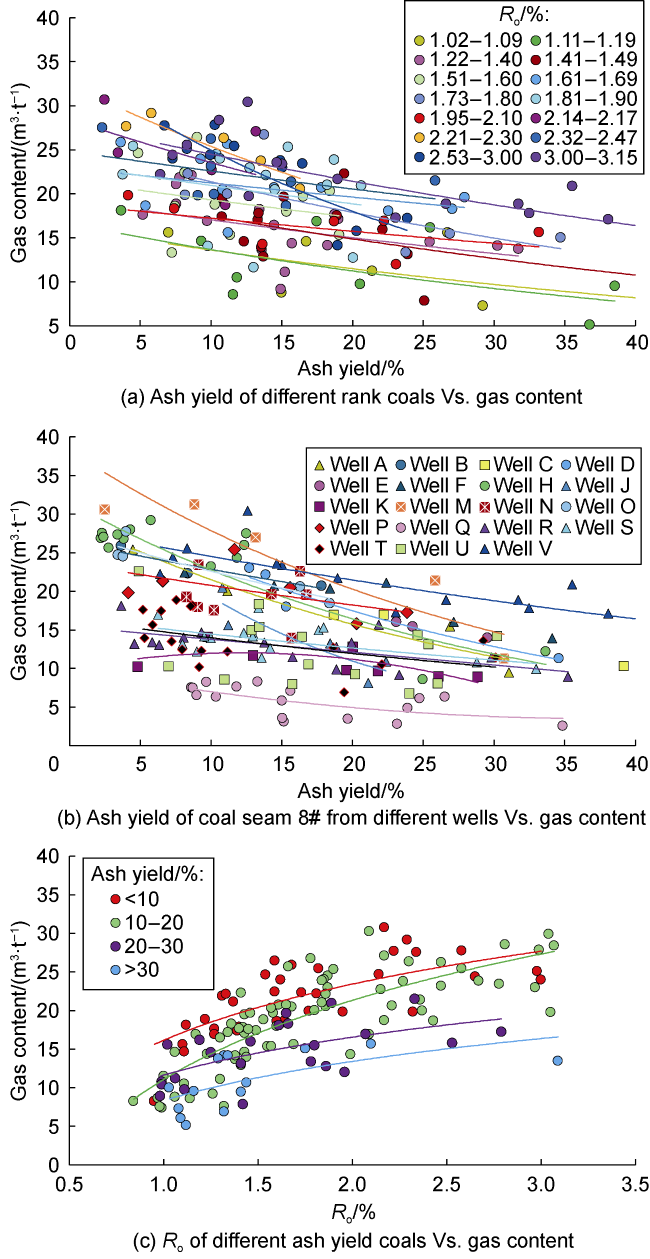
Fig. 6. Relationships between gas content and ash yield, Ro of the Upper Paleozoic coal reservoirs in the Ordos Basin. |
Table 1. Test results of pressure-preserved cores collected across the entire interval of coal seam 8# in the Carboniferous Benxi Formation from Well V in the Ordos Basin |
| Coal seam interval | Core No. | Depth/ m | Ash yield/ % | Langmuir volume/ (m3·t−1) | Langmuir pressure/MPa | Gas content/ (m3·t−1) | Water saturation/% |
|---|---|---|---|---|---|---|---|
| Upper | 1 | 2 274.04 | 12.69 | 19.76 | 25.60 | ||
| 2 | 2 274.46 | 12.60 | 31.47 | 3.21 | 30.44 | 19.90 | |
| 3 | 2 275.00 | 15.04 | 28.65 | 3.25 | 23.40 | 7.74 | |
| 4 | 2 275.69 | 7.30 | 32.83 | 3.46 | 24.43 | 10.03 | |
| 5 | 2 276.40 | 6.41 | 32.28 | 2.91 | 22.23 | 22.38 | |
| 6 | 2 277.03 | 8.31 | 29.39 | 3.22 | 25.57 | 13.50 | |
| Lower | 7 | 2 277.51 | 26.62 | 28.18 | 3.78 | 18.89 | 47.40 |
| 8 | 2 277.76 | 41.76 | 17.15 | 3.86 | 19.22 | 62.91 | |
| 9 | 2 278.02 | 38.08 | 17.04 | 3.40 | 17.11 | 55.41 | |
| 10 | 2 278.28 | 35.52 | 18.62 | 3.88 | 20.91 | 57.62 | |
| 11 | 2 278.81 | 32.48 | 19.32 | 3.65 | 17.80 | 54.77 | |
| 12 | 2 279.17 | 31.72 | 22.39 | 4.24 | 18.86 | 37.03 | |
| 13 | 2 279.56 | 18.94 | 32.09 | 4.20 | 21.71 | 53.57 | |
| 14 | 2 279.82 | 14.66 | 28.37 | 3.61 | 23.58 | 62.73 | |
| 15 | 2 280.95 | 23.06 | 17.28 | 41.14 | |||
| 16 | 2 281.22 | 42.35 | 21.52 | 3.53 | 11.91 | 53.55 |
Coal ash originates primarily from minerals. Coals with high ash yields or inorganic pores and fractures are typically water-wet and gas-repellent, leading to preferential occupation of reservoir space by water molecules. In contrast, coals with low ash yield have more organic pores with strong CH4 storage capacity [40]. From the perspective of reservoir evolution process, during burial-related thermal metamorphism, hydrocarbon generation or tectonic uplifting, CH4 molecules preferentially occupy the space in low-ash-yield coals. Conversely, in high-ash-yield coals, a complex capillary pressure sealing system may be created in the nano-pore and throat network when formation water is expelled from or invades the reservoir. On the one hand, the sealing system may reduce the adsorption capacity and limit available space for free gas. On the other hand, it may enhance the self-sealing property of the coal reservoirs [41]. Notably, evaluating the impact of coal quality on fluid distribution requires a holistic analysis that considers coal structure, reservoir-caprock combination, internal segmentation and their geometrical relationship. Among all factors, the equilibrium between gas and formation water pressures is the most important. When considering coal structure, the influence of the presence of partings shouldn’t be ignored. For example, coal seam 8# contains 1-2 partings (mainly mudstone or carbonaceous mudstone). The coal structure can be classified into Type I (no partings), Type II (one parting) and Type III (two partings). Compared to the eastern areas, coal reservoirs in the central Nalinhe-Uxin banner-Jingbian areas are over 3 000 m depth, exhibiting reduced coal thickness and prevalent Type II-III structures, resulting in diminished gas storage capacity with the average gas content of only 17.6 m3/t. Roof lithology is another important factor that prevents gas escape through vertical channels. There are three reservoir-caprock combinations for 8# coal seam in the Ordos Basin, which are coal-mudstone, coal-limestone, and coal-sandstone. The first two are dominant, while coal-sandstone combination is mainly distributed in the northeast and north of the basin. The breakthrough pressure of the limestone roof is the highest, 20 MPa on average, followed by the mudstone (about 5 MPa). The sandstone with the strongest transport capacity has the lowest breakthrough pressure, only about 1.5 MPa. As a result, the coal-sandstone combination has lower peak gas logging values and measured gas content compared to the other two combinations [22-24].
3.3. Formation temperature
In the Ordos Basin, the temperature of the Upper Palaeozoic coal reservoirs increases linearly with depth, with the average geothermal gradient of about 3 °C/100 m, which belongs to a normal geothermal gradient [8]. According to previous research, when temperature and pressure thresholds are reached, saturated adsorbed gas content begins to decrease with depth. Some predictive models have been established for adsorbed gas content by considering variables such as coal rank and formation temperature [3,8]. Based on the isothermal adsorption experiments on high-rank coals under varying temperatures and pressures, every 1 000 m increases in depth, the temperature rises by 30 °C, the Langmuir volume decreases by about 3 m3/t, and the Langmuir pressure increases slightly. Consequently, the reduction in the saturated adsorbed gas content at reservoir pressure typically maintains in a relatively small range [17]. Fig. 7 indicates that the vertical variation of the saturated adsorbed gas content follows a general law featured by “increasing- steady-decreasing”, with constant coal rank and varying only formation temperature and pressure with depth. Temperature begins to negatively affect the adsorption capacity of various rank coals at 1 500-2 200 m. However, the difference in adsorbed gas content remains less than 1 m3/t between 2 000 m and 3 000 m. This indicates that the negative effect of temperature on the adsorption capacity of coal reservoirs objectively exists. Moreover,the coupling of temperature with reservoir pressure, reservoir properties, and in-situ CH4 density determines the upper limit of gas content. Compared with the pronounced regional heterogeneity in coal quality, the relative continuous vertical variations in temperature and pressure, along with their uniform gradients, result in weak regional modification of gas content in deep coal reservoirs. For example, due to increasing Ro with depth, the in-situ saturated adsorbed gas content in the Daning-Jixian block continuously increases with depth without exhibiting an obvious turning point, although the increase rate tends to gradually slow [8].
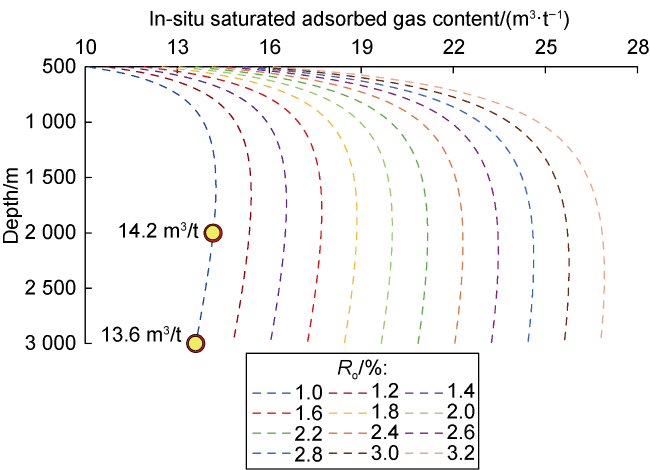
Fig. 7. Theoretical model of vertical variation of saturated adsorbed gas content in coal reservoirs (modified from Reference [8]). |
4. Gas enrichment models of coal reservoirs
Coal reservoirs shallower than 1 500 m typically exhibit an open and actively recharging fluid system. Below 1 800 m, ultra-low permeability reservoirs with self-sealing ability (to prevent water invasion and gas escape), lateral hydrodynamic (or hydraulic pressure) sealing and tight cap rock collectively create a closed and stagnant fluid system. Within this closed system, the uniform pressure gradient is related to the connectivity of fractures and pores as well as the spatial differentiation of gas-water relationships. Under the constraints of deep formation temperature and pressure conditions, reservoir properties are key factors controlling the fluid distribution in deep coal seams. Regional variability and superimposed relationships of coal quality and reservoir-caprock combinations significantly influence the storage capacity for fluids in various occurrences. Macroscopically, this influence is reflected in non-uniform distribution of gas-rich, water-rich and transitional fluid systems. Microscopically, fluid distribution is controlled by the dynamic balance of gas-water migration and accumulation under capillary force constraints. In addition, production practices in the Daning-Jixian block have confirmed that micro-structure plays a regulatory role in the fluid allocation in coal reservoirs. The distribution of free gas is correlated with the regional tectonic framework and structural styles. Gas-water relationships and production behaviors differ significantly among uplift zones, gentle structural zones, positive and negative microstructural zones. In particular, local structural highs exhibit trap characteristics favorable for free gas enrichment [42-43] (Fig. 8 ).
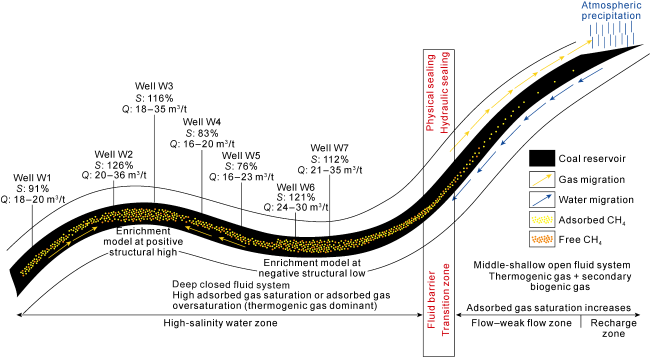


Fig. 8. Schematic gas enrichment models of coal reservoirs at different structural locations (S—average adsorbed gas saturation; Q—total gas content). |
In summary, under the constraints of deep formation temperature and pressure conditions, the gas accumulation capacity of coal reservoirs is controlled by storage capacity, wettability, and sealing properties. These characteristics are related to coal quality, reservoir-caprock combinations, and structural position, encompassing geological factors such as coal rank, ash yield, mineral composition, pore-throat structure, parting distribution, surrounding rock lithology and tectonic morphology. At similar depths, high-rank coals generally exhibit higher gas contents. For example, coal reservoirs in the Daning-Jixian block have significantly higher gas contents than those in the Linxing-Shenfu block. Conversely, at comparable coal ranks, coals with higher ash yields possess poorer gas storage properties and generally demonstrate moderate to abundant water saturation and lower gas content, due to inorganic components and water-wet, gas-repellent mineral pores and fractures. Additionally, compared to sandstone caprock, limestone and mudstone caprocks demonstrate superior sealing property. For accurate resource evaluation and reserve estimation, it is essential to fully consider the heterogeneity of coalbed texture and coal quality, ensuring parameters are precisely quantified on single boreholes. According to current exploration results, the upper and middle coal intervals with low ash yields, low water saturation, and high gas content represent high-quality reservoirs or sweet spots [44]. Within similar coal-forming or depositional environment, gas content is governed by local structural morphology, style and position. In the case of Ro>2.0% as measured in exploration wells, positive structural highs subjected to tensile stress are more favorable for developing tensile or extensional fractures that provide excellent storage space for free gas. Consequently, the gas content in these structural highs is significantly higher than that in steep slopes, where adsorbed gas is generally under or near saturation levels. In broad and gentle dipping negative structural lows, high stress conditions, ultra-low permeability, strong self-sealing characteristics, excellent formation integrity and favorable preservation conditions collectively enhance CH4 enrichment potential (Fig. 8 ). Previous development practices in the Daning-Jixian block have confirmed that positive microstructures offer distinct advantages, such as higher permeability, lower stress levels and improved reservoir stimulation potential[14]. During production, CH4 may gradually migrate toward structural highs along the pressure drop direction to form dynamic gas reservoirs [42]. In contrast, negative structural lows are subjected to strong compression stress conditions [45], which restricts the propagation of hydraulic fractures and hinders efficient proppant transport and placement. For example, some production wells in the Hexi groove area of the Daning-Jixian block produced gas immediately after put into production but experienced rapid production declines, likely due to insufficient reservoir stimulation and inadequate fracture propping. Overall, coals with higher rank and low ash yield, along with limestone and mudstone caprocks, exhibit pronounced gas accumulation potential. Both positive structural highs and negative structural lows, particularly when located away from faults, are favorable for gas enrichment. Conversely, steep slopes typically demonstrate lower gas content. Future study should prioritize developing the criteria for parameter classification based on regional geology, exploration well data and production performances.
5. Conclusions
In the central-eastern Ordos Basin, the threshold depth for adsorbed gas oversaturation in coal reservoirs is 1 500-1 800 m, corresponding structurally to the transitional zone between the central slope of the Jinxi Flexure Belt and the west-dipping gentle slope. The coal reservoirs shallower than 1 500 m typically represent an open fluid system characterized by high water mobility, strong water invasion, relatively low water salinity which slightly increases with depth, and scattered pressure gradients. In these shallow reservoirs, the free gas is largely dissipated, and adsorbed methane is variably mixed with secondary biogenic gas, resulting in water-rich conditions and adsorbed gas undersaturation. Below 1 800 m, ultra-low permeability reservoirs with self-sealing ability form a closed fluid system through the combined effects of lateral hydrodynamic sealing and vertical confinement by tight caprocks. Within this system, surface runoff infiltration is minimal, original fluids are largely preserved, and the secondary alteration is minor, and pressure gradients are convergent and relatively uniform. Most reservoirs at these depths exhibit adsorbed gas saturation exceeding 100%, with free gas content typically ranging from 1 m3/t to 8 m3/t, and locally exceeding 10 m3/t.
Under the influence of formation temperature and pressure conditions, the gas accumulation of deep coal reservoirs is primarily controlled by coal quality, reservoir-caprock assemblages and structural position, which collectively determine reservoir properties, wettability and sealing capacities. Superimposed zone with coals of high rank and low ash yield, accompanied by limestone or mudstone caprocks, are particularly favorable for gas accumulation. Conversely, coals with high ash yields contain abundant inorganic pores and fractures characterized by water-wet and gas-repellent properties, readily occupied by water molecules and forming moderate to abundant water saturation and lower gas content reservoirs. The middle and upper parts of coal seams, which exhibit low ash yield, low water content and high gas content, are sweet spot intervals. Structurally, both positive structural highs and gentle and wide negative structural lows are favorable for gas accumulation, whereas steep slopes generally exhibit relatively lower gas content.
Acknowledgments
The authors sincerely thank PetroChina Coalbed Methane Company Limited, PetroChina Changqing Oilfield Company, China United Coalbed Methane Company Limited, and Sinopec East China Petroleum Bureau for providing valuable basic data.