

Introduction
The passive continental margins are formed through a series of complex geodynamic processes of continental thinning, continental breakup and subsequent oceanic lithosphere formation, and present diverse structure types and architectural features [1-2]. According to the difference of architecture and magmatism, the passive continental margins have been classified into two end-members, e.g. magma-rich and magma-poor margins. The magma- rich margins are characterized by magma-dominated with the high-velocity lower crust (HVLC) and the seaward-dipping reflectors (SDRs), while the magma-poor margins are characterized by weak magmatism, with wide rifts controlled by detachment faults, and the exhumation of serpentinized mantles in ocean-continent transition (OCT) [3-4]. In recent years, the dissection to the continental margin of the northern South China Sea (SCS) shows that there is a type of intermediate continental margin, which has combined features of magma-poor and magma-rich margins. The intermediate continental margin of the northern SCS had poor magma during its initial rifting period and then rich during its late rifting period, with rapid rift-drift transition in the narrow OCT, but no exhumation of the lithospheric mantle. The crust along the continental margin of the northern SCS is different from the wedge-shaped thinning of the magma- poor margins and the significant thickening of the magma-rich margins along the Atlantics [5-8]. Several researchers have found that the intermediate continental margin undergoes complex tectonics, stratigraphy-magmatic interactions, and special rifting-continental breakup process, which is an important supplement example to the study of passive continental margins [9-13]. Based on the systematic study of the architectures of typical passive continental margins, previous studies subdivided the continental margin from the continent to the ocean into four structural domains: the proximal zone, the necking zone, the hyperextended zone and the ocean-continent transition zone. Different structural domains were mainly individually controlled by stretching, necking, hyperextension and breakup of continental lithosphere [14-15]. The necking zone is a narrow zone located in the transition of continental crust from a weakly thinned proximal zone to an extremely thinned distal zone. Based on the systematic study of the architectures of magma-rich and magma- poor continental margins, it shows that the Moho geometry of the necking zone generally changes from a relatively flat in the proximal zone to a high dip angle (up to 35°). The crust between the sedimentary basement and Moho discontinuity shows a convergent wedge-shaped geometry with a width of 10-100 km, and the crustal thickness can be sharply thinned from ~30 km to ~10 km, indicating the style and intensity of the crust thinning and deforming [1,15 -18]. The tectonic deformation in the necking zone is intense, yet with minimal modification by basaltic magmatism during lithospheric breakup. This allows the crustal architecture and sedimentary sequences to preserve the processes of four distinct deformation phases. Consequently, it provides a crucial window for investigating continent lithospheric thinning and breakup processes and their tectonic responses [15,17].
The northern margin of the SCS is a typical intermediate passive continental margin, and the necking zone is typically represented by the Baiyun Sag, Kaiping Sag and its adjacent areas in the deepwater area of the Pearl River Mouth Basin (PRMB). The tectonic deformation is strong and complex, and it has the most prospective hydrocarbons for exploration in the deepwater area of the PRMB. The necking zone in the deepwater area of the PRMB is rich in oil and gas resources, and a series of important petroleum discoveries have been achieved in the Baiyun Sag and Kaiping Sag [19], but most petroleum is underexplored. The total geological resources of petroleum in the Baiyun Sag are estimated to be 1.8×10⁹ t, and natural gas accounts for about 60% [20]. So far, fifteen gas fields and three oil fields have been discovered, with the proven natural gas reserves exceeding 200×109 m3 and crude oil exceeding 60×106 t. The total geological resources of petroleum in the Kaiping Sag exceed 600×106 t, and the first commercial petroleum breakthrough was achieved in 2021, with the discovery of the first deepwater and deep reservoir 100-million-ton oilfield in the northern SCS [21]. The necking zone in deepwater area exhibits NS segmentation and EW zonation, with the development of multi-level detachment faults, diverse sag structures, intense magmatic activities, and multi-style and multi-phase crustal thinning and sedimentary filling responses [9,11,22 -26]. Compared with the structure of the necking zone at typical magmatic-rich and magmatic-poor passive continental margins, the intermediate continental margin exhibits greater complexity and variability. However, a systematic description of the lithospheric structure is lacking, which results in poor understanding on the tectonic control factors and tectonic deformation mechanism. This strongly influenced the petroleum exploration process in the deepwater area of the northern SCS. In this study, we systematically analyze the lithospheric structure characteristics, thinning mechanisms, and syn-rift tectonic deformation response processes of the necking zone in the deepwater area of the PRMB, explore its petroleum geological significance, and aim to facilitate petroleum exploration in the deepwater area of the PRMB.
1. Lithospheric structure of the northern South China Sea margin and the geological setting of the necking zone
The continental margin of the northern South China Sea is located at the junction of the Pacific, Indian-Australian and Eurasian plates, represents a Cenozoic passive continental margin developed on the fold basement of a Mesozoic complex continental-margin magmatic arc. During the extension and breakup of continental lithosphere in the northern SCS, the region underwent sequential deformation processes, which extended laterally from continent to ocean and vertically from the surface to the Moho discontinuity, ultimately to the breakup of lithosphere at continental margin. Faults evolved from small high-angle normal faults to larger medium-angle listric faults, and eventually to major low-angle detachment faults, and the tectonic deformation transitioned from a dispersed pattern to a centralized pattern, migrating toward the eventual lithospheric breakup and formation of oceanic crust [5]. The breakup of the continental margin led to the development of distinct structural belts with variable characteristics from continent to seaward [25] (Fig. 1): the proximal zone mainly includes the Zhu I Depression and Zhu III Depression, characterized by half-grabens with widths of 100-300 km and crust thicknesses of approximately 30-22 km. This zone shows limited crustal thinning with thinner syn-rift deposits and thicker post-rift deposits, along with the development of medium- to high-angle normal faults. The necking zone involves primarily the Zhu II Depression, composed by the Baiyun Sag and Kaiping Sag, where abrupt crustal thinning over a width of 70-110 km is observed, with a crustal thickness ranging from 6 km to 26 km. This zone is characterized by landward-dipping and seaward-dipping detachment faults with thick accumulation of sedimentary infill. The hyperextended zone, composed by the Zhu IV Depression (mainly including Liwan Sag), exhibits the thinnest continental crust of about 11 km thick [23]. It is dominated by seaward-dipping detachment faults, with remarkable characteristics such as metamorphic core complexes and extensional allochthons [10,12]. Finally, the ocean-continent transition zone at the southern margin of the PRMB is characterized by an abrupt southward change from continent crust to typical oceanic crust. This transition is marked by the occurrence of mid-ocean ridge basalts interbedded with sediment strata, but no serpentinized mantle exhumation has been observed in the region [2,6].
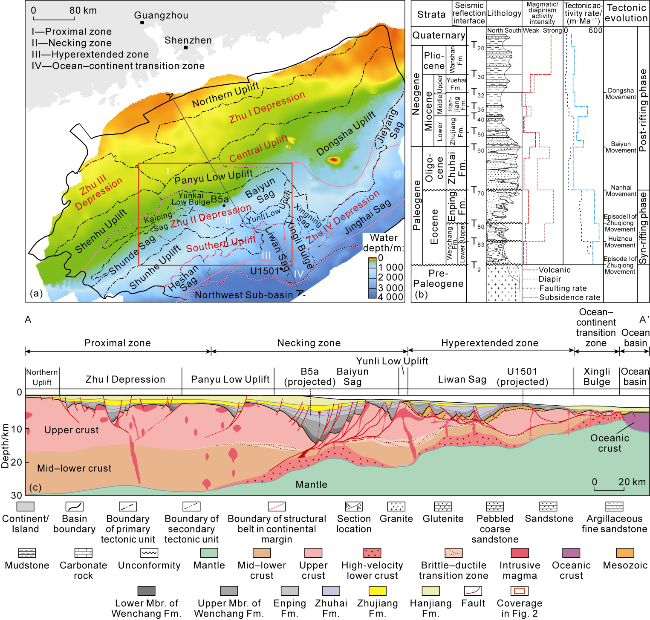
Fig. 1. Tectonic unit division of Pearl River Mouth Basin (a), comprehensive stratigraphic column of the deepwater area (b) and the structural geology profile across the continental margin in northern SCS (c) (modified after Reference [25]). |
The deepwater area of the PRMB in the northern SCS has developed Cenozoic sedimentary sequences as follows: syn-rift megasequence of fluvio-lacustrine deposits of the early Eocene Wenchang Formation and the late Eocene Enping Formation; post-rift megasequence of neritic continental shelf deposits of the Oligocene Zhuhai Formation and continental slope deposits from the Miocene Zhujiang Formation to Quaternary strata (Fig. 1b). The Cenozoic syn-rifting phase in the PRMB experienced four major regional tectonic movements, namely, the early Eocene episode I of the Zhuqiong Movement, the mid-Eocene Huizhou Movement, late Eocene episode II of the Zhuqiong Movement and late Oligocene Nanhai Movement [27]. These tectonic phases resulted in the formation of four regionally significant unconformities (namely the seismic reflectors of Tg, T83, T80 and T70). Correspondingly, the deepwater necking zone underwent multi-phase crustal thinning, accompanied by distinctive tectonic-sedimentary responses [25]. Significant variations in terms of faulting and subsidence rates in different sags are recorded through successive deposition of the early Wenchang Formation, the late Wenchang Formation and the Enping Formation, reflecting a complex episodic evolution of rifting (Fig. 1b). Since the Oligocene, coinciding with continental breakup along the northern SCS margin and multi-stage seafloor spreading, post-rift thermal subsidence has driven multi-episode differential subsidence in the deepwater area. This process has simultaneously led to the sedimentary sequences on both shallow-water continental shelf and deep-water continental slope.
The deepwater area of the PRMB has involved multi- stage magmatism during both syn-rifting and post-rifting phases[2,12,23], characterized by stronger east and weaker west, and stronger early stage and weaker late stage. This played an important role in crustal breakup and the formation of oceanic crust. Magmatism in the basin was stronger in the west and weaker in the east, as evidenced by the development of typical high-velocity lower crust (HVLC) east of the Kaiping Sag and seaward (Fig. 1c). These features resulted from decompression melting of the lower crust induced by mantle asthenospheric upwelling during the late syn-rift to post-rift phases. The HVLC gradually thinned westward and eventually disappeared toward the western part of the basin [2,7,13]. The magma during the syn-rifting phase had the characteristic of first poor and then rich, which is reflected in weaker magmatism during the early deposition period of the Wenchang Formation, and the strongest magmatism during the early deposition period of the Wenchang Formation and the deposition period of the Enping Formation with the widest influence scope (Fig. 1b). Such pulsed magmatic activity profoundly controlled tectonic deformation and differentiation of crustal architecture along the continental margin [9,11].
2. Necking zone types of continental margin and characteristics of thinned crustal architecture
Governed by spatiotemporally systematic and sequential crust-mantle coupling processes, passive continental margins exhibit necking zone types and thinned crustal architectures that manifest genetic affinities with adjacent tectonic domains and demonstrate spatially continuous transitional characteristics [15]. The continental-margin necking zone in the PRMB shows a crustal geometry with central thinning and flank thickening, characterized by multi-level and multi-dipping detachment fault systems that govern the spatially variable syn-rift depression structure (Fig. 2a, 2b). Based on integrated analysis of variations in crustal thinning magnitude and styles, types of detachment faults, and magmatism intensity, the deepwater necking zone situated in Baiyun Sag and Kaiping Sag is subclassified into four distinct thinned crustal architecture types: wedge-shaped extreme thinned crustal architecture in Baiyun Main Sub-sag, dumbbell-shaped moderate thinned crustal architecture in Baiyun West Sub-sag, box-shaped weak thinned crustal architecture in eastern Baiyun Sag, and metamorphic core complex asymmetric weak thinned crustal architecture in Kaiping Sag.
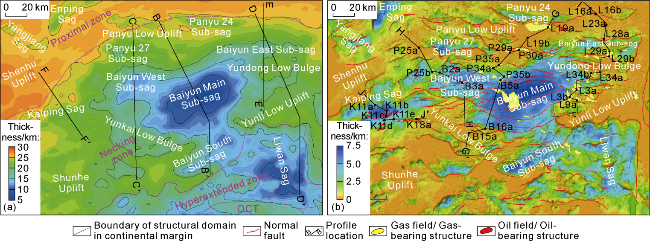
Fig. 2. Map of crustal thickness estimation in deepwater area of Pearl River Mouth Basin (a) and map of syn-rift sediment thickness and fault distribution in Wenchang-Enping formations (b) (see the plan position and range in Fig. 1a). |
2.1. Wedge-shaped extreme thinned crustal architecture in Baiyun Main Sub-sag
The wedge-shaped extreme thinned crustal architecture in Baiyun Main Sub-sag is characterized by the development of multiple landward-dipping, stepwise crust mantle or inter-crustal detachment faults, the presence of broad and thick syn-rift sedimentary sequence, intense wedge-shaped thinning throughout the crust, and stronger magmatism on gentle slopes compared to the steep slopes.
Multiple landward-dipping crust-mantle and inter- crustal detachment faults control the development of broad and thick syn-rift deposits (Fig. 3). The large crust- mantle detachment faults in the central rift, identified on long-offset seismic profiles as the main fault controlling the structure of the Baiyun Main Sub-sag, converge in scoop-type downward at a depth of 8-9 s TWT (two-way travel time) near the Moho discontinuity [23-25]. Stepwise inter-crustal detachment faults in the southern rift show listric geometries with steep upper segments and flat lower segments, terminating upward at T70 and T40 interfaces and downward into mid-crustal ductile shear zone. In the northern rift, two sets of north-dipping inter- crustal detachment faults beneath the Panyu Low Uplift root into mid-crustal ductile shear zone (Fig. 3). These detachment faults govern the broad and thick syn-rift sequences, accompanied by a maximum cumulative horizontal displacement of ~40 km and a total syn-rift subsidence reaching 12 km [9,25].
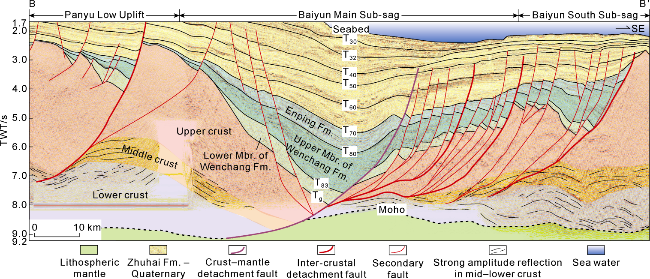
Fig. 3. Seismic-geology structural profile across Baiyun Main Sub-sag (profile location shown in Fig. 2). |
The intense wedge-shaped crustal thinning in the Baiyun Main Sub-sag is controlled by hierarchical detachment faulting, coupled with deep-seated magmatism. The sedimentary basement Tg interface and the Moho discontinuity converge toward the center of the wedge- like rift from both the north and south, with crustal thickness sharply decreasing from ~25 km to a minimum of 6 km. Seismic profiles reveal a tripartite crustal architecture: the upper crust exhibits clear reflection horizons of Tg at it top, with clear internal fault planes, and locally display short-axis, high-amplitude reflections indicative of magmatic intrusions; The middle crust is delimited by well-defined upper/lower boundaries which could be traced by subparallel, continuous and moderate-amplitude seismic reflections; The lower crust generally shows weak seismic reflections with local discontinuous and high-amplitude ones. The Moho discontinuity appears laterally discontinuous, and its depth could be further constrained by using adjacent long-offset seismic profiles. Separated by a crust-mantle detachment fault in the center, the northern and southern regions of the Baiyun Main Sub-sag exhibit differential crustal thinning (Fig. 3). In the south, the upper crust thinning occurs through multi-level detachment faults accompanied with block rotation, while middle crust displays boudinage-style thinning, attributed to ductile extension coupled with detachment faulting. In the north, the crust thinning is marked by an intense lateral convergence as the result of upper crust-mantle detachment and lower crustal flow. The wedge-like lower crust appears to be thicker than the southern region and dramatically thickens landward. The middle crust displays ductile thinning with significant doming beneath the Panyu Low Uplift, different from a mildly thinned but intensely rotated/tilted upper crust.
2.2. Dumbbell-shaped moderate thinned crustal architecture in Baiyun West Sub-sag
The dumbbell-shaped moderate thinned crustal architecture in Baiyun West Sub-sag manifests as following: development of opposingly-dipping inter-crustal detachment faults controlling narrow and shallow syn-rift sedimentary strata, dumbbell-shaped moderate crustal thinning, middle crustal thinning through ductile shearing and rupture, and overall weaker magmatism.
The opposingly-dipping inter-crustal detachment faults along the northern and southern flanks of the sub-sag govern the development of its narrow and shallow syn-rift sedimentation (Fig. 4). The major inter-crustal detachment faults generally converge downward into mid-crustal ductile shear zones. The north-dipping faults exhibit listric geometries with steep upper segments and flat lower ones, which are similar to that of the Baiyun Main Sub-sag, and dominate an upper-crustal thinning through stepwise tilting. Different from the Baiyun Main Sub-sag, however, the north-dipping and south-dipping faults form an opposing detachment faulting system, with significantly lower fault density and weaker fault activity on the Yunkai Low Bulge to the south, compared to the southern margin of the Baiyun Main Sub-sag. The maximum thickness of syn-rift sedimentation controlled by detachment faulting reaches ~4.5 km in the center of the sub-sag, which thin stepwise toward its northern and southern margins. The thickness of the lower Wenchang Formation is comparable to that of the Baiyun Main Sub-sag, while the upper Wenchang and Enping Formations exhibit markedly reduced thicknesses.
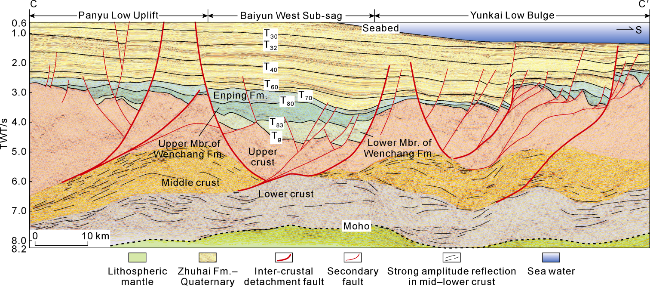
Fig. 4. Seismic-geology structural profile across Baiyun West Sub-sag (profile location shown in Fig. 2). |
The Baiyun West Sub-sag along with its northern and southern flanks exhibit a tripartite crustal structure of moderate but laterally heterogeneous thickness. It is characterized by dumbbell-shaped moderate thinning where the middle crust is thinned through ductile shearing and detachment faulting (Fig. 4). Long-offset seismic profiles cross the Yunkai Low Bulge and the Baiyun Main Sub-sag reveal shallower depths of the Moho discontinuity beneath the Yunkai Low Bulge (crustal thickness of 12-22 km), compared to that beneath the Baiyun Main Sub-sag [25]. This region displays well-defined and laterally traceable interfaces between the three distinct crustal layers, with seismic reflections analogous to those in Baiyun Main Sub-sag. Mantle-derived magmatism in the Baiyun West Sub-sag is notably weaker and more localized than that in Baiyun Main Sub-Sag, while strong mantle underplating and intense ductile extension of middle crust beneath the sag center drive the generation of boudinage-like structure. The upper wall of the main detachment fault develops a gently uplifted mid- lower crustal ductile dome structure, while an undulating mid-lower crustal uplift is observed in the southern segment. Under the combined mechanisms of overlying detachment faulting and localized magmatic underplating of mantle-derived magma beneath, the mid-crustal ductile layer underwent detachment and fragmentation through ductile shearing, resulting in a dumbbell-shaped crustal architecture characterized by moderate thinning with thinner center and thicker flanks.
2.3. Box-shaped weak thinned crustal architecture in eastern Baiyun Sag
The box-shaped weak thinned crustal architecture of eastern Baiyun Sag demonstrates a combination of low- angle intra-crustal detachment faults with a ramp-flat- ramp configuration, which control broad and shallow syn-rift sedimentary strata, and a box-shaped weak thinning in overall crust but alternating with magmatism- induced thickening.
The eastern Baiyun Sag with two sets of north-dipping, low-angle inter-crustal detachment faults with a ramp- flat-ramp feature governs the broad and shallow syn-rift deposits. While previous studies [9,25] classified these faults as detachment faults in the upper crust, we believe their categorizations as inter-crustal detachment faults based on their downward termination onto the roof of the mid-crustal ductile shear zone. The detachment faults show detaching upper wall and uplifting lower wall, with their active hinges pivoting northward. This process has initiated multiple new active faults rooted in the main detachment faults, which may propagate to form secondary detachment faults. These features align with the rotational-hinge detachment model proposed by Reston et al. [28] (Figs. 5-6). The syn-rift sequences controlled by these dual detachment faults are thinner than those in the Baiyun Main Sag and Baiyun West Sub-sag but exhibit comparable width to the Baiyun Main Sub-sag. A northward migration of rifting center accommodates a greater overall magnitude of extension in this sag.
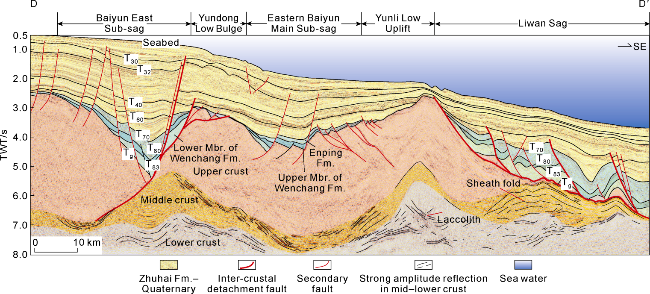
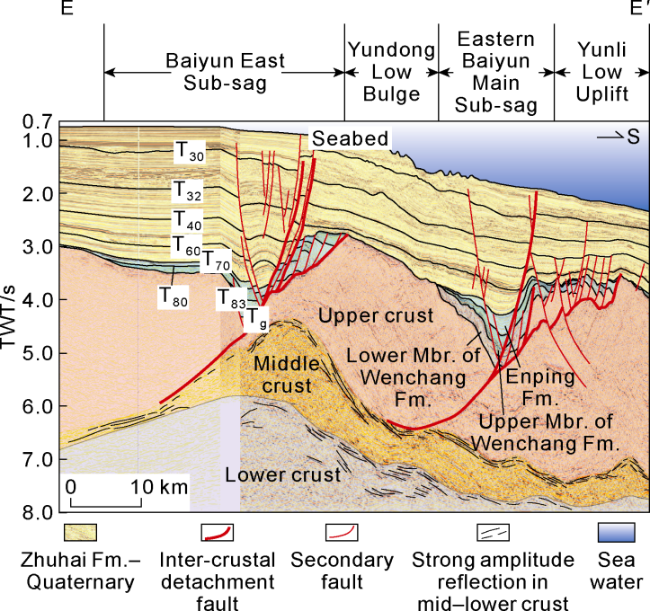
The eastern Baiyun Sub-sag exhibits a box-shaped weak thinned crustal architecture characterized by progressive upper-crustal thinning through lower wall exhumation during low-angle detachment rollback, mid- crustal attenuation via intense ductile stretching, and interleaved lower-crustal ductile dome structures driven by alternating magmatic underplating and crustal flow. The necking zone in this sub-sag transitions westward into the intensely thinned crust of the Baiyun Main Sub-sag and southward into the hyperextended domain of the Liwan Sag. Over a lateral distance of approximately 80-90 km, the crustal thickness decreases from ~25 km to 15 km, indicating an overall weak thinning. SN-trending seismic profiles reveal at least two laterally continuous and traceable intra-crustal interfaces, below which abundant characteristic ductile shear fabrics are observed. These interfaces are spatially aligned with the undulating relief of sedimentary base of the sag, and are therefore interpreted as the upper and lower boundaries of the mid-crustal ductile layer (Figs. 5-6). Stronger magmatism is revealed in deep eastern Baiyun Sub-sag by abundant high-amplitude seismic reflections related to intrusions in lower-crust, producing large-scale laccoliths and sheath folds beneath the Yunli Low Uplift and adjacent areas. This shows evidences of alternating magmatic underplating and therefore induced lower crustal thickening. Concurrent thermal input further enhanced a lateral lower crustal flow, promoting ductile thinning in the middle crust and the formation of ductile domes in the mid-lower crust beneath the lower wall of the main detachment fault. These features suggest a genetic link between lower crustal flow, mid-crustal doming, and upper-crustal low-angle detachment faulting (Fig. 5).
2.4. Metamorphic core complex asymmetric weak thinned crustal architecture in Kaiping Sag
The metamorphic core complex asymmetric weak thinned crustal architecture in Kaiping Sag is characterized by low-angle ramp-flat-ramp style inter-crustal detachment faults, the presence of moderately wide and thick syn-rift sedimentary sequences, middle crustal exhumation and thinning, and lower crustal thickening, altogether forming an asymmetric overall crustal thinning architecture with metamorphic core complex and related detachment system.
In terms of crustal architecture and thinning degree, the Kaiping Sag shares certain similarities with the eastern Baiyun Sag, except that it has developed a typical metamorphic core complex. A thickened lower crust and a middle crust nearly exhumed to the surface under intense magmatism, together with a broad and moderately thick dish-shaped depression, are consistent with the typical rift featured by metamorphic core complex and related detachment system (Fig. 7). A seaward-dipping large-scale inter-crustal detachment fault system of ramp- flat-ramp geometry develops above the metamorphic core complex in the Kaiping Sag. This fault extends downward to the upper boundary of the mid-crustal ductile shear zone. In the central segment of this fault, the middle crust on the lower wall is nearly exhumed to the surface and in direct contact with the overlying sedimentary strata. Notably, the tuffaceous rhyolites overlying the fault surface are dated to be 151.4-160.4 Ma, indicating that the detachment system inherits pre-existing Mesozoic weak zones. The low-angle detachment fault system exhibits a rotational hinge-style forward- propagating geometry, which controls the accumulation of moderately wide and thick syn-rift deposits.
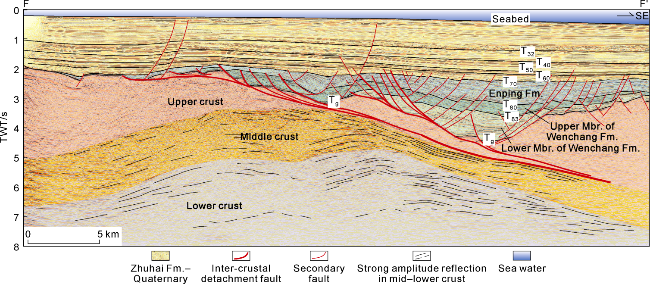
Fig. 7. Seismic-geology structural profile of Kaiping Sag (profile location shown in Fig. 2). |
The Kaiping Sag necking zone, with a crustal thickness of 25-18 km, transitions eastward from weakly thinned crust to the moderately thinned crust of the Baiyun West Sub-sag necking zone (Fig. 2a). The crustal architecture of the Kaiping Sag closely resembles that of the eastern Baiyun Sag. Seismic profiles reveal at least two laterally continuous and traceable dome-shaped shear zones, displaying characteristic high-amplitude foliation below, which are interpreted as the upper and lower boundaries of the ductile middle crust (Fig. 7). This layered mid-crustal unit could be traced northward into the Yangjiang Sag, where it exhibits a typical thickness of 3-6 km and a broad lateral extent [21]. Beneath the upper wall of the main detachment fault, the lower wall exposes a dome-shaped metamorphic core complex, composed of exhumed middle crust. Unlike the elongated and intermittently distributed domes in the eastern Baiyun Sag, the domes in the Kaiping Sag are isolated and circular, suggesting that the deep magmatic upwelling persistently thickens the lower crust through convection. These deep thermal processes promoted asymmetric ductile extension and thinning of the middle crust, accompanied by localized exhumation and differential erosion of the upper crust. This structural configuration represents an asymmetric and weakly thinned necking zone governed by evolution of the metamorphic core complex. Furthermore, it exerted a primary control on the development of low-angle and rotational hinge-style detachment faulting which propagates forward.
3. Mechanisms of continental-margin crustal necking and tectonic deformation responses
3.1. Major control factors on the continental-margin crustal necking
3.1.1. Rheological stratification and heterogeneity of the lithosphere
The continental margin of the PRMB displays lithospheric rheological stratification and heterogeneity, which has governed differential crustal necking and thinning processes along its strike. The tripartite crustal structure identified in the necking zone—characterized by distinct seismic reflection patterns—reveals differential lithospheric strength and rheological behavior: the upper crust predominantly comprises brittle granites; the middle crust consists of partially molten granites, gneisses, or migmatite with low viscosity, susceptible to significant thermal weakening during extension, accommodating deformation via plastic flow [29]; the lower crust features widespread mafic rocks (e.g., gabbros) or granulite-facies rocks exhibiting variable thermos-rheological behavior—initially ductile during early rifting but progressively strengthening with crustal thinning and cooling [14,17]. Global passive margin analogs [1] and numerical modeling [29] demonstrate that lithospheres with such "sandwich-type" rheological stratification typically develop weak /decoupled mechanical behaviors, forming wide rift continental margins with dispersive or non-localized deformation during crustal thinning. This results in broadly distributed crustal thinning, shear zones and faults, with significant crust tectono-thermal differentiation along the strike.
3.1.2. Intensity of mantle-derived magmatism
Mantle-derived magmatism during rifting phase has been a critical factor contributing to strong crustal necking and architectural differentiation in the PRMB. The ductile shear domes of the mid-lower crust which are typically observed in the necking zone, show high correlation with underplated high-velocity lower crust (HVLC) and elevated heat flow. This indicates that mantle-derived magmatism has played an important role in shaping the differential architecture of the necking zone. The mechanisms include: firstly, mantle-derived magma underplating thickens and thermally weakens the mid-lower crust, enhancing ductile deformation and triggering lateral "crustal flow" [30] along detachment faults, causing asymmetric ductile thinning and decoupling; secondly, domal uplift in necking zones drives episodic local uplift-erosion of upper crust and sedimentary sequences with flank syn-tectonic subsidence during syn-rift stage, and rapid magma cooling during post-rift stage induces anomalous subsidence afterwards.
3.1.3. Deformation modes of detachment faults
The detachment faults have played important roles in crustal necking and thinning. Their spatially differentiated configuration with magmatic activity of varying intensity has led to significant lateral changes in the crustal architecture during the transition of multi-stage deformation modes. The detachment faults predominantly localized along pre-existing tectonic zones formed by Mesozoic active continent-margin subduction, where accreted crust and thrust decollements within trench- arc-basin systems serve as later brittle-ductile transition surfaces, fundamentally controlling tectonic styles of faults and sag structure at varying degrees [9]. The detachment faults were accompanied by differential magmatism. Magmatic activity-induced vertical uplift or lateral crustal flow exerted forces on the upper wall or lower wall of the fault. During the transition of multi-stage deformation modes, this led to distinct detachment structural styles such as unidirectional stepwise detachment, opposingly-dipping detachment, ramp-flat-ramp detachment, and metamorphic core complex detachment. Detachment faults terminated at the crust-mantle or inter-crust boundary, separating and decoupling the overlying brittle crustal layers from the underlying ductile crustal layers, thereby playing a crucial role in shaping the diversity of crustal architecture.
3.2. The process of continental-margin crustal thinning and the tectonic deformation response in the necking zone
The continental-margin lithosphere of the PRMB has undergone Type II margin breakup, in which the lithospheric mantle breakup earlier than crust [13,29]. The crustal thinning in the necking zone can be subdivided into three deformation phases, namely the uniform stretching, necking, and hyperextension phases, which are dominated by three deformation modes (pure shear, simple shear, and critical Coulomb wedge) respectively. In the uniform stretching phase, the continental-margin lithosphere was basically controlled by a pure shear deformation mechanism, with stress distributed throughout the continental margin. Lithospheric extension was accommodated by widespread high-angle normal faults in the brittle upper crust and upper mantle, and plastic deformation in the ductile mid-lower crust. In the necking phase, with the yield of the strongest lithospheric layer (usually the upper mantle), the deformation mode shifted to simple shear deformation, and the stress transferred to the current necking and hyperextended zones. The crust thinned rapidly through viscoplastic necking of the ductile layer and brittle detachment faulting, marking the main phase of crustal thinning. In the hyperextension phase: the deformation mode shifted to critical Coulomb wedge deformation, with stress concentrated in the current hyperextension zone. The continental crust was greatly thinned through sequential detachment, while the necking zone continued to be affected by magma and strong extension, forming a rotational-hinge detachment deformation.
In the setting of rheological stratification and heterogeneity of the lithosphere, the necking zone in the PRMB formed four different types of thinned crustal architectures through the spatiotemporal coupling of mantle magmatism and detachment fault deformation modes in the three deformation phases (Figs. 8-9). In the early deposition period of the Wenchang Formation, corresponding to the uniform stretching phase, the Baiyun Sag and Liwan Sag were located in the inner arc-forearc background of Mesozoic magmatic arc, and the pre-existing thrust fault system with main detachment surface was developed (Fig. 8a). Dewatering and floating of subduction plates in the stagnant mantle asthenosphere caused local magma upwelling, the lithospheric mantle was brittle weakened near the plate suture zone, the lower crust was locally uplifted by the heat of magma intrusion, and the pre-existing thrust faults in the upper crust were subjected to dispersive high-angle negative inversion brittle deep faults in pure shear deformation mode, forming a narrow and deep rifted lake basin. This stage laid the foundation for the distribution of depocenters striking along the basin (Fig. 8b). In the late deposition period of the Wenchang Formation, corresponding to the necking phase, the fracture and subsidence of subduction plates that remained in the asthenosphere caused large-scale upwelling of asthenosphere mantle magma and necking of lithosphere mantle, in which the strongest upwelling of magma was under Baiyun Main Sub-sag, and the heating of magma caused the viscoplastic necking of ductile layer in the mid-lower crust to shrink sharply, and the high-angle listric main detachment fault in Baiyun Main Sub-sag ruptured the lower crust to form a crust-mantle detachment fault. In other areas, the high-angle faults in the upper crust cut downward into the brittle-ductile transition surface of the middle crust and converged downward to a low angle, becoming inter-crust detachment faults, and finally forming wide rift systems controlled by stepped detachment faults (Fig. 8c). In the deposition period of the Enping Formation, corresponding to the hyperextension phase, the asthenosphere magma further surged upward and migrated toward the sea, transmitting heat and magmatic material upward to the lower crust, forming an extensive and partially molten HVLC at the bottom of the lower crust. Thus, the lower crust became more ductile and formed crustal flows, creating domes of the mid- lower crust near the deep detachment fault or large concealed fault in the necking zone (Fig. 8d). The domes coupled with the main detachment fault on the upper wall or lower wall would result in differentiated thinning crustal architectures. When the dome acted on the upper wall of the crust-mantle detachment fault, cooperatively thinning with the stepwise detachment thinning of the upper crust and the ductile stretching thinning of the mid-lower crust, it led to a wedge-shaped extreme thinned crustal architecture in the Baiyun Main Sub-sag (Fig. 9a). When the dome weakly acted on the upper wall of the inter-crustal detachment fault, with the middle-crustal ductile layer undergoing thinning through ductile shearing and being pulled apart by the detachment fault, it gave rise to a dumbbell-shaped moderate thinning crustal architecture in the Baiyun West Sub-sag (Fig. 9b). When the dome acted in distributed or concentrated style on the lower wall of the main detachment fault, it resulted in a typical rotational-hinged detachment, forming respectively box-shaped weak thinned crust in the eastern Baiyun Sag (Fig. 9c) and the metamorphic core complex weak thinned crustal architecture in the Kaiping Sag (Fig. 9d). As the asthenospheric mantle upwelling migrated to the south of the Liwan Sag, the lithosphere was broken up and the oceanic crust of SCS was finally formed. The ductile lower crust rapidly cooled and became embrittled in the landward direction, establishing the fundamental architecture of the thinned crust in the necking zone. Ultimately, the necking zone developed four types of thinned crustal architectures with different degrees of crustal thinning from stronger to weaker: wedge-shaped extreme thinned crustal architecture, dumbbell-shaped moderate thinned crustal architecture, box-shaped weak thinned crustal architecture, and metamorphic core complex asymmetric weak thinned crustal architecture.
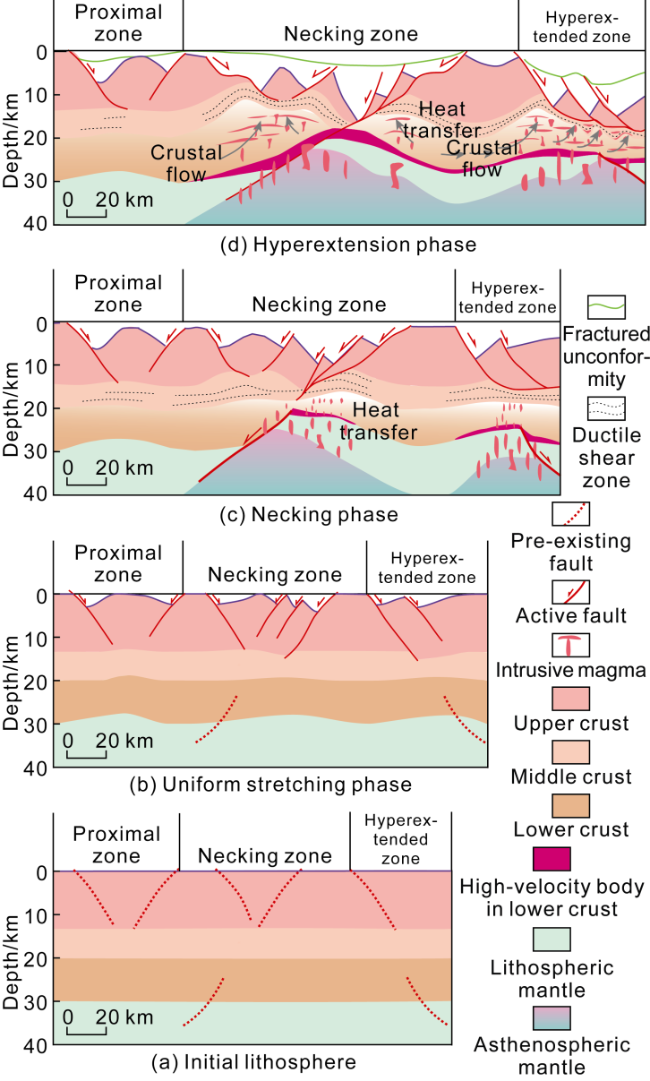
Fig. 8. Crustal thinning processes across the continental margin of the Pearl River Mouth Basin. |
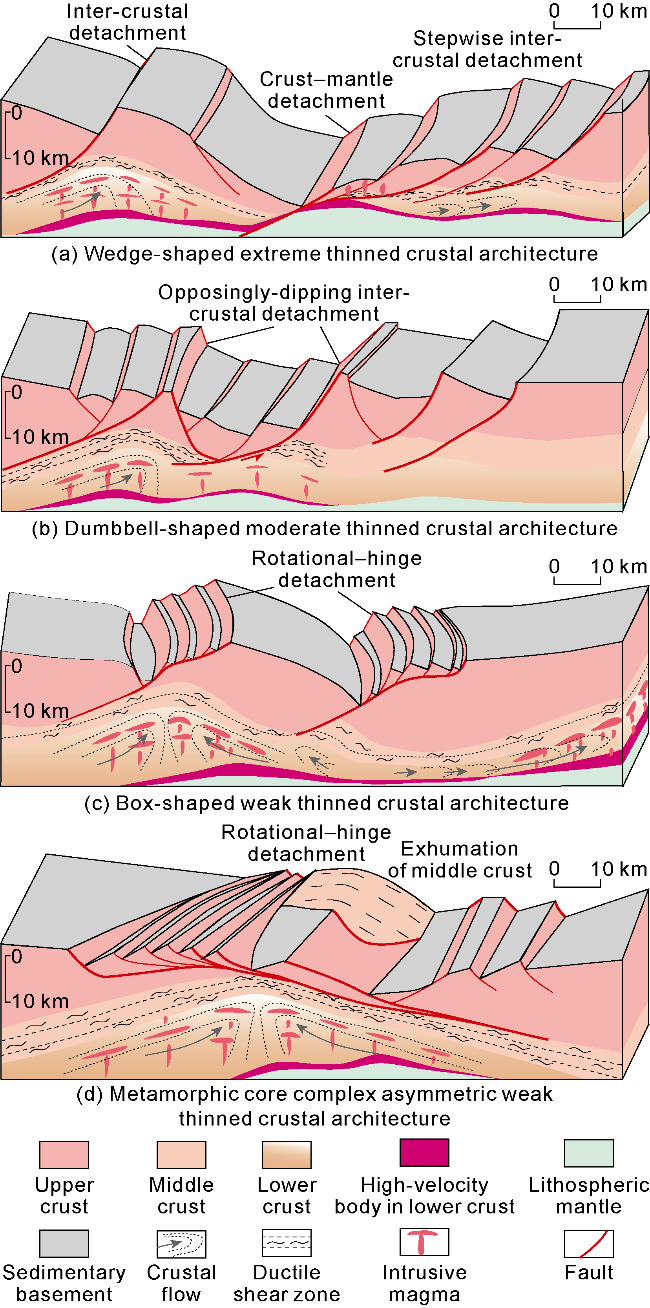
Fig. 9. Differential crustal thinning architectures of continental margin in deepwater area of the Pearl River Mouth Basin. |
4. Hydrocarbon accumulation patterns in the continental margin necking zone and associated petroleum geological significance of crustal thinning
4.1. Hydrocarbon accumulation patterns in the necking zone of the continental margin
The necking zone of the continental margin is an important area for petroleum exploration in the deepwater area of the PRMB. In the early stage, within the Baiyun and Kaiping Sags, breakthroughs were achieved in the Panyu gas fields, Baiyun East gas fields, Liuhua light oil fields and Kaiping deep 100-million-ton oil field, which shows great petroleum exploration potential. However, the horizontal and vertical differences in the hydrocarbon accumulation and enrichment are significant. The discovered petroleum reservoirs in the Baiyun Sag are mainly distributed in the gentle slope zone in the north of Baiyun Main Sub-sag and the peripheral areas of the eastern Baiyun Sag, which is estimated to be more than 90% of the discovered petroleum reserves within the Zhuhai Formation to lower member of the Zhujiang Formation in the mid-shallow layers. However, no large-scale commercial petroleum breakthrough has been made in Yunkai Low Bulge and Baiyun West Sub-sag in the southwest of Baiyun Sag. The petroleum discoveries in Kaiping Sag mainly occurred in the Wenchang Formation and Enping Formation in the deep layers of the southern gentle slope zone, while no large-scale discoveries have been made in the northern steep slope zone of the Kaiping Sag.
Through the coupling of crustal thinning degree and source-fault-ridge-sand difference, four different thinning crustal structures-petroleum accumulation patterns are formed in the necking zone of the PRMB. First, the Baiyun Main Sub-sag with wedge-shaped extreme thinned crustal architecture facilitates a natural gas accumulation pattern characterized by "intense hydrocarbon charging from proximal to distal sources along gentle slopes, with counter-regional fault trapping enabling high enrichment" (Fig. 10a). The source rocks in lacustrine facies of Wenchang Formation, coal measures in delta facies and shallow lacustrine subfacies of Enping Formation in Baiyun Main Sub-sag are "hot and fast maturing", and the generated natural gas migrated along inherited faults and diapir gas chimney, and then transported to Enping Formation-Zhuhai Formation near source rocks in gentle slope and Zhujiang Formation-Yuehai Formation far away from source rocks, and is blocked by reverse faults to form Panyu gas field group. Second, the Baiyun West Sub-sag with dumbbell-shaped moderate thinned crustal architecture facilitates a predominantly gas-prone hydrocarbon accumulation pattern characterized by "near- source convergence at intra-sag uplifts with fault-sand coupling enabling weak enrichment" (Fig. 10b). The Baiyun West Sub-sag lacks large-scale lacustrine source rocks of Wenchang Formation and Enping Formation, and it is shallow buried, generating a small amount of natural gas to converge to the near-source intra-sag uplifts, and forming reservoirs locally in the structure with good fault-sand coupling in Zhujiang Formation, and no large-scale petroleum field has been found at present. Third, the eastern Baiyun Sag with box-shaped weak thinned crustal architecture has formed a petroleum accumulation pattern of "gentle slope zones and intra-sag uplifts enabling near-source high-efficiency accumulation, with deepwater depositional reservoir-seal pairs controlling enrichment" (Fig. 10c). The petroleum in Baiyun East Sub-sag is coexisting, mainly crude oil, and the crude oil accumulated at the Zhujiang Formation in the northern gentle slope zone is converged into reservoirs through inherited faults and structural ridges, forming the Liuhua light oil field group. In the eastern Baiyun Main Sub-sag, oil and gas are coexisting, mainly gas, and the generated natural gas is channeled by inherited active faults and gas chimneys, and efficiently accumulated near the deep-water sedimentary sources of Zhuhai Formation and Zhujiang Formation in the intra-sag uplifts, forming the eastern Baiyun gas field group. Fourth, the Kaiping Sag with metamorphic core complex asymmetric weak thinned crustal architecture has formed a crude oil accumulation pattern of "gentle slope zone near source convergence and deep fault-seal coupling controlling enrichment in deep layers" (Fig. 10d). The semi-deep lacustrine source rocks in the lower member of Wenchang Formation mainly generate oil. The generated oil vertically migrated by inherited faults, and accumulated in the near-source structural traps with good fault-seal coupling in the upper member of Wenchang Formation and Enping Formation in the deep gentle slope zone.
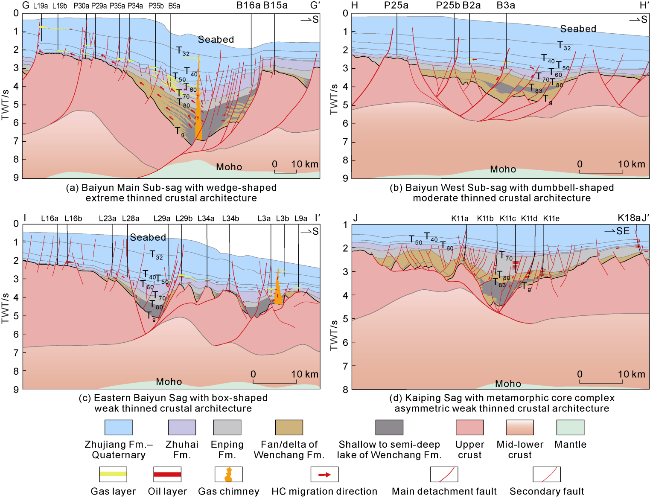


Fig. 10. Hydrocarbon accumulation patterns for the four crustal thinning architectures in the necking zone in the deepwater area of the Pearl River Mouth Basin (profile location shown in Fig. 2). |
4.2. Petroleum geological significance of crustal thinning
Shallow hydrocarbon accumulation in the necking zone exhibits intrinsic linkages to deep thinned crustal architecture. Unique lithospheric architecture and deformation processes create favorable hydrocarbon convergence zones with optimal source-fault-ridge-sand configurations, constituting key enrichment controls: (1) Intense crustal thinning in the necking zone during rift period established dual source rocks in the Wenchang and Enping Formations. Uniform stretching phase at early deposition period of the Wenchang Formation with deep faulting and late deposition period of the Wenchang Formation with detachment processes created multiple deep sags, controlling the development of source rocks in semi-deep lacustrine sub-facies in rift centers and extensive shallow lacustrine sub-facies peripherally. During the hyperextension phase at Enping deposition period, it formed broad shallow depositional settings hosting large coal measures in delta facies and source rocks in shallow lacustrine sub-facies. Source rocks in strongly thinned Baiyun Main Sub-sag and moderately thinned Baiyun West Sub-sag exhibit rapid thermal maturation (predominantly generating gas), while weakly thinned eastern Baiyun Sag generated both oil and gas, and the source rocks in the Kaiping Sag with metamorphic core complex mainly generated oil. (2) Inherited detachment faults serve as efficient hydrocarbon conduits, particularly large-scale detachment faults along mid-lower crustal domes and their seaward-dipping flanks. They experienced intense reactivation during post-rift magmatic cooling period, effectively channeling deep-sourced hydrocarbons to shallow reservoirs. Moreover, post-rift faults peripheral to domes exhibit superior sealing capacity with potent counter-regional trapping capabilities. (3) Under multiphase differential thinning and domal uplift during rifting period, coupled with differential thermal subsidence in the post-rift phase, the necking zone lithosphere develops persistent migration fairways along gentle slopes and inter-sag structural highs—serving as long-term hydrocarbon migration conduits. (4) Syn-rift domal uplift of mid-lower crust drives robust sediment supply, developing large braided delta systems that constitute critical deep to ultra-deep reservoirs. Post-rift differential thermal subsidence in thinned lithospheric domains controlled south- to-north migration of dual shelf-break positions from Zhuhai Formation to Zhujiang Formation, forming two sets of shelf-edge deltas and deepwater fans as primary mid-shallow reservoirs. Stepwise crustal thinning from continental to oceanic domains establishes geothermal gradients with cooler NW and hotter SE [20], governing orderly sandstone diagenesis: comparatively high-poroperm reservoirs dominate northern slope of Baiyun Sag and Kaiping Sag, while southern Baiyun Sag exhibits low-poroperm sandstones. In general, the gentle slopes and intra-sag uplifts controlled by mid-lower crustal domes and their seaward-dipping flanks are the most prospective hydrocarbon accumulation plays within the necking zone, due to the high-efficiency hydrocarbon convergence in these areas.
5. Conclusions
The necking zone along the deepwater area of the Pearl River Mouth Basin in the northern South China Sea develops four distinct thinned crustal architectures, i.e. wedge-shaped extreme thinned crustal architecture in Baiyun Main Sub-sag, dumbbell-shaped moderate thinned crustal architecture in Baiyun West Sub-sag, box-shaped weak thinned crustal architecture in eastern Baiyun Sag, and metamorphic core complex weak thinned crustal architecture in Kaiping Sag. These regions exhibit distinct variations in crustal thinning degree and styles, types of detachment faults, syn-rift sedimentary strata distribution and magmatic activity intensity.
The differential thinning in the necking zone is governed by the non-uniform rheological stratification and the lithosphere along the continental margin, the intensity of mantle-derived magmatism, and detachment fault deformation pattern. Rheological stratification resulted in the deformation thinning from the dispersed distribution to the seaward migration. Mantle-derived magmatism induces magma underplating and crustal flow, accentuates ductile thinning-decoupling of the mid-lower crust and promotes the development of the domal uplifts. While the detachment faults facilitated the separation and decoupling of the crust through multiphase deformation processes. The necking zone has three phases of deformation thinning and associated tectonic deformation response, i.e. uniform stretching phase in the early deposition period of the Wenchang Formation, necking phase in the late deposition period of the Wenchang Formation, and hyperextension phase in the deposition period of the Enping Formation. During the early deposition period of the Wenchang Formation, the pre-existing thrust faults experienced pure shear deformation and reactivation, and formed narrow and deep rifts. During the late deposition period of the Wenchang Formation, magma drove the crust-mantle and intra-crustal detachment faults to form simple shear deformation and wide rift systems. During the deposition period of the Enping Formation, the lower crustal flow and ductile shear domes differentially coupled with upper wall and lower wall of main detachment faults. This tectonic process resulted in different crustal thinning degrees and four divergent thinned crustal architectures.
The necking zone at continental margin in the PRMB's deepwater area serves as the primary exploration frontier, which exhibits significant lateral and vertical heterogeneity in the hydrocarbon accumulation. In this study, we established four distinct thinned crustal architectures— hydrocarbon accumulation patterns. The Baiyun Main Sub-sag with strongly thinning crust is rich in natural gas along the northern gentle slope via proximal—distal charging. The eastern Baiyun Sag with weakly thinned crust is rich in oil and gas in near-source shallow reservoirs across gentle slopes and intra-sag uplifts. The Kaiping Sag with metamorphic core complex and weakly thinned crust is rich in oil in the near-source deep layers on the southern gentle slope. Therefore, the shallow hydrocarbon accumulation in the necking zone exhibits linkages to the deep thinned crustal architectures. The unique crustal thinned architectures and deformation processes within the necking zone facilitated optimal hydrocarbon accumulation with well-configured source-fault-ridge-sand systems, which is critical for hydrocarbon enrichment. The most promising hydrocarbon accumulations are predominantly in the domal uplift zones and their seaward-dipping flank structures in the mid-lower crust.