

Introduction
Lithium has garnered significant attention in recent years due to its extensive applications in electric vehicles, renewable energy storage, and other domains [1-6]. However, China's current lithium demand has exceeded domestic supply, resulting in an import dependency rate of over 60% [7]. As China's lithium demand continues to grow, the supply-demand gap for lithium resources is expected to further widen in the future [8]. Consequently, the exploration, development, and secure supply of lithium resources have become critical national strategies.
Lithium is mainly distributed in Australia, the Democratic Republic of Congo, and Chile, Bolivia, and Argentina in South America [9]. Therefore, the safe supply of lithium resources in China is facing enormous pressure and there is an urgent need to find new lithium sources. Lithium resources mainly occur in three types: granite-pegmatite, saline lake-brine, and clay [10]. Currently, China faces challenges in greatly enhancing the production of these types of lithium resources. Technically, the granite-pegmatite type lithium is produced with significant environmental pollutions and high costs [11], the saline lake-brine type lithium is hard to extract and corresponds to a too long production cycle [10], while the clay type lithium cannot be extensively explored and developed yet due to its unclear enrichment pattern [12-13].
Since modern saline lakes are rich in lithium, it is believed that the strata of saline lacustrine facies recording long-term evaporation processes in the geological history contain abundant lithium. In China, multiple sets of saline lacustrine strata are developed in the petroliferous basins such as Junggar, Bohai Bay, and Subei, and they are also important shale oil producing systems [14-16], showing certain advantages in terms of geological conditions and production costs. In this regard, taking two sets of saline lacustrine strata in the Permian, i.e. Lucaogou Formation and Fengcheng Formation, in the Junggar Basin as examples, this paper systematically discusses the distribution and enrichment mechanism of lithium in the shale oil sweet-spot intervals of these strata, through multi-scale observations (e.g. core, outcrop, thin section, and scanning electron microscope (SEM)), and using whole-rock geochemical data. In order to promote the utilization of such shale-hosted lithium resources, this paper summarizes the distribution characteristics of lithium resources in the shale oil sweet-spot intervals, proposes possible ways and technical requirements for co-production of lithium with shale oil, and presents key issues to be solved in the future. The research findings are expected to provide scientific evidences for the exploitation of lithium resources.
1. Distribution of lithium resources in saline lacustrine shale
Saline lakes refer to the lakes where the water salinity reaches saltwater to brine in the geological history, which are widely distributed in Middle Cenozoic. Due to their high productivity and favorable preservation conditions, the saline lacustrine strata usually contain abundant organic matters, and have a great potential of shale oil [17]. With the rapid exploration and development of continental shale oil in recent years, China has become one of the few countries that can achieve extensively commercial development of continental shale oil [18]. As of the end of 2024, China's annual production of continental shale oil exceeded 600×104 t (Fig. 1), including over 180×104 t contributed by saline lacustrine shales, making it an important replacement for increasing and stabilizing crude oil production [19].
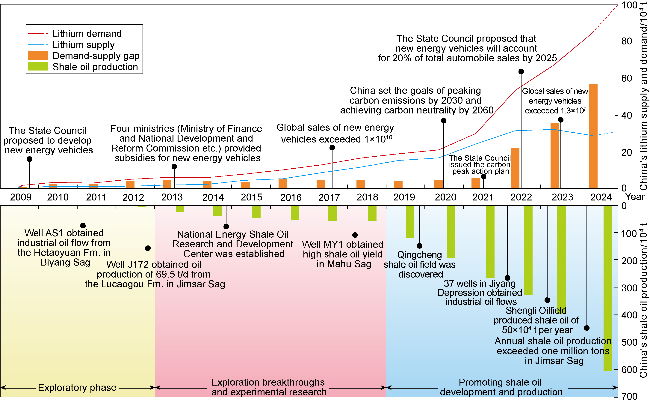
Saline lakes are generally formed in environments with arid climate and closed or intermittently closed waters in the geological history [17]. By the extent of closure, saline lakes can be divided into intermittently closed saline lakes and perennially closed brine/alkali lakes [17,22]. In China, intermittently closed saline lakes are mainly distributed in the Permian Lucaogou Formation in the Junggar Basin and the third member of the Paleogene Shahejie Formation in the Bohai Bay Basin, and the perennially closed brine/alkali lakes are found in the Permian Fengcheng Formation in the Mahu Sag of the Junggar Basin, the Paleogene Qianjiang Formation in the Jianghan Basin and the Paleogene Hetaoyuan Formation in the Biyang Sag, which have been proved to have large shale oil potentials [23-24]. This paper takes the Permian Lucaogou Formation and Fengcheng Formation in the Junggar Basin as examples to analyze the distribution and enrichment pattern of lithium in two types of saline lacustrine shale oil sweet-spot intervals.
1.1. Lithium distribution in shale oil sweet-spot intervals in the Lucaogou Formation
1.1.1. Sedimentary background and environment of Lucaogou Formation
Distributed in the southeast margin of the Junggar Basin (Fig. 2a), the Lucaogou Formation has experienced a complex structural and sedimentary history since the Early-Middle Permian, which makes it buried or exposed. Paleogeographic reconstruction shows that during the Early-Middle Permian the ancient lakes were located at latitude 39°-43°N, under an environment with arid to semi-arid climate, and closed to intermittently closed waters having depths from tens of meters to over a hundred meters and salinity ranging from brackish to saline [25]. Overall, the water bodies with large depth and high salinity led to stratification of the lake waters in the Lucaogou Formation, resulting in a reduced water environment at the lake bottom. In this environment, a large amount of organic matters was preserved, contributing to the formation of high-quality source rocks.

The Lucaogou Formation can be further divided into upper and lower members based on the lithology combination. Paleoclimate studies show that due to the climate warming, the upper member was deposited in higher-level waters that were intermittently closed, with a low salinity, while the lower member survived in lower- level waters that were closed, with a high salinity [25-26].
1.1.2. Lithofacies and lithium content of shale oil sweet-spot intervals in Lucaogou Formation
According to shale oil production and source-reservoir configuration, two shale oil sweet-spot intervals were identified in the upper and lower members of the Lucaogou Formation [27]. The upper sweet-spot interval is located in the middle-lower part of the upper member, while the lower sweet-spot interval in the lower part of the lower member (Fig. 2c). These sweet-spot intervals are characterized by repeated combinations of 2 to 3 lithofacies. Here, the lithofacies combination, depositional texture, and lithium content of the upper and lower sweet-spot intervals are described based on the thin section and SEM observations of more than 400 samples from outcrops and cores, in conjunction with 110 whole-rock major and trace elements and 150 TOC and porosity data from the same samples (Fig. 3).

Petrographic observations show that the upper sweet- spot interval includes a lithofacies combination of felsic reversely- to normally-graded laminar shale and felsic- calcareous hybrid tabular parallel lamellar shale, both exhibiting a low lithium content (Fig. 3). The former features a reversely- to normally-graded lamina set, indicating that it was deposited by hyperpycnal flow process. It has the quartz and feldspar contents of greater than 90%, lithium content of 4-32 μg/g, TOC of 2.52%-2.86%, and porosity of 7.30%-8.81% (mainly intergranular pores). The latter is characterized by the set of rhythmic, tabular, parallel, felsic-rich lamina and dark organic lamina, without biological disturbance, indicating that it was deposited in a humid, quiet and reduced deep lake environment. It has feldspar and quartz as dominant minerals, lithium content of 41-80 μg/g, TOC of 5.10%-9.21%, and porosity of 2.97%-4.09% (mainly organic pores).
Unlike the upper sweet-spot interval, the lower sweet- spot interval has a lithofacies combination of felsic-calcareous fabric-hybrid lamellar shale and carbonate tabular parallel lamellar shale, with higher lithium contents than the upper sweet-spot interval (Fig. 3). The former contains typical fabric-hybrid beds with bright and dark laminae. The bright laminae are mainly composed of feldspar and quartz, almost without calcium. The eroded basement and low-angle cross bedding indicate that the lithofacies was low-density turbidity current deposits transported by rivers to a semi-deep to deep lake environment. It has the lithium content of 57-93 μg/g, TOC of 3.57%-3.69%, and porosity of 6.39%-14.22% (mainly intergranular pores). The latter is characterized by a rhythmic set of tabular parallel bright calcite-dolomite laminae and clay-rich dark laminae, almost with no quartz and feldspar. The combination of rhythmic clay and calcareous tabular laminae indicates that it is a calcareous lamellar mud sediment deposited in dry, quiet, and reduced deep lake environment. It has the highest lithium content (139-247 μg/g) in the Lucaogou Formation, TOC of 4.31%-9.18%, and porosity of 0.51%-3.20%.
The above observations and summaries show that both the upper and lower sweet-spot intervals of the Lucaogou Formation combine shales originated from input of fluvioclasts and sedimentation of suspended sediments. Overall, the lower sweet-spot interval contains higher lithium content than the upper sweet-spot interval, making it a key lithium-containing interval worthy of consideration in future shale oil exploitation. In both intervals, the shales originated from input of fluvioclasts exhibit higher porosity, but lower TOC and lithium content, than the adjacent shales originated from sedimentation of suspended sediments. Therefore, the shales originated from input of fluvioclasts can store shale oil, while the shales originated from sedimentation of suspended sediments has a higher lithium content. Together, they form the lithofacies combination in the shale oil sweet-spot intervals.
1.2. Lithium distribution in shale oil sweet-spot intervals in the Fengcheng Formation
1.2.1. Sedimentary setting of the Fengcheng Formation
The Fengcheng Formation in the northwestern margin of the Junggar Basin was deposited in saline/alkaline lake during the Early Permian, and contains rich shale oil resources [28]. It is divided into three members: Feng-1 to Feng-3 (Fig. 4), consisting of volcanoclastic rock, terrestrial clastic rock, carbonate rock, and evaporite rock. Paleogeographic study has shown [29] that, during the deposition of the Feng-1 Member, frequent volcanic activities in the northern lake led to the development of tuff, tuffaceous conglomerate, and volcanic rocks in the early stage of Fengcheng Formation, and the salinity of the water was relatively low in this period as revealed by geochemical indicators. When the Feng-2 Member deposited, volcanic activities weakened, the climate became dry, the lake was closed with increased water salinity, and evaporites were deposited with magnesium/calcium-rich carbonates. During the deposition of the Feng-3 Member, the salinity of the lake water decreased again, the proportion of calcite in dolomitic mudstone increased, while more terrestrial clasts were input.
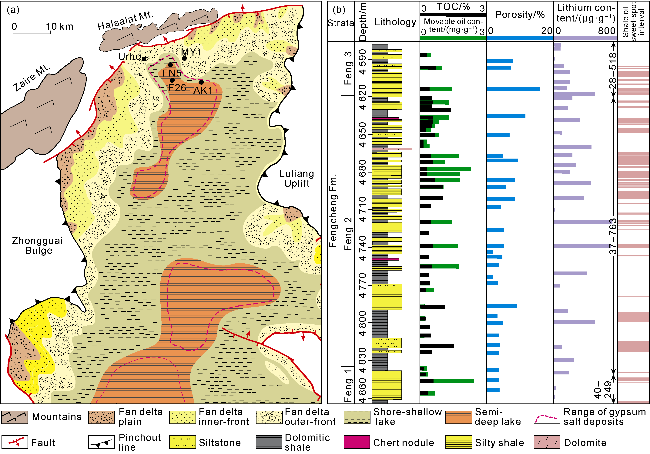
1.2.2. Lithofacies characteristics and lithium content of the shale oil sweet-spot interval in the Fengcheng Formation
Shale oil sweet-spots in the Fengcheng Formation are concentrated in the Feng-2 and Feng-3 Members. Based on the lithofacies combination and source-reservoir configuration, shale oil sweet-spots were classified into two types: interlayered and laminar [30]. Here, the lithofacies combinations and lithium contents in the two types of shale oil sweet-spots are summarized based on thin section and SEM observations of 75 samples from Well MY1, in conjunction with tests of major/trace elements and TOC (Fig. 5).

Fig. 5. Lithofacies characteristics, mineral composition and lithium content of sweet-spot intervals of the Fengyeng Formation in Well MY1 (some data sourced from Reference [29]). |
The interlayered sweet spots are widely distributed in the Feng-2 and Feng-3 Members of two lithofacies: dark-gray blocky mudstone and yellow-gray blocky mudstone (Fig. 5a), and have been altered by dolomite or quartz during the diagenesis period (Fig. 5b, 5c), which destroyed the original depositional textures, making it impossible to identify the sedimentary mechanisms through the textures. Compared to the dark-gray blocky mudstone, the yellow-gray blocky mudstone has a higher felsic content (Fig. 5d-5e), indicating that it may be influenced by stronger fluvioclast inputs.
The laminar sweet spots are mainly distributed in the Feng-2 Member of two lithofacies: gray-white laminar shale and gray-white thin-layered mudstone, which generally contain a high lithium content, up to 763 μg/g (Fig. 5f) and, similarly, have been altered by dolomite and alkaline minerals during the diagenesis period (Fig. 5g, 5h). Under the microscope, the gray-white laminar shale is observed with alkaline minerals as major bright laminae, felsic minerals as brighter laminae, and organic matter as major dark laminae (Fig. 5g). The rhythmic combination of felsic bright laminae and organic-rich dark laminae, and the relatively high content of clasts, indicate deep-lake laminar mudstone deposited in the period with intense fluvioclast input (Fig. 5i). The gray-white thin-layered mudstone that is interbedded with the gray-white laminar shale indicates semi-deep to deep-lake deposits from endogenous suspended carbonates in the period of relatively weak fluvioclast input. As a result of this sedimentary process, this lithofacies contains a large amount of granular ferrodolomite and lenticular dolomite formed during the diagenesis period (Fig. 5j), which "dilutes" the organic matter.
According to the above observations, the shale oil sweet-spot intervals of the Fengcheng Formation have higher lithium contents than the Lucaogou Formation, and also develop felsic-rich lithofacies originated from strong fluvioclast input and carbonate-rich lithofacies formed by endogenous suspended carbonates in the period of relatively weak fluvioclast input, with a higher lithium content in the latter lithofacies than in the former lithofacies.
2. Enrichment mechanism and resource potential of lithium in saline lacustrine shale and possible development methods
2.1. Enrichment mechanism of lithium in saline lacustrine shale
According to the correlation between lithium content and other elements/compounds content in samples and environmental indicators (Fig. 6a), it is believed that lithium enrichment is directly related to the salinity of lake water. The geochemical correlation analysis for 110 samples of the Lucaogou Formation in the Jingjingzigou section shows that Li is strongly related to B/Ga and Cs, with the correlation coefficients of over 0.5, and weakly related to other elements such as Mg and Ca. As B/Ga is an important indicator for the restoration of paleosalinity, and the increase in B/Ga values is usually associated with an increase in salinity, the strong correlation between Li and B/Ga further supports the close relationship between lithium enrichment and salinity (Fig. 6b).
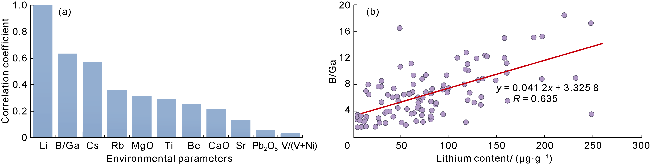
Fig. 6. Correlations between elements (including lithium)/compounds and environmental indicators (a), and correlation between lithium content and B/Ga for samples (b) from the Lucaogou Formation in Jingjingzigou section. |
The analysis of lithium contents in the same type of lithofacies at different water depths shows that lithium enrichment is not tied to water depth, but related to the lake hydrology, closed or open. Fig. 7 illustrates the lithium contents in different lithofacies at varying water depths of the Lucaogou Formation in the Jingjingzigou section. The average lithium content in the lower member is 100 μg/g, higher than that (60 μg/g) in the upper member. For the same lithofacies in the upper or lower member, the lithium content gradually decreases with increasing water depth (Fig. 7, Fig. 8a-8c). However, this trend is not observed for the same lithofacies at different water depths between the upper and lower members. As shown in Fig. 8c and 8d, in the lower member, although the semi-deep lake subfacies is deeper than the shore- shallow lake subfacies, its lithium content is higher in case of the same type of lithofacies. Coupling with the previous studies on the paleoclimate and sedimentary environments of lake facies in the upper and lower members of the Lucaogou Formation [25-26], we believe that the difference in lithium content between the upper and lower members is attributed to the degree of lake closure during the depositional period. When the lower member deposited, the lake water was closed, and the arid climate caused the lake water level to drop. No lithium flowed out, while the lake water continued to evaporate and concentrate, enhancing the lithium content (Fig. 9a). When the upper member deposited, the climate became humid, and the lake water level rose, accompanied with an intermediately closed water environment. A part of water outflowed with some lithium, reducing the lithium content in the lake (Fig. 9b).
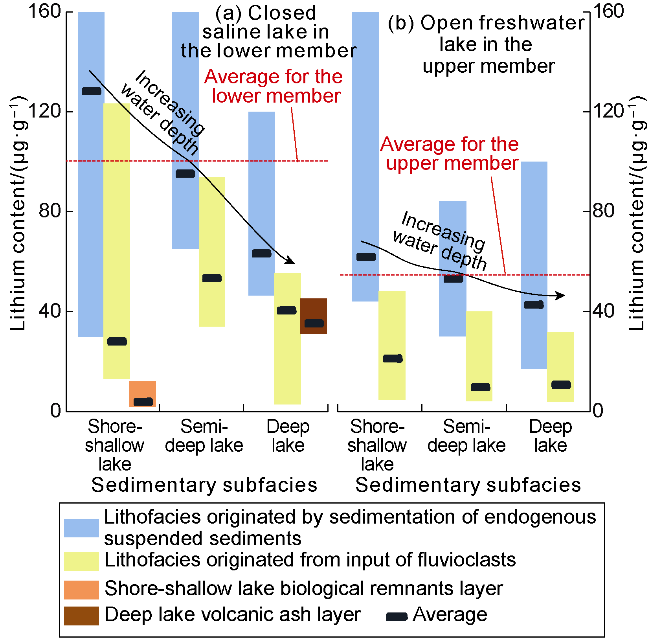
Fig. 7. Lithium contents at different water depths in the lower and upper members of the Lucaogou Formation in the Jingjingzigou section. |

Fig. 8. Lithofacies combination and lithium contents at different water depths in the lower (a-c) and upper (d) members of the Lucaogou Formation in Jingjingzigou section. |
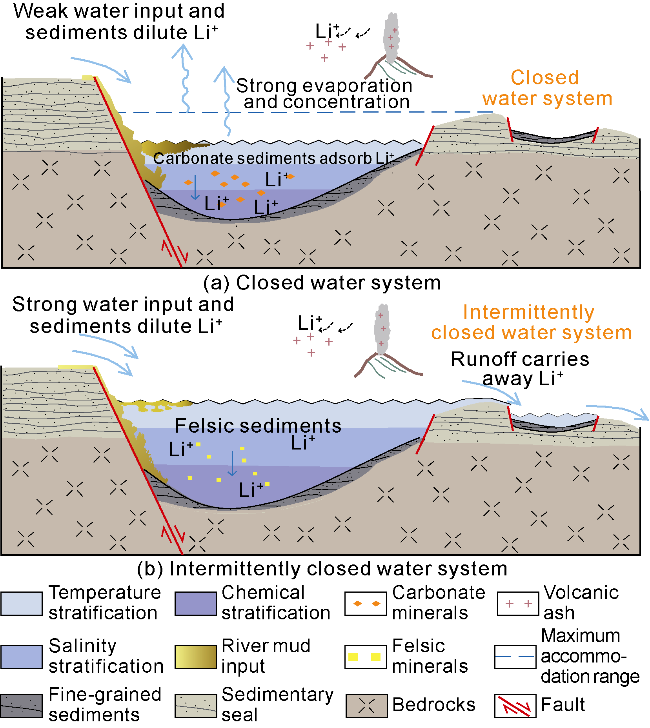
Fig. 9. Lithium enrichment patterns in closed hydrological system (a) and intermittently closed hydrological system of ancient saline lakes (b). |
The comparison of different types of lithofacies at the same water depth shows that inputs via river or inputs of terrestrial clasts or biological remnants may "dilute" the lithium content. As shown in Figs. 3, 5, 7, and 8, in lithofacies combinations at different water depths, the lithium content of the lithofacies originated from input of fluvioclasts is generally lower than that of the lithofacies originated from sedimentation of endogenous suspended sediments. Lee's observation and analysis of shales using time-of-flight and scanning secondary ion mass spectroscopy (TOF-SIMS) showed that lithium mainly exists in the form of lithium carbonate in shale, so it often occurs in endogenous lithofacies with rich carbonate minerals [33]. The feldspar minerals input by fluvioclasts "dilute" the content of carbonate minerals in the deposits, reducing the lithium content in the lithofacies originated from input of fluviocalsts [34]. In addition, as shown in Fig. 8c, the lithium content of the deep lake volcanic ash layers is lower than that of the endogenous deposits. Although modern research indicates that volcanic debris input may increase the lithium content [35], our observation suggests that the "dilution" effect of volcanic debris may be more prominent than the input of lithium, thus leading to the decrease of the lithium content.
Lithium is mainly enriched in carbonate minerals of mudstone/shale, and diagenesis such as recrystallization may cause certain changes in the form of lithium element, but the specific mechanism is not yet clear. As shown in Fig. 6a, there is a correlation between lithium and magnesium/calcium in the samples from the Lucaogou Formation, indicating that lithium may exist in magnesium-rich minerals such as dolomite. Fig. 5i-5j show that there are various forms and types of dolomite in the gray-white lithium-rich thin-layered mudstone. This phenomenon is indicated to be attributed to multi-stage diagenetic processes (e.g. dissolution, cementation, and recrystallization) carbonate minerals such as dolomite due to changes in temperature and pressure during diagenesis [36]. These diagenetic processes change the way carbonate minerals exist, which may lead to lithium migration. However, the mechanism of lithium migration during the diagenetic stage is still unclear and requires further observation and research.
Lithofacies combination studies and geochemical analysis show that lithium enrichment in saline lacustrine shales is a comprehensive result of lithium production, dilution, and migration in the sedimentation-diagenesis process. Strong evaporation and closed hydrological environment in the sedimentary period increase lake water salinity and pH value, causing water stratification. As a result, lithium is deposited with carbonate at the bottom of the lake. River-carried water and clasts, and volcanically transported debris reduce the lithium content in sediments (Fig. 9). In the diagenetic stage, the changes in temperature and pressure might alter the way carbonates exist, which possibly cause further migration of lithium.
2.2. Resource potential of lithium in saline lacustrine shale and possible methods of co-producing lithium with shale oil
Shale oil reservoirs should be hydraulically fractured before getting economic shale oil production. During fracturing of shale oil sweet-spot intervals of saline lacustrine shales, lithium-rich and oil-containing lithofaices coexisting in the same interval are treated simultaneously to expel a large quantity of lithium and shale oil. The lithium and oil are released together with fracturing fluid, and lithium is carried as a component of the shale oil-containing produced water to the surface.
During shale oil production, the Ca2+ released from calcium-rich minerals after fracturing and acidizing can significantly enhance the intensity of lithium discharge from shale into water. Through experimental simulation and testing lithium content in the water produced from the Marcellus marine shale in North America, Lee found that the Ca2+ concentration of the fluid flowing back during fracturing or acidizing is a key factor controlling the intensity of lithium release, while the effects of temperature and pressure are relatively small [32]. Under the simulated underground conditions (130-200 °C, 0.270- 1.555 MPa), when the Ca2+ concentration in fluid exceeds 0.1 mol/L, the release of lithium will exceed 90% [32]. As shown in Table 1, the content of carbonate minerals in the Marcellus shale ranges from 3.0% to 58.0%. During shale gas production, the dissolution of these minerals may lead to an increase in Ca2+ concentration, promoting the release of lithium. This explains why the average lithium content in the water produced may reach 82.9 μg/g [37].
Table 1. Comparison of lithium contents in shale and produced water between Chinese continental saline lacustrine shale and American marine shale |
| Type | Basin | Interval | Paleoenvironment | Carbonate mineral content/% | TOC/% | Lithium content in shale/(mg·g-1) | Lithium content in shale oil-containing produced water/(μg·g-1) | Data source |
|---|---|---|---|---|---|---|---|---|
| Continental shale | Junggar | Upper member of Lucaogou Fm. | Brackish lake | 8.7-50.3 (24.1) | 2.5-9.2 | 4.0-80.1 (60.4) | 110.8 (estimated) | References [25, 28] |
| Lower member of Lucaogou Fm. | Brackish- saline lake | 11.5-67.8 (33.0) | 1.2-20.4 | 57.0-247.0 (99.8) | 183.0 (estimated) | References [25, 28] | ||
| Feng-1 and Feng-2 | Saline- alkali lake | 8.0-59.0 (24.1) | 0.3-2.55 | 102.0-763.0 (282.0) | 517.2 (estimated) | Reference [31] | ||
| Marine shale | Appalachian | Marcellus shale | Brine | 3.0-58.0 (14.0) | 0.4-7.9 | 19.0-85.0 (45.2) | 21.6-233.0 (82.9) | References [33, 38-39] |
Note: 1. The values in parentheses are average; 2. The lithium content in shale oil-containing produced water for Lucaogou Formation and Fengcheng Formation are estimated by assuming a consistent ratio of lithium content in rock to lithium content in produced water with that for Marcellus shale. |
Due to the high contents of carbonate minerals and lithium, higher lithium concentration should be measured in the shale oil-containing produced water theoretically from saline lacustrine shales, suggesting a higher potential of lithium recovery. As shown in Table 1, the lithium content of saline lacustrine shale is generally higher than that of marine shale, and the high carbonate content also ensures the enough Ca2+ concentration released with fracturing and other fluids, and high lithium release. Considering that there are no adequate data of lithium concentration in fracturing fluid and produced water from the Lucaogou Formation and Fengcheng Formation, this paper estimates the lithium content in produced water from the two formations according to the ratio of lithium content in rock to lithium content in produced water for Marcellus shale in North America. Given the average lithium contents in rock and produced water for the Marcellus shale of 45.2 μg/g and 82.9 μg/g, respectively, and the average lithium contents in rocks of the upper and lower members of Lucaogrou Formation and the Fengcheng Formation of 60.4, 99.8, and 282.0 μg/g, respectively, the average lithium concentrations in the produced water for the three target horizons are estimated to be 110.8, 183.0, and 517.2 μg/g, which far exceed the current industrial grade of 50 μg/g in salt lake brine. Moreover, coupling with the shale oil resources in the Lucaogou Formation and Fengcheng Formation (15.62× 10⁸ t and 8.25×10⁸ t) [40-41], it is believed that the lithium resources co-produced with shale oil will be highly potential.
The lithium in the sweet-spot interval of saline lacustrine shale oil is "idle resources", and the exploitation of shale oil makes it possible to co-produce lithium. Fig. 10 shows a co-production scenario of lithium and shale oil from a saline lake. A fracture network is induced by fracturing the interlayered sweet-spot interval in the Fengcheng Formation dolomitic shale in Well MY1. Acid or fracturing agent interacting with the abundant carbonate minerals in the formation promotes a large amount of Ca2+ into the fluids, greatly enhancing the discharge of lithium from the shale into the fluids which are brought back to the surface with shale oil.
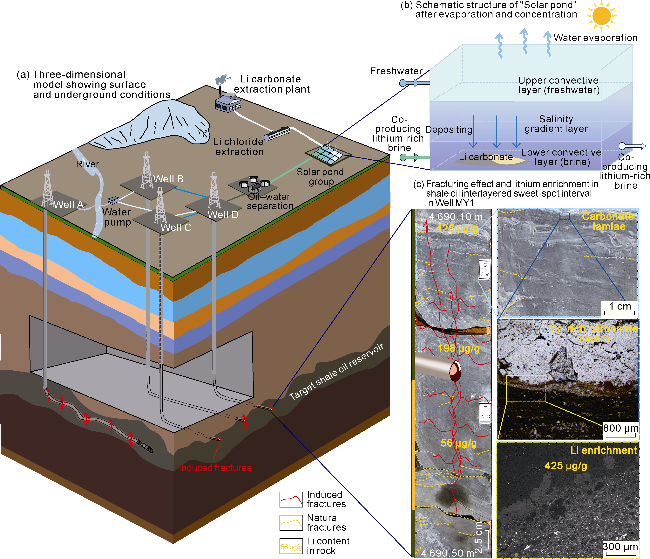


Fig. 10. Conceptual diagram of possible methods for co-producing lithium with shale oil in saline lakes (the solar pond structure is modified from Reference [9]). |
The lithium-rich brine co-produced with shale oil is evaporated and concentrated in "solar ponds" after recycling and pretreatment, in order to reduce the cost of extracting lithium with extractants. Applying extractants to extract lithium-rich brine has been a hot research topic in recent years, but due to various factors such as process maturity and economic feasibility, it has not yet reached the level of large-scale commercial utilization. Considering water shortage in northwest China and significant water consumption during fracturing process, we suggest that the lithium-rich brine extracted with shale oil should be recycled for fracturing lithium-rich formations to continuously increase lithium concentration. Alternatively, such lithium-rich brine can be pretreated to extract lithium and then reused for hydraulic fracturing. In addition, the advantages of arid climate and vast usable land in northwest China should be utilized as much as possible to establish "solar ponds" for lithium evaporation and concentration, in order to reduce the cost of later extraction. As for extraction methods, lithium should be extracted at a lower cost based on the characteristics of lithium-rich brine, using adsorbents such as titanium based, manganese based, or organic compounds, or a combination of multiple processes [42].
3. Research directions of lithium co-production with shale oil in saline lacustrine shales
During geological history, saline lacustrine shales accumulated a large amount of lithium in shale due to high salinity and enclosed water systems. These resources are originally "stagnant", but the large-scale development of shale oil now makes it possible to utilize them. To accelerate the utilization of such lithium resources, we propose the following suggestions.
3.1. Enrichment and distribution patterns of lithium in shale
In the changing sedimentary environments of terrestrial lake basins, and the lithofacies and their combinations of shale layers are abundant and rapidly changing in space. It is urgent to identify the combination and spatial distribution of oil-rich and lithium-rich lithofacies. The examples of the Permian Lucaogou Formation and Fengcheng Formation in the Junggar Basin show that there are significant differences in the characteristics of petroleum reservoirs and lithium contents at different water depths and of different origins. After finding out the enrichment rules of oil and lithium in different lithofacies in the saline lacustrine shale layers, stratigraphic research shall focus on the combination and spatial changes of oil-rich and lithium-rich lithofacies. Due to the strong heterogeneity of mud shale at scales from centimeters to meters, traditional seismic sedimentology and sequence stratigraphy have low spatial resolution, making them difficult to predict the lithology. Therefore, it is necessary to establish the distribution laws of lithium resources in different lithofacies based on fine sedimentology, organic geochemistry, major and trace elements, and reservoir physical properties, and predicts the spatial distribution of oil-rich and lithium-rich lithofacies by considering cyclic stratigraphy and fine-grained sequence stratigraphy [43].
Considering that lithium enrichment is the result of complex interactions among physical, chemical, and biological processes, future research can include multiple factors such as paleoclimate, redox conditions, and microbial activity to establish a multi-parameter model for lithium enrichment, in order to more comprehensively reveal the enrichment mechanism of lithium resources. It should be noted that the lithium content as high as 763 μg/g in the laminar sweet-spot interval of the Fengcheng Formation is an outlier. Why is there such a significant difference in lithium content among different lithofacies, and does the adsorption of clay minerals lead to redistribution of lithium elements? These questions deserve further study on differential enrichment laws of lithium resources.
3.2. Evaluation system for producing shale oil and lithium resources in saline lacustrine shale
In the context of energy structure transformation, both oil and lithium resources face significant demands. However, there are differences in the enrichment of lithium and oil in the saline lacustrine shale reservoirs. Future study should focus on the production methods and value evaluation systems after understanding the enrichment laws of oil and lithium resources. Present evaluation is mainly on shale oil by evaluating the porosity, permeability, organic matter content, and fracturability of shale samples [44], but the lithium resources have not yet received attention. It is proposed to evaluate the lithium resources based on the understanding of the occurrence state and spatial distribution, and considering flowback rate, cost, and market price. After comprehensively analyzing the enrichment laws of the two types of resources, we can select favorable oil and lithium zones. For example, for the lower sweet-spot interval of the Lucaogou Formation, which is rich in oil but has a lower lithium content, priority should be given to oil production, with lithium as a co-product. However, for the laminar sweet-spot interval in the Fengcheng Formation with a high lithium content and a low oil content, priority should be given to lithium, with oil as a co-product. For those layers with extremely high lithium contents, lithium may be the primary choice.
3.3. Characterization and release mechanism of lithium in saline lacustrine shale
Lithium exists as an associated element in saline lacustrine shale. Currently, the state of lithium and its release mechanism and process are still unclear. Studies should be put on the characterization of lithium and how it releases with fracturing fluid, and what factors affect the lithium content in produced water. The measurement of whole-rock lithium content by inductively coupled plasma mass spectrometer (ICP-MS) or X radial fluorescence mud logging (XRF) is basic for lithium description. To investigate the heterogeneity at "lamina scale", use focused ion beam scanning electron microscope (FIB-SEM), FIB-TOF-SIMS, quantitative evaluation of minerals by scanning electron microscopy (QEMSCAN) and other methods [45] to describe mineral composition, arrangement, lithium occurrence state and distribution at the scales of thin sections or SEM, and discuss how sedimentation-diagenesis controls lithium distribution. For the release mechanism, it is necessary to conduct physical-chemical experiments or numerical simulations based on the understanding of the lithium occurrence state in shale and minerals [36], in order to restore the release process of lithium at formation temperature and pressure.
3.4. Future co-production of shale oil and lithium
The lithofacies in saline lacustrine shales change rapidly, so it is necessary to set up lithium development plans based on the lithology of the pay layers. Mixed sediments are common in saline lacustrine shales [46]. For mixed layers of different types of minerals such as carbonate, felsic and salts at different proportions, the factors affecting lithium release may be more complex. Different fracturing fluids, acid fluids, oil displacement agents and extraction methods are needed to improve lithium release to produced water. In addition, lithium pollution must be paid attention when pre-treating the lithium-rich produced water and evaporation and concentration in "solar ponds". After concentrating, effective extraction or recovery processes should be used according to the composition of the lithium-rich brine to reduce costs and achieve commercial development.
Chinese shale oil is mainly of lake/lacustrine facies, which was once considered difficult for commercial development due to the strong heterogeneity of lacustrine shale. Our preliminary research shows that the saline lacustrine shale is rich in lithium resources. In the future, co-production of lithium and shale oil is potential, which is expected to reduce shale oil exploitation costs and improve the recovery benefits, and can accelerate the arrivals of "terrestrial shale oil revolution" and "new energy revolution".
4. Conclusions
Taking the saline lacustrine shales of the Lucaogou Formation and Fengcheng Formation in the Junggar Basin as examples, this paper analyzes the distribution of lithium resources in the shale oil sweet-spot intervals in saline lacustrine shales through multi-scale observations of core, outcrop, thin section and SEM, and whole-rock geochemical data. The results indicate that the sweet-spot intervals in saline lacustrine shales contain abundant shale oil and lithium resources. The distribution of lithium has a stronger correlation with lithofacies, especially in the lower sweet-spot interval of the Lucaogou Formation and the laminar sweet-spot interval of the Fengcheng Formation, where the lithium content is significantly high.
The lithium enrichment in saline lacustrine shale is a comprehensive result from production, dilution, and migration during the sedimentation and diagenesis stage. The lithium enrichment is closely related to the salinity of lake water, and has no absolute correlation with water depth. Fluviocast input may "dilute" the lithium content in shale. Volcanic debris input and diagenesis may affect the distribution of lithium, but the mechanism is not clear.
To produce lithium resources while producing shale oil is potential, future studies should focus on the distribution law of lithium resources in mud shale layers, reveal the relationship between lithium and shale oil enrichment, and comprehensively consider the market demand, production potential and costs to evaluate the economic feasibility of developing the two resources, and provide decision-making basis for subsequent development. In addition, efficient extraction and recovery technologies, and environmental protection measures shall be developed to maximize resource utilization and provide theoretical and technical supports for co-producing lithium and shale oil in saline lacustrine shales.
In short, with the increasing demand on oil and lithium resources, to co-produce lithium and shale oil may be a new field worthy of profound research and application. By adopting effective development and extraction technologies, it is expected to get the efficient co-production of lithium and shale oil resources, providing a new guarantee for the safe supply of lithium resources in China.