

Introduction
From a volumetric perspective, fine-grained sedimentary rocks occupy a significant position in the stratigraphic record. They contain rich sedimentary information, exhibit stable and continuous distribution, and can serve as a key medium for stratigraphic correlation and large-scale paleoenvironmental reconstruction [1-4]. Furthermore, fine-grained sedimentary rocks are often rich in organic matter and possess porosity and permeability, enabling them to function as source rocks, seals, and unconventional reservoirs. They are thus an indispensable component of petroleum systems [5], holding great significance for understanding hydrocarbon resource potential and formation mechanisms. They can also act as important hosts for rare earth elements and critical minerals [6-7].
The primary target intervals for shale oil and gas exploration and development are composed of fine-grained sedimentary rocks. Since the early 21st century, with the widespread application of hydraulic fracturing and horizontal drilling technologies, there has been a growing emphasis among researchers on evaluating the economic potential of fine-grained sedimentary reservoirs. Concurrently, the traditional view that fine-grained sedimentary rocks form via suspension settling in low-oxygen, quiet water environments has been challenged [8-10]. Fine-grained sedimentary rocks that appear undisturbed at hand-specimen scale may have been completely homogenized by bioturbation at the microscopic scale [11]. These findings have prompted a re-evaluation of the redox conditions during fine-grained deposition.
In describing the lithology, lithofacies, or sedimentary structures of fine-grained sedimentary rocks, terms such as laminated, thin-bedded, bedded, massive, lamination density, lamina density and lamination fissure are frequently used. Particularly in the extensive Chinese literature, terms like laminated shale, bedded shale, massive shale, felsic shale, argillaceous shale, siliceous shale, massive mudstone and laminated mudstone are common. This has led to a situation where fundamental researchers and applied production researchers often do not communicate within the same conceptual framework. Disagreements even arise regarding whether a specific shale succession qualifies as shale oil reservoirs, which hinders the progress of shale oil and gas exploration and development.
We contend that as exploration and development of shale successions deepen, refined lithology and lithofacies classification, the establishment and iterative refinement of precise geological models, and the accurate identification of sweet spots and target intervals have become critical factors influencing operational success. Therefore, it is necessary to discuss and standardize the usage of the aforementioned terminology. As new understandings emerge, the related terminological framework must evolve accordingly. Based on a review of extensive literature (particularly textbooks from different periods) and typical domestic and international case studies, this paper traces the origins and customary usage of these concepts. It aims to assist researchers in achieving a correct understanding and to provide reference and guidance for future studies.
1. Classification of sedimentary rocks
In China, there has been a surge in publications in recent years concerning new discoveries and perspectives on the composition and sedimentary processes of fine-grained sedimentary rocks. According to statistics from the China National Knowledge Infrastructure (CNKI), taking the study of Chinese black shales as an example, only 53 papers related to fine-grained sedimentary rocks were published between 1959 and 1998, accounting for a mere 2% of the total publications on black shale research. From 1999 to 2000, publications saw a slow growth, with 180 papers, constituting 7% of the total. Between 2000 and 2009, a period marked by the widespread application of horizontal drilling and fracturing technologies, the number of related publications showed a sharp upward trend [12]. The period from 2009 to 2022 entered a phase of rapid development, with related papers reaching 2 083, accounting for 91% of the total.
We have systematically compiled classification schemes for sedimentary rocks from domestic and international textbooks on Sedimentary Petrology [13-42] (Table 1). The following observations can be made. (1) Across different editions and periods, the fundamental classification of sedimentary rocks is consistent, dividing them into clastic rocks, pyroclastic rocks, chemical rocks, biogenic (carbonate) rocks), etc. During the 1950s and 1960s, Chinese academia was significantly influenced by the classification schemes of Soviet scholars, primarily adopting those proposed by ШВЕЦОВ M C and РУХИН Л Б [13-14]. (2) For the grain-size classification of clastic rocks, two main standards are used: the natural grain-size scale and the phi (ϕ) grain-size scale. Scholars from the UK and US favor the ϕ grain-size scale, while Soviet scholars focus on the natural grain-size scale. Chinese scholars employ both standards. (3) For the classification of terrigenous clastic rocks, scholars from the UK and US generally employ a “tripartite division”: conglomerate, sandstone, and mudrocks (shale, siltstone). Chinese scholars typically use a “quadripartite division”: conglomerate, sandstone, siltstone, and mudrocks (claystone). (4) The terminological systems for conglomerate and sandstone are largely consistent among scholars from different countries, although there are some differences in the lower size limits for grain-size categories [23,43 -45] (Table 2). The boundary between gravel and sand is generally 2 mm (or 1 mm), between sand and silt is generally 0.062 5 mm (or 0.10 mm/0.05 mm), and between silt and clay is generally 0.003 9 mm (or 0.010 mm/0.005 mm/0.004 mm).
Table 1. Classification of sedimentary rocks in domestic and international textbooks and monographs |
| Classification and grain-size boundaries of sedimentary rocks | Author and source | Publication year |
|---|---|---|
| Clastic rocks (coarse clastic rocks (>1 mm), sandstone (0.1-1.0 mm), siltstone (0.01-0.10 mm, or 0.005-0.050 mm)); Claystone (<0.01 mm); Chemical and biochemical rocks; Hybrid sedimentary rocks and other sediments | ШВЕЦОВ M C [17]; РУХИН Л Б [18]; АВДУСИН П П [19] | 1954; 1955; 1956 |
| Pyroclastic rocks; Clastic rocks (coarse clastic rocks-conglomerate (>2 mm), medium clastic rocks-sandstone (0.05-2.00 mm), fine clastic rocks-siltstone (0.005-0.050 mm)); Claystone; Chemical and biochemical rocks | Chengdu Institute of Geology [20] | 1961 |
| Clastic rocks (conglomerate and breccia (>2 mm), sandy rocks (sandstone (0.1-2.0 mm) and siltstone (0.01-0.10 mm)); Chemical and biochemical rocks; Claystone (Rocks mainly composed of clay minerals, <0.01 mm or <0.005 mm) | Mineral and Rock Teaching and Research Office of Beijing Petroleum Institute [21] | 1961 |
| Clastic rocks (conglomerate (>2 mm), sandstone (0.062 5-2.000 0 mm); shale, mudstone and siltstone (<0.062 5 mm)); Chemical and biochemical rocks | Pettijohn [22] | 1975 |
| Volcaniclastic rocks; Terrigenous clastic rocks (conglomerate and breccia (coarse clastic rocks) (>2 mm), sandstone (0.062 5-2.000 0 mm), siltstone (0.004-0.062 5 mm), mudrocks (<0.004 mm)); Endogenic sedimentary rocks; Combustible organic rocks; Accessory rocks | HE Qixiang [13] | 1978 |
| Terrigenous clastic sedimentary rocks (conglomerate (>2 mm), sandstone (0.062 5-2.000 0 mm), mudrocks (<0.062 5 mm)); Chemical rocks; Biogenic rocks | Folk [23] | 1980 |
| Terrigenous sedimentary rocks (conglomerate (>2 mm), sandstone (0.062 5-2.000 0 mm), siltstone (0.003 9-0.062 5 mm), argillaceous rocks (mudrocks) (<0.003 9 mm)); Volcanic- derived sedimentary rocks; Endogenic sedimentary rocks | LIU Baojun [24] | 1980 |
| Terrigenous clastic sedimentary rocks (conglomerate and breccia (>2 mm), sandstone (0.062 5-2.000 0 mm), mudrocks (<0.062 5 mm, including siltstone, claystone, and other types such as mudstone, shale, marl, slate)); Biogenic, biochemical, and organic rocks; Chemical rocks; Volcaniclastic rocks | Tucker [25-26] | 1981; 1982 |
| Clastic rocks (conglomerate (>2 mm), sandstone (0.1-2.0 mm), siltstone (0.01-0.10 mm), claystone (<0.01 mm)); Chemical rocks; Volcaniclastic rocks; Biogenic rocks | Department of Petrology of Huadong Institute of Petroleum [27]; FENG Zengzhao [28]; ZHAO Chenglin et al. [29]; ZHU Xiaomin [30] | 1982; 1993; 2001; 2008 |
| Volcaniclastic rocks; Terrigenous sedimentary rocks (terrigenous clastic rocks: coarse clastic rocks-conglomerate and breccia (>2 mm), medium clastic rocks-sandstone (0.05-2.00 mm), fine clastic rocks-siltstone (0.005-0.050 mm), mudrocks (claystone, <0.003 9 mm)); Endogenic sedimentary rocks; Accessory rocks | ZENG Yunfu et al. [31] | 1986 |
| Volcanic-derived sedimentary rocks; Terrigenous sedimentary rocks (terrigenous clastic rocks: conglomerate and breccia (>2 mm), sandstone (0.062 5-2.000 0 mm), siltstone (0.003 9-0.062 5 mm), claystone (<0.003 9 mm)); Endogenic sedimentary rocks | FANG Yesen et al. [32] | 1987 |
| Allogenic sedimentary rocks: terrigenous rocks (clastic rocks, including conglomerate (>2 mm), sandstone (0.05-2.00 mm), and siltstone (0.005-0.050 mm)), mudrocks (shale, mudstone); Authigenic sedimentary rocks (clastic-biochemical rocks, chemical rocks, organic rocks) | YU Suyu et al. [33] | 1989 |
| Conglomerate/Breccia (>2 mm); Sandstone (0.062 5-2.000 0 mm); Siltstone (0.003 9-0.062 5 mm); Claystone and shale | HE Jingyu et al. [34] | 1987 |
| Volcaniclastic rocks; Terrigenous sedimentary rocks (conglomerate and breccia (>2 mm), sandstone (0.062 5-2.000 0 mm), siltstone (0.003 9-0.062 5 mm), claystone/mudrocks); Endogenic sedimentary rocks; Organic rocks | ZHANG Pengfei [14] | 1990 |
| Siliciclastic sedimentary rocks (conglomerate and breccia (>2 mm), sandstone (0.0625-2.000 0 mm), mudstone and shale (<0.062 5 mm)); Carbonate rocks; Other sedimentary rocks | Boggs [35] | 2009 |
| Clastic sedimentary rocks (conglomerate (>2 mm), sandstone (0.062 5-2.000 0 mm), mudrocks (<0.062 5 mm)); Biogenic sedimentary rocks; Chemical sedimentary rocks; Volcaniclastic sedimentary rocks | Stow [36] | 2010 |
| Terrigenous clastic rocks (conglomerate and breccia (>2 mm), sandstone (0.062 5-2.000 0 mm), mudstone); Carbonate rocks; Other types of endogenic sedimentary rocks; Volcaniclastic rocks | YU Bingsong et al. [37] | 2016 |
| Volcanic-derived sedimentary rocks; Terrigenous sedimentary rocks (terrigenous clastic rocks: conglomerate and breccia (>2 mm), sandstone (0.062 5-2.000 0 mm), siltstone (0.003 9- 0.062 5 mm), claystone (<0.003 9 mm)); Endogenic sedimentary rocks; Other sedimentary rocks | LIN Chunming [38] | 2019 |
| Clastic rocks and volcaniclastic rocks (conglomerate (>2 mm), sandstone (0.062 5-2.000 0 mm), siltstone (0.003 9-0.062 5 mm), claystone (<0.003 9 mm)); Carbonate rocks; Other sedimentary rocks | ZHU Xiaomin [39] | 2020 |
| Volcaniclastic rocks; Terrigenous sedimentary rocks (terrigenous clastic rocks: conglomerate and breccia (>2 mm), sandstone (0.05-2.00 mm), siltstone (0.005-0.050 mm, conventionally defined as 0.01-0.10 mm), mudrocks (claystone) (<0.003 9 mm)); Endogenic sedimentary rocks | ZHENG Rongcai et al. [40] | 2021 |
| Clastic rocks (conglomerate (>2 mm), sandstone (0.1-2.0 mm), siltstone (0.005-0.100 mm), mudstone (<0.005 mm)); Carbonate rocks; Other sedimentary rocks | JIN Zhenkui et al. [41] | 2021 |
| Conglomerate, sandstone, mudstone (siltstone, claystone) (<0.062 5 mm) | HU Zuowei et al. [42] | 2021 |
Table 2. Classification of clastics particle size in relevant domestic and international standards |
| National standard of the People’s Republic of China (GB/T 17412.2— 1998) [43] | Petroleum and natural gas industry standard of the People’s Republic of China (SY/T 5368—2000) [44] | Grain size classification of sedimentary rocks [23,45] | |||||||||
|---|---|---|---|---|---|---|---|---|---|---|---|
| Terrigenous clastics | Natural grain-size scale/mm | ϕ grain- size scale | Terrigenous clastics | Natural grain-size scale/mm | ϕ grain- size scale | Wentworth grain-size scale | U.S. standard sieve mesh | Natural grain-size scale/mm | ϕ grain- size scale | ||
| Gravel | Boulder | ≥128 | ≤-7 | Gravel | Boulder | ≥256 | ≤-8 | ||||
| Cobble | [32, 128) | (-7, -5] | Cobble | [64, 256) | (-8, -6] | ||||||
| Pebble | [8, 32) | (-5, -3] | Pebble | ≤5 | [4, 64) | (-6, -2] | |||||
| Granule | [2, 8) | (-3, -1] | Gravel | ≥2 | ≤-1 | Granule | (5, 10] | [2, 4) | (-2, -1] | ||
| Sand | Coarse sand | [0.5, 2.0) | (-1, 1] | Very coarse sand | [1, 2) | (-1, 0] | Sand | Very coarse sand | (10, 18] | [1, 2) | (-1, 0] |
| Coarse sand | [0.5, 1.0) | (0, 1) | Coarse sand | (18, 35] | [0.5, 1.0) | (0, 1] | |||||
| Medium sand | [0.25, 0.50) | (1, 2] | Medium sand | [0.25, 0.50) | (1, 2] | Medium sand | (35, 60] | [0.25, 0.50) | (1, 2] | ||
| Fine sand | [0.06, 0.25) | (2, 4] | Fine sand | [0.125, 0.250) | (2, 3] | Fine sand | (60, 120] | [0.125, 0.250) | (2, 3] | ||
| Very fine sand | [0.062 5, 0.125 0) | (3, 4] | Mud | Very fine sand | (120, 230] | [0.062 5, 0.125 0) | (3, 4] | ||||
| Silt | Coarse silt | [0.03, 0.06) | (4, 5] | Coarse silt | [0.031 3, 0.062 5) | (4, 5] | Coarse silt | >230 | [0.031 3, 0.062 5) | (4, 5] | |
| Fine silt | [0.004, 0.030) | (5, 8] | Fine silt, mud | <0.031 3 | >5 | Fine silt | [0.003 9, 0.031 3) | (5, 8] | |||
| Mud | <0.004 | >8 | Clay | <0.003 9 | >8 | ||||||
However, there is significant variation among scholars from different countries regarding the upper size limit for mud [15-19,23,36,43,45 -48] (Table 3). (1) In the UK and US terminological system, mud encompasses both silt and clay size fractions, with an upper particle size limit of 0.062 5 mm. Corresponding petrological terms include shale, mudrocks, mudstone, siltstone, etc. (2) In the Chinese terminological system, mud is equivalent to clay. It is referred to with terms such as mud [20], clay, mud (clay) [13], clay (mud) [24], etc. In early Chinese translations, some individuals translated “clay” in the Udden-Wentworth scale as “Ni” (equivalent to “mud” in English). We believe that this is the root cause of the current confusion in the terminological system. The upper particle size limits include 0.005 0 mm (decimal system), 0.003 9 (0.004 0) mm (geometric progression based on powers of 2), and 0.01 mm. Corresponding petrological terms include mudstone, shale, mudrocks, claystone, etc.
Table 3. Classification of grain size and comparison of mud particle boundary in fine-grained sediments |
| Natural grain- size scale/mm | ϕ grain- size scale | Domestic and international classification standards | |||||||||||
|---|---|---|---|---|---|---|---|---|---|---|---|---|---|
| Wentwor- th [23,45] | Doeglas modified Wentworth [46] | German standard [47] | UADS and American Society of Soil [47] | Stow [36] | International soil standard [48] | ШВЕЦОВ M C [17] | АВДУСИН П П [19] | Standard for classification and naming scheme of sedimentary rock [43] | РУХИН Л Б [18] | ||||
| ≥0.062 5 | ≤4 | Sand | Sand | Sand | Sand | Sand | Sand | Siltstone | Coarse | Siltstone | Sand | Silty grain | Coarse |
| [0.050 0, 0.062 5) | (4, 5] | Coarse silt | Very coarse silt | Coarse silt | Coarse silt | Silt | Coarse silt | ||||||
| [0.032, 0.050) | Silt | Medium | Medium | ||||||||||
| [0.025, 0.032) | (5, 6] | Medium silt | Coarse silt | Medium silt | Fine silt | ||||||||
| [0.020, 0.025) | Fine | Fine | |||||||||||
| [0.015 6, 0.020 0) | Medium silt | Medium silt | |||||||||||
| [0.010 0, 0.015 6) | (6, 7] | Fine silt | Medium silt | Fine silt | |||||||||
| [0.007 8, 0.010 0) | Mudstone | Coarse | Mudstone | Claystone | |||||||||
| [0.006 3, 0.007 8) | (7, 8] | Very fine silt | Fine silt | Very fine silt | |||||||||
| [0.003 9, 0.006 3] | Fine silt | Fine silt | |||||||||||
| [0.002 0, 0.003 9) | (8, 9] | Clay | Very fine silt | Coarse clay | Mud | ||||||||
| [0.001, 0.002) | (9, 10] | Clay | Clay | Clay | Medium clay | Clay | |||||||
| [0.000 5, 0.001 0) | (10, 11] | Fine clay | Fine | Claystone | |||||||||
| <0.000 5 | >11 | Very fine clay | |||||||||||
2. Terminology related to fine-grained sedimentary rocks
2.1. Definition of fine-grained sedimentary rocks
Krumbein was the first to propose the concept of fine- grained sediment based on rock grain-size analysis, suggesting the boundary between coarser-grained materials and fine-grained materials to be 0.062 5 mm (or 4ϕ) [49]. Fine-grained sedimentary rocks refer to clastic sedimentary rocks have a grain size smaller than 0.062 5 mm (content higher than 50%). They are primarily composed of fine-grained materials such as clay and silt, along with minor amounts of particles including authigenic carbonate minerals, biogenic silica, and phosphate. These rocks constitute over 2/3 of all sedimentary rock types globally distributed. Subsequently, definitions and classifications have been provided by Picard, Weaver, and Lundegard [50-52]. Gorsline introduced the concept of “fine-grained sedimentology”, defining it as the fundamental discipline that studies the composition, texture and structure, classification and origin, sedimentary processes, and distribution patterns of fine-grained sedimentary rocks [53].
Similar definitions of fine-grained sedimentary rocks have been adopted domestically. According to the textbook Sedimentary Petrology published by YU et al., as well as the textbook Fine-grained Sedimentary Petrology published by HU et al. in recent years, fine-grained sedimentary rocks are defined as sedimentary rocks in which sediments with a grain size below 0.062 5 mm constitute more than 50% of the rock volume. These fine-grained sediments include terrigenous clastics, volcaniclastics, intrabasinal particles, bioclasts, authigenic minerals, lime mud, dolomitic mud, siliceous mud, and organic matter within the clay-sized (less than 0.003 9 mm) to silt-sized (0.003 9-0.062 5 mm) range [37,42].
Overall, the concept of fine-grained sedimentary rocks is clear. Rock types include mudstone, mudrock, shale, claystone, silty mudstone (shale), argillaceous siltstone, siltstone, etc. However, a universally accepted and widely applied classification system has not yet been established. Particularly, many of the involved terms lack rigorous definitions, often leading to confusion in research.
2.2. Descriptions of fine-grained sedimentary rocks in Chinese textbooks and monographs
The publication of Sedimentary Petrology textbooks in China can be broadly divided into three stages. This section outlines the main viewpoints related to fine-grained sedimentary rocks, showing the gradual transition in domestic textbooks from describing fine-grained sedimentary rocks as claystone to mudstone comprising siltstone and claystone, essentially in a chronological order [13-14,21,27 -33,37 -40,42,54 -56] (Table 4).
Table 4. Descriptions of fine-grained sedimentary rocks in Chinese textbooks and monographs |
| Rock type | Term description | Authors and source of literature |
|---|---|---|
| Claystone | Claystone is a product of mixed mechanical and chemical sedimentation, with particle diameters less than 0.01 mm | HUA Hua [54] |
| Claystone is a comprehensive term for loose or consolidated rocks composed mainly of particles smaller than 0.005 mm and containing a large amount of clay minerals. It encompasses all clay rock types, whether plastic or non-plastic | Chengdu Institute of Geology [55] | |
| Claystone is primarily composed of clay minerals | Mineral and Rock Teaching and Research Office of Beijing Petroleum Institute [21] | |
| Claystone is a sedimentary rock mainly composed of clay minerals (content >50%). Mudstone has two meanings: (1) a synonym for claystone; (2) claystone with poorly developed fissility. Shale refers to claystone with well-developed fissility | Huadong Institute of Petroleum [27]; FENG Zengzhao [28] | |
| Claystone is a sedimentary rock composed mainly of fine particles smaller than 0.003 9 mm and containing clay minerals. Mudstone and shale are formed by the diagenesis and consolidation of clay. Mudstone lacks obvious bedding and is massive. Shale possesses very thin bedding/fissility and splits easily along the bedding planes | FANG Yesen et al. [32] | |
| Claystone and mudstone have particle sizes smaller than 0.01 mm. Shale has fissile structure, mudstone has massive structure, and transitional types exist. Lamina thickness ranges from 0.05 mm to 1.00 mm, mostly 0.1-0.4 mm. Fissility is the property of rock splitting easily into thin sheets parallel to the bedding direction | YU Suyu et al. [33] | |
| Clay is a glutinous substance. Clay minerals are fine-grained, hydrous layered silicate minerals with disordered transitional structures | REN Leifu [56] | |
| Claystone refers to sedimentary rocks dominated by clay minerals (content >50%). In terms of grain size, rocks with more than 50% of components smaller than 0.005 mm (or 0.003 9 mm) are called claystone | ZHAO Chenglin et al. [29]; ZHU Xiaomin [30,39] | |
| Claystone refers to sedimentary rocks primarily composed of clay-sized siliciclastic materials, with clay-sized material constituting more than 50% of the total detritus. Shale refers to clay rock with fissility or which can be split into thin flakes. Mudstone refers to rock without fissility or which cannot be split into thin flakes | LIN Chunming [38] | |
| Argillaceous/ muddy rocks | Argillaceous/muddy rocks are mainly composed of particles smaller than 0.062 5 mm and contain a large amount of clay minerals, existing as loose or consolidated rocks | LIU Baojun [24] |
| Argillaceous rocks, claystone, mudstone | Argillaceous rocks are fine-grained sedimentary rocks composed of abundant silt-sized quartz and clay minerals. Consolidated clay or claystone is an argillaceous rock composed of relatively pure clay minerals, often massive or thinly bedded. Impure watery mud, composed of clay minerals, organic matter, silt-sized quartz, etc., forms massive or thinly bedded mudstone after diagenetic compaction | HE Jingyu et al. [34] |
| Claystone/ mudrock | Claystone/mudrock refers to a type of fine-grained rock where clay mineral content exceeds 50%, but which is usually dominated by terrigenous clastics. After diagenesis, clay forms consolidated mudstone and shale, collectively termed claystone. Mudstone is a massive claystone without lamination or fissility | ZHANG Pengfei [14] |
| Mud rocks | Mud rocks represent a type of rocs composed mainly of clay minerals, with a grain size less than 0.004 mm | HE Qixiang [13] |
| Mud rocks/ argillaceous rocks | Mud rocks /argillaceous rocks are mainly composed of clay minerals and fine detritus smaller than 0.003 9 mm (content >50%), containing a small amount of silt-sized detritus | ZENG Yunfu et al. [31] |
| Mud rocks /argillaceous rocks is a type of sedimentary rocks dominated by clay minerals (content > 50%, particle size generally <0.003 9 mm or <0.005 0 mm) | ZHENG Rongcai et al. [40] | |
| Mudstone | Mud (clast) broadly refers to a mixture of clay-sized and silt-sized materials. Mudstone is a massive and usually unfossiliferous rock formed by the consolidation of mud. Shale is typically layered and fissile. Sedimentary rocks dominated by clay minerals are called claystone (grain size <0.004 mm). Rocks where silt-sized particle content is higher than clay mineral content are called siltstone. Mudstone is the general term for all such rocks | YU Bingsong et al. [37] |
2.2.1. From the 1950s to the 1960s
In China during the 1950s and 1960s, the early period relied primarily on translated works from the Soviet Union. These included Sedimentary Petrology: Volume 1 of ШВЕЦОВ M C, Principles of Sedimentary Petrology and Справочное руководство по петрографии осадочных пород Том второй Осадочные породы of РУХИН Л Б, Clay Sedimentary Rocks of АВДУСИН П П, Petrology-Sedimentary Petrology of ПЕТРОВВ П and СТРАХОВ H M, Лекции по петрографии оседочных пород and Фации и формации осадочных пород of РЕЗНИКОВ А П, Rock Structure, Volume 2: Sedimentary Rocks of ПОЛОВИНКИНА Ю И, and Методы изучения осадочных пород translated by ZHI Ping et al., among others. Textbooks included Basic Knowledge of Sedimentary and Metamorphic Rocks compiled by HUA Hua; Lectures on Sedimentary Petrology (unpublished) compiled by Beijing Geological Institute; Sedimentary Petrology and Tutorial on Sedimentary Facies and Paleogeography compiled by Chengdu Geological Institute; Sedimentary Petrology compiled by the Mineral and Rock Teaching and Research Office of Beijing Petroleum Institute; and Sedimentary Petrology edited by DAI Donglin [17-21,54 -55,57 -63].
In the aforementioned textbooks and monographs, it was specified that the claystone was primarily used as a general term for fine-grained sedimentary rocks in the early days in China, with a particle size less than 0.005 mm (or less than 0.01 mm).
2.2.2. From the Late 1970s to the 1990s
During this period, several monographs by European and American scholars were translated and published in China, such as Genesis of Sediments and Sedimentary Rocks of Engelhardt, Origin of Sedimentary Rocks of Blatt et al., Sedimentary Rocks of Pettijohn, and The Field Description of Sedimentary Rocks of Tucker [46-47,64 -65]. At that time, institutions specializing in petroleum, geology and mineral resources, coal, and comprehensive universities published a series of textbooks, including some internal publications, such as Sedimentary Petrology (unpublished) of Chengdu Geological Institute and Sedimentary Rocks and Sedimentary Facies (unpublished) of Tongji University.
Textbooks in this stage mostly continued to use the descriptions and definitions of fine-grained sedimentary rocks in the 1950s-1960s. However, due to the introduction and translation of Western works, some textbooks noted the inconsistency in the definition and connotation of mudrock between foreign and domestic terminology [13,33]. Notably, LIU Baojun defined argillaceous/muddy rocks as a comprehensive term for this major category, composed mainly of particles smaller than 0.062 5 mm and containing a large amount of clay minerals, existing as loose or consolidated rocks [24]. In contrast, FENG Zengzhao explicitly rejected the application of the foreign concept of “mudrocks” [28].
2.2.3. Since the 21st century
Chinese universities began a new wave of publishing Sedimentary Petrology textbooks. Most still adhered to the view that claystone/mudrock refers to sedimentary rocks primarily composed of clay minerals with a particle size smaller than 0.003 9 mm [30,38 -40]. However, some textbooks used mudstone as the general term for fine-grained sedimentary rocks, emphasizing a particle size smaller than 0.062 5 mm [37,42].
The Sedimentary Geology of JIN Zhenkui [41] emphasized that mud refers to clastic material with a particle size smaller than 0.005 mm, but mud is not synonymous with clay minerals. The former is determined by grain size, the latter by mineral composition. Shale refers specifically to mudstone with well-developed fissility/lamination, containing over 50% clastic material smaller than 0.005 mm. Siltstone refers to sedimentary rock where silt content exceeds 50%. Its textural components include grains, matrix, cements, and pores. Coarse silt has a size range of 0.05- 0.10 mm, and fine silt ranges from 0.005 mm to 0.050 mm.
Overall, although the concept of fine-grained sedimentary rocks is clear, the currently description of fine- grained sedimentary rocks uses claystone/mudrocks as the general term for this major category in most Chinese textbooks, emphasizing its particle size as smaller than 0.003 9 mm (or less than 0.01 mm). Within this framework, mudstone and shale are further described. Varieties such as black shale/mudstone, carbonaceous shale/mudstone, siliceous shale/mudstone, calcareous shale/mudstone, ferruginous shale/mudstone, silty shale/mudstone, silt- containing shale/mudstone, and oil shale are also detailed.
2.3. Layered sedimentary structures
Terms such as laminae, lamina sets, bed sets, bedding, and layers/strata are among the most frequently used in the description of sedimentary rocks. These features are commonly identified based on vertical variations in composition, texture, color, and other related characteristics [13,20,29,37,66 -71]. In the 1960s, textbooks used in China primarily referred to those edited by ПОЛОВИНКИНА Ю И in the former Soviet Union [61]. Subsequently, with the continuous accumulation of observational data and the advancement of research, these concepts have been progressively refined and revised, while remaining generally consistent overall (Table 5).
Table 5. Descriptions of the terminologies for laminae, lamina sets, bed sets, bedding, and layers as defined in Chinese textbooks and monographs |
| Term | Definition | Authors and source of literature |
|---|---|---|
| Layers/ strata | A geological body that is more or less homogeneous in composition. Transitions between layers/strata are related to facies changes, and adjacent layers/strata are products formed under different facies conditions | Chengdu Institute of Geology et al. [20] |
| The fundamental unit of sedimentary strata, characterized by essentially uniform composition, texture, color, and internal structure. It is bounded above and below by bedding planes separating it from adjacent layers and exhibits a certain degree of spatial stability. Such a rock body forms under generally consistent depositional environments over a relatively large area. | HE Qixiang [13] | |
| The basic unit constituting sedimentary strata, composed of rocks with essentially uniform composition and deposited under broadly stable natural conditions over a relatively large area. A single layer may comprise one or multiple laminae, lamina sets, or bed sets. Layer thickness is not strictly defined and may vary widely, ranging from a few millimeters to several tens of meters, although it is typically on the order of several centimeters to several tens of centimeters | ZHAO Chenglin et al. [29]; SUN Honglie et al. [70] | |
| Bedding/ stratification | A layered structure formed by vertical variations in rock properties, in which layers may be separated by bedding planes or may occur without distinct boundaries. In addition to lithological changes, repetitive alternations may occur, forming what is termed rhythmic bedding | Mineral and Rock Teaching and Research Office of Beijing Petroleum Institute [21] |
| The internal structure of a layer and the most common type of sedimentary structure, expressed by a layered appearance resulting from abrupt or gradual changes in composition, texture, or color | HE Qixiang [13] | |
| A layered structure produced by vertical variations in rock properties, manifested through abrupt or gradual changes in mineral composition, texture, or color | ZHAO Chenglin, ZHU Xiaomin [29] | |
| Bedding is generally defined as sedimentary laminae with thicknesses greater than 1 cm | YU Bingsong et al. [37] | |
| A layered structure formed during deposition as a result of changes in depositional environments and processes, expressed by vertical variations in sediment composition, grain characteristics, and color | ZHAO Wenzhi et al. [71] | |
| Laminae | The most elementary component unit of bedding, characterized by small thickness (from several millimeters to several centimeters). A lamina may represent part of a specific rock type and is formed simultaneously under particular depositional conditions | Chengdu Institute of Geology [20] |
| The smallest unit of bedding, typically several millimeters to several centimeters thick, or even less than 1 mm, representing a depositional unit formed synchronously under stable depositional conditions | HE Qixiang [13] | |
| The most basic and smallest unit constituting bedding, within which no layers are visible to the naked eye. Laminae result from simultaneous deposition under given conditions and are generally several millimeters to several centimeters thick, with the larger thicknesses observed only in conglomerates | ZHAO Chenglin et al. [29]; SUN Honglie et al. [70] | |
| Sedimentary layers only a few millimeters thick are directly referred to as laminae. | YU Bingsong et al. [37] | |
| The smallest unit composing bedding, which may be formed by vertical variations in sediments with identical grain composition and texture, or by vertical changes in organic matter abundance and the stratified enrichment of specific minerals (e.g., pyrite, quartz, calcite). Laminae are typically 0.5-1.0 mm thick | ZHAO Wenzhi et al. [71] | |
| Lamina sets | Assemblages composed of numerous laminae of the same type that are similar in texture, composition, thickness, and attitude, formed under identical depositional conditions | Chengdu Institute of Geology [20] |
| Assemblages composed of multiple laminae of the same type with similar texture, composition, thickness, and morphology, bounded above and below by bedding surfaces, and representing products of relatively stable hydrodynamic conditions over a certain period | HE Qixiang [13] | |
| Assemblages composed of numerous laminae of the same type that are similar in composition, texture, thickness, and attitude, formed under identical depositional conditions and reflecting relatively stable flow regimes over a given time interval | ZHAO Chenglin et al. [29]; SUN Honglie et al. [70] | |
| Bed sets | Assemblages composed of a series of similar lamina sets, with no obvious discontinuities between them | HE Qixiang [13] |
| Assemblages formed by the superposition of two or more similar lamina sets with essentially consistent lithology, or lamina sets with differing properties but genetic relationships, stacked together without distinct breaks | SUN Honglie et al. [70] |
In international sedimentological literature, Campbell defined a stratum as a rock layer clearly bounded by distinct upper and lower bedding planes. Sedimentary layers or strata were further classified into four types: laminae, lamina sets, beds, and bed sets [66]. O’Brien et al. defined a lamina as the thinnest recognizable unit in sediments or sedimentary rocks, primarily identified on the basis of color, composition, and grain size, with a thickness of less than 1 cm (typically 0.05-1.00 mm) [67]. Investigations of lamina depositional mechanisms have been closely associated with the development of lacustrine paleoclimate studies, sedimentary geology, and hydrocarbon exploration since the 20th century [68] (Fig. 1). Stow regarded bedding (thickness greater than 1 cm) and lamination (thickness less than 1 cm) as descriptive terms for sedimentary stratification or layering. In this framework, a stratum is a genetic term without a strictly defined thickness, whereas lamination represents a common type of layered structure within beds. Laminae and beds typically reflect distinct or subtle variations in grain size, composition, and color, resulting from changes in depositional processes, sediment supply, or depositional environments [36]. Lazar et al. suggested that bedding records sediment input and accumulation, basal energy conditions, and bioturbation, and encompasses laminae, lamina sets, and beds [69].
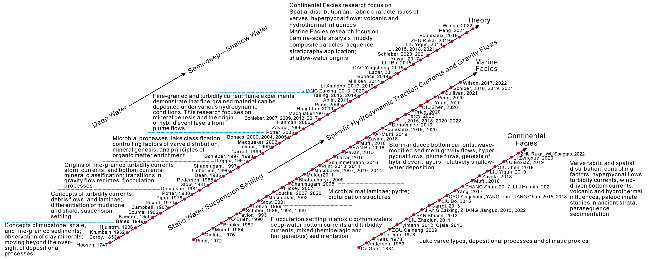
Fig. 1. Research progress on textures in fine-grained sedimentary rocks. |
Biddle et al. systematically clarified the relationship between bedding and laminae, noting that organic-rich mudstones are commonly described as thin-bedded, laminated, or fissile [12]. Analogous to the distinction between clay minerals and clay-sized particles, the application of the term “bed” in mudstones often leads to conceptual ambiguity. In the literature, “bed” is frequently used in a dual sense: first, as a depositional unit with a thickness greater than 1 cm, and second, as a genetic depositional unit representing a single or discrete depositional event [70]. Although both meanings are applicable to coarse-grained siliciclastic rocks, in fine-grained siliciclastic rocks—particularly clay-mineral-dominated sediments—many depositional units are thinner than 1 cm, with bed thicknesses predominantly in the range of 1 to 4 mm [69]. Therefore, when describing mudstones, it is recommended that the term “bed” be used to denote an individual event bed, whereas “laminae” should refer to the internal fissile subdivisions within these units, irrespective of absolute thickness.
In summary, the concepts of bedding and laminae are generally well defined and broadly consistent in either international and Chinese textbooks or monographs. However, differences exist in the criteria used to classify the thickness of strata or bedding [2,13,20 -21,25,29,33,36,71 -74]. International textbooks commonly adopt a thickness-based criterion, in which bedding is defined as having a thickness greater than 1 cm, whereas lamination is defined as having a thickness less than 1 cm [2,25]. In contrast, Chinese textbooks tend to emphasize that bedding and layers/strata belong to two distinct conceptual systems, resulting in inconsistencies in the standards used for thickness classification [13,33] (Table 6).
Table 6. Descriptions of bed and bedding thickness in domestic and international textbooks or monographs |
| Thickness/ m | Textbook and monograph source | ||||||||||
|---|---|---|---|---|---|---|---|---|---|---|---|
| Mckee et al. [72] | Ingram [73] | Chengdu Institute of Geology [20] | Beijing Petroleum Institute [21] | HE Qixiang [13] | Potter et al. [2] | Tucker [25] | YU et al. [33] | ZHAO Chenglin et al. [29] | Wilkims [74] | Stow [36] | |
| ≥2 | Very thick bedding | Very thick bedding | Massive bed | Massive bed | Massive bed | Very thick bedding | Massive bed | Massive bed | Very thick bedding | Very thick bedding | |
| [1.2, 2.0) | Thick bed | Thick bed | |||||||||
| [1.0, 1.2) | Thick bedding | ||||||||||
| [0.6, 1.0] | Thick bedding | Thick bed | Thick bedding | Large-scale bedding/ thick bed | Thick bed | Thick bedding | Thick bedding | ||||
| [0.5, 0.6] | Thin bedding | ||||||||||
| [0.3, 0.5] | Medium- thick bed | Medium- thick bed | Medium- thick bed | Large-scale bedding/ medium- thick bed | Medium- thick bed | ||||||
| [0.1, 0.3] | Medium- thick bedding | Thin bedding | Medium- thick bedding | Medium- thick bedding | Medium- thick bedding | ||||||
| [0.05, 0.10] | Thin bedding/thick laminae | Thin bed | Thin bed | Thin bed | Thin bedding/ very thick laminae | Medium- scale bedding/thin bed | Thin bed | Thin bedding | Thin bedding | ||
| [0.03, 0.05) | Very thin bedding | ||||||||||
| [0.02, 0.03) | Very thin bedding/ medium laminae | Very thin bedding | Thin bedding/ thick laminae | Small-scale bedding/ thin bed | Very thin bedding | Very thin bedding | |||||
| [0.01, 0.02) | Leaf-like bed | Very thin bed/ laminae | |||||||||
| [0.006, 0.010) | Laminae | Very thin bedding/ thin laminae | Microbed/ leaf-like bed | Thick laminae | Very thin bedding/medium laminae | Small-scale bedding/ very thin bed/ foliaceous bed | Very thin bed/ leaf-like bed | Thick laminae | Thick laminae | ||
| [0.005, 0.006) | Medium laminae | ||||||||||
| [0.003, 0.005) | Medium laminae | Medium laminae | |||||||||
| [0.002, 0.003) | Very thin bedding/ very thin laminae | Very thin bedding/thin laminae | Thin laminae | ||||||||
| [0.001, 0.002) | Thin laminae | ||||||||||
| [0.000 5, 0.001 0) | Microbed | Thin laminae | Very thin bedding/ very thin laminae | Thin laminae | Very thin laminae | ||||||
| <0.000 5 | Very thin laminae | Very thin laminae | |||||||||
3. Discussion and suggestions
3.1. Discussion on sedimentary structure terminology
The concept of “bedding” is clearly and consistently defined in both international and Chinese textbooks and literature, whereas some scholars use “stratification” as the same meaning [2,25 -26,36], except a slight difference in thickness - bedding refers to layers thicker than 1 cm, and lamination refers to layers thinner than 1 cm. HAN Shuhe’s translation of The Field Description of Sedimentary Rocks indicates that stratification in a broad sense includes both bedding (thicker than 1 cm) and lamination (thinner than 1 cm) [65]. ZHAO Chenglin et al. defined horizontal fine layers with thicknesses less than 1 mm as lamination [29]. SUN Honglie et al. defined lamination as the stratified nature of sediments composed of laminae, commonly manifested by variations in composition, grain size, and color, reflecting weak periodic fluctuations in depositional environments [70]. ZHAO Wenzhi et al. proposed that a lamina represents the smallest unit formed by stratified variations in sediment input as well as biological and biogeochemical processes within depositional environments; frequent occurrence of laminae results in lamination, and when lamina boundaries coincide with bedding planes, lamination is equivalent to bedding [71]. Notably, some Chinese authors regard lamination as the same as lamina [37].
Based on the discussion above, the following terminology is recommended: lamina or laminae for “Wenceng”, lamination for “Wenli”, and laminated for “Wencengzhuang”.
Fissility is a widely used term in the description of fine-grained sedimentology. The 1920 publication a Brief Account of China’s Mineral Resources by WENG Wenhao represents a landmark work that first systematically and definitively incorporated the concept of shale into the Chinese geological lexicon. In Chapter 2 Classification of Strata, the term fissility was explicitly introduced and defined for the first time. When describing Sinian system siliceous limestone, WENG noted that it also contains thin-bedded limestone with well-developed fissility. More importantly, in his description of Paleozoic strata, he provided a definitional statement for shale: Shale is consolidated clay; its fabric resembles the leaves of a book, hence its name. This statement clearly established that shale derives its name from its characteristic fissility (a leaf- or book- like planar fabric or layering). This marked the formal establishment of fissility as a specialized term describing a rock’s physical property in the Chinese publications [75]. Subsequent textbooks and monographs have consistently included descriptions of fissility and shale (Table 7).
Table 7. Definitions and connotations of “fissility” in relevant Chinese textbooks |
| Definition and connotation of fissility | Authors and source |
|---|---|
| Shale is a type of claystone. Any claystone that can split into thin flakes or paper-like sheets parallel to bedding is referred to as shale, and this tendency to split parallel to bedding is termed fissility | РЕЗНИКОВ А П [59] |
| Shale is also a structural variant of claystone. It can part readily along bedding into thin flakes or sheets and commonly exhibits distinct microscopic lamination; this fabric is commonly described as fissility | Chengdu College of Geology [55] |
| Shale is a claystone characterized by platy or extremely thin bedding and a thinly laminated structure that splits parallel to bedding, i.e., fissility. Fissility develops primarily from the preferred alignment of platy minerals (e.g., mica and clay) parallel to the depositional surface during sedimentation, or from their rotation and alignment parallel to bedding under overburden loading, rather than from post-depositional metamorphism | Beijing Petroleum Institute [21] |
| Fissility is a characteristic fabric of mudrocks and refers to the property of splitting into thin sheets along planes parallel to bedding | HE Qixiang [13] |
| Thinly bedded claystone with horizontal bedding and readily separable parting surfaces parallel to bedding (termed “bedding joints” in some former Soviet textbooks) are referred to as shale; paper-thin partings are also described as fissility | LIU Baojun [24] |
| Shale is a claystone in which fissility is well developed | Huadong Institute of Petroleum [27] |
| The tendency of mudrocks to split into sheet-like fragments parallel to bedding is most characteristic of shale and is termed fissility | ZENG Yunfu et al. [31] |
| Shale commonly exhibits extremely thin bedding (fissility) and splits readily along bedding | FANG Yesen et al. [32] |
| Fissility denotes the tendency of a rock to split readily into thin sheets along planes parallel to bedding; claystone with such a fissile fabric are referred to as shale | YU Suyu et al. [33] |
| Fissility is the tendency to part into thin layers parallel to bedding, and mudrocks exhibiting this property are referred to as shale. In addition, shale fissility may also be associated with the presence of extremely fine lamination, such as alternations of clay-rich and organic-rich laminae; this readily separable fabric is also termed lamellation | HE Jingyu et al. [34] |
| Fissility generally corresponds to individual layer thicknesses ≤1 mm, whereas lamination typically refers to millimeter-scale layering | ZHANG Pengfei [14] |
| In rocks with relatively high diagenetic strength, splitting into thin sheets parallel to bedding may be developed, and this property is referred to as fissility | SUN Honglie et al. [70] |
| For claystone with horizontal bedding, where horizontal laminae <1 cm thick, the fabric is termed page-like bedding or fissility. Such rocks split readily into sheet-like fragments parallel to bedding as a result of the preferred horizontal alignment of layered clay minerals. Where the thickness of horizontal laminae <1 mm, the fabric is termed lamination | ZHAO Chenglin, ZHU Xiaomin [29]; ZHU Xiaomin [39] |
| Preferred orientation of clay minerals commonly imparts fissility to claystone; this fissility is most characteristic of shale and is therefore termed fissility | HU Zuowei et al. [42] |
| Lamellation (also referred to as page-like bedding) denotes the tendency of extremely thin beds to split very readily into thin slabs or flakes parallel to bedding | ZHAO Wenzhi et al. [71] |
It should be noted that some Chinese textbooks published from the 1960s to the 1990s cited Flawn’s classification scheme for argillaceous rocks based on recrystallization and rock-fabric characteristics, in which “parting” was translated as an equivalent to bedding or fissility [76]. An early Chinese bilingual paper entitled Some Aspects of the Palaeoecology of Non-marine Faunas and Rates of Sedimentation in the Lancashire Coal Measures used fissile and fissility [77], and other terms such as lamellae and foliation were presented as similar concepts [78]. However, the latter two words belongs to metamorphic petrology. By around 2017, with the rapid advancement of shale oil and gas exploration and development, Chinese publications showed increasingly diverse English equivalents for bedding, bed, laminate, lamination, and fissile. In the Chinese translation of Pettijohn’s Sedimentary Rocks by LI Hanyu et al., fissility was translated as “Pikaixing” and fissile as “Boliezhuang” [64]. Some textbooks and monographs also mention lamellation as an equivalent for “Yeli” [34,72].
In fact, international literature presents three distinct formulations for defining and describing shale and fissility. (1) Laminated clayey rock [79] - this concept was used in the earliest descriptions of shale. (2) Fissile-fissility [23,47,67,77,80 -81] - Ingram discussed fissility in mudrocks as the tendency to split along approximately parallel surfaces, attributed to the preferred parallel alignment of clay crystallites within the rock [81]. O’Brien further noted that fissility refers to the ease with which a rock separates into thin sheets along parting surfaces that are parallel or subparallel to bedding (e.g., bedding partings in shale or cleavage partings in schist), and that it is a key criterion distinguishing shale from mudstone [67]. Some studies suggest that fissility develops through the long-term combined effects of stress release, moisture loss, and weathering [80-84]. Moreover, fissility in mudstone is often misinterpreted as being caused by macroscopically visible bedding or lamination [83-84]. Fissile mudstones may be laminated or thinly bedded; in other cases, primary fabrics can be completely homogenized by bioturbation, whereas lamination may also become apparent only after later compaction [11,85 -87]. Weaver emphasized that the shale definition incorporates the structural term fissile, the development of which is closely related to the preferred alignment of laminae, platy minerals, and organic matter. He argued that fissility is governed not only by particle orientation and bedding but also by weathering, temperature, and moisture content. Notably, he proposed that shale does not exist at depth but only as potential shale; that is, fine-grained rocks in the subsurface may develop fissility and meet the shale definition only after overburden reduction and subsequent processes such as weathering or dehydration [80]. Therefore, fissility should be used strictly as a descriptive term and applied only to mudstones that exhibit evidence of splitting (or weathering-related parting) along bedding-parallel planes of weakness [69,82,84]. (3) Laminated or fissile [14] and laminated and fissile [22,25]. Factors promoting fissility include an increase in total clay-mineral content, which allows clay particles to rotate and align parallel under overburden pressure; settling of clay particles parallel to the sediment-water interface; preferred orientation of clay minerals under weak electrical currents; penecontemporaneous growth and surface growth of clay minerals parallel to bedding; unloading following erosion, with clay expansion inducing parting; and relatively low carbonate content, high sulfur content, and high carbon content.
Based on the above analysis, fissile, fissility, or lamellation may correspond to the same connotation, denoting the tendency of mudrocks to split into thin sheets or flakes along bedding planes (Fig. 2).
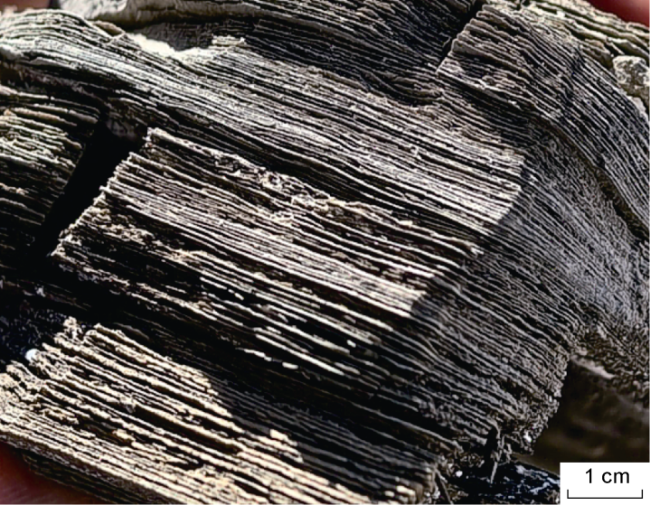
Fig. 2. Shale of the Permian Lucaoogou Formation at the West Dalongkou Section, Junggar Basin, Xinjiang. |
3.2. Tracing the terminology of fine-grained sedimentary rocks
As previously explained, this section outlines the earliest usage and meaning of the term shale in Chinese. In the 1920s, during the formative stage of Chinese geology led by WENG Wenhao, geologists commonly used shale or claystone as collective terms for consolidated argillaceous rocks, with emphasis placed on material composition [75]. In 1929, TAN Xichou et al. from the Geological Survey of the Ministry of Agriculture and Commerce of the Nationalist Government proposed the name Nenjiang Formation, whose strata mainly include mudstone, silty mudstone, oil shale, and related lithologies [88]. However, mudstone appeared and became established relatively late in Chinese geological literature as an independent rock type parallel to shale. In sedimentology monographs and textbooks published in the early 1950s to early 1960s (e.g., the Lectures on Sedimentary Petrology of the Beijing Geological Institute [59]), shale was described as having well-developed thin-bedded fissility and as splitting readily into sheets along bedding, whereas mudstone was characterized as massive, lacking fissility or exhibiting only very weak fissility, with conchoidal or irregular fracture surfaces [21]. By the late 1970s to the 1980s, Sedimentary Petrology edited by LIU Baojun provided formal definitions, in which mudstone was defined as a clay rock lacking fissility or with poorly developed fissility, whereas shale was defined as a clay rock with fissility or schistosity [24].
Internationally, the term shale has an even earlier origin [79-82,89 -92]. As early as 1960, Tourtelot reviewed the origin and usage of shale [79]. In general, “shale” has three principal connotations. (1) The earliest usage arose in the British mining industry. William Hooson defined shale as consolidated laminated clayey rocks [89]. Since the 1980s, this concept has been widely adopted in Chinese textbooks published by comprehensive universities and by the geological-mineral, petroleum, and coal sectors, where shale is commonly described as a special rock type composed mainly of clay minerals and fine clastics with particle sizes less than 0.003 9 mm (content higher than 50%), and characterized by fissility and/or lamination. (2) Shale may also denote a lithostratigraphic unit or a stratigraphic interval, such as the Barnett Shale and Woodford Shale in the United States, or the Wufeng Shale in the Sichuan Basin, China [93-96]. In 1924, Lee and Chao proposed the lithostratigraphic unit name Longma Shale, which represents one of the earliest known Chinese naming examples related to shale [90]. (3) In addition, shale is used as a collective term for fine-grained sedimentary rocks composed predominantly of particles less than 0.062 5 mm [23,25,36,45,47]. In this broad sense, shale spans the clay-silt boundary; consequently, many rocks classified as siltstone may also be termed shale, and vice versa.
From the above discussion, it is evident that the usage of the terms shale, mudstone, and mudrock differs between Chinese and international literature (Table 8). HE Qixiang et al. noted that in Europe and North America, mudrocks is commonly used as an umbrella term encompassing claystone and siltstone [13]. ZENG Yunfu et al. and other scholars further pointed out that the definition and usage of claystone remain inconsistent in international sedimentology. In the UK and US literature, rocks in which the content of the part with a particle size range less than 0.003 9 mm is greater than 2/3 are classified as claystone, whereas those in which the content of the part with a particle size range from 0.003 9 mm to 0.062 5 mm is greater than 2/3 are classified as siltstone, transitional lithologies between these end members are referred to as mudstone and shale. Collectively, these fine-grained rocks are termed mudrocks or argillaceous rocks [29-31]. Authors from the former Soviet Union classified the mud-sized particles (size less than 0.01 mm) content reaches 50% as argillaceous rocks, and further required that particles size greater than 0.001 mm account for no less than 25%.
Table 8. Descriptions of fine-grained sedimentary rocks in international textbooks and monographs |
| Rock type | Key characteristics | Representative authors |
|---|---|---|
| Claystone | Consolidated clay that retains substantial cohesion upon rewetting | Twenhofel [97] |
| Poorly consolidated material composed predominantly of clay-sized particles | Flawn [76] | |
| Massive rock composed chiefly of clay minerals | Ingram [81] | |
| Clay content greater than two-thirds | Folk [45] | |
| Clay content greater than 75% | Picard [50] | |
| Consolidated clay; where bedding parts readily (i.e., exhibits fissility), it may be termed shale | Pettijohn [22] | |
| Shale | Consolidated laminated clayey rocks | Hooson [89] |
| Claystone and siltstone in which cleavage is parallel to bedding | Twenhofel [97] | |
| Fine-grained rock containing 50%-100% clay-sized particles, with clay minerals accounting for ≥25% of the total rock volume | Picard [50] | |
| A rock harder than claystone | Flawn [76] | |
| Fissile argillaceous rocks, including claystone, siltstone, and mudstone | Ingram [81]; Folk [45] | |
| A lithostratigraphic unit or a stratigraphic interval | Tourtelot [79] | |
| A laminated and/or fissile rock, commonly used for buried or ancient sediments | Pettijohn [22] | |
| A collective term for fine-grained sedimentary rocks | Tourtelot [79]; Potter [2] | |
| Mudrock | Massive claystone or siltstone containing at least 50% silt and clay, with no specific connotation regarding the percentage of each | Ingram [81] |
| A general term for claystone and siltstone. Mud includes silt, clay, and mixtures of both | Blatt et al. [47]; Tucker [25] | |
| A detrital rock containing more than 50% silt and/or clay | Folk [45] | |
| Mudstones | Partially indurated muddy rock that readily disintegrates into mud upon repeated drying and wetting | Shrock [98] |
| Mixture of clay, silt, and water forms mud; both claystone and siltstone are called mudstone | Twenhofel [97] | |
| Forty sedimentologists suggested abandoning the term “mud” (Why not abandon “mudstone”?) | Twenhofel [97] | |
| Rock with approximately equal proportions of silt and clay | Folk [45] | |
| Claystone lacking fissility and lamination; it is blocky or massive | Pettijohn [22] | |
| A general category term for fine-grained siliciclastic rocks, intended to be consistent with other general sedimentary-rock terms (e.g., sandstone and limestone) | Macquaker [84]; Potter [3] | |
| Argillite | Highly indurated siltstone or shale | Twenhofel [97] |
| Indurated muddy rock without visible parting, cleavage, or foliation | Flawn [76] | |
| Metamorphic mudstone or shale lacking cleavage | Pettijohn [22] | |
| Argillaceous rocks | Mudstone is indurated mud with the composition and texture of shale, but lacking fine lamination or fissility, with similar clay and silt content, equivalent to mudrock | O’Brien [67] |
| A general term for fine-grained sedimentary rocks, where particle size is an important parameter for further subdivision into claystone, mudstone, and siltstone | Wilkins [74] | |
| Fine-grained sedimentary rocks | Often classified by grain size into siltstone, mudstone, and claystone. However, the term claystone is contentious: a fine-grained rock dominated by clay minerals is not the same concept as one dominated by clay-sized particles | Lazar et al. [83] |
In recent years, some Chinese textbooks have used mudstone as an umbrella term for the broad category of fine-grained terrigenous clastic rocks [37,42]. SUN Honglie et al. defined claystone as a clastic rock with grain size less than 0.003 9 mm, composed predominantly of clay minerals and commonly containing a certain proportion of silt [70]. Mudstone was defined as a clastic sedimentary rock in which the combined silt and clay content exceeds 90%, encompassing siltstone, claystone, and transitional lithologies between the two [70]. Shale was defined as a mudrock characterized by fissility or interlayer parting, formed from argillaceous sediments in which clay-mineral and silt fractions together exceed 90% through relatively strong and/or prolonged diagenetic compaction; shale accounts for approximately 40%-60% of sedimentary rocks by volume [70].
Biddle noted that the term shale is highly contentious [12]. Some authors use it as a generic category term for all fine-grained argillaceous sediments, broadly equivalent in rank to sandstone and limestone [2,79]. Others use shale and mudstone interchangeably [1,35]. Most authors define shale as a mudrock exhibiting fissility (or bedding-parallel parting), whereas mudstone is defined as a massive, non-fissile mudrock [2-3,22]. In addition, some authors restrict shale strictly to a descriptive textural term [82-83,91]. Selley further argued that shale should be abandoned by geologists and reserved for communication among engineers or managers [92].
Mudstone-shale is frequently used in Chinese literature but lacks a clear definition. In most cases, it is employed as a catch-all term when mudstone and shale cannot be unambiguously distinguished. However, the term is generally absent from published textbooks. One exception is Sedimentary Petrology by YU Bingsong et al., in which mudstone-shale is mentioned and interpreted as mudstone with a higher degree of induration [37]. Internationally, terms such as mudshale and mud-shale have also been used to denote indurated fine-grained sedimentary rocks with 33%-65% clay and bed thicknesses less than 10 mm [2-3,23,46,50,52,81]. Nevertheless, these terms are not widely adopted, and therefore the authors recommend avoiding their use.
In some Chinese publications, felsic shale, silty shale or clay quartz is usually referred to as the same Chinese expression (长英质页岩, or Changyingzhiyeyan in Chinese pinyin) [93-96]. Notably, felsic was originally established within the terminology of igneous and metamorphic rocks in earlier literature. The term felsic shale is rare within the Euro-American geological literature. It is believed to be comparable with the usage and relevant standards in conventional textbooks, such as silty shale and siliceous shale. The Chinese translation of “siliceous shale” is a standardized geological term in the Chinese framework, referring to shale composed mainly of clay minerals but enriched in siliceous components [34].
3.3. Application of the term “shale” in the energy industry
In the petroleum industry, shale oil and gas reservoirs in Europe and North America are not restricted to fine-grained shales that are clay-rich or silica-rich; many productive intervals are instead fine-grained carbonates or siltstones. Increasing proportions of siliceous and carbonate components generally enhance rock brittleness, which promotes the development of natural fractures and improves fracability during hydraulic fracturing, thereby increasing reservoir stimulability. In a carbonate-silica- clay ternary diagram (including a range of lithologies such as chert, diatomite, radiolarian earth, platy diatomaceous earth or silica, siliceous mudstones chalk columns, and calcareous mudstone on carbonate columns) [99], both the siliceous and carbonate end-members fall within the compositional domain of developed “unconventional” reservoirs (Fig. 3).
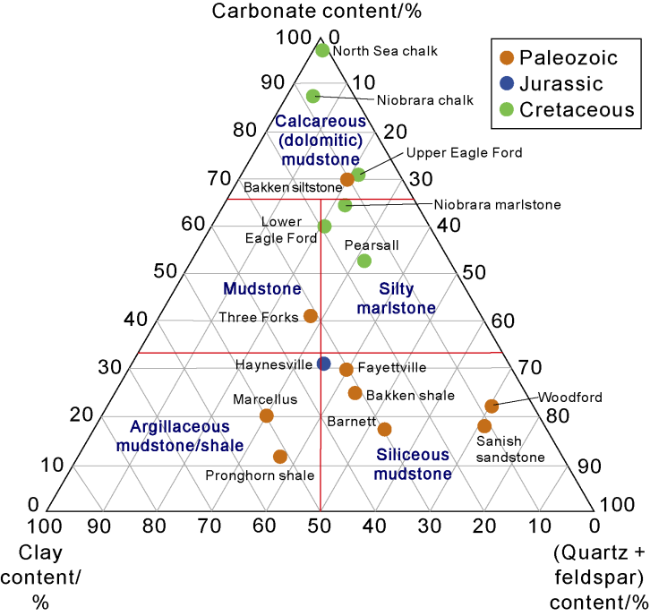


Fig. 3. Ternary diagram of mineral composition for major North American shale plays [99]. |
In recent years, with the steady progress of shale oil and gas exploration and development in China, several professional bodies have issued formal definitions of shale. In the Geological Evaluation Methods for Shale Gas, shale is defined as a fine-grained sedimentary rock composed of detrital particles (grain size less than 0.062 5 mm), clay, organic matter, and related components, and characterized by fissility and brittleness [100]. The Geological Evaluating Methods for Shale Oil defines shale as a fine-grained sedimentary rock with grain size less than 0.062 5 mm and with platy or flaky bedding [101]. The Shale Oil: Terminology defines shale as a fine-grained sedimentary rock dominated by clay minerals, featuring platy or flaky rhythmic lamination, with grain size less than or equal to 0.062 5 mm. It further defines a shale formation series as a stratigraphic succession consisting of shale together with adjacent, associated, or intercalated thin beds of siltstone, fine sandstone, carbonate rocks, mixed sediments, and related lithologies, in which individual interbeds are less than or equal to 5 m thick [102].
It is evident that, across the broader geoscience community and the energy industry, “shale” has been widely adopted as an umbrella term for fine-grained clastic sedimentary rocks. Moreover, descriptive derivative terms such as “shale oil” and “shale gas” have become firmly established in both academic and industrial usage.
3.4. Suggestions for the classification of fine-grained sedimentary rocks
As noted by Ulmer-Scholle, numerous classification schemes for fine-grained sedimentary rocks have been proposed historically; however, the schemes discussed above have received only 2-3 citations per year since publication. In contrast, the carbonate-rock classification schemes of Folk and Dunham have been widely adopted, with mean annual citation rates of 26 and 55, respectively [103-104]. These comparisons suggest that the development of robust classification schemes for fine-grained sedimentary rocks will require more detailed work and broader community discussion among sedimentologists.
In line with the definitions adopted in most historical Chinese textbooks and the views accepted by the majority of scholars, the authors recommend that, in academic usage, fine-grained sedimentary rocks be employed as an umbrella term for sedimentary rocks composed of particles less than 0.062 5 mm. This category includes claystone/mudrocks and siltstone, the latter being defined by a silt-sized fraction (0.003 9-0.062 5 mm) exceeding 50%. Claystone/mudrocks may be further subdivided into argillaceous mudstone/shale, calcareous mudstone/shale, siliceous mudstone/shale, silty mudstone/shale, and silt- containing mudstone/shale. In this framework, shale is characterized by fissility, whereas mudstone is massive. Argillaceous mudstone/shale is defined by the content of clay minerals or clay-sized particles (grain size less than 0.003 9 mm or less than 0.01 mm) greater than 50%, whereas the other mudstone/ shale types emphasize that the content of the part with a particle size range less than 0.062 5 mm exceeds 50%.
As pointed out by WANG Chengshan et al. [105], advances in sedimentological theory have been closely coupled with changes in observational scale. In the early 20th century, research shifted from macroscopic description to micrometer-scale observation under the microscope, which laid the foundation for sedimentology as a discipline. Since the 1970s, the focus expanded from outcrop- and section-scale studies to basin-scale analysis. With the advent of the 21st century, sedimentological research has again moved toward higher-resolution observations at submicron to nanometer scales using scanning electron microscopy, and a six-level framework of multi-scale observational and descriptive techniques has been established [106]. More recently, SUN Longde et al. proposed a new classification scheme based on three end members—rigid grains, plastic components, and reservoir space [107]. Looking ahead, extensive analyses of large sample sets from shale successions in representative basins, together with the microfacies concept developed for carbonate rocks, are expected to enable integrated shale microfacies studies that link thin-section petrography and electron microscopy and incorporate palaeontological, sedimentological, and petrographic descriptions. Such an approach may ultimately yield a classification scheme and systematic framework for fine-grained sedimentary rocks with practical value for evaluating shale oil and gas enrichment zones/intervals, and may further support the development of an independent discipline of “fine-grained sedimentology”.
4. Conclusions
In both Chinese and international textbooks on Sedimentary Petrology, the basic classification of sedimentary rocks is broadly consistent, comprising clastic rocks, pyroclastic rocks, chemical sedimentary rocks, and biogenic (carbonate) rocks. Clastic rocks are further subdivided into conglomerate (breccia), sandstone, siltstone, and claystone/mudrocks.
In Euro-American usage, “mud” conventionally includes both silt- and clay-sized fractions, with an upper grain-size limit of 0.062 5 mm. In contrast, in Chinese usage, “mud” is commonly equated with “clay”, with an upper grain-size limit of 0.003 9 mm (or 0.01 mm).
In most Chinese Sedimentary Petrology textbooks published in different periods, claystone/mudrocks is treated as a distinct lithologic type, alongside sandstone and siltstone, and is defined by a grain size less than 0.003 9 mm (or less than 0.01 mm). Within this framework, mudstone and shale are then described as subordinate categories. However, some textbooks use “mudstone” as an umbrella term for fine-grained sedimentary rocks, emphasizing a grain size less than 0.062 5 mm.
The terms laminae, bedding, and layers/strata are used in broadly consistent ways in both Chinese and international textbooks. Fissility or lamellation is used to denote the tendency of a rock to split readily into thin sheets along planes parallel to bedding, usually as a synonym for bedding, specifically referring to page-like bedding in which horizontal fine layers are less than 1 cm thick.
In current international literature, the term “shale” is generally used in three senses. (1) It refers to consolidated laminated clayey rocks. (2) It is commonly used to denote a lithostratigraphic unit or a stratigraphic interval. (3) It serves as a general term for fine-grained sedimentary rocks. However, an increasing number of scholars argue that “shale” should be strictly restricted to a descriptive structural or textural term, reflecting rock fabric and weathering-related characteristics, rather than being used as a generic term encompassing all related lithologies.
Fine-grained sedimentary rock refers to the collective term for all sedimentary rocks composed of fine-grained material with particle sizes less than 0.062 5 mm, including claystone (mudrocks) and siltstone. Argillaceous mudstone/shale is characterized by a content greater than 50% clay minerals or clay-sized particles (particle sizes less than 0.003 9 mm), whereas other types of mudstone/shale emphasize that particles less than 0.062 5 mm account for over 50%. In common usage, “shale” should not include siltstone. Establishing a sound and widely accepted classification scheme is therefore essential. The guiding principle should be that the name of any rock conveys the maximum possible information while remaining concise; in this respect, structure and fabric constitute the most meaningful criteria for description and classification.