

Introduction
Since the 21st century, technology breakthroughs in deepwater exploration made both sides of the South Atlantic a core region for oil and gas growth in global passive continental margin basins [1-4]. By 2025, 141 large oil and gas fields had been discovered in 38 passive continental margin basins on both sides of the South Atlantic. The total recoverable oil and gas reserves were 426×108 t, accounting for over 40% of the total discovered oil and gas equivalent in passive continental margin basins worldwide [5-7]. Previous studies have conducted comparative analyses of the geological characteristics of oil and gas resources on both sides of the South Atlantic [8-10]. In 2018, the authors conducted pioneering research in this domain, which enhanced the geological understanding and improved oil and gas exploration in the region [11]. In recent years, the Upper Cretaceous slope fans/submarine fans in the Guyana Basin on the east coast of South America and the deepwater pre-salt carbonate rocks of the Santos Basin have discovered giant oil and gas fields. In 2019, large Upper Cretaceous oil fields Yellowtail and Tripletail 1 have been discovered in the Guyana Basin, with recoverable oil reserves of 1.18 × 10⁸ t and 1.16 × 10⁸ t, respectively. In 2021, the large pre-salt oil field of Curacao was discovered in the Santos Basin, with recoverable oil and gas reserves of 2.67×10⁸ t. Significant breakthroughs have been made in oil and gas exploration in the deepwater areas of the Namibian coastal basins in Southwest Africa, the post-salt gravity flow slope fans/submarine fans of the Lower Congo Basin in Angola and the Niger Delta Basin. In 2022 and 2024, large oil fields such as Venus 1 and Mopane 1X have been discovered in the Orange Basin of Namibia, with recoverable oil reserves of 2.49×10⁸ t and 1.78×10⁸ t, respectively. In 2019, new oil fields have been found in gravity flow slope fans/submarine fans such as Agogo and Ndung in the Lower Congo Basin of Angola. In the Niger Delta Basin, deltaic oil and gas reservoirs such as Enyie and Ntokon1AX have been discovered in 2018 and 2023. The various hydrocarbon accumulation combinations (or plays), including those post- and pre-salt layers, slope fans/submarine fans and deltas, and oil and gas discoveries mentioned above indicate substantial exploration potential of this region. At the same time, the continuous new data and information, such as seismic and drilling data, has changed previous understanding on this region, suggesting that previous geological knowledge on this region was limited and lacked sufficient foresight. Therefore, the formation and evolution of passive continental margin basins on both sides of the South Atlantic, their intrinsic tectonic-sedimentary genetic relationships, and the distribution patterns of oil and gas resources require further investigation and analysis, as well as systematic comparison and summarization. This paper, within the framework of plate tectonics, integrates paleo-magnetic, seismic, and geological information to reconstruct the evolutionary history of conjugate passive continental margin prototype basins on both sides of the South Atlantic. It compares the differences in source, reservoir, and caprock combinations corresponding to each prototype basin, clarifies the orderly accumulation patterns of oil and gas in major oil and gas fields, and further identifies favorable exploration targets in different types of passive continental margin basins.
1. Formation and evolution of paleo-tectonic and sedimentary environment in the South Atlantic and its adjacent regions
The passive continental margin basins on both sides of the South Atlantic were formed successively during the Mesozoic and Cenozoic periods with the breakup of West Gondwana and the expansion of ocean basins. The basins on the east coast of South America and the west coast of Africa have obvious conjugate characteristics [12-17] (Fig. 1). Considering the limitations of the initial Jurassic rift development and the conformance of basin evolution, this paper divides the prototype basins in this region into two extensional phases since the Early Cretaceous: the rift phase in the Early Cretaceous and the depression phase since the Late Cretaceous. They are further subdivided into four evolutionary stages: the Early Cretaceous Berriasian-Barremian intracontinental rift stage, the Early Cretaceous Aptian-Albian intercontinental rift-initial drift-related transition stage, the Late Cretaceous-Paleogene drift-related marine transgressive depression stage, and the Neogene-Quaternary drift-related marine regressive depression stage. Both sides were filled with lacustrine, marine-terrestrial transitional and marine sedimentary systems [18-22] (Figs. 2 and 3). Controlled by basin formation and sedimentation, the passive continental margin basins on both sides of the South Atlantic can be divided into three segments from north to south: northern segment, central segment and southern segment, bounded by the Guinea Transform Fault Zone, Ascension Transform Fault Zone and Rio Grande Transform Fault Zone [23-28] (Fig. 1).
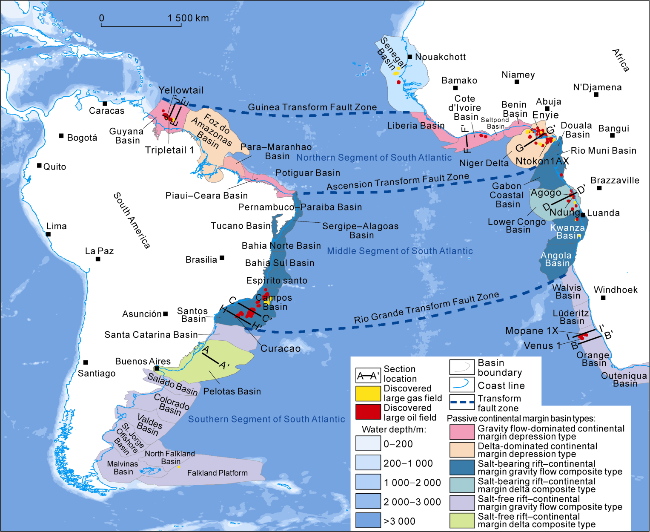
Fig. 1. Distribution map of passive continental margin basins and large oil and gas fields on both sides of the South Atlantic. |
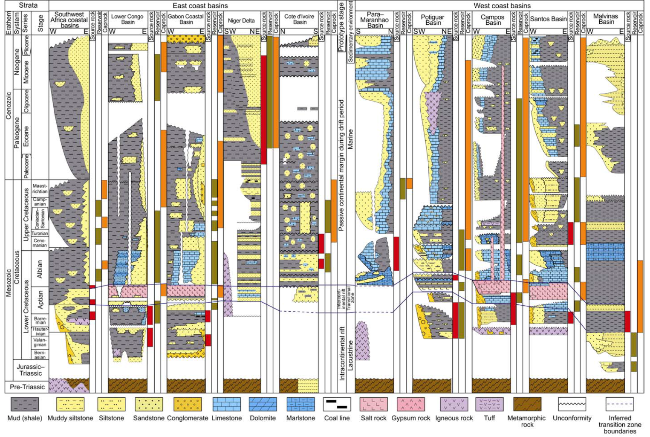
Fig. 2. Stratigraphic correlation profile of the basins on both sides of the South Atlantic. |
1.1. Tectonic-sedimentary environment during the rift period in the Early Cretaceous
1.1.1. Berriasian-Barremian intracontinental rift stage
This stage is mainly characterized by intracontinental rifts and terrestrial sedimentation. Only the southernmost part of the study area gradually transitioned to a marine environment.
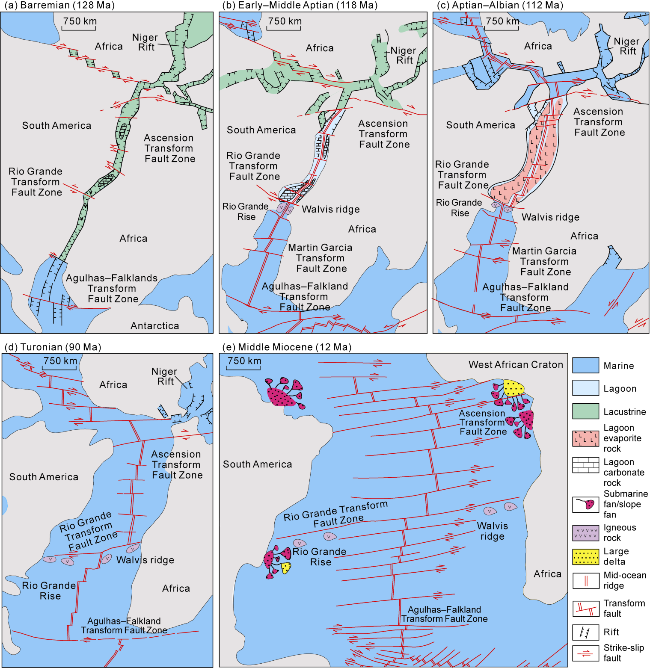
During the Early Cretaceous, controlled by the Tristan hot mantle plume event and extensional faults in north- south direction, rifting activity extended from south to north in the western Gondwana Craton. As a result, narrow rift belts in north-south direction were developed [29-33]. The intracontinental rift strata were extensively filled with lacustrine, fluvial, and deltaic terrestrial sediments [5-6]. Towards the end of this stage, increased extensional activity connected the southern segment of southern Africa to the Indian Ocean. The overall sedimentary environment shifted from terrestrial to marine, with terrestrial sedimentation continuing only south of the Rio Grande Transform Fault in the northern segment. In the northern segment, the east-west extension of the central section was converted into the almost east-west slip along Ascension and Romanche Transform Faults [34-35], forming a narrow and deep passive rift basin dominated by terrestrial clastic sediments (Fig. 3).
1.1.2. Aptian-Albian intercontinental rift-initial drift-related transition stage
During the Early Cretaceous Aptian Stage, both sides of the South Atlantic were in a transitional period of intercontinental rifts. The northern segment was mainly littoral and shallow marine environment, the central segment was dominated by lagoon carbonate and salt rock deposits, and the southern segment was chiefly marine clastic deposits.
In the early and middle Aptian Stage, the initial oceanic crust was formed from south to north [26]. Marine transgression formed the landmark transgressive sandstone and conglomerate bodies that marked the end of the early rift period [5-6]. Since the intercontinental rift period, the northern segment was filled with narrow and closed marine clastic sediments under east-west tension and torsional stress. The southern segment had a wide water environment and a well-developed littoral and shallow marine clastic sedimentary system [34]. The central segment, accompanied by intense magmatic activity, formed the nearly east-west trending Rio Grande Rise-Walvis Ridge volcanic highlands on the southern side of the present Santos Basin. In the middle segment, a lagoon sedimentary environment with restricted seawater circulation due to lateral obstruction was formed in a north-south oriented, narrow elongated rift zone. The boundary fault blocks on both sides of the intercontinental rifts, influenced by a high geothermal gradient, experienced thermal expanding and tilting. Due to the near-equatorial environment and large amount of evaporation, shallow-sea carbonate sediments were extensively developed [26] in this zone without clastic rock supply. By the late Aptian Stage, the climate remained arid, and the central basins were characterized by thick evaporites composed of salt-anhydrite combinations [26]. Salt rocks are dominant in the formations, with total area close to 100×104 km2, and the maximum thickness over 4 000 m [5-6]. Except for the Guiana-Liberia area in the north, which was transgressed and connected to the mid-Atlantic, the scales of the northern transition basins were limited by the passive rifts, and the remaining areas were still dominated by marine clastic rocks. The basins on both sides of the southern segment were dominated by littoral shallow marine sedimentary environments (Fig. 3).
Since the Albian Stage of the Early Cretaceous, all three segments of the study area (southern, central, and northern) had entered the passive continental margin evolution stage of the drift period, dominated by littoral shallow marine sediments. However, there are significant differences in sediment thickness [5-6,34]. From the early Albian Stage, oceanic crust expanded, the lithosphere shifted outward, newly formed ocean basins widened, and the oceanic crusts on both sides cooled. Symmetrical subsidence occurred from the continental margin to the mid-ocean ridge. Passive continental margin sedimentation was widely developed in the continental crust and transition zone during the drift period. Due to the intrusion of seawater, the environment for the development of restricted evaporites ceased, subsequently dominated by shallow marine sedimentation.
1.2. Tectonic-sedimentary environment during the drift-related depression stage since the Late Cretaceous
1.2.1. Late Cretaceous-Paleogene drift-related marine transgressive depression stage
From the Cenomanian period of the Late Cretaceous to the end of the Paleogene, the entire region was in marine transgression. The sedimentary strata from bottom to top transitioned from shallow-water shelf to deep-water basin. In the northern segment, due to the westward and southward movement of the South American Plate along the transform faults, it connected with the Central Atlantic, resulting in a large influx of clastic material and the formation of gravity flow fans. The central and southern segments were dominated by deep-water clastic rock deposits. From the Cenomanian to the Turonian period, a set of black shale deposits from the anoxic environment of the maximum transgression period were deposited in the central and northern segments [5-6]. In the northern segment, steep transform faults were well developed, the continental shelf was narrow, and the continental slope was steep. River- carried sand bodies collapsed along the steep slopes due to floods or earthquakes, forming high density flows. The erosion slopes and valleys carved parallel canyons and channels on the shelf-upper slope, and unloaded on the lower slope-rise edge, forming submarine fans.
1.2.2. Neogene-Quaternary drift-related marine regressive depression stage
Since the Miocene, influenced by the closure-suture- orogeny of the Neo-Tethys Ocean, the entire South Atlantic entered marine regression period. Sea levels continued to drop, sediment supply was abundant, and sand bodies continued to accumulate. Large and constructive delta- deep-water gravity flow systems (such as the Niger, Lower Congo, Foz do Amazonas, and Pelotas deltas) were developed.
2. Types and geological characteristics of passive continental margin basins in the South Atlantic tectonic domain
Comprehensive seismic-geological correlations reveal significant differences in the horizontal and vertical architectures of the basins on both sides of the South Atlantic. Based on the dominant strata, namely the "dominant prototype basin stage", this paper divides the basins in the study area into two main types: rift-continental margin depression composite type and continental margin depression-dominated type. Further, based on whether it contains salt (salt structure) and the dominant sedimentary reservoir, they are subdivided into six sub-types: salt-free rift-continental margin gravity flow composite type, salt-free rift-continental margin delta composite type, salt-bearing rift-continental margin gravity flow composite type, salt-bearing rift-continental margin delta composite type, gravity flow-dominated continental margin depression type and delta-dominated continental margin depression type (Table 1). Analogy shows that when the thickness of the rift strata and the continental margin depression strata (including the delta strata) exceeds 3 500 m and 4 500 m, respectively [36], the lower source rocks generally enter the peak of hydrocarbon generation and expulsion. They can be used as the thickness thresholds of the "dominant prototype basin". The upper source rocks have mostly entered the mature stage. Due to the differences in paleo geothermal gradient and organic matter type, the thresholds can fluctuate.
Table 1. Classification and geological characteristics of passive continental margin basins on both sides of the South Atlantic |
| Basin types | Classification criteria | Sedimentary filling characteristics in drift period | Typical basins | ||||
|---|---|---|---|---|---|---|---|
| Main types | Sub-types | Basin architecture | Structure feature | Delta | Gravity flow deposits | Salt rock and carbonate rock | |
| Rift- continental margin depression composite | Salt-free rift-continental margin gravity flow composite type | Dual rift-depression layers, with sedimentary thicknesses greater than 3 500 m and 4 000 m, respectively, high geothermal gradient. | No salt structure | Mid- small | Medium channel- slope fan system | Not developed | Orange |
| Salt-free rift-continental margin delta composite type | Large | Large landslide/Channel- Submarine fan | Pelotas | ||||
| Salt-bearing rift-continental margin gravity flow composite type | Dual rift-depression layers, with sedimentary thicknesses greater than 3 500 m and 4 500 m, respectively. | Developed salt structures | Mid- small | Medium channel-slope fan system | Salt and carbonate rocks are developed in the lower part of the depression. | Santos | |
| Salt-bearing rift-continental margin delta composite type | Large | Large landslide/Channel- Submarine fans | Lower Congo | ||||
| Continental margin depression- dominated | Gravity flow-dominated continental margin depression type | The rift layers are not developed, and the sedimentary thickness of the depression layers are greater than 4 000 m. | Transform faults controlled basin formation, with narrow shelf, steep slope, salt-free structures. | Small | Mid-small skirt-shaped submarine fan | Not developed | Cote d'Ivoire, Guyana |
| Delta dominated continental margin depression type | Mainly composed of modified strata formed by highly constructive deltas since the Miocene. | From land to sea, four major annular tectonic zones: growth fault, plastic diapir, thrust fold, and foredeep gentle slope. | Large | Mid-large landslide/ Channel- Submarine fan | Not sure | Niger Delta, Foz do Amazonas | |
2.1. Salt-free rift-continental margin depression composite type
The passive continental margin basins of salt-free rift-continental margin depression composite type are mainly distributed in the southern segment of the study area. Seismic data show that, except for the development of large deltas in the Pelotas Basin, the passive continental margin basins in the southern segment are generally salt-free rift-continental margin depression composite type (Fig. 1). It is featured by the rift strata that are better developed and the faults that form a tectonic pattern of alternating graben and horst. The thickness of the sedimentary center is generally greater than 3 500 m. However, the volcanic eruptions in the early rift stage of basins such as Pelotas and Walvis in the northern part of the southern segment were relatively strong. The seaward dipping reflector sequences (SDRS) increased [37]. The progradation characteristics of the depression strata are obvious on the seismic section. They are in angular unconformity contact with the underlying strata (Fig. 4a). The thickness of the sedimentary center of the depression strata is greater than 3 500 m. Although some are less than 4 500 m, because the current geothermal gradient is greater than 4.0 °C/100 m, the source rocks are mostly mature. The depression strata also belong to the dominant prototype basins. The lower part of the depression strata has weak seismic reflection and almost blank in deep-water areas, showing the sedimentary characteristics of deep-water fine-grained sediments during the marine transgression period. Based on the dominant reservoir characteristics of the depression stage, the salt-free rift-continental margin depression composite basins are subdivided into two sub-types: salt-free rift-continental margin gravity flow composite type and salt-free rift-continental margin delta composite type. The dominant reservoirs of these two sub-types of basins during depression stages were deep-water gravity flow and deltaic sedimentary systems, respectively. The typical representative basins are the Pelotas Basin (Fig. 4a) and Orange Basin (Fig. 4b).
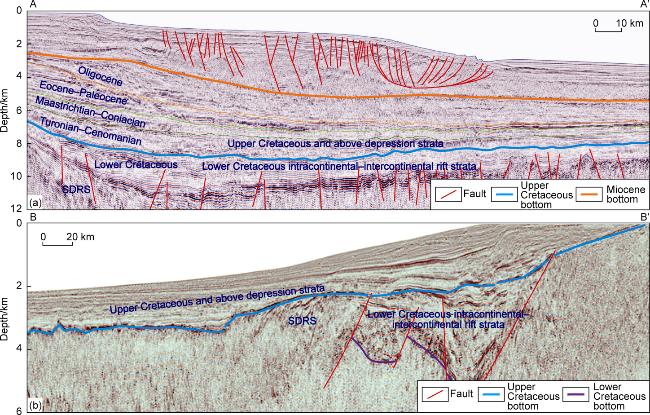
Fig. 4. 2D seismic interpretation section of passive continental margin basins of salt-free rift-continental margin depression composite type (see the location of the seismic section in Fig. 1). |
2.2. Salt-bearing rift-continental margin depression composite type
The passive continental margin basins of salt-bearing rift-continental margin depression composite type are mainly distributed in the central segment of the study area. These basins exhibit well-developed rift and depression strata, with salt rocks developing during the transition period. Specific characteristics are (Fig. 5): (1) Large sedimentary thickness (up to 5 000 m); (2) During the transition period, lower lagoon carbonate rocks (over 1 000 m thick, found in basins on both sides of the South Atlantic, such as Santos, Campos, Kwanza, and Lower Congo) and upper evaporite rocks are developed. The latter covers the entire central segment with an area of 1.0×10⁶ km2, thickening to over 4 000 m towards the sea; (3) Active salt tectonic movements led to an increase and expansion of strong seismic reflection interfaces in post-salt deep-water gravity flow sand bodies, synchronized with global sea-level decline. Based on the dominant reservoir characteristics during the depression stage, the basins of salt-bearing rift-continental margin depression composite type are further subdivided into two sub-types: salt-bearing rift-continental margin gravity flow composite sub-type and salt-bearing rift-continental margin delta composite sub-type. Typical representative basins are Santos (Fig. 5a) and Lower Congo basins (Fig. 5b). The Lower Congo Basin belongs to the salt-bearing rift-continental margin delta composite basin. Currently, its exploration is not active, but significant breakthroughs have been made in the post-salt gravity flow slope fans/submarginal fans. Its pre-salt rifting tectonic layers also possess enormous oil and gas exploration potential.
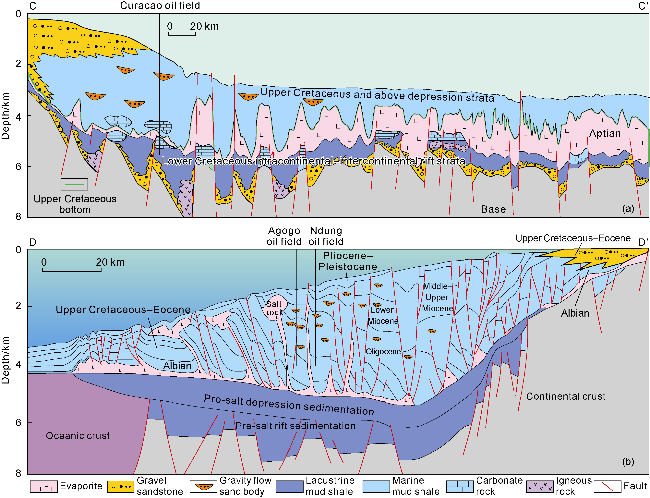
Fig. 5. Geological sections of passive continental margin basins of salt-bearing rift-continental margin depression composite type (see Fig. 1 for section locations). |
2.3. Gravity flow-dominated continental margin depression type
Passive continental margin depression basins of gravity flow-dominated continental margin depression type are mainly distributed in the northern segment of the study area. The basins have two significant characteristics (Fig. 6a), mainly reflected in: (1) The rift strata are limited, only visible in local areas of basins such as Ceara and Benin. They are controlled by steeply dipping strike-slip faults, resulting in a narrow distribution; (2) The depression strata are over 5 000 m thick and rich in gravity flow sand bodies. The narrow shelf-steep slope landform makes it easy for sand body collapses due to floods and earthquakes, with stacked slope fans/submarine fans on the lower continental slope and continental rise (Fig. 6b).
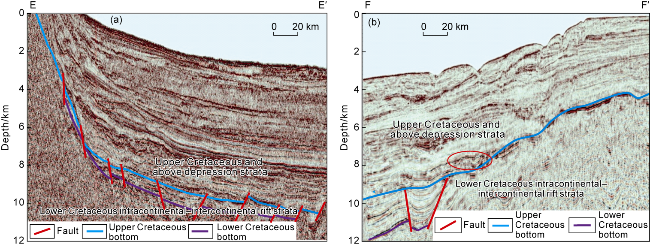
Fig. 6. 2D seismic interpretation sections of gravity flow-dominated passive continental margin basins in a continental margin depression (the locations of the seismic sections are shown in Fig. 1). |
2.4. Delta-dominated continental margin depression type
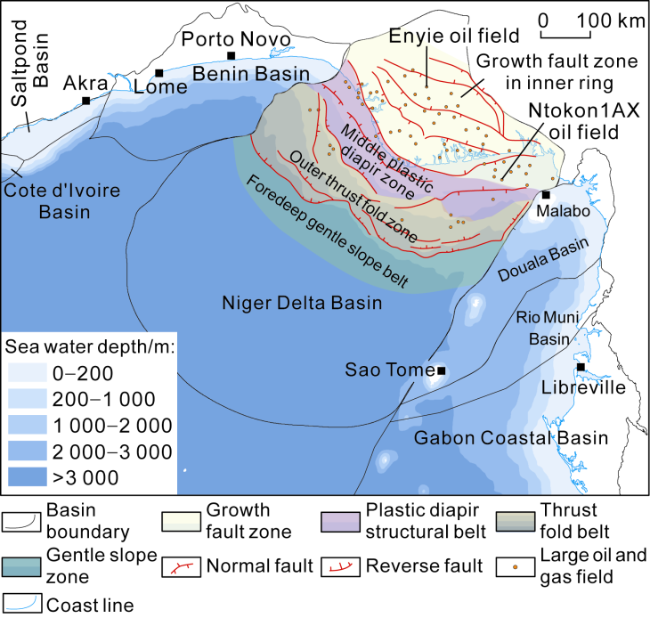
Passive continental margin basins of delta-dominated continental margin depression type are scattered throughout the study area. These basins are characterized by highly constructive deltaic strata developed since the Miocene, and belong to a special type of passive continental margin basins. Seismic data show that two delta-dominated basins (Niger and Foz do Amazonas) have been identified in the three segments across the entire study area (Figs. 7 and 8). Due to their large sedimentary thickness (over 4 500 m since the Miocene), these basins altered the original architectures and formed unique tectonic-sedimentary systems.
The Niger Delta Basin is a typical example of this type of basins, exhibiting clear architecture characteristics of layered vertically and zoned laterally (Figs. 7 and 8). Vertically, the basin is subdivided into three stratigraphic units: the lower rift strata, the middle depression strata, and the upper delta-modified strata. The seismic reflection and sedimentary filling of the rift and depression strata are basically consistent with the rift-continental margin depression composite basin. During the Miocene, the highly constructive delta accumulated rapidly. From land to sea, it sequentially develops four major annular structures: growth fault with well-developed sand bodies in delta front sub-facies scale, as well as the plastic diapir, thrust fold and foredeep gentle slope in submarine fan [38-42].
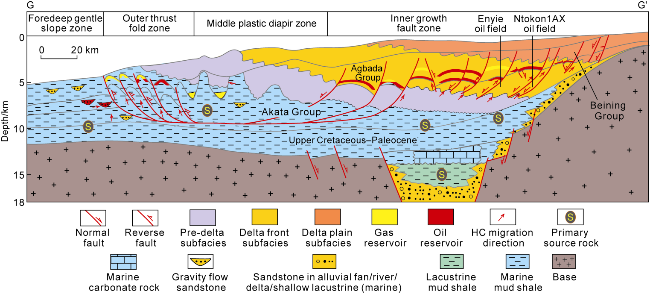
Fig. 7. Seismic-geological section and hydrocarbon accumulation pattern of large oil and gas fields in a delta-dominated passive continental margin basin in Niger. |
3. Orderly hydrocarbon accumulation with feature of being segmented along-strike, zoned across-strike, and layered vertically
Based on the above basin type classification and combined with case studies of large oil and gas fields, it is found that the distribution of large oil and gas fields in the study area has obvious segmentation along the north-south direction. Affected by the sequential extensional stretching and the breakup of western Gondwana continent from south to north, the central and southern segments of the study area exhibit well-developed rift strata with significant sedimentary thickness. The upper and lower tectonic layers correspond to two sets of petroleum systems and two plays. In the northern segment, however, due to the late development and short duration of the rifts, the rift strata are thinner. Dominated by upper continental margin depression strata, oil and gas are mainly enriched in the upper play, and sand bodies in gravity flow submarine fan and delta facies are the key targets for oil and gas exploration. Currently, both the upper continental margin depression play and the lower rift play have obtained substantial oil and gas discoveries, with the most discoveries found in the passive continental margin basins of the salt-bearing rift-continental margin depression composite type in the central segment. Zonation is distinct in across-strike direction in each type of basin. Large oil and gas fields formed in rift strata are often distributed along horst-type paleo-uplift tectonic zones, while lithological traps in depression strata are mainly distributed in lower continental slope fans and continental rise submarine fan groups. Highly constructive deltaic strata have enriched oil and gas along four major annular tectonic zones. The specific orderly accumulation patterns of large oil and gas fields in each basin type are as follows:
3.1. Salt-free composite basins develop two interconnected plays
The passive continental margin basins of the salt-free rift-continental margin depression composite type in the southern segment have two sets of favorable plays. The lower intracontinental-intercontinental rift strata formed large oil and gas fields of the "stratigraphic-structural type" (Fig. 9), while the upper drift-related depression strata formed large oil and gas fields of the "gravity flow fan type".
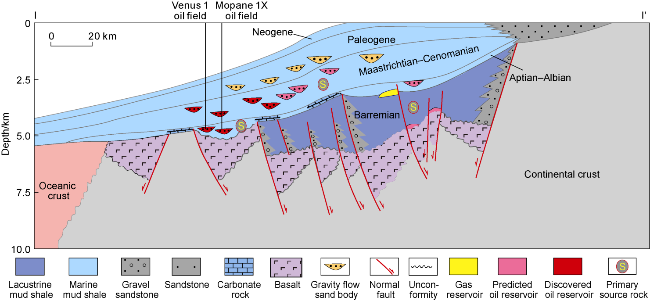
Fig. 9. Diagram of accumulation pattern of large oil and gas fields in a passive continental margin basin of salt-free rift-continental margin depression type. |
The widely distributed thick lacustrine mudstones in Barremian intracontinental rifts have reached the peak of hydrocarbon generation and expulsion, forming the material basis for large petroleum systems. The Kudu gas field in the Orange Basin of Southwest Africa confirms that its main source rocks are such mudstones and shales, with a TOC value of about 10%, a peak hydrogen index of about 600 mg/g, and a hydrocarbon generation potential of 9-11 mg/g (up to 57 mg/g). The Sea Lion oil field on the eastern edge of the North Falkland Basin in South America is also supplied with hydrocarbons by the same lacustrine mudstones and shales [43]. It entered the mature stage at the end of the Paleogene. Oil and gas migrated vertically along faults to the sandstone and conglomerate at the top of the rift or the early deep-water gravity flow sandstone, eventually forming large tectonic-stratigraphic composite oil and gas reservoirs such as Kudu and Sea Lion.
Due to the high regional geothermal gradient, the Aptian-Turonian marine transgressive shale in the southern segment of the depression has experienced the peak period of hydrocarbon generation and expulsion [44]. However, its distribution is limited to the sedimentary center of each basin and it is also the dominant prototype basin. In the depression strata of the Orange Basin in southwestern Africa, three large oil and gas fields, Venus 1, Mopane 1X and Mangetti 1X, have been discovered. The confirmed and estimated recoverable reserves are 2.49×10⁸, 1.78×10⁸ and 0.71×10⁸ t, respectively. The source rocks are marine mudstone and shale of the Lower Cretaceous Aptian or Cenomanian-Turonian stages. The reservoir consists of slope fans and submarine fans from the Upper Albian of Lower Cretaceous-Upper Cretaceous.
3.2. The salt-bearing composite basins contain two independent giant petroleum systems
In the passive continental margin basins of salt-bearing rift-continental margin depression composite type in the central segment of the southern Atlantic, giant oil and gas fields are developed in pre-salt lacustrine carbonate rock-post-salt deep-water gravity flow sand body combination (Fig. 10). The main pre-salt reservoirs are lacustrine carbonate rocks, while the main post-salt reservoirs are marine clastic rocks. A total of 53 large oil and gas fields have been discovered in the central segment of the southern Atlantic [5-6], including 32 large oil and gas fields in the Campos, Santos, and Espirito-Santo basins on the east coast of Brazil, and 21 large oil and gas fields in the Gabon Coastal Basin, Kwanza Basin, and Lower Congo Basin in West Africa.
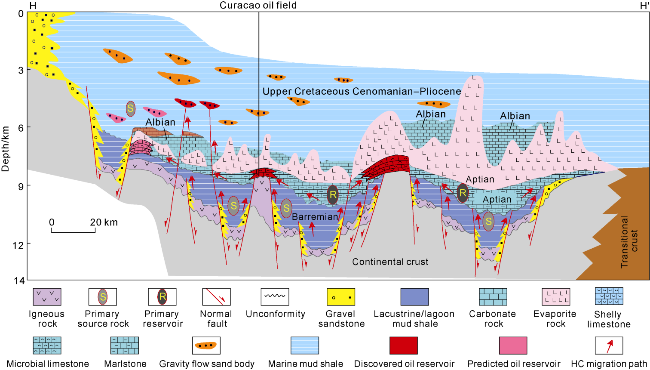
Fig. 10. Diagram of accumulation pattern of large oil and gas fields in a passive continental margin basin of salt-bearing rift-continental margin depression type (modified from reference [35]). |
The primary source rocks of the pre-salt giant petroleum systems are lacustrine-lagoon mud shales in the intracontinental rift-intercontinental restricted marine environment [45]. Taking the Lower Cretaceous Aptian Lagoa Feia Formation in the Campos Basin as an example, its black calcareous shale belongs to Type I kerogen [32], with TOC values of 2%-6%, hydrogen index up to 900 mg/g, and hydrocarbon generation potential generally over 10 mg/g. This set of shale is widely developed, with a cumulative thickness of 100-400 m [46-47]. It entered the peak of oil generation during the Miocene. Due to the high thermal conductivity of the overlying thick salt rocks, it produced a cooling effect and is still in the oil generation window. Oil and gas migrated vertically along the faults of rift period to accumulate in the pre-salt Aptian carbonate rocks.
The primary reservoirs of the giant post-salt oil and gas fields in the central segment of the South Atlantic are composed of gravity flow fan sandstone and a small amount of carbonate rocks, with transgressive shale providing a regional caprock. The only difference lies in the hydrocarbon supply pattern. The wedge-shaped sedimentary bodies in drift period resulted in significant thickness differences in the depression strata in each basin: the thickest layer is at the foot of the lower continental slope, generally over 4 000 m. The marine transgression shale of the Cenomanian-Turonian stage is mainly composed of Type II kerogen (TOC value of 2%- 5%, with a peak value of 10%) [45-48], which has reached the peak of hydrocarbon generation and expulsion, laying the foundation for large-scale resources. Due to the continuous input of sufficient material sources, the maximum burial depth of the Lower Congo Basin since the Oligocene was close to 6 000 m. The marine mudstone of the Upper Oligocene has also entered the mature threshold (Type II kerogen, with TOC value of up to 14.4%) [5], which provides excellent conditions for hydrocarbon supply. On the contrary, the Campos Basin, with its relatively thin depression strata, can still form large oil and gas fields: the salt bodies experienced intense activity in the late period, and oil and gas migrated vertically through salt windows, accumulating in the post-salt Albian carbonate rocks at the near end and filled Miocene deep-water fans at the far end. Salt structures might be formed either before or after gravity flow deposition, resulting in two types of traps: submarine fan lithological traps above salt pillows, and composite traps formed by lithological pinch-outs and fault-induced shielding. The multi-stage superimposed gravity flow composite sand bodies coupled with faults create a migration-closure system, often resulting in multiple oil-water contacts within the same oil and gas field, leading to extremely complex oil-water relationships.
3.3. Large submarine fan oil and gas reservoirs are developed in gravity flow-dominated continental margin depression basins
During the drift period of the passive continental margin basins of gravity flow-dominated continental margin depression type in the northern segment, gravity flow submarine fans were widely developed within the thick (over 5 km) deep-water clastic wedge, forming giant hydrocarbon accumulation belts. Taking the Cote d'Ivoire Basin as an example, as of 2024, 45 oil and gas fields had been discovered in the basin [5-6]. In 2007, Well M-1 at a water depth of 1 322 m first discovered the Jubilee giant oil field, with recoverable reserves of 2.75×10⁸ t. The main strata are Turonian gravity flow composite sandstones, with an effective oil layer thickness up to 97 m, a single layer thickness of 2-36 m, and an average porosity of 22%. In 2010, Well Teak-1 in the high part of the northern side of the Jubilee oilfield discovered a 71.7 m thick oil layer, adding a Campanian fan-shaped oil reservoir. Following Jubilee, breakthroughs were made in the Upper Cretaceous gravity flow sand bodies in the Liberia Basin north of the Tano Sub-basin and the deepwater area of Guyana on the opposite coast. The recoverable reserves of the Liza oilfield in the Guyana waters are 2.47×10⁸ t. Subsequently, 11 large fan-shaped oil and gas reservoirs, including Yellowtail, Lau Lau-1, and Payara, were put into production. During the drift period, the deep-water sediments were thick, and the lower Turonian-Cenomanian marine shale entered the peak of hydrocarbon generation and expulsion [31-32]. Oil and gas flowed into the fan body in a single migration, forming a lithological trap. The shale generated hydrocarbons and acted as an effective caprock. Oil and gas could migrate upwards along unconformities or faults and accumulate in the shallow fan bodies. Seismic data show that the multi- stage submarine fans, which are stacked in a "skirt" shape from bottom to top in the lower slope-continental rise area, are the most promising reservoir in the passive continental margin basins of gravity flow-dominated continental margin depression type in the northern segment (Fig. 11).
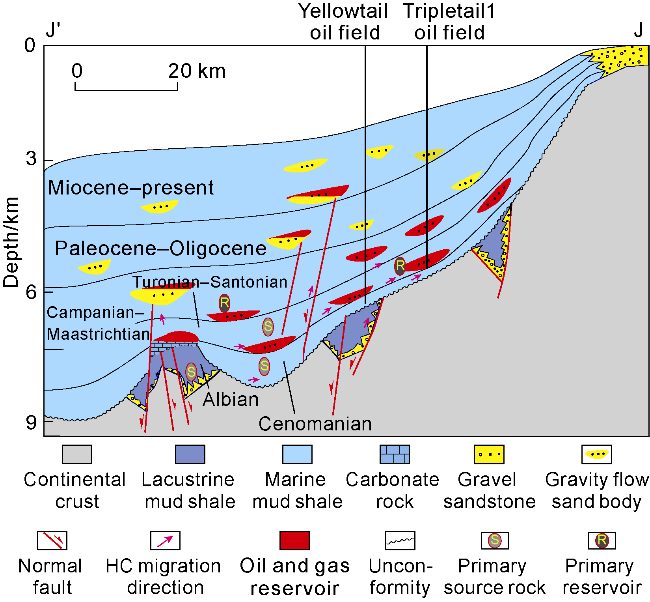


Fig. 11. Accumulation pattern of large oil and gas fields in a passive continental margin basin of gravity flow-dominated continental margin depression type. |
3.4. Delta-fan complex hydrocarbon accumulation belts in delta-dominated continental margin depression basins
Delta-dominated continental margin depression basins are a special type of passive continental margin basins, characterized by very thick deltaic sequence and unique tectonic-sedimentary system. Different hydrocarbon accumulation belts (Fig. 7) are formed in four major annular tectonic zones (Fig. 8).
The Niger Delta Basin has a very thick sedimentary layer (up to 12 km), forming a typical hydrocarbon accumulation system with "self-generation, self-storage, and self-sealing" [49]. The main source rocks are the mud shales in the pre-delta Akata Formation and the frontal Agbada Formation. Its TOC value is 1.4%-1.6% with a peak value of 14.4%. The kerogen is mainly of types II-III [50-51]. The high sedimentation-subsidence rates allowed the Oligocene source rocks to quickly enter the oil-generating window. The oil and gas migrated upward along faults to accumulate in delta sand bodies and gravity flow fans. They eventually accumulated in four major annular tectonic zones: growth fault zone, plastic diapiric zone, thrust fold zone and gentle slope zone (Fig. 8). The growth fault zone is dominated by fine sandstone from underwater distributary channels and mouth bars in the Agbada-Akata formations, with permeability of (2 000- 3 000)×10−3 μm2 and porosity of 25%-35%. The plastic diapirs in middle ring, thrust folds in outer ring, and gentle slope zones are dominated by gravity flow sandstone reservoirs such as landslide bodies, submarine fans and channels. A total of 61 large oil and gas fields have been discovered: 49 of them are rolling anticline traps in growth fault zone. Although the exploration level in the remaining three tectonic zones is low, 2, 9, and 1 large oil fields have been discovered, respectively.
The continental margin depression strata in the Foz do Amazonas Basin on the northeastern coast of Brazil [52-53] have large deltaic sand bodies, which is like the hydrocarbon accumulation conditions of the Niger Delta Basin. Currently, the exploration degree is extremely limited. Analogy results show that such basins have good prospects for oil and gas exploration.
4. Exploration directions for large oil and gas fields
In the southern segment of the South Atlantic, the passive continental margin basins on both sides of the ocean basins are mainly of the salt-free rift-continental margin depression composite type. The rift play in the lower tectonic layer and the submarine fan play in continental margin depression in the upper tectonic layer both have good exploration prospects. The Early Cretaceous Hauterivian-Barremian intracontinental rift strata are mainly composed of volcanic eruption and sedimentary formations. It should focus on finding fault blocks, buried hills, or fault-lithological complex traps within the mud shale sediments of the marine transgression stage at the end of the rifting. It is predicted that the shallow- water rift strata of the Colorado Basin have the greatest exploration potential. Aptian and Cenomanian-Turonian high-quality source rocks are widely distributed. Only the source rocks in the sedimentary centers have reached the peak stage of hydrocarbon generation and expulsion. The slope fans/submarine fans near the source rock centers in the late Aptian-Cenomanian drift-related depression strata in the basins such as Colorado, Valdes and Falkland have better exploration prospects. The Pelotas Basin in the southern segment of the South Atlantic is a salt-free rift-continental margin delta composite basin. The deep-water exploration level of this basin is lower. The plays of the lower rift system and the upper continental margin depression delta-submarine fan are worth exploring.
In the central segment of South Atlantic, both sides of the ocean basin are passive continental margin basins of the salt-bearing rift-continental margin depression composite type, which have excellent preservation conditions. Both the post-salt and pre-salt plays are conducive to the formation of large oil and gas fields. In the southwestern deep-water pre-salt region of the Santos Basin on the east coast of Brazil, undrilled large inherited structural traps still exist. Deep-water gravity channels-fan bodies are also developed near the western depression in the post-salt region, which is noteworthy. Besides the Espirito-Santo Basin, which has better exploration potential in the deep-water pre-salt region, the key targets in other basins are the post-salt deep-water gravity channels-lobes. In the Kwanza Basin on the southern West African coast, the key target is the deep-water pre-salt lacustrine carbonate play. In the basins from the Gabon Coastal Basin to Douala Basin in the north, the main sediments are the post-salt deep-water gravity channels-lobes, with both deep-water pre-salt lacustrine carbonate and sandstone plays. The Lower Congo Basin in the central segment of South Atlantic is a salt-bearing rift-continental margin delta composite basin. It has numerous trap types and targets for exploration, and has already obtained lots of oil and gas discoveries, thus it has promising exploration prospects. The upper continental margin depression sequence is similar to that of fan delta deposits. In addition, due to the influence of salt diapiric activity, the exploration potential of deep-water gravity channel-fan bodies in the central diapiric tectonic zone should not be ignored. Moreover, its pre-salt carbonate play also deserves close attention.
In the northern segment of the South Atlantic, apart from the Niger Delta Basin and the Foz do Amazonas Basin, the basins on both sides are passive continental margin ones of gravity flow-dominated continental margin depression type. Due to the smaller distribution of rift strata in these basins, the primary target is the Upper Cretaceous skirt-shaped gravity flow submarine fans of the drift-related depression period, with key basins being the Cote d'Ivoire Basin and the Guyana Basin in the waters off Suriname. During the transitional intercontinental rift stage, isolated carbonate platforms and carbonate formations also possess the potential to form large oil and gas fields, with key basins being the Guyana-Suriname- French Guiana coastal basins and the Piaui-Ceara Basin. The Niger Delta Basin off the west coast of Africa in the northern segment is a passive continental margin basin of delta-dominated continental margin depression type. This basin has been proven to be rich in hydrocarbons and has excellent exploration prospects. The Niger Delta Basin has great potential for detailed exploration of new strata in shallow-water deltaic sand bodies along its growth fault zones. However, exploration levels of deep-water, especially ultra-deep-water gravity flow channels and fans are relatively limited. Extensive 3D seismic data reveal numerous lithologic oil and gas reservoirs. The Foz do Amazonas Basin on the eastern coast of northern South America is a similar type of basin to Niger Delta Basin, with similar hydrocarbon accumulation conditions. It has significant unexplored deep-water potential, particularly in the Upper Cretaceous, Paleogene, and Miocene gravity flow submarine fans (Table 2).
Table 2. Exploration directions for large oil and gas fields in the passive continental margins on both sides of the South Atlantic |
| Segments | Basin types | Main basins | Plays (lower/upper tectonic layers) | Major exploration targets | Evaluation on prospects |
|---|---|---|---|---|---|
| Southern segment | Salt-free rift- continental margin gravity flow composite type | Colorado, Valdes, and Falkland | Rift system volcanic rock formation/continental margin depression submarine fan | Fault blocks, buried hills, and fault-lithological complex traps within marine transgressive mud shale sections at the end of the rifting; slope fans/submarine fans during the drift-related depression period adjacent to the source rock center. | The shallow-water rift strata hold the greatest potential; the submarine fans surrounding the center of the Aptian- Cenomanian source rocks need further exploration. |
| Salt-free rift- continental margin delta composite type | Pelotas (deep-water area) | Rift system/continental margin depression delta-submarine fan | The rift system in lower tectonic layer of the deep-water area, and the deltas-submarine fans in upper tectonic layer. | The exploration level is limited, and both plays are worth exploring. | |
| Central segment | Salt-bearing rift- continental margin gravity flow composite type | Brazil's east coast: Santos, Espirito-Santo; West Africa coast: Kwanza, Gabon-Douala | Pre-salt lacustrine carbonate rocks/post-salt deep-water gravity channel-lobe | Large-scale pre-salt deep-water inherited structural traps and deep-water fans in the western post-salt depression of the Santos Basin; pre-salt carbonate rocks in the Kwanza Basin; post-salt and pre-salt channels and lobes in the Gabon-Douala Basin. | The preservation conditions are excellent, and large oil and gas fields can be formed in both pre- and post-salt layers; the pre-salt layers in Santos Basin and the Kwanza Basin, and the post-salt layers in the Gabon Basin are the keys. |
| Salt-bearing riftcontinental margin delta composite type | Lower Congo | Pre-salt carbonate rocks/post-salt fan delta + deep-water gravity flow fan | Pre-salt carbonate rock traps; deep-water gravity channel-fan in the central diapiric tectonic zone. | Numerous discoveries have been made, and the prospects are optimistic; the post-salt fan and the pre-salt carbonate rocks are equally important. | |
| Northern segment | Gravity flow- dominated continental margin depression type | Cote d'Ivoire, Guyana- Suriname sea area, and Piaui-Ceara | Upper Cretaceous skirt- shaped gravity flow submarine fans in drift-related depression period/isolated carbonate platforms in transitional period. | Upper Cretaceous submarine fans; isolated platform carbonate rock formations. | Skirt-shaped submarine fans are preferred; isolated platforms can form large oil and gas fields. |
| Delta-dominated continental margin depression type | Niger Delta | Delta sand bodies/deep- water to ultra-deep-water gravity flow channel-fan | Shallow-water deltaic sand bodies along growth fault zones; deep-water to ultra- deep-water lithological traps. | Oil and gas enrichment has been confirmed, with excellent prospects; refined potential mining in shallow-water area and lithological reservoirs in deep-water area are new targets. | |
| Foz do Amazonas (Northern Brazil) | Similar to the Niger Delta, gravity flow submarine fan | Undrilled deep-water areas: Upper Cretaceous, Paleogene, and Miocene gravity flow submarine fans. | The hydrocarbon accumulation conditions are similar to those of the Niger Delta Basin, with great potential in deep-water areas. |
5. Conclusions
The passive continental margin basins on both sides of the South Atlantic exhibit a mirror-like conjugate distribution. The evolutionary sequence of the paleo-tectonic and sedimentary environment can be summarized into four stages: the Early Cretaceous Berriasian-Barremian intracontinental rift stage, the Early Cretaceous Aptian- Albian intercontinental rift-initial drift-related transition stage, the Late Cretaceous-Paleogene drift-related marine transgressive depression stage, and the Neogene-Quaternary drift-related marine regressive depression stage.
Based on basin architecture and superposition patterns, the passive continental margin basins in the study area are divided into two main types: rift-continental margin depression composite type and continental margin depression-dominated type. Furthermore, based on the salt layer development degree and differences in sedimentary infill patterns, the study area can be further subdivided into six sub-types: (1) The salt-free rift-continental margin gravity flow composite type, characterized by dual rift-depression tectonic layers, the absence of evaporite rocks, and the dominance of gravity flow along the continental margin of the depression strata; (2) The salt-free rift-continental margin delta composite type, characterized by dual rift-depression tectonic layers, the absence of evaporite rocks, and the dominance of continental margin deltas in the depression strata; (3) The salt-bearing rift-continental margin gravity flow composite type, characterized by dual rift-depression tectonic layers, thick salt rocks developed during the transition period, and the dominance of continental margin gravity flow in the depression strata; (4) The salt-bearing rift-continental margin delta composite type, characterized by dual rift-depression tectonic layers, thick salt rocks developed during the transition period, and the dominance of continental margin deltas in the depression strata; (5) The gravity flow-dominated passive continental margin type, characterized by the dominance of passive continental margin depression strata and absence of salt rock; (6) The passive continental margin type, characterized by the dominance of passive continental margin delta-gravity flow. The representative basins include the Niger Delta and the Foz do Amazonas Delta. These basins were strongly affected by fluvial-oceanic sedimentation in the late period, and their deltaic strata exhibit annular structural zonation from land to sea, including growth fault belt, plastic mudstone diapir, thrust fold and gentle slope.
The superposition and evolution of two main types and six sub-types of passive continental margin prototype basins, as well as the differences in tectonic-sedimentary filling, cause that the oil and gas enrichment of the South Atlantic passive continental margin basins exhibits an orderly accumulation characteristic of "segmented along-strike, zoned across-strike and layered vertically". At the same time, large oil and gas fields also have their own unique enrichment patterns. In the basins of salt-free rift-continental margin depression composite type, both rift and depression strata provide hydrocarbons. With the overlaying marine shale as the caprock, the oil and gas mainly accumulate in the tectonic-stratigraphic complex structure or deep-water fan sandstone. In the basins of salt-bearing rift-continental margin depression type, salt rocks act as boundaries: the oil and gas from the source rocks in the pre-salt rift system accumulate in pre-salt lacustrine carbonate rocks, while the oil and gas from the source rocks in the post-salt depression are enriched in gravity flow sand bodies of the drift period (partially vertically adjusted by salt windows). The two independent petroleum systems constitute a hydrocarbon accumulation pattern with dual-reservoirs: "pre-salt carbonate rocks and post-salt clastic rocks". In the basins of gravity flow-dominated continental margin depression type, the main source rock is the marine shale of the depression period. Oil and gas accumulate nearby in the skirt-shaped gravity flow composite fans within the depression strata, forming large-scale reservoirs. In the highly constructive basins of delta-dominated continental margin depression type, the source-reservoir-caprock are integrated. Controlled by a four-level annular structure of "growth fault-plastic diapir-thrust fold-gentle slope", oil and gas are enriched in an annular pattern.
The southern and northern ends of the east coast of South America have low exploration degree but significant exploration potential. In addition to the Foz do Amazonas and Pelotas deltas and their associated deep-water gravity-flow systems, the Upper Cretaceous slope fans and submarine fans in both segments represent important exploration targets. Similarly, the west African coast represents the region with the greatest exploration potential in both its southern and northern segments, with the primary targets of the Upper Cretaceous slope fans/submarine fans in gravity flow facies.